Bi-Directional Relay for Coded Cooperation
Chan T.D. Thai
June-Koo Kevin Rhee
Jinoo Joung
SungBo Yang
Information and Communications University Daejeon, South Korea
{chanttd|rhee.jk}@icu.ac.kr,
Sangmyung University Seoul, South Korea
Hyundai Motor Seoul, South Korea [email protected]
Abstract - Coded cooperation (CC) allowing a pair of users to help each other with relaying part of partner’s data is investi-gated to extend wireless channel reach by cooperative diversi-ty. Taking advantage of a bidirectional property of data flows, instead of transmitting the each packet from each user in the second phase of CC, we propose to broadcast a joint packet with XOR-gated information of the two second packets from both users. The throughput is increased and the quality is also improved based on mathematical analysis and simulation.
Keywords - coded cooperation, network coding, cooperative networking, diversity, bidirectional relay
I. INTRODUCTION
Cooperative networking diversity [1] has been proposed as an effective method to combat fading which is a chal-lenge in wireless communications. Openness of wireless channel, which provides channel diversity, is exploited and possibly considered as an advantage rather than a disadvan-tage as before. In spatial diversity, replicas of original data are transmitted in different paths so that the destination can combine them to retrieve original data. Cooperative net-working in which the users help each other by relaying their partner’s data is based on that principle. Some typical co-operative networking algorithms are store-and-forward (S&F), amplify-and-forward (A&F), decode-and-forward (D&F) [2], compress-and-forward (C&F) [3], coded coope-ration (CC) [4], and space time coded-coopecoope-ration [5]. In multi-hop scenario, an intelligent coding scheme has been proposed to generate codewords delivered over multiple paths as a diversity method [6].
Diversity makes transmission more reliable when net-work coding [7] is carried out at a higher layer and thus helps increase throughput by reducing bandwidth usage. Bi-directional relaying [8] is itself a special case of this me-thod. In the coded bi-directional relay (CBR), the relay node combines the two packets from two users into a single ‘joint-packet’ by XOR-gating the information and multi-casts it to both users. Amplify-and-forward CBR [9] utiliz-ing the inherent packet combinutiliz-ing that emerges from simul-taneous utilization of a multiple access channel can provide a higher throughput in a errorless channel but severely de-grade the performance in noisy channels compared with the former. Investigating in multiple-node cooperation, Ref. [10] assumed that every node can receive all other packets except the packet destined to it, the relay broadcasts a
pack-et achieved from XOR-gating all transmitted packpack-ets to-gether. However, the assumed situation is not always the case, therefore more general situation should be investi-gated. Adaptive network coded cooperation [11] proposed a coding method that can adapt to the current network graph.
Coded cooperation and network coding combination method was also proposed. A network coding approach to cooperative diversity [12] can be considered as a typical algorithm of this type. An encoding was proposed in which each partner transmits the algebraic superposition of its lo-cal and relayed information. Packet decoding is done by iterating between the codewords from the two partners.
Considering both upward and downward stream, we propose a method based on a combination of coded cooper-ation and bi-directional relaying to increase throughput of the network. System model and algorithm will be described in part II. We discuss about throughput enhancement in III by a mathematical analysis. Computer simulation is pre-sented in IV.
II. SYSTEMMODELANDPROPOSEDMETHOD
We consider a wireless network including many stations communicating with an AP. A situation where nodes X, Y exchanges packets with the AP as showed in Fig 1. We first discuss how regular CC applies to this scenario, followed by the proposed method.
A. Regular coded cooperation
We first investigate sending XU from X and sending YU
from Y to AP (upward transmission). In regular coded co-operation, packet XU’ after being coded by convolutional
coding to XU is punctured into two packets XU1 and XU2 (ie.
XU’ = XU1 + XU2) with punctuation ratio Rp i.e.
Figure 2. Fig 2 Two-phase transmissions in regular coded cooperation: a. for the first phase for transmitting the first parts of coded packets, and b. - e. for the second phases for transmitting the second parts of coded packets, case 1: All channels with retrievable errors, case 2: Cooperating channels with
bidirectional irretrievable errors, and cases 3 and 4: Cooperating channels with unidirectional irretrievable errors, respectively.
LxU1 = RpLxU2 , (1)
where LxU1 and LxU2 are respectively packet sizes of XU1 and
XU2.
In the first phase, X and Y broadcast their own packets (XU1
and YU1) (Fig 1a). Depending on if they can correctly receive the
packet from the partner or not in this phase (by checking CRC), they send their own data or partner’s data in the second phase. Y achieves XU2 from XU1 by decoding XU1 to get XU (convolutional
coding rate is chosen high enough that decoding XU1 to get XU’
is possible) and puncturing XU into XU1 and XU2 [8]. Similarly,
X can get YU2 from YU1. Four cases in the second phase are
shown in Fig 2b (fully cooperative), c (non-cooperative), and d-e (partly cooperative).
When looking at the second phase of CC, we can see that case 1 and case 2 are symmetric (AP receive XU1, YU1, XU2, YU2)
but case 3 and case 4 are not symmetric (AP receive XU1, YU1,
2YU2 for case 3 and XU1, YU1, 2XU2 for case 4). This reduces
diversity degree and therefore the performance.
B. Symmetric Coded Cooperation
Symmetric CC is similar to CC and the difference is that in symmetric CC there are not case 3 and case 4 i.e. the second phase is fully cooperative or non-cooperative. It is never partly cooperative. Because we mention symmetric CC here in order to easily make a comparison between BICC and CC only, how the users in symmetric CC know whether to choose full cooperation or non-cooperation mode is not investigated here.
On the other hand, the downward transmission is not de-scribed in CC. Based on the principle of CC, we propose a transmission scheme for the downward transmission so that BiCC performance can be compared to CC.
C. Bi-Directional Coded Cooperation (BiCC)
Instead of fully exchanging packets in the second phase, we propose a method to reduce transmission steps by broadcasting a joint packet of XOR-gated information of these packets. Howev-er, the case that the relay can decode received packets does not always occur due to transmission error. The relay checks the packet overheard from its partner by looking at CRC attached to packet. For easy understanding, we call the process of transmit-ting and receiving XU and XD is the first transmission set, the
process of transmitting and receiving YU and YD is the second
transmission set. For the sake of simplicity, we only investigate
the first transmission set when X and AP exchange XU and XD
packets and Y is the relay. The second transmission set is carried out in a similar way and also showed in Fig 3 as examples. The principle is as follows:
• X encodes and punctures XU into XU1 and XU2 as in CC.
X transmits XU1. AP does the same processes with XD.
• If Y can overhear and decode both XU1 and XD1, it
recov-ers XU2 and XD2 as in CC, and broadcasts XU2
⊕
XD2;otherwise, it stays in silence.
• If X and AP do not receive XU2
⊕
XD2 after waiting for acertain time period, they transmit XU2
⊕
XD2,respective-ly.
• X and AP respectively combine the received packets to
retrieve XD and XU.
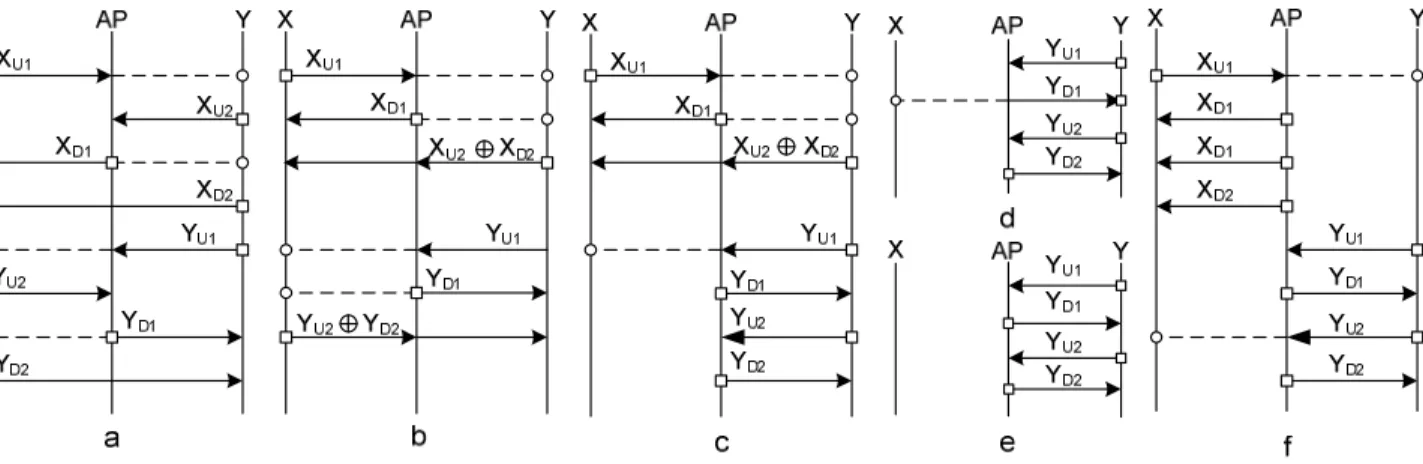
Considering four cases for the first transmission set and four cases for the second transmission set, we have 16 cases in total. Fig. 3a shows the first case when all of the relays receive their partner’s data correctly (fully cooperative in both upward and downward transmissions). In the data flow figures, small boxes are the sources of the transmissions, arrow ends are destinations, and small circles are overhearing nodes (relays). A solid line connects a source and a destination and a dashed line indicates an overheard packet. Considering both transmission sets, the total 16 cases are classified into 3 types:
1) Type 1: Full-bidirectional relaying: Type 1 is used when
Y can decode XU1, XD1 and X can decode YU1, YD1 (Fig 3b). Y
transmits XU2
⊕
XD2 in the first transmission set. X thereaftertransmits YU2
⊕
YD2 in the second set. At X, because XU2 isoriginal data, XD2 can be retrieved by doing XU2
⊕
(XU2⊕
XD2).In the same manner, XU2, YU2 and YD2 are retrieved at
correspondent destination nodes. Correspondent combining processes are achieved at the nodes to get the data. Compared to CC, the number of transmission steps is reduced by two in two transmission sets thus the throughput increases by a certain ratio α (remember that the number of steps in regular CC and symmetric CC is the same). α will be evaluated in III.
2) Type 2: Semi-bidirectional relaying: Type 2 is used when
in one transmission set, the relay can decode both overheard packets (e.g. in Fig 3c, Y can decode XU1, XD1); whereas in the
other set, the relay can not decode both overheard packets (can decode only one overheard packet or no overheard packet) (e.g. in Fig 3c, X can decode YU1 but not YD1). We also show two
other cases when Y can decode both overheard packets but X
cannot. X can decode YD1, not YU1 (Fig 3d) and X cannot
decode both YD1 and YU1 (the first transmission sets are not
Figure 3. a. Regular coded cooperation, b. Full-bidirectional relaying, c, Semi-bidirectional relaying, d and e. Semi-bidirectional relaying (second transmission set) f. Non-bidirectional relaying. Dashed lines indicate overheard packets.
3) Type 3: Non-bidirectional relaying: Type 3 is used
when no relay can decodes both overheard packets in both transmission sets (an example is showed in Fig 3f). Both relays react similarly as Y in the example we considered in type 2. We cannot reduce any transmission step here and throughput remains the same as CC.
For easy understanding, the improvement from CC to BiCC can be separated into two steps. Firstly, due to sym-metry, BER of symmetric CC is lower than that of CC. Secondly, due to broadcasting a joint packet, BiCC has a higher throughput although BER is maintained as in sym-metric CC case.
In BiCC, the transmission may follow one of the three types discussed above. The full-bidirectional relaying gives us the highest throughput increase, the semi-bidirectional relaying can give half of the first case’s increase whereas the last one give no increase because the number of steps it used is same as CC. The probability of each type will be estimated in the next section. Accordingly, the general throughput of the system can be defined.
III. THROUGHPUT ANALYSIS
Compared with symetric CC, type 1 can save one transmission step in one CC procedure (four steps) by broadcasting XU2
⊕
XD2 instead of transmitting XU2 and XD2individually. Therefore, we can say that, from (1), the transmission time duration of symmetric CC is
XU = XU1+XU2 = (Rp + 1)XU2
Here we simply use XU instead of LxU for packet size of
XU. The same rule is applied in the following inductions.
The transmission time duration in type-1 case is
2 2
1 2
1
2 p U
U
U R X
X X ⎟ ⎠ ⎞ ⎜ ⎝ ⎛ + = +
Factor 1/2 comes from the effective bandwidth
occupa-tion by broadcasting one packet (XU2
⊕
XD2). With thesame bandwidth used, throughput is inversely proportional to transmission time. Thus when type 1 is used instead of symmetric CC, the throughput increase is
(
)
⎟ ⎟ ⎠ ⎞ ⎜ ⎜ ⎝ ⎛ + + = ⎟ ⎠ ⎞ ⎜ ⎝ ⎛ + + 1 2 1 1 2 1 1 p p p R RR . (2)
Throughput of type 3 can be evaluated as symmetric CC throughput (since the transmission step number is the same) as
) 1 (
3 TB Pe
T = −
where Pe is the packet error rate and TB is the throughput
when the channels are ideally error-free. If type 1 is used, throughput is increased by a ratio as (2) thus can be written as follows: ⎟ ⎟ ⎠ ⎞ ⎜ ⎜ ⎝ ⎛ + + − = 1 2 1 1 ) 1 ( 1 p e B R P T
T .
With a similar way, we can get throughput for type 2 as
⎟ ⎟ ⎠ ⎞ ⎜ ⎜ ⎝ ⎛ + + −
= (1 ) 1 2(2 1 1)
2
p e
B P R
T
T .
Let Pi the probability that type i is used and will be
eva-luated later. The system throughput can be easily obtained as 3 3 2 2 3 1 1 3 2 1 2 2 1 1 3 1 ) ( ) ( ) 1 ( T T T P T T P T P P T P T P P T T i i i + − + − = − − + + = =
∑
= .The throughput increase compared with symmetric coded cooperation is
) 1 2 ( 2 ) 2 )( 1 ( ) ( ) ( 2 1 3 2 2 3 1 1 3 + + − = − + − = − = Δ p e B R P P P T T T P T T P T T T . (3)
In order to calculate type i probability Pi, we consider
TABLE I. TYPECLASSIFICATIONBASEDONCCCASES
Upward trans 1 2 3 4
Downward trans
1 1 2 2 2
2 2 3 3 3
3 2 3 3 3
4 2 3 3 3
P1 = P11
∑
=+
= 3
2 1 1 2
i
i i P
P
P , (4)
P3 = 1−P1−P2
where Pij is probability that the first set is in case i and
the second set is in case j. Because these set are indepen-dent, let pi is probability of case i in a single CC process, we
have
Pij = pipj . (5)
Probability for case 1 is evaluated in [8] with reciprocal inter-channels
∫
∑
∞ ∞
= ⎟
⎟ ⎠ ⎞ ⎜
⎜ ⎝ ⎛
⎥ ⎥ ⎦ ⎤ ⎢
⎢ ⎣ ⎡ − ≥
0
12 12 2 12
1 1 min1, a(d)P(d|γ ) p(γ )dγ
p
B
f
N
d d
,
where NB is the number of Trellis branches in the code
word, df is the code free distance, a(d) is the number of error
events of Hamming weight d, γij is instantaneous SNR of
the channel from node i to node j, and p(γij) is probability
density function of γij that depends on fading type. Other
cases can be similarly evaluated. PER for each case can be bounded as follows
B
f
N
d d i
e a d p d i
P
∫∫
∑
∞ ∞ ∞
= ⎟
⎟ ⎠ ⎞ ⎜
⎜ ⎝ ⎛
⎥ ⎥ ⎦ ⎤ ⎢
⎢ ⎣ ⎡ − − ≤
0 0
10 10, ,)
| ( ) ( , 1 min 1
1 γ γ
10 10 20 10) ( )
(γ pγ dγ dγ
p ×
Consequently, PER for CC can be obtained:
∑
== 4
1 i
i i CC
e Perp
P . (6)
It is also the same for BiCC. In conclusion, with (4), (5), and (6), throughput increase in (3) can be defined.
III. NUMERICALRESULTS
We use computer simulations to compare BER and spectral efficiency of BiCC and CC as well as show BiCC case percentage. In the BiCC case, we assume that there are two wireless stations are communicating with an AP as in Fig. 1. The four packets are exchanged to follow the scheme in the Fig. 3. In the CC case, because downward transmissions are not supported, only upward transmissions are simulated (only XU and YU are sent).
The instantaneous signal-to-noise ratio (SNR) of the wireless channel between node i and j (can be users or AP) is modeled as follows
2 , , , 0 2 , ,
,j ij ij i j i j ij
i
N
KS
d
h
P
h
βγ
=
Γ
=
−Where P is the transmit power and N0 is the additive
white Gaussian noise power at the receivers, K = 1 is the path loss for an arbitrary reference distance, Si,j is a
log-normal shadowing component with E[10logSi,j] = 0dB and
Var[10logSi,j] = 1, di,j = 0.5 is the distance between node i
and j, β = 2 is the path loss component and |hi,j| is fading
magnitude. We investigate both quasi-static Rician (σ = 1, υ = 1) and Rayleigh (σ = 1) fading, such that the fading coefficients {hi,j} are constant for a given transmitted block,
or code word, but are i.i.d for different blocks. Packet length is 200 bits, 1/2 rate convolutional code is used with polynomial generator [15 17 13 15], 8PSK modulation is used and puncturing rate is 50% with puncturing table [1 0 1 0] for N1 and [0 1 0 1] for N2.
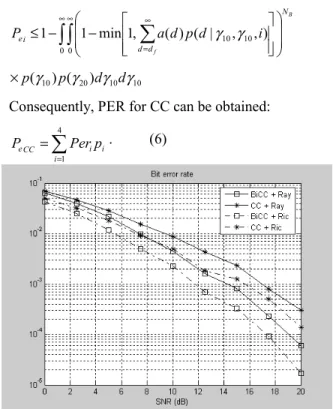
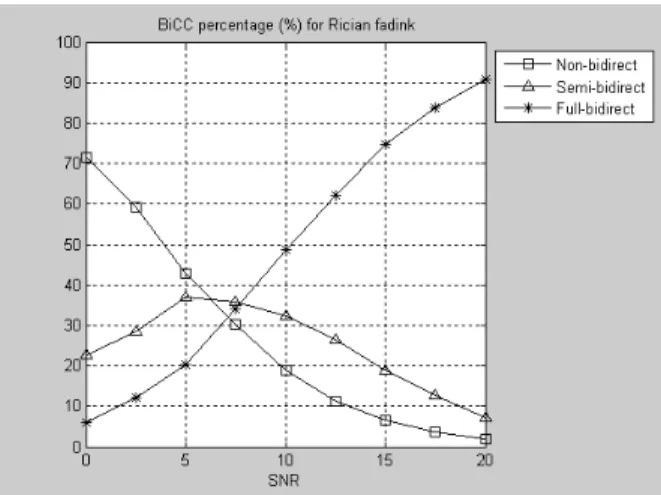
BER of BiCC and CC are showed in Fig 4 when there is Rayleigh or Rician fading. Figure 5 shows the throughputs of BiCC and CC. When SNR is higher, the probability of full-bidirectional relaying is higher and throughput is high-er. The percentage of BiCC types are shown in Fig 6.
Figure 4. BER performance comparisons of BiCC and regular CC for Rayleigh (Ray) and Rician (Ric) channels models.
Figure 6. BiCC percentage
IV. CONCLUSION
Taking advantage of bi-directional flow property and openness of radio channels, a novel approach is proposed to increase the throughput transmission without degrading any of quality. Instead of sending all packets in the second phase of regular coded cooperation, respective packets are XOR together and broadcasted. Some problems of CC were also analyzed and solve. We showed the throughput increase in mathematical analysis and computer simula-tions.
REFERENCES
[1] [1] S. Valentin, H. S. Lichte, H. Karl, G. Vivier, S. Simoens, J. Vidal, A. Agustin, and I. Aad, “Cooperative wireless networking beyond store-and-forward: Perspectives for PHY and MAC design”, WWRF WG3 Whitepaper 2006
[2] [2] J. N. Laneman, G. W. Wornell, and D. N. C. Tse, “An efficient protocol for realizing cooperative diversity in wireless networks,” in Proc. of IEEE International Symposium on Information Theory (ISIT), June 2001, p. 294.
[3] [3] S. Simoens, J. Vidal, and O. Munoz, “Cooperative compress-and-forward relaying in mimo-ofdm systems,” in Proc. IEEE SPAWC, Jul 2006.
[4] [4] T. E. Hunter and A. Nosratinia, “Cooperation diversity through coding,” in Proc. of IEEE International Symposium on Information Theory (ISIT), July 2002, p. 220
[5] [5] M. Janani, A. Hedayat, T. E. Hunter, and A. Nosratinia, “Coded cooperation in wireless communications: space-time transmission and iterative decoding,” IEEE Transactions on Signal Processing, vol. 52, no. 2, pp. 362–371, Feb. 2004.
[6] [6] Gang Shen, Kayin Wu, Erwu Liu, Dongyao Wang, and Shan Jin, “Path diversity with a new coded cooperation scheme over multi-hop wireless channels”, Proc. VTC 2007-Spring. IEEE 65th,
pp. 140-144, Apr. 2007.
[7] [7] R. Ahlswede, N. Cai, S. Li, and R.W. Yeung, “Network information flow”, IEEE Trans. Info Theory, vol. 46, no. 4, pp. 1204 – 1216, July 2000.
[8] [8] P. Larsson, N. Johansson, and K.-E. Sunell, “Coded bi-directional relaying,” in Proc. IEEE Veh. Technol. Conf. - Spring, 2006, pp. 851–855.
[9] [9] Petar Popovski, and Hiroyuki Yomo, “Wireless network coding by Amplify-and-Forward for bi-directional traffic flows”, IEEE Communications Letters, Vol. 11, No. 1, Jan 2007.
[10] [10] Cong Peng, Qian Zhang, Ming Zhao, and Yan Yao “SNCC: A selective network-coded cooperation scheme in wireless network”, Proc. ICC’07, pp. 4219-4224, Jun. 2007.
[11] [11] Xingkai Bao, and Jing Li, “Adaptive network coded cooperation (ANCC) for wireless relay networks: Matching code-on-graph with network-code-on-graph”, IEEE Trans. Wireless Comm, vol. 7, no. 2, pp. 574 - 583 Feb 2008.
[12] [12] Lei Xiao, T. E. Fuja, J. Kliewer, and Daniel J. Costello, “A Network coding approach to cooperative diversity”, Trans. Info Theory, vol. 53, no. 10, pp. 3714-3722, Oct. 2007.