JOURNAL OF SOCIAL WORK
& SOCIAL DEVELOPMENT
Volume 06, Number 01 & 02, 2015
DEPARTMENT OF SOCIAL WORK
JSWSD is a bi-annual refereed journal to publish original ideas that will promote issues pertinent to social justice, well being of individuals or groups or communities, and social policy as well as practice from development perspectives. It will encourage young researchers to contribute and well established academics to foster a pluralistic approach in the continuous efforts of social development.
Editor:
Asok Kumar Sarkar Professor, Visva-Bharati, Santiniketan
Editorial Advisors:
Surinder Jaswal Professor, Tata Institute of Social Sciences, Mumbai B. T. Lawani Director, Bharati Vidyapeeth University, Pune Sukladeb Kanango Retired Professor, Visva-Bharati, Santiniketan Sonaldi Desai Professor, University of Maryland, USA
Editorial Board:
P. R. Balgopal Professor Emeritus, University of Illinois, USA Monohar Pawar Professor, Charles Stuart University, AU Niaz Ahmed Khan Professor, University of Dhaka, Bangladesh D. Rajasekhar Professor, ISEC (Centre of Excellence), Bangalore Rama V. Baru Professor, JNU, New Delhi
Swapan Garain Professor, TISS, Mumbai
Kumkum Bhattacharya Professor, Visva-Bharati, Santiniketan P. K. Ghosh Professor, Visva-Bharati, Santiniketan Debotosh Sinha Professor, Visva-Bharati, Santiniketan
Paramita Roy Associate Professor, Visva-Bharati, Santiniketan
Editorial Assistance:
Dr. Sasmita Patel Assistant Professor, Visva-Bharati, Santiniketan Dr. Subhashree Sanyal Assistant Professor, Visva-Bharati, Santiniketan
© Copyright 2015 by Department of Social Work, Visva-Bharati
The material printed in this journal should not be reproduced without the written permission of the Editor. The statements and opinions contained within this publication are solely those of the contributors and not of the Editor or Department of Social Work, Visva-Bharati.
For more information about subscription or publication, please contact: Prof. Asok Kumar Sarkar
Department of Social Work Visva-Bharati
Sriniketan-731236 Birbhum, W.B., India.
The present volume is comprised of two issues i.e. June and December 2015. It includes eight articles and two book review papers. The major thrusts addressed by most of the articles are policy level priorities of the present Government of India. The first article of Ms. C. B. Taneja and Dr. C. K. Ghosh is highly relevant with Government’s recent approch of skill development. It gives an idea of establishing community college and describes how a Non-governmental Organisation (NGO) with credible involvement in community development registered with an open university and started the process of teaching-learning transaction by adopting the 4C Model of Competence, Compassion, Conscientiousness and Change making.
The second article written by Dr. Paramita Roy is on the Rashtriya Swasthya Bima Yojana (RSBY) programme of the Indian government that provides hospitalisation coverage to BPL families. The paper analyses the accessibility and affordability of the scheme in four districts of South Bengal. It was found that there were differences in the performance in the four districts. The performance of the relatively poorer districts was encouraging in terms of accessibility. As far as affordability is concerned, it was seen that the out-of-pocket expenditures of the poorer patients definitely reduced and beneficiaries were also willing to contribute a larger amount of money as premium to enjoy the continued sustainability of the scheme.
Dr. Sudeshna Lahiri in the next article analyses how gender roles colour student opinion about teacher performance and what empirical evidences has to say about teacher performance. Simultaneously, two studies were conducted seeking student opinion and rating about teachers. The instrument used was same set of 30 items with different set of instructions for each . Student opinion is found to be associated with gender on two of the dimensions of teacher effectiveness. However, no significant effect of gender on student evaluation of teachers on any of the dimensions. Because opinion means a judgment based on insufficient evidence to imply certainty, the revealed that student opinion was conditioned with preconceived gender role whereas female teachers defied those imposed roles with their performance as teaching professional.
Ms. Sudeshna Saha states Companies Act, 2013 makes corporates to compulsorily spend 2% of their net profit on CSR activities. As per the Chapter-VII, there are several areas of CSR activities. One area of involvement could be towards creating employment opportunities through livelihood generation, particularly for women. Support could be extended as part of CSR to women belonging to SHGs and also to those individuals desiring to enter into enterprise activities. The support could involve financial, training and marketing components. Ms. Saha’s study highlights how CSR aims to uplift women from their daily drudgery and pain in order to emancipate.
mutually symbiotic phenomenon and both are at the cross roads impacting the image, objectification and commodifcation of women to large extent. The present paper is a commentary and a theoretical perspective on this crossroad of media, women and society and would seek to understand women and their representation by media, society’s role in representation, its impacts and challenges and where human service professions and civil society have an organized role to play.
Prof. Pratibha J. Mishra and Mr. Vikram Singh attempt to explore the issues related to growth and expansion of higher education from diversification and equity point of view in Indian context. First and foremost the article highlights the idea of equity in education and then discusses the expansion in access to education and inequalities. It has also discussed the implications of policies and approaches related to improve equity. Authors aspire to look into the role of state, market and civil society organization in ensuring equity.
According to Dr. R. Venkataravi and Mr. S. Ramesh, in the 21st century, Information, Communication and Technology (ICT) is the most powerful ‘enabler’ to provide a variety of inputs for rapid development of rural areas. The ICT could be an effective tool for rural extension by the government and non-governmental organizations to disseminate Information Resource. The present paper aims to portray the effects of the Village Knowledge Centre (VKC) in the rural Tamil Nadu. Main objective of the paper is to discuss the areas of influence of VKC on the livelihood of the rural communities. It is based on a micro level study conducted by the authors in Pillaiyarnatham, Dindigul district, Tamil Nadu and presents how the VKC has impacted upon the rural people in utilising the development initiatives of the government and non-governmental organisations (NGO). The major findings indicate that information resource to large extent has empowered rural community by leveraging the access to various services and resources. The paper also discuss operational problems in VKC, particularly in the remote area, even after having technological intervention.
In the last article, Dr. Rakesh Dwivedi states that neonatal mortality is one of the major health problems in India. Though India has made remarkable progress in the reduction of child mortality during last two decades, the United Nations (UN) estimates that about 2.35 million children died in India in 2005. India accounts for highest number of under five deaths in the world. Community practices regarding child birth and newborn care affect the survival of newborn the most. It is important to intervene in the areas where community beliefs are affecting the survival of the baby. There are also two book review papers included after the articles. One book addressing the issues of Islam has been reviewed by Tripti Debnath and the other one that tries to understand the Social Work Research through Human Rights lens has been reviewed by Dr. Sasmita Patel. Both the books are relevant for social work intervention. Hope the information published in this volume would be useful for development professionals, research scholars and academicians.
Editor’s Note
Establishing a Community College – From Need Analysis to 1 Organization of Teaching-Learning – A Case Study of a
Community College and its 4C Model Chandni Bedi Taneja & C. K. Ghosh
Accessibility and Affordability in Rashtriya Swasthya Bima Yojana 24 (RSBY): A Comparative Study of Four Districts in South Bengal
Paramita Roy
Performance of Women in Classroom: Opinion versus Evaluation 39 Sudeshna Lahiri
Role of CSR in Uplifting Women from Shackles of Deprivation– 55 A Study of Few Industries in West Bengal
Sudeshna Saha
Media and Gender on Cross Roads: Interpretations and Juxtaposition 67 Subhashree Sanyal
Expansion of Higher Education: Diversification and Equity in India 75 Pratibha J. Mishra & Vikram Singh
Village Knowledge Centre: A Tool for Rural Extension 95 R. Venkataravi & S. Ramesh
Community Practice with Newly Born Children: 108 Revisiting the Rural Areas of Lucknow
Rakesh Dwivedi
Book Review 118
Tripti Debnath
Book Review 121
Establishing a Community College – From Need
Analysis to Organization of Teaching-Learning – A
Case Study of a Community College and its 4C Model
Chandni Bedi Taneja
*C. K. Ghosh
**Abstract
A Community College is defined as an institution which is for the community, by the community and of the community. It is an institution owned by the community. It can be local or region based, trade or occupation based. It provides training towards upskilling followed by assessment and certification leading to gainful employment. An Open University (OU) which has inbuilt flexibility in its operation is best suited for operationlisation of a scheme which would bring the Community Colleges under an umbrella. The OU will create regulatory mechanisms for teaching-learning transactions and certification of successful learners. The first step for a Community College would be to get registered with the OU based on a prescribed procedure.
The paper describes how a Non-government Organisation (NGO) with credible involvement in community development registered with an OU and started the process of teaching-learning transaction by adopting the 4C Model of Competence, Compassion Conscientiousness and Change making.
Keywords: community college, NGO, 4C model
Background
In order to get registered with an OU, an NGO has to fine tune its activities to suit the academic requirement of the university. However, the process must begin with a need analysis which is considered to be the gospel of a Community College. Such an analysis backed up by the flexibility of the open university system provides a viable supplement to the mainstream education scenario. The NGO, we are going to talk about, has played a significant role in logically combining the systematic analysis with the subsequent process of institutionalization of the academic programmes with the University.
Open and distance learning system has been mandated towards offering such programmes which are need based but generally not offered by the conventional education system. As on date, the academic programmes on offer by OUs is an aggregate of conventional as well as non-conventional programmes. Conventional programmes are like BA, B Com, BSc, BCA, M Com, MBA’ etc. whereas unconventional programmes are like those in the areas of tourism, rural development, library and information science, consumer * Executive Director, Navjyoti India Foundation, E-mail: [email protected] **Regional Director, IGNOU Regional Centre, Delhi-3, Dwarka, New Delhi –
protection, human rights, dairy technology, value added products in fruits and vegetables, water harvesting, rehabilitation and resettlement, intellectual property rights, etc. While the number of unconventional programmes are much more than the conventional counterpart, the enrolment has been largely more on the conventional programmes rather than the unconventional ones. This has been the hard reality related to the otherwise phenomenal growth of the open university system in India during the last 25 years.
We may try to figure out the reason behind such a situation. Generally an OU follows a three-tier system (Headquarters Regional Centres Study Centres) for its programme delivery. While admitting a student, the OU attaches her/him with a regional and a study centre. The study centres are not permanent establishments of the OU whereas these are the main interface between a learner and the university. It implies that a study centre needs to be activated for an academic programme in order that a learner taking admission in that programme is attached to it. The activation of the study centre for a particular programme depends on the availability of infrastructure as well as faculty relevant to the programme of study, which according to the experience is not always very simple. The objective is to reach out to the unreached and so it is prudent to establish study centres at a rural and remote area which is generally deprived of educational facilities. But more often than not that such place may lacks the desired infrastructural facilities and human resources. So despite the fact that even if there is tremendous urge for learning a particular non-conventional programme by a group of prospective learners at a place, an OU cannot provide them the opportunity for its inability to establish a study centre.
An analysis of the geographic location of the learner support centres under the OUs reveals that penetration into rural and remote area has not been very significant. It is being reiterated that the study centres are not the permanent establishments of the OUs but are owned by other Institutions of higher learning, NGOs etc. Thus, inspite of best efforts, the OUs have not yet been able to create the desired outreach through the three-tier system. On the other hand, even if a study centre gets established at a remote area by observing all the prescribed norms, its location may be far off from that of a desirous learner of a non-conventional programme which is activated at that centre. So, the learner, despite her/his desire cannot take admission.
We shall now present the case study of an NGO getting registered as a Community College under an open university. The study consisted in examining the four strategies adopted by the Community College that enabled it to emerge as a classic example of teaching-learning organization. Six primary sources of data as established by Yin (1994) were used while conducting the case study: documentation, archival records, interviews and focus groups, direct observation, participant observation and physical artifacts. Under strategy one, the college worked very closely with the community identifying their needs and aspirations. Strategy two focused on adopting five disciplines of a learning organization. Under strategy three, the college developed its processes based on the principles of quality management and formalized the quality policy through a written statement and communicated to all who work with the organization. With strategy four, the college developed its 4C model and implemented it keeping the holistic development of the learners as the prime focus.
Profile of NGO
The NGO has a history dating back to 1987, when 16 like minded police officials set up the organization with an objective of crime prevention and social development. It started with a drug deaddiction and rehabilitation centre and thereafter a stitching centre ‘Apradh Sudhar Silai Kendra’ (which means Centre for Crime Prevention and Sewing) for women to wean them away from crime and a school to rehabilitate about 100 children in the slums of Yamuna Pushta (which means embankments of Yamuna) was opened. These children if not persuaded for education would have either been beggars, rag pickers, pick pocketers or small burglars. Alongside, it provided missionary employment to hundreds from within the community itself.
Journey towards Registration as a Community College
To understand more fully how the college successfully developed and streamlined its delivery model, it is necessary to provide a brief retrospective regarding the origins and growth patterns of the college. The Community College emerged from its most revered journey of 23 years and worked very closely with the community assessing their needs, aspirations and finding solutions for their day to day lives. As the organization matured, the programmes expanded based on the demands of the community.
The educational programmes for the children created aspirations among them for seeking opportunities for higher education. It was found that there was a huge gap in the vision of the children and the reality. Steven and Brint & Karabel (1989) points out that there is a huge discrepancy between ambition and capacity of the opportunity structure and the societies face this problem what might be called as ‘management of ambition’. Responding to such needs of the community, the NGO registered itself with an open university to widen and strengthen opportunities for creating human capital. Moreover, training programmes undertaken earlier were restricted to informal courses, these were almost free of cost, which provided the skills without any certification. Hence it aided self employability and not career placement. With the community college getting registered, all the academic programmes stood standardized with credit points for theory, practical, field learning, etc. The NGO had taken a further leap and emphasizing the ideology and mission statement to empower those who wanted to move ‘towards self reliance’.
The administrative head of the NGO shares her experience in the urbanized village of Delhi where the parents are hesitant to pay even the small fees for they believe it ought to be free and that it is the government’s responsibility of the government to provide everything. Reason being they are all so used to free bees, water, electricity, rations and their children’s schooling. She further adds that
It is not impossible to teach them free but question is, ‘Why habituate their parents to having education to their children free of cost? Free education was being taken as a birth right. It did not matter if the schools were untidy, without computer education, poor English learning, no science, and passing only to drop out later. The NGO was set up to exactly meet this need. Make the learners employable, repair the foundation of their education, prepare them for a career by skills training of their need, but at a small cost which makes them own it’.
help themselves with dignity and self respect thereby focusing on the lines of empathetic and dignity-centred “teach-a-man-to fish” than sympathetic “give-a-man-a-fish” (Yunus, 2003).
The NGO operates in the form of what is called a multi-location Community College from 40 villages of Sohna Block, District Gurgaon which is a typical rural area characterized by male dominant society and social evils such as child marriage, purdah system, etc. Another region is characterized by urbanized rural setting in Karala in North West part of Delhi interspersed with unauthorized colonies. And the third and the fourth are the resettlement colonies of Delhi in Bawana and Jahangirpuri in North West part of Delhi. The areas have been defined on the basis of community i.e. rural, urbanized rural and resettlement colony. Within the broad community, there are original inhabitants of the area and migrant population with different needs.
The Community College - Adopting Four Strategies
A. Strategy - I: Community Outreach Programme and Need Analysis Community outreach is an important aspect to offer solutions to learning that are ‘lifelong’ and ‘lifewide’. Lattimore et al (2012) focuses on creating strategic plans to meet the needs of variety of stakeholders. Additionally, Deggs and Miller (2013) mention the significance of consistency required between community college leaders and community leaders which influences individual’s acceptance of formalized education. Thus need analysis was done in the community to understand the learning requirements of the community. Home visits, door to door surveys, focus group discussions, meetings and discussions with key resource persons, school visits, factory visits, community resource mapping and other participatory rural appraisal techniques were used to ascertain the preferences of the defined community and to gather the education needs from them. Five exploratory questions were developed to identify the academic programmes:
1. Is there any change in the preference of academic programmes in the community based on the location or geographical area?
2. What is the perception regarding the issue of gender as far as the academic programmes are concerned?
3. In order to make the community employable, at what age do we need to initiate the academic programmes in the community college? 4. Does the demand of the community match the needs of the ‘labour
market’?
5. Are there any barriers that prevent the community to take up the academic programmes?
Desk Top Publishing in rural areas. In addition to these courses, the youth in resettlement colonies wanted hardware course, electrician, beauty, hairstyling and fashion designing course. However, for spoken English course, a feedback was obtained that
‘The boys preferred to study Spoken English course at a distant place and not in the vicinity of their homes so that they can get some time to loiter and loaf around while the girls preferred to learn at their doorsteps. Also the boys in rural areas felt ashamed of learning English for the fear of being mocked at by their fellow friends’.
Initially the girls in the newly established resettlement colonies, i.e. Bawana were reluctant to take up the courses as they did not realize the significance of higher education vis-a-vis the already established resettlement colony, i.e. Jahangirpuri where there was more awareness amongst the parents and the girls. Another reason was that the girls felt they cannot go outside the community to take up jobs hence enrolment in these courses would not be of any benefit. In rural area, an incident was reported wherein the father preferred to let her daughter learn as he realized that education was vital for the marriage of their daughters. The Principal of the Community College at, Naya Gaon quotes:
‘One father in the rural area came with his daughter and pleaded to educate her and started to sob. On being asked what the matter was, he shared he had got his elder daughter married with great difficulty as she was 12th grade pass and he did not find a suitable match for the elder daughter a few years ago. From this experience, he did not let his younger daughter study. But now after few years, he is unable to marry her. The reason being that she is only seventh grade pass and all the potential marriage proposals are rejected, she being not adequately qualified for the boys. He now realizes that time has changed and education is highly required. He requested to enroll her for all the courses so that he can proudly say that she has passed courses with University degree’.
the schools in the area had only arts as the stream. They could not read or write basic English. A student of Class V who studied in a private school and an employed youth in rural area were asked to introduce themselves in English. The youth stammered and could not speak with confidence and thus he realized the significance of this academic programme. The youth shared that there were no computers in their schools and even if there were, they were either not running or there was no computer faculty to teach them. The private centres that existed were in a one room shop with many students on a single computer. There was also a demand for programmes such as adult literacy from the age group of above 30 years. Men wanted their wives to enroll in the courses so that they could contribute towards the education of their children and also visit their schools. The women also realized that it would enhance their self confidence.
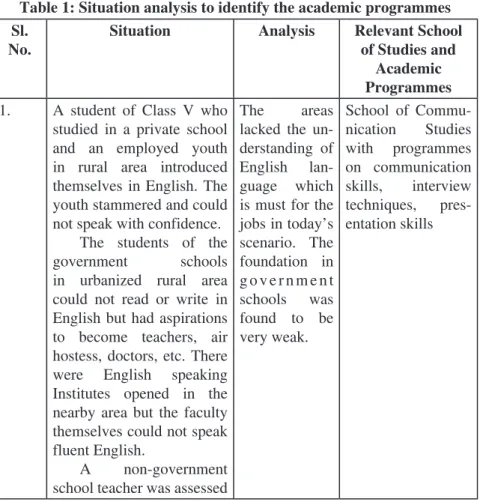
Table 1: Situation analysis to identify the academic programmes Sl.
No. Situation Analysis Relevant School of Studies and Academic Programmes 1. A student of Class V who
studied in a private school and an employed youth in rural area introduced themselves in English. The youth stammered and could not speak with confidence.
The students of the government schools in urbanized rural area could not read or write in English but had aspirations to become teachers, air hostess, doctors, etc. There were English speaking Institutes opened in the nearby area but the faculty themselves could not speak fluent English.
A non-government school teacher was assessed
The areas lacked the un-derstanding of English lan-guage which is must for the jobs in today’s scenario. The foundation in g o v e r n m e n t schools was found to be very weak.
for her English language providing remedial education in resettlement colony. Lot of mistakes in pronunciation and grammar were observed.
2. The youth in the rural area had no access to computers or cyber café.
The students of the urbanized rural area shared that there were either no computers in their schools and if at all there were, they were not operational and there were no faculty. Also the private Institutes in the nearby area did neither have the quality, nor the computers and the student were taught in a one room shop.
The youth and students in resettlement colonies had access to basic computer knowledge due to interventions made by the NGO. They wanted advanced and professional courses in computers which was not accessible and affordable for them.
There was no good com-puter training Institutes or professional programmes in computers in the vicinity.
School of Comput-ers Sciences focus-ing on Computer fundamentals, Desk Top Publishing, Tally, Graphics Designing, Web de-signing, Animation
3. Women were not literate but wanted to gain knowledge so as to enhance their self esteem.
The students wanted to clear entrance exams for government jobs. However, the area in the urbanized village lacked authentic
I l l i t e r a c y amongst wom-en in the area. Private Insti-tutes not genu-ine in the area.
preparatory institutes. Some of the students and elders reported that many private institutes had fraudulently taken money with the guarantee for government jobs.
4. In the rural areas and resettlement colonies, the community demanded for the courses on Right to Information.
Some of the community members shared that there was a strong need of premarital counseling courses for boys and girls in urbanized villages.
Lack of aware-ness on basic rights
School of Law with Non- Credit Customized Pro-gramme in General Law and General Knowledge
5. Women wanted short term courses in rural areas
In already established resettlement colonies of Jahangirpuri, the young girls had a huge demand of courses such as fashion technology and hair styling
Lack of vo-cational insti-tutes in rural areas
Lack of quality train-ing at low cost in resettlement colonies
School of Vocation-al Education and Training with short term courses and fashion technology, beauty culture
Community outreach programme not only helped in analyzing the needs of the community for various courses, but was a key factor in connecting with them imparting awareness on education and overall well being and happiness. Social purpose in lifelong education was advocated at various levels and relationship between education, employability and economic development was highlighted. It also played an important role to understand the barriers and challenges which hinders the community to demand for the academic programmes. It was also a learning for the organization to think strategically and then work with them to find solutions. One potential learner exemplifies this vividly:
At the same time, the bell of his cellphone rang and we asked him the price of the phone. To which he replied, INR 10000 and a monthly bill of INR 2000. This clearly reflected that it was the mindset of the people that needs to be changed and not the issue of affordability’.
Though the programme fees was quite low, there were some community members who were not willing to pay or could not genuinely afford even the low fees. In tandem with the mission of self-reliance of the NGO, the Community College approached banks who offered a special scheme of providing loan at differential rate of merely 4%, payable when they are employed.
The issues of accessibility were also addressed. The rural area is widespread to 40 villages and community residing in remote villages with no access to transport system demanded that the classes be run in their village. Keeping in view, the satellite centres were set up to make it more accessible. The area was divided into inner circle, middle circle and outer circle to plan the outreach and satellite centres. Accessibility however is not just about the physical conditions and layout of buildings. The notion of accessibility, according to Crowther et al (2010) pertain to human element, in other words, how welcoming and accepting are the people involved in the projects even as beneficiaries. In resettlement colonies of Bawana, it was found that the students of the Bawana village did not want to go to resettlement colony which was just 1 km away due to their cultural differences. Similarly, the parents in the unauthorised colonies of Karala were not willing to send their children to Karala village because of issues of eve teasing and crime. Thus, satellite centres were set up in Bawana village and colonies of Karala making educational opportunities available at the doorsteps of the community. This also led to identification of another need of inculcating moral values in the academic programme.
It is not always correct to say that lifelong learning is dependent on access to educational provisions, it most typically arises through everyday experience as well (Billett 2009). Thus community outreach is an everyday process at Community College and all team members from Head of the college, administrators to field staff reach out to the community, meeting all the stakeholders to assess their needs and aspirations and translating their learning to classroom teaching.
(1) supportive and shared leadership, (2) shared values and vision, (3) collective learning and application of learning (formerly identified as collective creativity), (4) supportive conditions, and (5) shared personal practice.
Learning organizations have been defined as schools that: employ processes of environmental scanning; develop shared goals; establish collaborative teaching and learning environments; encourage initiatives and risk taking; regularly review all aspects related to and influencing the work of the school; recognize and reinforce good work; and, provide opportunities for continuing professional development (Silins et al, 2002).
The most commonly mentioned elements of a learning organization can be summarized as: coordinated group effort towards commonly shared goals; active commitment to continuous improvement and to the diffusion of best practices throughout the organization; horizontal networks of information flow to help bring together expertise as well as links with the external world; and, the ability to understand, analyze, and use the dynamic system within which they are functioning (Keating, 1995).
Senge (1990) posits that learning organizations are characterized by valuing and developing the five disciplines and that the basic meaning of a learning organization is one that is continually expanding its capacity to create its future. The five disciplines are systems thinking, personal mastery, mental models, team learning and shared vision.
• Personal mastery. Drives people to expand their ability to achieve their goals thus living in a continual learning mode.
• Mental models. It refers to assumptions, generalizations and beliefs that influence the limited thinking of how the world or the individual works.
• Shared vision. Collaborative creation of future encompassing personal vision by building group commitment.
• Team learning. Aligning and developing the capacities of a team through collective learning and thinking thus innovating and developing new ideas.
• Systems thinking. Views the systems as a whole, a conceptual framework focusing on interrelationships between various units, disciplines, members that shape the behavior of the systems.
to achieve more of their potential including professional development, empowerment, action research, and ethical learning communities. Kleine-Kracht (1993) suggested that administrators, alongwith teachers, must be learners: ‘questioning, investigating and seeking solutions’ for improvement in educational institutions. They focus on an organization without hierarchy and a need for everyone to contribute. The traditional pattern that ‘teachers teach, students learn and administrators manage is completely altered’. The Principal should let go of the old paradigms of the role of an administrator (Morrissey, 2000). There were three factors required of principals that attempted restructuring and reforms in educational institute: ability to share authority, ability to facilitate the work of staff and the ability to participate without dominating. The studies of Leithwood et al (1998) made clear that leadership contributes significantly to conditions fostering organizational learning processes.
In a learning community, shared vision among the staff supports and guides the norms and behavior about teaching and learning in the college. Staff participated in development of shared vision and values of the Community College so that it is imbibed in the culture of the organization and is used as a guidepost in decision making. The vision of the Community College is to widen and strengthen the opportunities to create human capital, thus the student remains the focus of teaching and learning at the College which is reflective in the behavior of the staff as well.
Taylor (1985) recognizes learning as something that humans do which requires consciousness. It is the capacity to utilize what humans know and leads to change both in what they know and how they know. Thus inputs and feedback from teachers, administrators, parents and even community members are taken to address college wide issues such as low attendance, low achievement scores, behaviour, etc. Collective meetings with the teachers are conducted to learn from each other. Regular faculty meetings are conducted to improve on the curricula based on the experiences. Feedback is also obtained from various industry verticals to improvise the curriculum based on the market demand. The Heads of all the four Colleges meet every week and continually learn from the experiences of each other in informal meetings, raising their capacities and expand their patterns of thinking thus developing evolving standards. This relationship not only produces satisfactory and new ideas but also enhanced bonding amongst Principals and teachers. The issues are identified and discussed applying information and new ideas to solve problems. There are monthly reviews with the Head of the organization and collective thinking fosters creativity taking the organization to the next level.
share their issues everyday using ICT. The issues are posted on the group email. Once the issues are identified, the ideas and inputs are invited and dialogue takes place around the topic. The group then decides the best and develops strategies jointly to resolve the issues.
Effective communication systems are another method that promotes efficient learning about latest updates not only about the college but also about the world.
The College has instituted other effective communication systems that help the leadership team know what is going on in various locations as they share daily priorities and reports on group email. A similar system is developed within the College where all the teachers and administrators of the College interact with each other for mutual sharing and learning. Also news articles are circulated in the group email to remain updated about the current affairs about the country and global issues.
At the Community College, systems thinking imply that employees must think beyond their roles, process units or departments. And must realize the significance of their work for the larger benefit of the society. From the historical service based experience as a non-government organization working closely with the community and ensuring quality, the college recognizes that quality and lifelong learning entails not just meeting the needs of potential students applying for the courses but all the stakeholders in the education system. In the systems approach, the college embraces all the stakeholders responding to their critical needs and forging partnerships to create value to its learners. Therefore, the Community College cannot work in isolation as an educational institute but has to integrate other variables that make up the education system working in close relation and interconnectedness. It views its environment holistically analyzing demographic profile, socio economic status, willingness to pay by the community and reflecting on their issues and problems. This would enable full potential of students and nurture better learning. Joseph et al (2002) have developed Guidance System for Transforming Education (GSTE) based on Banathy’s theoretical framework of process values and process activities to help society progress through transformational journey of education system. To emphasize the systems approach of the Community College, an example of an eve teasing launched by the college is cited here:
share the issue with either parents or their teachers or even to the student counselor with the fear that they will not be allowed to study further even in the community college. So staying away from the class for few days seemed to be an easy option for them and temporary relief from the problem. We realized that the issue could not be ignored as it is related to the education of girls. Therefore, we decided to launch a campaign with the students of college mobilizing the volunteer from the community and related stakeholders to voice the concern at large scale and integrated this in the system.
The Community College realized early that value based services need to be provided to students to ensure the learners have the best possible available service. This included support services ranging from registration to counseling, career awareness sessions, orientation sessions, educational tours, cultural enrichment tours, seminars and workshops, talent recognition and, students’ festivals, use of latest technology, learning labs and project works, celebrations of festivals and achievements, financial aid and placement opportunities.
Table 2: Providing operational practices based on Senge’s five discipline areas
Sl.
No. Discipline Operational Practice 1. Personal
Mastery • Self readings by all employees• Discussions with subject matter experts • Opportunities to contribute to their own
learning by writing research papers, articles, curriculum
• Staff views their personal goals in the context in which they are working
• Staff critically examines own practices and set standards for continual improvements in teaching-learning process
• Professional development is linked with dealing with real time issues and realize everyday is a new learning within classroom and beyond classrooms
2.
Mental
models
• Imparting regular awareness amongst various stakeholders to evolve their mindsets about education system involving holistic growth • Providing awareness to potential learners on
the diverse career and employment opportunities available
• Staff and teachers are encouraged to experiment and take risks for personal and organizational growth
• Staff values difference of opinions with little defensiveness
• Weekly feedback from students and a system of feedback box
• Encourage open dialogues amongst staff on their views and beliefs and interpretations of a situation
• Staff shares challenges and receptive to new ideas
• Teachers are proactive in problem solving in the classrooms and not wait for someone else to take decisions
• Learns from best practices from multi location colleges
3. Shared vision • Involvement of staff in developing vision encouraging ownership and accountability • Curriculum is aligned with vision
• Learner centred approach
• Promotes understanding of college vision, values and culture during orientation programme of new learners
• Extracurricular activities for students to work towards the vision
• Students make their own rules and regulations to align their behavior with the college vision 4. Team learning • Flat organizational structure
• Collegial relationship between the Principals, teachers and support staff
• Buddy system amongst the students
• Open dialogue between cross functional teams and informal sharing of ideas and resources • Regular feedback from multiple sources
including students, parents, peers, community, market etc
• Shared decision-making in a team
• Daily sharing of priorities and outputs in the group email
• The Morning Circle (TMC) to start the day • Circulation of latest news and updates in
group email
• Weekly strategic meetings of the leadership team
• Monthly review meetings and fostering new and creative ideas
• College Board meetings twice a year
• Regular and meaningful faculty meetings to discuss projects, teaching strategies and curriculum
5. Systems
thinking • Build strong network of stakeholders and their ownership in community college • Creating a network of support from amongst
the community and volunteers
• Active participation of community members, parents and public representatives
• College Management Committees for various disciplines are formed comprising of students, teachers, parents and community members • Need analysis of the community and aware of
issues that may impact the college
• Identifying root cause of the problems and finding solutions
• Feedback on curricula from industry verticals • Regular sharing with parents and community
by teachers and Principals through home visits, community meetings and focus group discussions
• Existence of interconnectedness amongst various units and processes
• Attend and participate in seminars and conferences thus sharing ideas beyond the local community facilitating organizational learning
C. Strategy - III: Quality Focus
The Community College has been working towards bringing quality improvement and quality management through Total Quality Management (TQM) philosophy. Izadi et al (1996) describes the implications of TQM in University programs such as vocational and technical education. According to them, TQM allows internal and external customers to communicate with faculty to continuously improve educational processes. If parents, alumni, and students (internal customers) are satisfied, they will recommend degree programs to others. Likewise, if employers, taxpayers (in state supported institutions), and graduate schools (external customers) are satisfied with the graduates of programs such as technology education, they may continue relationships and support. Here emphasis on quality, beneficiary focus, process improvement and continual learning has become part of its culture. The College developed processes based on the principles of Plan-Do-Check- Act with clearly defined inputs, outputs and measurability indicators using a collaborative approach of all its team members. Additionally, The Community College has identified four values that serve as its framework i.e. transparency, commitment to continuous learning, missionary zeal and co-option. The College considers these values vital to its success in meeting its performance targets. The Quality Policy has been defined and communicated to all. The Quality Policy states,
The Community College is committed to transform a large section of our marginalized and disadvantaged society towards self reliance and empowerment by:
• Enhancing beneficiaries’ satisfaction
• Complying with the requirements of international standards
• Achieving continual improvements in effectiveness of our management system through systematic analysis and review of results
• Training, participation and involvement of all our employees
its processes and test checking in the field before applying for certification for International Organization for Standardization.
D. Strategy - IV: Developing Innovative 4C Model
We have already completed 12 years of the 21st century, the rapid social and economic changes being encountered by us present complex and unprecedented challenges to contemporary societies. Societies now must cope simultaneously with global economic competition, the demand for new competencies in the population, the provision of opportunities for health and well-being across the population, and the maintenance of the social fabric for nurturing, socializing, and educating the next generation (Keating 1995). Many of the key issues are brought into focus if we use the new notions of learning and develop a clear picture of quality of life, overall happiness and well being. Schuller and Watson (2009) proposes a framework that consists of learning called forms of capital: learning as an investment in the economy called human capital, learning as an investment in the society called social capital and learning as an investment in identity capital. The identity capital is also referred as individualization by Van der veen (2010).
Billett (2010) defines learning as a personal process directed by the capacities, interests, situations and support, and engaging the human mind and consciousness. Life coping skills is not only helpful to the individual, but also to the transforming of nature of day-to-day social life (Giddens 1991). Thus a 4 C model is recommended and being followed in the Community College providing a lifetime of learning to the diverse community it serves for overall well-being. Field (2009) defines well being as positive mental state associated with social quality as confidence, optimism about the future, a sense of influence over one’s destiny and social competence that promotes satisfying and supportive relationships with other people. The teaching-learning process at the Community College creates a learner-centred approach focusing on well-being and quality of life which is reflected in its model. We look at each in turn:
We teach them to be courageous to overcome the impediments and barriers, with integrity and rising above the challenges. Our entire education methodology focuses not only to produce competent students but also compassionate, conscientious and the change-makers. These beliefs and values are enthused and stimulated in all the programs that we design and implement’.
Competent
as per their needs. All the programmes have well defined credit system. Technology is used as a tool to facilitate learning. The teaching process surpasses the blackboard-chalk rather the sessions are conducted through multimedia system. The vision, mission, values and culture of the college are presented during the orientation session on the first day of the college and integrated throughout the curriculum and learning practices. Jenkins and Sung-Woo (2012) mentioned that many students arrive at community colleges without clear goals for college and careers. Hence the students in this community college are motivated to develop their own mission statements and align it with the organizational goals during the orientation programme. The students write their autobiography and are encouraged to share about their dreams, aspirations, likes, dislikes and what life means to them. To promote the climate fit to meet the competitive needs, state-of-the-art laboratory facilities and equipments and class sizes tailored to learning needs are provided. Additionally, faculty ensured that participative and enriching enironment is created in the classroom for students. Jackson et al (2013) indicated that the benefits of partiipation included greater empathy for and awareness of students, the development of authentic relationships with students and enhanced enegagement in the larger campus community.
Regular exposure trips are conducted to enrich them with the national history and general knowledge. The students of the Community College were asked to write what they knew about Mahatama Gandhi before the exposure trip to Gandhi Darshan and Gandhi Smriti. Some of the excerpts are given below on what they wrote before and after the trip:
Community Colleges all this revealed that knowledge about freedom movement were passé. A very senior teacher of the college proclaims that children who grow up with poor sense of history are rootless. Hence all these exposure trips and learnings are an integral part of our College curriculum. The impact of the exposure visit was clearly evident. Majority of them could now write the historical dates, names of the Ashrams set up by Gandhiji, and details about his family clearly mentioning the names of his parents, wife and sons. They now knew that the title of Mahatma was given by Rabindranath Tagore and Father of the Nation by Subhash Chandra Bose. They attempted to write about Dandi March, Satyagraha and other significant movements and their importance in national history.
The students are asked to make their project work thus transforming the classroom learning into experiential learning which is followed by presentations and sharing of their projects. This enhances their presentation skills, promotes inquiry and curiosity about their environment and subject and confidence.
We truly believe that each student has an inherent talent thus a talent hunt chart is developed by the teacher within the first month of joining of the student. The students are provided a platform to showcase their talent on various occasions. There are also clubs such as music, theatre, sports, media and journalism for the all round development of the learner.
Intra college and intercollege competitions are organized to inculcate competitive spirit amongst the students. Further, they are also given opportunities to participate at zonal, district, National and International level.
The immense talent can be exemplified by the fact that some students participated in a ten day camp to learn Karate and Taekwondo. Just after ten days, they were given an opportunity to participate at National level wherein all the students who participated won gold and silver medals and fetched third position for the college. A few days later, they represented the country at International level where they won accolades as they fetched silver and bronze medals.
During summers and winters, special learning festivals are organized to expose the students to various career opportunities and career counseling sessions with the experts. Continuous and term end assessments are conducted to know the progress of the student in achieving the desired learning levels.
Compassionate
The students are taught to respect all religions and thus all the festivals irrespective of any religious conviction are celebrated. Feedback on their learnings and reflections are documented by the students. The students begin their day with a prayer and by writing thought of the day on the white board in the hallway. Moral values are inculcated as a part of classroom teaching. Special spiritual sessions are conducted on regular basis.
Some students belonging to low socio-economic group were found to be often complaining about their situation. With the pretext to make them realize that there were more poverty stricken people than them, they were asked to conduct a cloth distribution drive in a place with no shelters. The drive led to a feeling of gratitude amongst them.
Conscientious
As a practice, the students contribute to cleanliness drives in their campus to enhance ownership of the college and appreciate the hygienic practices. Regular sessions on personality development and awareness on their rights and duties augment their learning in classrooms. Monthly analysis of attendance of the students is done and displayed don the notice board so that the student stays alert on his regularity. Systems are developed to apply for the leave application.
Changemakers
In order to make the youth responsible and proactive in community development in their local area, the students are organized into a voluntary group called Beat Officers. The concept also builds up leadership capacities amongst them. The students identify the top ten needs of their area and work to seek solutions to the issues identified. They are in the process of developing a community library and spreading the awareness on the education as ambassadors of change through cycle rallies and street plays. Each month, they identify a theme and the activities revolve around the social and environmental issues selected. Thus, service learning programs develop sense of civic responsibility in addition to their academic skills bringing commitment to their own community and bringing out change in the society.
The Way Forward
The Community College thus evolved as an organic part of the social life of the community that it served for more than two decades. It plays a significant role in meeting the needs of unemployed, underemployed, underrepresented, underserved and disadvantaged across all age groups, culture and gender through various academic programmes. In addition, it holds a unique position in this juxtaposition of secondary and post secondary education for those who are able but disadvantaged in terms of receiving adequate learning levels and quality education for them to succeed in higher studies or career. It also expands the demographic profile of the students who cannot afford the minimal fees by providing loan opportunities through bank linkages with special schemes. The four pronged strategy of community outreach and need analysis, learning organization, quality management and 4C model makes it a unique representation trying to bring out educational reforms through community colleges. The Community College in a humble manner strives to customize the educational programs as per the needs of its students thus creating a learning-centred focus in teaching practices to a learning organization giving the perfect platform to empower one and all.
Acknowledgement
The authors wish to acknowledge the contributions made by Ms. Sujata Santosh and Ms. Archana Jain towards giving the paper its final shape.
References
Alphonse, X. (2007), Community Colleges in India: Education for Livelihood; The Concept and Implementation of Community College System in India, New Delhi: Gyan Books Pvt. Ltd.
Billett, S. (2010), The Perils of Confusing Lifelong Learning with Lifelong Education, International Journal of Lifelong Education, 29 (4), 401-413.
Billett, S. (2009), Conceptualising Learning Experiences: Contributions and Mediations of the Social, Personal and Brute, Mind, Culture and Activity, 16 (1), 32-47. Brint, S. Karabel, J. (1989), The Diverted Dream: Community Colleges and the
Promise of Educational Opportunity in America, 1900 – 1985, New York: Oxford University Press, pp 7.
Crowther, J. Maclachlan, K. Tett, L. (2010), Adult Literacy, Learning Identities and Pedagogic Practice, International Journal of Lifelong Education, 29 (6), 651-664. Deggs, D. M. Miller, M. T. (2013), Community College and Community Leader
Expectations of the ‘Village’, Community College Journal of Research and Practice, 37 (6), 424-432.
Giddens, A. (1991), Modernity and Self-identity: Self and Society in the Late Modern Age, Stanford: Stanford University Press.
Hord, S. M. (1997), Professional Learning Communities: Communities of Continuous Inquiry and Improvement, Texas: Southwest Educational Development Laboratory, pp. 17.
Izadi, M. Kashef, A. E. Stadt, R. W. (1996), Quality in Higher Education: Lessons Learned from the Baldrige Award, Deming Prize, and ISO 9000 Registration, Journal of Industrial Teacher Education, 33 (2), 60-76.
Jason, M. H. (2000), The Role of the Principal as Transformational Leader in a Multicultural Learning Community, The High School Journal, 83 (3), 1-9. Jackson, D. L. Stebleton, M. Laanan, F. S. (2013), The Experience of Community
College Faculty Involved in a Learning Community Program, Community College Review, 41 (1), 3-19.
Jenkins, D. Cho, Sung-Woo (2012), Get with the Program: Accelerating Community Colleges Students’ Entry into and Completion of Programs of Study. Working Paper 32, NY: Community College Research Center.
Jospeh, R. Jenlink, P. M. Reigeluth, C. M. Carr-Chelman, A. Nelson, L. M. (2002), Banathy’s Influence on the Guidance System for Transforming Education, World Futures, 58, 379-394.
Keating, D. (1995), The Learning Society in the Information Age, Toronto: Canadian Institute for Advanced Research Program in Human Development, Working Paper No.2.
Kleine-Kracht, P. A. (1993), The Principal in a Community of Learning, Journal of School Leadership, 3(4), 391-399.
Lattimore, J. B. D’Amico, M. M. Hancock, D. R. (2012), Strategic Responses to Accountability Demands: A Case Study of Three Community Colleges. Community College Journal of Research and Practice, 36 (12), 928-940.
Leithwood, K. Leonard, L. Sharratt, L. (1998), Conditions Fostering Organizational Learning in Schools, Educational Administration Quarterly, 34(2), 243-276. Morrissey, M. S. (2000), Professional Learning Communities: An Ongoing
Exploration, Austin, TX: Southwest Educational Development Laboratory. Schuller, T. Watson, D. (2009), Learning through Life: Inquiry into the Future of
Lifelong Learning, Leicester: NIACE.
Senge, P. M. (1990), The Fifth Discipline: The Art and Practice of the Learning Organization, New York: Doubleday, 14.
Silins, H. Zarins, S. Mulford, B. (2002), What Characteristics and Processes Define a School as a Learning Organisation? Is This a Useful Concept to Apply to Schools? International Education Journal, 3 (1), 24-32.
Taylor, C. (1985), Human Agency and Language: Philosophical Papers 1, Cambridge: Cambridge University Press.
Van der veen, R. (2010), Demography, Social Structure and Learning through Life. International Journal of Lifelong Education, 29 (4), 415-425.
Yin, R. K. (1994), Case Study Research: Design and Methods, 2nd edn, Thousand Oaks, CA: Sage Publishing.
Accessibility and Affordability in Rashtriya Swasthya
Bima Yojana (RSBY): A Comparative Study of Four
Districts in South Bengal
Paramita Roy
*Abstract
The Rashtriya Swasthya Bima Yojana (RSBY) is a flagship programme of the Indian government to provide hospitalisation coverage in both public and private hospitals/ nursing homes for a BPL family of five up to Rs. 30,000. This paper analyses the scheme in two parts. In Part A, the accessibility of the scheme to its prospective beneficiaries is analysed. The analysis is done in terms of a comparison of different aspects in accessibility across the four districts of south Bengal. In Part B, the affordability of the scheme to the beneficiaries was studied across the four districts. It was found that there were differences in the performance in the four districts. The performance of the relatively poorer districts was encouraging in terms of accessibility. As far as affordability is concerned it was seen that the out-of-pocket expenditures of the poorer patients definitely reduced and they were also willing to contribute a larger amount of money as premium to enjoy the continued sustainability of the scheme.
Keywords: Rashtriya Swasthya Bima Yojana (RSBY), accessibility, affordability
Introduction
Health care financing continues to be a key challenge in the developing world. An estimated 1.3 billion people do not have access to effective and affordable health care (WHO 2000). Medical expenditure is, one of the important causes of impoverishment of people particularly in the lower income brackets. In particular hospitalisation expenses can put an immense burden on poor families. In India over 25% of hospitalized people fall below the poverty line (NRHM, 2005). Hospital expenses are burdensome because they are often unplanned, lumpy and painfully chronic. Moreover the burden of expenses is exacerbated by the annual rate of inflation for inpatient and outpatient care. The poor therefore easily fall into vicious debt-traps. There is also the burden of new diseases and health risks.
To protect the people against the hazards of health expenditures, the Government of India, in 2008, introduced the Rashtriya Swasthya Bima Yojana (RSBY), a first ever health insurance programme for the poor. It provides for the hospitalisation expenses (upto Rs. 30,000) for a poor family of five (in the BPL category) against the payment of a nominal annual payment. A smart card is issued to poor people identified by the government and a list of designated hospitals is given to them in which they can get hospitalised * Associate Professor, Department of Social Work, Visva-Bharati, Sriniketan –
for treatment. An insurance company is selected through competitive bidding and the central and the state governments share the premium per person to be paid to the company. Insurance agents do the networking with the designated hospitals or nursing homes to deliver the payments against treatment claims. The prospective patients receive cashless treatment upon biometric verification of their identity. A nation-wide database system is managed for regular information flow among the stakeholders and a public website is maintained for social viewing.
Since this programme was initiated nation-wide and involved all the features of a modern health insurance scheme it is imperative to study the impact of this programme on the target group in order to make it sustainable. The initial aspect on the functioning of any scheme is whether the target beneficiaries are able to gain proper accessibility to the service. After that it is also important to know whether the scheme justifies the affordability aspect as RSBY was primarily floated to support the poor in times of financial crisis created by health emergencies. This paper has the following objectives to understand the working of RSBY in West Bengal.
1. To ascertain the accessibility (reaching out) to prospective beneficiaries to the RSBY scheme across the selected districts of south West Bengal. 2. To understand the affordability (expenses incurred) of the beneficiaries
that they had to bear in the utilisation of the RSBY scheme.
Methodology
This research study analyses the accessibility and affordability of the scheme, RSBY, from the perspective of the beneficiaries. They respond to queries on the treatment provided by the health service providers and on the process of service delivery. A sample of 508 beneficiaries of the scheme was selected who received treatment at designated private hospitals or nursing homes in four selected districts of West Bengal. The selection of the districts was done according to their economic standards, area and demographic composition (Table 1). Two of the districts were predominantly rural (Birbhum and South 24 Parganas) while the other two (Burdwan and North 24 Parganas) were predominantly urban in their population mix. The former two districts also had low GDP. Two of the districts (Birbhum and North 24 Parganas) had approximately half the area than the other two districts (Burdwan and South 24 Parganas).
Table 1: Demographic details of the four districts District Total
population Percentage of rural population
Density of population (per sq km)
Area
(sq. Km) GDP (Rs.crore) 2009-10
Birbhum 3502387
(4) 87.20(1) 771(3) 4545(3) 11431.44(4) Burdwan 7723663
(3) 60.13(3) 1100(2) 7024(2) 40349.66(2) N24Pgns 10082852
(1) 42.41(4) 2463(1) 4094(4) 48371.24(1) S24Pgns 8153176
(2) 74.39(2) 693(4) 9960(1) 32394.51(3) (1) Source: Census 2011 Bureau of Applied Economics & Statistics, Govt. of WB, 2011. (2) The figures in the brackets depict the rankings in terms of the column variables.
in the respective districts. The total number of beneficiaries was decided keeping a minimum of 50 patients in each district for purpose of statistical analysis. In this way the sample size turned out to be 508. Finally, the number of respondents from each hospital or nursing home was determined by dividing the sample size of the district with the selected number of hospitals of the district. The data was collected randomly according to the list of patients about to be discharged or those who have been discharged on that day in each of the hospitals or nursing homes. The data was collected over the year 2013. The primary data was fed into SPSS (version 16.0) to support quantitative analysis on selected variables.
A. Accessibility of RSBY
The following are the factors which were identified to be possibly related to accessibility of the prospective beneficiary to the hospitals to avail of the cashless treatment for the intended surgery:
i. Distance of Hospital from Patients’ Home
Table 2: District wise average distance of Hospital from patient’s home (in kms.)
District Birbhum Burdwan N24Pgns S24Pgns
Average distance 27 69 59 12
Fig 1: District wise average distance of Hospital from patient’s home
Source: Researcher’s Fieldwork, 2013
The figure above clearly shows the greater distance that patients covered to reach service delivery units in Burdwan. It may be that Burdwan being situated in a semi-urban area has a lot of patients travelling from neighbouring districts to get treatment as many hospitals and/or nursing homes did not have the required infrastructure to carry out the surgeries. North 24 Parganas had a comparatively low value of distance travelled as it catered to relatively poorer people of the urban areas.
ii. Health Camps as a Means of Information
for treatment from the health camps. It was followed by North 24 Parganas, Burdwan and South 24 Parganas. Among the people referred the maximum number of beneficiaries who got treated was from Birbhum followed by North 24 Parganas, Burdwan and then South 24 Parganas.
Table 3: District –wise hospitals that organised health camps District Target
no. of h e a l t h camps
No. of c a m p s done
Total no. of population
screened No. of people referred
No. of p e o p l e provided treatment Male Female Total
Birbhum 150 135 756 866 22953 3904 3126 Burdwan 200 90 7500 12500 20000 1400 700 N24Pgns 200 115 1455 1620 3075 2615 1715 S24Pgns 150 42 3982 2925 6907 480 272 Source: Adapted from http://rsbywb.gov.in/html/claim.php as on 14.04.2014
iii. Enrolled Population
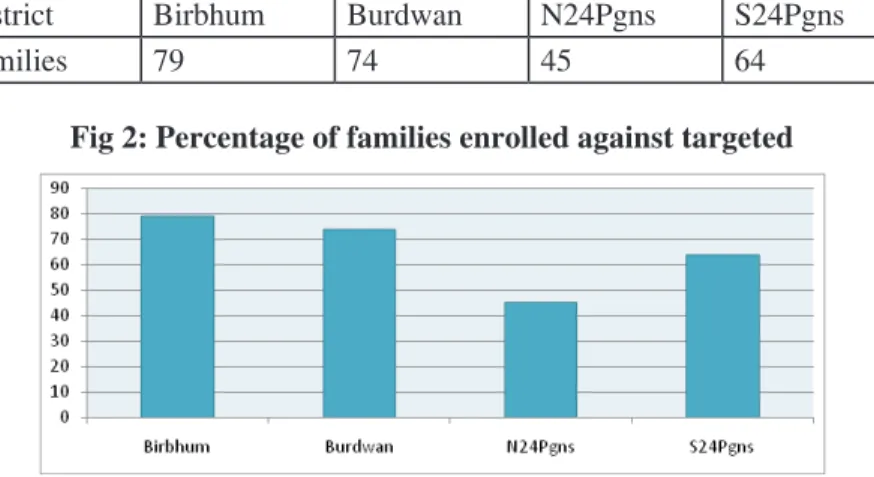
Whether the scheme had been able to fulfil its target of reaching out to the targeted population or not could be understood by observing the data in the Table 4. North 24 Parganas had been the poorest performer in terms of enrolling the targeted families. This district had managed to target only 45% of the targeted families. Birbhum was the best in terms of the said targeting (79%) and Burdwan was a close second. South 24 Parganas targeted only 64% of the families. So it is observed that RSBY was comparatively better accessed by the poor in the rural areas than the urban areas.
Table 4: Percentage of families enrolled as against targeted District Birbhum Burdwan N24Pgns S24Pgns
Families 79 74 45 64
Fig 2: Percentage of families enrolled against targeted
iv. Increase in Membership
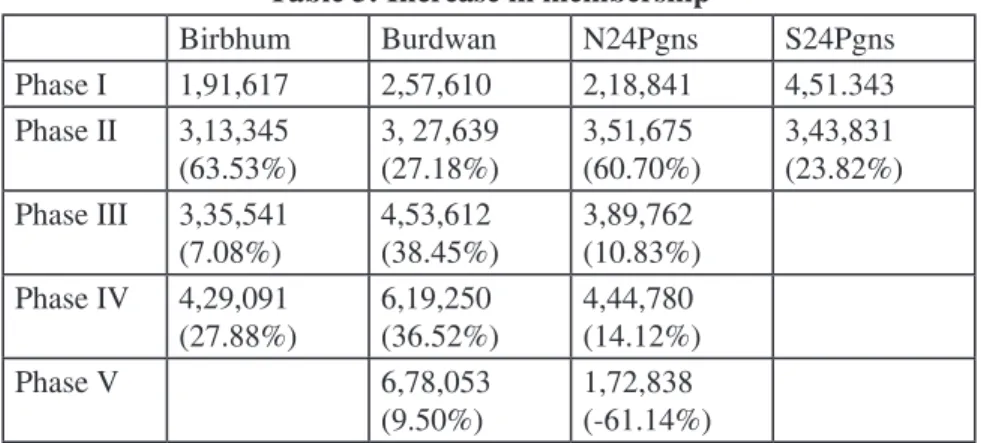
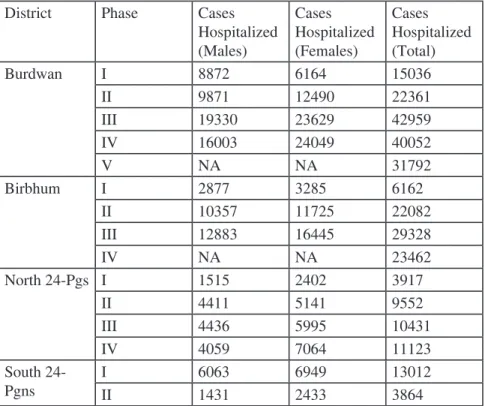
The Table 5 shows the increase in membership across districts and over the phases of execution of the scheme. For all the districts there was an increase in the rate of new membership in the second phase of the scheme. But apart from Burdwan (where there was only a slight increase in the mentioned rate) and South 24 Parganas (where the scheme was still in Phase II) in both the districts of Birbhum and North 24 Parganas, there was a rapid fall in the rate of increase in membership in Phase III. For the last two districts again there was a rise in the rate of membership in Phase IV. For Burdwan, however, there was a slight fall in the rate of increase in membership in Phase IV and a rapid fall in the increase in membership in the last phase, that is, in Phase V. The picture was dismal in North 24 Parganas in Phase V where there was a fall in the membership. The facts on membership increase were also reflected in the pattern of hospitalization in Table 8. There was a general fall in enthusiasm in getting enrolled and therefore utilizing treatment through hospitalization in the later phases.
Table 5: Increase in membership
Birbhum Burdwan N24Pgns S24Pgns Phase I 1,91,617 2,57,610 2,18,841 4,51.343 Phase II 3,13,345
(63.53%) 3, 27,639 (27.18%) 3,51,675 (60.70%) 3,43,831 (23.82%) Phase III 3,35,541
(7.08%) 4,53,612 (38.45%) 3,89,762 (10.83%) Phase IV 4,29,091
(27.88%) 6,19,250 (36.52%) 4,44,780 (14.12%)
Phase V 6,78,053
(9.50%) 1,72,838 (-61.14%)
Source: Adapted from http://rsbywb.gov.in/html/claim.php as on 14.04.2014 *(Percentages calculated by the researcher from given absolute data.
The figures in brackets indicate percentage increase over previous phase)*
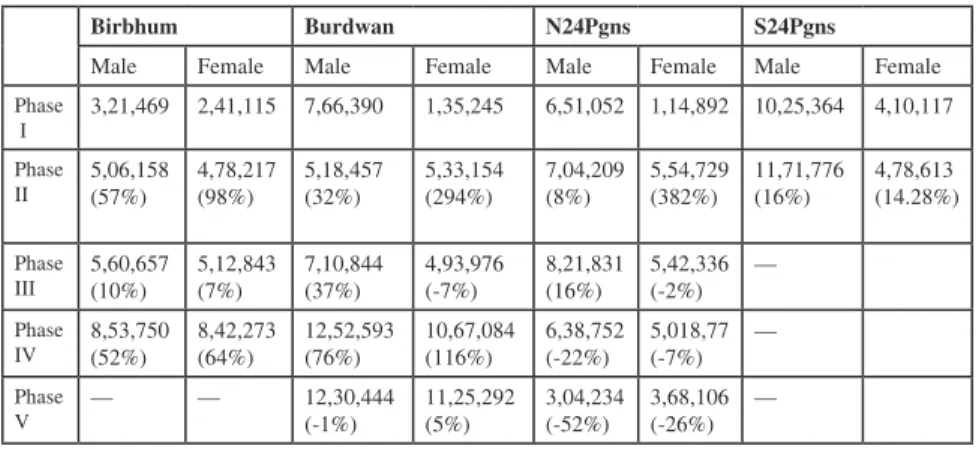
v. Gender-wise Increase in Membership
Table 6: Gender-wise increase in membership
Birbhum Burdwan N24Pgns S24Pgns
Male Female Male Female Male Female Male Female
Phase
I 3,21,469 2,41,115 7,66,390 1,35,245 6,51,052 1,14,892 10,25,364 4,10,117
Phase
II 5,06,158(57%) 4,78,217(98%) 5,18,457(32%) (294%)5,33,154 7,04,209(8%) 5,54,729(382%) 11,71,776 (16%) 4,78,613 (14.28%)
Phase
III 5,60,657(10%) 5,12,843(7%) 7,10,844(37%) 4,93,976(-7%) 8,21,831(16%) 5,42,336(-2%) —
Phase
IV 8,53,750(52%) 8,42,273(64%) 12,52,593(76%) 10,67,084(116%) 6,38,752(-22%) 5,018,77(-7%) — Phase
V — — 12,30,444(-1%)
11,25,292 (5%)
3,04,234 (-52%)
3,68,106 (-26%)
—
Source: www.rsby.gov.in and the calculations by the researcher. (The figures in the brackets indicate percentage increase column-wise, the
figures are rounded to the nearest whole number)
vi. Average Family Size Enrolled
The total number of people who could possibly access the benefits of RSBY was also related to the average size of the families enrolled. The average size of the families enrolled across districts and over the different phases is shown in Table 7. The average size of the families was larger in North and South 24 Parganas than the other two districts. A look across the phases shows that in the later phases comparatively larger families were covered by the scheme.
Table 7: Average sizes of families enrolled
District Family Size
Birbhum 3.3
Burdwan 3.32
N24 Parganas 3.52
S24 Parganas 4.0
Average 3.5
Source: www.rsby.gov.in and the calculations by the researcher.
vii. Phase-wise Hospitalization Cases