E&M1-Sticky Tape Activity
Part I – Top tapes
1. Take a 15 cm to 20 cm piece of transparent tape and make a handle on the end by folding under the first cm of tape, sticky side to sticky side. Place this tape on the lab table. This is the base tape.
2. Attach a second similarly prepared strip of tape onto the base tape. Label this tape “T” for top.
3. Repeat steps 1 and 2 so that you have two sets of base and top tapes.
4. Quickly peel the first of the T tapes from the base, and hang the T tape from the edge of the table.
5. Quickly peel the second of the T tapes from the base and slowly bring the second T tape near the hanging T tape. Describe what you see. Include a series of sketches of the tapes as they approach one another with vectors to represent the forces on the tapes. Label the forces.
base top bottom
table
Part 2 – Top and Bottom tapes
6. Repeat steps 1 through 3 above, but do not label the tapes yet. Place another
15 cm tape with handle on top of each of the tape sets. You now have two sets of 3-layer tapes.
7. Label uppermost tape “T” for top, and the middle tape “B” for bottom.
11. Hang each strip next to the hanging paper and foil. (Place them at least 15 cm apart.)
12. Repeat step 10 with the other set of tapes.
13. With a T tape hanging from one hand and a B tape hanging from the other, experiment by approaching each of the four strips hanging on your table (top tape, bottom tape, foil and paper). Describe what you see. Include a series of sketches of the tapes as they approach one another with vectors to represent the forces on the tapes. Label the forces.
Our Model of the Atom and the assignment of (+) and (-) charges
Our current model of the atom is consistent with the existence of 2 types of charge. An atom has a positively charged nucleus surrounded by mobile negatively charged
electrons. Materials become charged by the gain or loss of these mobile electrons. Based on observations you will see later we assign the label of negative to the PVC rod when rubbed with fur and positive to the Lucite rod when rubbed with plastic.
14. Rub the PVC rod with fur and approach each of the four hanging objects. Describe what you see. Note the strength of the interactions
15. Rub the Lucite rod with plastic and approach each of the four hanging objects. Describe what you see. Note the strength of the interactions
16. Based on your observations from using the two rods, label the T and B tapes with either a + or -. Restate the interaction between T and B tapes, T and T tapes, and B and B tapes using the terms positive and negative instead of top and bottom.
table
F
P
T
B
Names:
Summary Page:
#5: Sketch with labeled force vectors for two top tapes close enough to affect each other.
Sketch with labeled force vectors for two top tapes half as far apart as left sketch
#8: Describe paper on paper interaction #9: Describe foil on foil interaction
#13: Describe top tape and foil interaction
Diagram with forces
Describe top tape and paper interaction
Diagram with forces
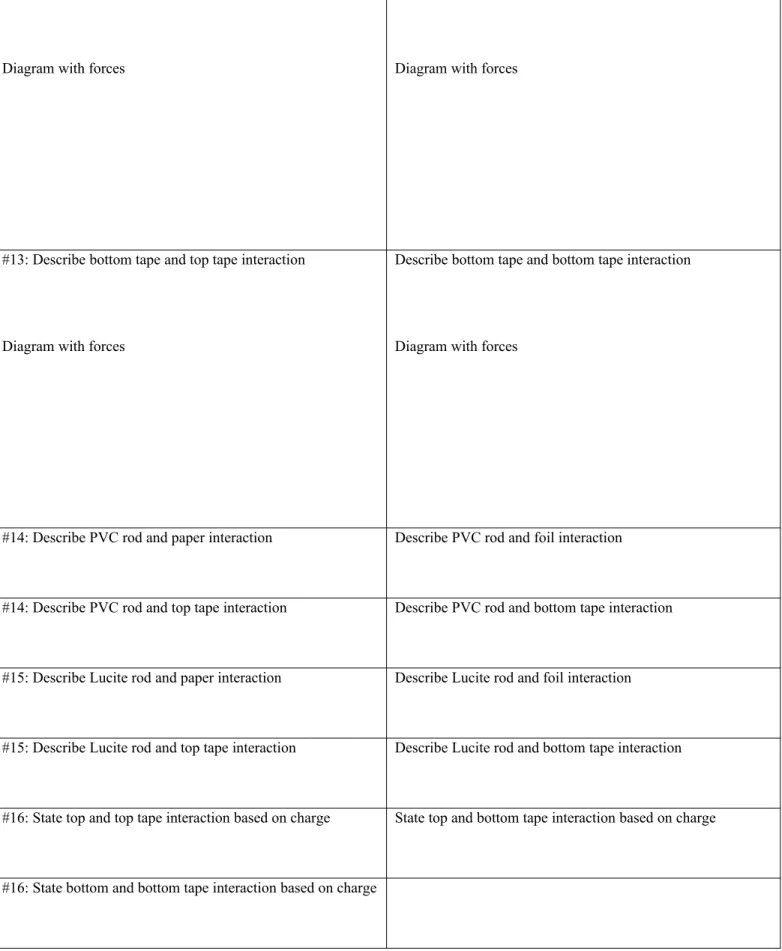
#13: Describe top tape and top tape interaction
Diagram with forces
Describe top tape and bottom tape interaction
#13: Describe bottom tape and foil interaction
Diagram with forces
Describe bottom tape and paper interaction
Diagram with forces
#13: Describe bottom tape and top tape interaction
Diagram with forces
Describe bottom tape and bottom tape interaction
Diagram with forces
#14: Describe PVC rod and paper interaction Describe PVC rod and foil interaction
#14: Describe PVC rod and top tape interaction Describe PVC rod and bottom tape interaction
#15: Describe Lucite rod and paper interaction Describe Lucite rod and foil interaction
#15: Describe Lucite rod and top tape interaction Describe Lucite rod and bottom tape interaction
Thought pages:
1. Imagine you could see the differences between the top and bottom tapes at the atomic level. On the partially separated T and B tapes diagram a way of representing how the tapes change as they are separated.
2. Complete the diagrams below in such a way that helps to explain why the neutral piece of paper can be attracted to both a top and a bottom tape while keeping these facts in mind. The paper is neutral and electrons can’t move away through the paper. Shown on the paper are 5 non-mobile atomic cores. Draw in an appropriate shifting of the electron cloud for the 5 atoms in the paper.
+ Hint: Here is a normal atom with a positive nucleus and an electron cloud evenly spread around it. The center of the electron cloud is centered on the nucleus. T tape + + + + + + + + + +
Hint 2: Here is an atom where the cloud has been shifted upward by an external charge. The center of the electron cloud is where the – sign is.
3. Complete the diagrams below in such a way that helps to explain why the neutral piece of foil can be attracted to both a top and a bottom tape. The diagram should also demonstrate why the foil has a greater attraction to the tape than the paper does. Hint: each atom has a free electron that can easily be moved by an external charge.