The handle
http://hdl.handle.net/1887/73832
ho
lds various files of this Leiden University
dissertation.
Author: Williams, S.G.
Title: Finding focus : using external focus of attention for practicing and performing
music
Finding Focus
Using External Focus of Attention
for Practicing and Performing Music
Finding Focus
Using external focus of attention for practicing and performing
music
Proefschrift
ter verkrijging van
de graad van Doctor aan de Universiteit Leiden,
op gezag van Rector Magnificus prof.mr. C.J.J.M. Stolker,
volgens besluit van het College voor Promoties
te verdedigen op donderdag 6 juni 2019
klokke 10:00 uur
door
Susan Gayle Williams
Promotor
Prof.dr. Henk Borgdorff
Universiteit Leiden
Copromotores
Dr. Rebecca Schaefer
Universiteit Leiden
Dr. Michiel Schuijer
Conservatorium van Amsterdam
Promotiecommissie
Prof.dr. Bernhard Hommel
Universiteit Leiden
Prof.dr. Adina Mornell
University of Music and
Performing Arts Munich
TABLE of CONTENTS
ACKNOWLEDGEMENTS ... 3
GLOSSARY of TERMS ... 4
INTRODUCTION ... 6
Background and Context: Training Performing Musicians ... 6
Approaches to Learning to Play Music ... 11
Aim and Relevance of this Research ... 14
Research Approach ... 15
Outline of this Dissertation ... 16
PART I: MAKING MUSIC ... 19
1 Learning Motor Skills ... 20
What Kind of Skill is Music-making? ... 20
Current Theories on Motor Control and Motor Learning ... 21
Stages of Learning Motor Skills and the Role of Attention ... 24
Explicit and Implicit Motor Learning ... 27
The OPTIMAL Theory of Motor Learning ... 32
Motor Learning and Motor Performance for Music-making ... 33
2 Attentional Focus for Learning and Performance ... 35
Introduction: What do Musicians Focus on? ... 35
What is Attentional Focus? ... 35
Types of Focus ... 36
Limitations of Attentional Focus ... 38
The Effects of Arousal and Anxiety on Attention ... 40
Optimal Focus for Learning and Performance ... 40
External Focus of Attention ... 41
3 Audiation and Musical Imagery ... 51
Introduction ... 51
Audiation: Music as Language ... 51
Musical Imagery ... 53
Singing and Gesture ... 56
Playing Variations ... 57
Practicing Musical Intention ... 58
Summary of Part I ... 59
PART II: FOCUSSING ON MUSICAL INTENTION Three Empirical Projects ... 60
4 An Overview of the Projects ... 62
Introduction ... 62
APT: Designing an Audiation Practice Tool ... 63
How External Focus was used in the Projects ... 64
5 Empirical Project One: The Effects of External Focus on the Skill Acquisition of Natural Trumpet Players ... 65
Introduction ... 65
Method ... 65
Results ... 76
Discussion ... 83
6 Empirical Project Two: The Effects of Using External Focus in Preparing a Trumpet Ensemble Project “Macht und Musik” ... 86
Introduction ... 86
Method ... 88
Discussion ... 99
7 Empirical Project Three: Using External Focus in a Mixed Ensemble Project “Biber Immersion Project” ... 101
Introduction ... 101
Method ... 102
Results ... 105
Discussion ... 107
PART III: DISCUSSION, CONCLUSIONS and RECOMMENDATIONS ... 109
8 General Discussion of the Research Findings ... 110
The OPTIMAL Theory Revisited ... 112
Recommendations for Future Research ... 113
9 Conclusions: Approaching Practice and Performance ... 114
A Holistic Approach to Learning and Performing ... 114
The Three Stages of Learning Reformulated ... 116
Training Performing Musicians ... 117
The Role of Conservatoires ... 118
Future Directions ... 120
10 Disseminating and Applying Research on Musicians’ Motor Learning to Musicians and their Teachers ... 121
Bridging Science and Musical Practice ... 121
SUMMARY ... 123
SAMENVATTING ... 126
REFERENCES ... 129
CURRICULUM VITAE ... 136
APPENDICES ... 137
Appendix A Test Pieces ... 138
Appendix B Self-efficacy Scales ... 145
Appendix C General Information Questionnaire ... 147
Appendix D Pre-sight-reading/Pre-performance Questionnaire ... 148
Appendix E Repertoire Assessment Form ... 149
Appendix F Practice Style Assessment Form ... 150
Appendix G Logbook Session Sheets ... 151
Appendix H Explanation, Guidelines and Rules for Using APT ... 152
Appendix I Guidelines and Rules for the Practice Sessions ... 153
Appendix J Post-performance Questionnaires ... 154
Appendix K Practice Style Data ... 157
Appendix L Post-APT Phase Questionnaire Answers to “Comments” with Analysis ... 158
Appendix M Practice Instructions for Project Two ... 161
Appendix N Practice Log Sheets for Project Two ... 162
Appendix O Post-performance Survey Questions for Project Two ... 163
Appendix P Transcripts of Post-project Interview for Project Two ... 164
Appendix Q Coding for the Post-project Interview ... 184
Appendix R Post-project Questionnaire for Project Three ... 185
Appendix S Transcripts of the Answers to the Post-project Three Questionnaire ... 186
Appendix T Program for “Macht und Musik” (Project Two) ... 189
Appendix U Program for the “Biber Immersion Project” (Project Three) ... 196
Appendix V Schedule for the “Biber Immersion Project” ... 201
Appendix W Teacher Training Document ... 202
ACKNOWLEDGEMENTS
Thanks go to my promoter – prof. Henk Borgdorff and my co-promotores dr.Rebecca Schaefer and dr. Michiel Schuijer for your expert guidance and generous support. This work involved a complex interaction between the disciplines of performing arts, pedagogy and psychology and needed a very subtle and critical blend of supervisors, which I thankfully had. Thanks also to prof. Adina Mornell and dr. Melissa Bremmer and to Joram van Ketel for your tremendous help and advice.
The support of the Royal Conservatoire The Hague is gratefully appreciated, and in particular that of Martin Prchal.
The research presented in this thesis owes a lot to the enthusiasm and inspiration I have shared with many of my colleagues both those who I have performed with and those I have worked with in the field of Performance Science – in particular my dear colleagues from the ‘Potential to Performance’ team: Wieke Karsten, Päivi Arjas, Erja Joukamo-Ampuja, Eve Newsome and Gabriela Meyer.
Thank you to my husband Matthias and son Jonathan for your love and patience, and to Wayne Williams for your indispensable help.
GLOSSARY of TERMS
Associative focus: focusing on something that is relevant to the task at hand
Audiation: the comprehension and internal realization of music, or being able to hear or feel sound when it is not physically present
Cognition: the mental action or process of acquiring knowledge and understanding through thought, experience, and the senses
Declarative learning: learning by following verbal instructions
Dissociative focus: focusing on something that is not relevant to the task at hand
Motor skill: a skill involving movement
Movement efficiency: refers to energy expenditure: the less energy expended during execution of a sport skill, the more efficient is the movement
Explicit learning: learning, which generates verbal knowledge of movement performance (e.g. facts and rules)
External focus: focus on the intended result of one’s movements
Implicit learning: learning that occurs without the person’s awareness
Internal focus: focusing on the movements of the body
Music-making: playing or singing music
Procedural learning: learning by doing
“People think focus means saying yes to the thing you’ve
got to focus on. But that’s not what it means at all. It
means saying no to the hundred other good ideas that
there are. […] You have to pick carefully.”
1“Intention unites desire and action.”
2INTRODUCTION
“Why do you play music?” I asked this question to the first year bachelor students at the Royal Conservatoire of The Hague. The answers were about how good it feels to play: “I enjoy the feeling of playing music”; “I like playing together with my colleagues”; “I enjoy communicating with an audience”. When I asked: “Why does someone come to a live concert?” I received similar answers: “To feel something”; “To be moved”; “To be touched”.
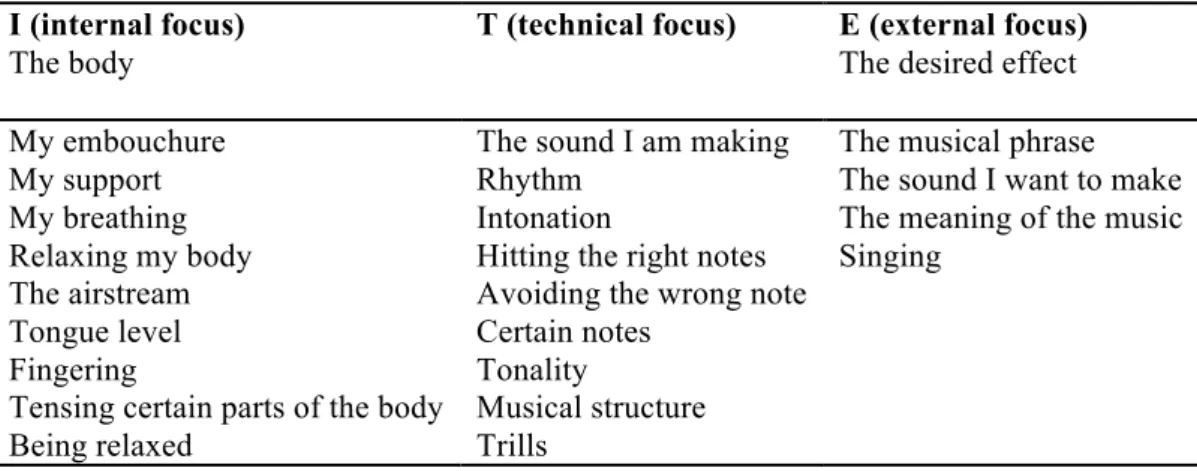
When I asked, however, “What do you focus on/think about when you practice?”, the answers were quite different: “Playing the right notes”; “Not making mistakes”; “Intonation”;
“Rhythm”; “Sound quality”; “My breathing”; “My hand position”; “What would my teacher think?”; “Am I good enough?”
How can we explain this discrepancy between musicians’ goals (to be expressive, connected to the music, the ensemble and the audience, to feel the music and move the listener), and what they focus on during practice (technical and physical control, perfection and approval)? Is it correct to assume that technical proficiency leads directly to or is a pre-requisite for expressive and convincing playing? Do expression and technical facility need to be separate elements of music-making? How do they interact and affect each other? What does a musician need to focus on in order to learn and perform well: technical elements, expressive elements, or both? Does this depend on whether the player is advanced or a beginner, on the difficulty of the piece or skill, or whether the piece or skill is new or not?
The research presented in this dissertation looks for answers to these questions by examining research findings and current knowledge on motor control and attentional focus, and to apply this knowledge to musicians in order to understand better how to focus during practice and performance.
Background and Context: Training Performing Musicians
Training Musicians at Conservatoires
“What we need is an institutional responsibility and policy to disseminate, discuss and try out practicing alternatives. Why are there hardly any courses on practicing in institutions that depend entirely on this activity? Is it beneficial for the development of institutional quality to act as if all students are expert practitioners?” (Jørgensen, 2009, p. 91)
confidence and self-efficacy3 and the ability to perform under pressure. In conservatoires
today all of these aspects are primarily the responsibility of the main subject instrumental (or vocal) teacher. Every teacher has his/her own approach and knowledge, and each student arrives with his/her own personal history, aptitudes and personality, and thus requires customised attention. For this reason a conservatoire needs to provide tools, techniques and knowledge that can fill any of the gaps in a particular student – teacher constellation. Courses in practicing and performance preparation need to be an integral part of a conservatoire’s curriculum (Jørgensen, 2009; Smilde, 2009; Williams, 2014).
By comparison with the typical training of a conservatoire musician, a potential professional athlete would have several hours of supervised training every day from a team of experts including a coach, fitness trainer, mental trainer, and dietician. Athletes are not expected to structure their own training and to train alone. Before the emergence of the conservatoire system, musicians were trained in a master-apprentice system where the young musician would live for several years with the master and absorb many aspects of what it is to be a good musician. Today’s conservatoire system is confronted with the challenge of producing elite musicians without the funding to provide hours of supervised practice every day. The usual amount of time with the teacher is one to one and a half hours per week. A logical solution would be to provide classes and information to help students to train themselves so that they can feel confident that what they do in the practice room is quality practice. Practical applications for practicing music based on relevant theories and research from psychology, pedagogy and neuroscience could be made available to both teachers and students in conservatoires.
Courses in teaching musicians how to practice are not yet part of the normal curriculum for most conservatoires (my own courses are an exception) but the subject is gaining interest amongst teachers and institutions, and there have been several international conferences on the topic of teaching practicing in conservatoires in the last few years. After 10 years of teaching courses in practicing and performance preparation both in The Hague and in Bremen I have observed the following:
- Students generally arrive with very idealistic aims, aspirations and expectations. When asked about their aims, they rarely mention making money, acquiring fame or seeking approval or security.
- There are often motivation problems (this is often a result of the initial joy of playing being lost and expectations of musical fulfilment not being met as a student is
confronted with the expectations of the institution, the teacher, comparing themselves
3 Self-efficacy is a person’s belief in their ability to succeed in a specific situation or task and is known
with other students, and thinking that “now it’s serious – it is not supposed to be fun anymore”).
- Many students suffer from injury problems connected with playing.
- There is limited knowledge of how to practice – most students use two or three standard methods (e.g. repetition, playing slowly, changing rhythm).
- Most students rely solely on the main subject teacher for guidance in how to play and perform. In many cases there is little autonomy and ability to reflect and self-regulate.
- Most students struggle with nervousness during performance, which impairs their ability to play to their current capacity.
- Most students trust in a technical approach to playing and practice – i.e. by trying to correct wrong notes through repetition, practicing intonation, tempo, rhythm and articulation and/or consciously steering and analysing their physical posture and movements. Thus practice is often primarily problem solving rather than exploration, and focussed on avoiding errors.
Mastering the Natural Trumpet
A lifetime of performing on and teaching the natural trumpet has taught me that there is no real security and ultimate control that will ensure that a concert, phrase or single note will be successful. All musicians live with this fact. It may even be this very human vulnerability that engages an audience and makes them come to a live performance rather than listen to a ‘perfect’ recording. Nevertheless, our job is to be able to play as convincingly as possible. A great musical result will include a high level of technical accuracy as well as being
expressive. Technical accuracy can be to some extent measured – the amount of right and wrong notes, intonation, tempo, rhythm and whether the composer’s markings or the conductor’s commands are followed. Musicality, expression and the ability to move the listener are more subjective. Different audience members can be affected in vastly different ways. The fact that technical accuracy can be quantified (measured) and that expressivity and musicality are more subjective concepts could be the reason that many players focus on technical aspects during practice – it’s easier to judge the result.
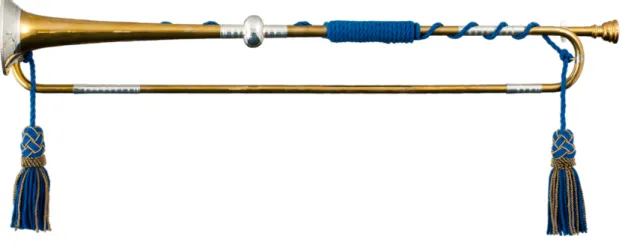
Figure 0.1 A Natural Trumpet
Many players (including myself) have noticed that the more they focus on hitting the right note or on avoiding mistakes, the worse they play. Looking for more security as a performer and teacher of the natural trumpet has led me to this research topic. Knowing what could benefit trumpeters on the subject of what to focus on during playing is very likely to be relevant to musicians in general.
A Historical Perspective to Musicians’ Training
A technical focus was not always the norm for musicians, and for this reason it is important to see how this occurred by looking at it from a historical perspective. The nature of musicians’ training changed radically after the emergence of French conservatoire system (a system that developed into the one we have today).
Thanks to the organisation of shared knowledge – something that developed enormously in the 19th century – what used to take a lifetime to learn could be learned in a few years (Ericsson, 1996). Since the advent of the French conservatoire system at the end of the 18th
century, the teaching and learning of music has become more systematic and specialised. This allowed knowledge and skills to be passed on in a much more efficient way than in previous centuries, and resulted in a general development of expertise. Knowledge was collected and disseminated freely. In the field of music, method books were written and the study of music was systematised and opened up to the general public. The former (pre-19th century) master-apprentice system was controlled by guilds; knowledge was largely conveyed through an oral tradition and was usually kept exclusive to the guild members.
conservatoire training was “life skills” and experience; that the focus was too much on honing specific technical skills (Smilde, 2009). Life skills and practical experience were the very thing that an apprentice experienced in the middle ages, renaissance and baroque times. In earlier times the master-apprentice relationship was based on observation and imitation, and was a full-time one. As mentioned previously, the apprentice lived with the master for several years and learned how the master approached his profession, and not only musical skills. Often the apprentice or journeyman played together with a master in performances to gain experience. In the modern system, this relationship – although still regarded and experienced as the most important one by students – is limited to one hour or 90 minutes of instruction per week.
The approach to music itself and the role of the musician also changed. In baroque times the task of the musician was to move the listener4 (Quantz, 1752; CPE Bach, 1753; Mattheson,
1739; Haynes & Burgess, 2016). Trained musicians were aware that music portrays emotions, and the devices of affect and rhetoric and were learned. Being able to compose and to
improvise was also an integral part of being a good musician. In the 19th century the emphasis began to shift to a more technical approach, both to the understanding of music as well as how to play it. During the 20th century, in conservatoires the study of music became more and more subdivided into parts: theory, history, skills. Skills themselves were dissected into controlling movements, breathing mechanisms, muscles, ear training, etc. A musician was a specialised instrumentalist, by comparison with, for example, a Stadtpfeifer5 in 18th century
Germany, who was trained as a musician and was expected to be able to play four or five instruments competently. Most importantly, the primary goal of musicians changed from serving and moving the listener to being, themselves, in the spotlight. The idea of training specialist ‘virtuosi’ was firmly established in the 19th century and continues today.
What conservatoires are facing today is the necessity of producing musicians that are multi-talented (e.g. they can play repertoire from several genres, or even on more than one instrument), flexible and have entrepreneurial skills (Smilde, 2009). The cultural landscape has changed and is continuing to change at an increasingly rapid rate. One aspect of concern for musicians and their teachers is the increasing demand for technical perfection on stage. Musicians are often overly concerned with error avoidance and don’t have adequate training in error and risk management (Kruse-Weber & Parncutt, 2014; Kruse-Weber & Marin, 2016).
The result of today’s intensive technical approach and ever-increasing demand for (technical) perfection is an increasing prevalence of injury, burnout and depression amongst professional musicians (Ackermann, Driscoll & Kenny, 2012). An additional by-product of technical focus
4 The role of emotion and music composition and performance will be mentioned several times, but the
field of emotions and music is too large to address in detail in this study.
is that musicians (and also audiences) are losing “literacy” – a concern voiced by Nikolaus Harnoncourt (already) in the 1980s:
“New methods, or methods similar to those used over two hundred years ago – must be used to train musicians. Rather than teaching music as a language, our academies drill only techniques of performance. This focus is, however, merely the lifeless skeleton of technocracy.” (Harnoncourt, 1982 p. 13).6
Even though there has been an increase of information, knowledge and insights relevant to musicians’ learning and performance in the last decades – particularly in the field of music pedagogy and psychology – the application of new knowledge is slow. Teachers at the conservatoire level are themselves usually not trained in pedagogy. Most teachers tend to use a traditional ‘transfer’ approach to teaching, involving giving verbal instruction, or by modelling (playing for the student). Others favour an approach based on the belief that musicians must first learn and develop technical skills before focussing on expression (Carey, 2013). Whilst the latter assumption seems logical, there is an increasing amount of evidence from the field of motor skill development – particularly in attentional focus – to suggest that a technical approach to learning complex skills like playing music is not the best way to learn efficient and effective music-making.
Approaches to Learning to Play Music
Focussing on Understanding and Controlling Technique: a Declarative Process
A convincing performance requires technical facility. But does focussing directly on technique bring the best results? In the 20th and 21st century, musicians have been
approaching music-making in an increasingly technical way involving declarative learning7, and consciously controlling the body’s movements (i.e. using internal focus).
For example, when playing the phrase in Fig. 0.2, a trumpeter may give himself the following instructions: “Take a good deep breath. Expand the ribs and engage the “support” muscles, below your stomach. Tighten the corners of the mouth. Lift the tongue level after the first note for the high C. Keep the air flowing, remembering to lift the tongue level for the high notes. Articulate: ta ti ta-da ta-da ta-da ta ta tee (last one with accent). Play mezzo forte and keep the quavers short…”.
6 Harnoncourt was not the first to complain about the conservatoire system’s inadequacies. For
example, in his essay Unsere Konservatorien (1895), Hugo Riemann stated “Die heute fast allgemeine
ausschließliche Dressur auf praktische Musikausübung ist eine traurige Errungenschaft der neuesten Zeit, und sie ist lediglich auf die Einrichtung der Konservatorien zurückzuführen” (Riemann, 1895, p. 25; emphasis from the original). [English translation: The drilling of musicians exclusively towards performing the music technically is a sad accomplishment of our current times, and the establishment of the Conservatoires is entirely responsible for this.]
Figure 0.2 A Fragment of Trumpet Repertoire8
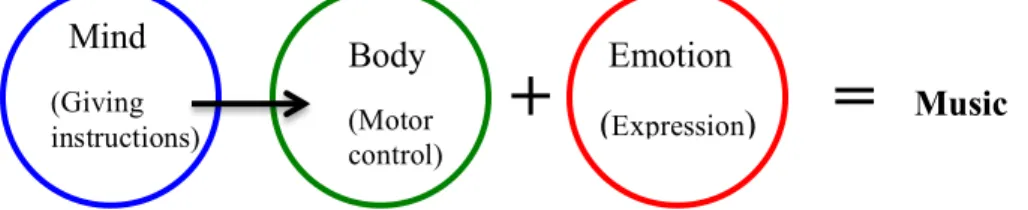
The above example combines instructions to the body and technical instructions about the musical score. The result is that players use their conscious minds in an analytical way to steer the learning and playing process. The basic assumption in this approach is that music-making should be steered in a declarative way – using conscious cognitive processes. As depicted in Figure 0.3 – when the technical details work and are co-ordinated, one can add expression.
Figure 0.3 A Model of a Declarative Process of Learning to Play Music
Figure 0.3. A model illustrating how instructions (from the mind) attempt to steer the body’s movements in order to produce a precise technical result. After this is achieved, the player can add expression.
One reason for the predominance of the above approach could be that we trust more in an analytical and technical approach due to advances in our knowledge of the functions and anatomy of the human body and brain, as well as in technology. An advantage of a technical approach is that it is quantitative (i.e. measurable). We can measure the result – we can tell how it is going (e.g. by checking things like accuracy, volume, articulation, speed, pitch or timing). Measuring whether a performance was expressive, moving and artistic is a much more subjective and difficult matter. It could be for this reason that much of a musician’s focus is on technical perfection and control.
Another reason for focussing on technical perfection is that we live in an age where ‘error avoidance’ is prominent. The recording industry and rising competition in the music industry
8 From BWV 43 (J.S. Bach) No. 7. Aria
Mind
(Giving instructions)
Body
(Motor control)
create pressure on performers to be accurate and ‘perfect’. Analysis and judgement during practice and in lessons are important aspects of the process of striving for perfection.
Is focus on the techniques of playing and performing the most efficient and effective way to learn and perform accurately and expressively, or is it better to focus on expression? Whilst technical accuracy is a very important attribute for a professional musician, is focussing on technical accuracy the best way of achieving it?
Focussing on Expression: a Procedural Process
By focussing on their intended result (expression) rather than on steering technical aspects, a musician is enabling a procedural process rather than a declarative one. Procedural learning is a process of acquiring a skill through repeated performance and practice: “Virtuosity is acquired by ‘doing’, that is, by practicing […], and not by being told what to do.” (Wulf & Mornell, 2008, p. 14).
Focussing on expression rather than on technique would be to focus on what rather than on
how: what a phrase should sound like or feel like for the listener – the musical intention. By focussing on the desired result, the mind of the player is not interfering with the complex and implicit (unconscious) process of motor learning. “If we trust our motor system to do its job, it is more likely to do that job than if we interfere with it by trying to exert control over it.” (Wulf, 2007).
Taking the same musical example from Figure 0.2, the player would be imagining how the phrase should sound or what effect he is trying to make. His movements and choices of volume, speed, articulation would be informed by a non-verbal process originating from his imagination of the desired result. In this case, emotion (in the form of musical expression) is informing the mind (which is engaging in focus rather than judgements and analysis) resulting in the body’s movements (motor control).
Figure 0.4 A Model of Procedural Learning for Music-Making
Figure 0.4. A model showing how emotion (in the form of musical expression) is informing the mind (in the form of focus) which in turn informs the body’s movements (motor control).
The key to the above process lies with attentional focus. When focussing only on technique the musician uses the conscious mind to analyse and give declarative instructions. Focussing on expression requires that the musician uses his mind to imagine the desired outcome: “Listen to ‘ideal music’ while playing; don’t listen to yourself […] fill your mind with sound.
Mind
(Focus)
Body
(Motor control)
Emotion
Use nuances. When you have controlled the sound, you will have controlled the body.” (Arnold Jacobs, in Nelson, 2006, p. 21).
The question often asked by musicians and addressed by this research is “What should I focus on during practice and during performance?” Focussing on the desired outcome – whether it be the desired sound, shape of phrase or expressing emotion, musical effect or meaning – is a form of external focus – a term recently coined in the movement sciences. Jacobs’ views (above) are not only relevant for experienced players. Even a beginner can benefit from focussing on a rich representation of the sound or an effect they want to make whilst learning a new piece or skill.
Aim and Relevance of this Research
The last two decades have seen a wealth of research from the fields of psychology and human movement science about attentional focus, which provide vital clues to answering the
question “What should I focus on during practice and during performance?” Of potential significance are findings that suggest that the learning of complex movements (of the type needed in sports and playing music) is better achieved implicitly, without much conscious attention, and that an external focus of attention – focussing on the intended result of the body’s movements – is more effective than an internal focus of attention – focussing on how to move the body.
The aim of this research is to determine if, how and why external focus can be of benefit to musicians. So far, general research on external focus – although extensive – has been mostly in the fields of sports and rehabilitation and by using quantitative methods to test relatively simple movements in controlled laboratory environments. Interpreting and applying external focus research for musicians in a naturalistic setting could result in valuable information about how to practice as well as how to focus attention during performance.
Research Questions and Hypothesis
The main research questions for the current work can be formulated as follows: How can we characterise external focus for musicians and what are the effects of external focus on
musicians’ learning and performance? An additional question is Do the kind of practicing
and performance preparation methods and approaches used in this study have an effect on the participants’ subsequent practice behaviour?
The first research question asks about the nature of external focus in a musician’s context. For sportspeople, an example of external focus (i.e. focus on the intended result of one’s
How does the concept of external focus translate to music-making? This second part of the (first) research question inquires about the effects of external focus on a musician’s skill acquisition and on performance. Based on empirical findings on external focus of attention, the expectation is that both learning and performance would be enhanced by external focus.
The second question inquires about whether the approaches and tools based on external focus that are presented to the participants in Projects 1-3 have an impact on their practice
behaviour afterwards. Changing habits and beliefs is very difficult – especially in a field that is based on tradition. It is be important to see if the musician’s own behaviour is impacted by the study.
The hypothesis of this study is that external focus is beneficial to musicians’ learning and performance. Sub-research questions and hypotheses are listed at the beginning of each of the empirical projects that comprise Part II of the study.
Research Approach
Applying the concept of external focus to the field of music in a naturalistic way requires a richer and more pragmatic approach than has been taken by the research so far undertaken in the movement and sport sciences. The combination of my own arts practice, music pedagogy experience and empirical research results in a unique contribution that addresses the wider realm of artistic practice. Making music is such a multifaceted phenomenon that convergent evidence from multiple disciplines and methods is required in order to obtain useful insights.
The research presented in the current thesis was compiled by designing and carrying out a series of three empirical projects in both semi-controlled as well as natural environments. A mixed methods research approach was used, with quantitative and qualitative elements. A music-pedagogical practice tool based on external focus was designed and used in all three projects.
The aim of the study on external focus had several aspects: to translate the idea of external focus from movement science into the field of music (how can external focus be characterised for music-making?); to design several ways to use, test and explore the application of external focus in field situations; and to collect data and find information to elucidate the effects of external focus and the instances in which it can work for musicians.
Outline of this Dissertation
This dissertation is divided into three parts.
Part I – Making Music (Chapters 1-3) – presents a literature review of relevant theories and research on motor learning and attentional focus. Conclusions from the review point out that music-making involves complex motor control and that results from research into implicit motor learning and external focus of attention suggest that external focus could be of benefit to musicians. Audiation is defined and proposed as an example of external focus for music-making, and a practice tool based on audiation is designed and then used in three empirical projects/interventions.
Part II – Focussing on Musical Intention (Chapters 4-7) – presents the three empirical projects in which the audiation practice tool is evaluated experimentally.
Part III – Discussion, Conclusions and Recommendations (Chapters 8-10) – here the combined results of the projects are then compared with the existing research on external focus to determine whether external focus is beneficial for learning and performing music, and whether there are some new insights into external focus of attention from a study based on musicians.
A brief description of each chapter follows.
PART I: Making Music
Chapter 1 – Learning Motor Skills – explains that music-making is a psychomotor activity involving motor learning. The nature and aspects of motor learning are explained, and the main current theories of motor learning are presented and discussed. Of particular interest and importance is the implicit motor learning theory – a theory put forward by Richard Masters, which claims that movement skills are better learned without much declarative knowledge or conscious cognition. The three stages of learning are described, and the role of attention in motor learning is discussed –in particular the question of what kind of attention is
recommended for each stage of learning. Conclusions from Chapter 1 raise doubts about the efficacy of declarative learning – even in the early stage of skill acquisition.
Chapter 2 – Attentional Focus for Learning and Performance – discusses attentional focus and presents in detail the relevant research and findings on external focus. The chapter concludes with a report on research about external focus in the performing arts and presents ideas about how external focus can be applied to music-making.
clarifying the musical intention of the player. The chapter forms a basis for the design of a practice tool – APT (Audiation Practice Tool) – to be used in the three empirical projects.
PART II: Focussing on Musical Intention: Three Empirical Projects
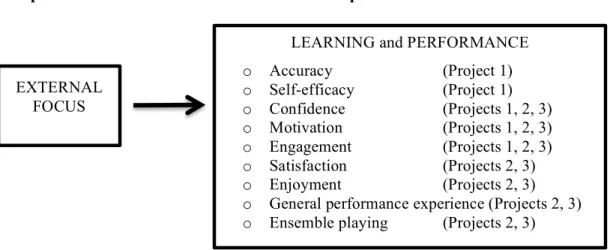
Chapter 4 – An Overview of the Projects – presents three empirical projects that explore the effects of external focus on musical learning and performance. A brief description of each project is followed by the research questions and hypotheses as well as an explanation of how external focus is used in each project.
Chapters 5, 6 and 7 – describe each of the three projects respectively. Aims, subjects, methods and measures, procedure, results, analysis and conclusions are presented for each of the projects. Project One asked “What are the effects of external focus on the accuracy and confidence of natural trumpeters?” using a mixed methods intervention. The results showing the benefits of the external focus tool compared to the participants’ usual way of practicing were around the threshold of significance for accuracy, and there were positive trends for self-efficacy for performance and for confidence. Project Two investigated how external focus affected the preparation and performance of a trumpet consort concert (the seven participants from Project One also participated in Project Two). Qualitative data was collected in this project, revealing that the participants were more engaged and suffered less nervousness than usual during performance. Project Three involved a mixed ensemble of string players, trumpeters and keyboard players in a workshop and performance of instrumental music. Again, external focus was at the centre of the pedagogy and methods used in the project, and the participants were asked for their feedback. The results revealed that several of the participants experienced a positive “out of the ordinary” concert
experience, as well as positive reactions to approaching rehearsals and concert preparation with external focus.
PART III: Discussion, Conclusions and Recommendations
Chapter 8 – General Discussion of the Research Findings – connects the theory and research presented in the literature review with the findings from the present study (including all three empirical projects), revealing what this study can confirm and suggesting further areas for research.
Chapter 9 – Conclusions: Approaching Practice and Performance – argues a holistic approach to music-making. The three stages of learning that were described in the literature review in Chapter 1 are reformulated to reflect how implicit learning and external focus can be used to benefit the learning and performing process.
thesis as well as illustrating a way of presenting information about psychomotor learning in such a way that it can be readily used in the practice room, in the lesson and on stage. A workbook for musicians – Quality Practice – written by the researcher is presented as an example of applying research and findings from psychology, pedagogy and neuroscience about motor learning to music-making.9 A central theme of this workbook is the role of
attention throughout the learning process. Making relevant empirically based knowledge available and accessible for musicians can thus encourage new and innovative ways to practice, learn and perform.
PART I: MAKING MUSIC
Making music is a sensorimotor activity: the result of a combination of motor skills (involving complex movements of the body) and sensory skills (involving the collection of aural/listening, visual and tactile experiences). Learning to make music requires hours and years of practice involving the repetition of highly complex movements until they can be reproduced reliably (Altenmüller, 2012). Experts in music pedagogy advise that effective practice needs to include developing focussed attention, using goal setting, self-regulation, self-reflection, and the ability to form good strategies (Chaffin & Lemieux, 2004; Ericsson, 2002; Araújo, 2016; Zimmerman, 1998; McPherson & McCormick, 2006; Bonneville-Roussy & Bouffard, 2015).
Although many pedagogues and trainers stress the need for developing attention, focus and working with goals, there is often little advice on what to focus or concentrate on. Musicians are usually advised to repeat something until it is automatic and to notice if something is right or wrong – i.e. to evaluate their playing or compare what they are doing with what they want to achieve. What often occurs is that the musician goes into a process of trying to understand intellectually not only what and why something is or is not optimal, but also how to control the process consciously. Recent theories on motor learning suggest that understanding and controlling complex movements consciously impairs optimal learning and performance. Implicit (unconscious) motor learning and external focus of attention (focussing on the intended effect of one’s movements) will be presented in this chapter as an alternative to conscious control and understanding.
In the first chapter the current mainstream views and theories of motor control and
1
Learning Motor Skills
As playing music requires motor skills it is useful to understand the principles and theories of motor control and motor learning in order to know how to train a musician well. It is not within the scope of this dissertation to undertake a detailed review and critique of all motor control and motor learning theories, though aspects that have relevance for an inquiry into external focus will be discussed in detail. A brief summary of the relevant theories to this research is presented below, beginning with defining what type of motor skill playing music is.
What Kind of Skill is Music-making?
Playing an instrument involves different types of motor skills. Schmidt and Wrisberg (2008) describe categories of skills within sports that can be directly applied to music-making. The skill categories can be visualised as a tree-diagram (Figure 1.1). The top of the diagram shows that skill can be subdivided in motor and cognitive skill (each containing procedural and declarative knowledge). Cognitive in this context refers to conscious cognition10 - skills
requiring conscious thinking and decision making, whereas motor skill refers to a task involving movement and little or no decision-making.11
Motor skills can be divided first of all as open or closed skills. Open skills are those for which the environment is constantly or perhaps unpredictably changing (e.g. during a football match). Closed skills are skills for which the environment is predictable and stable (e.g. shooting an arrow at a predetermined unmoving target) (Schmidt & Lee, 2005). Music-making is generally a closed skill as the environment is relatively predictable and a piece of music is usually rehearsed and prepared in advance with the understanding of how it needs to sound for the concert (and the way the instrument responds can be, in general, considered stable). The last set of categories describes how movements can either be discrete, serial or continuous. Music performance would be categorised a “serial” skill, because it involves the connecting of many discrete movements (a discrete movement – with a discernible beginning and end – would be a single note or a fragment of music consisting of a short group of notes). As a piece of music contains many notes/fragments connected together, it would be
categorised as a serial motor skill (Schmidt & Wrisberg, 2008).12
10Cognition also involves unconscious processes, for instance the processing of perception, memory,
learning, thought, and language without being aware of it.
11 Cognition is a highly complex subject. An elaborate discussion of cognitive skills is outside the
scope of this discussion.
12An exception to this definition would be improvisation – which could be considered a continuous
Figure 1.1 Categories of Skill
Figure 1.1 illustrates categories of skill, highlighting the types of skills and movements used for playing music (formulated from information from Schmidt & Wrisberg, 2008, pp. 3-8). The red, bold categories describe the skills needed for music-making. Discrete movements are connected to make serial movements.13
Now that the type of motor skills for performing music have for the most part been defined as
closed skills, involving discrete and serial movements, the following section investigates the question “How do musicians learn and perform these skills?”
Current Theories on Motor Control and Motor Learning
What are the current theories that can explain how we learn complex movements and how can these theories help musicians know how to approach the way they practice and perform? The following section describes the two main streams of thinking on motor learning: Motor Program Theory and Dynamic Pattern Theory (Schmidt & Wrisberg, 2008).
Motor Program Theory
Motor Program Theory is probably the most accepted explanation at present for how we learn complex movements. The main concepts within the theory are outlined here and include an explanation of a “closed loop” system and an “open loop” system, and finally “Schema Theory”.
13 Motor Skills do involve cognition – in the form of attention (rather than thinking about strategies and
making decisions).
Skill
Skills can involve movement and/ or decision making
Motor skill Little decision making
Closed
[e.g. Bowling, writing, playing a concert]
Predictable environment
Discrete movements
[e.g.Throwing, shifting gears, playing a single note]
Task has a recognisable beginning and end
Serial movements [e.g. Playing an instrument,
gymnastics routine]
A series of discrete actions
Continuous movements
[e.g. Swimming, steering a car]
No recognisable beginning or end
Open
[e.g. Catching a butterfly, playing a football match, wrestling]
Unpredictable environment
Cognitive skill
In 1971, Jack Adams introduced the idea that learning a movement involves a “closed loop” process. The process involves four components: 1. Executive – making executive decisions about how to perform the movement; 2. Effector – carrying out the actions; 3. Feedback – getting feedback that provides information; and 4. Comparator – detecting error and comparing the feedback to what was desired (Schmidt & Wrisberg, 2008).
Music example: If we were to apply the closed loop system to describe a musician’s learning process it would look as follows:
1. Executive: The player would decide how to play a phrase or fragment of music – this may involve things like what it needs to sound and/or feel like, how to control the body, and what to focus on.
2. Effector: Play the section of music.
3. Feedback: Notice how it sounded, what it felt like.
4. Comparator: Compare the played version with the desired version and detect the errors (leading back to 1. deciding how to play it again).
A closed loop way of processing an action demands a great deal of attention and takes some time to process information during the learning process (Adams, 1971; Schmidt & Lee, 2005; Schmidt & Wrisberg, 2008). This can be useful when learning a new skill, learning certain types of movements (e.g. continuous movements such as swimming, or holding a certain posture), or during early stages of learning (e.g. learning a new piece of music). According to this theory, errors are to be avoided as they are retained in the memory.
Complex short discrete movements (like those involved in performing music) are, however, too demanding on the attention to use a closed loop model (Schmidt, 1975). The open loop system was proposed by Schmidt to explain how one learns and performs skills that require fast reactions. Schmidt introduced the idea that whilst feedback can be available when one is performing an action (as in the closed loop model): “Most types of motor behaviour represent a complex blend of both open- and closed- loop control operations” (Schmidt & Wrisberg, 2008, p. 110). When a complex movement requires fast reaction time, there is no time for processing feedback, and is therefore referred to as an “open loop”.
Movements are learned by the development of a motor program. Schmidt explains that the motor program relies on building up a schema or set of rules that allow the person to perform new variations of the movement – implying that one does not need to have a new motor program for every skill. Building up the schema involves practicing the movement in various ways. The schema theory presumes that errors are part of the process of collecting
information about how to perform.
and articulation. The collected information forms the schema that can then allow the player to be able to play other tones and patterns than the ones practiced.
Dynamic Pattern Theory
“Practicing (music) can be considered as a self-organizing process, which frequently starts with uneconomical activation of large neuronal pools in the sensory-motor brain regions.” (Altenmüller & Schneider, 2008, p. 341)
A newer theory – the Dynamic Pattern Theory (Kelso & Schöner, 1988; Newel, 1991; 2003) – states that there are no “rules” generated by movements but rather that they occur and are learned by a system involving “self-organisation” and continual adaptation to the
environment through sensory feedback. This theory is very compelling, as it takes into
account the complexity of the interaction between the person and their environment. The view that Dynamic Pattern Theory is now the dominant view of the underlying mechanisms of motor learning is also reflected in a recent overview of this research area (Hommel, Brown & Nattkemper, 2016).
Music example: To allow a holistic self-regulating process to occur, a musician could explore a segment of music using variation, improvisation and involving sensory awareness – e.g. focussing on touch and sound, and by focussing on the desired outcome without analysing, comparing or consciously correcting the movements.14
Degrees of freedom
There are many possible combinations of muscle and joint activity that can produce a specific action, and there are variations to every movement (e.g. trajectory and form). This is referred to as the “degrees of freedom-problem” (Schmidt & Wrisberg, 2008), as it is very hard to predict specific movement parameters or decide on the optimal movement. Learning how to deal with the many degrees of freedom is a central problem in motor control, and involves the balancing of allowing certain muscles and joints to move during an action, and preventing or “freezing” others (Schmidt & Wrisberg, 2008). In the case of a piano player, for example, this would involve the player freeing (or freezing) the freedom in the wrist, hand and fingers. One of the major roles of motor programs would be, therefore, to “coordinate the many degrees of freedom needed to produce an effective & efficient action”. The question remains – to what extent is it important to understand and consciously steer the movements, or is it better to focus on something else and allow a self-organisation to take place? For both sports and
14 An example of this kind of approach to practicing music can be found in ‘Practicing in Flow’ by
music-making it is the outcome that matters and not how you get there. The dynamic pattern theory suggests that the optimal balancing of the degrees of freedom are found during an unconscious “organising” process. Practicing can therefore be considered as a self-organising process.
To sum up: a motor program consists of pre-structured sets of motor commands that are constructed at the highest cortical levels and then conveyed to the lowest centres in the hierarchy responsible for executing the movement. Unlike the motor program theory, in the Dynamic Patterns Theory, there are no hierarchies in contrast to a command-based centre. It seems likely that different theories or combinations of theories discussed above may best explain different types of movement – depending on the type of task, the environment and the skill level of the player (Schmidt & Wrisberg, 2008). Another factor that could be relevant is whether the skill is new – in an early stage of learning – or in an advanced stage of learning. The next section will look in detail at the different stages of learning motor skills.
Stages of Learning Motor Skills and the Role of Attention
It is widely accepted amongst experts in motor learning that learning occurs in stages – each of which has certain characteristics. A description of each stage of learning, its characteristics and the role of attentional focus in each stage is described in the following section. One of the most referred to paradigms was put forward by Fitts and Posner (1973) and describes three consecutive stages of learning that they call cognitive, associative and autonomous stages. Although there is general consensus about the stages of learning amongst experts, there is some contention about the role of attention during each stage. A description of each stage follows.
Early stage (cognitive stage)
In the early stage of learning, a skill involving complex movements is characterised by being halting, slow and rigid, and containing inconsistencies and errors. The player is exploring different ways to achieve the goal; getting an idea of the movement, using a step-by-step approach (Gentile, 1972; Schmidt & Wrisberg, 2008; Schmidt & Lee, 2005; Wulf, 2007) or by understanding the patterns involved (Newell, 1985).
learning process (Masters, 2012; Wulf, 2007). This will be discussed in more depth in the following section on explicit and implicit motor learning.
Middle stage (associative stage)
During this part of the learning process, the movements become more efficient, fluent, confident, decisive and adaptable, as well as reliable (Schmidt & Wrisberg, 2008; Wulf, 2007). Progress is usually slower than in the first stage of learning as the player is making subtle adjustments to the movements. A musician’s playing would begin to sound more fluid, feel more relaxed, and there would be fewer incorrect notes and more details in the execution. The middle stage is also referred to as the “motor stage” (Adams, 1971).
Later stage (autonomous stage)
In the later stage of learning, the person’s movements become more automatic and exhibit more consistency, efficiency and confidence. Execution is smooth, effortless and automatic as well as accurate and adaptable. At this stage, reliable performance is possible (Schmidt & Wrisberg, 2008; Wulf, 2007). In the case of musicians, the music would feel more effortless, sound fluent, have nuances and be (virtually) free of wrong notes.
Overlearning
It is worth mentioning here that sometimes a skill can be “overlearned” and starts to degrade as a result of too much practice (Altenmüller, 2006). A performance would revert back to a more halting rendition, be less fluid and have more errors. Reliable performance is possible only when the autonomous stage has been reached. Although automaticity is the goal of practice, it also has its downside. Learning requires not only repetition, but also deliberate practice involving concentration and attention to structured goal setting in order for control to become more automatic (Ericsson, 2008). Paradoxically, once automaticity is achieved and the player is able to shift attention elsewhere, improvement can stop and development of bad habits or even degradation can occur (Altenmüller, 2006, 2012; Hattie & Yates, 2014).
The Role of Attention During the Stages of Learning
Of importance to this thesis is the question of where a player’s attention should be during a particular stage of learning. During learning, cognitive demands gradually decrease as the task becomes more automatic. The person’s attention is at first often on controlling the movements by breaking them up into parts. Later the parts are joined, and there is more room for attention to details or to the overall musical and expressive goals as the movements themselves are controlled more automatically (Wulf, 2007).
The general assumption, then, is that in the first stage of learning there is a need for more conscious attention as well as verbal instruction and feedback. As the attentional and
not related to carrying out the task, or on a higher level of task focus, i.e. by focussing on expression. Many musicians approach the (learning) process by first learning technical skills and later focussing on musical and expressive aspects.
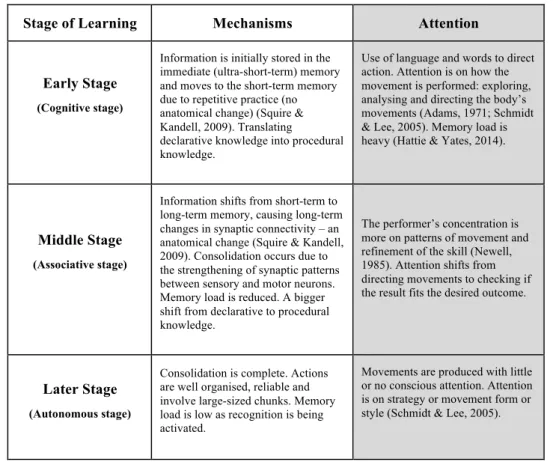
In Table 1.1, the stages of motor learning are outlined, the mechanisms are described, and the role of attention is highlighted. The table was composed by the author, and is the result of a compilation of the following sources: Altenmüller & Grün, 2002; Altenmüller, 2006; 2012; Hattie & Yates, 2014; Schmidt & Lee, 2005; Schmidt & Wrisberg, 2008; Squire & Kandel, 2009. Major research on motor learning referred to by the above sources includes: Adams, 1971; Fitts & Posner, 1967; Gentile, 1972; and Singer, 1993. Nomenclature differs amongst researchers, and some of the more common and descriptive examples are included in the table.
Table 1.1 Stages of Learning
Stage of Learning Mechanisms Attention
Early Stage
(Cognitive stage)
Information is initially stored in the immediate (ultra-short-term) memory and moves to the short-term memory due to repetitive practice (no anatomical change) (Squire & Kandell, 2009). Translating
declarative knowledge into procedural knowledge.
Use of language and words to direct action. Attention is on how the movement is performed: exploring, analysing and directing the body’s movements (Adams, 1971; Schmidt & Lee, 2005). Memory load is heavy (Hattie & Yates, 2014).
Middle Stage
(Associative stage)
Information shifts from short-term to long-term memory, causing long-term changes in synaptic connectivity – an anatomical change (Squire & Kandell, 2009). Consolidation occurs due to the strengthening of synaptic patterns between sensory and motor neurons. Memory load is reduced. A bigger shift from declarative to procedural knowledge.
The performer’s concentration is more on patterns of movement and refinement of the skill (Newell, 1985). Attention shifts from directing movements to checking if the result fits the desired outcome.
Later Stage
(Autonomous stage)
Consolidation is complete. Actions are well organised, reliable and involve large-sized chunks. Memory load is low as recognition is being activated.
Movements are produced with little or no conscious attention. Attention is on strategy or movement form or style (Schmidt & Lee, 2005).
Table 1.1 illustrates the stages of learning, the mechanisms involved and the role of attention.
How important are declarative processes to learning complex movements? Should people first understand what they are doing in a verbal cognitive way in order to achieve automaticity? The next section investigates this question by discussing and comparing explicit and implicit approaches to motor learning.
Explicit and Implicit Motor Learning
Explicit motor learning is defined as “learning which generates verbal knowledge of movement performance (e.g. facts and rules), involves cognitive stages within the learning process and is dependent on working memory involvement”, whereas implicit learning is “learning which progresses with no or minimal increase in verbal knowledge of movement performance (e.g. facts and rules) and without awareness” (Kleynen et al., 2015, p. 2). As explained earlier in stages of learning, the cognitive load when learning something new is heavier than when the movement becomes more automatic. Questions arise concerning how much instruction and declarative knowledge to give a learner, and when it is appropriate to use explicit or implicit learning strategies. The main strategies used in sports and
rehabilitation training include discovery learning, analogy learning, errorless learning, observational learning, dual task learning, trial and error learning, and movement imagery15
(Kleynen et al., 2015)16. These are all strategies that are familiar to musicians; an added
strategy would be auditory imagery.
Explicit learning involves conscious thinking and use of the working memory, and is usually operationalised by giving rules and instructions or by instructing the learners to find rules and instructions for themselves, and can be promoted by using various types of feedback. Implicit learning is better promoted by restricting feedback, by using an external focus of attention and by practicing the entire skill (Kleynen et al., 2015). Implicit learning (also called tacit
learning) is a term coined by Arthur Reber in 1965. Reber claimed that implicit processes are more effective than explicit ones because they existed before the evolution of the cerebral cortex and consciousness. From an evolutionary perspective, long before people learned to talk they were still able to move effectively, and the implicit unconscious mechanisms that evolved were the most effective for survival. The development of verbal conscious functions and working memory meant that the necessity of the implicit mechanisms was not as great. Man has been described as being more reliant on conscious thinking processes (Reber, 1989;
15 Discovery learning would involve allowing learners to discover the rules themselves; analogy
learning would involve presenting an analogy (e.g. image) to focus on; errorless learning involves learning in a way that no errors occur during practice (e.g. playing very slowly); observational learning means learning by observing someone else; dual task learning involves focussing on something else (e.g. counting backwards) whilst performing the skill; trial and error learning focuses on repeating the task, and noticing and responding to what works and what doesn’t work; movement imagery involves imagining how the movement would look or feel.
1992). The questions that remain are: when, how and why should implicit learning be used instead of explicit learning, or can one use a combination?
The main considerations to be taken into account when deciding whether an explicit or implicit approach is appropriate are the type and difficulty of the task, whether the individual is a novice or expert, and the stage of learning. Many scientists and coaches believe that an explicit declarative stage is important for early stages of learning or with novices (as suggested by stages of learning models, e.g. by Fitts & Posner (1967) and by Schneider & Shiffrin (1977). Others claim that novices learn better with implicit methods and experts learn better when using rules and instructions (explicit methods). Schlapkohl & Raab (2016) described several studies on novices and expert athletes using both explicit and implicit approaches – the implicit approach used analogies (e.g. in a study involving table tennis players, the players were instructed to: “Try to move the arm as if you were throwing a discus”), and the explicit approach involved a set of instructions. The conclusions were that expert athletes benefit from rule-based instructions, whereas novices and pupils should be instructed implicitly
(Schlapkohl & Raab, 2016, p. 39). Robert Singer is an example of those who believe that explicit methods are needed before and after making the movement, but that during the movement, an implicit approach is better. His ‘five step approach’ consists of: Readying, Imaging, Focussing, Executing and Evaluating (Singer, 1988). A more radical view has been taken by Richard Masters, who claims that it is important not to think about the movement while executing it, that instructions should be kept to a minimum, and that explicit learning is generally detrimental (Maxwell, Masters & Eves, 2000; Masters, 2012; Wulf, 2007). Since many of the views of Masters are in line with research on external focus, a review of Masters’ implicit learning theory and his research follows here.
Masters’ Implicit Learning Theory
Richard Masters claims that conscious thought can interfere with the automatic execution of a movement, and that motor learning should be primarily implicit in order to be efficient and to be reliable under pressure. His theory aligns with Reber’s view that the older implicit
processes lead to better learning and performance: “Implicit processes are embedded in neuroanatomical brain structures that phylogenetically are older and more sophisticated than explicit processes” (Masters & Poolton, 2012, p. 68, citing Reber, 1992). MacMahon & Masters (2002) describe explicit motor learning as a conscious process involving ‘hypothesis testing’: comparing internal thoughts with external facts and evaluating the success of the solution according to the movement-related feedback. The result is an accumulation of explicit knowledge in the form of rules and facts, which are stored in the long-term memory.
“reinvestment”. Most sportspeople (and musicians) will recognise that thinking about how to do a movement during performance disrupts the flow and execution of that movement. Although verbal-analytical aspects of working memory activity may be gradually withdrawn during learning, the declarative knowledge that has been collected still remains available for retrieval, manipulation and application by the working memory (Zhu et al., 2012). Masters and Maxwell (2004) describe the Theory of Reinvestment as the retrieval and application of declarative knowledge during performance and cite wide-ranging empirical research that reveals that reinvestment is detrimental to performance (e.g. Baumeister, 1984; Bliss, 1895; Boder, 1935; Borkovec, 1976; Henry & Rogers, 1960; Reason & Mycielska, 1982; Weinberg & Hunt, 1976; Wulf et al., 2001). Masters’ research reveals several causes for reinvestment, including the fact that some personality types are more prone to ‘overthinking’, psychological pressure, injury or fatigue, the availability for too much time for movement preparation, as well as unexpected events before or during a performance (Zhu et al., 2012).
Research on Implicit Learning
Most research on implicit motor learning has been carried out since 1992, and in many fields, including rehabilitation, child development and surgery, as well as sports (Masters & Poolton, 2012). Researchers have explored several ways to induce implicit motor learning: using secondary tasks, errorless learning, analogy learning, and marginal perception. Details of each of these and some results of the research are given below.
Using secondary tasks: the learner is thinking about something unrelated to the movement (e.g. counting backwards from 1000) whilst playing. The secondary task uses up a large proportion of the working memory (thus hampering hypothesis testing), leaving the main task to be carried out unconsciously.
Masters’ early research on implicit motor learning in 1992 used a complex secondary task with novice golfers. Participants reported that they putted ‘intuitively’ (showing implicit learning). They performed better under real-life pressure situations than the other two groups (explicit learners and discovery learners) (Masters, 1992). This kind of dual task experiment has been replicated repeatedly with positive results (for an overview, see Masters & Poolton, 2012, p. 60). One disadvantage was that dual task learning was slower than the other two types of learning (explicit and discovery). When a simpler kind of dual task learning was tried (MacMahon & Masters, 2002), the results showed that hypothesis testing was not halted. The dilemma remained of how to have a secondary task that is complex enough to halt hypothesis testing without slowing down learning.
familiar, and therefore not later retainable from the memory. An experiment involving beginner golfers and putting from very short distances, then gradually lengthening the distances, showed that they were more accurate (over a full range of distances) in a delayed retention test than a group that learned by first practicing over larger distances, and a control group (Masters, Kerr & Wheedon, 2001; Maxwell et al., 2001). In another study, when
explicit instruction was added after the initial implicit learning phase, the players’ performance remained stable (Poolton, Masters & Maxwell, 2005). More recently, there has been a great deal of research and interest in implicit motor learning using errorless learning techniques in rehabilitation and surgery (for details, see Masters & Poolton, 2012, p. 64).
Analogy learning: instead of giving verbal explanations, presenting a mental model of a new concept that is familiar to the learner (e.g. imagine the phrase ‘cascading like a waterfall’). Analogies allow the individual to make inferences about concepts with little awareness of the rules that underlie the concepts (Donnelly & McDaniel, 1993). A great deal of research related to implicit learning has been carried out using analogies, with mostly positive results when compared to explicit learning. Studies on not only golf putting, but also tennis, table tennis basketball and other sports have shown that using analogies promotes implicit learning (e.g. Liao & Masters, 2001; Poolton, Masters & Maxwell, 2007; Koedijker, Oudejans & Beek, 2011). One problem with using analogies is that an analogy coming from a trainer may not always make sense to any particular individual – or be the most descriptive for the task. A solution could be to search for the most powerful/accurate analogy together with the learner.