Non-equilibrium dynamics and structure of interfacial ice
Oliviero Andreussi
a, Davide Donadio
b, Michele Parrinello
b, Ahmed H. Zewail
c,*aScuola Normale Superiore, Piazza dei Cavalieri 7, I-56126 Pisa, Italy
bEidgeno¨ssische Technische Hochschule Zu¨rich, Department of Chemistry and Applied Biosciences, c/o USI-Campus via G. Buffi 13, CH-6900
Lugano, Switzerland
cLaboratory for Molecular Sciences, Arthur Amos Noyes Laboratory of Chemical Physics, California Institute of Technology, Pasadena CA 91125, USA
Received 20 April 2006 Available online 13 May 2006
Abstract
Stimulated by recent experiments [C.-Y. Ruan et al. Science 304, (2004) 81], we have performed molecular dynamics and ab initio structural studies of the laser-induced heating and restructuring processes of nanometer-scale ice on a substrate of chlorine terminated Si(1 1 1). Starting from proton disordered cubic ice configurations the thin film behavior has been characterized at several temperatures up to the melting point. The surface induces order with crystallization in theIclattice, but with void amorphous regions. The structure
changes on the ultrashort time scale and restructures by heat dissipation depending on the relaxation time and final temperature. Our results show the general behavior observed experimentally, thus providing the nature of forces in the atomic-scale description of inter-facial ice.
Ó2006 Elsevier B.V. All rights reserved.
Interfacial ice is fundamental to a rich variety of phe-nomena, including those in electrochemistry, heteroge-neous reactions, and tribology. For this reason the structural and chemical properties of thin water films adsorbed on different substrates have been the subject of several theoretical and experimental investigations [1,2]. In particular, the interaction of water with transition met-als (Ru[3], Rh[4], Pt[5,6], Pd[7]) and silica[8,9]has been extensively analyzed. Experimentally, the equilibrium structures of these systems can be determined by using thermal desorption spectroscopy, electron and scanning microscopy, and electron diffraction (LEED and REED). Recently, by exploiting ultrafast electron crystallography (UEC)[10], C.-Y. Ruan et al. were able to extend the meth-odology to study the structure and non-equilibrium dynamic evolution of interfacial ice on silicon surfaces
[11]. The structural changes induced by a sudden laser-induced temperature jump of the substrate were monitored by acquiring ultrafast diffraction patterns, providing a
microscopic description of a complex non-equilibrium process.
In this Letter, we provide the theoretical basis for direct atomistic description of the water–substrate interface, and simulate the structure and dynamics obtained by UEC for direct comparison with the experimental findings. In order to provide a coherent microscopic description of the experimental results [11], we performed an extensive molecular dynamics (MD) study on the total system inves-tigated. We treated the real system which consists of a sin-gle crystal Si(1 1 1) surface, chemically terminated with chlorine atoms [12] and covered by a thin layer of water at temperatures lower than 150 K under ultrahigh vacuum conditions. The charge separation between silicon and chlorine atoms renders the interaction stronger than with hydrogen-terminated surface. In this sense, the surface is more hydrophilic, as demonstrated in contact angle mea-surements [11]. The experiments show that the substrate covered by ice film consists of two regions: a thin crystal-line interfacial region, made of about three water bilayers, and a thicker region of orientationally disordered nano-sized crystals. From the electron diffraction patterns it was determined that the interfacial region has a crystalline
0009-2614/$ - see front matter Ó2006 Elsevier B.V. All rights reserved. doi:10.1016/j.cplett.2006.04.114
*
Corresponding author. Fax: +1 626 405 0454.
E-mail address:[email protected](A.H. Zewail).
arrangement of cubic ice Ic, which is rotated by 30° with respect to the underlying silicon surface, so as to match the periodicity of the chlorine atoms. The residual lattice mismatch between the epitaxial iceIcand Si(1 1 1) is smaller than 2%.
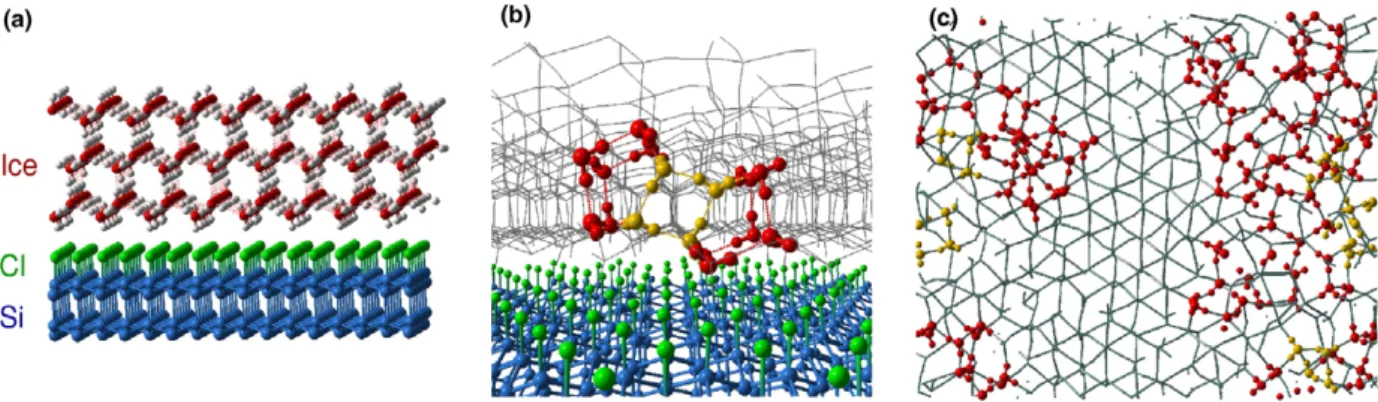
For the theoretical treatment, we model the system as a periodic, chlorine terminated, silicon slab covered by three or nine bilayers of water (Fig. 1), and containing 432 and 1296 water molecules, respectively. This makes possible the study of structure and dynamics of epitaxial ice; the rel-atively thick upper layer of orientationally disordered crys-talline islands is not modeled explicitly. In the real system, the crystalline islands could play a role as a sink through which heat can be dissipated, but they affect only margin-ally the structural properties of the interfacial layers, which are well represented in our model. The time scale of the processes we address and the large size of the systems are out of reach of ab initio simulation techniques, so that the choice of classical MD is unavoidable. By this choice we rule out that water can react with the substrate and dis-sociate[13,14]. Even if possible, the occurrence of this pro-cess is rare and overall does not influence the reorganization of water at the interface of the Cl:Si(1 1 1) surface.
The classical MD simulations were performed in the microcanonical ensemble in runs of 100 ps after 500 ps equilibration, with time steps of 1 fs, in a constant temper-ature ensemble enforced by a Berendsen thermostat [15]. We used the DLPOLY program [16] throughout. The long-range electrostatics are computed using the 2D Hautman– Klein–Ewald method [17] in the equilibrium simulations, while for the faster smoothed particle mesh Ewald method
[18]was adopted to study non-equilibrium dynamics. The interaction between water molecules is modeled by the classical TIP4P potential [19], which has been shown to reproduce qualitatively the entire phase diagram of water
[20,21] and quantitatively the structural and thermody-namic properties of amorphous ice in the range of temper-atures considered in this work[22,23]. In order to reproduce
the elastic and thermal properties of the silicon slab the Keating potential[24]is adopted.
We also performed ab initio simulations to examine the nature of the chemical bond at the Cl terminated Si(1 1 1) surface. We investigated a periodic system (Si32Cl8H8), using the CPMD program [25] and a Si28Cl6H30 cluster, using the GAUSSIAN03 program[26]; in both cases hydrogen atoms were added in order to saturate the silicon dangling bonds. In the former case, the stretching frequency for the SiACl bond and the Wannier centers were calculated in the framework of density functional theory (DFT), using the BLYP functional [27,28] with an energy cutoff of 70 Ry and norm-conserving pseudopotentials to treat core elec-trons. In the isolated system, Mulliken and ESP charges were computed at the Hartree–Fock (HF) level with a 6-31G* basis set. The calculation shows that the charge transfer induced by the Cl atoms termination of the slab is limited to the topmost layer of Si atoms, while the other Si atoms can be considered neutral. The charge in Si and Cl was fitted using RESP[29], a procedure which gave for the charges to be used in the effective potential ±0.3jej. The covalent part of the SiACl interaction is modeled by a har-monic potential, the parameters of which were fitted on the ab initio geometry and stretching vibrational frequency, giving a harmonic spring constant k= 650 kJ/(mol A˚2) and an equilibrium distancer0= 2.15 A˚ . The parameters that describe the short-range and van der Waals interac-tions between water and Cl were taken from the standard GROMOS96 force field[30].
We first checked whether the ice Icstructure of the ice layers is stable within our model. Proton disordered initial configurations were generated by a Monte Carlo method
[31] that allows supercells of ice with zero total dipole moment to be generated. The algorithm was modified so as to produce configurations with zero total dipole moment in the plane of the slab and maximum binding energy with the substrate. Several configurations with different initial proton arrangements were equilibrated at temperatures ranging from 70 to 240 K. The experimentally determined
structure is stable at low temperature except for a rear-rangement of the hydrogen bond network at the interface, which takes place spontaneously already atT= 70 K . This local rearrangement (seeFig. 1b) is due to the presence of under-coordinated molecules on top of the interstitial sites of the Cl layer. In this process the under-coordinated mol-ecules are displaced and form a new bonding pattern where 4- and 5-fold rings are formed. This apparently massive rebonding is obtained with small but concerted displace-ments and bond switches that allow an extra hydrogen bond to be gained, thus decreasing the total energy of the system. These topological defects are similar to those that have been shown to mediate melting in bulk ice Ih [32,33]. Here they occur both at the Cl:Si(1 1 1)–water inter-face and at the free surinter-face of the H2O film, irrespective of the thickness of the sample.
However, the predominant crystalline arrangement of the system is preserved, and these configurations are com-patible with the experimental electron diffraction patterns (see the leftmost frame in Fig. 5c). As the temperature is raised, the number of these and other similar topological defects increases and they act as nucleation centers for the formation of extended amorphous regions (Fig. 1c) which coexist with crystalline domains. Because of the interaction between the interface and the free surface bilay-ers, this effect is more prominent in the three bilayer sys-tem, which indeed melts at 210 K, while the thicker film melts at 240 K.
We investigated in more detail this progressive disorder-ing phenomenon in the three bilayer system, where inter-faces play a greater role. In Fig. 2 we illustrate the temperature-induced changes in the pair correlation func-tion. Comparing the temperature dependence of g(r) of interfacial ice with that of bulk ice (Ic) and low-density amorphous ice (LDA), it appears that interfacial ice at short distances (3–4 A˚ ) has extra features that cannot be
explained only on the basis of the Debye–Waller thermal broadening. These features are due to the reconstructive process that favors the formation of short four- and five-membered rings even relative to low- and high-density amorphous ice [22,23] (Fig. 3). The analysis of the radial distribution function between molecules in the same n -membered ring averaged over all the rings with the same size[22,23](inset in Fig. 3) shows that the main contribu-tion to the broad feature around 3–4 A˚ in the differential
g(r) in Fig. 2does indeed come from the shorter distance between next nearest neighbors in the smaller rings.
In order to elucidate the role of the interface in the induced amorphization process of the ice film which pre-cedes melting, we carried out an analysis of the orienta-tional distribution of the water molecules [34] at different temperatures, dividing the system into interfacial, middle and surface layers. The results displayed inFig. 4show that the presence of the substrate enforces a higher structural order in the interfacial layer, which retains its average ori-ginal orientation even at 210 K when the surface and mid-dle layers melt. Thus, the order induced by the substrate is present even in the molten state, supporting crystallization into cubic ice structure. Increasing the layer thickness from three to nine bilayers does not alter this picture except for the slightly increased stability of the system, reflected in a higher melting temperature. Since the interaction between the interfacial water and the free surface is effectively reduced, the two surfaces can reorganize independently until the melting point is approached.
This success in the characterization of the structure at the interface led us to investigate the dynamic response of the system to a sudden laser-induced temperature jump, as was done using UEC [11]. In the experiment, after an equilibration at about 150 K, IR pulses were directed to
Fig. 2. Difference radial distribution function curves for three bilayer interfacial ice (Int. Ice, black line) equilibrated at different temperatures (top panel:g(r, 180 K)–g(r, 150 K); middle panelg(r, 210 K)–g(r, 150 K); bottom panelg(r, 210 K)–g(r, 180 K)). Results obtained for bulk cubic ice (IceIc, red line) and low-density amorphous ice (LDA, green line) are also reported.
the substrate to initiate the temperature jump. After about 1 ns, the temperature of the whole system was restored to the initial value of 150 K, consistent with heat-diffusion
[35]. In our MD simulated experiment, we equilibrated the slab at 130 K, in order to account for the low melting point of the TIP4P water model [20,21], and obtained the effect of laser heating by rescaling the velocities of the Si atoms for an equilibration time of 120 fs, so as to bring the kinetic temperature of the substrate up to a target tem-peratureTpulse. The heat jump in the substrate remains for a finite time determined by the relaxation towards equilibrium.
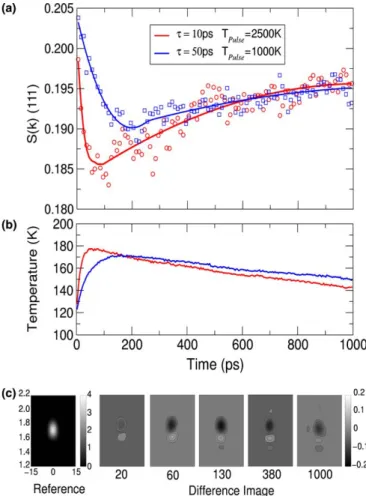
A deeper insight into the nature of non-equilibrium pro-cesses was gained by varying the values of Tpulse, ranging from the value of Tpulse= 370 K to an extreme value of Tpulse= 2500 K. Due to the small system size and to the lack of a polycrystalline overlayer we simulate substrate heat dissipation by applying a thermostat, using the Ber-endsen thermostat [15] with a relaxation time (s). For a more realistic channel of heat dissipation, we performed these simulations on a system of nine bilayers and using different values ofs, ranging from 20 to 200 ps. The effec-tive water temperature is determined by Tpulse, s, and the coupling at the interface. For example, forTpulse= 2500 K and s= 10 ps, the peak in water molecule temperature is found to be 180 K (Fig. 5b); melting was not reached under these conditions. The experimental temperature was derived from the Debye–Waller factor, and this does not take into account the extent of mode selectivity at short times. InFig. 5a, we contrast two cases in which a
substan-tial heat transfer between the substrate and the ice over-layer is observed.
The molecular dynamics simulations provide a good agreement with the experimental trends. The time evolu-tion of the broadening of the (1 1 1) diffracevolu-tion peak moni-tored during the simulation (Fig. 5a) reproduces the experimental behavior, which indicates an early time deple-tion of the (1 1 1) diffracdeple-tion spot followed by recovery as the system equilibrates toward the initial temperature. Two phenomena combine to produce this effect. One is the creation of topological defects at the water–vacuum interface, which are characterized by four- and five-mem-bered rings. The other, which is dominant, is the expansion in the direction orthogonal to the surface that causes hydrogen-bonds elongation and the temporary breaking of six-membered rings. On the time scale of the simulations the creation of defects is irreversible, whereas the equilib-rium interlayer distance is recovered once the heat has been dissipated. We tested for the presence of these different ring
Fig. 4. Orientational probability distribution P(cosh,u) for the three regions of three bilayer thick interfacial ice. The two independent orientational parameters (h,u) are the angular polar coordinates of the vector normal to the substrate’s surface, in a coordinate frame fixed to the individual water molecules[34]. The presence of four preferred orienta-tions is evident for the crystalline systems (below 180 K). At higher temperatures systems present orientational disorder in the bulk region, while molecules at the free surface tend to point towards the inner layers and a more structured bilayer is present at the ice–substrate interface.
Fig. 5. (a) Time evolution of the normalized structure factorS(k) for the (1 1 1) vectors of the iceIcreciprocal lattice. Two choices for relaxation time are given: s= 10 ps, Tpulse= 2500 K (blue curve) and s= 50 ps
Tpulse= 1000 K (red curves). (b) Instantaneous temperature of the water molecules during the non-equilibrium dynamics. (c) Diffraction difference images for the (1 1 1) Bragg spot at different times (ps), for thes= 50 ps
structures and found dominance of the six-membered rings. Moreover, the fraction of hydrogen-bonds per water mole-cule at the interface is indeed near 4 and follows the same temporal behavior ofS(k).
From the above results, it is evident that, even with the simplicity of the model, the theoretical approach presented here captures the essential features of the microscopic phe-nomena underlying the structure and dynamics of nanome-ter-scale interfacial ice.
References
[1] P.A. Thiel, T.E. Madey, Surf. Sci. Rep. 7 (1987) 211. [2] M.A. Henderson, Surf. Sci. Rep. 46 (2002) 1. [3] P.J. Feibelman, Science 295 (2002) 99–102.
[4] P.J. Feibelman, Phys. Rev. Lett. 90 (2003) 186103(4).
[5] S. Meng, L.F. Xu, E.G. Wang, S. Gao, Phys. Rev. Lett. 89 (2002) 176104(4).
[6] E.H.G. Backus, M.L. Grecea, A.W. Kleyn, M. Bonn, Phys. Rev. Lett. 92 (2004) 236101(4).
[7] J. Cerda, A. Michaelidis, M.-L. Bocquet, P.J. Feibelman, T. Mitsui, M. Rose, E. Formin, M. Salmeron, Phys. Rev. Lett. 93 (2004) 116101(4).
[8] J. Yang, S. Meng, L.F. Xu, E.G. Wang, Phys. Rev. Lett. 92 (2004) 146102(4).
[9] S. Engemann, H. Reichert, H. Dosch, J. Bilgram, V. Honkimaki, A. Snigirev, Phys. Rev. Lett. 92 (2004) 205701(4).
[10] C.-Y. Ruan, F. Vigliotti, V.A. Lobastov, S. Chen, A.H. Zewail, Proc. Natl. Acad. Sci. USA 101 (2004) 1123.
[11] C.-Y. Ruan, V.A. Lobastov, F. Vigliotti, S. Chen, A.H. Zewail, Science 304 (2004) 80.
[12] A. Bansal, X. Li, S.I. Yi, W.H. Weinberg, N.S. Lewis, J. Phys. Chem. B 105 (2001) 10266.
[13] L.J. Webb, N.S. Lewis, J. Phys. Chem. B 107 (2003) 5404.
[14] B.J. Eves, G.P. Lopinski, Surf. Sci. 579 (2005) L89.
[15] H.J.C. Berendsen, J.P.M. Postma, W.F. van Gunsteren, A. Di Nola, J.R. Haak, J. Chem. Phys. 81 (1984) 3684.
[16] W. Smith, T. Forester, J. Mol. Graphics 14 (1996) 136. [17] J. Hautman, M.L. Klein, Mol. Phys. 75 (1992) 379.
[18] U. Essmann, L. Perera, M.L. Berkowitz, T. Darden, H. Lee, L.G. Pedersen, J. Chem. Phys. 103 (1995) 8577.
[19] W.L. Jorgensen, J. Chandrasekhar, J.F. Madura, R.W. Impey, M.L. Klein, J. Chem. Phys. 79 (1983) 926.
[20] E. Sanz, C. Vega, J.L.F. Abascal, L.G. MacDowell, Phys. Rev. Lett. 92 (2004) 255701(4).
[21] C. Vega, E. Sanz, J.L.F. Abascal, J. Chem. Phys. 122 (2005) 114507(9).
[22] R. Martonak, D. Donadio, M. Parrinello, Phys. Rev. Lett. 92 (2004) 225702(4).
[23] R. Martonak, D. Donadio, M. Parrinello, J. Chem. Phys. 122 (2005) 13501(10).
[24] P.N. Keating, Phys. Rev. 145 (1966) 637–645.
[25] CPMD, Copyright IBM Corp 1990–2001, Copyright MPI fu¨r Festko¨rperforschung Stuttgart. 1997–2004.
[26] M.J. Frisch, G.W. Truks, H.B. Schlegel, et al., GAUSSIAN03, Gaussian Inc., Pittsburgh, PA, 2003.
[27] A.D. Becke, Phys. Rev. A 38 (1988) 3098.
[28] C. Lee, W. Yang, R.G. Parr, Phys. Rev. B 37 (1988) 785.
[29] C. Bayly, P. Cieplak, W. Cornell, P.A. Kollman, J. Phys. Chem. 97 (1993) 10269.
[30] D. van der Spoel, A.R. Buuren, D.P. Tieleman, H.J.C. Berendsen, J. Biomol. NMR 8 (1996) 229.
[31] V. Buch, P. Sandler, J. Sadlej, J. Phys. Chem. B 102 (1998) 8641. [32] D. Donadio, P. Raiteri, M. Parrinello, J. Phys. Chem. B 109 (2005)
5421.
[33] H. Iglev, M. Schmeisser, K. Simeonidis, A. Thaller, A. Laubereau, Nature 439 (2006) 183.
[34] P. Jedlovszky, A. Vincze, G. Horvai, Phys. Chem. Chem. Phys. 6 (2004) 1874.