Dynamics and stability of vortex-antivortex fronts in type-II superconductors
Chiara Baggio,1Martin Howard,1,2and Wim van Saarloos11
Instituut-Lorentz, Leiden University, P.O. Box 9506, 2300 RA Leiden, The Netherlands 2
Department of Mathematics, Imperial College London, South Kensington Campus, London SW7 2AZ, United Kingdom (Received 12 March 2004; published 19 August 2004)
The dynamics of vortices in type-II superconductors exhibit a variety of patterns whose origin is poorly understood. This is partly due to the nonlinearity of the vortex mobility, which gives rise to singular behavior in the vortex densities. Such singular behavior complicates the application of standard linear stability analysis. In this paper, as a first step towards dealing with these dynamical phenomena, we analyze the dynamical stability of a front between vortices and antivortices. In particular, we focus on the question of whether an instability of the vortex front can occur in the absence of a coupling to the temperature. Borrowing ideas developed for singular bacterial growth fronts, we perform an explicit linear stability analysis which shows that, for sufficiently large front velocities and in the absence of coupling to the temperature, such vortex fronts are stable even in the presence of in-plane anisotropy. This result differs from previous conclusions drawn on the basis of approximate calculations for stationary fronts. As our method extends to more complicated models, which could include coupling to the temperature or to other fields, it provides the basis for a more systematic stability analysis of nonlinear vortex front dynamics.
DOI: 10.1103/PhysRevE.70.026209 PACS number(s): 05.45.⫺a, 74.25.Qt
I. INTRODUCTION
A. Motivation
The properties of type-II superconductors have been stud-ied extensively in past decades. The analysis of patterns in the magnetic flux distribution has generally focused on equi-librium vortex phases. The interplay of pinning and fluctua-tion effects, especially in the high-Tcsuperconductors, gives rise to a rich variety of phases whose main features are by now rather well understood[1,2]. In comparison with equi-librium behavior, however, our understanding of the dynam-ics of vortices, and the dynamical formation of vortex pat-terns, is still much less well developed.
Recently, experiments with magneto-optical techniques on flux penetration in thin films have revealed the formation of a wide variety of instabilities. An example is the nucle-ation of dendritelike patterns in Nb and MgB2 films [3–5]. These complex structures consist of alternating low and high vortex density regions and are found in a certain temperature window. Likewise, flux penetration in the form of droplets separating areas of different densities of vortices has been observed in NbSe2 [6]. Patterns with branchlike structures have been found also in high-Tcmaterials, like YBa2Cu3O7−x
[7]. In addition, the scaling of the fluctuations of a (stable) vortex front penetrating a thin sample has been studied[8].
Usually the occurrence of dendritelike patterns in interfa-cial growth phenomena can be attributed to a diffusion-driven, long-wavelength instability of a straight front, similar to the Mullins-Sekerka instability [9] found in crystal growth. In this paper, we therefore investigate the stability of a straight front of vortices and antivortices which propagate into a type-II superconductor. Furthermore, according to the experimental data [10–13], the boundary between vortices and antivortices exhibits many features suggestive of a long-wavelength instability.
The nucleation of dendrites associated with the propaga-tion of a flux front into a virgin sample has been attributed to such an interfacial instability. This results from a thermo-magnetic coupling [4,5,14,15] where a higher temperature leads to a higher mobility, enhanced flux flow, and hence a larger heat generation. However, the cause of the instability at the boundary between fluxes of opposite sign is still being debated. Shapiro and co-workers[16]attribute these patterns to a coupling to the temperature field via the heat generated by the annihilation of vortices with antivortices. On the other hand, Fisher et al.[17,18]claim that an in-plane anisotropy of the vortex mobility is sufficient to generate an instability. There are several reasons to carefully reinvestigate the idea of an anisotropy-induced instability of propagating vortex-antivortex fronts. First of all, even though this mecha-nism was claimed to be relevant for the “turbulent” behavior at the boundaries of opposite flux regions, the critical aniso-tropy coefficients found on the basis of an approximation [17,18] correspond to an anisotropy too high to describe a realistic situation, even when a nonlinear relation between the current and the electric field was considered [19–21]. Secondly, the calculation was effectively done for a symmet-ric stationary interface, rather than a moving one. Thirdly, the physical picture that has been advanced [17] for the anisotropy-induced instability is that of a shear-induced Kelvin-Helmholtz instability, familiar from the theory of fluid interfaces [22]. However, it is not clear how far the analogy with the Kelvin-Helmholtz instability actually extends.
speed are stable in the absence of coupling to the tempera-ture. We shall see that the issue of the stability of fronts between vortices and antivortices is surprisingly subtle and rich: while we confirm the finding of Fisher et al. [17,18] that stationary fronts have an instability to a modulated state, our moving fronts are found to be stable for all anisotropies. Moreover, our calculations indicate that the stability of such fronts depends very sensitively on the distribution of antivor-tices in the domain into which the front propagates, so it is difficult to draw general conclusions.
Besides the intrinsic motivation to understand this aniso-tropy issue, there is a second important motivation for this work. Our coarse-grained dynamics of the vortex densities is reminiscent of reaction-diffusion equations with nonlinear diffusion. This makes the coarse-grained vortex dynamics very different from the Gaussian diffusive dynamics of a linear diffusion equation. For example, the fact that vortices penetrate a sample with linear density profiles [23] is an immediate consequence of this. More fundamentally, the dy-namically relevant fronts in such equations with nonlinear diffusion are usually associated with nonanalytic (singular) behavior of the vortex densities—such singular behavior has been studied in depth for the so-called porous medium equa-tion[24–26], which has a similar nonlinear diffusion. In the case we will study, the front corresponds to a line on one side of which one of the vortex densities is nonzero, while on the other side it vanishes identically. In the regime on which we will concentrate, this vortex density vanishes linearly near the singular line. But for other cases encountered in the lit-erature[18,27], even more complicated nonlinear dynamical equations arise that are reminiscent of reaction-diffusion-type models in other physical systems. The case of bacterial growth models[28,29]illustrates that the nonlinearity of the diffusion process can have a dramatic effect on the front stability, so a careful analysis is called for. Nevertheless, in our case nonlinear diffusion by itself does not lead to an instability of the front, unlike in the bacterial growth case [29]or viscous fingering[9].
From a broader perspective, we see this work as a first step towards a systematic analysis of moving vortex fronts. The linear stability analysis which we will develop can equally well be applied to dynamical models which include coupling to the temperature or in which the current-voltage characteristic is nonlinear. For this reason, we present the analysis in some detail for the relatively simple case where the vortex velocity is linear with respect to the magnetic field gradient and the current. Even then, as we shall see, the basic uniformly translating front solutions can still have surpris-ingly complicated behavior. We find that the density of vor-tices which penetrate the sample vanishes linearly for large enough front velocities, but with a fractional exponent for front velocities below some threshold velocity [30]. Since the latter regime appears to be physically less relevant, and since we do not want to overburden the paper with math-ematical technicalities, we will focus our analysis on the first regime. As stated before, in this regime we find that an an-isotropy in the mobility without coupling to the temperature does not give rise to an instability of the flux fronts.
Our analysis will be aimed at performing the full stability analysis of the fronts in the coupled continuum equations for
the vortex densities. Our procedure thus differs from the one of[17,18]in which a sharp interface limit was used. In many physical systems, it is often advantageous to map the equa-tions onto a moving boundary effective interface problem, in which the width of the transition zone for the fields is ne-glected. One can in principle derive the proper moving boundary approximation from the continuum equations with the aid of singular perturbation theory. The analogous case of the bacterial growth fronts[29]indicates, however, that such a derivation can be quite subtle for nonlinear diffusion prob-lems. Indeed it is not entirely clear whether the assumptions used in the sharp interface limit of Refs. [17,18] are fully justified. For this reason, we have developed an alternative and more rigorous stability analysis which allows for a sys-tematic study on fronts in vortex dynamics.
B. The model
The physical situation that we have in mind refers to a semi-infinite two-dimensional(2D) thin film in which there is an initial uniform distribution of vortices due to an exter-nal field H applied along the z direction. By reversing and increasing the field, a front of vortices of opposite sign pen-etrates from the edge of the film. We will refer to the original vortices as antivortices with density n−, and to the ones
pen-etrating in after the field reversal as vortices with density n+.
In the region of coexistence of vortices and antivortices, an-nihilation takes place. Vortices are driven into the interior of the superconducting sample by a macroscopic supercurrent J along the y direction due to the gradient in the density of the internal magnetic field. Flux lines then tend to move along the direction x transverse to the current under the influence of the Lorentz force on each vortex(see, e.g.,[1,2]),
F±= ±1
cJ⫻0ez, 共1兲
where 0 is the quantum of magnetic flux associated with
each Abrikosov vortex. We consider the regime of pure flux flow in which pinning can be neglected, while the viscous damping then gives rise to a finite vortex mobility. We follow a coarse-grained hydrodynamic approach in which the fields vary on a scale much larger than the distance between vortices. Since the magnetic flux penetrates in the form of quantized vortices, the total magnetic field in the interior of the thin film can be expressed in a coarse-graining proce-dure through the difference in the density of vortices and antivortices,
B =共n+− n−兲0ez. 共2兲
The dynamical equations for the fields of vortices and anti-vortices are simply the continuity equations
n+
t = − ·共n
+v+兲−n +n−
,
n−
t = − ·共n
−v−兲−n +n−
, 共3兲
vor-tices annihilate in pairs, the total magnetic field Bz is con-served in the annihilation process. The annihilation terms depend on the recombination coefficient; a simple kinetic gas theory type estimate shows that −1 is of order of v
0,
since the cross section of a vortex is of order0, the
coher-ence length[16]. The velocity v can be determined with the phenomenological formula for the flux flow regime,
v±= ± J⫻0
c ez, 共4兲
where the Hall term has been neglected with good approxi-mation for a case of a dirty superconductor [2]. The drag coefficient is given by the Bardeen-Stephen model [31] and generally depends on the temperature of the sample. In this paper, we neglect this important coupling to the tempera-ture, but we will allow the mobility(the inverse of the drag) to be anisotropic. In passing, we also note that the above linear relation between the current J and the flow velocity v± is often generalized to a nonlinear dependence[18]. For sim-plicity, we do not consider this case here, but our method can be extended to such situations.
For a type-II superconducting material with a Ginzburg-Landau parameterⰇ1 /冑2, the magnetization of the sample can be neglected, so that B⬇H. Then, by using the Maxwell equation(in which the term related to the displacement cur-rents has been neglected with good approximation),
J = c
4 ⫻B, 共5兲
together with Eqs.(2)and(4), and substituting into Eq.(3), we get
n+
t = D ·关n
+ 共n+− n−兲兴−n +n−
, 共6兲
n−
t = D ·关n
− 共n−− n+兲兴−n +n−
, 共7兲
where the coefficient D is given by D =02/共4兲. This is the system of nonlinear differential equations which governs the dynamics of the vortex-antivortex front. The situation that we will study in our analysis is the following. We consider a front of vortices which propagates into the superconducting thin film from the left edge at x = −Lxin the positive x
direc-tion. At x = −Lx, we impose the boundary condition that
the density of vortices n+ is ramped up linearly in time,
n+共−L
x, t兲= Rt. This corresponds to the field going up
lin-early, just as in the Bean critical state[23]. We impose also that far right at x→⬁, n+ vanishes while n− approaches a constant value n⬁. Through a rescaling of time and length variables, the coefficients of Eqs. (6) and (7) can be set to unity. In particular, it is convenient to rescale the time and length variables according to the following transformation:
t→t n⬁
,
x→ x l0
= x
冑
40 2,
n→ n
n⬁. 共8兲
We will henceforth analyze Eqs.(6) and(7) with D = 1 and
= 1.
As we already mentioned in the Introduction, and as we shall see in detail below, the above continuum equations have a mathematical singularity at the point where n+
van-ishes. Of course, in reality there cannot be such a true sin-gularity and our continuum coarse-grained model breaks down at scales of the order of the London penetration depth. In particular, the derivative of the magnetic field and thus the current J are not discontinuous with respect to the space variable, but they decrease exponentially in a distance ap-proximately equal to the penetration depth. Effects like ther-mal diffusion, the finite core size, and the nonlocal relations which are neglected in the London approximation all play a role there, and the Ginzburg-Landau equation would provide a more appropriate starting point. Clearly, if the dynamical behavior of our continuum model would be very sensitively dependent on the nature of the singularity, then this would be a sign that the physics at this cutoff scale would really strongly affect the dynamically relevant long-wavelength dy-namics. In practice, however, this is not the case. First of all, our method to do the linear stability analysis is precisely aimed at making sure that the singularities at the level of the continuum equations do not mix with the behavior or pertur-bations of the front region. Secondly, as we shall see, there are no instabilities on scales of the order of the microscopic cutoff provided by the London penetration depth.
C. The method
In our analysis, we first study a planar front which propa-gates with a steady velocityvalong the x direction. By con-sidering the propagation of the front in the comoving frame, we get a system of ordinary differential equations (ODEs) for the vortex and antivortex density fields. The derivation of the uniformly translating solution is discussed in Sec. II A. As we will see, the profile that corresponds to the planar front for the density of vortices is singular. In particular, in the regime on which we will focus, the derivative of the vortex density is discontinuous at the point where the field vanishes, while in the low-velocity regime there are higher-order singularities. As a consequence of this nonanalytic be-havior, the numerical integration of the equations has to be done with care near the singular point.
rep-resented by a nondiagonal tensor and depends on the angle between the direction of propagation of the front and the fast growth direction given by the anisotropy. By applying a lin-ear stability analysis, we get a system of equations for the fields representing the perturbation. Through a shooting method, and by matching the proper boundary conditions, we are then able to determine a unique dispersion relation for the growth rate of the perturbation. In Sec. IV, we treat the case of a stationary front, with a velocityv= 0. Contrary to the case of a moving front, no singularity in the profiles of the fields is present and the analysis can be carried out in the standard way.
II. THE PLANAR FRONT
A. The equations and boundary conditions
In this section, we analyze the planar uniformly translat-ing front solutions n+= n0+共x −vt兲, n−= n0−共x −vt兲which are the starting point for the linear stability analysis in the next sec-tion. We refer to the system in a comoving frame in which the new coordinate is traveling with the velocity v of the front,= x −vt. The temporal derivative then transforms into
t兩x=t兩−v. Since the front is uniformly translating with
velocity v, the explicit time derivative vanishes. In the co-moving frame system, we consider to vary in the spatial interval关−L , +⬁兴. Equations(6)and(7)become
−vdn0
+
d = d
dn0
+d
d共n0
+− n 0 −兲− n
0 +n
0
−, 共9兲
−vdn0
−
d = d
dn0
−d
d共n0
−
− n0+兲− n0+n0−. 共10兲
This is a system of two ODEs of second order. Motivated by the physical problem we wish to analyze, the relevant uni-formly translating front solutions obey the following bound-ary conditions at infinity:
lim
→+⬁
n0−= n⬁, lim
→+⬁
dn0−
d = 0,
lim
→+⬁
n0+= 0, lim
→+⬁
dn0 +
d = 0. 共11兲
It is important to note that the constant n⬁can actually be set to unity: by rescaling the density fields as well as space and time, any problem with arbitrary n⬁can be transformed into a rescaled problem with n⬁= 1. The stability of fronts there-fore does not depend on n⬁, and in presenting numerical results we always use the freedom to set n⬁= 1.
On the left, the density of vortices n+ increases linearly
with time with sweeping rate R. After a transient time, be-cause of the annihilation process, the field n0−and its deriva-tive vanish. The dynamical equation(9)for the n+field then yields
dn0+
d = −v+ O
冉
1
n0+
冊
, 共12兲i.e., we recover the well known critical state result[23]that in the absence of antivortices the penetrating n+field varies
linearly with slope −v. Requiring that this matches the boundary condition n+共−L
x, t兲= Rt for large times at = −L
then immediately yields that R =v2. It can be easily derived
that the density of antivortices decays with a Gaussian be-havior on the left. By using indeed the relation(12)for large distances and substituting it in Eq.(10), we get
n0−⬇Ae−2/4. 共13兲
Since the analysis of the planar front profiles and of their stability is naturally done in the comovingframe, we will in practice use a semi-infinite system in the frame, and impose as boundary conditions at= −L
lim
→−L
n0−= 0, lim
→−L
dn0−
d = 0,
lim
→−L
n0+= constⰇ1, lim
→−L
dn0+
d = −v. 共14兲
Of course, in any calculation we have to make sure that L is taken large enough that the profiles n0± have converged to their asymptotic shapes.
B. Singular behavior of the fronts
Effectively, Eqs.(6),(7),(9), and (10) have the form of diffusion equations whose diffusion coefficient vanishes lin-early in the densities n+and n−. As already mentioned, it is well known, from, e.g., the porous medium equation [24–26], that such behavior induces singular behavior at the point where a density field vanishes (see, e.g., Ref. [32]). Because we are looking at fronts moving into the region where n+= 0, in our case the singularity is at the point where the n+density vanishes. Let us choose this point as the origin
= 0. Then the relevant front solutions have n+共兲= 0 for all
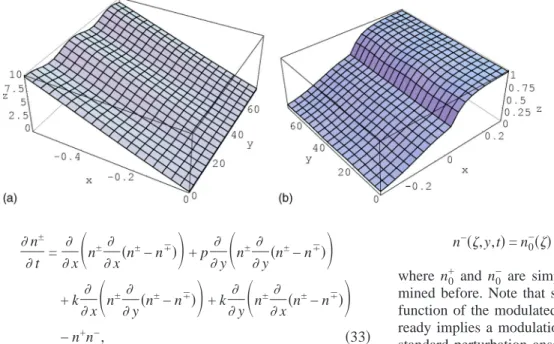
⬎0; see Fig. 1[33].
Because n0−共0兲⫽0, the prefactor of the highest derivative in the n− equation does not vanish at = 0, and hence one might naively think that n−is nonsingular at this point. How-ever, because of the coupling through the diffusion terms, this is not so. By integrating Eq.(10)over an interval cen-tered around= 0 and using that the field values n0+ and n0− are continuous, one immediately obtains that
lim
⌬→0
冏
冉
dn0+
d − dn0−
d
冊
冏
−⌬⌬
= 0. 共15兲
Before we analyze the nature of the singularity in more detail, we note that because of the nonanalytic behavior at
= 0, it is necessary to analyze the region ⬍0 where n0+ ⫽0 separately from the one at ⬎0 where n0+= 0. In the latter regions, the equations simplify enormously, as the re-maining terms in Eq. (10) can be integrated immediately. Upon imposing the boundary conditions(11)at infinity, this yields
dn0−
d = −v
共n0−− n⬁兲
n0− , ⬎0. 共16兲
Let us now analyze the nature of the singularity at= 0. As the effective diffusion coefficient of the n+ equation is linear in n+, analogous situations in the porous medium equa-tion suggest that the field n+vanishes linearly. This motivates
us to write for −1Ⰶ⬍0 [34]
n0+共兲= A1++ A2+2+ ¯,
n0−共兲= A1−+ A2−2+ ¯ + nan−共兲, 共17兲 where nan−共兲 is the analytic function which obeys Eq. (16) for all. Clearly, the continuity condition (15)immediately implies
A1+= A1−. 共18兲 If we now substitute the expansion(17) with Eq. (18)into Eq.(9)for n0+we get by comparing terms of the same order
A1+共v− nan−
⬘兲
= 0, O共1兲,4共A2+− A2−兲− 2nan−
⬙
− nan− = 0, O共兲. 共19兲 Here nan−⬘
= dnan−/ d兩=0, etc. Likewise, if we substitute theex-pansion into Eq.(10)for n0−, we get
2vA1−− 2nan−共A2+− A2−兲= 0, O共1兲 共20兲 since the term of order unity involving nan− cancels in view of Eq.(16). Higher-order terms in the expansion determine the
coefficients A2+ and A2−, and other terms like A3± separately, but are not needed here. Together with Eq. (16), the above equations(19)and(20)immediately yield
nan −
⬘
=v,
nan−共0兲= 1/2,
A1+= A1−= −v+ 1
16v, 共21兲
where for convenience we have now put n⬁= 1.
There are two curious features to note about the above result. First of all, n0+always vanishes at the point where n0−is half of the asymptotic value n⬁at infinity. Secondly, note that
A1+is negative forv艌1 / 4 and positive forv⬍1 / 4. Since the vortex density n+ has to be positive, we see that these uni-formly translating front solutions can only be physically rel-evant forv艌1 / 4.
Since the front velocity in this problem is not dynamically selected but imposed by the ramping rate R =v2at the
bound-ary, we do expect physically realistic solutions withv⬍1 / 4 to exist. In fact, it does turn out that in this regime the nature of the singularity changes: instead of vanishing linearly, n0+ vanishes with a v-dependent exponent. Indeed, if we write for −1Ⰶ⬍0[34]
n0+共兲=兩兩␣共A1++ A2++ ¯兲. 共22兲
n0−共兲=兩兩␣共A1−+ A2++ ¯兲+ nan−共兲, 共23兲 and substitute this into the equations, then, in analogy with the result above, we find
nan−
⬘
=v,nan−共0兲= 1/2,
A1+= A1−,
␣= 1
8v2− 1⬎1 共v⬍1/4兲, 共24兲
while again for⬎0, n0+vanishes. A singular behavior with exponent depending on the front velocityvis actually quite surprising for such an equation [30]. However, one should keep in mind that this behavior is intimately connected with the initial condition for the n− vortices. If one starts with a
case where n−does not approach a constant asymptotic limit on the far right, but instead increases indefinitely, one will obtain solutions where n+vanishes linearly. For this reason,
and in order not to overburden the analysis with mathemati-cal technimathemati-calities, from here on we will concentrate the analysis on the regimev艌1 / 4.
Since our study will limit the stability analysis to fronts with velocity v艌1 / 4 in our dimensionless variables, let us check how the scale that we consider relates with the realistic values of flux flow velocities. By considering relations (8), the velocities are measured in units of
v0=
l0n⬁
= c
冑
H⬁
Hc2
冑
nn⬁v0
4 ⬇c
冑
0 2
a2
冑
nv0
4a2,
共25兲 where we have expressed the viscosity in terms of the upper critical field Hc2and the normal state resistivitynby using [31]. Furthermore, a is the distance between vortices for →⬁; thus, since H⬁=0n⬁⬇0/ a2, it follows that
H⬁/ Hc2⬇0
2/ a2. For the constant we have used the
esti-mate −1=v
0 discussed after Eq. (3). We can then rewrite
Eq.(25)as
v⬇c2 0
3
4a4n. 共26兲
By considering typical values in Gaussian unitsn⬇10−16s
for the resistivity of the material, a coherence length0⬇2
⫻10−7 cm for high-Tc compounds, and a magnetic field
H⬁⬇20 G (which corresponds to a length a⬇10−4cm), our
velocity is then measured in units ofv⬇1 cm/ s. This veloc-ity scale is much less than values found typically in the flux flow regime, since in the presence of instabilities, fronts of vortices can propagate with much higher velocities of order 104− 106 cm/ s [5]. Thus, the regime v艌1 / 4 is indeed the
physical relevant one.
C. Sum and difference variables
At first glance, the equations look like two coupled second-order equations. However, there is more underlying structure due to the fact that the annihilation term does not effect the difference n+− n−. In order to integrate the set of equations (9) and(10), it is convenient to consider the fol-lowing transformations in the variables related to the sum and difference of the density fields:
D = n+− n−,
S = n++ n−. 共27兲
In these variables, the equations become
−vdD0
d = d dS0
dD0
d , 共28兲
−vdS0
d = d
dD0 dD0
d − S02− D02
2 . 共29兲
By numerically integrating Eqs.(28) and (29) and looking for the solutions which satisfy the boundary conditions above, we obtained the uniformly translating front solutions. As Fig. 1 illustrates for v= 1, the profile is singular at the point where the density of the n+ field vanishes linearly, in
agreement with the earlier analysis.
Because of this singularity, the numerical integration of the set(28)and(29)is quite nontrivial. In particular, because of the discontinuity in the derivative of the n+field, the
sys-tem(28)and(29)effectively needs to be solved only in the interval关−L , 0关, as the matching to the behavior for⬎0 has already been translated into the boundary conditions (21).
The first equation can be straightforwardly integrated, and by combining it with the second, the set reduces to
dD0
d =
−v共D0+ n⬁兲
S0
,
dS0
d =
S0关v共2D0+ n⬁兲兴dD0
d +共S0
4− S 0 2D
0 2兲/2
vS02+关v共D02+ n⬁D0兲兴
. 共30兲
One can easily verify that in this formulation, the expression on the right-hand side is indefinite at the singular point = 0, as both the terms in the numerator and denominator vanish. In order to evaluate the expression, it is then neces-sary to perform an expansion of the numerator and denomi-nator around the critical point values S = −D = n⬁/ 2. From such an analysis one can then recover the relations (21) which we previously obtained from a straightforward expan-sion of the original equations. Numerically, we integrate the equations by starting slightly away from the singular point with the help of the results from the analytic expansion.
III. FRONT PROPAGATION IN THE PRESENCE OF ANISOTROPY
A. Dynamical equations
As mentioned before, we are interested in the effect that an anisotropy in the vortex mobility could have on the sta-bility of the front. In particular, the motivation for such an investigation is the experimental evidence that an instability for a flux-antiflux front was found in materials with an in-plane ab anisotropy, such as, for example, YBa2Cu3O7−␦
[12].
In a material characterized by an in-plane anisotropy, the effective viscous drag coefficient depends on the direction of propagation of the front. More precisely, the mobility defined in Eq.(4)then becomes a nondiagonal tensor. This leads to a nonzero component of the velocity v perpendicular to the driving Lorentz force. We want to investigate whether the noncollinearity between the velocity and the force is respon-sible for an instability of the flux-antiflux interface. In the presence of anisotropy, the phenomenological formula (4) then has to be replaced by
v =ˆ−1F =⌫R−1
冉
1 00 ␣
冊
RF, 共31兲where ⌫ is a constant, ␣ represents the anisotropy coeffi-cient, and R is the rotation matrix corresponding to an angle
between the direction of propagation of the front x and the principal axes x
⬘
of the sample. The coefficient ␣ varies in the range [0,1] with the limiting case of infinite anisotropy corresponding to␣→0. For␣= 1, the isotropic case is recov-ered. The matrixˆ−1is given in particular byˆ−1=⌫
冉
cos2+␣sin2 cos sin共1 −␣兲
n±
t =
x
冉
n±
x共n
±− n⫿兲
冊
+ py
冉
n±
y共n
±− n⫿兲
冊
+ k x
冉
n±
y共n
±− n⫿兲
冊
+ k y
冉
n±
x共n
±− n⫿兲
冊
− n+n−, 共33兲
where the length and time variables have been rescaled and the elements k and p depend on the angle through the formulas
k =cossin共1 −␣兲
cos2+␣sin2 , p =
␣cos2+ sin2
cos2+␣sin2. 共34兲 Starting from an initially planar profile derived in Sec. II A, we want to study the linear stability of the front of vortices and antivortices by performing an explicit linear stability analysis on Eq.(33).
B. The linear stability analysis
As we have already mentioned in earlier sections, our linear stability analysis differs from the standard one, due to the presence of a singularity. The type of perturbation that we want to consider should not only involve the profile in the region where n+ vanishes, but should also in particular
in-volve the geometry of the front. In other words, as Fig. 2 illustrates, we want to perturb also the location of the singu-lar line at which the density n+ vanishes. As discussed in
more detail in[29], the proper way to implement this idea is to introduce a modulated variable
共,y,t兲=+⑀eiqy+t+i⍀t 共35兲 and then to write the densities in terms of this “comoving” modulated variable. Of course, the proper coordinate is the real variable Re. However, when we expand the functions in Fourier modes and linearize the dynamical equations in the amplitude, each Fourier mode can be treated separately. Thus, we can focus on the single mode with wave number q and amplitude⑀and then take the real part at the end of the calculation. The profiles of the fields n+ and n− are now perturbed by writing
n+共,y,t兲= n0+共兲+⑀共n+1+ in2+兲共兲eiqy+t+i⍀t, 共36兲
n−共,y,t兲= n 0
−共兲+⑀共n 1 −+ in
2
−兲共兲eiqy+t+i⍀t, 共37兲
where n0+ and n0− are simply the planar front profiles deter-mined before. Note that since we write these solutions as a function of the modulated variable, even the first term al-ready implies a modulation of the singular line. Indeed, the standard perturbation ansatz would fail for our problem be-cause of the singular behavior of the front. The usual ansatz of a stability calculation
n+共,y,t兲= n0+共兲+⑀共n1++ in2+兲共兲eiqy+t+i⍀t 共38兲 only works if the unperturbed profiles are smooth enough and not vanishing in a semi-infinite region. If we impose on our corrected linear stability analysis the conditions
n1++ in2+
n0+ bounded and
n1−+ in2−
n0− bounded, 共39兲
then as→0 the perturbations can be considered small ev-erywhere, plus we allow for a modulation of the singular line [29].
We next linearize Eq.(33)around the uniformly translat-ing solution accordtranslat-ing to Eqs.(36)and(37). We obtain a set of four linearized ODEs for the variables D1, D2, S1, S2, which correspond, respectively, to the real and imaginary parts of the difference and sum variables introduced in Eq. (27). These equations, which are reported in the Appendix, depend also on the unperturbed profiles D0, S0, which are known from the derivation in Sec. II A. Moreover, there is an explicit dependence on the parameters q ,,⍀.
In order to analyze the stability of the front of vortices and antivortices, the dispersion relation共q兲,⍀共q兲 must be derived. This can be determined with a shooting method: for every wave number q there is a unique value of the growth rateand frequency ⍀which satisfies the boundary condi-tions related to the perturbed front. If the growth rate is posi-tive, a small perturbation will grow in time, thus leading to an instability.
C. The shooting method
The singularity of the front makes the numerical integra-tion difficult to handle, as in the case of the planar front. In view of the relations(39), the boundary conditions
n1+= 0, n2+= 0, 共40兲 have to be imposed for= 0. These yield the boundary con-ditions for the variables D1, S1, D2, S2,
S1= − D1, S2= − D2. 共41兲 Moreover, by substituting these boundary conditions and the relations (21) for the unperturbed fields in the linearized equations for D1, D2, S1, S2, the following relations can be
derived forvanishing from the left[35]:
冏
dD1d
冏
0−=+ qkD2共0兲, 共42兲
冏
dD2d
冏
0−=⍀− qkD1共0兲− 2qk
冏
dD0
d
冏
0−. 共43兲
An explicit expression for the derivative of the sum of the real and imaginary part of the perturbations S1, S2can also be derived from the equations reported in the Appendix. In par-ticular, these have the following generic form:
dS1共兲
d = N1共兲
D1共兲
, dS2
d = N2共兲
D2共兲
, 共44兲
which is similar in structure to Eqs. (30): N1,D1,N2,D2
depend onthrough the set of functions
冉
D0,S0,dD0d , dS0
d,D1,S1, dD1
d ,D2,S2, dD2
d
冊
,and on the parameters q ,,⍀.
Equations(44) are not defined at the singular point. By substituting the boundary conditions given by Eqs. (41)–(43), both the numeratorsN1,N2and the denominators
D1,D2 vanish. Again, as with Eq. (30), we encounter the
problem of dealing with the singularity at = 0. This diffi-culty can be overcome in the same way as in Sec. II B for the derivation of the planar front profile. In particular, we cannot start the integration at the singular point, but we have to start the backwards integration at some small distance on the left of = 0. We do so by first obtaining the derivatives of the fields S1 and S2 analytically through the expansion of Eqs.
(44)around the critical point. In the limit→0, this yields the following self-consistency condition for the derivatives:
冏
dS1d
冏
0−=兩N1
⬘兩
0−
兩D1
⬘兩
0−,
冏
dS2d
冏
0−=兩N2
⬘兩
0−
兩D2
⬘兩
0−, 共45兲
where N1
⬘
,N2⬘
,D1⬘
,D2⬘
denote the derivatives of the corre-sponding functions evaluated at the singular point. Once these are solved and used in the numerics, the integration can be carried out smoothly.Because of the singularity at the point= 0, the derivative of the perturbed fields is not continuous there and a relation-ship for the discontinuity in the derivatives can be derived, as was the case for the unperturbed fields. In particular, the expression (15) is generalized for the perturbed field. This implies that the derivative of the total magnetic field is again continuous even at the singularity.
From the equations for the perturbed fields given in the Appendix, the boundary conditions at= −L can be derived. Just like the unperturbed field for the antivortex density van-ishes on the left with a Gaussian behavior according to Eq. (13), also the perturbations n1− and n2− vanish as a Gaussian, i.e., faster than an exponential.
Moreover, since the density of vortices increases linearly asymptotically, we can retain in the equations only terms which are proportional to the density of vortices n0+. From this we get the following equation for the density of the perturbation␦n+= n
1 ++ in
2
+forⰆ−1:
d2␦n+ d2 + 2iqk
d␦n+ d − pq
2␦n+= pq2dn0 +
d . 共46兲
The solutions of this equation which do not diverge are of the form
␦n+= −dn0
+
d + Ce
, = iqk +
冑
关q2共p − k2兲兴, 共47兲where C is an arbitrary constant and k and p represent the coefficients of anisotropy defined in Eq.(34). Thus, the per-turbations decay on the left of the film with a decay length
0, such that
1
0
= q
冑
p − k2. 共48兲 Note that the decay length becomes very large for smallq—this type of behavior is of course found generically in
diffusion limited growth models. Technically, it means that we need to be careful to take large enough systems to study the small-q behavior. From the numerical integration, it was verified that Eqs.(47)and(48)describe correctly the behav-ior of␦n+at large distance.
Furthermore, since vortices are absent in the positive re-gion, we have to impose that the density of the perturbation related to the n+ field, and its derivative in space, have to
vanish there. Similarly, we get a second ODE with constant coefficients by considering that the density of antivortices is constant at large positive distances. Taking again n⬁−= 1, we get, forⰇ1,
d2␦n−
d2 +共v+ 2iqk兲 d␦n−
d −共pq
2++ i⍀兲␦n−= 0. 共49兲
In order to satisfy the boundary condition, we must consider the solution which vanishes exponentially. The solution of this equation which does not diverge is of the form
␦n−= C1e¯, Re共¯兲⬍0. 共50兲 We applied the shooting method in a four-dimensional space defined by the free parameters D1共0兲, D2共0兲,, and ⍀, by
integrating backward in the interval关−L , 0兴and then in关0 , +⬁关, looking for solutions of the type (47)and(50).
By matching the solutions to the boundary conditions
lim
→−L
n1+= −dn0
+
d, lim→−L
lim
→+⬁
n1−= 0, lim
→+⬁
n2−= 0, 共51兲
we then obtain a unique dispersion relation for the real part of the growth rate共q兲.
D. Results
Figure 3 represents the dispersion relation for an angle
=/ 4 and different coefficients of anisotropy␣. The front is always stable, even in the presence of very strong aniso-tropy, for very low values of␣. As the anisotropic coefficient
␣ is lowered from above, for fixed wave number q, the growth rate 共q兲 increases, but it is always negative. For small q, a quadratic behavior of共q兲is found,
⬇cq2, qⰆ1, 共52兲
where the(negative)coefficient c depends on the anisotropy of the sample. In Fig. 4, we have plotted the frequency⍀as a function of the wave number q. One observes from Eq. (35)that⍀/ q is the velocity with which the perturbation of
the front shifts along the direction transverse to the propaga-tion direcpropaga-tion. The behavior of⍀共q兲 is linear for low wave number q and is proportional to the nondiagonal element of the mobility tensor k,
⍀共q兲⬀kq, qⰆ1. 共53兲
For an anisotropy coefficient equal to 1, the isotropic case is recovered and then ⍀共q兲 vanishes identically for all wave numbers.
As we have already mentioned, the equations that we have used are valid at scales larger than the cutoff repre-sented by the London penetration depth. Anyway, since our results clearly show a stability in the large-q behavior, our model provides a good description for the dynamics of the front.
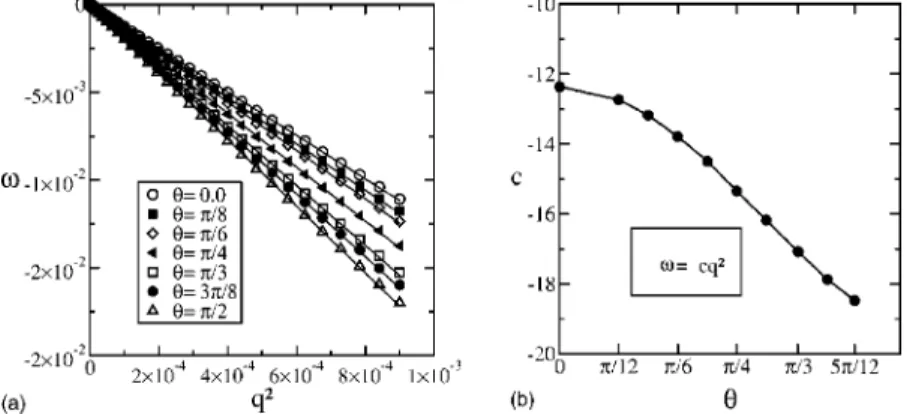
In Fig. 5, we plot the growth rateas a function of q2for different values of the angle. Linear regression then gives a slope corresponding to the constant c in Eq.(52), which is half the second derivative of the growth ratewith respect to the wave number at q = 0. The dependence of c as a func-tion of the angleis shown in the lower plot. As the angle increases, the front becomes more and more stable. This be-havior can be understood directly from the form of the equa-tions. By applying the transformation
FIG. 3. Dispersion relation共q兲 for different values of aniso-tropy coefficient␣and a velocityv= 1.0.
FIG. 4. Imaginary part of the growth rate⍀共q兲 for different values of the anisotropy coefficient␣, with velocityv= 1.0.
→
2 −, 0⬍⬍/4, 共54兲 the elements of the mobility tensor transform into
p→1 p, k→
k
p. 共55兲
By considering the quadratic relation of共q兲for small q and the fact that the equations are invariant under the transforma-tions q˜ = pq and(55), it is easy to derive
共q兲兩= p2共q兲兩/2−, 0⬍p⬍1, 共56兲
which proves that the dispersion relation becomes more negative as increases. When the direction of propagation is that of the fast growth direction, the isotropic case is recovered.
In Fig. 6, we show the dependence of the coefficient c as a function of the velocity of the front. The front is stable for velocities for which n0+ vanishes linearly共v艌1 / 4兲. Further-more, the front becomes more stable with increasingv. As one can easily understand from the form of the unperturbed front, the vortex density profile becomes steeper with in-creasing the velocity. The v→⬁ limit corresponds to the case of a front of vortices propagating in the absence of antivortices. Thus, the results confirm the stability of the front without an opposing flux of antivortices.
IV. STATIONARY FRONT
As we mentioned in the Introduction, we have also ana-lyzed the case of a stationary front, withv= 0. In this case, it is easy to derive the unperturbed profiles for the densities of vortices and antivortices, since they are continuous and do not present any singularities. This case was previously stud-ied in [17] and treated in terms of a sharp interface limit. Equations(9)and(10)in this case simplify to
d
dn0
+d
d共n0
+
− n0−兲− n0+n0−= 0, 共57兲
d
dn0
−d
d共n0
−− n 0 +兲− n
0 +n
0
−= 0. 共58兲
The profiles of vortices and antivortices are symmetric in this case, and outside the interfacial zone the density fields can be easily derived analytically. By neglecting the annihilation term, the profiles of vortices and antivortices have a depen-dence on the coordinateof the type
n0±=
冑
N2⫿2C共±1兲, 共59兲 where兴−1,1关 denotes the region where vortices and anti-vortices overlap, N is the density at 共±1兲, and C is a con-stant. The density of vortices and antivortices decays with a Gaussian tail, as can easily be calculated from Eqs.(57)and (58). For Eq. (57), by considering that n0+ assumes a Gaussian-like dependence, and from the form of Eq.(59), we get the following equation:−dn0
+
d dn0−
d = n0
+
n0−. 共60兲
This yields in a self-consistent way a Gaussian behavior for
n+,
n0+⬇Ae−2−共N2/C−21兲, 共61兲
where A is a constant. The density profiles for the vortices and antivortices are represented in Fig. 7. The stability of the front was studied by following a similar procedure as for the moving front. Because of the regular profiles, the ansatz(35) that we have applied for the case of a finite velocity is not required. Thus the linear stability analysis can be carried out in the standard way and the linearized equations for the per-turbation can easily be integrated. We do not explain here the procedure in detail, since it is a simplified version of the one discussed in the previous section.
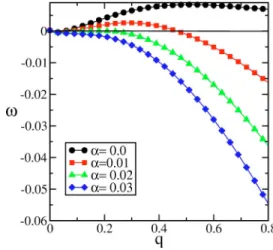
As Fig. 8 shows, an instability is found below a critical coefficient of anisotropy ␣c⬇0.02. These results confirm
previous approximate calculations[17], but, as we have al-FIG. 6. Velocity dependence of half the second derivative of
共q兲with respect to q evaluated at q = 0. As the velocity increases, the front becomes more and more stable.
ready underlined, this coefficient would correspond to an ex-tremely high in-plane anisotropy which is not found in any type of superconducting material. We conclude that this model of a stationary front in the presence of anisotropy is insufficient to explain the turbulent behavior that has been found experimentally at the flux-antiflux boundary.
V. CONCLUSIONS
From our analysis, it follows that the planar front of vor-tices moving with a sufficiently large velocityvin a super-conducting thin film is stable even in the presence of strong in-plane anisotropy. For stationary fronts, on the other hand, our stability analysis confirms the earlier approximate analy-sis of[17], confirming that such fronts show an instability to a modulated state in the limit of very strong anisotropy. From an experimental point of view, the critical anisotropy of this instability is very high when compared with real values that can be found for materials with both tetragonal and ortho-rhombic structure [20,21], even when a nonlinear current-electric field characteristic is considered [18]. From a theo-retical point of view, the behavior in the limit of small but finitev is still open as we have not investigated the range 0⬍v⬍1 / 4 where the profiles have a noninteger power-law singularity. It could be that the instability gradually becomes suppressed asvincreases from zero, or it could be that the limitv→0 is singular, and that moving fronts are stable for any nonzerov. Only further study can answer this question. Our calculations differ markedly from previous work in that we focus on moving fronts from the start, where our results follow from a straightforward application of linear stability analysis to our model. Taken together, these results lead to the conclusion that a model which includes a realistic in-plane anisotropy, but which neglects the coupling with the temperature, cannot explain the formation of an instability at a vortex-antivortex boundary for sufficiently large front ve-locities. At the same time, our calculations show that the issue of the stability of vortex fronts is surprisingly subtle and rich. For example, we note the fact that for any front
velocity, the value n0−at the singular line is exactly n⬁/ 2 for anyv. Is this simply a mathematical curiosity or is the ab-sence of instabilities related to this unexpected feature through the boundary conditions at infinity? Is the presence of a gradient in the antivortex distribution far ahead of the front perhaps necessary to generate a long-wavelength front instability? These are all still open issues, so clearly it is difficult to make general statements about the(transient) sta-bility of such fronts in less idealized situations.
One possible interpretation of the results is that when one has a finite slab into which vortices penetrate from one side, and antivortices from the other side, a stationary modulated front (anihilation zone) forms in the middle for extremely large anisotropies. However, a moving front never has a true Mullins-Sekerka-type instability, since a protrusion of the front into the region of antivortices is always damped as a result of the increased annihilation.
The fact that the turbulent behavior at the interface be-tween vortices of opposite sign was found in a temperature window[12]shows that the coupling with the local tempera-ture in the sample has to be considered. It appears that it is necessary to include both the heat transport and dissipation in the model. Applying an appropriate stability analysis to such extended models is clearly an important issue for the future.
ACKNOWLEDGMENTS
We are grateful to Hans de Haan for performing time-dependent simulations of the one-dimensional vortex dynam-ics equations, which showed that we were initially mistaken about the nature of the induced singularities in the n−field. In
addition, we have profited from discussions with Peter Kes, Rinke Wijngaarden, and Gianni Blatter. C.B. is supported by the Dutch research foundation FOM, and would also like to thank the “Fondazione A. Della Riccia” and “Fondazione ing. A. Gini” for additional financial support. M.H. acknowl-edges financial support from The Royal Society.
APPENDIX A: LINEARIZED EQUATIONS FOR THE PERTURBED FRONT
From the linear stability analysis, we get the linearized equations for the variables D and S,
冉
D1+dD0
d
冊
−⍀D2+ pq2S 0
冉
D1+dD0
d
冊
= +v dD1d
+
冉
dS0d
冊冉
dD1d
冊
+冉
dD0d
冊冉
dS1d
冊
+ S0 d2D1d2 + S1 d2D0
d2
− qk
冋
2S0dD2
d + dS0
dD2+ dD0
d S2
册
, 共A1兲D2+⍀
冉
D1+dD0
d
冊
+ pq2S
0D2= +v
dD2
d +
冉
dS0d
冊冉
dD2d
冊
+
冉
dD0d
冊冉
dS2d
冊
+ S0 d2D2d2 + S2 d2D0
d2 + qk
冋
2S0冉
dD1d
+d
2D 0
d2
冊
+ dS0d
冉
D1+ dD0d
冊
+ dD0d
冉
S1+ dS0d
冊
册
, 共A2兲
冉
S1+dS0d
冊
−⍀S2+ pq2D 0
冉
D1+dD0
d
冊
= +v dS1d
+ 2
冉
dD0d
冊冉
dD1d
冊
+ D0 d2D1d2 + D1 d2D0
d2 − qk
冋
2D0 dD2d
+ 2dD0
d D2
册
− S0S1+ D0D1, 共A3兲S2+⍀
冉
S1+dS0d
冊
+ pq2D
0D2= +v
dS2
d + 2
冉
dD0d
冊冉
dD2d
冊
+ D0
d2D2
d2 + D2 d2D0
d2 + qk
冋
2D0冉
dD1d + d2D0
d2
冊
+ 2dD0
d
冉
D1+ dD0d
冊
册
− S0S2+ D0D2. 共A4兲[1]G. Blatter, M. V. Feigel’man, V. B. Geshkenbein, A. I. Larkin, and V. M. Vinokur, Rev. Mod. Phys. 66, 1125(1994). [2]G. Blatter and V. B. Geshkenbein, Vortex Matter, in The
Phys-ics of Superconductors, Vol. 1, edited by K. H. Bennemann and K. Emerson(Springer, Berlin, 2003), pp. 726–936.
[3]C. A. Duran, P. L. Gammel, R. E. Miller, and D. J. Bishop, Phys. Rev. B 52, 75(1995).
[4]T. H. Johansen, M. Baziljevich, D. V. Shantsev, P. E. Goa, Y. M. Galperin, W. N. Kang, H. J. Kim, E. M. Choi, M.-S. Kim, and S. I. Lee, Europhys. Lett. 59, 599(2002).
[5]F. L. Barkov, D. V. Shantsev, T. H. Johansen, P. E. Goa, W. N. Kang, H. J. Kim, E. M. Choi, and S. I. Lee, Phys. Rev. B 67, 064513(2003).
[6]M. Marchevsky, L. A. Gurevich, P. H. Kes, and J. Aarts, Phys. Rev. Lett. 75, 2400(1995).
[7]P. Leiderer, J. Boneberg, P. Brüll, V. Bujok, and S. Herming-haus, Phys. Rev. Lett. 71, 2646(1993).
[8]R. Surdeanu, R. J. Wijngaarden, E. Visser, J. M. Huijbregtse, J. Rector, B. Dam, and R. Griessen, Phys. Rev. Lett. 83, 2054 (1999).
[9]W. W. Mullins and R. F. Sekerka, J. Appl. Phys. 34, 323 (1963).
[10]T. Frello, M. Baziljevich, T. H. Johansen, N. H. Andersen, Th. Wolf, and M. R. Koblischka, Phys. Rev. B 59, R6639(1999). [11]M. V. Indebom, H. Kronmüller, P. Kes, and A. A. Menovsky,
Physica C 209, 259(1993).
[12]M. R. Koblischka, T. H. Johansen, M. Baziljevich, H. Hauglin, H. Bratsberg, and B. Y. Shapiro, Europhys. Lett. 41, 419 (1998).
[13]V. K. Vlasko-Vlasov, V. I. Nikitenko, A. A. Polyanskii, G. V. Crabtree, U. Welp, and B. W. Veal, Physica C 222, 361 (1994).
[14]G. R. Mints and A. L. Rachmanov, Rev. Mod. Phys. 53, 551 (1981).
[15]I. Aranson, A. Gurevich, and V. Vinokur, Phys. Rev. Lett. 87, 067003(2001).
[16]F. Bass, B. Ya. Shapiro, and M. Shvartser, Phys. Rev. Lett. 80, 2441(1998).
[17]L. M. Fisher, P. E. Goa, M. Baziljevich, T. H. Johansen, A. L. Rakhmanov, and V. A. Yampol’skii, Phys. Rev. Lett. 87, 247005(2001).
[18]A. L. Rakhmanov, L. M. Fisher, A. A. Levchenko, V. A. Yampol’skii, M. Baziljevich, and T. H. Johansen, JETP Lett.
76, 291(2002).
[19]G. J. Dolan, F. Holtzberg, C. Feild, and T. R. Dinger, Phys. Rev. Lett. 62, 2184(1989).
[20]K. Zhang, D. A. Bonn, S. Kamal, R. Liang, D. J. Baar, W. N.
Hardy, D. Basov, and T. Timusk, Phys. Rev. Lett. 73, 2484 (1994).
[21]C. A. Murray, P. L. Gammel, D. J. Bishop, D. B. Mitzi, and A. Kapitulnik, Phys. Rev. Lett. 64, 2312(1990).
[22]P. G. Drazin and W. H. Reid, Hydrodynamic Stability( Cam-bridge University Press, CamCam-bridge, 1981).
[23]C. P. Bean, Rev. Mod. Phys. 36, 31(1964).
[24]J. Bear, Dynamics of Fluids in Porous Media(Elsevier, New York, 1972).
[25]L. A. Peletier, in Application of Nonlinear Analysis in the Physical Sciences, edited by H. Amman, N. Bazley, and K. Kirchgaessner(Pitman, London, 1981).
[26]The similarity between the nonlinear diffusion equation of vor-tices and the porous medium equation was pointed out in par-ticular by J. Gilchrist and C. J. van den Beek, Physica C 231, 147(1994).
[27]V. M. Vinokur, M. V. Feigel’man, and V. B. Geshkenbein, Phys. Rev. Lett. 67, 915(1991); H. G. Schnack and R. Gries-sen, ibid. 68, 2706(1992); V. M. Vinokur and V. B. Geshken-bein, ibid. 68, 2707(1992).
[28]I. Golding, Y. Kozlovsky, I. Cohen, and E. Ben-Jacob, Physica A 260, 510(1998).
[29]J. Müller and W. van Saarloos, Phys. Rev. E 65, 061111 (2002).
[30]In the nomenclature of G. I. Barenblatt, Similarity, Self-Similarity and Intermediate Asymptotics(Consultants Bureau, New York, 1979), this corresponds to a transition from self-similarity of the first kind to self-self-similarity of the second kind as a function of the front velocity.
[31]We assume for the viscosity the Bardeen-Stephen relation =0Hc2/nc2, with
nresistivity of the material in the
nor-mal state. J. Bardeen and M. J. Stephen, Phys. Rev. 140, A1197(1965).
[32]C. M. Bender and S. A. Orzsag, Advanced Mathematical Methods for Scientists and Engineers (McGraw-Hill, New York, 1978).
[33]In mathematical terms, the field n+has compact support. [34]To simplify the presentation, we have included only the terms
we need for our discussion. One can generalize the analysis by including regular terms with integer exponents, but the analy-sis then shows that these terms have to be absent if ␣ is a noninteger.