“THE IDEA OF PEOPLE LISTENING MAKES ME HAPPY”: BUILDING COMMUNITY THROUGH EXPERIMENTATION AT WXDU
Jaycie N. Vos
A thesis submitted to the faculty at the University of North Carolina at Chapel Hill in partial fulfillment of the requirements for the degree of Master of Arts in the Department of American
Studies (Folklore).
Chapel Hill 2018
ABSTRACT
Jaycie Vos: “The Idea of People Listening Makes Me Happy”: Building Community Through Experimentation at WXDU
(Under the direction of Gabrielle Berlinger)
WXDU, the college and community radio station at Duke University in Durham, North Carolina, is built on an ethos of experimentation that creates community and a sense of belonging among its DJs. Rooted in the disciplines of folklore, oral history, music, and radio studies, this thesis explores the ways in which DJs build community through the acts of discovering new music, curating radio shows, sharing music on air, and making connections with others on campus and in the community. Each of these acts is an exploration and affirmation of WXDU’s values of experimentation, learning, nonconformity, and access to alternative music. This thesis considers the impact on individuals who participate in a
ACKNOWLEDGEMENTS
To my excellent advisor, Gabrielle Berlinger, and committee members, Bill Ferris and Glenn Hinson, for their wisdom, encouragement, and gentle pushing to help me think carefully about this project.
Many thanks to Zoe van Buren and Virginia Ferris, who selflessly served as a sounding board and offered advice and reassurance with their typical thoughtfulness and warmth.
TABLE OF CONTENTS
LIST OF FIGURES ………viii
PROLOGUE………1
INTRODUCTION……….5
Disciplinary Approach……….…8
Roadmap………11
CHAPTER 1: DISCOVERY………13
Reviews………..15
Playlist……….17
Physical Space………19
CHAPTER 2: CURATION……….27
CHAPTER 3: SHARING……….33
CHAPTER 4: MAKING CONNECTIONS ……….42
CONCLUSION………55
APPENDIX 1: BIBLIOGRAPHIC ESSAY………58
Folklore………..58
Oral History……….60
Music………62
Radio Studies……….64
LIST OF FIGURES
Figure 1. The entrance in Bivins Building………...1
Figure 2. Filing cabinets..……….………22
Figure 3. Posters and stickers adorn walls..……….……….23
Figure 4. The music library...……….………24
Figure 5. A stack of playlist CDs……….……….27
Figure 6. Crates of newly arrived music…....……….……….70
Figure 7. The music director’s desk…....……….………..71
Figure 8. A cupboard in the entryway…....……….……….72
Figure 9. The music director’s cubbie….…....……….………73
Figure 10. The music library is crammed….…....……….……….74
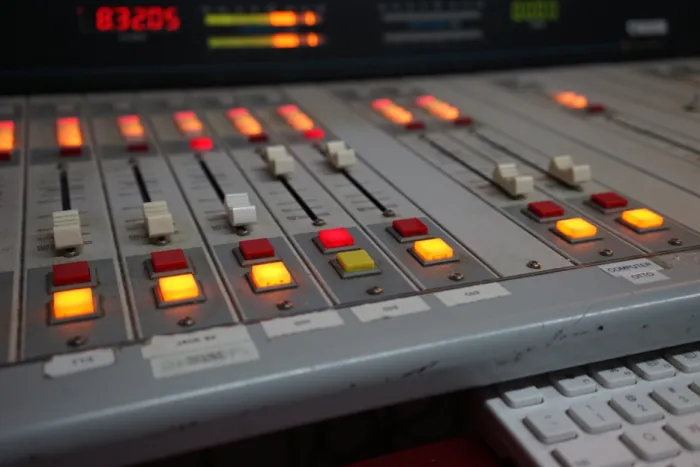
Figure 11. The board in the control room..….…....……….………75
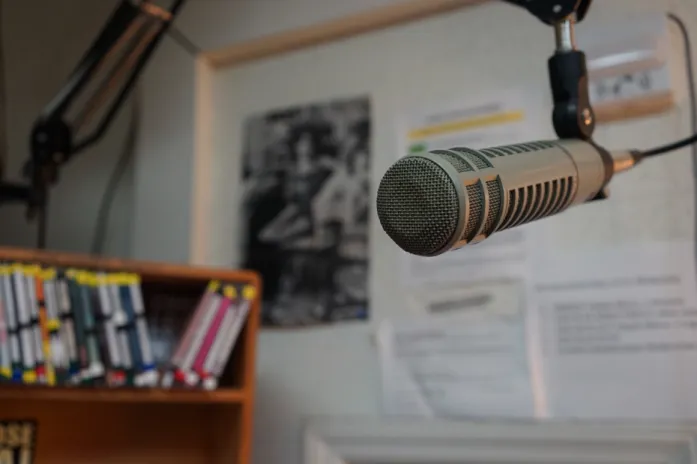
Figure 12. The microphone in the control room...……….………..76
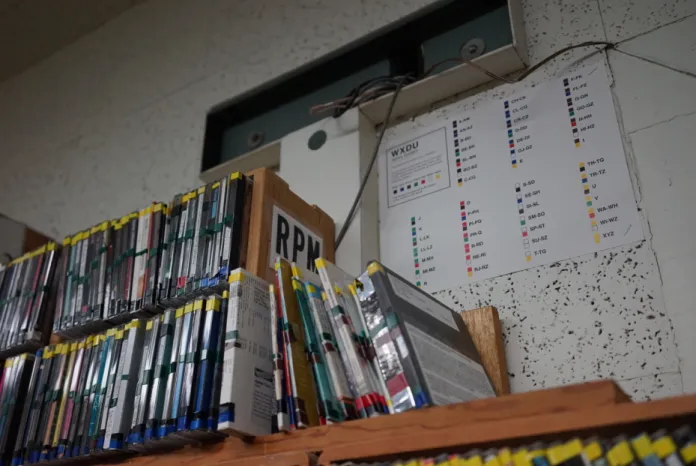
Figure 13. The music library, organized by genre…....……….…………77
Figure 14. All albums are carefully labeled…....……….……….78
Figure 15. The sign illuminates……….…....……….…………79
Figure 16. The external door………...……….…………80
PROLOGUE
I had never set foot on Duke University’s east campus before the warm, summer evening of Wednesday, May 18, 2016. After a month or two of emailing with the training director, I walked up Brodie Gym Drive to the Bivins Building, a red brick, two story structure with a blue neon sign in one window and whose door was plastered with tape and brightly colored fliers of all sizes advertising past and upcoming shows at local music venues, plus the odd dog-walking gig and graduate student group information.
The door was locked, and I awkwardly waited on the stoop for a minute after ringing the doorbell until a man with a head of dark brown hair and a beard, glasses, and a trucker cap with a patch pinned on the front opened it, beckoning me inside in a deep, growly voice. I walked through the entryway and past the stairs, noticing stickers and posters covering the walls and doorways, into what I learned was the station lounge, where two large windows with crooked, dusty blinds let some light pour in on a radiator, two large tan couches, a couple of coffee tables covered in CDs and a tray full of different colored tape and scissors, a large desk with audio equipment and a computer, and an ancient, giant red Coke machine. I made myself comfortable on the couch and waited for others to join the official summer 2016 WXDU training meeting about to begin.
The meeting itself was a blur. I remember that about six people showed up and we took turns introducing ourselves before Kelly – the man with the deep voice and beard – launched into the station’s mission, policies, and procedures. But the details of that memory do not matter so much; the important thing was that by 7:30 pm that evening, a plan had been set in motion for me to learn to be a DJ at WXDU, 88.7 FM, the Duke University and community radio station in Durham, North Carolina.
By January 2017, I had seven months of DJing experience and a growing sense of
friends and family because it was such a great source of joy. A few friendships had started to blossom with DJs I saw regularly. I had just started to review new albums to add to playlist, and I had a growing hope to get more involved or somehow add something to the WXDU
community.1 I enrolled in Glenn Hinson’s “Art of Ethnography” course for the spring 2017 semester, and as all of the assignments for the course revolved around fieldwork with one particular group, I immediately wanted to focus on WXDU as a community to learn more about the context of group expression and meaning-making.
My interest in this project quickly turned into something I wanted to explore on scales bigger than were possible for “Art of Ethnography.” As such, this thesis examines the questions and ideas from that early work that I felt deserved more time, space, and energy to consider. My thesis is built primarily on the four months of fieldwork I conducted at WXDU between January and April of 2017, including extensive notes of my observations and reflections on my participation at weekly committee meetings, weekly music staff meetings, my weekly Sunday night radio show, and special events such as the Brickside music festival. During this time, I conducted 11 ethnographic interviews with student and community-member DJs about their experiences as a DJ and, when appropriate, as official committee members at WXDU. On
several different occasions, I photographed the now-former WXDU station at the Bivins Building in its last year, before the station moved to the new Duke Arts building. Memories and
reflections of my earlier seven months of participation, from June to December 2016, also shape and inform my work.
1 I use the term “playlist” throughout this thesis without the article “the” preceding it, as is
I should note that at the time I started “Art of Ethnography,” I knew I would be moving across the country in a few months, and I was already saddened at the thought of leaving WXDU. This project, along with continuing to review albums from afar, has allowed me to stay connected to a space and a group of people that continues to positively shape my life. Given my role at the station and the relationships I built while there, I am particularly embedded and invested in the station community, its mission, and its success. Consequently, this thesis – rather than unfolding from the perspective of an objective outsider – reflects my subjective opinions and experiences with WXDU.
INTRODUCTION
other’s tastes in music, making his recommendations for me particularly spot on. Sure enough, once I was on air and had a sense of the next two or three songs I wanted to play, I previewed a little bit of the Hand Habits album and loved what I heard: dreamy guitars, hazy female vocals conveying emotion, a pretty melody surrounded by a lot of space. After hearing the first little bit of most of the tracks, I went with Brett’s recommended starting track from the review, “Nite Life,” and queued it up. I grinned when he came in. “I knew you’d like it.” I grinned even more.
What a gift to be part of a community where one of the primary activities is listening to new music each week, especially when the fellow DJs became friends who grew to understand my taste in music and could point me to just the right album. The thrill of playing something brand new never faded, and sharing that with Brett and whomever might have tuned in that week elevated my joy.
Guided by the simple question, “What does it mean to you to be a DJ at WXDU?,” and expanding out from there, this thesis explores the ways in which DJs build community and form individual and communal identity through the acts of discovering new music, curating radio shows, sharing music on air, and making connections with others on and off campus as a result of participating in radio.2 People typically join WXDU because they love music, but what they
often find is a surprising space for solace, freedom, self-acceptance, and belonging. In this thesis, I consider the impact on individuals who participate in a community that encourages and prioritizes experimentation in DJ performance, and I consider what this means for those who identify as outside of the norm. At WXDU, experimentation is a guiding principle of the DJing
2 While the term community sometimes refers to Durham, North Carolina, I more often use it to
process. Experimentation can mean discovering or playing music that is new or pushes
boundaries (e.g. music that defies harmonic, instrumentation, rhythmic, or other conventions); playing a set of tracks together that are somehow novel or unusual in their juxtaposition; or simply playing music in a genre or by artists with which an individual DJ is generally unfamiliar. There is no single definition for experimentation, but the key factor is that it somehow pushes beyond what is typically expected or familiar for both the DJs and the listening audience.
Unlike many other college radio stations, WXDU welcomes both student and community-member DJs, creating a vibrant cross-section of the Triangle’s music-loving
community.3 Stephen, a longtime community-member DJ, gives a fair description of the people involved at the station:
If you’re willing to get up at 2 am every Wednesday night for four months, one day a week, just to play music on a radio station that maybe 20 people are listening to, you’re either, something’s wrong with you, or you just really like it. And I think with most dedicated college DJs, it’s a little bit of both. It’s a weird sort of madness. (2017)
The WXDU community does change and shift over time as Duke undergraduates join, as others graduate and leave the station, and as community members come and go. At any given time, there are upwards of 70 DJs affiliated with the station. With this flux in mind, the WXDU community from summer 2016 to spring 2017 – the period during which I was most actively involved with the station – was approximately 75% white and about 60% male.4 There is a mix
of working and professional class community members, and undergraduate and graduate students from a range of wealthy and working class backgrounds. The age range spans from
3 The Triangle refers to the cities of Durham, Chapel Hill, and Raleigh, plus surrounding suburbs
and towns in North Carolina.
about 18 to about 50. The vast majority of my observations and interactions with WXDU DJs, in terms of those I interviewed and those with whom I interacted on a regular basis at the weekly meetings or before or after my weekly show, represent a small, self-selecting group of
particularly dedicated, involved student and community-member DJs who hold leadership positions or consistently choose to participate in the non-required station activities. There are many WXDU DJs that I have never met simply because they did not attend meetings. Thus, what my fieldwork represents likely skews toward the experiences of especially passionate and dedicated WXDU DJs.
Disciplinary Approach
This thesis is situated at the intersection of oral historical and folkloristic understandings of ethnographic fieldwork. I was originally trained in oral history research by Jacquelyn Dowd Hall, an historian specializing in labor history, southern history, women’s history, and oral history methodology and theory. This training provided me with the skills and knowledge necessary to conduct interviews in an historiographic context, with attention to both filling gaps in the historical or archival record, and exploring nuanced, personal experiences of past events and reflections on these lived experiences. Later, I learned the practice and theory of
ethnographic fieldwork in academic courses with folklorists Glenn Hinson and Gabrielle Berlinger. From this training, I understand ethnographic interviewing as centered more on the aesthetics and interpretation of creative expression in everyday life, within historical
frameworks. There are certainly similarities in both practices, such as the emphasis on personal expression of lived experience, the collaborative nature of intentionally co-creating an
knowledge with future generations. Differences lie largely in the scope of what is captured in or with an interview. As folklorist Timothy Lloyd notes, oral history is generally focused on
recollections of the past in audio form, while ethnographic fieldwork welcomes a broader conception of traditional cultural expression, which can include stories and jokes,
performances, demonstrations and explanations of folk beliefs and practices, among others (2012). Whereas oral historians seek to situate the individual experience into longer historical narratives, folklorists attempt to understand the style and context of these myriad expressions, and to record and document such performances through audio recordings and additional means such as photography, video recording, and collecting physical artifacts (Lloyd 2012). In my own practice of interviewing DJs, I drew upon both, seeking oral accounts of personal reflections on participation and meaning-making at WXDU. In some cases, as applicable, I asked questions of a more historical nature, seeking to gain an understanding of WXDU’s functions over time from community member DJs who have been involved for many years. I also took extensive field notes, photographed the station, and included many personal reflections in addition to the interviews in my attempt to better understand and document the overall functions and ethos of WXDU.5
While I drew upon both folklore and oral history models in my methodological
approach, I relied upon core folklore concepts in my theoretical analysis, specifically engaging the concept of performance as interpreted by folklorists Richard Bauman and Deborah A. Kapchan (Bauman 1977, Kapchan 2003). I use Bauman’s foundational text, Verbal Art as
Performance, to understand the significance that performance offers as an interpretative frame
to derive and make sociocultural meaning of an act or event. Kapchan echoes this, stating that performance is a “framed activit[y] concerned with giving meaning to experience,” and this is the definition that I use in my work with WXDU (2003, 136). Both scholars emphasize the necessity of exchange between performer and audience, and Kapchan especially emphasizes the agency in performance, which impacts how I interpret DJ actions beyond simply sharing music (Bauman 4, 11, 29-30; Kapchan 121, 136). Analyzing the acts of discovery, curation, sharing, and connecting as performance, I consider DJ activity to be a public claiming and proclaiming of an identity that embraces experimentation and people whose values, interests, and priorities exist outside of the mainstream, challenging the status quo. Here, the framed activities are the four stated DJ actions, particularly curation and sharing, as they overtly assert value between the DJ, as performer, and the listening audience. These activities are framed by the radio broadcast, where DJs speak and play music – interspersed with public service
announcements – on air and claim authority as a broadly-distributed voice, and where this all happens entirely within a sonic – rather than visual – landscape. They are also expressed within the context of Duke University’s social campus and larger music-listening communities
throughout the Triangle and across the globe. At WXDU, this alternative identity is largely centered on experimentation through music as a form of creative expression, which can extend to alternative, progressive ideas with aesthetic and political value. Particularly in curating and then broadcasting their shows, DJs take a very public stage where they seize control in their environment and use their own voice to assert their thoughts, preferences, values, and
encourage fellow outsiders to join and gain a sense of belonging, and it can promote change on campus and in the Durham community through the introduction and endorsement of new, different ideas. In these ways, participating at WXDU can be transformative, which Bauman asserts is a key power of performance (1977, 45). Ultimately, WXDU can be conceived of as a community using aural performance to publically and consciously claim and affirm an
alternative identity.6 Roadmap
WXDU’s formal mission is “to inform, educate, and entertain both the students of Duke University and the surrounding community of Durham through quality progressive alternative radio programming” (“Welcome to WXDU,” wxdu.org). The station primarily airs
noncommercial music – music that is released by means other than major labels and that is not popular in the mainstream – as well as educational programming. DJs take this mission very seriously, and there is a spirit of learning through experimentation and exploration of new music and educational programming that grounds every part of the station’s activities, from new DJ training to the music that is added to the library each week to the playlist requirements of each show. This extends to WXDU committee members’ and individual DJs’ attitudes and values, and it guides their decision-making about choices large and small. The following
chapters explore four acts at the core of involvement with WXDU that contribute to an ethos of experimentation through which DJs build community and gain a sense of belonging: discovery, curation, sharing, and connection. Each of these acts is an exploration and affirmation of
6 For further discussion of performance and other folklore concepts that informed my work, see
CHAPTER 1: DISCOVERY
People are initially drawn to radio because they love music with a passion; as Aaron, an undergraduate DJ and the programming director at the time of our interview, told me, joining WXDU is a sign of having a legitimate interest in music and actively prioritizing that interest (2017). For these serious music lovers, WXDU offers something special: access to dozens of new albums, as well as the massive existing library of CDs and vinyl records, from a variety of artists across genre and physical geography each and every week. Access to this massive amount of music is critical to support the station’s mission, which states that its purpose is to “inform, educate, and entertain both the students of Duke University and the surrounding community of Durham through quality progressive alternative radio programming” (“Welcome to WXDU,” wxdu.org). But beyond simply housing thousands of albums by artists as disparate as Mitski, Fela Kuti, and Pete Seeger, the station’s educational mission is interpreted by music staff and DJs and reinforced through DJ training to demand that DJs share new and diverse music with their listeners.7 DJs see this demand as an exciting call to discover, explore, and experiment
with new music at their shows each and every week. As Stephen says:
Our motto here, about the education component – in any other place, I would think something like that sounds corny. And it is a little corny, but it’s actually true… I’ve done a playlist show every schedule since I’ve been here because I learn about new music
7 Mitski is a Japanese-American singer-songwriter and a leading lady in the indie rock scene
every week. And what’s better than that? And it’s free! It’s amazing, and that’s why I still do it. I have this huge notebook – it’s just page after page full of band names, and every week I’m excited to go up there and dig through the library…. I have a ton of music, but this is still here, this is way more fun. So whatever you’re into, you can explore it for years on end, just from what we have. Being such a big fan of music, it’s a great outlet. (2017)
This opportunity to prioritize music discovery particularly drew in undergraduate DJ Evan, who had just served a term as training director at the time of our interview. For him, having access to new music, a good live music scene in the area, and the ability to broaden his horizons with experimental music was a strong factor in deciding where to attend school, because being involved with music is an important part of his identity and what he wants out of his college experience (2017).
Undergrad DJ Zoe, who served as general manager at the time of our interview, also discusses the educational component:
In the end, it’s supposed to be educational. You’re supposed to be exposing people to as many different types of sound as possible…. We’re lucky to have an institution behind us so we have that freedom to really experiment with the sounds we’re putting out there. (2017)
Zoe continues, elaborating on how this priority to learn pulls her to the station:
This freedom to discover and experiment is highly encouraged in DJ training and in the handbook, and it ultimately matters more than having a flawlessly cohesive show, giving DJs space to try things and explore without the added pressure of an expectation to sound perfectly professional at all times.8 This is represented in the mission, which continues on to state, “WXDU resolves to remain a laboratory where all members are free to make and learn from their mistakes” (“Welcome to WXDU,” wxdu.org).
DJs appreciate this lack of pressure because it keeps the focus on actually exposing themselves to new music and pushing themselves to keep learning, which creates meaning beyond just the music. Undergraduate DJ Mika reflects on this:
I get to hear totally new music, new bands, and it’s me feeling like I’m growing and learning along with my listeners, which I really like. It’s definitely made me more open minded.… I used to listen to a very set segment of bands and type of music, and I never thought that I would want to expand my horizons, but WXDU has made me so much more open to all kinds and forms of musical expression, and it feels like a learning experience. I really love to learn, so I think that’s why I love radio. It’s a different kind of learning. (2017)
In the act of music discovery through experimentation, three overlapping mechanisms are at play at the station: the reviews, playlist, and physical space.
Reviews
Before any album can be added to the WXDU library, it must be reviewed by a DJ. As such, a given DJ can significantly impact which albums can be discovered, get played each week, and make up the overall WXDU library through their reviews. Reviews are emailed to the entire WXDU DJ population each Sunday, and they are also printed out and affixed to the physical CD
8 The handbook is the written set of policies and procedures that all DJs learn and are tested
or vinyl record for DJs to read. The reviews are meant to give DJs a general sense of an album: they describe how the music sounds, notify DJs of any indecent or obscene tracks so that they can avoid playing them and violating FCC regulations, give basic information about the artist to contextualize the album, and give DJs a starting point to explore the album, such as listing favorite tracks or noting which tracks share similarities with music by other artists. Because all reviews are written by fellow DJs, there is an exchange of taste and trust. Mika really values this; she explains:
having a bad week based on how that review compared to their others. As he becomes more familiar with different DJs’ reviews, he can intuit or assume something about an album just by knowing which DJ chose to review it. Brett continues:
It feels like there’s this lineage where somebody used to be into this very singular type of music at the station. They’re not here anymore, but it sounds like something that harkens back to their era. I don’t know. Sometimes I get worried that I review too much weird, unformed noise, but maybe, I don’t know. Maybe nobody cares, and maybe it will be a thing that I did, back whenever I was here.
…
It’s slightly validating when [reviewers] name a band that you really like, in like, “Oh, they will sound like this.” Right? Because it fills out that web a little bit. Like, “Oh yeah, I know this, and I am a part of this in a weird way. My musical history has brought me to this point and it fills out my knowledge of what I’m doing here.” (2017)
In this way, reviews allow DJs to learn about other DJs from decades past, thus adding to a greater awareness and understanding of the station’s longer musical evolution, sense of community, and how they fit in to it all.
Playlist
within the span of several months. Playlist CDs and vinyl records are temporarily marked with colored electrical tape in a particular way to demarcate their playlist status, with different colors indicating different lengths of time a given album has been on playlist. All of these albums are temporarily housed on a special shelf in the control room, right next to the CD and record players, where they are immediately discoverable, accessible, and convenient to DJs actively doing their shows. As the natural extension of reviews, playlist is where DJs first encounter the physical form of new music at the station, and it sets parameters on DJ activity that requires discovery.
The requirement works. As Brett says, “If I wasn’t at the station, I would still be listening to the stuff I was listening to in college because what sort of push is there for me to find all this weird European stuff, or whatever?” (2017). Again, DJs generally embrace playlist because it aids in the exploration of new music.9 Mika details what she enjoys about it:
I like to pull mostly from playlist because it’s so fun, and I love the surprise. That’s what I love. I love queueing something up and hearing the first ten seconds and being like, “Hmm. That sounds like that would be good!” And then playing it on air. It’s like a present. You never know what you’re going to get. (2017)
Since albums do not get added unless they have been reviewed, there is an element of
appreciating the community effort of creating playlist each week. It also helps DJs think about how they relate to their fellow DJs. Aaron elaborates:
I think the reason that playlist works, and it’s important to talk about, playlist works because the best way that you’re ever going to experience music is your friends’ recommendations. I like to think that most everyone at the station could be friends. So
9 In general, playlist is embraced as practical and important. There was one particularly
dramatic scenario during my time with WXDU where a DJ denounced the merits of playlist via station-wide communication. Other DJs immediately jumped into the conversation,
when Stephen or Georg or Kelly or Ross or anyone that reviews music for the station takes their time to review music and write about it and send it in, I’m thinking of that in terms like, “This is my friend recommending that I listen to something.” Reviews should be taken seriously, and it’s a huge privilege to have twenty albums a week that you can just listen to before they come out. (2017)
Playing from playlist honors the work that other DJs have put into reviewing albums for the station, and even within the constraints of playlist requirements, it facilitates a sense of exploration and experimentation. Aaron continues:
There’s free form radio stations that exist that have no structured programming
whatsoever [as opposed to WXDU with its playlist requirements and restrictions].… But also that kind of chaos is not always constructive. I’m definitely somebody who believes in a certain degree of constraint being really good for creativity…. [Even with playlist], you can be pretty weird on the air if you want to be and play pretty weird music. There’s a certain degree of presentation.… It can be really fun and great. (2017)
For Aaron, the playlist also provides opportunities for DJs to curate their shows within the constraints, which he finds to be artistic in its own right. Because all DJs are working with a common set of materials and the same requirements, playlist can be a unifying experience for the station community as they learn about and enjoy new artists and albums together. And by reviewing albums and adding content to the playlist that reflects their own taste and
experiences – such as musicians known on only a local level in other states where students grew up – this structure and practice allows individual DJs to create and support these moments of unity and shared discovery and enjoyment for the station overall.
Physical Space
the time of our interview, notes that the posters help connect DJs to the “broad history of music in time” at the station, again indicating both individual DJ tastes from years past as well as the larger evolution of the types of music and particular artists that WXDU has valued (2017). These physical traces tie current DJs to past and present activities and values. And as most DJs only see the DJ immediately before and after their show for a few minutes each week, this ephemera also serves as evidence of human activity at the station. This can remind DJs that they are indeed part of a larger community, even if the physical building is almost always empty save for the DJ on air, as they interact with the artifacts of DJs past and present. The physical materials also serve as jumping off points for exploration; for example, an undergraduate DJ might see a T. Rex poster, wonder who they are and what they sound like, and decide to dig through the library to find some of their records and play them during their show.
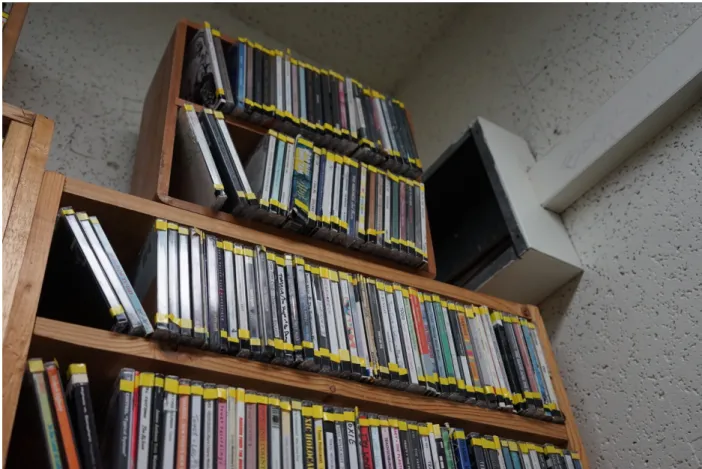
The WXDU library is all physical, and it is divided across several small, wonky rooms and hallways where thousands of CDs are stacked on shelves from floor to ceiling according to genre, consisting of rock, country-bluegrass-folk (CBGF), blues, world, jazz, RPM, North Carolina artists, classical, R&B/soul, hip hop, new age, and others. There is also a room crammed full of vinyl records, organized according to the same genres. DJs are prohibited from playing music from online sources like Spotify or Bandcamp. But again, rather than see this as a barrier or a nuisance, DJs embrace the physical library as an invitation to explore and dig through its
contents, noting that this form of discovery can feel more personal and purposeful than finding music online. As Mika explains:
a CD, maybe skim the review or the track list, and think, “That sounds cool, I’m gonna try it out.” I like that a lot.… It’s much more intentional. I feel like I’m in more control or I, like, have more agency over what I choose because I have to physically pull it out and select a track. It’s so much different from doing a quick click on Spotify or on Bandcamp, searching something up, or going through recommended artists. It’s cool that they have those algorithms, but it’s not the same as you being the one choosing to find that artist and listen to them. (2017)
Figure 4. The music library winds through several hallways and small rooms on the second floor of the station.
older formats range from bafflement and disgust to fascination. Access to old and obsolete playback equipment and audio recording formats is another learning opportunity and way to connect with the longer, evolving history of radio and WXDU (Robby 2017, Kelly 2017). As Kelly says:
There’s some value in the experience of the radio station still having [that equipment] around, like, “This is what it was like.” I would love for us to have tape decks and card machines here so that people can see and have that experience, of like, “This is what all these different things were.” …That stuff is cool to have around because that’s part of the learning station, the educational aspect of the station. That doesn’t mean that we don’t also have the computer system. It’s also, “and.” “And and and,” having those options. (2017)
This emphasis on discovering music can also lead to self-discovery and finding a place within the Duke community for many DJs, many of whom tend to view themselves as outsiders or apart from the mainstream community on campus and throughout the Triangle. Music plays a significant role in nearly every DJs’ personal sense of identity, bringing joy and comfort and serving as a critical outlet as a coping mechanism and for understanding their place in the world. Aaron and Evan both emphasized how rewarding it is to be surrounded by an endless stream of new music to pour through and to find others on campus and in the community who share their serious care and interest in music. WXDU gives them a place on campus that feels like it’s theirs and that they belong. According to Aaron, “There’s obviously not monetary gain or social gain from working in college radio. Like I said, it’s not like a sexy thing to do, but it is incredibly rewarding to be surrounded by music and people who really care about it” (2017). Evan expands on this:
Mika expresses similar thoughts, noting that through WXDU she feels like she has found her own corner on campus to understand herself and to feel more at home, citing it as a source of personal expression and growth, which surprised her. She explains:
It’s something that I realized if I want it, I have to be much more intentional about it. And that’s hard for me because it’s harder for me to put myself out there. I’m not as outgoing so I think, for me, I like to sit back and let things come, which sometimes works, and sometimes it doesn’t. But I think that when I meet undergrads who DJ around campus, it feels like a community then…. I really love how WXDU feels kind of secret and it’s very alternative and experimental.… I want more students to know about it because it’s really special, and it’s helped me like Duke more. I think there are a lot of people, a lot of undergrads especially, who came into Duke thinking something else and got here and realized it was different from what they’d been expecting. And I think a lot of those people could use radio, and having that outlet. I think it would be nice. (2017) Through formal means and mechanisms, like reviews, playlist, the library, and the mission, WXDU prioritizes and facilitates discovering new music. By extension, these
CHAPTER 2: CURATION
After the initial discovery, DJs select music to play on their shows. These choices can carry significance and illuminate priorities and values shared by the WXDU community. Some DJs make their selections by physically laying all playlist CDs out on the counter in the control room and rearranging them into some sort of order, like Robby does.
Figure 5. A stack of playlist CDs sits on the desk in the control room where a DJs peruses and determines what to play.
method, DJs maintain the option to experiment and explore when they choose their music. Some of this is due to the playlist requirements and the range of albums that get added to the library in the first place; Kelly notes that the rules are in place to discourage DJs from playing the same things over and over, and to avoid a monoculture and to celebrate the vast diversity of new and existing music in the WXDU library (2017). But this is also a choice that many WXDU DJs purposely make because it aligns with their personal interests and values, and it supports the overall ethos of the station, where nonconformity matters.
Brett reflects on this, noting that the sense of mystery and freedom around the station initially drew him to it. He tends to select new music for his shows, and he is particularly drawn to music that is challenging or pushes past what is known or comfortable. For example, he is currently very interested in atonal or drone music because he feels it progresses the idea of what music is. He explains:
I feel like the drone is a really interesting phenomenon in modern music. It’s a new thing that is really abrasive and doesn’t sound right. But the more you listen to it, the more your brain can come to understand the really interesting relationships with it, even though it’s not pleasant or harmonious in the classic sense. (2017)
Carolina, and they are all relatively lesser known. In this way, the music that DJs select celebrates certain sounds, artists, and genres, and shapes the sonic output from the station.
There is also a general sense that WXDU exists for both the WXDU community and the greater listening community and to educate and expose its DJs and other listeners to new, diverse content, rather than to indulge a given DJ’s particular interest. Again, this is part of the formal mission and is reinforced through training and communication from station leadership, such as the programming director, who remind DJs that they should not only play music within their existing knowledge and preferences. Many DJs see the act of pushing beyond their boundaries as a way to honor other DJs’ tastes and energy they put into reviewing albums for the station. Brett reflects on the significance of this:
I don’t really like metal music that much, but I get that there is something there that engages other people at the station, and I know they spent a lot of time on it. So I will play metal music, one, to learn about it, two, to validate their time spent on it…. I do want to affirm, in a way, not even the artist, but the people who take a risk on reviewing something really highly that might not be cool on Pitchfork, or might not be cool even among local musicians or whatever. I’ve always thought that was something worth affirming, even if it’s just by playing something I don’t like. I do feel like that adds something to the social dimension of the station. (2017)
Curating a show to reflect music beyond one individual’s personal taste supports and indicates a greater, unofficial mission of the station: it’s not always about you. Kelly recalls some
interactions with Mitch, an undergraduate student at Duke and the general manager of the station at the time of our interview, the result of which he found very promising:
I feel like Mitch has really gotten that. Every now and then I see him articulate those kinds of ideas where he’s like, “This is not what I’m into, but that doesn’t matter. It’s not about me.” And I’m like, “Yes!” Because that’s a hugely important lesson that
Though unexpected from an activity largely centered around the enjoyment of music, DJing can make people reflect deeply on their place in the world and how they relate to others. There is an overarching understanding that DJs are playing for the Duke and Durham
communities – and not just themselves – which creates an inherent connection to these
communities. This is a particularly interesting social dynamic, as DJs play for a virtually invisible audience, where the interaction is largely one-sided. Yet this interaction, which is shaped by individual DJs’ selections on behalf of the station as a community itself, has the potential to be transformative, as these selections can express aesthetic and political values. Brett shares a recent example:
I don’t understand metal that well, but I know Kelly and Stephen are on this anti-white power metal tirade right now, where the political climate is such that we are not going to deal with anything that has any connections to white power, which is what a lot of European metal is into right now. Conversations like that, to me, seem to build a lot of community. Where it’s like, “Oh, I didn’t think about that before, but now I want to be on your side.” (2017)
Another example is with artists who have been recently accused of sexual assault. On a case by case basis, the station determines whether to scrub the library entirely of the accused artist’s music, to leave existing albums but halt any future acquisitions of their music, or to continue adding albums and placing a disclaimer on the review so that each DJ can make the decision on their own.10 In these ways, the selections that DJs make about what to add to the library and
what to play on their shows express some values and moral stances.
Curating shows, particularly selections from playlist, can also be interpreted as a form of artistic expression. As Aaron says, “Putting music in context is so important. The art of DJing is
10 The latter, to my knowledge, is generally reserved for cases that have not yet materialized
truly an art. It’s really incredible to see what can be done just by this pastiche kind of thing. It’s super modern, a really modern art form, but super cool too” (2017). This idea of creativity in selecting tracks is addressed in the mission, which states, “WXDU seeks to give its staff the freedom to pursue their personal aesthetic within the framework of a cohesive format” (“Welcome to WXDU,” wxdu.org). Each DJ works with the same set of 50 or so albums on playlist, which can be perceived as the raw materials, yet no two shows are remotely the same. Each DJ interprets playlist in their own way, whether it’s through the individual tracks selected, or the order in which they are played and how they sound lined up next to each other, or which albums from the rest of the library they work into their show. The results are wildly different, and each show is a DJ’s chance to make their own statement or mark on the sonic landscape of the station with their selections. Yet since the contents are finite and all DJs are working with the same materials at a high level, there is some connecting fiber in the music that ties it all back together where the core values of the station are present. Brett reflects on this:
It’s really cool to see how everybody interprets a pretty similar list of music. Everybody has to work off a pretty static playlist, and it’s cool to be a part of this creative group where I’m going to spin playlist one way and you’re going to spin it another. It seems like we’re all part of something, as vague as that sounds. (2017)
Again, that there is this sense of being part of a bigger community is particularly important when considering that DJs rarely see each other or interact aside from sharing new reviews or attending to official station business.
CHAPTER 3: SHARING
Playing and introducing music live is perhaps the most exciting, nerve-racking, and meaningful act. By broadcasting content on air, DJs share their tastes, opinions, values, and that of WXDU as an entity with the local and potentially global listening audience. For some DJs, like Stephen, there is a hip factor about being on air that keeps them coming back week after week. He says, “It’s cool to be on the radio. I still think that’s great. You can be heard around the world doing this stuff… I’m not a performer in any way, so this is definitely an outlet” (2017). The act of sharing music on air is also a major source of happiness for DJs like Robby, who recalled when his wife had twins and he considered leaving the station to have more time to help with them. His wife told him, “Do what you can do, but you should really always DJ because it makes you happy.” After reflecting on this, he says, “It’s what I need to do to survive… I love it. It’s just great. It’s fun to DJ” (2017). While the assessment that it is fun may seem somewhat shallow, its close proximity to his claim that he needs radio “to survive” indicates that there is something deeper at play. Indeed, while it is fun, DJing is an outlet from professional and family stresses, and it offers opportunities for creative expression. In sharing something he loves so deeply with others, he confirms the need to participate at the station, suggesting that through DJing he gains some sense of internal fulfillment. As he goes on to explain, Robby also really enjoys getting listener feedback, which can be very self-affirming. He says, “I’ll go for weeks without hearing anything at all, and then somebody will write in on the thing and go, ‘Awesome set today. It totally made my week.’ And that’s cool! You feel
something that way... That’s what keeps me going, too” (2017).
is a comforting and powerful way for her to open up to others, even those with whom she is already very close. She explains:
My family always listens, which is special to me because my parents are into music – and my dad actually really loves listening to music – but they never understood in high school why I wanted to go see live music all the time, or why I was so obsessed with listening to music alone in my room all the time. I think it’s been cool to share that with them, through them listening, because they get to see the side of me that I never expressed to them before. That’s something that’s really special.
My friends at Duke who tune in I think are always surprised by what I play because I really like to play weird, offbeat stuff. It makes me really happy because it’s the only time I get to do things like that, to step outside the norm. For them it’s very cool because, once again, it’s like them seeing a different side of me, in a good way. It’s me being more exploratory and less serious – which I’m generally a more serious, intense person, so it helps me be more balanced and lighthearted. (2017)
She also finds joy and meaning in sharing music with the broader Duke community, many of whom might never listen to the types of music WXDU plays. She continues:
Sometimes I’m surprised by the people that tune in. I was loosely friends with this one guy in my hall from my freshman year, and he’s totally not someone you’d expect to listen to WXDU. He’s very into his fraternity and only listens to the top 50 songs, or whatever. Which is fine. But one day I got on snapchat and he messaged me, like, “I tuned in and it was awesome.” And that made me really happy because I was like, “Wow, he might not ever listen to that kind of music, but he took the time to tune in and listen and hear what I had to say.” Even though I was playing music, it feels like something I’m sharing with people. And that was really special, and I wish I could get more people to tune in who maybe don’t listen to music normally.… One time my roommate was studying in a private room with a bunch of her friends, who I don’t know very well, on a Sunday night. I told her to tune in, and she played it out loud for
everyone. And of course my first reaction was, “Oh my god!” Because sometimes my shows feel very personal, but she said they all really loved it, and I thought it was really cool that I was playing music like that, and that was also special. Sometimes when I’m able to extend my show to more of the typical Duke student is when I feel most fulfilled and excited about WXDU. (2017)
are most passionate about. Sharing music can by grounding, reassuring, and remind DJs that they are not totally alone. Mika illuminates this:
DJing makes me feel at peace and it gives me perspective, and it helps me express things that I’m not able to express on a daily basis at Duke because of the nature of the
student population. It took me so long to find people who I could talk to music about for extended periods of time and who were willing to listen to some of the
[recommendations] I made [to] them, and talk about it, and talk about how it made them feel, and that’s very special. So before I had that, which only started happening recently, WXDU was a nice way to remind myself that [music] meant something to me. Because sometimes it feels like it gets pushed down during the week with the crush of school and people and Duke culture and all of that, so it’s really nice for me to have an outlet where I can feel like myself and I don’t have to worry. It’s really funny because when I was so scared to DJ, it was because the idea of people listening made me nervous. But now the idea of people listening makes me happy because I feel like I’m sharing something with them, and it feels like I’m having a social interaction in a way, like a fulfilling, meaningful one that’s inclusive and safe, and I really like it. (2017) WXDU DJs share content that, as Aaron says, makes “a conscious effort to peel back,” resists the status quo, and expresses a sincere interest in experimentation (2017). DJs do this not only because it makes them happy to share and potentially connect with others, but also out of what Robby calls a “responsibility to teach young people about music, new music.” He continues:
It’s important for the vibrancy of the community to have music that’s challenging but listenable, and interesting, and a whole variety of stuff. I think WXDU fulfills that mission. I think that’s part of it. And that’s a thing I really support because it influenced me so much. You know, I’ve been involved in bands and music forever. It’s a
I’m gonna blast the control room all the time, and play weird stuff, and expose them to that. The best thing about Brickside [a day-long music festival that WXDU helped sponsor at Coffeehouse] yesterday was seeing sorority girls that I had classes with during Ævangelist [a death metal band], being exposed to something that they would never be exposed to otherwise. (2017)
In this way, DJs can feel an obligation to share new and alternative music – and by extension, alternative art and ways of perceiving the world – with others, assigning power to WXDU’s role and the message it communicates in the world.
As many DJs feel like they do not belong in other social contexts in their lives, WXDU offers a sort of home where outside ideas and points of view are safe and celebrated. It is particularly important for many undergraduates to share challenging music with and find community beyond the average Duke student or groups. Aaron notes:
Despite wealth and despite privilege, [Duke] houses a lot of people who are generally not really interested in alternative ways of thinking or non-popular forms for art or music. I think it’s generally a culture that’s bred totally out of most people being really involved in STEM.… Basically the only people that I’m friends with at Duke that are involved with STEM are also exceptional in the sense that they love art and love music and are creative people. (2017)
progressive voice is honored and celebrated, and DJs can confidently stand in their outsider status together.
By making this space and asserting the power and significance of their own voice, they create a place of belonging and work toward changing these restrictive norms, encouraging fellow and future students to engage in alternative ways of thinking and existing. As Zoe explains, “When you’re on the air, you have a voice, to some extent. Being heard is, I think, a powerful idea and it’s something people gravitate to because it’s easy to feel like a small fish in a large pond.” She continues:
We’re not really as focused on catering to the entire student body as a whole. I think we’re focused on being an alternative space. [The Last Day of Classes and Campus Concerts committees] are putting on giant concerts for the entire student body, bringing in huge names. They want to appeal to as many people as possible at Duke.… [Their events are] much better attended than a lot of the things we do. There’s a lot of
organizations like that under DUU [Duke University Union] that aren’t really focused on being an alternative space. And I think DUU understands that we’re different and also that what we do is important. I think you have kids who, if they didn’t have WXDU, and if they didn’t have the Coffeehouse, they would have transferred. I have talked to kids like that, I feel like I am potentially one of them, so I think it’s really important these spaces exist. (2017)
In sharing content that deviates from the norm, DJs both assert their outsider identity with pride and create opportunity for this community to challenge the status quo. Sharing this content can make others feel more welcome and included on campus and in the greater community, particularly those who feel lost or like they do not belong, and it can help shape a community that embraces learning and experimentation. It also pushes on the idea that there is content that is better or worse than other content, honoring the validity of subjective
who is the audience, what sort of relationship they might have, etc. – and that rejecting a binary good/bad gives space to thinking more openly about music that is unfamiliar or new to a listener. He elaborates:
There’s people that I’m friends with that definitely think, “There’s good and there’s bad music. And you’re playing bad music. If you’re playing bad music, then you’re a bad DJ.” And I think that’s bullshit because that person’s mom might be listening, and all of a sudden, that person is the best DJ in the world, to that person’s mom. And that matters. Does that mean that that person should be able to do that all the time? No. But... we can have duality of existence and thought, and that can be both things at the same time. It can be both really important but also know that, but we should push and strive to do something different and better next time, and the coolest thing will be to keep your mom listening, and challenge them. Play crazy shit, and see if they keep listening, and see if you can expose them to stuff that they would never have admitted to liking, or that they might not like. And they might not ever like it, but, but they will have heard it. And there will be this weird point of connection that you can have.
…
[Your show] can be the greatest thing ever; it’s fine, as long as you’re also remembering that it’s not the greatest thing ever. It’s the thing that was the greatest thing because you are doing it in that moment for you. And having that kind of perspective, but not trying to then impose this globalized [notion], like, “This thing is important.” No, no, no, that thing was great because of you guys, and it was great for you. And something else was great over here, and that’s great too, and this is great too, and it can all be great. As long as you’re not hurting somebody or impeding on somebody’s ability to exist and have a good time. Then I think it’s all cool. (2017)
Again, this opportunity to share unfamiliar or challenging music – and giving listeners an opportunity to hear it – is a priority because it perpetuates both the rejection of the status quo and adds to the sonic landscape of a community where outsiders belong.
individual DJs belong to something bigger than themselves and express values, tastes, and ideas as individuals and for the station as a whole to the public. In part, this is why the rules exist – so that WXDU is represented well and in accordance with its mission – and there is a special kind of power there, as Zoe noted, where DJs can play anything they want and try anything out so long as it stays within WXDU’s guidelines and does not violate any FCC regulations. This responsibility and level of trust that the station gives DJs – especially undergraduates – can be very empowering. Mitch notes that the trust makes him feel really welcome (2017).
While there are rules, at the same time, radio shows are a time each week where DJs are totally in control of what they choose to explore, consume, and share. Having this outlet – whether for creativity, solace, freedom, or anything else – is something that nearly every DJ I interviewed indicated matters tremendously to them. For example, Zoe’s show is a time for her to take a break from her hectic academic schedule and engage with music, which she is very passionate about. She explains:
CHAPTER 4: MAKING CONNECTIONS
Beyond sharing music and ideas with listeners and making connections while on air, WXDU provides DJs with time and space to both connect with the local community and to reflect inwardly. By supporting an ethos of experimentation, WXDU reminds DJs that they are free to explore and shape their own identities in whatever manner might feel safe and
Mika started out feeling somewhat detached from WXDU because of the prominence of community members’ involvement at the station, particularly in leadership roles.11 She did not
know these DJs well and the age difference surprised her. At the time, she did not know many undergraduate DJs either, so she was hesitant to really get involved. But she eventually started subbing for Who’s Got the Cuckoo, which is run by community-member DJ Robby, and met more students who were involved. This made her feel more connected. She has come to enjoy knowing some community-member DJs, and she subs for the Cuckoo and other shows on a regular basis; she appreciates that “having community members brings a lot of great perspective and also very interesting music tastes to the station.” But she worries that the station is more or less managed “by community members who have DJed here for so long, and students are kind of appendages that come in and go out” (2017). Because the station has played such a significant role in her undergraduate career thus far, she wants to encourage even more students to get involved and ensure that they have opportunities to participate in leadership positions so that they might have similarly positive experiences, particularly if they are struggling to find a place at Duke (2017).
This desire for more student involvement is, in fact, shared by many community-member DJs. Robby feels that “if students got involved more, we could all learn from each other,” and he notes that there are some opportunities to bridge the gap, such as the screen printing workshops he occasionally puts on for the station (2017). Kelly, a community member
11 There are elections each spring for leadership roles at the station, so the level of
himself, is adamant that the station should primarily be run by and for the students, and that radio can be an incredible, valuable experience for undergraduate students so community members – and especially those in leadership positions – should prioritize reaching undergrads and facilitating training so that they can get on air. To him, community radio without students is “deadening”: “it’s a bunch of people playing the same stuff all the time” and fetishizing their past or their youth instead of embracing new music with current cultural relevance and
supporting young people to do the same (2017). Kelly also notes that it is important for college radio stations to exist and function within the context of their particular college, to let students guide what the station believes it wants and needs, and to respect students’ decisions to not take a 4 am show, for example (2017). There is not a one-size-fits-all model for college radio, and WXDU operates by and for its specific DJ population.
Undergraduate DJs also find many benefits from including community-member DJs. Aaron appreciates being able to get to know DJs who have been involved in the local music scene for many years and learning more about music, Durham, and the region from them. He says, “Individually meeting people introduce[s] the value of Durham outside of Duke,” which helps him explore the “legitimate culture” of the city beyond campus; it makes the area more “tangible” and intellectually and culturally accessible to him (2017).
Similarly, Evan notes the significance of having some tie to the world beyond Duke. He points to the station’s role in connecting him to local people who are heavily involved in music, which is the part of any community that he particularly seeks and to which he is drawn. He recalls:
people, real people.… Honestly, the highlight of my year last year was a house show at Daniel Bachman’s house. I knew so many people there, just through the station. To be out, in Durham, at something like that was so much better than any party I had been to at Duke. (2017)
Evan also appreciates the stability and depth that community-member DJs can bring to the station. He says, “I like the fact that there’s older people here that ground everything in something that’s maybe not as cool on the surface, but is much cooler and more fulfilling in terms of what kind of music the station plays” (2017).
Interacting with community members helps Aaron feel more welcome and secure with himself in this particular place. He says:
Every time I get to meet a new community member at the station, it’s so great. It’s so grounding, and I’ve just generally noticed feeling more comfortable, and more
comfortable with who I am and how I express my personality, because I no longer feel like I have to be grounded in a Duke culture. I can feel more generally a part of the area. I’m gonna be living in Durham [off campus] this summer… and I’m really excited for that opportunity to feel more involved with a community that isn’t the sort of community that Duke creates, which is a transient community, or a community that can be superficial.…The station’s been really good in the sense that it feels like I’ve been
interacting with real people, normal people – which is weird because so many people at the station are weird and awkward, but in a cool, fun way. In a way that’s like, “Ok, these are real people.” It’s not like an elite group that feels so alienating. (2017)
In addition to helping students connect outward, this direct engagement with the community can also support the Durham community to feel more in touch with Duke. Zoe values this connection to the broader community and the ways the station can make them feel included. She explains:
I’d say WXDU and the Duke Coffeehouse have similar vibes in that they’re the only organizations [in DUU] where they’re also engaged with the community, which I would definitely emphasize is really important because Duke is often seen as this extremely separate, sort of elite entity that doesn’t really interact with the community. And I don’t know how much they do to really try to alter that. I mean, I think it’s true. I think they don’t interact with the community very much, and the community members feel that. So the fact that we have these spaces where we can bring community members in and interact with them, to say, “There’s spaces at Duke for you, too.” There’s people who are interested in being part of the community, like the Durham community, who aren’t just trying to exist inside the Duke bubble. That’s really important. (2017)
Mika has similar thoughts that the radio station can connect with community members in meaningful ways. She compares it to the Nasher Museum of Art and observes positive outcomes.12 She elaborates:
Nasher is very supportive of community things and they really like to get to the root of creative expression that people in Durham can identify with. Which I really, really like. For them, it’s not about being an elite university’s art museum. It’s about being
connected to the people in the Triangle, and I feel like WXDU is like that too. You know, we’re not a snooty, intellectual college radio station. It’s about the people who DJ here and the people who listen. (2017)
This intentional connection between WXDU and the Triangle reminds DJs that there is space beyond the mainstream or any “snooty” groups, and creates the possibility for community members to feel the same sort of reassurance, grounding, and celebration of outsider status that students experience. Again, in claiming this identity as an alternative community, WXDU
12 At the time of the interview, the radio station was moving to a new space yet to be fully
can welcome others within Durham and the Triangle to connect with Duke in a mutually fulfilling way.
Involvement at the station also gives students meaningful, positive connections to the campus in concrete and abstract ways, which they did not always expect. Mika explains how participating with WXDU indicates certain interests and priorities, which makes building genuine friendships easier. She continues:
I met three DJs this semester when I was rushing an all-girls living group, which I wasn’t expecting at all.… It was an instant sense of camaraderie, and like, “Oh my gosh, I found another one!”… I think that made us friends much quicker. And we were able to move from more superficial conversation to talk about music, and we listened to Pussy Riot, and it was just really fun. It feels like when I meet another DJ on campus, I instantly have a connection with them because I know that they care about something that means a lot to me, and I respect that because music has definitely been defining for me. So when I meet someone that’s a DJ, I know that they’re an active lover of music, and I think that’s really cool. (2017)
Prior to coming to Duke, Aaron only vaguely knew that WXDU existed, but now he can’t imagine life without it. He reflects:
I was influenced in no way by the radio station being here [in deciding where to attend school], which is so weird because now that I’m in it and as involved as I am, Duke would be really odd without it, and kind of formless. It’s weird how it didn’t seem like a selling point at all, but now it’s a necessity for my general well-being at school. (2017) For Aaron, participating at the station is grounding. Similarly, Mika imagines herself in the future, long graduated, enjoying a stop at the station whenever she comes back to campus to visit because of the tangible connection it offers. She says:
These connections are certainly not effortless, but they are deeply worthwhile to DJs. Zoe acknowledges that serving as general manager is extra work for her, but she is happy to do it because it means she is helping the station continue to function and exist. Minutes into our interview, she says that once she joined WXDU, “I started to feel like I was a part of something, which is really important.” She elaborates:
There are certain spaces on campus, and WXDU is absolutely one of them, Coffeehouse is the other … where if they didn’t exist, and if I wasn’t a part of them, I would feel very much that Duke wasn’t really the place for me. WXDU has absolutely been vital to me feeling like I go to the right school. I felt, when I first came to Duke, ‘Have I made a mistake?’ I went to an art school for seven years before I went to Duke, and I majored in creative writing. Everyone was super interested in art, everyone was really interested in experimentation, and in experiencing different things. That was the culture I was used to. It was definitely important that I was exposed to a different type of culture because that’s not really how the real world works. But still, Duke was such an extremely polar environment from where I was that it was absolutely culture shock. Everyone is so pre-professional, everyone is in STEM, everyone is focused on basically what their
paycheck’s going to look like after they get out of college - which I certainly understand because college is expensive – but I just really didn’t feel the interest in the arts and exploring weird – quote unquote weird – spaces. So finding these spaces at Duke was like, “Okay. There’s a place for everyone. I can thrive here.” (2017)
challenged him in surprising ways. The station gives him a healthy way to express anger and frustration and to channel the difficulties and unhappiness into something constructive. Being part of WXDU prevents him from burning out from what he finds to be the unpleasant social culture, rather than leaving and losing this opportunity to learn at a world-class institution. He says, “You can be cynical and nihilistic and think that your situation sucks or dislike something… or you can actually try and change it” (2017). Being on the radio is his attempt at this, and through claiming the validity and importance of alternative ways of thinking, WXDU gives him a place to feel like he’s at home on campus.
Though they cannot necessarily directly empathize, many community members see and support WXDU’s function as a haven for some of the student DJs. Kelly explains that “in every training class, there’s always one or two of them that are like, ‘I was gonna drop out’ or ‘I was trying to transfer’ [if not for the station].… It’s a hard place to be” (2017). Stephen notes that WXDU “is all open arms” and it is like having a “built in community,” where people notice if you are sick and miss your show (2017). Robby also emphasized that WXDU does not turn people away for not being “cool enough,” and it is not a cliquey place. To facilitate this, WXDU is open to anybody who goes through the training, follows the basic guidelines set forth by the station and the FCC, and shows up to their slot on air each week (2017). It is an easy place to join and get involved, as long you put forth the effort; none of the training procedures or guidelines are exceptionally difficult or demanding, and they are also spelled out transparently in the