Working Paper No. 980
Balance Sheet Effects of a Currency Devaluation: A Stock-Flow Consistent Framework for Mexico
by
Lorenzo Nalin
National Autonomous University of Mexico (UNAM) and
Giuliano Toshiro Yajima
Sapienza University of Rome December 2020
*We are grateful to Juan Carlos Moreno Brid, Esteban Perez Caldentey, and Michalis Nikiforos for their useful comments to a first draft of this paper. Of course, any remaining error should be attributed to ourselves.
The Levy Economics Institute Working Paper Collection presents research in progress by Levy Institute scholars and conference participants. The purpose of the series is to disseminate ideas to and elicit comments from academics and professionals.
Levy Economics Institute of Bard College, founded in 1986, is a nonprofit, nonpartisan, independently funded research organization devoted to public service. Through scholarship and economic research it generates viable, effective public policy responses to important economic problems that profoundly affect the quality of life in the United States and abroad.
Levy Economics Institute P.O. Box 5000
Annandale-on-Hudson, NY 12504-5000 http://www.levyinstitute.org
Copyright © Levy Economics Institute 2020 All rights reserved
1
ABSTRACT
This working paper empirically and theoretically analyzes the exchange rate’s role in Mexico’s development for the period 2004–19. We test the hypothesis of the re(emergence) of the balance sheet effect due to an increase in external debt in the nonfinancial corporate sector; higher foreign debt would affect private investment after episodes of real currency depreciation, in the spirit of the literature put forward by Gertler, Gilchrist, and Natalucci (2007) and Céspedes, Chang, and Velasco (2004). We build a stock-flow consistent (SFC) model, following the OPENFLEX model proposed in Godley and Lavoie (2006), to explore the balance sheet implications from a theoretical
perspective. We simulate the 2014 fall in the Mexican peso generated by the drop in oil prices to replicate stylized facts for Mexico for the period under investigation. The scenario analysis points to a hysteresis effect of the real exchange rate (RER) depreciation on investment flows. That is, firms’ investment ratio does not completely recover from negative shocks in the currency.
KEYWORDS: International Finance Forecasting and Simulation; Models; Applications; Foreign Exchange; Macro-Based Behavioral Economics
JEL CLASSIFICATIONS: F37; F31; E7
2
1 INTRODUCTION
From 2004 to 2014, global prices for raw materials soared and oil’s price increased from $35 per barrel to $110. During that time, the Mexican economy experienced an increase in financial inflows, especially government fixed income securities (Bastourre and Zeolla 2017). The low interest
environment occurred in concomitance with the commodity prices boom period that the Latin American region was experiencing, a factor that helped to attract financial capital to Latin American countries, including Mexico (Gruss 2014). However, since the fall in oil prices in September
2014—an event that marked the end of the global commodity price boom—the Mexican economy has suffered from flow reversal in fixed income and derivative markets; as a result, the currency depreciated roughly 35 percent in real terms and the currency has remained on average 15 percent more depreciated than before the shock (2004–14). From 2015 to 2019, exports were the only GDP component that benefitted from international price competitiveness, growing from 26 percent to 35 percent of total GDP. While exports grew throughout the period, private investment decelerated and, from mid-2015, declined. Gross fixed capital formation as a share of GDP decreased 2.2 percentage points from 2015 to 2019, private capital formation declined 0.68 percent, and public capital formation declined 1.2 percent. Among the most affected investment components,
nonresidential investment felt 4.27 percent per year on average, followed by investment in domestic equipment and machinery with a decrease of an average of 0.43 percent per year. Also, the public sector and households appear to have performed poorly after the 2014 depreciation. The debt-to-GDP ratio increased from 49 percent to 53.5 percent, government-spending-to-debt-to-GDP decreased from 19 percent to 17 percent, and household consumption as a share of GDP fell from approximately 69 percent to around 66.5 percent. As a result, per capita GDP growth during the period was steady, at around 1.4 percent (versus the previous 2 percent in 2010–14).1
Based on the limited evidence of a positive association between currency depreciation and
expansionary macroeconomic performance, we advance the hypothesis that for Mexico during the period 2004–19, real depreciation was not favorable for capital accumulation in the private sector due to the (re)emergence of the balance sheet effect for nonfinancial firms. Indeed, the nonfinancial
1 Data presented are based on the authors’ calculations with data from the Bank for International Settlements (BIS),
3
sector increased financing its activities through international savings, expanding their balance sheet’s exposure to foreign liability revaluations (Chui, Kuruc, and Turner 2016).
To explore the theoretical implications of the balance sheet effect, we develop a stock-flow consistent model (SFC) in the tradition of the OPENFLEX model presented in Godley and Lavoie (2006). SFC models are demand-side models, based on the tradition of Tobin (1969, 1982) and Brainard and Tobin (1968), expanded by the Cambridge Group during the 1980s by Cripps and Godley (1976), and finally reconciled in Godley and Lavoie’s (2006) book, Monetary Economics. The SFC methodology is based on macroeconomic accounting, aimed at tracking transactions between sectors, assets, and countries. Those relationships are modeled by looking at the national accounts system. There are three reasons why we opted for this methodology. First, it provides an alternative framework for the interaction between the financial and real sectors in an open economy (Godley and Lavoie 2006). Additionally, it encompasses a portfolio approach—based on the
seminal work of Brainard and Tobin (1968), Tobin (1969; 1982), Tobin and Macedo (1980), and Backus et al. (1980)—to assess the impact of financial flows on the real exchange rate (RER), and their consequences on macroeconomic variables. Finally, it properly addresses center-periphery asymmetries existing between developed and developing economies.
Results from simulations emphasize how debt revaluation affects balance sheets, discouraging private, nonfinancial investment. The model shows that during economic expansionary phases, nonfinancial firms issue external debt to finance investment and face growing demand. However, as soon as depreciation materializes, firms find themselves with a higher stock of debt and a
devaluated domestic currency. The final effect is the revaluation of debt that might lead to a lower level of investment flows, especially for those firms that already suffer currency mismatches (Chui, Kuruc, and Turner 2016). Simulations also show that after depreciation, the system finds a new equilibrium, but with a higher stock of debt and lower investment flow. This would explain, in our view, why in its recent history Mexico experienced a constant increase in external debt in the private sector as well as a lower investment ratio.
4
2 LITERATURE REVIEW
The literature on the exchange rate has identified several channels through which this variable can impact income and income growth in a small, open economy. Transmission mechanisms can be summarized into four groups, the first two of them pointing toward a positive causation while the others argue the opposite: i) the trade channel; ii) the investment channel; iii) the redistribution channel; and iv) the financial/balance sheet channel.
i) The trade channel relates to the price effect, that is, the competitiveness of domestic tradable goods with respect to foreign peers, which ultimately might lead to the increase in the demand for exports. This channel finds its origin in the Mundell-Fleming model and balance-of-payment restrictions. That is, under certain specific conditions—such as
increasing global demand and a limited propensity to import—the undervalued currency can promote medium-run growth in the external sector and, consequently, sustainable economic growth (Thirlwall 1979; Thirlwall and Hussain 1982; Moreno-Brid 1999; Pérez Caldentey and Moreno-Brid 2019).
ii) The investment channel concerns the effect of currency devaluation on the profit rate, in accordance with Frenkel and Ros (2006), Rodrik (2008), Bresser-Pereira (2008), Rapetti (2013), and Ros (2015). As real wages decrease, the profit rate grows, stimulating capital accumulation. Ultimately, this channel also needs to account for firms’ productive structure and the technology domestically available for different sectors of the economy, as
mentioned by Aghion, Bacchetta, and Banerjee (2001) and Agénor and Montiel (1999). Not all sectors can rely on domestic supply of those capital goods needed in their production lines. Thus, some manufacturers depend on imported inputs, a factor that might outweigh the benefit of lower real wages in case of currency depreciation, reducing the profit margin rate.
iii) The redistribution channel refers to the effect of a currency depreciation on wages. Probably the most influential work on it is the Díaz-Alejandro effect (1963)—initially addressed in Alexander (1952) and successively by Krugman and Taylor (1978).2 It argues that real
2 Krugman and Taylor (1978) also add that devaluation has a negative effect on growth due two important factors: first,
5
depreciation leads to inflationary pressure, which implies a reduction in real wages.
Thereby, it affects private consumption, producing a redistribution of income from workers in favor of entrepreneurs. Provided that workers have a higher propensity to consume than entrepreneurs, redistribution increases the rate of savings at the expense of consumption. Recently, Ribeiro, McCombie, and Lima (2019) have shown that when the labor income share is taken as an additional control in measuring the direct impact of exchange rate misalignment on growth, this ceases to be statistically significant.
iv) Finally, there is a financial side of the currency devaluation, which is composed of the loss in firms’ net worth—the so-called balance sheet effect—generated by the revaluation of foreign liabilities and the consequent increase in the risk premium (Bernanke and Gertler 1989; Gertler, Gilchrist, and Natalucci 2007; Céspedes, Chang, and Velasco 2004;
Bernanke, Gertler, and Gilchrist 1994). According to these works, it is necessary to evaluate the effect of an exchange rate depreciation on a firm’s balance sheet, since this balance sheet effect could negatively impact private investment.
The financial impact of a RER depreciation has received relatively less attention in recent years. Major contributions on balance sheet channel are found in the works of Bernanke and Gertler (1989), Greenwald and Stiglitz (1993), Sachs, Tornell, and Velasco (1996), Kiyotaki and Moore (1997), Furman et al. (1998), Radelet and Sachs (1998) Krugman (1999), Chang and Velasco (1999), Gertler, Gilchrist, and Natalucci (2007), and Céspedes, Chang, and Velasco (2004), and is related to Bernanke, Gertler, and Gilchrist’s (1994) financial accelerator theory. This family of models is also defined as open economy financial accelerator models and was born during the 1990s to study currency crises experienced in emerging countries at the time (Delli Gatti et al. 2007). They explicitly take into account the problems posed by foreign currency debt (Krugman 1999).
According to the aforementioned authors, it is necessary to evaluate the effect of exchange rate depreciation on firm’s balance sheet, since this could negatively impact private investment through a decrease in the net wealth effect and higher risk premiums that firms experience when facing currency depreciation. On the one hand, authors recognize the positive effect of a RER depreciation on trade in the external sector, in line with the tradition of the Mundell-Fleming model. On the other hand, they consider the effect on firms with foreign exchange–denominated liabilities. For these companies, exchange rate depreciation would lead to a negative wealth effect. The result is an
6
increase in the risk premium and a decrease in access to credit, with a consequent decrease in private investment.
Bernanke and Gertler (1989) developed a business cycle model that includes a financial system, following Diamond (1965), to study periods of financial distress, followed by depreciation and reduction of net wealth. They show that with the presence of financial turmoil, agency costs are higher and, ultimately, they lead to a decrease in physical investment (Bernanke and Gertler 1995). Sachs (1989) argues a country suffers from the debt overhang problem when it accumulates a high stock of external debt, creating in potential investors the fear of future taxes on their returns (implicit or explicit), what Deshpande (1997) defines as the debt overhang and the disincentive to invest. Bernanke and Gertler (2000) argue that the magnitude of asset price fluctuations generated by currency devaluations do not always create the credit-market frictions mentioned in Bernanke and Gertler (1989). The initial state of households’, firms’, and intermediaries’ balances sheets might lead to different outcomes. In this sense, Kiyotaki and Moore (1997) stress the role of asset prices and collateralizable net worth after a currency devaluation.
Aghion, Bacchetta, and Banerjee (2001), studying the Asian financial crisis, develop a model where a small, emerging, financially liberalized economy can suffer destabilizing effects in the face of monetary shocks. They argue that output volatility could be avoided if the economy opens to foreign direct investment only. Krugman (1999) develops a theoretical model to replicate stylized facts for the Asian crisis in 1997, which later will be defined by the literature as the “third
generation” crisis models. He shows the dilemma around stabilizing RER depreciation when the economy is facing a shock. On the one hand, interest rates might rise to stabilize the currency, which could reduce investment. On the other hand, the interest rate hike could be avoided and the currency not stabilized, but in this case the impact of depreciation could be even worse, as its effects would be self-reinforcing through the decline in output and investment. Céspedes, Chang, and Velasco (2004) simulate two different models, one in which the economy is characterized by financial fragility—expressed by a high level of corporate indebtedness—and another is an economy with robust finances. The authors show analytically that the financial condition of the corporate sector—fragility or resilience—affects the depreciation’s outcome. There will be an expansionary effect via trade in the case of robust finance, while the balance sheet effect will predominate in the case of excessive indebtedness before the depreciation. Cavallo et al. (2005)
7
provide a further explanation of the currency depreciation’s financial effect. They study, theoretically and empirically, the consequences of RER depreciation on the value of assets and liabilities on the balance sheets of companies in emerging countries. They focus on the implications for growth and investment in the presence of a financial crisis. The authors claim that during
episodes of financial crisis, a financial constraint exists—a level of depreciation above which investors engage in a domestic asset selloff—that generates further exchange rate depreciation, an effect that authors define as overshooting. Exchange rate depreciation due to overshooting causes a negative wealth effect that aggravates the fall in output and private investment generated by the crisis, especially in the case of firms with high foreign debt ratios. Delli Gatti et al. (2007) build a model based on Greenwald and Stiglitz (1993) and Greenwald (1998). They argue that depreciation effects materialize in two different moments. The first round (direct) effect and second round (indirect) effect. The former consists of a positive effect on exports and negative effect on net worth due to higher input costs for firms. The latter is the upward adjustment in interest rates due to the increased risk premium after depreciation. The vision of their balance sheet is additionally oriented toward the effect on firms’ creditworthiness; that is, depreciation reduces the wealth of the company and increases the risk premium, which makes access to external financing for new projects difficult.
Empirically, econometric studies confirm that devaluations are more likely to have a negative effect on output and growth in countries with high external debt burdens (Forbes 2002; Galindo, Panizza, and Schiantarelli 2003; Blecker and Razmi 2008; Kearns and Patel 2016). The effect has been largely validated for emerging markets, including the Latin American region, using data that generally cover the end of the 1990s and beginning of the 2000s.
Forbes (2002) uses a sample of 13,500 firms from 42 countries to examine the impact of 12 major depreciations on firms’ performance between 1997 and 2000. He finds empirical evidence of depreciation’s negative effect on net income, but a positive relationship with market capitalization. The latter might suggest, according to the author, that depreciations increase the present value of firms’ expected future profits (through higher exports). He also suggests that the final effect of depreciation on investment depends on output type, foreign sales exposure, production structure, debt outstanding, size, and profitability. Galindo, Panizza, and Schiantarelli (2003) found that firms in Latin American might possibly reverse the benefits of expansionary devaluation in the Mundell-Fleming tradition due to excess dollarization of debt. They qualitatively study the evolution of the
8
currency composition of firms’ liabilities in six large Latin American economies (Argentina, Brazil, Chile, Colombia, Mexico, and Peru). They calculate the share of foreign currency debt in total debt for the year 2000 showing that all six countries experienced increased penetration of foreign debt and warn about the balance sheet effect on depreciation given high stocks of debt.
Benavente, Johnson, and Morande (2003) study the dichotomy between boosts in export revenues and financial net worth on Chilean listed companies for the period 1994–2001. They evaluated the impact of the Asian financial crisis (1997–99) on firms with dollar debt elements on their balance sheets. Using panel data and generalized methods of moments (GMM) methodology, they did not find statistical evidence of the balance sheet effect. They argue that those results are influenced by the fact most of the firms in their sample are exporters, which implies that they have a natural hedge over currency fluctuation derived from nature of their sales in foreign currency. They also did not find evidence of a positive effect of depreciation on investment, as the international environment was lacking a strong recovery in global demand.
Janot, Garcia, and Novaes (2008) study the balance sheet effect of the 2001 financial crisis. They use a logit analysis of a sample of 190 companies in Brazil. They split the sample between hedged firms (as a control group) and firms with external currency positions (not hedged). They found that firms with currency mismatches reduced investment by 8.1 percent compared to the control group. They also look specifically at exporters. They find that among exporting firms, those with currency mismatches had 12.4 percent lower investment that those with hedged positions.
Blecker and Razmi (2008) study a sample of 17 developing countries for the period 1983–2004 using annual data to study the expansionary hypothesis for the RER. They test the “contractionary devaluation” hypothesis: that a lower relative price of exports (real depreciation) from a developing country with respect to industrialized countries has a negative effect on the depreciating country’s own short-run growth rate, in spite of any possible stimulus to exports. This is because
industrialized countries are providers of credit and capital goods to developing countries.
However, researchers do not always find evidence of the balance sheet effect at work. For instance, Bleakley and Cowan (2010) studied 3,000 publicly listed firms from 15 emerging markets to see how investment reacts to capital flight when firms have maturity mismatches by estimating the
9
effect on investment of the interaction of short-term exposure and aggregate capital flight at the firm level from 1991 to 2002. They did not find statistical evidence. Bonomo, Martins, and Pinto (2003), using a sample of 163 firms, did not find statistical evidence of balance sheet effects for Brazil for the period 1990–2002. Echeverry et al. (2003) study the case of Colombia for the period 1995–2001 using 3,500 firms and they find little statistical evidence of the balance sheet effect, as the
coefficient for the interaction between debt and the exchange rate was negatively signed, but statistically insignificant.
In recent times (since the global financial crisis of 2008), the share of foreign-currency denominated liabilities on the balance sheets of nonfinancial corporations has increased sharply in many middle-income countries (Chui, Kuruc, and Turner 2016), suggesting balance sheet effects will remain an important feature in emerging countries. Chui, Kuruc, and Turner (2016) construct different currency mismatch measures to highlight how the foreign currency position of nonfinancial companies in emerging countries has worsened since 2010 as a result of the massive issuance of dollarized debt generated by low international interest rates. The result is a fragile balance sheet in the 280 companies analyzed since the increase in dollar debt has not been accompanied by an increase in income from exports. The result is therefore an increase in the risk premium and a decrease in profitability of the companies analyzed. Both elements negatively influence access to credit and, therefore, private investment.
Using a sample of 1,000 companies, Serena and Sousa (2017) empirically study the effect of a real depreciation on the investment of companies in 36 countries. The authors find that the level of dollarized debt is a crucial element in detecting the investment behavior of private companies. Moreover, the bond market and the maturity of the debt also influence the final decision on the level of corporate investment. Authors conclude that the effect of a depreciation will be a contraction in investment if the debt is issued in dollars, while it will be an expansion if the debt is denominated in local currency. In the first case the depreciation decreases the debt stock in nominal terms; in the second case it increases it. Moreover, the negative effect on the balance sheet will have a greater magnitude according to the duration of the bonds, since companies that issue long-term bonds in dollars will have a more adverse effect when the currency depreciates in real terms, as they must pay more service on the debt in dollars for an extended period of time.
10
Hofmann, Shim, and Shin (2016) study the financial risk of exchange rate volatility from the point of view of an exchange rate appreciation. The authors empirically study the connection between the exchange rate and the sovereign yield differential between emerging and developing countries. They find that appreciations in the nominal exchange rate have the effect of lowering emerging countries’ risk premium and attracting capital. However, when the multilateral RER also appreciates, there is an increase in the risk premium of the emerging countries, since financial agents discount a contraction in exports and imbalances in the balance of payments caused by currency appreciation in advance.
3 MODEL DESCRIPTION
Following Tobin and Macedo (1980), Backus et al. (1980), Godley (1996, 1999), Godley and Lavoie (2006), and Izurieta (2003), we describe two simple economies: Mexico (MX) and the United States (US). Table 1 reports the flow diagram of our model, while table 2 and table 3 show the balance sheet and transaction flow matrix, respectively. Both economies are composed of five sectors (government, central banks, firms, financial intermediaries, and households) and six financial assets, namely money (HPM), deposits, foreign and domestic bills, and two securities called “commodity based asset” (CBA) and “derivative” (DER).
Structured notes as well as the financial intermediaries both represent a modification of the
canonical OPENFLEX model, and they have been proposed in Nalin and Yajima (2019). Financial intermediaries offer financial products to the public and to do so, they are able to securitize assets, i.e., they can pool assets to create new financial securities and sell them to investors (Henderson, Pearson, and Wang 2015). Financial products are distributed to the domestic household sector, which accounts for them as an asset. The financial sector does not expressively consider commercial banks, as their role in distributing financial instruments to households would be marginal.
We assume that the US financial sector has the ability to create ad hoc financial products. The process of securitization follows the logic that US financial intermediaries buy MX bills and
11
securitize them in a new product, whose price not only depends on the MX bills’ yield, but also follows the dynamics of commodity markets. Ultimately, they sell this product to US domestic households in the form of CBAs.
US financial intermediaries do perform another function, namely, the provision of liquidity to domestic Mexican firms. This represents a step toward a more realistic depiction of deeply integrated financial markets with respect to Nalin and Yajima (2019); as a result, the present extension incorporates the issuance of corporate securities in foreign bond markets.
12 Table 1. Balance Sheet Matrix
Households
Production Financial sector Government Central bank
$
Households Production Financial sector Government Central bank
Σ
Deposits
+Dh
-D
xr$
+Dh
-D
0
Corporate Bills$
-Bc#$
xr$
+Bc#$
0
Corporate Bills#
+Bc$#
xr$
-Bc#$
0
Treasury bills#
+Bb$#
xr$
+Bh#
+Bb#
-B#
+Bcb#
0
Treasury bills$
+Bh$
+Bb$
-B$
+Bcb$
xr$
+Bb#$
+Bcb#$
0
CBAs
+pCBAh
-pCBAh
xr$
0
Derivatives
xr$
+pDERh
-pDERh
0
Capital Stock
+K
xr$
+K
K
High-powered money
+Hh
+Hb
-H
xr$
+Hh
+Hb
-H
0
Balance
- V
0
0
- NW
g- NW
cb- V
0
0
- NW
g- NW
cb0
Σ
0
0
0
0
0
0
0
0
13
Central banks are in charge of the supply of money (𝐻); the stock of money that households own ( 𝐻) represents a liability for the monetary institutions ( 𝐻). Government issues debt ( 𝐵) that is accumulated by two domestic sectors (i.e., households and central banks) and the external sector; households allocate their wealth to diversify their four-asset portfolios (local treasury bills, money, deposits, and structured notes), while the domestic central bank buys the portion of 𝐵that does not go to the household sector—in practice, the domestic central bank steps in to absorb the gap
between the supply of and demand for domestic bills. This representation does not allow for unsold securities in the market. Central banks also accumulate foreign bonds as strategic reserves;
however, as the dollar is the reserve currency due to the so-called hierarchy of currency
(Kaltenbrunner 2015), the US central bank only needs to hold domestic bills, while the MX central bank holds domestic and foreign bills as reserves. As a result, there is an asymmetry in the central banks’ profits.
Moreover, consumption (𝐶), government expenditure (𝐺), trade (imports [M] minus exports [X]), and taxes (𝑇) compose total income (𝑌). It is entirely distributed to households in the form of total income (𝑌 , 𝑌 ). Households receive income (𝑌 ) from the production sector plus profits from the local\financial intermediaries. They also receive interest payments on the stock of securities previously accumulated. They report two outflows, namely, consumption (which feeds back to the production sector) and government taxes (which are an inflow for the government). In this sense, we are considering a type of income defined as Haig-Simons (Godley and Lavoie 2006), that is, income does not only come from the real sector but also takes into account the revaluation of net worth and the payment of interest that households experience.
14 Table 2. Transaction Flow Matrix
Households ProductionFinancial sector Government Central bank $ Households Production Financial sector Government Central bank Σ
Consumption - C + C xr$ - C + C 0 Government expentitures + G - G xr$ + G - G 0 Trade -IM xr$ +X 0 +X xr$ -IM 0 Taxes - T + T xr$ - T + T 0 GDP + Y$ - Y$ xr$ + Y# - Y# 0
Financial sector profits + Fb - Fb xr$ + Fb - Fb 0
Central bank profits + Fcb - Fcb xr$ + Fcb - Fcb 0
Interest on Deposits + rd-1.D-1 - rd-1.D-1 xr$ + rd-1.D-1 - rd-1.D-1 0
Corporate Bills$ - rc#-1.Bc#$-1 xr$ + rc#-1.Bc#$-1 0
Corporate Bills# + rc$-1.Bc$#-1 xr$ - rc$-1.Bc$#-1 0
Treasury bills# + rb#-1.B$#-1 xr$ + rb#-1.B##-1 + rb#-1.B##-1 - rb#-1.B#-1 + rb#-1.Bcb#-1 0 Treasury bills$ + rb$-1.B$$-1 - rb$-1.B$-1 + rb$-1.Bcb$-1 xr$ + rb$-1.B#$-1 + rb$-1.Bcb#$-1 0
Derivatives xr$ + rcba-1.DER-1 - rcba-1.DER-1 0
CBAs + rcba-1.CBA-1 - rcba-1.CBA-1 xr$ 0
Change in the Deposits + ΔDh - ΔD xr$ + ΔDh - ΔD 0
stocks of Corporate Bills$ +ΔBc#$ xr$ -ΔBc#$ 0
Corporate Bills# -ΔBc$# xr$ +ΔBc#$ 0
Treasury bills# + ΔBb# xr$ + ΔBh# + ΔBb# - ΔB# + ΔBcb# 0
Treasury bills$ + ΔBh$ + ΔBb$ - ΔB$ + ΔBcb$ xr$ + ΔBh#$ + ΔBcb#$ 0
Derivatives xr$ + ΔpDERh - ΔpDERh 0
CBAs + ΔpCBAh - ΔpCBAh xr$ 0
High-powered money + ΔHh - ΔH xr$ + ΔHh + ΔHb - ΔH 0
Σ 0 0 0 0 0 0 0 0 0 0 0
15
In each period, firms and household pay taxes to the government, which represents a positive flow for the government—and for this reason 𝐺 appears with a positive sign. The government is
responsible for public spending to provide services to the entire economy. It could be the case that the government spends more than it collects (𝑇 𝐺 0). To do so, it issues bills (𝐵) to collect money from the public. Domestic bills are distributed to households in both countries.
The government pays interest (𝑟 , 𝑟 ) on debt previously issued (𝐵_ , 𝐵_ ). It is a positive inflow for holders (households, central banks, and the financial sectors). However, while
households increase their total wealth with the profit received on the assets they hold, central banks and intermediaries return profits received on (domestic and foreign) bills. Having in mind how assets are allocated among sectors of both economies and how balance sheets and flows reciprocally feedback one into another, we can now summarized all the possible transactions in a flow diagram, which we report in table 3.
In formalizing the behavior of flows, stocks, and funds, we follow the structure proposed in Godley and Lavoie (2006), Lavoie and Daigle (2011), and Bonizzi (2015). The novelty of our equations concerns: a) the presence of a financial sector, which is in charge of the process of securitization of bills into new financial products, and b) the accumulation process by firms who financed their productive activities in excess of profits by issuing corporate securities.
We follow Godley and Lavoie (2006) and Lavoie and Daigle (2011) in considering the following variables as endogenous in the system: import prices, export prices, domestic sales deflators, GDP deflators and the exchange rate, exports, imports, output, consumption, domestic sales and
disposable income, taxes, interest payments, the supply of money, holdings of foreign and domestic bills, holding of derivatives, household wealth, and the government deficit and debt.
16
Table 3. Flow Diagram
Note: Arrows into (out of) the boxes represent sources (uses) for a specific sector. Solid lines show nonfinancial transactions, while the dashed lines show flow-of-funds and interest payments. Upper- (lower-) case letters stand for US (MX) flows.
Legend: i) HPM and MX bills, MX households (HH); ii) HPM and MX bills, MX financial intermediaries (FIs); iii) structured notes, HH; iv) MX advances, MX central bank (CB); v) MX bills, US FIs; vi) MX corporate securities, US FIs; vii) US bills, MX CB; a) net government spending, MX HH; b) output, MX HH; c) FIs dividends, MX HH; d) net exports, MX firms; e) CB profits, MX government
3.1 Arterial Flows
Equations (1) and (2) describe the disposable income identities in both countries, which are
obtained from the columns of the transaction flows matrix in table 3. Regular disposable income is total income plus capital gains (adopting the Haig-Simon convention), plus returns on assets. This equation, differently from Lavoie and Daigle (2011) and Lavoie (2006), is enlarged with a new asset, CBAs.
The presence of financial assets in the disposable income equation links aggregate income to the behavior of financial products. When the price of these assets increases (decreases), the economy will be better off (worse off) because of additional capital gains (losses). Capital gains are described in equations (5) and (6); they are calculated through accounting for variations in the price of the CBA, ∆𝑝 , on the price of accumulated stock of the asset, 𝐶𝐵𝐴_ .
17
The part of income not consumed 𝑌𝐷 𝐶 increases the net wealth. Equations (3) and (4) describe how the accumulation of wealth (∆𝑉) by the household sector is done through savings. Households pay taxes to the government on their regular income. Equations (9) and (10) describe the taxable income. They imply a fixed tax rate, 𝜃 < 1, which is exogenously given by the government. Notice that the government in this case does not tax capital gains.
Columns 5 and 10 of the balance sheet show that central banks receive interest payments for the bills they hold. The US dollar is the reserve currency, thus, the US central bank only needs to hold domestic bills, while the MX central bank holds domestic and foreign bills as reserves. As a result, there is an asymmetry in the central banks’ profits (equations [13] and [14]): 𝐹 only includes interest payments on local bills. As in Godley and Lavoie (2006), the model assumes that central banks have only the function of providing liquidity so that the profits generated by holding
securities are given back to the government to relax its budget constraint, (equations [15] and [16]), as stated in columns 3 and 8 in the transaction flow matrix.
Government spending (equations [15] and [16]) needs to not exceed the budget constraint. When government expenditures exceed revenues—that is, when there is a primary budget deficit—it issues more domestic bills. The stock of debt issued by the government generates outflows for interest payments on the sectors that hold bills—households, the foreign sector, and domestic central banks.
The arterial flows that correspond to the balance of payment are obtained from rows 3 and 6 of the transaction flow matrix. The trade balance and the interest on bills received from and paid to the foreign country compose the current account balance (𝐶𝐴𝐵). Equations (17) through (19) capture this identity. The capital account (𝐾𝐴𝐵) (equations [18] through [20]) tracks the variation in flows due to the bond market and exchange rate revaluations. Notice that these equations are not specified in the matrices presented in the previous sector. However, they can be derived due to the principle of consistency (Godley and Lavoie 2006; Nikiforos and Zezza 2017).
18 Disposable income (1) 𝑌𝐷 𝑌 𝐹𝑏 𝑟 ∗ 𝐵 _ 𝑟𝑑 ∗ 𝐷_ 𝐶𝐵𝐴_ 𝐶𝐺 𝐶𝐺 𝐶𝐺 ∗ 1 𝜃 (2) 𝑌𝐷 𝑌 𝐹𝑏 𝑟 ∗ 𝐵 _ 𝑟𝑑 ∗ 𝐷_ 𝐷𝐸𝑅_ 𝐶𝐺 𝐶𝐺 𝐶𝐺 ∗ 1 𝜃 Wealth (3) ∆𝑉 𝑌𝐷 𝐶 (4) ∆𝑉 𝑌𝐷 𝐶 Capital gains (5) 𝐶𝐺 ∆𝑝 ∗ 𝐶𝐵𝐴_ (6) 𝐶𝐺 ∆𝑝 ∗ 𝐷𝐸𝑅_
Demand for cash
(7) 𝐻_ 𝑉 𝐵 _ 𝐷_ 𝑃 ∗ 𝐶𝐵𝐴_ (8) 𝐻_ 𝑉 𝐵 _ 𝐷_ 𝑃 ∗ 𝐷𝐸𝑅_ Tax (9) 𝑇 𝑌 𝐹𝑏 𝑟 ∗ 𝐵 _ 𝑟𝑑 ∗ 𝐷_ 𝐶𝐵𝐴_ ∗ 𝜃 (10) 𝑇 𝑌 𝐹𝑏 𝑟 ∗ 𝐵 _ 𝑟𝑑 ∗ 𝐷_ 𝐷𝐸𝑅_ ∗ 𝜃 Central bank (11) Δ𝐵 _ Δ𝐻_ Δ𝐻 _ (12) Δ𝐵 _ Δ𝐻_ Δ𝐻 _ Δ𝐵 _ ∗ 𝑥𝑟 (13) 𝐹 𝑟 ∗ 𝐵𝑐𝑏 _ 𝑟 ∗ 𝐵𝑐𝑏 _ ∗ 𝑥𝑟 (14) 𝐹 𝑟 ∗ 𝐵𝑐𝑏 _
19 Government budget constraint
(15) ∆𝐵_ 𝐺 𝑇 𝑟 ∗ 𝐵_ 𝐹𝑐𝑏
(16) ∆𝐵_ 𝐺 𝑇 𝑟 ∗ 𝐵_ 𝐹𝑐𝑏
Current and capital account
(17) 𝐶𝐴𝐵 𝑋 𝐼𝑀 𝑟 ∗ 𝐵 _ 𝑟 ∗ 𝐵 _ 𝑟 ∗ 𝐵 _ ∗ 𝑥𝑟 𝑟 ∗ 𝐵 _ ∗ 𝑥𝑟 𝑟 ∗ 𝐵 _ ∗ 𝑥𝑟 (18) 𝐾𝐴𝐵 ∆𝐵 _ ∆𝐵 _ ∆𝐵 _ ∗ 𝑥𝑟 ∆𝐵 _ ∗ 𝑥𝑟 ∆𝐵 _ ∗ 𝑥𝑟 (19) 𝐶𝐴𝐵 𝑋 𝐼𝑀 𝑟 ∗ 𝐵 𝑟 ∗ 𝐵 𝑟 ∗ 𝐵 ∗ 𝑥𝑟 𝑟 ∗ 𝐵 _ ∗ 𝑥𝑟 𝑟 ∗ 𝐵 _ ∗ 𝑥𝑟 (20) 𝐾𝐴𝐵 ∆𝐵 _ ∆𝐵 _ ∆𝐵 _ ∗ 𝑥𝑟 ∆𝐵 _ ∗ 𝑥𝑟 ∆𝐵 _ ∗ 𝑥𝑟 3.2 Trade
This section describes trade between countries. Equations (21) through (32) formalize the relations among prices and quantities of goods and services exchanged between MX and the US. Trade depends on a set of prices and elasticity to changes in prices and income.
Trade flows are measured in real terms, as shown in equations (21) and (22)—variables in bold are natural logarithms, a transformation that allows us to introduce elasticity. The volume of exports (𝒙𝑴𝑿) depends on the elasticity (𝜂 ) to prices and the elasticity to income (𝜀 ). Similarly,
volume of imports (𝒎𝑴𝑿)depends on the elasticity to domestic income and domestic and foreign
prices
Equation 23 states that export prices for MX depend on the exogenous component 𝜒 ), and on the elasticity to the exchange rate, domestic prices,and foreign prices. Symmetrically, equation (24) states the relation that import prices depend on their elasticity to domestic and foreign prices, as well with the exchange rate.
20
Prices between countries are symmetric, that is, import prices for MX equal export prices for the US, adjusted by the exchange rate (equations [25] and [26]). Rows 3 and 6 in the transaction flow matrix impose the consistency requirement that quantities of imports for the US correspond to export prices and volumes for MX, and vice versa (equations [27] and [28]). Finally, flows are expressed in real terms (equations [29] through [32]).
Export and import real quantities
(21) 𝒙𝑴𝑿 𝜖 𝜂 ∗ 𝒑 𝒎 𝟏 𝑼𝑺 𝒑 𝒚 𝟏 𝑼𝑺 𝜀 ∗ 𝒚𝑼𝑺 (22) 𝒎𝑴𝑿 𝜚 𝜓 ∗ 𝒑𝒎 𝟏𝑴𝑿 𝒑𝒚 𝟏𝑴𝑿 𝜋 ∗ 𝒚𝑼𝑺 (23) 𝒑𝒙𝑴𝑿 𝜒 𝜒 ∗ 𝒑𝑼𝑺𝒚 1 𝜒 ∗ 𝒑𝒚𝑳𝑨 𝜒 ∗ 𝒙𝒓𝑴𝑿 (24) 𝒑𝒎𝑴𝑿 𝜇 𝜇 ∗ 𝒑𝑼𝑺𝒚 1 𝜇 ∗ 𝒑𝒚𝑳𝑨 𝜇 ∗ 𝒙𝒓𝑴𝑿
Export and import prices
(25) 𝑝 𝑝 ∗ 𝑥𝑟 (26) 𝑝 𝑝 ∗ 𝑥𝑟 (27) 𝑥 𝑚 (28) 𝑚 𝑥 (29) 𝑋 𝑥 ∗ 𝑝 (30) 𝑋 𝑥 ∗ 𝑝 (31) 𝐼𝑀 𝑚 ∗ 𝑝 (32) 𝐼𝑀 𝑚 ∗ 𝑝
3.3 Income and Price Determination
The income and price determination block closely follows the one defined in Godley and Lavoie (2006) and Zezza and Dos Santos (2006). Again, real and nominal values are in lower- and
uppercase, respectively, while the superscripts depict the nationality. Real disposable income is of the Haig-Simon type—i.e., gross of any inflation loss.
Real sales are the sum of the domestic sales—household and government consumption—plus real exports to the external sector, adjusted for the level of prices.
21
Sales volume 𝑠 ) represents the sum of consumption, government spending, and exports. To obtain the sales values (𝑆 , sales volume is multiplied by sales prices 𝑝 ), which, in turn, is obtained by adding a markup (𝜑 ) to unit costs ∗ ∗ ∗ . Finally, the price of domestic sales 𝑝 is the ratio between sales and import prices between the two
countries.
Both nominal wages and markups are assumed to adjust to past inflation according to the parameters (Ω , Ω ) and (Φ , Φ ), which are meant to capture the bargaining power of workers and the degree of monopoly of firms, respectively. They also depend on an exogenous component, 𝑊 (𝑊 ) and 𝜑 (𝜑 )
Therefore, the domestic output (both real and nominal) is defined as sales minus imports (equations [69] through [72]), with the GDP deflator being simply the ratio between nominal and real output (equations [73] and [74]).
The stock of wealth is measured in real terms 𝑣 ; it is adjusted for the price of domestic sales
𝑝 . Also, disposable income can be expressed in real terms (𝑦𝑑) by carefully adjusting the lagged stock of wealth to the inflation accumulated in the last period.
Real consumption (equations [49–50]) depends on expected real disposable income 𝑦𝑑 and the stock of wealth accumulated by households. Expected disposable income (equations [51] and [52]) is assumed to be a simple average based on the past value of income.
Notice that beside the wage bill (𝑊 ∗ 𝑁 ) and imports (𝐼𝑀 ), interest payment on foreign debt are also considered within firms’ unit costs, in line with Bortz (2014) and as it appears from equations (37) and (38). Hence, profit margins are directly influenced by the balance sheet effect. After having defined prices and quantity of sales, it is possible to define the domestic sales value, domestic sales volume, nominal GDP, real GDP, GDP deflator, value of consumption, value of government expenditure, and tax yield. This is done through simple identities.
22 Basic accounting identities in an open economy
(33) 𝑠 𝑐 𝑔 𝑥 (34) 𝑠 𝑐 𝑔 𝑥 (35) 𝑆 𝑠 ∗ 𝑝 (36) 𝑆 𝑠 ∗ 𝑝 (37) 𝑝 ∗ ∗ ∗ ∗ (38) 𝑝 ∗ ∗ ∗ ∗ (39) 𝑝 (40) 𝑝 (41) 𝑌 𝑆 𝐼𝑀 (42) 𝑌 𝑆 𝐼𝑀 (43) 𝑦 𝑠 𝑚 (44) 𝑦 𝑠 𝑚 (45) 𝑣 (46) 𝑣 (47) 𝑦𝑑 𝑣 ∗ (48) 𝑦𝑑 𝑣 ∗ (49) 𝑐 𝛼 ∗ 𝑦𝑑 𝛼 ∗ 𝑣 (50) 𝑐 𝛼 ∗ 𝑦𝑑 𝛼 ∗ 𝑣 (51) 𝑦𝑑 (52) 𝑦𝑑$ $ $ (53) 𝑖𝑛𝑓𝑙 𝑝 /𝑝 1 (54) 𝑖𝑛𝑓𝑙 𝑝 /𝑝 1 (55) 𝑊 𝑊 𝑊 ∗ 1 𝑖𝑛𝑓𝑙𝑊 (56) 𝑊 𝑊 𝑊 ∗ 1 𝑖𝑛𝑓𝑙𝑊
23 (57) 𝑖𝑛𝑓𝑙𝑊 Ω ∗ 𝑖𝑛𝑓𝑙 (58) 𝑖𝑛𝑓𝑙𝑊 Ω ∗ 𝑖𝑛𝑓𝑙 (59) 𝜑 𝜑 𝜑 ∗ 1 𝑖𝑛𝑓𝑙𝜑 (60) 𝜑 𝜑 𝜑 ∗ 1 𝑖𝑛𝑓𝑙𝜑 (61) 𝑖𝑛𝑓𝑙𝜑 Φ ∗ 𝑖𝑛𝑓𝑙 (62) 𝑖𝑛𝑓𝑙𝜑 Φ ∗ 𝑖𝑛𝑓𝑙 (63) 𝐷𝑆 𝑆 𝑋 (64) 𝐷𝑆 𝑆 𝑋 (65) 𝑑𝑠 𝑐 𝑔 (66) 𝑑𝑠 𝑐 𝑔 (67) 𝑌 𝑆 𝐼𝑀 (68) 𝑌 𝑆 𝐼𝑀 (69) 𝑦 𝑠 𝑚 (70) 𝑦 𝑠 𝑚 (71) 𝑝 (72) 𝑝 (73) 𝐶 𝑐 ∗ 𝑝 (74) 𝐶 𝑐 ∗ 𝑝 (75) 𝐺 𝑔 ∗ 𝑝 (76) 𝐺 𝑔 ∗ 𝑝 3.4 Financial Intermediaries
The financial sector of both countries works in a similar way, except for the equations describing the behavior of the two structured assets, namely the CBA (issued by the intermediaries in the US) and the DER (issued by the intermediaries in the MX) in a similar way as Nalin and Yajima (2019). The flow of funds in columns 3 and 8 define the quantity of bills demanded by the domestic
US/MX financial sector (𝐵 ,𝐵 . It is calculated as a residual of the quantity of wealth not allocated in deposits or foreign bills—we report it in equations (78) and (88). The demand for high-powered money by the intermediaries (𝐻 _ ) corresponds to a fraction of total deposits (equations
24
[78] and [88]). Similarly, the demand for foreign bills corresponds to a fraction of the structured notes (𝐶𝐵𝐴_ , 𝐷𝐸𝑅) issued by the financial sectors and distributed to local households.
We assume that the demand for foreign corporate securities (equations [80] through [90]) always matches its own supply multiplied by the exchange rate. Interest paid on demand deposits, corporate securities, foreign bills, and capital gains (losses) on exchange rate appreciation (depreciation) compose the total profits of the financial sector (equations [86] through [96 . Notice that the deposit rates (equations [81] through [91]) comove with the local policy rate—i.e., the rate on government bills—while the rates on securities (equations [82] through [92]) follow the behavior of the foreign policy rate plus a premium.
US financial sector (77) 𝐵 𝐷 𝐵 𝐻 𝐵 𝑃 ∗ 𝐶𝐵𝐴 𝐴 (78) 𝐻 𝜌 ∗ 𝐷 (79) 𝐵 _ 𝜌 ∗ 𝐶𝐵𝐴_ (80) 𝐵 𝐵 ∗ 𝑥𝑟 (81) ∆𝑟 𝜌 ∗ ∆𝑟 (82) 𝑟 1 𝜌 ∗ 𝑟 (83) 𝑃 𝒑𝒙𝑴𝑿 (84) 𝐶𝐺 ∆𝑥𝑟 ∗ 𝐵 _ (85) 𝐶𝐺 ∆𝑥𝑟 ∗ 𝐵 _ (86) 𝐹 𝑟 ∗ 𝐵𝑏_ 𝑟 ∗ 𝐷_ 𝑟 ∗ 𝐵 _ ∗ 𝑥𝑟 𝐶𝐺 𝐶𝐵𝐴_ 𝑟 ∗ 𝐴_ MX financial sector (87) 𝐵 𝐷 𝐵 𝐻 𝐵 𝑃 ∗ 𝐷𝐸𝑅 𝐴 (88) 𝐻 _ 𝜌 ∗ 𝐷_ (89) 𝐵 _ 𝜌 ∗ 𝐷𝐸𝑅_ (90) 𝐵 𝐵 ∗ 𝑥𝑟
25 (91) ∆𝑟 𝜌 ∗ ∆𝑟 (92) 𝑟 1 𝜌 ∗ 𝑟 (93) 𝑃 (94) 𝐶𝐺 ∆𝑥𝑟 ∗ 𝐵 _ (95) 𝐶𝐺 ∆𝑥𝑟 ∗ 𝐵 _ (96) 𝐹 𝑟 ∗ 𝐵 _ 𝑟 ∗ 𝐷_ 𝑟 ∗ 𝐵 _ ∗ 𝑥𝑟 𝐶𝐺 𝐷𝐸𝑅_ 𝑟 ∗ 𝐴_
3.5 Firms’ Capital Accumulation and Financing
The decision of firms to accumulate capital stock follows the accelerator mechanism based on Harrod (1939) and Domar (1946), in line with Godley and Lavoie (2006) and Bortz (2014). The current capital stock is made up of the stock accumulated in the past period net of depreciation and augmented with the demand for investment. The latter depends upon the discrepancy between the targeted amount of capital firms want to accumulate in order to meet current demand and the capital stock previously accumulated—i.e., if current capital is less than the target, then firms will invest to match demand. In other words, the targeted amount of capital is a function of nominal output— gross of depreciation allowance—in the sense that growing demand puts upward pressure on the capital target.
The novelty of the model is in the way the process of capital accumulation is financed. As in Kalecki (1971), we consider that firms have two ways to finance investment, namely, internal funding (reinvestment of profits) or external resources (debt issuance). When profits are not enough to finance the desired level of investment, firms decide to cover the gap by issuing corporate
securities sold to foreign financial intermediaries.
The nonfinancial sector in emerging economies has increasingly relied on upon international fixed income markets at the expense of demand for loans (Chui, Kuruc, and Turner 2016). Since these liabilities are denominated in foreign currency, their value depends upon the exchange rate and the capital losses (gains) deriving from its depreciation (appreciation). Hence, in equations (97) through
26
(105), it is possible to see how firms’ profits are exposed to the balance sheet effect predicted by Céspedes, Chang, and Velasco (2004).
The effect generated by exchange rate fluctuations also needs to consider the revaluation in the value of imports. Indeed, imports weight on revenues, as the nominal output is composed by sales minus imported goods. Accordingly, the exchange rate influences reinvested profits also from the traditional production side via higher import prices (Krugman and Taylor 1978), beside the external debt channel abovementioned. Finally, firms hire workers in accordance with a target between actual and desired employment (equations [98] through [106]), the latter being nominal output over labor productivity (equations [99] through [107]), which in this model is set exogenously.
US firms (97) 𝐹 𝑌 𝑊 ∗ 𝑁 𝑟 ∗ 𝐵 ∗ 𝑥𝑟 𝐷𝐴 𝐶𝐺 (98) 𝑁 𝑁 𝜁 ∗ 𝑁 𝑁 (99) 𝑁 (100) ∆𝐵 𝐼 𝐹 (101) 𝐾 𝐾 𝐼 𝐷𝐴 (102) 𝐷𝐴 𝛿 ∗ 𝐾 (103) 𝐾_ 𝜅 ∗ 𝑌 (104) 𝐼_ 𝛾 ∗ 𝐾_ 𝐾 𝐷𝐴 MX firms (105) 𝐹 𝑌 𝑊 ∗ 𝑁 𝑟 ∗ 𝐵 ∗ 𝑥𝑟 𝐷𝐴 𝐶𝐺 (106) 𝑁 𝑁 𝜁 ∗ 𝑁 𝑁 (107) 𝑁 (108) ∆𝐵 𝐼 𝐹 (109) 𝐾 𝐾 𝐼 𝐷𝐴 (110) 𝐷𝐴 𝛿 ∗ 𝐾
27
(111) 𝐾_ 𝜅 ∗ 𝑌
(112) 𝐼_ 𝛾 ∗ 𝐾_ 𝐾 𝐷𝐴
3.6 Asset Demand and Supply and Exchange Rate Closure
Table 3 shows that US residents’ demand for assets is given by the demand for deposits, domestic bonds, and CBAs. US residents receive𝑟 ,𝑟 ,𝑟 on deposits, domestic bills, and CBAs. MX residents’ portfolio is composed of deposits, domestic bills, and DER, paying 𝑟 , 𝑟 ,𝑟 , respectively. According to columns 1 and 5, savings (𝑌𝑑 𝐶) in each period increase wealth. Households allocate their wealth among assets. This is reported in the matrix portfolios depending on expectations on yields and preference (equations [113] and [114]). The model assumes, in line with Godley and Lavoie (2006), the supply of assets equals demand. Equations (115) through (130) show all the identities for the several asset classes used in the model. Moreover, changes in central banks’ stocks of domestic Treasury bills are equal to changes in the liabilities of each central bank, as shown in equations (98) and (98). Once again, the equation for the MX central bank is enlarged with foreign bills held as reserves.
Having defined all the equations for both countries, it is now possible to close the model using the exchange rate. A common assumption is that the central bank buys any quantity of government liabilities that are not demanded by the private sector and supplies an amount of HPM equal to its demand (Nikiforos and Zezza 2017). Hence, the amount of foreign reserves, measured in dollars, becomes a constant. US bills supplied to foreign bondholders are a residual, i.e., the residual between the total amount of bills and the sectorial demand for bills (equations [110] and [112]). Higher (lower) demand for bills appreciates (depreciate) the exchange rate—the so-called quantity notation.
Notice that equation (134) implies an upward (downward) movement for appreciation (depreciation).
The reader could argue that this closure makes the nominal exchange rate only dependent upon the supply and demand for foreign assets; however, this could be a misleading interpretation, since the model is a fully interdependent one. Consider for instance foreign bills’ demand: this would depend
28
on how much “leverage” intermediaries could make in issuing their structured papers, which in turn would depend on households’ wealth, income, and so on. This is the essence of the financial view on the exchange rate adopted by our work and based on stylized facts for Mexico; it means, considering explicitly money and financial transactions among the determinants of the exchange rate.
Asset demand for MX residents3
(113) 𝐵 _ 𝐷_ 𝑃 ∗ 𝐷𝐸𝑅_ 𝜆 𝜆 𝜆 ∗ 𝑉# 𝜆 𝜆 𝜆 𝜆 𝜆 𝜆 𝜆 𝜆 𝜆 ∗ 𝑟 𝑟 𝑟 ∗ 𝑉
Asset demand for US residents (114) 𝐵 _ 𝐷_ 𝑃 ∗ 𝐶𝐵𝐴_ 𝜆 𝜆 𝜆 ∗ 𝑉$ 𝜆 𝜆 𝜆 𝜆 𝜆 𝜆 𝜆 𝜆 𝜆 ∗ 𝑟𝑟 𝑟 ∗ 𝑉
Supply of stocks equals demand
(115) 𝐻_ 𝐻_ (116) 𝐻_ 𝐻_ (117) 𝐴_ 𝐴_ (118) 𝐴_ 𝐴_ (119) 𝐷_ 𝐷_ (120) 𝐷_ 𝐷_ (121) 𝐵 _ 𝐵 _ (122) 𝐵 _ 𝐵 _ (123) 𝐶𝐵𝐴_ 𝐶𝐵𝐴_ (124) 𝐷𝐸𝑅_ 𝐷𝐸𝑅_
3 Each portfolio is composed of two elements, namely an exogenous vector (𝜆 ) and the response of assets to changes
in yields (𝜆 ). According to Brainard and Tobin (1968), Tobin (1968, 1982), and Backus et al. (1980), for the vertical constraint to be realized it must be that 𝜆 𝜆 𝜆 1 and 𝜆 𝜆 𝜆 0, while the horizontal constraint implies 𝜆 𝜆 𝜆 0.
29 (125) 𝐵 _ 𝐵 _ (126) 𝐵 _ 𝐵 _ (127) 𝐻 _ 𝐻 _ (128) 𝐻 _ 𝐻 _ (129) 𝐵 _ 𝐵 _ (130) 𝐵 _ 𝐵 _
Exchange rate closure
(131) 𝑥𝑟 (132) 𝐵 _ 𝐵 _ ∗ 𝑥𝑟 (133) Δ𝐵 _ Δ𝐵 _ ∗ 𝑥𝑟 (134) 𝑥𝑟 (135) 𝐵 _ 𝐵_ 𝐵 _ 𝐵 _ 𝐵 _ 𝐵 _ (136) 𝐵 (137) 𝐵 _ 𝐵_ 𝐵 _ 𝐵 _ 𝐵 _ (138) 𝐵 _ _ (139) 𝑅𝐸𝑅 𝑥𝑟 ∗ (140) 𝑅𝐸𝑅 𝑥𝑟 ∗
In the short run, the system reaches “equilibrium” through price adjustments in financial markets, although this condition should not be seen as a state of rest, as long as the expectations that drive expenditure and portfolio decisions are not fulfilled and/or the stocks are not at their target level (Nikiforos and Zezza 2017).
30
4 MODEL CALIBRATION
Before proceeding with scenario analysis, we need to calibrate the model to include some important stylized facts and asymmetries between the MX and US economies. The choice of values for
exogenous parameters and initial stocks determine the calibration of the model. Once this is done, a steady state is usually computed (Caverzasi and Godin 2013). The disadvantage is that in models this large, stability analysis becomes almost impossible, and one can only infer about it by reading actual tendencies and not by looking at mathematical conditions (Bortz 2014).
The reader should be reminded, though, that calibration does not intend to completely match the characteristics of either of these two countries, but rather a stylized interpretation of both
economies. Scenario analysis needs not to be interpreted as a macroeconometric exercise to forecast trends in variables. Instead, the exercise consists of examining the impact of the shocks compared with the baseline scenario and evaluating how variables diverge from their baselines.
According to Carnevali et al. (2019), a model’s coefficients can be: a) calibrated, based on stylized facts; ii) estimated through standard econometric techniques; or iii) fine-tuned in such a way to obtain a specific baseline scenario. For (i), Lavoie and Daigle (2011), and Bonizzi (2015) adopt the parameters from chapter 12 of Godley and Lavoie (2006), which are empirically estimated by Gennaro Zezza. Alternatively, practitioners selected values for (ii) from empirical estimations, such as Valdecantos and Zezza (2015). We adopt (iii), in which numerical values for the parameters are individuated, basing the choices on the observation of stylized facts. Thus, we borrowed most parameters from Godley and Lavoie (2006), although we make asymmetrical assumptions for the following three elements of the model, namely: i) the Marshall-Lerner (M-L) condition; ii) propensity to consume; and iii) labor productivity. For all, we adopt parameters based on the empirical literature.
4.1 Marshall-Lerner Condition
An important consideration for SFC concerns the relationship describing the dynamic between the RER and trade flows. In SFC modeling authors reject the fulfillment of the M-L condition. Still, they assume that a positive relationship with the RER might exist: “It is often assumed that the sum of the elasticities with respect to relative prices must sum to at least one if the trade balance is to improve following devaluation (the Marshall-Lerner condition). But in verity the sum of these
31
elasticities need be no greater than the elasticity of terms of trade with respect to devaluation” (Godley and Lavoie 2006, 453).
Recall equations (23) and (24) from section 3.2 for the price of exports. If the M-L condition were to apply, it would be 𝜂 𝜓 1, while in SFC modeling it turns to be (Carnevali et al. 2019, 2020):
𝜂 ∗ 1 𝜒 𝜓 ∗ 𝜇 𝜇 𝜒
As a result, after a negative shock in the system, the currency depreciates, allowing the model to achieve a new steady-state equilibrium through the upward adjustment in exports favored by a competitive RER. In other words, the external sector is a buffer for the economy when a shock materializes.
To set parameters for trade elasticities, we review the empirical literature on the M-L condition in Mexico. Empirical studies for Mexico show contrasting results. López and Cruz (2000) find no evidence of the M-L condition for the period 1968–96. Goicoechea (2001) finds evidence for the period 1980Q1–2001Q2. In recent times, Cermeňo and Rivera (2015) do not find convincing evidence on the M-L condition for the period 1994–2014, as only the income elasticity turns out to be statistically significant. Using balance-of-payments constraint analysis, Pacheco-Lopez and Thirwall (2004) and Pacheco-Lopez (2005) find that the M-L condition is barely satisfied for Mexico. Spinola (2020) estimates several vector error correction models (VECMs) to test the effect of the RER on the trade balance; he finds contrasting results, sensitive to econometric
specifications.
Given the contrasting empirical evidence for the M-L condition in Mexico, we decide to use Carnevali’s parameters, which reject the M-L condition and construct generic parameters for simulations. We set both the price elasticity of exports and imports to 0.49 log (price import/infl). Notice, that the absolute value of the sum of each elasticity is 0.98, which is still close to unity. This setting allows us to consider a not fully M-L condition, but still close to it, in line with the findings of Pacheco-López and Thirwall (2004), Pacheco-López (2005) Cermeňo and Rivera (2015), and Spinola (2020).
32
4.2 Propensity to Consume
Developed and developing countries are unlikely to show the same propensity to consume out of income (Funke 2004; Case, Quigley, and Shiller 2011; Gross, Notowidigdo, and Wang 2020). Marginal propensity to consume out of income appears to be higher in developing countries than in developed ones, especially in the United States (Case, Quigley, and Shiller 2011). For the former, it is around 0.6 (Funke 2004), while for the latter 0.9 (Case, Quigley, and Shiller 2011). We adopt these values to model the different marginal propensities to consume between MX and US.
4.3 Labor Productivity
Acemoglu and Dell (2010) show that in the Americas there are differences between and within countries, especially when comparing Latin American countries with North American ones (the United States and Canada). Following their finding, we arbitrarily set a 30 percent difference in labor productivity between MX and US.
5 DESCRIPTION OF EXPERIMENT AND RESULTS
The episode used to evaluate the balance sheet effect on investment is the end of the commodity price boom. Commodity prices experienced an initial positive shock in 2004, followed by a drop in 2014. To model this, we impose a positive shock in the exogenous component of exports at the beginning of 2004. This is replicated by increasing the parameter 𝜒 in equation (21) for the period 2004–14; that is, we change from -2.2 to -.2 in the parameter of 𝜒 .
To calculate a proxy for the percentage change in the autonomous demand for exports, we looked at data for the volume of exports of crude oil, available in the central bank’s database. We consider the variation in the autonomous demand as a long-run change. We use the five-year moving average of the series as a proxy for this value. We then calculate the percentage difference in December 2015 from one year later, which results in a 9 percent change in the long-run (autonomous) demand for exports and translates into a change from -1.18 to -1.08 in the parameter of 𝜒
33
Additionally, to model changes in international monetary policy, in 2009 we impose a decrease in the US interest rate from 3 percent to 2 percent. In 2014, we impose a symmetric shock that increases interest back to 3 percent.
Simulations run during 110 periods called “years,” starting from a fictional 1990 to 2100. Shocks were introduced in the “year” 2004, 2009, and 2014:
2004: Increase in exogenous demand for exports; 2009: Decrease in the US interest rate;
2014: Decrease in exogenous demand for exports; 2014: Increase in the US interest rate.
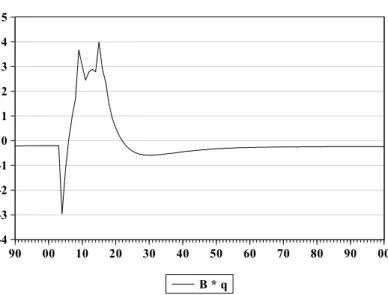
Initial values for stocks are set up mostly using Godley and Lavoie (2006) and are fictional; as a result, responses to shocks might be difficult to interpret. To have a better understanding of results, we normalize all the series according to their mean and standard deviations (SD). In this way, we can interpret results from shocks as the misalignment from the mean of the series, expressed in SDs. The reader will notice that some initial values are not equal to zero. The interpretation of that is the following. A positive (negative) initial value implies that before the simulation, the variable has, on average, higher (lower) values than after the simulation (the coefficient of the SD indicates how much higher). That is, after the shock the variable reports, on average, lower (higher) values than the initial one. We report the simulation results in figure 1 through figure 5. We analyze the results in five blocks, with figure 1 representing the response from the RER, figure 2 from trade, figure 3 from public finances, figure 4 from redistribution, and figure 5 from the corporate sector.
5.1 Effect on the RER’s Trajectory
Figure 1 reports estimations for the RER, which is calculated as the nominal exchange rate multiplied by the ratio between foreign and domestic prices. Being a system with only two
countries, the RER is interpreted as a bilateral RER. Additionally, we report the CBA price, terms of trade (TOT)—that is, the ratio between export and import prices—and the stock of CBAs held by US investors.
34
Figure 1. Responses from RER, CBA, TOT
Simulations show that the behavior of the RER follows two elements, namely, CBAs’ price and TOT.
After the initial increase in 2004 in the exogenous demand component for MX exports, TOT improved in MX and deteriorated in the US. In figure 1, from 2004 to 2014, TOT improved by 3.5 SD.
We report the price for CBAs on the right and the RER on the left. Structured notes register an increase in price of almost 4 SDs from 2004 to 2009, confirming the high sensitivity of this specific type of asset to commodity prices. The RER responds by appreciating by a similar magnitude during the same period. Both variables fall after 2009.
-1 0 1 2 3 4 90 00 10 20 30 40 50 60 70 80 90 00 RER
Real Exchange Rate
-1 0 1 2 3 4 90 00 10 20 30 40 50 60 70 80 90 00 TO T Terms of Trade -1 0 1 2 3 4 90 00 10 20 30 40 50 60 70 80 90 00 CBA price CBA Price -4 -3 -2 -1 0 1 2 3 4 5 90 00 10 20 30 40 50 60 70 80 90 00 CBA Stock CBA Stock
35
Growing prices in CBAs attract foreign investors, who shift their preferences toward CBAs and adjust their portfolios to a new set of asset prices. US households want to hold more CBAs as they expect to increase returns in their portfolio. After the fall in 2008 crisis—modeled by a reduction in the interest rate benchmark from the US by 1 percentage point—interest rates paid on US domestic bills and US deposit decrease, making US investors unhappy about their domestic yield. Thus, they keep a certain proportion of their portfolios allocated toward CBAs. As a result, the price of CBAs only falls slightly in the aftermath of the 2009 crisis, preventing a deep fall in the RER.
To supply a greater number of CBAs and meet the growing demand from domestic households, US financial intermediaries increase the demand for foreign bills—reducing their demand for domestic bills and deposits. A proportion of the new MX bills bought by households is securitized and offered to the US households. This generates higher demand for MX currency. As a result of the improvement in the TOT, the RER registers an upward movement (appreciation).
The four variables reported in figure 1 fall almost back to the original steady state after the double shock in 2014. After 2014, the TOT drops almost 4 SDs because of the reduction in demand for MX exports. The fall in demand for MX exports leads to a negative shock in CBA prices as the US financial sector adjusts its portfolio toward safer securities, such as US domestic bills and US deposits. That is, investors shift their preferences, generating a selloff in MX financial assets—what Dornbusch (1976) and Cavallo et al. (2005) define as overshooting of the currency. International investors’ portfolios adjust toward a conservative strategy, which financial practitioners commonly define as “flight to quality.” As a result, the price of CBAs falls by 3.5 SDs. Similarly, the stock of CBAs outstanding in the system drops from 0.9 SDs in 2014 to -3.8 SDs in 2016. We observe that the RER depreciates by almost 3 SDs over the next five fictional years.
The negative adjustment in the RER consequent to the selloff in domestic assets highlights the RER’s sensitivity to portfolio flows (Dornbusch 1976; Minsky 1996; Harvey 2009). Harvey (2001, 2009) argues that financial elements can affect the currency’s trajectory, underlying the fact the RER’s long-run path is simply the result of short-run elements. The more shocks the system experiences in the short run, the less likely they are to readjust to the initial value. Look, for example, at the time the RER needs to recover to its initial values. After the initial shock in 2004, the misalignment from the baseline scenario is recovered over a period of 25 fictional years, until
36
2030. This is in line with the purchasing power parity puzzle put forward by Rogoff (1996) that does not support the idea of the fulfillment of the law of one price for the RER.4 The RER’s nonstationarity implies that when a shock occurs, this price could float away from the original baseline for an extended period of time. In other words, the RER may be subject to hysteresis—that is, a process according to which shocks to economic variables are not completely absorbed over a long-time horizon.
5.2 Effect on Trade
The trade channel is the effect that a change in the relative price has on the trade volume, that is the demand for exports and imports. To explore how it functions, in figure 2 we report on the
simulation for export and import ratios to GDP, as well as the current and trade accounts. All variables are scaled by GDP.
Figure 2. Exports, Imports, Trade Balance, and Current Account
Having imposed an increase in the exogenous parameter for the demand for exports, the volume of exports from MX to US immediately increases. In turn, the current account benefits. Both variables increase by almost 6 SDs immediately after the positive shock in 2004.
4 The purchasing power parity (PPP) hypothesis holds that national price levels should be equal once converted to a
common currency (Rogoff 1996). According to this theory, the difference between domestic and foreign price inflation should equal changes in the spot exchange rate over time, expressed in logarithmic values.
-6 -4 -2 0 2 4 6 90 00 10 20 30 40 50 60 70 80 90 00 TB / Y CAB / Y Trade and Current Account
-6 -4 -2 0 2 4 6 90 00 10 20 30 40 50 60 70 80 90 00 X / Y M / Y Import and Export Ratio