COST OPTIMAL VIDEO TRANSCODING IN MEDIA CLOUD:
INSIGHTS FROM USER VIEWING PATTERN
Guanyu Gao
1, Weiwen Zhang
1, Yonggang Wen
1, Zhi Wang
2, Wenwu Zhu
3, Yap Peng Tan
1 1Nanyang Technological University, Singapore
2
Graduate School at Shenzhen, Tsinghua University, China
3Tsinghua University, China
{
ggao001, wzhang9, ygwen, eyptan
}
@ntu.edu.sg,
{
wangzhi@sz., wwzhu@
}
tsinghua.edu.cn
ABSTRACTVideo transcoding has been touted as an enabling technolo-gy to support growing media consumption over heterogenous devices. However, on-line transcoding could incur tremen-dous, if not prohibitive, cost in deploying or renting resources. In this research, we leverage an insight into the viewing pattern of video consumers to reduce the operating cost of video transcoding services. Specifically, it has been report-ed that viewers tend to terminate their session before the w-hole video is watched. As such, it is not cost-efficient for service providers to store or transcode all segments of the videos. Built upon this insight, we propose a partial transcod-ing scheme for content management in a media cloud to re-duce the operating cost. Particularly, each content is split in-to multiple segments and sin-tored in different files of varying playback rates. Some of the segments are stored in cache, re-sulting in storage cost; while some are transcoded in real-time in case of cache miss, resulting in computing cost. We aim to minimize the long-term operational cost by determining the number of segments for each playback rate to be cached or transcoded in real-time. We formulate this partial transcoding scheme as a constrained integer optimization problem. Lever-aging Lagrangian relaxation and a subgradient method, we obtain the approximate solution to the integer program. Nu-merical results indicate that our proposed partial transcoding scheme can save more than 30% of operational cost, com-pared with a brute-force scheme of caching all the segments.
Index Terms— Partial transcoding, user viewing pattern, media cloud, viewer behavior
1. INTRODUCTION
Mobile video, owning to the exploding popularity of mo-bile devices, has become one of the dominant contributors to mobile data traffic. According to Cisco’s prediction, global mobile video will increase 16-fold between 2012 and 2017, which accounts for over 66% of total mobile data traffic [1]. However, limited bandwidth and unstable wireless channel inherently deteriorate the user experience, triggering a tussle
between the growing demand of the mobile video traffic and the quality of network service.
Video transcoding has been touted as an enabling technol-ogy to support growing media consumption over heteroge-nous devices. [2] aimed to maximize the QoE for mobile users, by storing content copies transcoded in different bit rate. [3] proposed a distributed transcoding platform to re-duce transcoding time for users. Those two works only focus on improving user experience of client side, without consider-ing the operational cost of the content provider. Nevertheless, it was reported by [4] that it would cost millions of pounds for content providers to transcode and store a large number of content, including those seldom watched videos. Moreover, it is observed that only 10% of the most popular videos account for almost 80% of total views [5]; and for 60% of the videos, only less than 20% of their duration is viewed, most of users abort viewing within 40 seconds [6, 7, 8]. This user viewing pattern reveals that users consume only a small fraction of each video, which should attract content providers’ attention when designing the content management system.
Based on the insight from user viewing pattern, we pro-pose a partial transcoding scheme for content management in a media cloud. Any original video file is split into a set of seg-ments, each of which has a fixed playback duration. When the user consumes some contents, it sends a request to the stream-ing engine with a required streamstream-ing rate. If the requested segment in the playback rate is available, users can consume the content immediately, resulting in storage cost; otherwise, a real-time transcoding is conducted, resulting in transcod-ing cost. The more segments are cached, the less transcodtranscod-ing tasks will be conducted, and vice versa. Therefore, there ex-ists a tradeoff in optimizing the total cost.
Using the partial transcoding scheme, we aim to mini-mize the long term operational cost, including storage cost and computing cost, while satisfying the storage constraint and computation constraint of the streaming engine. We for-mulate the partial transcoding scheme as a constrained opti-mization problem, which is an integer program. Leveraging Lagrangian relaxation, we transform the original optimization
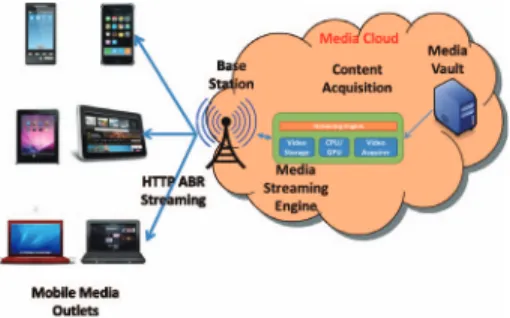
Fig. 1. A schematic diagram for streaming system: contents are transcoded into a set of files with different playback rates, and cached in the streaming engine.
problem and obtain the approximate solution. Particularly, we adopt subgradient method to achieve the optimal Lagrange multiplier. Numerical results show that i) the approximate so-lution is close to the optimal soso-lution; ii) our proposed scheme can save more than 30% of operational cost, compared with all-segments-stored scheme; iii) our proposed scheme is ro-bust to the change of the request arrival rate and more adap-tive than the full transcoding scheme without segmentation.
To the best of our knowledge, this is the first work to adopt the partial transcoding scheme under the user viewing pattern to save operational cost from the economic perspec-tive. Leveraging user viewing pattern, our proposed partial transcoding scheme can reduce the storage cost and comput-ing cost for cloud content providers.
The rest of the paper is organized as follows: Section 2 presents system model and problem formulation. Section 3 provides an approximation algorithm for solving the problem. The experiment results are presented in Section 4. Finally, Section 5 concludes the paper and discusses the future work.
2. SYSTEM MODEL AND PROBLEM FORMULATION
2.1. System Architecture
This subsection presents our proposed system architecture for media cloud with video transcoding capability, serving a wide range of media outlets. This reference architecture is based on real experience with one of the leading players in China.
Our proposed cloud-based streaming system is illustrated in Fig. 1, the system consists of three parts, including media vault, media streaming engine and mobile media outlets. The functionalities of each modules are explained as follows:
Media Vault:it stores media files in their original formats and all the transcoded copies of alternative playback rates.
Media Outlet:it provides a display function for the view-ers to consume the content and negotiates with the streaming engine for a proper playback rate.
Media Streaming Engine: it renders the content to me-dia outlets in the corresponding playback rate, which is
deter-mined by the physical capability of the media outlet and the network status. The engine obtains content files from three alternative resources. First, in its local storage, a partial set of content files in various playback rates are stored for con-sumption. Second, a full copy of its original content is stored in local storage and can be transcoded in a real-time manner, by the CPU/GPU in the streaming engine, into the request-ed format. Finally, in rare case, it can retrieve content files of transcoded formats from the media vault. In this paper, we only focus on the first two cases. Specifically, an original video file is split into a set of sub-files, each of which consists of video content of a fixed playback duration (e.g., 2 seconds). These sub-files are, encoded into a set of video formats with different playback rates, supporting different media outlets.
In this system, the streaming engine incurs two alterna-tive costs, demanding a trade-off in optimizing the total cost of service. First, it stores a partial set of transcoded content files in its local storage. This part of cost results from the rental of storage capacity from cloud service providers. Sec-ond, it transcodes the original content into the requested bi-trate, resulting in a computing cost. It can be seen that these two parts of cost are competing with each other. On one hand, if the storage capacity is large, more transcoded content files can be stored, minimizing the opportunity of conducting real-time video transcoding. On the other hand, if more computing resources are provisioned, less transcoded contents files are needed to store statically in the local storage. In the following, we present our mathematical formulation into an optimization problem, aiming to minimize the total cost of service.
2.2. System Model
In this subsection, we present mathematical models for the cloud-based HTTP ABR streaming system, including content management model, user-request model and cost model.
2.2.1. Content Management Model
We assume that the system manages a set ofM contents. For
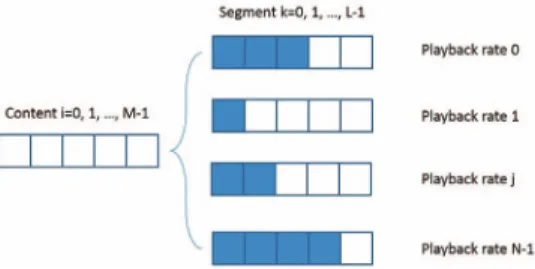
any videoi(i= 0,· · · , M−1), it is split intoLisegments, as
illustrated in Fig. 2. We assume thatLiis bounded by above,
i.e., Li ≤ L. Moreover, for each videoi, it is transcoded
into a set ofN playback rates. For each playback rate ofri,j
(j = 0,· · · , N−1), a subset of content files are cached in the streaming engine. In view of the user viewing pattern, we
assume that the firstni,j segments (i.e., from 0 toni,j−1)
are cached and the rest ofLi−ni,jsegments (i.e., fromni,j
toLi−1) are transcoded on live by the streaming engine.
2.2.2. User Request Model
It has been observed that not all viewers will complete the w-hole video clip, 60% of videos are watched for no more than 20% of their duration [6, 7]. As such, the user viewing pat-tern can be characterized by cumulative distribution function
Fig. 2. Content management under the partial transcoding scheme. Shaded segments are cached, and unshaded seg-ments are transcoded on live.
ofFi(k). In particular,Fi(k)denotes the probability in which
the user would watch the video up to thekth segment. In
prac-tise, the viewing pattern can be approximated by a truncated exponential distribution, resulting the following formula,
Fi(k) =K1
i(1−e
−μk),0≤k≤L
i−1, (1)
whereKiis a factor for theith content.
We consider a discrete time slot model and denote
xi,j,k(t)as the number of users watching thekth segment of
theith content in thejth playback rate at time slott. We
as-sume we have the initial information at the beginning of the first time slot for how many users are watching a particular
video segment (i.e.,xi,j,k(0−)). Then, given the initial
infor-mation, we have
xi,j,0(0) = xi,j,0(0−) +ai(0)pi,j, (2)
xi,j,0(t) = ai(t)pi,j, (3)
xi,j,k(t) = ai(t)pi,j1−Fi(k)
1−Fi(0), (4)
where ai(t)is the number of arrivals requesting for the ith
content in the first segment at time slot t, and pi,j is the
probability of playback rateri,jbeing requested1, for which
the condition ofNj=0−1pi,j = 1 is satisfied. We assume
E{ai}=λiis known.
2.2.3. Cost Model
Two cost components incur in this proposed architecture, i.e., storage cost and computing cost.
Storage consumption: The storage consumption of the ith content isBiS = jN=0−1ni,jfiri,j, wherefi denotes the
scaling factor for videoi and the file size is assumed to be
proportional to its playback rateri,j. Thus, the total storage
consumption to store all the contents is
BS =M−1 i=0 BS i = M−1 i=0 N−1 j=0 ni,jfiri,j. (5)
1The requested playback rate is determined by the varying wireless
chan-nel. We assume we have the information of the probability distribution of users requesting different playback rates.
Storage cost: It incurs storage cost in storing the cached
video files. Specifically, for theith content in thejth playback
rate, the storage cost isSi,j = cSfiri,j, where cS denotes
marginal price of storage space. Using this notation, the total
storage cost for theith content over timeT is given by
CS i = T−1 t=0 αtN−1 j=0 ni,jSi,j, (6)
whereαis a discounted factor (0 < α <1). Thus, the total
storage cost over timeTisCS=Mi=0−1CiS.
Computing consumption: The computing consumption
of theith content with playback rate ofri,jiswi,j =giri,j,
wheregidenotes the scaling factor for theith content and the
workload is assumed to be proportional to its playback rate. Using this notation, the total computing consumption for the
ith content in thejth playback rate over timeTis given by
BW i,j= T−1 t=0 αt Li−1 k=ni,j xi,j,k(t)wi,j. (7)
We assume that the computing cost of a particular video is proportional to the number of user requests. Thus, the total
computing consumption for theith content over timeT is
BW i = T−1 t=0 αtN−1 j=0 Li−1 k=ni,j xi,j,k(t)wi,j. (8)
The total computing consumption over time T is BW =
M−1
i=0 BiW.
Computing cost: It incurs computing cost in real-time transcoding the video file into the requested playback rate.
Specifically, the computing cost of transcoding theith
con-tent into playback rate ofri,jisWi,j =cWgiri,j, wherecW
denotes marginal price of computing. Similar to the comput-ing consumption, we can have the total computcomput-ing cost for the
ith content over timeT, given by
CW i = T−1 t=0 αtN−1 j=0 Li−1 k=ni,j xi,j,k(t)Wi,j. (9)
The total computing cost over timeTisCW =Mi=0−1CiW.
2.3. Problem Formulation
In this paper, we aim to minimize the time average storage cost and computing cost for partial transcoding. In a real sys-tem deployment, we observe that the storage space in the con-tent cache can be filled quickly, in order to meet all the QoE requirement. In addition, the computation capacity of the sys-tem is also limited. Hence, the content management with par-tial transcoding scheme can be formulated as the following
constrained optimization problem, min n Tlim→∞ 1 TE{CS+CW}, (10) s.t. BS ≤θ, (11) lim T→∞ 1 TE{BW} ≤ρ, (12)
where the expectation is taken overai. Eq. (11) represents
the storage capacity constraint with total limited cache size
θand Eq. (12) represents the computing capacity constraint
with workload thresholdρ.
3. SOLUTION OF COST OPTIMAL VIDEO TRANSCODING
In this section, we first make a transformation of the optimiza-tion problem and then solve it using Lagrange relaxaoptimiza-tion.
3.1. Transformation of the Optimization Problem
First, we note that from Eq. (2), the number of arrivals re-questing for a specified segment changes in the first few time
slots, due to the effect of the initial statexi,j,0(0−). Suppose
afterTs time slots, the system will enter into a stable state
with a fixed average number of arrivals. The average number of arrivals requesting for a specified segment can be given as E{xi,j,k(t)} = λipij1−Fi(k)
1−Fi(0). Then, considering Eq. (10),
we notice that the cost incurred from0toTs−1, will become
zero asT → ∞. Therefore, it does not contribute to the
over-all average cost and the minimum average cost per time slot is
determined by the cost incurred afterTstime slots. The same
rationale can be adopted for the constraint Eq. (12).
Since request arriving distribution is the same for each time slot under the stability of the system, we make a one-shot policy for the cost-optimal real-time transcoding. The minimum average cost per time slot can be achieved by solv-ing the followsolv-ing optimization problem,
min n M−1 i=0 N−1 j=0 [ni,jcSfiri,j + Li−1 k=ni,j Qij(k)cWgiri,j] (13) s.t. π1= M−1 i=0 N−1 j=0 ni,jfiri,j−θ≤0, (14) π2=M−1 i=0 N−1 j=0 Li−1 k=ni,j Qij(k)giri,j−β ≤0,(15) whereQij(k) = λipij11−−FFi(k) i(0), β = ρ(1−α) αTs .It’s an integer
linear program and known to be NP-hard, which can not be solved in polynomial time.
3.2. Approximate Solution of the Cost Optimal Video Transcoding
In this subsection, we rely on Lagrange relaxation to obtain the approximate solution to the optimization problem. We firstly rewrite the above optimization problem by introducing
variablesmi,j,k, which denotes whether thekth segment of
theith video in thejth playback rate should be cached, and
then relax the constraints (Eq.(14) and (15)) by bringing them into the objective function (Eq.(13)) with associated Lagrange Multipliers, we have L(μ) = min m M−1 i=0 N−1 j=0 Li−1 k=0
[Ai,j,k(μ)mi,j,k+Bi,j,k(μ)]
−μ1θ−μ2β, (16)
s.t. mi,j,k∈ {0,1},
whereμis the Lagrange multiplier, and
Ai,j,k(μ) = [fi(cS+μ1)−Qij(k)gi(cW +μ2)]ri,j Bi,j,k(μ) = Qij(k)giri,j(cW +μ2)
As we can see from Eq.(16), for a specifiedμ,Ai,j,k(μ)
andBi,j,k(μ)are constants. Then the subproblem is to
min-imize Eq.(16) by selecting appropriate m. It can be easily
solved by settingmi,j,kto 0 if the corresponding Ai,j,k(μ)
is no less than zero, and settingmi,j,kto 1 otherwise. Thus
the original problem is evolved to find the optimalμand then
solve the subproblem. We use the subgradient method to
ob-tain the optimal value ofμin an iterative manner. The details
of this algorithm are illustrated in Algorithm 1.
Algorithm 1Subgradient Method for Partial Transcoding
Input: Initialize Scalarσ∈(0,2),μ=0, s = 0, Output: 1: repeat 2: for alli∈[0, M), j∈[0, N), k∈[0, Li)do 3: ifAi,j,k(μ)>= 0then 4: mi,j,k←0 5: else 6: mi,j,k←1 7: end if 8: end for
9: Update upper bound (UB) and lower bound (LB) by
calculating Eq.(13) and (16).
10: Updateπ1andπ2by calculating Eq. (14) and (15).
11: Calculate step size:
12: δ← σ(UBπ2−LB)
1+π22 , μ←max(0, μ+δπ)
13: s←s+ 1 14: untils= 200
4. NUMERICAL RESULTS
In this section, we first describe the experimental setting. We then analyze the performance of the approximate solu-tion. Following that, we also compare the partial transcoding scheme with two alternative schemes.
4.1. Dataset Description and Experimental Setting User Viewing Pattern: As mentioned in [6], video ses-sions have a very high probability to be aborted in a short time, mostly within 40 seconds. Similar observation was also demonstrated in [7, 8]. We use Eq.(1) to approximately fit the data in [6], Fi(k) = K1 i(1−e −4.6 k Li−1),0≤k≤L i−1, (17) whereKiequals to 0.98.
Video Popularity Distribution: Only 10% of popular videos account for nearly 80% user requests [5], most of videos are not frequently requested. We describe this
char-acteristic by power-law distribution,y ∝ ik, wherey is the
PDF of a content viewed byiusers in a time slot.
Storage and Computing Cost:We adopt the storage and transcoding pricing model from Amazon S3 Standard Stor-age and Elastic Transcoder. The storStor-age price is $0.095/GB per month; the transcoding price is $0.015/minute for videos below 720p, and $0.030/minute for videos above 720p.
Video Duration and Bitrate: The average duration of online video is 4.3 minutes and only less than 5% of videos last more than 10 minutes [5]. For simplification, we assume video duration has a uniform distribution from 0 to 10 min-utes, and each video content is transcoded into five kinds of bitrate files.
4.2. Comparison between Approximate Solution and Op-timal Solution
We compare its approximate solution with the optimal
solu-tion, we select the dimension of the variablem (i.e. the
num-ber of segments) from102to107 and evaluate the
approxi-mation error ratio. As illustrated in Table 1, the approximate solution is close to the optimal solution and the error ratio
does not increase as the dimension ofm scales.
Table 1. Approximation Error of Different Dimensions
Dimension 102 103 104 105 106 107
Error Ratio(%) 0.0 2.4 2.6 2.8 2.7 2.7
4.3. Comparison with Alternative Schemes
We compare the performance of the proposed partial transcoding scheme with two alternative schemes, i.e., all-segments-stored scheme and full transcoding scheme without segmentation, given as follows:
2000 4000 6000 8000 10000 −20 0 20 40 60 80 Number of contents
Cost Reduction Percentage (%)
unlimited resource limited storage resource limited computing resource
(a) Varying content number
0 100 200 300 400 500 600 700 0
50 100
Average Request Arrival Rate (#/Month)
Cost Reduction Percentage (%) 0 100 200 300 400 500 600 7000 50 100
Cost Percentage
cost reduction percentage storage cost percentage computing cost percentage
(b) Varying request arrival rate
Fig. 3. Cost reduction over all-segments-stored scheme.
All-segments-stored scheme: it is a brute-force based scheme, which stores all the segments in different playback rates for each content. It would result in a large storage cost and zero computing cost, due to no transcoding operation.
Full transcoding scheme without segmentation: it is similar to the partial transcoding scheme that manages the tradeoff between storage cost and computing cost, but with-out file segmentation for content management. As such, the whole video file of a playback rate is either stored in local storage or transcoded online.
4.3.1. Comparison with all-segments-stored scheme
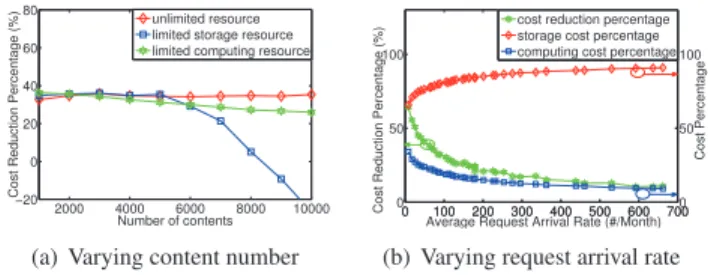
We plot the cost reduction percentage of partial transcoding scheme over the all-segments-stored scheme in Fig. 3. First, Fig. 3(a) shows the cases under varying content number and different resource constraints. The partial transcoding scheme can reduce the cost more than 30% when there are sufficient computing resource and storage resource (i.e., both Eq.(11) and Eq.(12) are inactive). While given limited computing re-source, the partial transcoding scheme also has less total cost than the all-segments-stored scheme, but the cost reduction percentage drops slightly as the number of contents increas-es. However, when the available storage resource is limited (i.e., storage constraint is tight), the cost reduction percentage will decline dramatically as the number of contents increas-es. When there are more than 6000 contents, the constraint of Eq. (11) becomes active, indicating that the storage re-source reaches its maximum utilization. Especially, when the number of contents is more than 8000, the partial transcoding scheme incurs more cost than the all-segments-stored scheme. This is because, with the increase of the number of contents, real-time transcoding will be conducted more frequently to satisfy the increasing number of user requests, due to insuffi-cient storage space to cache segments. Therefore, one needs to strategically choose the storage capacity for designing an effective partial transcoding scheme.
Second, Fig. 3(b) shows the cases under varying aver-age request arrival rate and a fixed number of contents. The partial transcoding scheme still outperforms the all-segments-stored scheme. As the contents’ request arrival rate increases, however, the overall cost reduction percentage decreases. Par-ticularly, the percentage of storage cost increases, while the
0 100 200 300 400 500 600 700 0 20 40 60 80 100
Average Request Arrival Rate (#/Month)
Cost Reduction Percentage (%)
Partial transcoding Full transcoding without segmentation
(a) Cost reduction percentage
0 200 400 600 800 1000 1200 1400 0 20 40 60 80 100
Average Request Arrival Rate (#/Month)
S
egmen
t/Vid
eo
Cached Percentage (%) Partial transcoding Full transcoding without segmentation
(b) Cached percentage
Fig. 4. Comparison with full transcoding scheme without seg-mentation.
computing cost decreases. This is because, with the increase of contents’ request arrival rate, there are more opportunity of transcoding segments that are not locally stored, resulting more computing cost. Thus, more segments will be cached in local storage rather than real-time transcoded with the in-crease of arrival rate.
4.3.2. Comparison with full transcoding scheme without seg-mentation
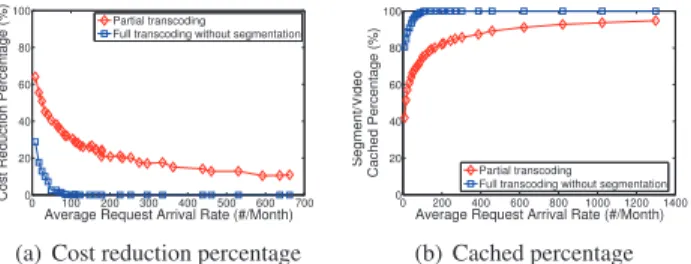
We compare partial transcoding scheme with full transcoding scheme without segmentation in Fig. 4. First, Fig. 4(a) plot-s the coplot-st reduction percentage for theplot-se two plot-schemeplot-s over all-segments-stored scheme. It shows that under different av-erage request arrival rates, the partial transcoding scheme can have more cost reduction than the full transcoding scheme without segmentation. This is because, for the full transcod-ing scheme without segmentation, a video file has to be com-pletely transcoded into the requested bitrate, even if a small fraction of the video is requested, resulting more computing cost. In addition, it can be observed that the full transcod-ing scheme without segmentation has restricted cost reduc-tion. When the request arrival rate is low, it can still reduce the cost, but such a cost reduction disappears as the request arrival rate increases to around 100. In this case, it stores al-l the segments, without any cost reduction compared to the all-segments-stored scheme.
Second, Fig. 4(b) plots the cached percentage of these t-wo schemes, respectively. As the average request arrival rate increases, the cached percentage of video files is much high-er than the cached phigh-ercentage of segments. Particularly, all the video files are stored under the full transcoding scheme without segmentation when the average request arrival rate reaches to around 100. This shows that the partial transcod-ing scheme is robust to the change of the request arrival rate and more adaptive than the full transcoding scheme without segmentation.
5. CONCLUSION
In this paper, we presented a mathematical model to achieve the cost optimal video transcoding by leveraging user viewing
pattern. We first proposed a partial transcoding scheme for content management and formulated the minimization cost problem into an integer linear program. We then applied the Lagrange relaxation technique to obtain an approximate solu-tion. Results show that our proposed method can save more than 30% of the operational cost. Moreover, compared with the method without partial transcoding scheme, our method is much more robust to the change of the request arrival rate. As future work, we will consider how to make caching policies in the case of the variation of video popularity.
6. REFERENCES
[1] Cisco, Cisco Visual Networking Index: Forecast and
Methodology, 2012 - 2017, 2013.
[2] Weiwen Zhang, Yonggang Wen, Zhenzhong Chen, and Ashish Khisti, “Qoe-driven cache management for http adaptive bit rate (abr) streaming over wireless networks,” inGlobal Communications Conference (GLOBECOM), 2012 IEEE. IEEE, 2012, pp. 1951–1956.
[3] Horacio Sanson, Luis Loyola, and Daniel Pereira, “Scal-able distributed architecture for media transcoding,” in
Algorithms and Architectures for Parallel Processing, p-p. 288–302. Springer, 2012.
[4] Ben Whitelaw, “Almost all youtube views come from just 30% of films,” Tech. Rep., The Daily Telegraph, 2011. [5] Meeyoung Cha, Haewoon Kwak, Pablo Rodriguez,
Yong-Yeol Ahn, and Sue Moon, “Analyzing the video popularity characteristics of large-scale user generated
content systems,” IEEE/ACM Transactions on
Network-ing (TON), vol. 17, no. 5, pp. 1357–1370, 2009.
[6] Alessandro Finamore, Marco Mellia, Maurizio M Mu-naf`o, Ruben Torres, and Sanjay G Rao, “Youtube every-where: Impact of device and infrastructure synergies on
user experience,” inProceedings of the 2011 ACM
SIG-COMM conference on Internet measurement conference. ACM, 2011, pp. 345–360.
[7] Lucas CO Miranda, Rodrygo LT Santos, and Alberto HF Laender, “Characterizing video access patterns in
main-stream media portals,” inProceedings of the 22nd
inter-national conference on World Wide Web companion. In-ternational World Wide Web Conferences Steering Com-mittee, 2013, pp. 1085–1092.
[8] S Shunmuga Krishnan and Ramesh K Sitaraman, “Video stream quality impacts viewer behavior: inferring
causal-ity using quasi-experimental designs,” inProceedings of
the 2012 ACM conference on Internet measurement con-ference. ACM, 2012, pp. 211–224.