UNITED STATES
SECURITIES AND EXCHANGE COMMISSION Washington, D.C. 20549
FORM SD
SPECIALIZED DISCLOSURE REPORT
CREE, INC.
(Exact name of registrant as specified in its charter)
North Carolina 0-21154 56-1572719
(State or other jurisdiction of incorporation) (Commission File Number) (I.R.S. Employer Identification Number) 4600 Silicon Drive
Durham, North Carolina 27703
(Address of principal executive offices) (Zip Code) Michael E. McDevitt (919) 407-5300
(Name and telephone number, including area code, of the person to contact in connection with this report.)
Check the appropriate box to indicate the rule pursuant to which this form is being filed, and provide the period to which the information in this form applies:
Section 1 – Conflict Minerals Disclosure
Item 1.01 Conflict Minerals Disclosure and Report
In accordance with Rule 13p-1 under the Securities and Exchange Act of 1934, as amended, Cree, Inc. (“Cree”) hereby files this Form SD and the associated Conflict Minerals Report with the SEC. The Conflict Minerals Report includes a description of Cree’s due diligence program, the efforts Cree undertook in making its determinations with respect to products manufactured by it in 2016, and the results of such efforts.
Conflict Minerals Disclosure
A copy of Cree’s Conflict Minerals Report is filed as Exhibit 1.01 to this Form SD and is publicly available at
http://www.cree.com/about/suppliers-contractors/cree-supplier-resources/conflict-minerals. No contents from Cree’s website are incorporated into this Form SD by this reference.
Item 1.02 Exhibit
The Conflict Minerals Report required by Item 1.01 of Form SD is filed as Exhibit 1.01 to this Form SD. Section 2 – Exhibits
Item 2.01 Exhibits
Exhibit 1.01 Conflict Minerals Report for the reporting period January 1, 2016 to December 31, 2016.
SIGNATURE
Pursuant to the requirements of the Securities Exchange Act of 1934, the registrant has duly caused this report to be signed on its behalf by the undersigned hereunto duly authorized.
CREE, INC.
By: /s/ Michael E. McDevitt Michael E. McDevitt
Executive Vice President and Chief Financial Officer
Exhibit 1.01 to Form SD Conflict Minerals Report
CREE, INC.
For The Year Ended December 31, 2016
This Conflict Minerals Report (CMR) of Cree, Inc. (Cree, the Company, we, us, or our) for the year ended December 31, 2016 is filed to comply with Rule 13p-1 under the Securities Exchange Act of 1934 (the Rule) promulgated by the Securities and Exchange Commission (the SEC) pursuant to the Dodd-Frank Wall Street Reform and Consumer Protection Act (the Act). This CMR has been prepared on behalf of Cree management.
This CMR contains forward-looking statements regarding our business and conflict minerals efforts, including steps we intend to take to mitigate the risk that conflict minerals in our products benefit certain armed groups. Words such as “expects,” “intends,” “believes,” and similar expressions or variations of such words are intended to identify forward-looking statements, but are not the exclusive means of identifying forward-looking statements in this CMR. Additionally, statements concerning future matters that are not historical are forward-looking statements. Forward-looking statements are inherently subject to risks and uncertainties, and actual results and outcomes may differ materially from the results and outcomes discussed in or anticipated by the forward-looking statements. Risks, uncertainties, assumptions, and other factors that could cause or contribute to such differences in results and outcomes include, among other things, our suppliers’ responsiveness and cooperation with our due diligence efforts, our ability to implement improvements in our conflict minerals program and our ability to identify and mitigate related risks in our supply chain. We undertake no obligation to review or update any forward-looking statements to reflect events or circumstances occurring after filing this CMR with the SEC. Cree has performed due diligence measures as required by the Rule with the goal of determining the chain of custody and country of origin information for the necessary conflict minerals, 1 also referred to as 3TGs, used in our products manufactured in 2016. In particular, we sought to determine whether any of the necessary conflict minerals in our product supply chains may have originated in the Democratic Republic of the Congo (DRC) or an adjoining country, also referred to as the Covered Countries, and whether any conflict minerals originating in the Covered Countries directly or indirectly financed or benefited armed groups in the Covered Countries. As used herein, the term “manufactured” includes products manufactured or contracted to be manufactured by Cree. _______________
1 The term “conflict mineral” is defined in Section 1502(e)(4) of the Act as (A) columbite-tantalite, also known as coltan (the metal
ore from which tantalum is extracted); cassiterite (the metal ore from which tin is extracted); gold; wolframite (the metal ore from which tungsten is extracted); or their derivatives; or (B) any other mineral or its derivatives determined by the Secretary of State to be financing conflict in the Democratic Republic of the Congo or an adjoining country.
Because not all suppliers have provided smelter and refiner data and the data provided by some of our suppliers is incomplete, Cree is unable at this time to determine the exact origin of the conflict minerals in all of the assemblies, components, and minerals supplied to us. Therefore, we cannot exclude the possibility that some conflict minerals used in our products manufactured in 2016 may have originated in the Covered Countries, come from sources other than recycled or scrap sources, or come from sources that directly or indirectly financed or benefited armed groups in the Covered Countries. We have obtained no information, however, to indicate that any conflict minerals used in our products manufactured in 2016 originated in the Covered Countries and directly or indirectly financed or benefited armed groups in the Covered Countries.
Pursuant to the Rule, Cree is submitting this CMR as an Exhibit to its Form SD. Company and Product Overview
Cree is a leading innovator of lighting-class light emitting diode (LED) products, lighting products, and semiconductor products for power and radio-frequency (RF) applications. Our products are targeted for applications such as indoor and outdoor lighting, video displays, transportation, electronic signs and signals, power supplies, solar inverters, and wireless systems.
We develop and manufacture semiconductor materials and devices primarily based on silicon carbide (SiC), gallium nitride (GaN), and related compounds. Our LED products consist of LED components, LED chips, and SiC materials. Our lighting products primarily consist of LED lighting systems, lamps and bulbs. We design, manufacture and sell lighting systems, lamps, and bulbs for indoor and outdoor applications, with our primary focus on LED lighting systems for the commercial and industrial markets. In addition, we develop, manufacture and sell power products made from SiC and RF devices made from GaN.
The majority of our products are manufactured at our production facilities located in North Carolina, Wisconsin, and China. We also use contract manufacturers for certain aspects of product fabrication, assembly, and packaging.
Our SiC materials, in the form of substrates and boules, do not contain any 3TGs, and thus no further due diligence is required with respect to those products. All other Cree products have the potential to include one or more of the conflict minerals. Table 1 below outlines Cree’s products and provides typical conflict mineral content along with the percent of revenue per business unit.
Table 1
Cree Business
Unit Percent of CreeRevenue* Products
Percentage of Products that contain Conflict
Minerals?
Typical Conflict Mineral Content by Weight Percentage
Au Sn W Ta
LED Lighting
Products 51%
LED Lamps and Bulbs 100% 0.1 - 1% 0.1 - 1% < 0.1% < 0.1% LED Lighting 100% 0.05 - 1% 0.1 - 1% < 0.1% < 0.05% Accessories 50-75% < 0.1% 0 - 1% < 0.05% < 0.1% LED Products 35% LED Chips 100% 0.5 - 3% 0.2 - 10% 0 - 0.6% 0% LED Components 100% 0.1 - 0.3% 0 - 0.3% 0 - 0.1% 0 - 0.1% Modules + Drivers 100% 0.1 - 0.3% 0.1 - 0.5% 0 - 0.01% 0 - 0.1% Accessories 30-50% < 0.1% < 0.5% 0% 0% Wolfspeed Products 14%
Materials 0% N/A N/A N/A N/A
RF Die 100% 0.5 - 35% 0.2 - 10% 0 - 0.6% 0%
Power Diodes 100% < 0.05% < 0.05% < 0.1% 0% RF Transistor Packages 100% 0.01 - 0.1% < 0.01% 0 - 85% < 0.05% *Note: Based on reported revenue for six months ended December 25, 2016.
Conflict Minerals Policy
Cree has adopted a Conflict Minerals Policy under which it expects its suppliers to develop internal conflict mineral policies, due diligence frameworks, and management systems that meet the minimum requirements of the guidelines developed by the Organisation for Economic Co-operation and Development (OECD). Our suppliers’ conflict minerals policies must be designed to identify and eliminate from use in products sold to Cree any conflict minerals which are known to come from sources funding armed groups in the DRC region. Cree requires its direct suppliers to source conflict minerals from smelters and refiners whose due diligence practices have been validated by an independent third party audit program such as the Conflict-Free Sourcing Initiative (CFSI) or its equivalent. Cree fully expects our suppliers to cooperate with us and to provide information to support these efforts, even if the supplier is not directly subject to the Act. Suppliers that do not reasonably comply with Cree’s Conflict Mineral Policy will be reviewed by Cree’s supply chain management to assess whether Cree will conduct business with those suppliers in the future.
To view Cree’s complete Conflict Minerals Policy, visit our webpage located at: http://www.cree.com/about/suppliers-contractors/cree-supplier-resources/conflict-minerals. With this reference we are incorporating into this Conflict Minerals Report only our Conflicts Minerals Policy and not the entire contents of our webpage.
Description of Our RCOI Process
Cree’s scoping process included creating a master supplier list of potential in-scope suppliers for 2016 by filtering our supplier database to remove suppliers known to be outside of the scope of the reasonable country of origin inquiry (RCOI), such as service providers, equipment vendors, and
indirect material suppliers. The objective of filtering was to identify only suppliers that provided to Cree items potentially containing 3TGs that were incorporated into final products in the calendar year 2016.
Once filtered, the master list was provided to Cree’s third-party conflict mineral compliance service provider (the CSP) to conduct a survey using the Conflict Minerals Reporting Template (CMRT). The CMRT was developed by the CFSI; an initiative sponsored by the Electronic Industry Citizenship Coalition, or the EICC, and the Global e-Sustainability Initiative, or the GeSI, and requires suppliers to identify the smelters and refiners that process the necessary conflict minerals contained in the items supplied and the country of origin thereof. During the supplier survey process, suppliers were contacted and responses were tracked using the CSP’s interactive cloud- based platform. This platform allows suppliers to upload completed survey forms directly to the system for review and management.
The CSP launched Cree’s 2016 campaign by providing information about itself and training materials to educate the suppliers believed to be in-scope on 3TGs and the CSP’s reporting system. The full campaign involved multiple communications by the CSP and/or Cree to each supplier, including automated emails, personalized emails, and in some instances phone calls. All significant communications were monitored and tracked in the CSP’s platform for transparency and future reporting.
Based on supplier feedback, the CSP and Cree determined which surveyed suppliers were also outside the scope of the RCOI. These suppliers were marked out-of-scope on the master list. In all other cases, the CSP and Cree reviewed the information provided by each supplier to determine the quality and nature of the response and to determine whether further action was needed to meet Cree’s expectations at this point in the process.
Although 98% of Cree’s in-scope suppliers responded to the RCOI, up from 93% in 2015, some of those suppliers have not yet provided complete smelter or refiner data after several requests by Cree and the CSP. For the suppliers that responded and provided smelter or refiner data, the CSP reviewed all supplier responses that claimed in the declaration section of the CMRT to have known DRC sourced material. The CSP compared the smelting and refining facilities identified in each of these surveys to the list of facilities that have received a “conflict-free” designation from the Conflict-Free Smelter (CFS) program, another resource developed by the CFSI, to determine whether each facility has been certified “conflict-free.”
Because there is considerable overlap between our RCOI and due diligence processes, the determinations we were able to make based on our survey efforts are discussed in more detail in the section below entitled “Due Diligence Results.”
Design of Our Due Diligence Process
Cree’s due diligence measures have been designed to conform in all material respects with the 5-step framework in The OECD Due Diligence Guidance for Responsible Supply Chains of Minerals from Conflict-Affected and High-Risk Areas, Third Edition, and the related Supplements for gold and for tin, tantalum and tungsten (collectively, the OECD Guidance) as it relates to our position in the
conflict minerals supply chain. A summary of the correlation between our due diligence measures and the 5-step framework set forth in the OECD Guidance is described below.
Step 1: Establish strong company management systems
Cree has established a strong management system to address our compliance with the Rule. Our management system is sponsored by the Company’s Chief Financial Officer with support from a team of internal subject matter experts from relevant functions such as Compliance, Engineering, Procurement, Legal, and Internal Audit. The team of subject matter experts is responsible for implementing Cree’s conflict minerals compliance strategy and reports to the CFO, who serves as the conflict minerals program manager. The program manager informs senior management about the results of our due diligence efforts on a regular basis and briefs the Company’s Audit Committee at least quarterly.
As described above, Cree has adopted a Conflict Minerals Policy that includes our commitment and requirement for responsible sourcing of Conflict Minerals. Cree has developed a due diligence strategy to implement our policy that includes using a CSP to educate Cree’s suppliers on the requirements of the Rule annually, or more frequently when deemed necessary, survey our suppliers using the CMRT, review and analyze results, and maintain records for transparency, reporting, and accountability purposes. Consistent with the OECD Guidelines, documentation relevant to Cree’s compliance with the Rule will be retained for a minimum period of five years after the date the related CMR is submitted to the SEC.
We have strengthened engagement with our suppliers by providing education, through the CSP and CFSI resources, on the Rule as well as by communicating, through our Conflict Minerals Policy and contractual provisions, our expectations for suppliers desiring to continue to do business with Cree. Specifically, this includes adding to our standard contracts language that obligates suppliers to exercise due diligence to comply with our Conflict Minerals Policy, which includes a requirement that the supplier must source conflict minerals from smelters and refiners whose due diligence practices have been validated by an independent third party audit program, such as the CFSI or a mutually agreed equivalent. As existing contracts are renewed with suppliers, the new conflict mineral language is being incorporated as well. We have also leveraged the existing communications between Cree’s procurement team and our suppliers to encourage the suppliers to interact with the CSP.
Cree’s Supplier Code of Conduct requires among other things that each Cree in-scope supplier eliminate from use in its products sold to Cree any Conflict Minerals which are known to come from sources funding armed groups in the DRC region. To assist in
determining in-scope suppliers and to provide an opportunity for earlier interaction, our new supplier setup procedures include a section asking the new supplier to indicate if any product(s) sold to Cree may contain 3TG material. Lastly, we have a Cree conflict minerals on-line platform that provides employees, suppliers, and other stakeholders a place to report any grievances or concerns with our conflict minerals program (http://www.cree.com/about/suppliers-contractors/cree-supplier-resources/conflict-minerals/conflict-minerals-form).
Step 2: Identify and assess risk in the supply chain
Because of our size, the complexity of our products, our position in the supply chain, and the depth, breadth, and constant evolution of our supply chain, it is difficult to identify sources of conflict minerals upstream from our direct suppliers. Further, we typically do not have direct relationships with 3TG smelters or refiners. Accordingly, we must rely on our direct suppliers to provide information on the origin of the 3TGs contained in assemblies, components, and materials supplied to us - including sources of 3TGs that are supplied to them from upstream sources.
The RCOI activities described above are an integral part of Cree’s efforts to identify and assess the risks in our supply chain. As further described below regarding our due diligence process, our CSP’s system is designed to automatically identify and flag missing
information and inconsistencies in supplier CMRTs. Flagged suppliers are contacted to gather pertinent data and perform an
assessment of the supplier's commitment to the due diligence process. A revised CMRT is requested and stored in the CSP’s database along with all of the information and findings from this process. During the RCOI process, known DRC sources are identified, and the smelter or refiner (SOR) status is validated against the current CFSI status. If further investigation of a SOR is deemed necessary, we gather additional information through other independent third party audit programs such as TI-CMC, the Responsible Jewellery Council’s Chain-of-Custody Certification Program, and the London Bullion Market Association’s Responsible Gold Programme.
Step 3: Design and implement a strategy to respond to identified risks
While many risks exist in the search for the origin of the conflict minerals used in assemblies, components, and materials supplied to Cree, we believe that one of the greatest risks to Cree is the inability to obtain complete and accurate information to make
determinations about our own products. Without this information, we in turn become an obstacle to our customers making determinations about their products.
While there are numerous initiatives working to improve transparency and accountability at the smelter and refiner levels of the supply chain, we can only benefit from the information being developed by these initiatives if our suppliers are able to trace back the conflict minerals in their products to a specific smelter or refiner.
This objective is reflected in our Conflict Minerals Policy, which indicates that we expect all of our suppliers to develop their own conflict mineral policies, due diligence frameworks, and management systems, and to provide us all information reasonably needed for us to comply with the Rule. We have included similar obligations in our contractual agreements with our direct suppliers. Our primary focus has shifted from ascertaining whether our immediate suppliers have undertaken efforts to build their own due diligence
capabilities meeting the expectations set forth in our Conflicts Minerals Policy to collecting and validating smelter information in completed CMRTs. Our due diligence framework also includes a corrective action management plan designed to move our suppliers toward compliance with our Conflict Minerals Policy. This includes a requirement that any suppliers identified as utilizing a smelter that is known to process Conflict Minerals from sources funding armed groups in the DRC region be placed in escalation mode for further review by our supply chain management and interaction with the supplier in accordance with our Conflict Minerals
Policy. For 2016, all known DRC sources identified in our supply chain were either CFSI “compliant” or “active”. Step 4: Carry out independent third-party audit of smelter/refiner’s due diligence practices
We typically do not have direct relationships with any 3TG smelter or refiner, so it is impracticable, if not impossible, for us to perform or direct audits of these entities within our supply chain. Rather, we have relied on audits conducted under the CFS program operated by the CFSI and other reputable auditors. The CFSI publishes a list of smelters, by conflict mineral, found to be compliant with the CFS protocol. Pursuant to the CFS program, a smelter voluntarily submits to an independent third party evaluation of its procurement activities and an assessment as to whether the materials processed by the smelter originated from conflict-free sources. If the smelter is able to demonstrate that the materials it processes are conflict-free, based on the sourcing location requirements of the CFS program, the smelter will be considered CFS-compliant.
The CFSI also makes available to its members information on the countries of origin of the conflict minerals processed by each CFS-compliant smelter. We are an active member of the CFSI in order to support their efforts and to have broader access to the country of origin information as well as other valuable tools and resources provided to its members.
Cree management has determined that it is reasonable and appropriate to rely on the results of the CFS program audits and other comparable audits. Given our position in the supply chain, however, our due diligence measures can provide only reasonable assurances, not guarantees, regarding the chain of custody and country of origin of the necessary conflict minerals in our products.
Step 5: Report on supply chain due diligence
The measures we took in 2016 to exercise due diligence on the source and chain of custody of our conflict minerals were as follows: • communicated our Conflict Minerals Policy to our suppliers and posted a copy on our webpage at
http://www.cree.com/about/suppliers-contractors/cree-supplier-resources/conflict-minerals;
• directed our in-scope suppliers to provide information concerning SORs in their supply chains by completing and sending to us the Conflict Minerals Reporting Template (CMRT) that provides a common means for suppliers to provide customers with information on the source of conflict minerals;
• analyzed suppliers’ CMRT responses for completeness and accuracy and pursued further information from the supplier when warranted;
• sent outreach letters to SORs to influence and leverage their participation to becoming CFS-compliant;
• sent outreach letters to our in-scope suppliers to influence and leverage, or ultimately remove SORs who are not CFS-compliant; and
• communicated our Supplier Code of Conduct defining our expectations of our in-scope suppliers to develop internal Conflict Minerals policies, due diligence frameworks, and management systems that are designed to identify and eliminate from use in products sold to
Cree any conflict minerals that are known to come from sources funding armed groups in the DRC region. Our Supplier Code of Conduct is located at http://www.cree.com/about/suppliers-contractors/cree-supplier-resources.
No other contents from our website are intended to be incorporated into the Conflict Minerals Report by these website references. Description of Our Due Diligence Process
Cree’s due diligence process reflects our strategy for identifying, assessing, and responding to the risk that conflict minerals known to have directly or indirectly financed or benefited armed groups in the Covered Countries may be included in our product supply chains. This description is of our process only and is not intended to imply that we have fully implemented this process for all of our suppliers in calendar year 2016.
Our due diligence process includes data evaluation in three phases, all of which are designed to move supplier responses toward compliance with our Conflict Minerals Policy:
Phase 1 - Did the supplier pass our minimum criteria for its CMRT, as assessed by our CSP?
Phase 2 - Did the supplier provide information in its 2016 CMRT survey response which passed Cree’s data validation criteria, as assessed by our CSP?
Phase 3 - Were the CSP’s conclusions reasonable, as assessed by Cree’s subject matter experts on the products supplied to us, and can the smelter information be validated by Cree?
In designing our due diligence process for calendar year 2016, we first reviewed prior year minimum criteria for evaluation during Phase 1 and reaffirmed the applicability for 2016. In evaluating a supplier’s CMRT, we primarily look for three things: effective date-is the information in the report current; completeness-are all of the questions reasonably answered; and consistency-are the supplier’s responses internally consistent.
Suppliers that do not meet these three requirements are contacted with the objective of helping them to understand the requirements for submitting a valid and complete CMRT. Phase 1 is essentially Cree’s corrective action management stage. By implementing supplier corrective action measures, Cree is helping to ensure its suppliers put policies and procedures in place that will produce the necessary data in an accurate and reliable manner.
During Phase 2, the CSP reviews the supplier’s information in its 2016 survey response to validate smelter and refiner information. Smelter and refiner information is reviewed and corrected, and duplicate information is removed whenever possible. All of this data and correspondence is stored in the CSP’s platform. Verified smelter and refiner information is used to obtain reliable information from CFSI and other reputable auditors on the country of origin of the conflict minerals processed by the known smelters or refiners in Cree’s supply chains.
If there are no obvious inaccuracies in the supplier’s CMRT responses, the supplier’s CMRT is deemed reliable by the CSP. If the supplier’s CMRT response is inadequate, the supplier’s survey
response will be placed in escalation mode and corrective action measures will be applied.
After the CSP completes its analysis under the first two phases, Cree commences its own evaluation in Phase 3. During this evaluation, Cree’s subject matter experts review the information provided by each supplier and the conclusions reached by the CSP from that supplier’s survey data to determine whether those conclusions were reasonable based on information the experts have about the assemblies, components, or materials supplied to Cree. By bringing our specialized knowledge of the industry and Cree’s products into the analysis, Cree is able to identify inaccuracies and inconsistencies in the survey data that may not be obvious to the CSP. If Cree finds inaccuracies and inconsistencies in the survey data, the supplier’s survey response will be placed in escalation mode and corrective action measures will be applied.
Additionally, during Phase 3 Cree validates supplier provided smelter information against the most current known CFSI aliases, smelter status, and mine sourcing. This step allows Cree to determine the certification status of the smelters, as provided in Table 3 below.
There were many challenges in 2016 similar to the previous year’s RCOI, and it is clear that many suppliers do not fully understand the scope of the requirements of the Rule, and that many privately held companies put little or no effort into screening their SOR lists. This, coupled with SOR and recycler dynamics, such as acquisitions, mergers, relocation, or simply going out of business, resulted in uncertainty with respect to SOR accuracy at any given moment in time. We continue to be reminded that it is impractical to expect all supply chain participants to have completed their due diligence procedures or even to be at the same stage of completion. Accordingly, our goal at this point, as reflected in our multi-phase due diligence efforts, is to get all suppliers to demonstrate that they are on the right path to obtain and provide to Cree complete and accurate SOR data. We believe that this will enable us in future years to better determine the facilities used to process the necessary conflict minerals used in the assemblies, components, and materials supplied to us, the country of origin of the necessary conflict minerals in those items, and the mine or location of origin with the greatest possible specificity.
Due Diligence Results
We received responses from the majority of our suppliers known to be in scope. We reviewed the responses against the minimum criteria we developed to determine which ones required further assistance to progress through Phase 3. The CSP and Cree worked directly with the suppliers that required further assistance to obtain revised responses or a commitment to meet the minimum criteria within a reasonable period of time.
Of the responses received, most of our suppliers met our minimum criteria for Phase 1. Of the suppliers contacted for additional information and clarification, a significant percentage provided sufficient information in Phase 2 to validate the accuracy of the survey responses. Further, during our evaluation in Phase 3, Cree determined that the conclusions reached by the CSP in Phase 2 were correct in almost all cases and that most of the smelters could be validated and accurately classified.
Despite our efforts, our due diligence measures can provide only reasonable, not absolute, assurances regarding the source and chain of custody of the necessary conflict minerals because we
are relying on source information provided by our suppliers, many of whom in turn obtained the information from their suppliers. We also are relying on information obtained and disseminated by independent third party audit programs, and such sources of information may provide inaccurate or incomplete information.
Additionally, a majority of the responses that included SOR data provided data at a company level as opposed to a product level. We were therefore unable to determine with certainty that the 3TGs reported by these suppliers were contained in assemblies, components, or materials actually supplied to us in 2016. None of the respondents, however, provided information that the necessary conflict minerals used in the assemblies, components, and materials they supplied to Cree were known to have directly or indirectly financed or benefited armed groups in the Covered Countries.
Table 2 lists the number of known and verified SORs identified by our suppliers as potentially having processed the necessary conflict minerals in each of Cree’s specific business units.
Table 2
Cree Business Unit Number of SORs*
LED Lighting Products 305
LED Products 303
Power & RF Products 305
*It should be noted that the number of SORs in each Cree business unit is inflated from the actual number that would have provided necessary conflict minerals to Cree because most suppliers are reporting at a company level instead of a product level.
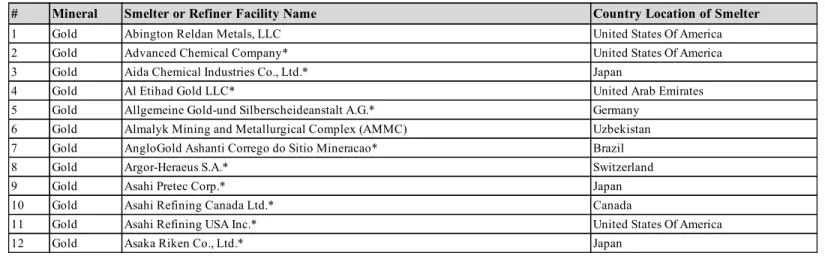
Table 3 below lists the SORs identified by our suppliers as potentially having processed the necessary conflict minerals in Cree’s products that are known and verified by the CFSI.
Table 3
# Mineral Smelter or Refiner Facility Name Country Location of Smelter
1 Gold Abington Reldan Metals, LLC United States Of America
2 Gold Advanced Chemical Company* United States Of America
3 Gold Aida Chemical Industries Co., Ltd.* Japan
4 Gold Al Etihad Gold LLC* United Arab Emirates
5 Gold Allgemeine Gold-und Silberscheideanstalt A.G.* Germany 6 Gold Almalyk Mining and Metallurgical Complex (AMMC) Uzbekistan 7 Gold AngloGold Ashanti Corrego do Sitio Mineracao* Brazil
8 Gold Argor-Heraeus S.A.* Switzerland
9 Gold Asahi Pretec Corp.* Japan
10 Gold Asahi Refining Canada Ltd.* Canada
11 Gold Asahi Refining USA Inc.* United States Of America
# Mineral Smelter or Refiner Facility Name Country Location of Smelter
13 Gold Atasay Kuyumculuk Sanayi Ve Ticaret A.S. Turkey
14 Gold AU Traders and Refiners* South Africa
15 Gold Aurubis AG* Germany
16 Gold Bangalore Refinery^ India
17 Gold Bangko Sentral ng Pilipinas (Central Bank of the Philippines)* Philippines
18 Gold Boliden AB* Sweden
19 Gold C. Hafner GmbH + Co. KG* Germany
20 Gold Caridad Mexico
21 Gold CCR Refinery - Glencore Canada Corporation* Canada
22 Gold Cendres + Metaux S.A. Switzerland
23 Gold Chimet S.p.A.* Italy
24 Gold Chugai Mining Japan
25 Gold Daejin Indus Co., Ltd.* Korea, Republic Of
26 Gold Daye Non-Ferrous Metals Mining Ltd. China
27 Gold DODUCO GmbH* Germany
28 Gold Dowa* Japan
29 Gold DSC (Do Sung Corporation)* Korea, Republic Of
30 Gold Eco-System Recycling Co., Ltd.* Japan
31 Gold Elemetal Refining, LLC United States Of America
32 Gold Emirates Gold DMCC* United Arab Emirates
33 Gold Fidelity Printers and Refiners Ltd. Zimbabwe
34 Gold Gansu Seemine Material Hi-Tech Co., Ltd. China
35 Gold GCC Gujrat Gold Centre Pvt. Ltd. India
36 Gold Geib Refining Corporation* United States Of America
37 Gold Gold Refinery of Zijin Mining Group Co., Ltd.* China 38 Gold Great Wall Precious Metals Co., Ltd. of CBPM China
39 Gold Guangdong Jinding Gold Limited China
40 Gold Guoda Safina High-Tech Environmental Refinery Co., Ltd. China
41 Gold Hangzhou Fuchunjiang Smelting Co., Ltd. China
42 Gold Heimerle + Meule GmbH* Germany
43 Gold Heraeus Metals Hong Kong Ltd.* China
44 Gold Heraeus Precious Metals GmbH & Co. KG* Germany
45 Gold Hunan Chenzhou Mining Co., Ltd. China
46 Gold HwaSeong CJ CO., LTD. Korea, Republic Of
47 Gold Inner Mongolia Qiankun Gold and Silver Refinery Share Co., Ltd.* China
48 Gold Ishifuku Metal Industry Co., Ltd.* Japan
49 Gold Istanbul Gold Refinery* Turkey
50 Gold Japan Mint* Japan
51 Gold Jiangxi Copper Co., Ltd.* China
52 Gold JSC Ekaterinburg Non-Ferrous Metal Processing Plant* Russian Federation
53 Gold JSC Uralelectromed* Russian Federation
# Mineral Smelter or Refiner Facility Name Country Location of Smelter
55 Gold Kaloti Precious Metals United Arab Emirates
56 Gold Kazakhmys Smelting LLC Kazakhstan
57 Gold Kazzinc* Kazakhstan
58 Gold Kennecott Utah Copper LLC* United States Of America
59 Gold KGHM Polska Miedz Spolka Akcyjna^ Poland
60 Gold Kojima Chemicals Co., Ltd.* Japan
61 Gold Korea Zinc Co., Ltd.* Korea, Republic Of
62 Gold Kyrgyzaltyn JSC* Kyrgyzstan
63 Gold L'azurde Company For Jewelry Saudi Arabia
64 Gold Lingbao Gold Co., Ltd. China
65 Gold Lingbao Jinyuan Tonghui Refinery Co., Ltd. China
66 Gold LS-NIKKO Copper Inc.* Korea, Republic Of
67 Gold Luoyang Zijin Yinhui Gold Refinery Co., Ltd. China
68 Gold Materion* United States Of America
69 Gold Matsuda Sangyo Co., Ltd.* Japan
70 Gold Metalor Technologies (Hong Kong) Ltd.* China
71 Gold Metalor Technologies (Singapore) Pte., Ltd.* Singapore
72 Gold Metalor Technologies (Suzhou) Ltd.* China
73 Gold Metalor Technologies S.A.* Switzerland
74 Gold Metalor USA Refining Corporation* United States Of America 75 Gold Metalurgica Met-Mex Penoles S.A. De C.V.* Mexico
76 Gold Mitsubishi Materials Corporation* Japan
77 Gold Mitsui Mining and Smelting Co., Ltd.* Japan
78 Gold MMTC-PAMP India Pvt., Ltd.* India
79 Gold Modeltech Sdn Bhd^ Malaysia
80 Gold Morris and Watson New Zealand
81 Gold Moscow Special Alloys Processing Plant* Russian Federation
82 Gold Nadir Metal Rafineri San. Ve Tic. A.S.* Turkey
83 Gold Navoi Mining and Metallurgical Combinat^ Uzbekistan
84 Gold Nihon Material Co., Ltd.* Japan
85 Gold Ogussa Osterreichische Gold- und Silber-Scheideanstalt GmbH* Austria
86 Gold Ohura Precious Metal Industry Co., Ltd.* Japan
87 Gold OJSC "The Gulidov Krasnoyarsk Non-Ferrous Metals Plant" (OJSC Krastsvetmet)* Russian Federation
88 Gold OJSC Novosibirsk Refinery* Russian Federation
89 Gold PAMP S.A.* Switzerland
90 Gold Penglai Penggang Gold Industry Co., Ltd. China
91 Gold Prioksky Plant of Non-Ferrous Metals* Russian Federation
92 Gold PT Aneka Tambang (Persero) Tbk* Indonesia
93 Gold PX Precinox S.A.* Switzerland
94 Gold Rand Refinery (Pty) Ltd.* South Africa
# Mineral Smelter or Refiner Facility Name Country Location of Smelter
96 Gold Republic Metals Corporation* United States Of America
97 Gold Royal Canadian Mint* Canada
98 Gold SAAMP France
99 Gold Sabin Metal Corp. United States Of America
100 Gold SAFINA A.S.^ Czech Republic
101 Gold Sai Refinery India
102 Gold Samduck Precious Metals* Korea, Republic Of
103 Gold Samwon Metals Corp. Korea, Republic Of
104 Gold SAXONIA Edelmetalle GmbH* Germany
105 Gold Schone Edelmetaal B.V.* Netherlands
106 Gold SEMPSA Joyeria Plateria S.A.* Spain
107 Gold Shandong Tiancheng Biological Gold Industrial Co., Ltd. China 108 Gold Shandong Zhaojin Gold & Silver Refinery Co., Ltd.* China 109 Gold Sichuan Tianze Precious Metals Co., Ltd.* China
110 Gold Singway Technology Co., Ltd.* Taiwan, Province Of China
111 Gold So Accurate Group, Inc. United States Of America
112 Gold SOE Shyolkovsky Factory of Secondary Precious Metals* Russian Federation 113 Gold Solar Applied Materials Technology Corp.* Taiwan, Province Of China
114 Gold Sudan Gold Refinery Sudan
115 Gold Sumitomo Metal Mining Co., Ltd.* Japan
116 Gold T.C.A S.p.A* Italy
117 Gold Tanaka Kikinzoku Kogyo K.K.* Japan
118 Gold The Refinery of Shandong Gold Mining Co., Ltd.* China
119 Gold Tokuriki Honten Co., Ltd.* Japan
120 Gold Tongling Nonferrous Metals Group Co., Ltd. China
121 Gold Tony Goetz NV^ Belgium
122 Gold TOO Tau-Ken-Altyn Kazakhstan
123 Gold Torecom* Korea, Republic Of
124 Gold Umicore Brasil Ltda.* Brazil
125 Gold Umicore Precious Metals Thailand* Thailand
126 Gold Umicore S.A. Business Unit Precious Metals Refining* Belgium
127 Gold United Precious Metal Refining, Inc.* United States Of America 128 Gold Universal Precious Metals Refining Zambia Zambia
129 Gold Valcambi S.A.* Switzerland
130 Gold Western Australian Mint (T/a The Perth Mint)* Australia
131 Gold WIELAND Edelmetalle GmbH* Germany
132 Gold Yamamoto Precious Metal Co., Ltd.* Japan
133 Gold Yokohama Metal Co., Ltd.* Japan
134 Gold Yunnan Copper Industry Co., Ltd. China
135 Gold Zhongyuan Gold Smelter of Zhongjin Gold Corporation* China 136 Tantalum Changsha South Tantalum Niobium Co., Ltd.* China 137 Tantalum Conghua Tantalum and Niobium Smeltry* China
# Mineral Smelter or Refiner Facility Name Country Location of Smelter
138 Tantalum D Block Metals, LLC* United States Of America
139 Tantalum Duoluoshan* China
140 Tantalum Exotech Inc.* United States Of America
141 Tantalum F&X Electro-Materials Ltd.* China
142 Tantalum FIR Metals & Resource Ltd.* China
143 Tantalum Global Advanced Metals Aizu* Japan
144 Tantalum Global Advanced Metals Boyertown* United States Of America 145 Tantalum Guangdong Zhiyuan New Material Co., Ltd.* China
146 Tantalum H.C. Starck Co., Ltd.* Thailand
147 Tantalum H.C. Starck Hermsdorf GmbH* Germany
148 Tantalum H.C. Starck Inc.* United States Of America
149 Tantalum H.C. Starck Ltd.* Japan
150 Tantalum H.C. Starck Smelting GmbH & Co. KG* Germany 151 Tantalum H.C. Starck Tantalum and Niobium GmbH* Germany 152 Tantalum Hengyang King Xing Lifeng New Materials Co., Ltd.* China
153 Tantalum Hi-Temp Specialty Metals, Inc.* United States Of America 154 Tantalum Jiangxi Dinghai Tantalum & Niobium Co., Ltd.* China
155 Tantalum Jiangxi Tuohong New Raw Material* China
156 Tantalum JiuJiang JinXin Nonferrous Metals Co., Ltd.* China 157 Tantalum Jiujiang Nonferrous Metals Smelting Company Limited* China 158 Tantalum Jiujiang Zhongao Tantalum & Niobium Co., Ltd.* China
159 Tantalum KEMET Blue Metals* Mexico
160 Tantalum KEMET Blue Powder* United States Of America
161 Tantalum King-Tan Tantalum Industry Ltd.* China
162 Tantalum LSM Brasil S.A.* Brazil
163 Tantalum Metallurgical Products India Pvt., Ltd.* India
164 Tantalum Mineracao Taboca S.A.* Brazil
165 Tantalum Mitsui Mining and Smelting Co., Ltd.* Japan 166 Tantalum Ningxia Orient Tantalum Industry Co., Ltd.* China
167 Tantalum NPM Silmet AS* Estonia
168 Tantalum Power Resources Ltd.* Macedonia, The Former YugoslavRepublic Of
169 Tantalum QuantumClean* United States Of America
170 Tantalum Resind Industria e Comercio Ltda.* Brazil
171 Tantalum RFH Tantalum Smeltry Co., Ltd.* China
172 Tantalum Solikamsk Magnesium Works OAO* Russian Federation
173 Tantalum Taki Chemical Co., Ltd.* Japan
174 Tantalum Telex Metals* United States Of America
175 Tantalum Tranzact, Inc.* United States Of America
176 Tantalum Ulba Metallurgical Plant JSC* Kazakhstan
177 Tantalum XinXing HaoRong Electronic Material Co., Ltd.* China 178 Tantalum Yichun Jin Yang Rare Metal Co., Ltd.* China
# Mineral Smelter or Refiner Facility Name Country Location of Smelter
179 Tantalum Zhuzhou Cemented Carbide Group Co., Ltd.* China
180 Tin Alpha* United States Of America
181 Tin An Thai Minerals Co., Ltd. Viet Nam
182 Tin An Vinh Joint Stock Mineral Processing Company Viet Nam 183 Tin Chenzhou Yunxiang Mining and Metallurgy Co., Ltd.* China
184 Tin China Tin Group Co., Ltd.* China
185 Tin CNMC (Guangxi) PGMA Co., Ltd. China
186 Tin Cooperativa Metalurgica de Rondonia Ltda.* Brazil
187 Tin CV Ayi Jaya* Indonesia
188 Tin CV Dua Sekawan* Indonesia
189 Tin CV Gita Pesona* Indonesia
190 Tin CV Serumpun Sebalai* Indonesia
191 Tin CV Tiga Sekawan* Indonesia
192 Tin CV United Smelting* Indonesia
193 Tin CV Venus Inti Perkasa* Indonesia
194 Tin Dowa* Japan
195 Tin
Electro-Mechanical Facility of the Cao Bang Minerals & Metallurgy Joint Stock
Company^ Viet Nam
196 Tin Elmet S.L.U.* Spain
197 Tin EM Vinto* Bolivia (Plurinational State Of)
198 Tin Estanho de Rondonia S.A. Brazil
199 Tin Fenix Metals* Poland
200 Tin Gejiu Fengming Metallurgy Chemical Plant* China
201 Tin Gejiu Jinye Mineral Company* China
202 Tin Gejiu Kai Meng Industry and Trade LLC^ China
203 Tin Gejiu Non-Ferrous Metal Processing Co., Ltd.* China 204 Tin Gejiu Yunxin Nonferrous Electrolysis Co., Ltd.^ China 205 Tin Gejiu Zili Mining And Metallurgy Co., Ltd. China 206 Tin Guanyang Guida Nonferrous Metal Smelting Plant* China
207 Tin HuiChang Hill Tin Industry Co., Ltd.* China
208 Tin Huichang Jinshunda Tin Co., Ltd.^ China
209 Tin Jiangxi Ketai Advanced Material Co., Ltd.* China
210 Tin Magnu's Minerais Metais e Ligas Ltda.* Brazil
211 Tin Malaysia Smelting Corporation (MSC)* Malaysia
212 Tin Melt Metais e Ligas S.A.* Brazil
213 Tin Metallic Resources, Inc.* United States Of America
214 Tin Metallo-Chimique N.V.* Belgium
215 Tin Mineracao Taboca S.A.* Brazil
216 Tin Minsur* Peru
217 Tin Mitsubishi Materials Corporation* Japan
218 Tin Modeltech Sdn Bhd^ Malaysia
# Mineral Smelter or Refiner Facility Name Country Location of Smelter
220 Tin Nghe Tinh Non-Ferrous Metals Joint Stock Company Viet Nam 221 Tin O.M. Manufacturing (Thailand) Co., Ltd.* Thailand
222 Tin O.M. Manufacturing Philippines, Inc.* Philippines
223 Tin Operaciones Metalurgical S.A.* Bolivia (Plurinational State Of)
224 Tin PT Aries Kencana Sejahtera* Indonesia
225 Tin PT Artha Cipta Langgeng* Indonesia
226 Tin PT ATD Makmur Mandiri Jaya* Indonesia
227 Tin PT Babel Inti Perkasa* Indonesia
228 Tin PT Bangka Prima Tin* Indonesia
229 Tin PT Bangka Tin Industry* Indonesia
230 Tin PT Belitung Industri Sejahtera* Indonesia
231 Tin PT Bukit Timah* Indonesia
232 Tin PT DS Jaya Abadi* Indonesia
233 Tin PT Eunindo Usaha Mandiri* Indonesia
234 Tin PT Inti Stania Prima* Indonesia
235 Tin PT Karimun Mining* Indonesia
236 Tin PT Kijang Jaya Mandiri* Indonesia
237 Tin PT Lautan Harmonis Sejahtera* Indonesia
238 Tin PT Menara Cipta Mulia* Indonesia
239 Tin PT Mitra Stania Prima* Indonesia
240 Tin PT O.M. Indonesia* Indonesia
241 Tin PT Panca Mega Persada* Indonesia
242 Tin PT Prima Timah Utama* Indonesia
243 Tin PT Refined Bangka Tin* Indonesia
244 Tin PT Sariwiguna Binasentosa* Indonesia
245 Tin PT Stanindo Inti Perkasa* Indonesia
246 Tin PT Sukses Inti Makmur* Indonesia
247 Tin PT Sumber Jaya Indah* Indonesia
248 Tin PT Timah (Persero) Tbk Kundur* Indonesia
249 Tin PT Timah (Persero) Tbk Mentok* Indonesia
250 Tin PT Tinindo Inter Nusa* Indonesia
251 Tin PT Tommy Utama* Indonesia
252 Tin Resind Industria e Comercio Ltda.* Brazil
253 Tin Rui Da Hung* Taiwan, Province Of China
254 Tin Soft Metais Ltda.* Brazil
255 Tin Thaisarco* Thailand
256 Tin Tuyen Quang Non-Ferrous Metals Joint Stock Company Viet Nam
257 Tin VQB Mineral and Trading Group JSC* Viet Nam
258 Tin White Solder Metalurgia e Mineracao Ltda.* Brazil 259 Tin Yunnan Chengfeng Non-ferrous Metals Co., Ltd.* China
260 Tin Yunnan Tin Company Limited* China
# Mineral Smelter or Refiner Facility Name Country Location of Smelter
262 Tungsten ACL Metais Eireli^ Brazil
263 Tungsten Asia Tungsten Products Vietnam Ltd.* Viet Nam 264 Tungsten Chenzhou Diamond Tungsten Products Co., Ltd.* China 265 Tungsten Chongyi Zhangyuan Tungsten Co., Ltd.* China
266 Tungsten Dayu Weiliang Tungsten Co., Ltd. China
267 Tungsten Fujian Jinxin Tungsten Co., Ltd.* China
268 Tungsten Ganzhou Huaxing Tungsten Products Co., Ltd.* China 269 Tungsten Ganzhou Jiangwu Ferrotungsten Co., Ltd.* China 270 Tungsten Ganzhou Seadragon W & Mo Co., Ltd.* China
271 Tungsten Ganzhou Yatai Tungsten Co., Ltd. China
272 Tungsten Global Tungsten & Powders Corp.* United States Of America 273 Tungsten Guangdong Xianglu Tungsten Co., Ltd.* China
274 Tungsten H.C. Starck Smelting GmbH & Co. KG* Germany
275 Tungsten H.C. Starck Tungsten GmbH* Germany
276 Tungsten Hunan Chenzhou Mining Co., Ltd.* China
277 Tungsten Hunan Chuangda Vanadium Tungsten Co., Ltd. Wuji* China 278 Tungsten Hunan Chunchang Nonferrous Metals Co., Ltd.* China
279 Tungsten Hydrometallurg, JSC* Russian Federation
280 Tungsten Japan New Metals Co., Ltd.* Japan
281 Tungsten Jiangwu H.C. Starck Tungsten Products Co., Ltd.* China 282 Tungsten Jiangxi Dayu Longxintai Tungsten Co., Ltd. China
283 Tungsten Jiangxi Gan Bei Tungsten Co., Ltd.* China
284 Tungsten Jiangxi Minmetals Gao'an Non-ferrous Metals Co., Ltd. China 285 Tungsten Jiangxi Tonggu Non-ferrous Metallurgical & Chemical Co., Ltd.* China 286 Tungsten Jiangxi Xinsheng Tungsten Industry Co., Ltd.* China 287 Tungsten Jiangxi Xiushui Xianggan Nonferrous Metals Co., Ltd.* China
288 Tungsten Jiangxi Yaosheng Tungsten Co., Ltd.* China
289 Tungsten Kennametal Fallon* United States Of America
290 Tungsten Kennametal Huntsville* United States Of America
291 Tungsten Malipo Haiyu Tungsten Co., Ltd.* China
292 Tungsten Moliren Ltd.* Russian Federation
293 Tungsten Niagara Refining LLC* United States Of America
294 Tungsten Nui Phao H.C. Starck Tungsten Chemicals Manufacturing LLC* Viet Nam 295 Tungsten Philippine Chuangxin Industrial Co., Inc.* Philippines 296 Tungsten South-East Nonferrous Metal Company Limited of Hengyang City* China 297 Tungsten Tejing (Vietnam) Tungsten Co., Ltd.* Viet Nam 298 Tungsten Unecha Refractory metals plant* Russian Federation 299 Tungsten Vietnam Youngsun Tungsten Industry Co., Ltd.* Viet Nam
300 Tungsten Wolfram Bergbau und Hutten AG* Austria
301 Tungsten Woltech Korea Co., Ltd.* Korea, Republic Of
302 Tungsten Xiamen Tungsten (H.C.) Co., Ltd.* China
# Mineral Smelter or Refiner Facility Name Country Location of Smelter
304 Tungsten Xinfeng Huarui Tungsten & Molybdenum New Material Co., Ltd.* China 305 Tungsten Xinhai Rendan Shaoguan Tungsten Co., Ltd.* China * CFSI Compliant Smelters/refiners as of May 18, 2017
^ CFSI Active Smelters/refiners as of May 18, 2017
Based upon the RCOI data made available from the CFSI, the countries of origin of the conflict minerals sourced and processed by the CFS-compliant smelters and refiners identified as potentially being in Cree’s product supply chains may include, but are not necessarily limited to, the following:
Australia, Austria, Belgium, Bolivia (Plurinational State Of), Brazil, Canada, China, Czech Republic, Estonia, France, Germany, India, Indonesia, Italy, Japan, Kazakhstan, Korea, Republic Of, Kyrgyzstan, Macedonia, The Former Yugoslav Republic Of [Macedonia], Malaysia, Mexico, Netherlands, New Zealand, Peru, Philippines, Poland, Russian Federation, Saudi Arabia, Singapore, South Africa, Spain, Sudan, Sweden, Switzerland, Taiwan, Province Of China, Thailand, Turkey, United Arab Emirates, United States Of America, Uzbekistan, Viet Nam, Zambia and Zimbabwe.
We are not including any country of origin information relating to other smelters and refiners identified as potentially being in Cree’s product supply chains because we do not have reliable third party audit results, and we have not completed our due diligence process with respect to, these facilities.
This CMR describes Cree’s efforts to determine the SOR and the country of origin of the necessary conflict minerals in our products manufactured in 2016 with the greatest possible specificity. In response to our RCOI inquiry, our suppliers identified a total of 305 known and verified SORs that may have processed the necessary conflict minerals contained in the materials provided to Cree. Based on the information obtained in our due diligence process, we have no reason to believe that any of these 305 SORs directly or indirectly finance or benefit armed groups in the Covered Countries. Since this does not reflect all of the SORs in our product supply chains, however, we are not in a position to conclude that all of the necessary conflict minerals in our products were obtained from conflict-free sources.
While we have not yet succeeded in obtaining a complete and accurate list of SORs for all of our products that include necessary conflict minerals, we believe that we have made good progress given the current state of the data available to us and the relative lack of sophistication of certain portions of our supply chain with respect to the requirements of the Rule.
Steps to Mitigate Risk
The previous parts of this CMR detail the steps taken in 2016 to mitigate risk. In the future, we plan to take or continue taking the following actions to improve the due diligence conducted on our supply chain to further mitigate any risk that the necessary 3TGs in our products could finance or
benefit armed groups in the Covered Countries:
a. Leverage our direct suppliers that can most effectively and most directly mitigate the identified risks;
b. Continue to be an active CFSI member and, as a member, support SOR and recycler outreach programs by sending letters and/or emails to them explaining the importance of audit certification;
c. Work with upstream distributors in our supply chain and develop best practices to improve the quality and reporting of RCOI data; d. Continue to strengthen engagement with relevant suppliers and to provide training, as appropriate, to help them understand and comply with Cree requirements related to 3TG minerals under the Rule;
e. Continue to seek qualitative improvements in supplier and smelter due diligence of conflict minerals; f. Continue to seek qualitative improvements in supplier and smelter due diligence of conflict minerals; and
g. Monitor to determine if any additional changes in our procurement process are needed to improve visibility to necessary 3TGs in the assemblies, components, and materials purchased.
During the fifth year of Cree’s conflict minerals program, the Company will continue its focus on obtaining complete and reliable SOR and country of origin data by requiring suppliers to provide in a timely manner accurate smelter identification numbers and
supplemental information that will allow Cree to determine the correlation between the identified SORs, countries of origin, and the assemblies, components, and materials supplied to Cree.
The Cree logo is a trademark of Cree, Inc.