Eduard Kuric
∗Institute of Informatics, Information Systems and Software Engineering Faculty of Informatics and Information Technologies
Slovak University of Technology in Bratislava Ilkoviˇcova 2, 842 16 Bratislava, Slovakia
Abstract
Software developer’s expertise can be defined as a degree of his or her familiarity with source code artifacts of a soft-ware system, respective to other developers of the system. Existing approaches to estimate developer’s expertise are usually based on evaluating a degree of developer’s source code authorship. In addition to the authorship, devel-oper’s development productivity should be considered. The contributions of this work can be split into three parts. First, we propose a developer’s model overlaying domain model and a method for its automatic acquisition. The model provides software project-related information at different levels of abstraction (e.g., at level of software concerns). It is based on metadata and relationships be-tween them derived from corresponding resources. Sec-ond, we propose a method for estimation of developer’s expertise in the subject software system at level of soft-ware concerns. The method considers both developer’s development productivity and his or her familiarity with a concern. Finally, we propose a method to recommend an expert developer for a newly created development task at level of concerns. We evaluate the proposed approach by applying it to the expert recommendation for develop-ment tasks.
Categories and Subject Descriptors
D.2.7 [Software Engineering]: Distribution, Mainte-nance,and Enhancement - Version control; D.2.8 [Software Engineering]: Metrics; D.2.9 [Software Engineering]: Management - Productivity, software process models, soft-ware quality, assurance, Programming teams; H.3.4 [ Infor-mation Storage and Retrieval]: Systems and Software - Information Networks
∗Recommended by thesis supervisor: Prof. M´aria
Bielikov´a
To be defended at Faculty of Informatics and Informa-tion Technologies, Slovak University of Technology in Bratislava on June 29, 2016.
c
Copyright 2011. All rights reserved. Permission to make digital or hard copies of part or all of this work for personal or classroom use is granted without fee provided that copies are not made or distributed for profit or commercial advantage and that copies show this notice on the first page or initial screen of a display along with the full citation. Copyrights for components of this work owned by others than ACM must be honored. Abstracting with credit is permitted. To copy other-wise, to republish, to post on servers, to redistribute to lists, or to use any component of this work in other works requires prior specific per-mission and/or a fee. Perper-missions may be requested from STU Press, Vazovova 5, 811 07 Bratislava, Slovakia.
Keywords
software developer, estimation of expertise, development productivity, familiarity with software artifact, software system, source code, expert recommendation, expert iden-tification, domain modelling, software developer model, latent topic, conceptual concern, interaction data, soft-ware repository, mining softsoft-ware repositories
1.
Introduction
In many explanatory dictionaries, expertise is defined as “a special skill or knowledge a person has in a particular field”. The person is called as anexpertin that field. The “or” conjunction between the terms skill and knowledge in the definition can cause questions. Can a person be an expert if he or she has only a special skill in a field of interest? Can a person be an expert if he or she has only special knowledge-base in that field of interest? What does “special” mean, i.e. how to quantify the difference between two special knowledge/skills in the same field of interest?
For those questions, it is not simple to take a clear posi-tion in general. Let’s consider. Is a “theoretical” physicist an expert if he or she is not able to check his or her theory in practice? If someone would say “no”, it could be inter-esting to hear a Richard Feynmann’s answer. There is one more example which is even more extreme. Consider two car mechanics. Both have special knowledge in repairing cars but only one of them has skills which enable him or her to repair the car with available tools. Then, are the mechanics both experts?
Previous research on modelling software developer’s ex-pertise can be categorized into implicit and explicit ap-proaches:
• Implicit approaches investigate how data collected from developer’s working activities can be used to estimate what he or she knows in a software project, a degree of his or her familiarity with software arti-facts, or what he or she wants/needs to know.
• Explicit approachesempirically study developers, they propose models describing different parts of knowl-edge and investigate how developers comprehend source code.
In our work we deal with implicit approaches. Expert recommendation systems in software engineering help to locate (discover) and to recommend individuals (experts)
who have appropriate expertise on a given source code artifact. IT managers and software development team leaders are increasingly challenged with the need to im-prove the efficiency and quality of software system devel-opment. The size of a software system and high rate of changes of source code make it difficult for developers to identify who, from the team, knows a particular part of the system. The identification of the software developer with right knowledge (expertise) to the developer who needs help during the implementation can improve col-laboration and awareness of the development team. The waiting time for an answer can be reduced by contacting the expert directly.
In general, existing approaches to estimate developer’s ex-pertise in/familiarity with source code artifacts are based on investigatinginteraction activities[4, 14],changes[10, 8, 5, 9],bugs[1, 12, 11, 21], or usage of technologies [15, 19, 20, 7, 18].
The proposed approaches are not usually generalizable, the metrics are usually defined with regard to the struc-ture of software repositories, there are no metrics esti-mating developer’s expertise at higher level of abstraction such as software concerns. In the field of expert remendation there is no a clear baseline with which to com-pare expertise metrics to each other. There are several definitions of developer’s expertise in literature, however, without a clear baseline, it is difficult to determine which automatic expertise method best approximates his or her expertise.
We identified the following open problems:
• Insufficient separation of domain conceptualization and resources. Conceptual concerns of a software system refer to main technical concepts that reflect business logic or domain of the system [3]. There is no clear distinction between the concerns repre-senting the domain conceptualization and resources such as: tasks defining developers’ work, software artifacts resulting from developers’ activities for the tasks, and interactions capturing and describing de-velopers’ activities with the artifacts. A lot of knowl-edge about a software and its developers is contained in these resources, however, the resources and the domain model are often seen as one layer [17, 16, 2]. The vocabulary or language used in source code differs from the one used for describing development tasks. It results in a lack of flexibility in estimation of developer’s expertise at the level of the concerns and the level of the particular software artifacts.
• None or minimal consideration of developer’s de-velopment skills. Existing approaches to estimate developer’s expertise in a part of a software system usually rely on the assumption that the developer’s commits to the code reflect his or her expertise in (familiarity with) that part of the system [10, 8, 14]. However, while solving tasks the software de-velopers rewrite their code, reverse (undo) changes, try alternatives, familiarize with surrounding code, explore information space, etc. Estimation of devel-oper’s expertise in source code has an impact on how quickly and successfully development task is sup-posed to be solved [12, 14]. The concept of exper-tise includes both knowledge and skills. To estimate
developer’s expertise in a software there should be considered both his or her knowledge and develop-ment skills. One thing is to be aware of the existence of some functionality, another thing is to be able to perform a correction, enhancement, or reduction of source code effectively in terms of the spent effort.
• Limited interconnection of tasks with codebase in ex-pert identification. Existing approaches to recom-mend an expert for a newly created development task are often based on use of a repository to iden-tify the person who has solved the tasks similar to the target task. The similarity is measured through comparing descriptions of the tasks [22, 11]. The time required to implement a new functionality, to change an existing functionality, or to fix a bug can be significantly reduced if the task is assigned to a developer who knows corresponding source code (a particular part of a software system) [4]. When the developer’s expertise is estimated only at the level of the tasks, it does not consider sufficiently the devel-oper’s expertise of a particular part of the codebase of a software system. The source code that a de-veloper has to consult in the target task does not have to be the same as in the similar tasks. Looking at the software system as a web of conceptual con-cerns inferred from both the tasks and codebase we can recommend the most expert developer to a task who best covers the task in terms of his or her (es-timated) expertise in the concerns included in the target task.
We aim to address these problems by devising methods for automatic domain model acquisition, expertise esti-mation, and expert recommendation at the level of con-ceptual concerns. In particular, thesis goals are:
• To design a domain model of a software project and a method for its acquisition that provides a clear separation between domain conceptualization and resources.
• To propose and evaluate a method for estimation of developer’s expertise at the level of conceptual con-cerns that covers both developer’s familiarity with tasks and codebase, and his or her development skills measured through development productivity reflect-ing the effort he or she expends while workreflect-ing on the particular concern.
• To propose and evaluate a method to recommend an expert for a newly created development task at the level of conceptual concerns inferred from both the tasks and the codebase of a software system.
2.
Software Developer’s Model Overlaying
Do-main Model
In our work we define developer’s expertise through his or her familiarity with a software system or its part as follows:
Developer’s expertise refers to a degree of being aware of existing functionality in a subject software system and a degree of ability to locate relevant source code artifact(s), respective to other developers of the software system. To construct a domain model we use primary data from a version control system, an issue tracking system and interaction data.
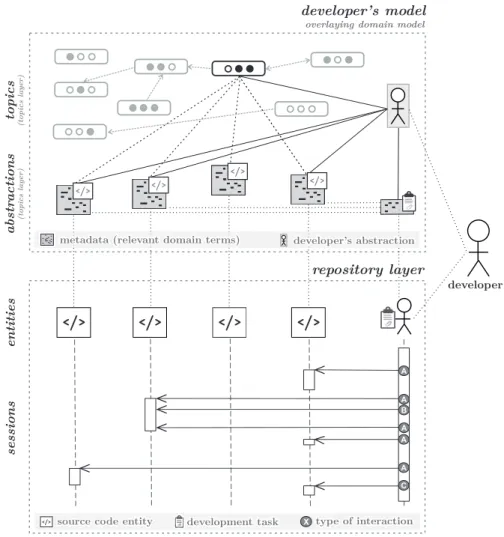
Developer model we propose overlays the domain model (see Figure 1). Domain model elements are metadata elements and topics. Metadata elements can be instances of source code entity abstraction and (development) task abstraction. They contain relevant domain terms and a set of attributes, e.g., source code properties estimated by using various software metrics. Topics are inferred1 from the metadata corpus containing the relevant domain terms. The developer model is updated when the overlay model receives information on developer’s activities from the repository layer.
We distinguish two types of relationships, namely,developer– metadata element relationship anddeveloper–topic rela-tionship. The developer–metadata element relationship between a developer and a metadata element is created iff the developer (co)authors the corresponding resource element to the metadata element. The developer–topic relationship between a developer and a topic is created iff the topic is assigned to a metadata element and there is a relationship between the developer and the metadata element.
Thedeveloper–metadata element anddeveloper–topic re-lationships can have attributes. A developer–topic re-lationship can have attributes (expertise characteristics) such as a degree of the developer’s familiarity with the topic and his or herdevelopment productivityon the topic (expertise metrics to estimate these characteristics will be defined later). Adeveloper–source code entity abstraction relationship can have an attribute such asa degree of de-veloper’s authorshipof the source code entity with respect to co-authors.
The proposed model provides general apparatus to define different types of relationships between domain elements. Various attributes can be assigned to the elements and relationships.
3.
Software Developer’s Expertise Estimation
The software system can be seen as a web of topics. We propose a method to recommend an expert for a target (newly created) development task of a topic. It is based on estimation of developer’s expertise on particular topics of the software system relative to other developers devel-oping the same system.To estimate developer’s expertise for a topic we propose two metrics. The first one estimates developer’s devel-opment productivity on the topic. The second one esti-mates his or her degree of familiarity with the topic. Both metrics are based on previous developer’s work (resolved tasks) on the subject topic.
Developer’s development productivity metric considers two characteristics influencing on development time required to complete a given task of a topic, namely,complexityof the task, and developer’sactivitiesperformed while solv-ing the task. It reflects the followsolv-ing assumptions:
• The more complex a developer’s change in a source code entity is and the less time he or she needs to
1Software concerns can be automatically extracted
(in-ferred) by using statistical topic modelling techniques adapted to software. Such technique can be used to ap-proximatesoftware concerns as (latent) topics.
perform the change, the higher his or her produc-tivity probably is.
• The more edit interactions a developer performs in a development session and the less exploration in-teractions he or she carries out in that session then the more expert he or she probably is.
The metric for estimation of developer’s familiarity with a topic considers his or her real source code contribution to the topic, i.e. the amount of created and modified source code. This metric reflects the following assumptions:
• The more lines of code a developer owns in a source code entity the more expert he or she is in the entity.
• Code contributions committed earlier in the past have a smaller weight than recent code changes.
While the productivity metric focuses on the process of development, the familiarity metric operates with the re-sult of the development (process).
4.
Contributions and Conclusions
Expertise is difficult to estimate or observe directly. There are many types of expertise, competing definitions, and possible taxonomies of expertise in literature. The most direct way to show developer’s expertise, perhaps, is to give the developer to solve a test (proposed for profes-sional licensing). However, a method of manual testing to identify an expert for a part of a software is not effec-tive in practice.
Finding experts is critical in the development of large soft-ware systems, especially if there are (geographically) dis-tributed teams. Authors [6] estimate that about half of development time software developers spend communicat-ing with each other. A substantial portion of this time is the information communication [13]. The time can be re-duced by an expertise-finding support that helps software developers to determine with whom to communicate dur-ing development tasks. On the other side, if we directly assign a task to a software developer who knows the cor-responding part of the software system and/or his or her development productivity on the topic of the task is high, the time required to resolve the task can be (significantly) reduced.
Contributions achieved in this work are as follows:
• proposal of a developer model overlaying the domain model and a method for its automatic acquisition,
• proposal of a novel method for estimation of devel-oper’s expertise at the level of topics that considers both developer’s familiarity with a topic and his or her development productivity on the topic,
• proposal of a novel method for recommendation of experts to newly created development tasks at the level of topics that are inferred from both the tasks and the codebase of a software system.
We conducted experiments on five open-source projects and performed a case study on two commercial/closed
Figure 1: Developer model we propose overlays the domain model. Domain model elements are metadata elements and topics. Metadata elements can be instances of source code entity abstraction and task abstraction. They contain relevant domain terms and a set of attributes, e.g., source code properties estimated by using various software metrics. Topics are inferred from the metadata corpus containing the relevant domain terms. The developer model is updated when the overlay model receives information on developer’s activities from the repository layer.
software projects. Although, experiments performed on the five open source projects and the two commercial projects do not provide enough justification of general-ity of our approach, the general results indicate that our approach can be useful in recommending experts.
Acknowledgements. This work was partially supported by grants No. APVV-0208-10, VG 1/0752/14 and VG 1/0675/11 and is the partial result of the Research & De-velopment Operational Programme for the project Re-search of methods for acquisition, analysis and person-alized conveying of information and knowledge, ITMS 26240220039, co-funded by the ERDF.
References
[1] J. Anvik and G. C. Murphy. Determining implementation expertise from bug reports. InProceedings of the 4th
International Workshop on Mining Software Repositories, MSR ’07, pages 2–, USA, 2007. IEEE Computer Society.
[2] M. F. Bosu and S. G. MacDonell. Data quality in empirical software engineering: A targeted review. InProceedings of the 17th International Conference on Evaluation and Assessment in Software Engineering, EASE ’13, pages 171–176, New York, NY, USA, 2013. ACM.
[3] T.-H. Chen, S. W. Thomas, M. Nagappan, and A. E. Hassan.
Explaining software defects using topic models. InProceedings of the 9th IEEE Working Conference on Mining Software
Repositories, MSR ’12, pages 189–198, Piscataway, NJ, USA, 2012. IEEE Press.
[4] T. Fritz, G. C. Murphy, E. Murphy-Hill, J. Ou, and E. Hill. Degree-of-knowledge: Modeling a developer’s knowledge of code.ACM Trans. Software Eng. Methodol., 23(2):14:1–14:42, Apr. 2014.
[5] T. Girba, A. Kuhn, M. Seeberger, and S. Ducasse. How developers drive software evolution. InProceedings of the 8th International Workshop on Principles of Software Evolution, IWPSE ’05, pages 113–122, USA, 2005. IEEE Computer Society. [6] J. D. Herbsleb, H. Klein, G. M. Olson, H. Brunner, J. S. Olson,
and J. Harding. Object-oriented analysis and design in software project teams.Hum.-Comput. Interact., 10(2):249–292, Sept. 1995.
[7] D. Ma, D. Schuler, T. Zimmermann, and J. Sillito. Expert recommendation with usage expertise. InICSM, pages 535–538, 2009.
[8] D. W. McDonald and M. S. Ackerman. Expertise recommender: a flexible recommendation system and architecture. InProceedings of the Conference on Computer Supported Cooperative Work, pages 231–240, USA, 2000. ACM.
[9] S. Minto and G. C. Murphy. Recommending emergent teams. In
Proceedings of the 4th International Workshop on Mining Software Repositories, MSR ’07, pages 5–, USA, 2007. IEEE
Computer Society.
[10] A. Mockus and J. D. Herbsleb. Expertise browser: a quantitative approach to identifying expertise. InProceedings of the 24th International Conference on Software Eng., pages 503–512, USA, 2002. ACM.
[11] N. Nagwani and S. Verma. Predicting expert developers for newly reported bugs using frequent terms similarities of bug attributes. InProceedings of the 9th International Conference on ICT and Knowledge Engineering (ICT Knowledge Engineering), pages 113–117, Bangkok, Jan 2012. IEEE.
[12] T. T. Nguyen, T. Nguyen, E. Duesterwald, T. Klinger, and P. Santhanam. Inferring developer expertise through defect analysis. InProceedings of the 34th International Conference on Software Engineering, pages 1297–1300, Zurich, June 2012. IEEE.
[13] D. E. Perry, N. Staudenmayer, and L. G. Votta. People, organizations, and process improvement.IEEE Software, 11(4):36–45, July 1994.
[14] R. Robbes and D. Röthlisberger. Using developer interaction data to compare expertise metrics. InProceedings of the 10th Working Conference on Mining Software Repositories, MSR ’13, pages 297–300, Piscataway, NJ, USA, 2013. IEEE Press.
[15] M. Robillard, W. Maalej, R. Walker, and T. Zimmermann.
Recommendation Systems in Software Engineering. Springer Berlin Heidelberg, 2014.
[16] D. Rodriguez, I. Herraiz, and R. Harrison. On software engineering repositories and their open problems. InProceedings of the First International Workshop on Realizing AI Synergies in Software Engineering, RAISE ’12, pages 52–56, Piscataway, NJ, USA, 2012.
[17] M. M. Rosli, E. Tempero, and A. Luxton-Reilly. What is in our datasets?: Describing a structure of datasets. InProceedings of the Australasian Computer Science Week Multiconference, ACSW ’16, pages 28:1–28:10, New York, NY, USA, 2016. ACM. [18] D. Schuler and T. Zimmermann. Mining usage expertise from
version archives. InProceedings of the 2008 International Working Conference on Mining Software Repositories, MSR ’08, pages 121–124. ACM, 2008.
[19] C. Teyton, J.-R. Falleri, F. Morandat, and X. Blanc. Find your library experts. InProceedings of the 20th Working Conference on Reverse Engineering (WCRE), pages 202–211, Koblenz, Germany, Oct 2013. IEEE.
[20] A. Vivacqua and H. Lieberman. Agents to assist in finding help. InProceedings of the SIGCHI Conference on Human Factors in Computing Systems, CHI ’00, pages 65–72, USA, 2000. ACM. [21] W. Wu, W. Zhang, Y. Yang, and Q. Wang. Drex: Developer
recommendation with k-nearest-neighbor search and expertise ranking. InSoftware Engineering Conference (APSEC), 18th Asia Pacific, pages 389–396. IEEE, Dec 2011.
[22] X. Xie, W. Zhang, Y. Yang, and Q. Wang. Dretom: Developer recommendation based on topic models for bug resolution. In
Proceedings of the 8th International Conference on Predictive Models in Software Engineering, PROMISE ’12, pages 19–28, New York, NY, USA, 2012. ACM.
Selected Papers by the Author
E. Kuric, M. Bieliková. ANNOR: efficient image annotation based on combining local and global features.Computers and Graphics, 47(2): 1–15, 2015.
E. Kuric, M. Bieliková. Estimation of student’s programming expertise. InProceedings of the 8th ACM/IEEE international symposium on empirical software engineering and measurement, p. 4, Torino, Italy, 2014. ACM.
E. Kuric, M. Bieliková. Webification of software development: user feedback for developer’s modeling. InProceedings of the 14th International conference on Web Engineering, pp. 550–553, Toulouse, France, 2014. Springer.
E. Kuric, M. Bieliková. Search in source code based on identifying popular fragments. InProceedings of the 39th international conference on current trends in theory and practice of computer
science, pp. 408–419, Spindleruv Mlyn, Czech Republic, 2013. Springer.
E. Kuric, M. Bieliková. Search in source code based on identifying popular fragments. InProceedings of the 39th international conference on current trends in theory and practice of computer science, pp. 408–419, Spindleruv Mlyn, Czech Republic, 2013. Springer.
E. Kuric, M. Bieliková. Automatic Image Annotation Using Global and Local Features. InProceedings of the 6th International Workshop on Semantic media adaptation and personalization, pp. 33–38, Vigo, Spain, 2011, IEEE CS.
M. Bieliková, I. Polášek, M. Barla, E. Kuric, K. Rástoˇcný, J. Tvarožek, P. Lacko. Platform independent software development monitoring: design of an architecture. InProceedings of the 40th International conference on current trends in theory and practice of computer science, pp. 126–137, Novy Smokovec, Slovakia, 2014, Springer.