A Complex Network Structure Design for Load Balancing and Redundant
Fengming M. Chang
Department of Industrial Engineering and Management Tungfang Institute of Technology, Kaohsiung, Taiwan
Abstract
The usages of the Internet are more and more important. Under the consideration of cost and redundant, multiple link structure for connecting to the Internet for an organization to reduce network traffic jam problem is more necessary. Most of the time, multiple line connections mean multiple Internet Service Provider (ISP). It leads to the management problem for traffic load balancing and multiple ISP routes. This paper presents a design of such a multiple links network structure using load balancers. Also, four load balancing schemes in the load balancer are tested and compared. This multiple ISPs structure got benefits of links redundancy and traffic load balancing. And it can be applied for primary and high schools that apply inexpensive multiple Asymmetric Digital Subscriber Lines (ADSL) (Cioffi et al. 1999).
Keywords: multiple links, load balancer, Internet.
1.
IntroductionThe explosive growth of the Internet applications has led a network traffic jam problem for us (Cardellinni et al. 1999; Baker et al. 1999). For this problem, multiple links to the Internet is a good solution. Although such a structure may be complex, it get many benefits, such as the increasing of network reliability, redundant and load balancing functions for network. Users also can choose different ISPs by cost rate or quality. For an organization that doesn’t have too much budge, low cost link technique still suitable for them. It happened in that organizations download data largely but upload lightly, and several ADSL lines with low cost can be satisfied. In Taiwan’s example, the download bandwidth of an ADSL line is 1.5 mega bits per second (MBps) (Cioffi et al. 1999) that is equal to a T1 leased line but cheaper in cost. Even the quality of an ADSL is getting down to 50% bandwidth, two ADSL lines cost is still far cheaper than a T1 link’s.
Another concept is that network structure can be built up by combining high and low cost links. There are several kinds of Internet lines productions, including T1, T3, ADSL, and so on that can be chosen and applied. To the main services such as Web, DNS, E-mail, and FTP applications, higher quality connection lines can be used for them. And to the other general users, more low cost links can be added to share loads, enrich bandwidth and backup links. To choose more than one ISP links can ensure constant Internet access. When one of the ISP breaks down, the other repair ISP links will keep network working. It’s also a kind of redundant function. On the other hand, load balancing can be worked among different ISP links also. When one of the ISP traffic is heavy, most of the network traffic can be assigned to the other ISPs.
By above discussion, a multiple links structure leads a load balancing problem (Robb 2001a). Load balancing schemes or algorithms for Internet have been researched plenty recently
(Cardellinni et al. 1999; Castro et al. 1999; Cherkasova et al. 2000; Grimm et al. 1998; Bryhni et al. 2000). Classical load balancing schemes include random, round robin, weight round robin, fastest connection, and fewest connections (Enterasys 2000; robb 2001b) in general and can be found in some network device. Most the load balancing researches compared their novel scheme with classical ones in simulation environment because of too many extra and uncertain factors in the real network. But in this study, load balancing schemes in real device are compared.
In a school in Taiwan, two load balancers (Enterasys 2000; Radware 2000a; Radware 2000b) are built up as a multiple links system between two campuses. There are four default load balancing schemes can be chosen in the load balancers. Three T1 leased lines, seven ADSL lines, including five links to Taiwan Academic Network (TANet) and two links to ISP are setup for this multiple links system. The detail of this design structure will be discussed in section 3.
In this paper, first, a multi-links-load-balancer is presented in subsection 2. And then in subsection 3, a design of multiple network links structure for our two campuses is discussed. This structure is a solution and really setup. In the next section, four schemes of load balancing in the load balancers are test and compared. At last, conclusions are present and discussed in subsection 5.
2.
Functions of load balancer
The device applied to the multiple links system is Radware LinkProof multi-links-load-balancers (Radware 2000a; Radware 2000b) that fit the transport layer model in the Open System Interconnection (OSI) of the International Standard Organization (ISO). It utilizes load balancing approaches to eliminate the complexities of Internet and provide optimal performance.
A multi-links-load-balancer provides the following main benefits:
I. Router functions, including IP address and routing assigned.
II. Addresses management among the various multiple ISPs.
III. Load balancing among multiple lines and ISPs.
IV. Redundancy functions.
V. Link failure detection. When one of the links is fail, no packet will be sent to this
fail link.
VI. Supply Network Address Translation (NAT) algorithm.
VII. Proximity. It uses proximity algorithms to choose the best link for outbound
traffic. Every a period of time, it re-calculate every links’ load and renew proximity information.
Furthermore, a load balancer provides four load balancing schemes for managers selecting: cyclic, least amount of traffic, fewest number of user, and fewest bytes number. Cyclic is the same as round robin schemes (Robb 2001b) in many researches before. And network managers can setup the best load balancing policy for their organizations.
3.
The multiple links system structure
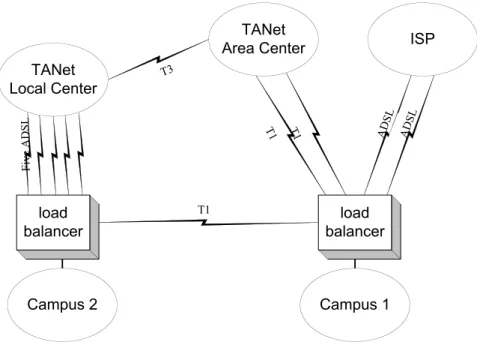
and all incoming/outgoing network traffic have to go through a load balancer. Computer center is located in the campus 1 and most of the main servers are in this campus. Two T1 lines are connected to the TANet Area Center that is the upper class. Two ADSL lines are linked to ISP, for ensuring constant Internet connecting. In campus 2, because budget is limited five ADSL are connected to TANet Local Center. This center connects to TANet Area Center using T3 line. In addition, a T1 line is connected between two campuses. Data exchanging between two campuses go through this line primarily.
T1 T1 T1 ADSL AD SL Five ADSL T3 TANet Local Center TANet
Area Center ISP
Campus 2 Campus 1
load balancer
load balancer
Fig 1. A multiple links campus network design. The design ideas of Fig 1 are as the following:
I. In campus 1, two T1 lines and two ADSL can be backup and load balancing each
other. Two T1 lines are repaired each other for connecting to TANet and so are two ADSL to ISP.
II. In campus 2, five ADSL lines and one T1 lines can be backup and load balancing
each other.
III. Most of the main campus servers are put in the computer center in the campus 1.
Campus 2 users contact servers in campus 1 throughout T1 links between two campuses. The backup links to campus 1 goes through five ADSL links, to TANet Local Center, through TANet Area Center, and then to campus 1 using two T1 links.
IV. In campus 2, outgoing traffic use one of the six lines: five TANet ADSL go through
TANet Local Center and one T1 that goes through campus 1. While campus 2 traffic go through campus 1 by T1, they continue outgoing by two T1 to TANet Area Center or two ADSL to ISP.
V. To prevent the routing problems. All the ADSL lines, two ADSL lines to ISP in
campus 1 and five ADSL lines to TANet in campus 2, translate outgoing packets by NAT.
VI. Because of the NAT translating, incoming packets can be only from TANet Area
campuses if need. Anyway, incoming traffic here is lower than outgoing one and we don’t need so many total network bandwidth.
VII. IF the T1 link between two campuses is broken down, campus 1 and outside users
can’t connect to servers in campus 2. We can ameliorate this by adding one more link, such as 64k, 512k, and T1 leased lines to be repaired. But the budget is not enough, we still keep it currently and force telephone company keep an eye on this link.
In brief, this design structure let both two campuses have two outgoing network directions as backup. And each direction also has more than one line as repaired excepting T1 between two campuses. Furthermore, multi-links-load-balancers are applied for all outgoing links keep load balancing and get good performance.
4.
Load balancing schemes compared
Load balancing schemes or algorithms are hot topic for the Internet network traffic. Because real network environment have several extra affectations for systems balancing, most researches compared their load balancing algorithms with classical ones in simulation environment. It’s hard to realize what could be like in the real world for these algorithms. Fortunately, the campus 2 in the system model of Fig 1 has 5 ADSL links connect to the same one load balancer. These 5 ADSL links have the same setup condition and can be compared each other. It provides an opportunity to test load balancing schemes in the load balancer. There are four schemes in the load balancer. One kind scheme is setup per week in the real system in this Taiwan’s school as Fig 1 one by one and record five ADSL lines incoming/outgoing traffic load by bytes. The statistic standard deviation is calculated to measure the degree of load balancing of these five ADSL. Four load balancing in load balancer we test and compared are:
I. Cyclic: It’s classical round robin scheme. If the current outgoing traffic goes
through ADSLi, 1!i!5, then the next service line is ADSL(imod5)+1
II. Least amount of traffic: to direct traffic to the least amount of packets.
III. Fewest number of users: to direct traffic to the ADSL line that has the fewest
number of users.
IV. Fewest bytes number: to direct traffic to the links that has the least number of bytes
has passed.
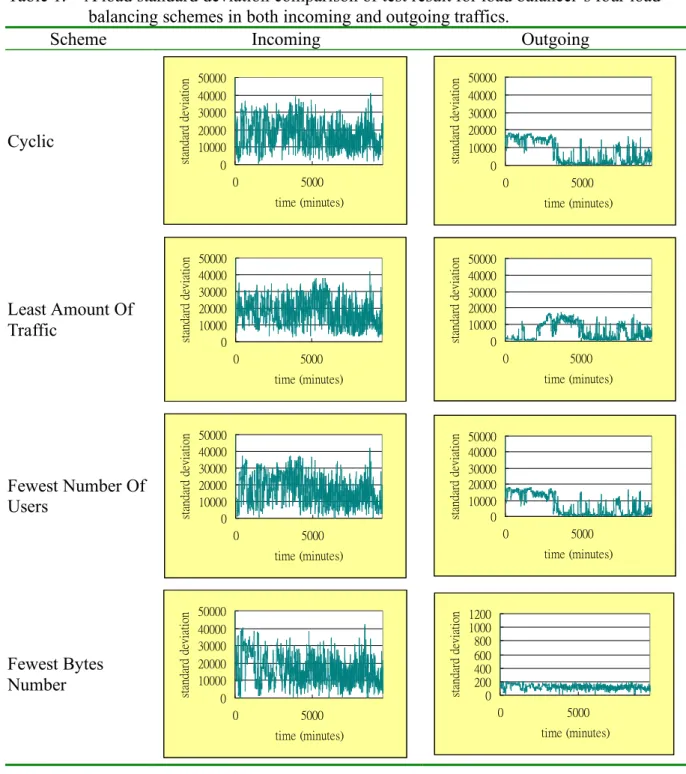
After four weeks’ test, five ADSL loads are recorded and the standards deviation among them are calculated. Table 1 is the result of five ADSL links incoming/outgoing traffic standard deviation curve during one week.
Because we can’t control incoming traffic load balancing, we can see load standard deviation between five ADSL are high for all schemes. Our load balancer can control load balancing for outgoing traffic, so the load standard deviation are low than incoming traffic in all schemes. Especially, the fewest bytes number scheme for outgoing traffic load balancing standard deviation is the lowest in all. Remember, the y-trajectory range in its chart on the right down corner of Table 1 is very lower than the others charts.
Table 1. A load standard deviation comparison of test result for load balancer’s four load balancing schemes in both incoming and outgoing traffics.
Scheme Incoming Outgoing
Cyclic ! "!!!! #!!!! $!!!! %!!!! &!!!! ! &!!! '()*+,)(-.'*/0 /' 1-21 32 +2 *4 (1 '( 5-! "!!!! #!!!! $!!!! %!!!! &!!!! ! &!!! '()*+,)(-.'*/0 /' 1-21 32 +2 *4 (1 '( 5-Least Amount Of Traffic ! "!!!! #!!!! $!!!! %!!!! &!!!! ! &!!! '()*+,)(-.'*/0 /' 1-21 32 +2 *4 (1 '( 5-! "!!!! #!!!! $!!!! %!!!! &!!!! ! &!!! '()*+,)(-.'*/0 /' 1-21 32 +2 *4 (1 '( 5-Fewest Number Of Users ! "!!!! #!!!! $!!!! %!!!! &!!!! ! &!!! '()*+,)(-.'*/0 /' 1-21 32 +2 *4 (1 '( 5-! "!!!! #!!!! $!!!! %!!!! &!!!! ! &!!! '()*+,)(-.'*/0 /' 1-21 32 +2 *4 (1 '( 5-Fewest Bytes Number ! "!!!! #!!!! $!!!! %!!!! &!!!! ! &!!! '()*+,)(-.'*/0 /' 1-21 32 +2 *4 (1 '( 5-! "!! #!! $!! %!! &!!! &"!! ! '!!! ()*+,-*)./(+01 0( 2. 32 43 ,3 +5 )2 () 6.
Table 2. Average standard deviation from Table 1.
scheme input output
Cyclic 17,574 6,940
Least Amount Of Traffic 17,779 5,554
Fewest Number Of Users 16,733 6,601
Fewest Bytes Number 16,101 122
Table 2 shows the average standard deviation for the result in Table 1. From the data in Table 2, the comparison of the test result is clearly. All the average standard deviations for
four load balancing schemes in incoming traffic control are almost the same and high. And in the outgoing traffic load balancing control, the average standard deviation for the fewest bytes number scheme is very low and it got a good balance.
5.
Conclusions
In this article, a design of multiple links network for a Taiwan’s school between it’s two separated campuses by using load balancer has presented. This structure considers both redundancy and load balancing functions and it did work well during the past year in this school. Because budgets are limited in primary and high schools, using a load balancer to combine all the low cost links together is suitable.
Four load balancing schemes are also executed and compared in the designed network structure. The problem here is the definition of load. It’s ambiguous can be CPU usage rate, CPU time, system response time, traffics counted by bytes, by users, by packets and so on. In this paper, traffics load is counted by bytes per second and it can be found that the fewest bytes numbers scheme, for outgoing traffic, is the best algorithm. Although CPU usage rate, CPU time, and system response time can affect network performance, but it’s another problem and we can’t control it. From the other viewpoint, four schemes applied here have considered above vagueness affections for network performance. In brief, fewest bytes number scheme is the best one in this network environment testing.
Reference
Baker, S. M. and Moon, B., “Distributed cooperative Web servers,” Computer Networks 31,
1999, pp.1215-1229
Bryhni, H., Klovning, E., and Kure, O., “A comparison of load balancing techniques for
scalable Web Servers,” IEEE Network, vol. 14, Jul. 2000, pp.58-64
Cardellinni, V., Colajanni, M., and Yu, P. S., “Dynamic load balancing on web-server
systems,” IEEE Internet Computing, May 1999, pp.28-39
Castro, M., Dwyer, M., and Rumsewicz, M., “Load balancing and control for distributed
World Wide servers,” Proceedings of the 1999 IEEE International Conference on Control
Applications, vol. 2, 1999, pp.1641-1619
Cherkasova, L. and Ponnekanti, S. R., “Optimizing a content-aware load balancing strategy
for share hosting service,” Proceedings of the 8th International Symposium on Modeling,
Analysis and Simulation of Computer and Telecommunication, 2000, pp.492-499
Cioffi, J., Silverman, P., and Starr, T., “Digital subscriber lines,” Computer Networks, vol. 31,
no. 4, Feb 25, 1999, pp.283-311
Enterasys Corp, “Server load balancing: The key to a consistent customer experience,”
Enterasys Corp, 2000
Grimm, C., Vockler, J. S., and Pralle, H., “Load and traffic balancing in large scale cache
meshes,” Computer Network and ISDN Systems, 1998, pp.1687-1695
Radware, LinkProof user’s guide, Jan. 2000a
Radware, LinkProof Sales Info Guide – A Traffic Manager for Multi-homed Neworks, Jan.
2000b
pp.48-50
Robb, D., “Load balancing algorithms,” Business Communications Review, May 2001b,