1
A Framework for Adaptive Process Modeling and Execution (FAME)
Perakath Benjamin Knowledge Based Systems, Inc.
[email protected] Madhav Erraguntla Knowledge Based Systems, Inc.
[email protected] Richard Mayer Knowledge Based Systems, Inc.
Michael Painter Knowledge Based Systems, Inc.
[email protected] Charles Marshall Knowledge Based Systems, Inc.
Abstract
This paper describes the architecture and concept of operation of a Framework for Adaptive Process Modeling and Execution (FAME). The research addresses the absence of robust methods for supporting the software process management life cycle. FAME employs a novel, model-based approach in providing automated support for different activities in the software development life cycle including project definition, process design, process analysis, process enactment, process execution status monitoring, and execution status-triggered process redesign. FAME applications extend beyond the software development domain to areas such as agile manufacturing, project management, logistics planning, and business process reengineering.
1.
Introduction
The information revolution of the last decade has led to significant technology developments in computer based systems. These developments have produced faster, cheaper, and easier-to-use computing technology, both for business and home users. The rapid pace of growth, however, has led to an increased need for innovative methods, tools, and infrastructures for the enterprises that design and produce these computer-based systems. The prolific growth of the software industry in particular has created intense demands for new and improved production systems, processes, and infrastructures. This paper focuses on technology that can support a critical aspect of software production: the cost effective management of the software development process.
This paper presents a novel, life cycle-integrated approach to managing software development projects. There are four main activities in the process life cycle: process modeling, process analysis, process enactment, and process execution status monitoring and control [2], [5]. Previous approaches to providing automated support for the process lifecycle have focused attention on subsets of the lifecycle [8], [6], [4]. The SMART architecture represents the first attempt to provide comprehensive support for the entire process life cycle [2]. SMART, however, does not provide robust support for execution status monitoring and process redesign based on feedback status-analysis driven feedback.
This paper presents the architecture and the concept of operation of FAME, a Framework for Adaptive Process Modeling and Execution. FAME can be used to support the following life cycle software development project management activities: i) defining the project objectives and metrics, ii) designing the software development process, iii) analyzing the alternative processes, iv) enacting the software development process (i.e., providing automated support for process execution), v) monitoring the process execution, and vi) facilitating rapid redesign of the software process based on deviations detected from process execution status data analysis.
Section 2 describes the FAME architecture. The FAME Concept of Operation is presented in Section 3. Section 4 summarizes the paper and enumerates potential applications and benefits of the research.
2.
Architecture
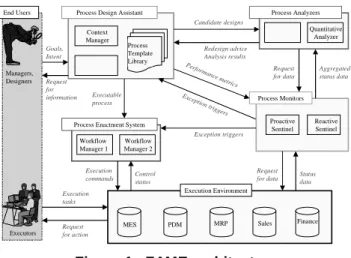
FAME employs an open architecture that provides life cycle support for the software development process (Figure 1).
Process Monitors Reactive Sentinel Proactive Sentinel Process Analyzers Qualitative Analyzer Quantitative Analyzer Process Design Assistant
Process Composer Context Manager MRP PDM Finance MES Sales Process Template Library Execution Environment Process Enactment System
Workflow Manager 1
Workflow Manager 2
Request for data Status data
Request for data Aggregated status data Exception triggers Exception triggers Performan ce m etrics Redesign advice Analysis results Candidate designs Executable process Execution commands Controlstatus
End Users Request for action Execution tasks Request for information Goals, Intent Managers, Designers Executors
Figure 1. FAME architecture
FAME implements a model-based approach to
closed-loop feedback control architecture
2.1
Process Design Assistant
2.2
Process Analyzers
3
2.4
Process Monitors
The Process Monitors are an agent-based system that monitors the process execution status, gathers compiled process status information, and submits this information to the Process Analyzers for detecting and correcting process exceptions and deviations. Reactive Sentinels are software agents designed to collect execution status data. These sentinels are programmed to detect process execution problems after they occur. The type of performance metrics that need to be reported to the software development project managers guides the selection of the type data to be monitored. For example, if the manager would like to look at the actual activity execution duration time for Activity A, then the sentinel gathers start and
before
3.
FAME Concept of Operation
Figure 2. FAME concept of operation
Project Metric Time Cost Utilization Risk Quality Variability Nominal Product - Centered Activity - Centered
Figure 3. Partial taxonomy of project oversight metrics
3.2
Develop Process Design
Process Design is an inductive process. Rather than starting from scratch, real-world designers attempt to re-use knowledge of previous designs. Process design knowledge re-use is facilitated through the FAME Process Template Library (PTL). The PTL is a structured collection of content-rich, re-usable process templates. The FAME Context Manager (Figure 1) provides
3.2.1 Process Decomposition
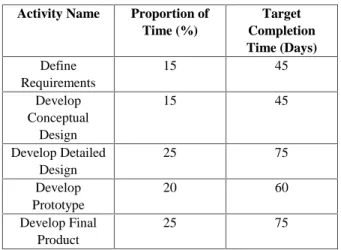
Table 1. Example metric decomposition
Activity Name Proportion of
Time (%) Target Completion Time (Days) Define Requirements 15 45 Develop Conceptual Design 15 45 Develop Detailed Design 25 75 Develop Prototype 20 60 Develop Final Product 25 75 3.2.2 Detailed Design
5 4. Design of activities that transforms a given set of inputs
to a desired set of outputs
5. Design of precedence constraints between activities or sets of tasks
6. Design of inter- and intra-activity coordination mechanisms (for example, a management activity typically needs to be designed to help coordinate and resolve contentions for resources that are shared between different tasks)
The FAME Process Composer provides automated support for these tasks. The Process Composer is based on the IDEF3 process description capture method and the IDEF5 ontology description capture method [10], [9]. 3.2.3 Process Composition
An important aspect of process design for large scale software development is process composition. Process composition is important because processes and process knowledge is becoming increasingly distributed. Process knowledge is distributed both within an organization and
3.2.4 Process Harmonization
3.3
Analyze Process
3.3.1 Qualitative Analysis
Input Output Mismatch Rule
Rate Mismatch Rule
browsing and navigating domain ontology descriptions relevant to the software project.
4. Bottleneck Resource Condition Detection Rules. This rule detects the existence of resources for which demand exceeds capacity (we refer to such resources as
3.3.2 Quantitative Analysis
Process Performance Aggregation
Modify Go ToTest Develop Prototype Maximum Time = 65 Minimum Time = 45 Expected Time = 55 Time Roll-Up
Analyze Execution Status Data
3.4
Enact Software Development Process
7 change) or to prevent any incidence of future problems or
undesirable performance (proactive change).
Based on the analysis results, the processes are redesigned, the execution specifications are regenerated, and the process improvement cycle repeats. The concept of operation thus shows how the FAME system supports the different phases of the software development process life cycle.
4.
Summary
This paper described the architecture and the concept of operation of FAME, a Framework for Adaptive Process Modeling and Execution. FAME is a model-based system than can be used by software development project teams to plan, analyze, schedule, execute, monitor, and control their work. The FAME architecture is general enough to be used effectively for process management in a variety of different application areas including agile manufacturing, project management, logistics planning, and business process reengineering. A variant of the FAME architecture was successfully deployed on two U.S. military process improvement initiatives in the manufacturing and logistics application domains [12]. FAME benefits include i) agile software development capabilities (the ability to respond quickly and cost-effectively to an unpredictably changing environment), ii) reduced time and cost for software development through robust process engineering and control, and iii) reduced life cycle costs through enhanced support for the software development process life cycle over extended periods of time.
5.
Acknowledgements
The research described in this paper was partly funded by the U.S. Defense Advanced Research Project Agency, Contract Number F33615-96-C-5601.
6.
References
[1] P. C. Benjamin, C.
Proceedings of the 1996 Winter Simulation Conference
Proceedings of the 16th International Conference on Software Engineering
Agile Competitors and Virtual Organizations: Strategies for Enriching the Customer
Proceedings of the 3rd ACM SIGSOFT/SIGPLAN Symposium on Practical Software Development Environments
Software Engineering Journal
Proceedings of the 12th International Conference on Software Engineering
IEEE Transactions on Knowledge and Data Engineering
Business Process Reengineering: A Managerial Perspective,