Policy based Data Encryption Mechanism Framework
Model for Data Storage in Public Cloud Service
Deployment Model
Boopathy D1 and Dr.M.Sundaresan2 1Department of Information Technology, Bharathiar University, Coimbatore, India [email protected]
2
Department of Information Technology, Bharathiar University, Coimbatore, India [email protected]
Abstract— Cloud computing technology is a new concept of providing dramatically scalable
and virtualized resources. It implies a Service Oriented Architecture type (SOA), reduced information technology overhead for the end-user, greater flexibility model, reduced total cost of ownership and on-demand service providing structure. From the user point of view, one of the main concerns is cloud security from the unknown threats. The lack of physical access to servers constitutes a completely new and disruptive challenge for investigators. The Clients can store, transfer or exchange their data using public cloud. This paper represents the encryption method for public cloud and also the cloud service provider's verification mechanism using the third party auditors with framework model. The Cloud Data Storage is one of the mandatory service which are acquiring in this rapid development business world.
Index Terms—
Secured cloud Data Storage, Cloud Encryption, Cloud Decryption, Encryption
Model, Cloud Service Provider. I. INTRODUCTION
Cloud computing is a natural evolution of the widespread adoption of virtualization service, service- oriented architecture (SOA), autonomic, and also utility computing. Cloud computing is the broader concept of infrastructure convergence [5]. This results in reduced cost of the services. Quality of services also gets better as the organization can spend the saved amount and time on improving it [1]. In cloud environment, resources are shared among all of the servers, users and individuals [3]. As a disarray invention with foreseen implication, cloud computing is mending way it uses business with IT [4]. Security and Privacy issues are of more concern to cloud service providers who are actually hosting the services [14]. Cloud computing models are of two types: Deployment model and Service model. Deployment model is further classified into four type's namely private cloud, community cloud, public cloud and hybrid cloud. Cloud computing service providers provide their services in a number of fundamental models [13].
Cloud computing is a term which is often used with synonyms like grid computing; cluster computing, autonomic computing [12].
© Elsevier, 2013
424
For the organization, the cloud service provider offers data centers to move their data globally [11]. It is up to the clients to decide the vendors and also depending on how willing they are to implement secure policies and be subject to 3rd party verifications [10]. Another factor of concern is that the cloud is still under development process and there are no set standards for the data storage and application communication [6].
A. Software as a Service (SaaS)
The capability provided to the consumer is to use the provider's applications running on a cloud infrastructure. The cloud applications are accessible from various client devices through a thin client interface such as a web browser (e.g., web-based email). The consumer does not manage or control the underlying cloud infrastructure including like network, servers, storage, operating systems or individual application capabilities, and with the possible exception of limited user-specific cloud based application configuration settings. It is also referred as Resource Code; provide (managed and scalable) resources as services to the user- in other words, the service providers basically provide enhanced virtualization capabilities. Accordingly, different types of resources may be provided via a service interface. [6]
B. Platform as a Service (PaaS)
The capability provided to the consumer is to deploy onto the cloud infrastructure consumer-created or acquired applications created using programming languages and tools supported by the service provider. The consumer does not able to manage or control the underlying cloud infrastructure including like network, servers, operating systems, or storage, but has control over the deployed cloud applications and possibly application hosting environment configurations.
C. Infrastructure as a Service (SaaS)
The capability provided to the consumer is to provision processing, networks, storage and other fundamental computing resources where the consumer is able to deploy and run arbitrary software, which can also include the operating systems and applications. The consumer/client does not manage or control the underlying cloud infrastructure but has control over operating systems; deployed applications, storage and possibly limited control of select networking components (e.g., host firewalls).
II. CLOUD COMPUTING TYPES
There are four different types of cloud are in use, they are:
A. Private Cloud
The private cloud infrastructure is operated solely for an organization. It may be managed or maintained by the service acquiring organization or a third party and may exist on organization premise or off premise.
B. Public Cloud
The cloud infrastructure is made available to the general public or a large industry group and is owned by an organization selling cloud services.
C. Community Cloud
The community cloud infrastructure is shared by the several organizations and supports a specific community purpose that has shared concerns.
D. Hybrid Cloud
The hybrid cloud infrastructure is a composition of two or more clouds (i.e. private, community, or public) that remain unique resource entities but are bound together by standardized or proprietary technology that enables data and application portability [1]. The Security goals of cloud data storage include three important points namely: Data Availability, Data Confidentiality and Integrity.
III. PROBLEM STATEMENT
Information security is a critical issue in cloud computing environments [9]. The public cloud is widely accessed and utilized by the many users for their own purpose, small organizations to manage their data and so on. The public cloud services providers are mostly make the trust among the users by some attraction advertisement and avail their service in very low cost. The data transferred, stored or exchanged in public cloud is mostly unsafe due to the untrust environment. The cloud Computing provides an undemanding and
425
non ineffectual Solution for Daily Computing [5]. The aspect of security and confidentiality must intervene to protect the data from each of the enterprises [10]. Share resources, software and information are provided to computers and other devices on demand [8]. Confidentiality means up to what level data should kept secured on the cloud. Integrity provides assurance that data is not altered but is accurate [7].
While the benefits of storage networks have been widely acknowledged, consolidation of enterprise data on networked storage poses significant security risks [2]. Hackers adept at exploiting network-layer vulnerabilities can now explore deeper strata of corporate information [2]. Its unauthorized disclosure could seriously and adversely impact the organization and its employees [16]. The Cloud Security Alliance's initial report contains a different sort of taxonomy based on different security domains and processes that need to be followed in general cloud deployment [15]. To bring the users data into safer side the secured data storage model is proposed.
IV. SECURED DATA STORAGE
The secured data storage is used the third party auditor as an intermediate person to connect and helps to transfer the secure data transfer between the data destination place to data accessing place. In this model both the data accessing user and data storing user are uses the secured process by using the encryption algorithms. The RSA algorithm is used to encryption style, but the process is made in moderate style. The data hijack and data stolen is not possible in this secured data storage model, due to the RSA algorithm moderate style.
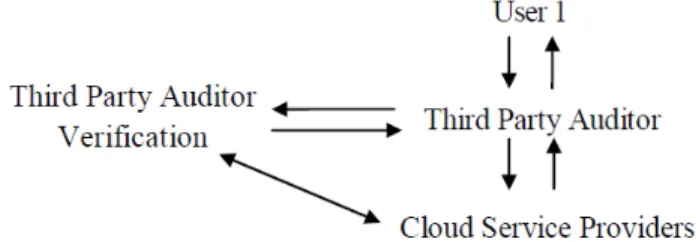
The user1 verifies the public cloud service provider using the third party auditor. When the third party auditor will issue the status of the selected service provider, user1 will ready to upload the files into that public cloud service provider. The third party auditor verification is taken place at two times. One is third party auditor fixes the information in the verification information system and second is cloud service providers working structure is defined in the third party auditor verification system.
Figure 1. User Verification Model at Data Upload
When user wants to download the file from the public cloud service provider again the verification process will be taken place to verify that the provider still in the live status or not. The working flow and data transfer information will be stored in the third party auditor verification system for further usage. Fig. 1. explain the verification model at data upload.
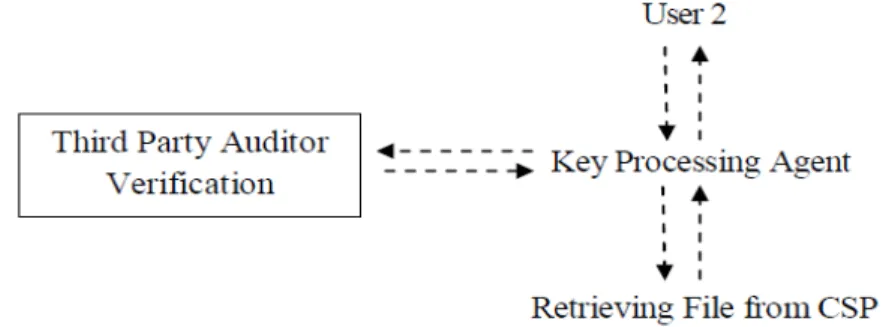
The User 1 encrypt the file using the private key and store it to the CSP with public key access, then the User 2 required the file which was stored by the User 1 in the CSP. The User 2 retrieving the file from the CSP
Figure 2. User Verification Model at Data Download
using his/her private key to get the decrypted file. The access made through the public key and the encryption took place through the User 2 private key. Fig. 2. explain the verification model at data download.
426
A. The Mechanism Working Style
Step 1: The RSA algorithm is used in this method. The User 1 send the file to the key processing client using his private key, then the file encryption taken place, public key was fixed and moved to CSP.
Step 2: When the user 2 required the encrypted file which was stored in the CSP by the User 1. So the User 2 used his/her private key to access the key processing client. The key processing client recognizes the User 2 request by his/her private key. Then the file was decrypted by using the public key then transfer to the User 2.
Figure 3. Data Storage with Third Party Auditor Verification.
File stored in the public cloud service provider in the encrypted format using the RSA algorithm.
Figure 4. Data Access with Third Party Auditor Verification.
The user2 retrieve the file from the public cloud service provider and decrypt the file using his/her private key. Fig. 3. explain the data storage with third party auditor verification and Fig. 4. explain the data access with third party auditor verification.
B. The Working Flow Code
User 2 = U2, User 1 = U1, Third Party Auditor = TPA, Public Cloud Service Provider = PCSP, Key Processing Client = KPC.
User1 storing the file in public cloud service provider:
1. U1 send request to TPA.
2. TPA analysis PCSP where the service is available. 3. If service is available TPA replies to U1 as positive
4. U1 send the file to KPC using private key and encrypt the file.
5. After encryption KPC stored the encrypted file in the PCSP with the public key access. 6. The Process is processed under the third party auditor verification mechanism.
User 2 access the file from the public cloud service provider:
1. U2 send request to TPA.
427 3. If service is available TPA replies to U2 as positive
4. U2 send the file to KPC using private key and decrypt the file.
5. The KPC access the file from the PCSP using the public key and decrypt the file using the U2 private key and send it to the U2.
6. The Process is processed under the third party auditor verification mechanism. Fig.5 is show the process.
Figure. 5. Multi Tenancy Data Storage Model for Non-Redundancy For Accuracy Level of Services = No. of. Cloud Service Providers
No. of. Cloud Services Rendering V. DISCUSSION
The Secured Cloud Storage mechanism is using the RSA algorithm for encryption and decryption. So the users can encrypt the file using their private key and stored the file in the public cloud service provider using public key. The public key is used to store and access the file from the public cloud service provider. The important thing is the public key is only used to access the file. The user required private key to decrypt the file. The processing methods take lesser steps when compared to the existing model. Fig. 6 is encryption comparison with existing model and Fig. 7 is decryption comparison with existing 1model.
Figure. 6. The Number of Steps involved in Encryption a file
428
Figure. 7. The Number of Steps involved in Decryption a file VI. CONCLUSION AND FUTURE ENHANCEMENT
The Secured Cloud Storage takes fewer steps to encrypt and decrypt the files. The existing models are still not entered into the real world service environment. The many encryption models for cloud environment are still in developing stage. The Secured Cloud Storage model will provide the maximum level of Secured structure in the cloud environment. In future the Secured Cloud Storage, the remaining algorithms will take into development to provide the better security to this model. The remaining algorithms results will take into consideration and compared to provide the maximum level of security in the cloud environment.
REFERENCES
[1] Abhuday Tripathi, Parul Yadav, "Enhancing Security of Cloud Computing using Elliptic Curve Cryptography", International Journal of Computer Applications (0975 - 8887) Volume 57- No.1, November 2012, Pg no: 26 - 30. [2] Dr.Nashaat el-Khameesy, Hossam Abdel Rahman, "A Proposed Model for Enhancing Data Storage Security in
Cloud Computing Systems", Journal of Emerging Trends in Computing and Information Sciences, VOL. 3, NO. 6, June 2012, Pg no: 970 – 974.
[3] Kawser Wazed Nafi, Tonny Shekha Kar, Sayed Anisul Hoque, Dr. M. M. A Hashem, "A Newer User Authentication, File encryption and Distributed Server Based Cloud Computing security architecture", (IJACSA) International Journal of Advanced Computer Science and Applications, Vol. 3, No. 10, 2012, Pg no: 181 – 186. [4] K.Govinda, V.Gurunathaprasad, H.Sathishkumar, "Third Party Auditing For Secure Datastorage In Cloud Through
Digital Signature Using Rsa", International Journal Of Advanced Scientific And Technical Research (Issue 2, Volume 4- August 2012) ISSN 2249-9954, Pg no: 525 -530.
[5] Mandeep Kaur, Manish Mahajan. "Implementing Various Encryption Algorithms To Enhance The Data Security Of Cloud In Cloud Computing", VSRD International Journal of Computer Science & Information Technology, Vol. 2 No. 10 October 2012 Pg no: 831 - 835.
[6] Simarjeet Kaur, "Cryptography and Encryption In Cloud Computing", VSRD International Journal of Computer Science & Information Technology, VSRD-IJCSIT, Vol. 2 (3), 2012, Pg no: 242-249.Amanjot Kaur, Manisha Bhardwaj, "Hybrid Encryption For Cloud Database Security", International Journal Of Engineering Science & Advanced Technology Volume-2, Issue-3, May- Jun 2012 , Pg.no: 737 - 741.
[7] M.Sudha , M.Monica, "Enhanced Security Framework to Ensure Data Security in Cloud Computing Using Data Secuity", Advances in Computer Science and its Applications, Vol. 1, No. 1, March 2012, Pg no: 32 - 37.
[8] Veerraju Gampala, Srilakshmi Inuganti, Satish Muppidi, Data Security in Cloud Computing with Elliptic Curve Cryptography, International Journal of Soft Computing and Engineering (IJSCE) ISSN: 2231-2307, Volume-2, Issue-3, July 2012, pp. 138 – 141.
[9] Maha TEBAA, Said EL HAJJI, Abdellatif EL GHAZI, "Homomorphic Encryption Applied to the Cloud Computing Security", Proceedings of the World Congress on Engineering, 2012, Vol I, WCE 2012, July 4 - 6, 2012, London, U.K. pp. 536 - 539.
[10]Ashish Bhagat, Ravi Kant Sahu. "Using Third Party Auditor for Cloud Data Security: A Review", International Journal of Advanced Research in Computer Science and Software Engineering, Volume 3, Issue 3, March 2013, pp. 34 - 39.
[11]N.Saravanan, A.Mahendiran, N.Venkata Subramanian, N.Sairam. "An Implementation of RSA Algorithm in Google Cloud using Cloud SQL", Research Journal of Applied Sciences, Engineering and Technology 4(19): 3574-3579, 2012, pp. 3574 - 3579.
[12]Pradeep Bhosale, Priyanka Deshmukh, Girish Dimbar, Ashwini Deshpande.: "Enhancing Data Security in Cloud Computing Using 3D Framework & Digital Signature with Encryption", International Journal of Engineering Research & Technology (IJERT), Vol. 1 Issue 8, October - 2012, pp. 1 - 8.
429
[13]Radhika G, K.V.V. Satyanarayana, Tejaswi A. "Efficient Framework for Deploying Information in Cloud Virtual Datacenters with Cryptography Algorithms", International Journal of Computer Trends and Technology- volume4Issue3- 2013, pp. 375 - 380.
[14]Mohit Marwaha, Rajeev Bedi. "Applying Encryption Algorithm for Data Security and Privacy in Cloud Computing", IJCSI International Journal of Computer Science Issues, Vol. 10, Issue 1, No 1, January 2013, pp. 367 - 370.
[15]Rashmi Nigoti, Manoj Jhuria, Dr.Shailendra Singh, "A Survey of Cryptographic Algorithms for Cloud Computing", International Journal of Emerging Technologies in Computational and Applied Sciences,4(2), March-May 2013, pp.141-146.
[16]Abhishek Mishra, Dileep Kumar Gupta, Dr. G. Sahoo BIT Mesra Ranchi, Jharkhand. "The Secure Data Storage in Cloud Computing Using Hadamard Matrix", International Journal of Engineering Science and Innovative Technology (IJESIT), Volume 2, Issue 2, March 2013, pp. 389 - 395.