ETSI GS NFV-INF 001
V1.1.1
(2015-01)
Network Functions Virtualisation (NFV);
Infrastructure Overview
Disclaimer
This document has been produced and approved by the Network Functions Virtualisation (NFV) ETSI Industry Specification Group (ISG) and represents the views of those members who participated in this ISG.
It does not necessarily represent the views of the entire ETSI membership.
Reference
DGS/NFV-INF001
Keywords
architecture, NFV
ETSI
650 Route des Lucioles
F-06921 Sophia Antipolis Cedex - FRANCE
Tel.: +33 4 92 94 42 00 Fax: +33 4 93 65 47 16
Siret N° 348 623 562 00017 - NAF 742 C Association à but non lucratif enregistrée à la
Sous-Préfecture de Grasse (06) N° 7803/88
Important notice
The present document can be downloaded from:
http://www.etsi.org
The present document may be made available in electronic versions and/or in print. The content of any electronic and/or print versions of the present document shall not be modified without the prior written authorization of ETSI. In case of any
existing or perceived difference in contents between such versions and/or in print, the only prevailing document is the print of the Portable Document Format (PDF) version kept on a specific network drive within ETSI Secretariat.
Users of the present document should be aware that the document may be subject to revision or change of status. Information on the current status of this and other ETSI documents is available at
http://portal.etsi.org/tb/status/status.asp
If you find errors in the present document, please send your comment to one of the following services:
http://portal.etsi.org/chaircor/ETSI_support.asp Copyright Notification
No part may be reproduced or utilized in any form or by any means, electronic or mechanical, including photocopying and microfilm except as authorized by written permission of ETSI.
The content of the PDF version shall not be modified without the written authorization of ETSI. The copyright and the foregoing restriction extend to reproduction in all media.
© European Telecommunications Standards Institute 2015. All rights reserved.
DECTTM, PLUGTESTSTM, UMTSTM and the ETSI logo are Trade Marks of ETSI registered for the benefit of its Members.
3GPPTM and LTE™ are Trade Marks of ETSI registered for the benefit of its Members and of the 3GPP Organizational Partners.
Contents
Intellectual Property Rights ... 5
Foreword ... 5
Modal verbs terminology ... 5
1 Scope
... 6
2 References
... 6
2.1 Normative references ... 6
2.2 Informative references ... 7
3 Definitions
and
abbreviations
... 8
3.1 Definitions ... 8
3.2 Abbreviations ... 11
4
Objectives of the NFV Infrastructure ... 13
4.1 Standardizing Organisations Impacting the NFVI ... 14
5
Structure of NFV Infrastructure Architecture Documentation ... 14
6
Architectural Principles of the Network Functions Virtualisation Infrastructure (NFVI) ... 16
6.1 Virtualisation and Associated Interfaces ... 16
6.1.1 Describing and Specifying Network Functions When Virtualised ... 16
6.1.2 NFV Interoperability Challenges ... 18
6.1.3 Management and Orchestration When Network Functions are Virtualised ... 19
6.1.4 Brief Formal Description and Definition of Virtualisation ... 20
6.1.5 Standardizing Organisations Impacting Virtualisation and Associated Interfaces ... 22
6.2 NFVI and Cloud Computing ... 22
6.2.1 Essential Characteristics of Cloud Computing applied to the NFVI ... 23
6.2.1.1 On-demand self-service in NFVI ... 23
6.2.1.2 Broad network access in NFVI ... 23
6.2.1.3 Resource pooling in NFVI ... 23
6.2.1.4 Rapid elasticity in NFVI ... 23
6.2.1.5 Measured service in NFVI ... 24
6.2.2 Service Models impacting the NFVI ... 24
6.2.2.1 SaaS... 24
6.2.2.2 PaaS... 24
6.2.2.3 IaaS ... 24
6.2.3 Cloud Deployment Models impact on NFVI ... 24
6.2.3.1 NFVI as a Private Cloud Infrastructure ... 24
6.2.3.2 NFVI Community Clouds ... 25
6.2.3.3 Public Cloud and NFVI ... 25
6.2.3.4 Hybrid Cloud and NFVI ... 25
6.2.4 Standardizing Organisations for Essential Characteristics of Cloud Computing applied to the NFVI ... 25
6.3 Domains and Inter-Domain Interfaces ... 25
6.3.1 Standardizing Organisations Impacting Domains and Inter-Domain Interfaces ... 28
6.4 Multiplicity, Composition, and Decomposition ... 29
6.4.1 Principles of Multiplicity ... 29
6.4.2 NFVI Implications of Complete and Partial Virtualization of Network Functions ... 30
6.4.2.1 Complete and Partial Virtualization ... 31
6.4.2.2 Decomposition of VNFs and Relationships between VNFs ... 31
6.4.2.3 1:1 VNF Implementation of a Network Element by a VNF ... 31
6.4.2.4 N:1 Implementation of a Network Element by Parallel VFNCs ... 32
6.4.2.5 1:N Multiplexed Implementation of Multiple Network Elements by a Single VNF ... 33
6.4.2.6 Shared Virtual Network Function Component Instances ... 34
6.4.2.7 Relationship of Virtual Network Functions to Orchestration ... 34
6.5.1 Interoperability and Hierarchical Interfaces... 35
6.5.2 Economics and Interoperability ... 36
6.5.3 Economic Analysis of Network Function Virtualization ... 38
6.6 Key Quality Indicators for the NFVI ... 39
6.7 Security Aspects ... 39
7
Domains of the NFV Infrastructure ... 40
7.1 Compute Domain ... 45
7.1.1 Functional Description of the Compute Domain ... 46
7.1.2 Compute Node ... 46
7.1.3 Functional Description of Storage ... 47
7.1.4 Scope of a Compute Node ... 48
7.1.5 Standardizing Organisations Impacting the Compute Domain ... 48
7.2 Hypervisor Domain ... 49
7.2.1 Standardizing Organisations Impacting the Hypervisor Domain... 50
7.3 Infrastructure Network Domain ... 51
7.3.1 Standardizing Organisations Impacting the Infrastructure Network Domain ... 53
8
Challenges in Performance and Portability of VNFs ... 53
8.1 Challenge 1: Processing performance depends on a number of factors ... 54
8.2 Challenge 2: Interconnection of VNFs matter, and there are many options ... 54
8.3 Challenge 3: Virtualisation may bring portability at the expense of unpredictable performance ... 55
8.4 Challenge 4: The environment should be as simple to manage as possible ... 56
Annex A (informative):
Contacts ... 57
Annex B (informative):
Bibliography ... 58
Intellectual Property Rights
IPRs essential or potentially essential to the present document may have been declared to ETSI. The information pertaining to these essential IPRs, if any, is publicly available for ETSI members and non-members, and can be found in ETSI SR 000 314: "Intellectual Property Rights (IPRs); Essential, or potentially Essential, IPRs notified to ETSI in respect of ETSI standards", which is available from the ETSI Secretariat. Latest updates are available on the ETSI Web server (http://ipr.etsi.org).
Pursuant to the ETSI IPR Policy, no investigation, including IPR searches, has been carried out by ETSI. No guarantee can be given as to the existence of other IPRs not referenced in ETSI SR 000 314 (or the updates on the ETSI Web server) which are, or may be, or may become, essential to the present document.
Foreword
This Group Specification (GS) has been produced by ETSI Industry Specification Group (ISG) Network Functions Virtualisation (NFV).
The present document gives an overview to the series of documents covering the NFV Infrastructure.
Infrastructure Architecture Document Document #
Overview GS NFV INF 001
Architecture of the Infrastructure Domains
Compute Domain GS NFV INF 003 Hypervisor Domain GS NFV INF 004 Infrastructure Network Domain GS NFV INF 005 Architectural Methodology Interfaces and Abstraction GS NFV INF 007
Service Quality Metrics GS NFV INF 010
Modal verbs terminology
In the present document "shall", "shall not", "should", "should not", "may", "may not", "need", "need not", "will", "will not", "can" and "cannot" are to be interpreted as described in clause 3.2 of the ETSI Drafting Rules (Verbal forms for the expression of provisions).
1 Scope
The present document presents an overview of the architecture of the NFV Infrastructure (NFVI) which supports deployment and execution of Virtualised Network Functions (VNFs).
As well as presenting a general overview description of the NFV Infrastructure, the present document sets the NFV infrastructure and all the documents which describe it in the context of all the documents of the NFV. It also describes how the documents which describe the NFV infrastructure relate to each other.
The present document does not provide any detailed specification but makes reference to specifications developed by other bodies and to potential specifications, which, in the opinion of the NFV ISG could be usefully developed by an appropriate Standards Developing Organisation (SDO).
The overall objectives of the ISG NFV were set out in the white paper [i.1] that led to the founding of the ISG and updated in the white paper update [i.2].
2 References
2.1 Normative
references
References are either specific (identified by date of publication and/or edition number or version number) or
non-specific. For specific references, only the cited version applies. For non-specific references, the latest version of the reference document (including any amendments) applies.
Referenced documents which are not found to be publicly available in the expected location might be found at http://docbox.etsi.org/Reference.
NOTE: While any hyperlinks included in this clause were valid at the time of publication, ETSI cannot guarantee their long term validity.
The following referenced documents are necessary for the application of the present document.
[1] ETSI ETSI GS NFV 001 (V1.1.1) (10-2013): "Network Functions Virtualisation (NFV); Use Cases".
[2] ETSI ETSI GS NFV 002 (V1.1.1) (10-2013): "Network Functions Virtualisation (NFV); Architectural Framework".
[3] ETSI ETSI GS NFV 003 (V1.1.1) (10-2013): "Network Functions Virtualisation (NFV); Terminology for Main Concepts in NFV".
[4] ETSI ETSI GS NFV 004 (V1.1.1) (10-2013): "Network Functions Virtualisation (NFV); Virtualisation Requirements".
[5] ETSI GS NFV-PER 002 (V1.1.1) (10-2013): "Network Functions Virtualisation (NFV); Proofs of Concepts; Framework".
[6] ETSI GS NFV-SEC 001 (V1.1.1) (10-2014): "Network Functions Virtualisation (NFV); NFV Security; Problem Statement".
2.2 Informative
references
References are either specific (identified by date of publication and/or edition number or version number) or
non-specific. For specific references, only the cited version applies. For non-specific references, the latest version of the reference document (including any amendments) applies.
NOTE: While any hyperlinks included in this clause were valid at the time of publication, ETSI cannot guarantee their long term validity.
The following referenced documents are not necessary for the application of the present document but they assist the user with regard to a particular subject area.
[i.1] NFV Whitepaper: "Network Function Virtualization", issue 1, (2012). NOTE: Available at http://portal.etsi.org/NFV/NFV_White_Paper.pdf.
[i.2] NFV Whitepaper: "Network Function Virtualization - Update White Paper", issue 2, (2013). NOTE: Available at http://portal.etsi.org/NFV/NFV_White_Paper2.pdf.
[i.3] IEEE Cloud Computing 2009: "The Method and Tool of Cost Analysis for Cloud Computing", Ying Li, Tiancheng Liu, Jie Qiu, Fengchun Wang.
[i.4] IEEE System Science (HICSS) (2012): "Costing of Cloud Computing Services: A Total Cost of Ownership Approach", B. Martens, M. Walterbusch, F. Teuteberg.
[i.5] TR174 Enterprise-Grade IaaS Requirements Rev1.3.
NOTE: Available at http://www.tmforum.org/TechnicalReports/EnterpriseGradeExternal/50445/article.html. [i.6] The Open Virtualization Format (OVF) Specification, Version 2.0, 2012, Distributed Management
Task Force.
NOTE: Available at http://dmtf.org/sites/default/files/standards/documents/DSP0243_2.0.0.pdf.
[i.7] Master Usage Model: Compute Infrastructure as a Service, Rev 1, (2012), Open Data Center Alliance.
NOTE: Available at
http://www.opendatacenteralliance.org/docs/ODCA_Compute_IaaS_MasterUM_v1.0_Nov2012.pdf. [i.8] Usage Model: Guide to Interoperability Across Clouds, 2012, Open Data Center Alliance. NOTE: Available at
http://www.opendatacenteralliance.org/docs/ODCA_Interop_Across_Clouds_Guide_Rev1.0.pdf. [i.9] USAGE: Input/Output (IO) Controls , Rev 1.1., 2012, Open Data Center Alliance. NOTE: Available at http://www.opendatacenteralliance.org/docs/IO_Controls_Rev_1.1_b.pdf.
[i.10] NIST SP-800-145 (September 2011): "The NIST Definition of Cloud Computing," Peter Mell and Timothy Grance, US National Institute of Standards and Technology.
NOTE: Available at http://csrc.nist.gov/publications/nistpubs/800-145/SP800-145.pdf. [i.11] Recommendation ITU-T Q.1741: "GSM evolved UMTS core network".
[i.12] ETSI GS NFV-INF 003: "Network Functions Virtualisation (NFV); Infrastructure; Compute Domain".
[i.13] ETSI GS NFV-INF 004: "Network Functions Virtualisation (NFV); Infrastructure; Hypervisor Domain".
[i.15] ETSI GS NFV-INF 007: "Network Functions Virtualisation (NFV); Infrastructure; Methodology to describe Interfaces and Abstractions".
[i.16] A. Capiluppi, K-J.Stol, C. Boldyreff, "Software reuse in Open Source: A Case Study", Int"l J. of Open Source Software and Processes, Vol 3. Iss. 3, (2011).
[i.17] NIST SP-800-146: "Cloud Computing Synopsis and Recommendations". [i.18] IEEE 802.1QTM: "Virtual LANs".
[i.19] IEEE 802.1adTM: "Support on Provider Bridges".
[i.20] ISO/IEC JTC1 SC 38: "Distributed application platforms and services (DAPS)". NOTE: Available at
http://www.iso.org/iso/home/standards_development/list_of_iso_technical_committees/jtc1_home/jtc1_s c38_home.htm.
[i.21] Recommendation ITU-T SG13: "Future networks including cloud computing, mobile and next-generation networks".
NOTE: Available at http://www.itu.int/en/ITU-T/studygroups/2013-2016/13/Pages/default.aspx.
[i.22] Recommendation ITU-T SG15: "Networks, Technologies and Infrastructures for Transport, Access and Home".
3 Definitions
and
abbreviations
3.1 Definitions
For the purposes of the present document, the following terms and definitions apply: container interface: environment within a HFB which is configured in or to realize a VFB
NOTE 1: This includes the configurability and/or programming language of the environment. The container interface is not an interface between functional blocks.
NOTE 2: Container interface should not be confused with 'containers' as used in the context of Unix type operating systems as an alternative to full virtual machines.
NOTE 3: The relation between a container interface as defined in the present document and a virtualization container as defined in the ETSI GS NFV 003 [3] is for further study.
domain: specific part of a larger entity which is useful to separate out based on given criteria
NOTE: Domains can be defined for many different purposes and the features which distinguish domains may differ in different contexts.
EXAMPLE: The compute domain, hypervisor domain, and infrastructure network domain may not be administrative domains.
functional block: basis element of a system
NOTE: A Functional Block has interfaces (both input interfaces, output interfaces), can hold state, and evolves its state and output parameters according to a unchanging transfer function.
Host Functional Block (HFB): functional block which can be configured and/or programmed
NOTE: When suitable configured and/or programmed, a Host Function Block behaves as if it were one or more functional blocks with a more specific definition. A Host Functional Block is said to host one or more Virtual Functional Blocks.
hypervisor: piece of software which partitions the underlying physical resources and creates Virtual Machines, and isolates the VMs from each other
NOTE: The Hypervisor is a piece of software running either directly on top of the hardware (bare metal hypervisor) or running on top of a hosting operating system (hosted hypervisor). The abstraction of resources comprises all those entities inside a computer/server which are accessible, like processor, memory/storage, NICs. The hypervisor enables the portability of VMs to different Hardware. infrastructure interface: interface between two HFBs
NOTE: An Infrastructure Interface can transport a virtualised interface without placing any dependency on the particular type of virtualised interface.
Network Element (NE): discrete telecommunications entity, which can be managed over a specific interface, e.g. the RNC (from Recommendation ITU-T Q.1741 [i.11])
Network Function (NF): Functional Block (FB) within a network infrastructure which has well-defined external interfaces and well-defined functional behaviour
NOTE: In practical terms, a Network Function is today often a network node or physical appliance.
Network Functions Virtualisation Infrastructure (NFVI): totality of all hardware and software components which build up the environment in which VNFs are deployed
NOTE: The NFV-Infrastructure can span across several locations, e.g. places where data centres are operated. The network providing connectivity between these locations is regarded to be part of the
NFV-Infrastructure. NFV-Infrastructure and VNF are the top-level conceptual entities in the scope of Network Function Virtualization. All other components are sub-entities of these 2 main entities.
NFVI-Node: physical device deployed and managed as a single entity providing the NFVI functions required to support the execution environment for VNFs
NFVI-PoP: single geographic location where a number of NFVI-Nodes are sited
portability: ability to transfer data from one system to another without being required to recreate or re-enter data descriptions or to modify significantly the application being transported
Virtual Functional Block (VFB): functional block, defined in a logical, implementation independent way, which is implemented by configuring a host functional block
NOTE: Programming is a form of configuration.
Virtual Machine (VM): virtualized computation environment which behaves very much like a physical computer/server
NOTE: A VM has all its ingredients (processor, memory/storage, interfaces/ports) of a physical computer/server and is generated by a Hypervisor, which partitions the underlying physical resources and allocates them to VMs. Virtual Machines are capable of hosting a VNF Component (VNFC).
virtualized interface: interface, defined in a logical and abstract way, between two VFBs
virtual network: topological component used to affect forwarding of specific characteristic information NOTE 1: The virtual network is bounded by its set of permissible network interfaces.
NOTE 2: In the NFVI architecture, a virtual network forwards information among the network interfaces of VM instances and physical network interfaces, providing the necessary connectivity and ensures secure isolation of traffic from different virtual networks.
Virtualised Network Function (VNF): implementation of an NF that can be deployed on a Network Functions Virtualisation Infrastructure (NFVI)
NOTE: A VNF is a VFB which provides exactly the same functional behaviour and interfaces as the equivalent Network Function.
Virtualised Network Function Component (VNFC): internal component of a VNF providing a VNF Provider-defined sub-set of that VNF's functionality, with the main characteristic that a single instance of this component maps 1:1 against a single VM Container Interface
NOTE: A VNFC which has been instantiated and deployed in a VM is called a VNFC Instance. A VNFC which is part of the resource pool is called a VNFC Resource, and a reserved VNFC is called a Reserved VNFC Resource. A more general VNF may be a functional composition of a number of VNFCs.
The following definitions relate to the specific domains of the NFVI, the compute domain, the hypervisor domain, and the infrastructure network domain. Further definitions relating to each domain are contained in each respective domain architecture document.
accelerator: co-processor or other specialized hardware entity deployed to offload processing, or otherwise improve performance of software running on a main processor
Central Processing Unit (CPU): device in the compute node which provides the primary container interface NOTE: The CPU instruction set is the primary runtime and execution language of the compute node. A
programme of CPU instructions loaded into memory and executing is the primary way by which a compute node acts as a HFB and hosts VFBs. A specific VFB is defined by the specific programme for that VFB running on the specific CPU.
compute domain: general area for focus which includes servers and storage
NOTE: The compute domain has its own architecture documentation within the Infrastructure architecture. compute Nnde: single identifiable, addressable, and manageable element within an NFVI-Node that provides computing resource using compute, storage, and networking functions
NOTE: A Compute Node is normally programmable and can run a hypervisor which supports VM instances. Stand-alone acceleration devices are also compute nodes.
execution cycle: step in the evolution of state within a compute node
NOTE: Strictly, this can be defined abstractly, in practical terms, this will relate directly to a CPU clock cycle. gateway node: single identifiable, addressable, and manageable element within an NFVI-Node that implements gateway functions
hypervisor domain: general area for focus which includes hypervisors
infrastructure connectivity service: connectivity service provided by the infrastructure network domain NOTE: The Infrastructure Connectivity Services abstract the details of topology, switching equipment, and
protocol/encapsulations of the infrastructure network domain. In practice relevant examples of Infrastructure Connectivity Service as likely to include E-Line and E-LAN services as defined by Metro-Ethernet Forum (MEF).
infrastructure network domain: general area for focus which includes all networking which interconnects compute/storage infrastructure and pre-exists the realisation of VNFs
Network Interface Controller (NIC): device in a compute node which provides a physical interface with the infrastructure network
network node: single identifiable, addressable, and manageable element within an NFVI-Node that provides networking (switching/routing) resource using compute, storage, and network forwarding functions
NOTE: This is a node in the NFV Infrastructure network and if the context is not clear should be called an Infrastructure Network Node.
offload: delegating processing (e.g. classification, forwarding, load balancing, cryptography, transcoding) to a different processor or other specialized hardware entity
state: set of all parameters held within a functional block
storage: non-volatile storage with in the compute domain
NOTE: In practice, this is likely to be implemented as spinning disks or as solid-state disks.
storage node: single identifiable, addressable, and manageable element within an NFVI-Node that provides storage resource using compute, storage, and networking functions
vCPU: virtualised CPU created for a VM by a hypervisor
NOTE: In practice, a vCPU may be a time sharing of a real CPU and/or in the case of multi-core CPUs, it may be an allocation of one or more cores to a VM. It is also possible that the hypervisor may emulate a CPU instruction set such that the vCPU instruction set is different to the native CPU instruction set (emulation will significantly impact performance).
vNIC: virtualised NIC created for a VM by a hypervisor vStorage: virtualised non-volatile storage allocated to a VM
vSwitch: Ethernet switch implemented in the hypervisor domain which interconnects vNICs of VMs with each other and with the NIC of the compute node
NOTE: The vSwitch may be combined with the hypervisor as a single software package or provided as a standalone piece of software running on top of or aside the hypervisor.
3.2 Abbreviations
For the purposes of the present document, the following abbreviations apply: 3GPP 3rd Generation Partnership Project
ACL Access Control List
API Application Programming Interface ASIC Application Specific Integrated Circuit
ATIS Alliance for Telecommunications Industry Solutions BIOS Basic Input Output System
BSS Business Support System
CDN Content Distribution Network COTS Commercial Off The Self CPU Central Processor Unit
CSA [TBC by EG SEC]
CSCF Call Session Control Function
DMA Direct Memory Access
DMTF Distributed Management Task Force
DNS Domain Name System
DPDK Data Plane Development Kit DPI Deep Packet Inspection
DRAM Dynamic Random Access Memory E-LAN Ethernet Local Area Network
E-Line Ethernet Line
EPC Evolved Packet Core
ETSI European Telecommunications Standards Institute
FB Functional Block
FIFO First In First Out GW Gateway HFB Host Functional Block HSS Home Subscriber Server HW Hardware IaaS Infrastructure as a Service
I-CSCF Interrogating Call Session Control Function IEEE Institute of Electrical and Electronics Engineers IETF Internet Engineering Task Force
ISO International Standard Organisation
IT Information Technology
ITU-T International Telecommunications Union - Telecommunications
KLR Kernel Level Rootkits
KQI Key Quality Indicators KVM Kernel-Based Virtual Machine
LAN Local Area Network
MAC Media Access Control
MANO Management and Orchestration MEF Metro Ethernet Forum
MME Mobility Management Entity
NAPI Network Application Programming Interface
NE Network Element
NF Network Function
NFV Network Functions Virtualisation
NFVI Network Functions Virtualisation Infrastructure NFVI-Node Network Functions Virtualisation Infrastructure Node
NFVI-PoP Network Functions Virtualisation Infrastructure Point of Presence NFVO Network Functions Virtualisation Orchestration
NIC Network Interface Card
NIST National Institute for Standards and Technology
NSI North American Association of State and Provincial Lotteries Standards Initiative NVF Network Functions Virtualisation
OAM Operations, Administration, and Maintenance
OASIS Organization for the Advancement of Structured Information Standards OCP Open Computing Project
ODCA Open Data Centre Alliance OMG Object Management Group
ONF Open Networking Foundation
OS Operating System
OSS Operational Support System PaaS Platform as a Service
PCEF Policy and Charging Enforcement Function PCIe Peripheral Component Interconnect - Express PCRF Policy and Charging Rule Function
P-CSCF Proxy Call Session Control Function
P-GW Proxy Gateway
PSTN Public Switched Telephone Network
RAM Random Access Memory
SaaS Software as a Service
SAN Storage Area Network
S-CSCF Serving Call Session Control Function
SDN Software-Defined Networking
SDN-C Software Defined Networking - Controller SDO Standards Developing Organisation
S-GW Serving Gateway
SLA Service Level Agreement
SNIA Storage Networking Industry Association SR-IOV Single Root Input Output Virtualisation SSD Solid State Disk
SSH Secure Shell
SSO Standards Setting Organisation SW Software
SWA SoftWare Architecture
TCP Transport Control Protocol TLS Transport Layer Security
TMF TM Forum
UML Unified Modelling Language vCPU Virtual Central Processor Unit VFB Virtual Functional Block
VFND Virtualised Network Function Descriptor VIM Virtual Infrastructure Manager
VLAN Virtual Local Area Network
VM Virtual Machine
VN Virtual Network
VNF Virtualised Network Function
VNFC Virtualised Network Function Component VNFD Virtualised Network Function Descriptor vNIC Virtual Network Interface Card
XML eXtensible Markup Language
4
Objectives of the NFV Infrastructure
The objectives of the Network Function Virtualisation Infrastructure emerge from consideration of the overall
objectives for NFV and the role that the NFVI has in supporting the NFV ecosystem. The NFV Use Cases document [1] identifies 9 fields of application or use cases for NFV. The NFVI is the totality of the hardware and software
components which build up the environment in which VNFs are deployed [3]. The NFVI is deployed as a distributed set of NFVI-nodes in various locations to support the locality and latency requirements of the different use cases and the NFVI provide the physical platform on which the diverse set of VNFs are executed; enabling the flexible deployment of network functions envisaged by the NFV Architectural Framework [2].
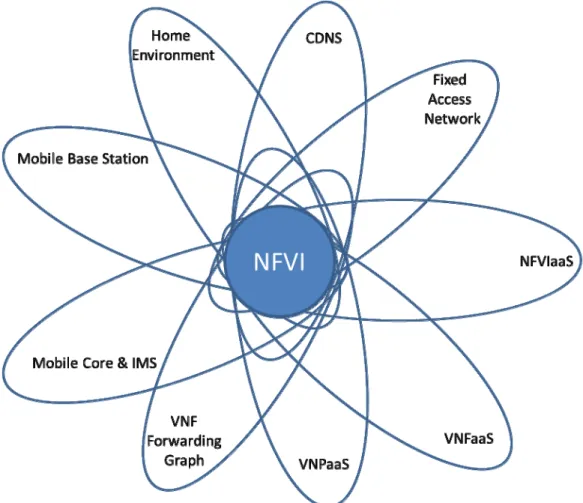
From a functional perspective, the NFVI provide the technology platform with a common execution environment for the NFV use cases as illustrated in figure 1. The NFVI provide the infrastructure that support one or more of these use cases simultaneously and is dynamically reconfigurable between these use cases through the installation of different VNFs.
The introductory NFV Whitepaper [i.1] envisaged an NFV ecosystem offering integration services as well as maintenance and third party support. The 2013 White paper update [i.2] reiterated the need for encouraging the development of an open NFV ecosystem with industry capabilities for the integration of solutions from different technology providers; where this open and innovative NFV ecosystem supported the porting of VNFs between nodes of the NFVI. The PoC Framework [5] was developed to further encourage this open global NFV ecosystem through the integration of components from different technology providers. The NFVI is the technology platform enabling the open innovation expected in the NFV ecosystem.
The NFV Architectural Framework [2] provides some initial description of the NFVI in clause 7.2.4 of that
specification. The NFV Requirements Specification [4] identifies a number of requirements for an NFVI to fulfil the role of supporting the execution environment for VNFs. These requirements span areas such as security, Operations and Maintenance and Service Models.
4.1 Standardizing
Organisations Impacting the NFVI
The ETSI NFV ISG is not intended to be a Standards Development Organization (SDO) (see [i.1], page 13); rather the documentation produced by the ISG, including this specification, should reference the work of existing SDOs and identify gaps where additional standardization efforts by those SDOs may be required to further enable the NFV ecosystem.
There are many standards organisations which already have or are progressing standards which are relevant to the NFVI and these are referenced at the end of each clause of the present document. At the general level, NIST is responsible for developing terminology for cloud computing applications and infrastructure. Cloud computing is an enabling
technology for network function virtualization. The relationship between cloud computing and NFV is discussed further in clause 6.2.
The 2013 Operator whitepaper update [i.2] also identifies the relevance of open source approaches as complementary to formal standardization efforts in the development of reference implementations as a substrate for open innovation in the NFV ecosystem. Open source developer communities and user communities can be helpful in the further development of the NFV ecosystem, (e.g. open source communities can provide a mechanism for increased software reuse [i.16]; and software reuse may increase the efficiency in the NFV ecosystem, as well as enabling more rapid development and deployment of new services which would support the increased service velocity objective of NFV. Open Source Communities do exist in support of projects relevant to the NFVI (e.g. the XEN and KVM hypervisors). The NFVI may include open source software components, but the role and collaboration mechanisms of open source communities in the NFV ecosystem are beyond the scope of the present document.
5
Structure of NFV Infrastructure Architecture
Documentation
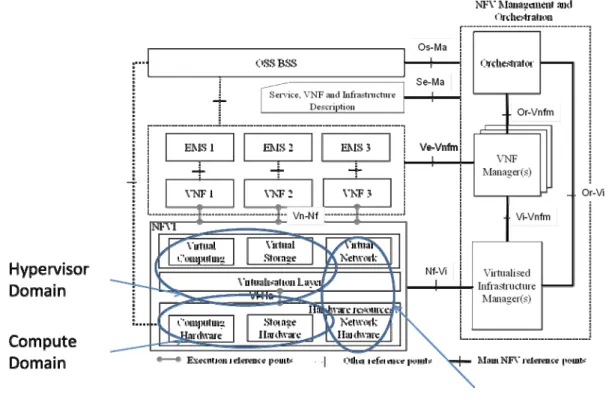
The overall architectural framework for NFV is set out in the "Architectural Framework" document [2]. Figure 4 of that document provides the NFV reference architectural framework and shows for the NFV Infrastructure (NFVI)
interactions with other parts of the NFV architecture, notably the Virtual Network Function (VNF) architecture (defined by the SWA Working Group), and the Management and Orchestration architecture (defined by the MANO Working Group) and well as with existing networks and systems.
NOTE 1: The Architectural Framework [2] is one of four documents covering the overall scope of ISG NFV. The others documents cover Use Cases [1], Terminology [3], and Requirements [4].
The architecture of the NFV Infrastructure (NFVI) is further separated into three domains, namely the compute domain (including storage), the hypervisor domain, and the infrastructure network domain. These domains are largely distinct both at a functional and practical level (see note). The general positioning of these domains within the NFV reference architectural framework is shown in figure 2.
NOTE 2: Examples of overlap functionality are a virtual Ethernet switch (vSwitch) and an embedded Ethernet switch in a NIC. These are discussed in more detail in clause 6.
Figure 2: NFV reference architectural framework and identification of NFVI domains
The documentation of the NFVI Architecture is structured as follows:
• Overview Documents. These documents give the overview and set out the feature for the Network Functions Virtualisation Infrastructure (NFVI):
- Overview of the Architecture of the NFVI (the present document). - Use Cases of the NFVI.
• Domain Documents. These documents define the architecture of the three domains of the NFVI: - Compute Domain Architecture.
- Hypervisor Domain Architecture. - Infrastructure Network Architecture.
• Methodology Documents. These documents set out principles for the specification, construction, and exploitation of the NFVI:
- Interfaces and Abstraction. The present document set out some of the foundations of virtualisation. In particular, it describes the way interfaces are specified, the way practical interfaces use an abstract view of a function, and the way in which a VNF is always a abstract view of a network function.
- Portability and Replicability. The present document set out the way in which the portability of VNFs between different implementation of NFVI may be assured. In addition, the document set out more generally the way one implementation of a component either of a VNF or of the NFVI may be replicated and replaced with another implementation. The present document provides the framework by which economic analysis including business case analysis can be carried out.
The primary specification of the NFVI is therefore contained in the three domain architecture documents. The
methodology documents contain important information about how the NFVI can be used in order to achieve the benefits set out in the white paper.
This NFVI Architecture Overview is structured as follows:
• Clause 6 sets out a number of important architectural principles on which the NFVI architecture is based. It covers a number of underlying foundations which are relied on in developing the more specific architecture of the NFVI including:
- virtualisation and functional block methodology (clause 6.1); - how NFV builds on Cloud Computing (clause 6.2);
- the principle of domains and the identification of the domains of the NFVI (clause 6.3);
- the principles and the multiplicities in mapping VNFs to host functions in the NFVI (clause 6.4); - economic and practical issues in achieving interoperability (clause 6.5);
- key quality indicators (KQIs) for the NFVI (clause 6.6); - overview of security aspects affecting the NFVI (clause 6.7).
• Clause 7 sets an overview of the architecture of each of the NFVI domains: - compute domain (clause 7.1);
- hypervisor domain (clause 7.2);
- infrastructure network domain (clause 7.3).
• Clause 8 sets out an overview of the performance challenges for the NFVI.
Some of the principles set out in clause 6 are defined in more detail in the NFVI documents "Methodology to describe: Interfaces and Abstractions" (ETSI GS NFV-INF 007 [i.15]).
Clause 7 gives an overview of the architecture of each NFVI domain. The detailed architecture of each domain are given in "NFV Infrastructure Architecture: Compute Domain" (ETSI GS NFV-INF 003 [i.12]), "NFV Infrastructure Architecture: Hypervisor Domain" (ETSI GS NFV-INF 004 [i.13]), and "NFV Infrastructure Architecture:
Infrastructure Network Domain" (ETSI GS NFV-INF 005 [i.14]) respectively.
6
Architectural Principles of the Network Functions
Virtualisation Infrastructure (NFVI)
This clause sets out an overview of a number of central principles on which the NFVI architecture is based.
6.1
Virtualisation and Associated Interfaces
This clause provides an overview of the way functional block methodology is developed to describe, define, and specify virtualisation of functions. Details of the way functional block methodology is used to describe, define, and specify virtual functions such as VNFs are set out in "Methodology to describe: Interfaces and Abstractions"
(ETSI GS NFV-INF 007 [i.15]).
6.1.1
Describing and Specifying Network Functions When Virtualised
Many network systems, including those specified by 3GPP, IETF, and ITU-T, are specified using the principles of systems engineering. Each component of the overall system is specified as a functional block and the interactions between the functional blocks are specified as interfaces. A significant, fundament principle of the systems engineering approach to specification is that the complete system is specified by the specification of the component functional blocks and their interconnection, and all components are always functional blocks.
Figure 3: Functional Block Architecture
An inherent property of a functional block is that its operation is autonomous. The behaviour of the function block is determined by:
• The static transfer function of the functional block. • The dynamic state of the functional block.
• The inputs it received in its interfaces.
If a functional block becomes disconnected from a functional block to which it should be connected, it will continue executing and setting outputs, however, the execution will follow according to the null input.
As stated above, the objective of NFV is to separate software that defines the network function (the VNF) from hardware and generic software that create a generic hosting network functions virtualisation infrastructure (NFVI) which executes the VNF. It is therefore a requirement that the VNFs and the NFVI be separately specified. However, this is a requirement that is not immediately satisfied by the method of functional blocks and associated interfaces a generalization of the technique.
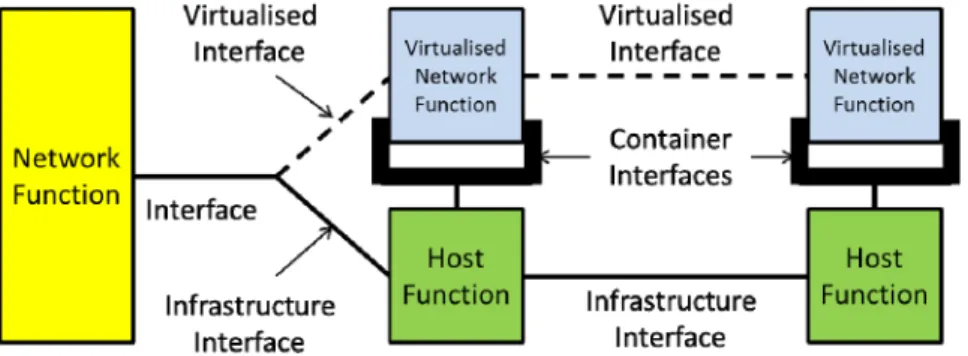
Figure 4 shows the situation when two of the three functional blocks of figure 3 have been virtualised. In each case, the functional block is now implemented as a virtualised network function executing on a host function in the NFVI.
Figure 4: Virtualisation of network function
This process has resulted in the following:
• The division of a functional block between a host function and a virtualised network function. • The creation of a new container interface between the host function and the VNF it is hosting.
• The division of the interface between the two network functions which are now virtualised between an infrastructure interface and a virtualised interface.
• The interface to the non-virtualised network function appears to be a homogeneous interface at its end with the non-virtualised function. However, at its virtualised end, it appears to be divided between an infrastructure interface and a virtualised interface.
However, in carrying out this process, there are two very important distinctions from the standard functional block description:
• The virtualised network function (VNF) is not a functional block independent of it host function. • The container interface is not an interface between functional blocks equivalent to other interfaces.
This arises as the VNF cannot exist autonomously in the way a functional block can. The VNF depends on the host function for its existence, and if the host function were to be interrupted, or even disappear, then the VNF will also be interrupted or disappear. Likewise, the container interface reflects this existence dependency between a VNF and its host function.
The relationship between the VNF and its host function is: • the VNF is a configuration of the host function.
• the VNF is an abstract view of the host function when the host function is configured by the VNF. Therefore a host function, when configured with a VNF, has the external appearance as being a functional block implementing the VNF specification. It is the host function that is the functional block but it appears from the outside to be the VNF. Equivalently, the VNF is an abstract view of the host function.
A more formal description of this relationship is set out in clause 6.1.3.
The NFV architecture is therefore defined using not just functional blocks and their associated interfaces, but is defined using the following entities:
• Host functions with their associated offered container interfaces and associated infrastructure interfaces. • Virtualised Network Functions (VNFs) with their associated used container interfaces and virtualised
interfaces.
The NFV documentation uses these constructs. The NFV documentation also noted that the container relationship between host function and virtualised function can be recursive layered. Host functions with more and more specific capability can be built up by the successive configuration with layers of virtual functions.
A specific example which is especially pertinent to NFV is as follows:
• A base host function which is a server blade (a specific implementation of a compute node, see below). This provides a container interface of extreme generality which is the 'bare metal' machine interface and the associated BIOS.
• This base host function is then configured with a virtual function (a programme is loaded and executed) which is a hypervisor. The server blade now configured with the hypervisor can provide a number of virtual machine container interfaces.
• A virtual machine can be configured with a virtual function (a programme which is loaded and executed) which is an operating system. The server blade now configured with the hypervisor and guest operating can provide a number of application container interfaces.
• A specific application can be configured with a virtual function (a programme which is loaded and executed) which is the application. The application itself may be capable of many different functional operations depending on its configuration.
• A specific functional operation can be configured with a virtual function which a specific configuration of the application.
6.1.2
NFV Interoperability Challenges
Interoperability challenges typically arise where interfaces cross administrative boundaries. The use of NFV within an administrative region does not present any new interoperability challenges between regions when the regions are interconnected by existing network function interfaces.
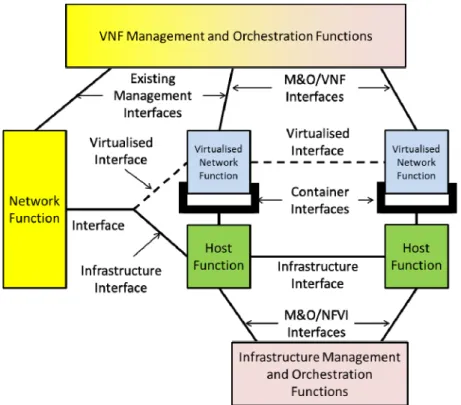
Consider the types of interfaces identified in figure 4: Existing Network Function Interfaces, Infrastructure Interfaces, Container Interfaces, and Virtualized Interfaces.
Existing Network Function Interfaces are already specified by other Standards Setting Organizations (SSOs). Those SSOs are already engaged in the process of identifying and resolving interoperability issues.
Infrastructure Interfaces are largely specified by the IT industry for cloud infrastructures. The IT industry is already engaged with resolving any Interoperability concerns with those interfaces.
Container interfaces have been specified by the IT industry for a number of applications, typically web service based. Extensions of these interfaces to support virtualized network functions may present additional interoperability challenges. Interoperability challenges exist here because the NFV concept assumes a multivendor environment supplying VNF and infrastructure components.
Any interoperability challenges with virtualized interfaces that are the functional equivalents of existing network function interfaces would likely be resolved by the SSOs that developed the original network function interfaces as they have the necessary deep functional expertise. Novel virtualization interfaces that do not correspond to existing
functional interfaces (e.g. due to some form of disaggregated virtualization) may present novel interoperability challenges, perhaps motivating the participants involved to prefer more standard solutions.
6.1.3
Management and Orchestration When Network Functions are
Virtualised
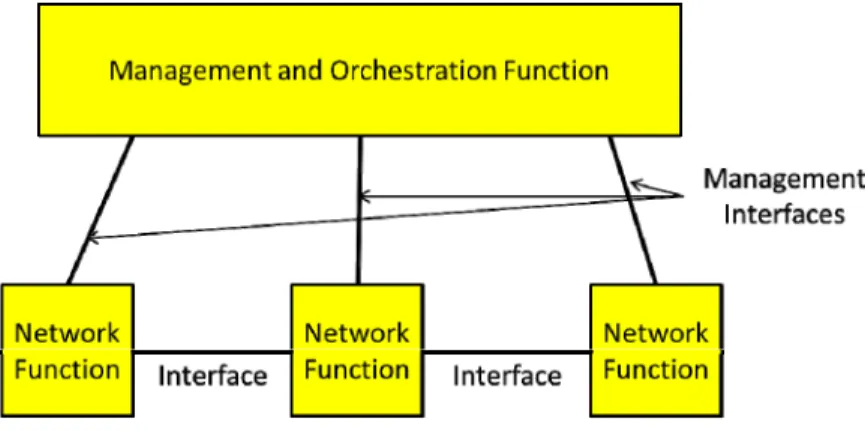
In a telecommunications operator's environment, network functions are capable of remote configuration and management. In order to achieve this, the network functions have an interface (often referred to as a 'north-bound' interface) to a management and orchestration function. This management and orchestration function is often highly complex and composed of a great many distributed component parts. However, it is still defined using the same systems engineering techniques of functional blocks and interfaces. This is illustrated in figure 5.
Figure 5: Management and orchestration of network functions
The objective of NFV is to separate the virtualised network functions from the infrastructure, and this includes their management. As shown in figure 6, the management and orchestration functions are divided between the management and orchestration of the network functions virtualisation infrastructure (NFVI) and the management and orchestration of the VNFs.
Figure 6: Management and orchestration of virtualised network functions
The management and orchestration of the NFVI is an integral and essential part of the NFV framework and is specified within the GS NFV MANO documentation.
It is likely that there is existing management of the network functions that are now virtualised by a NFV deployment. Managing the VNFs using the existing systems can be used for the deployment of NFV. This is represented by the yellow in the VNF Management and Orchestration Functions block in figure 6.
On the other hand, removal of the hardware from the VNFs removes the requirement to manage hardware aspects. In addition, the great flexibility offered by NFV can only be fully exploited if the management and orchestration implements efficient VNF lifecycle management process adapted to new business process requirements: fast order delivery, fast recovery, auto-scaling, etc. Therefore, the target objective is that the management and orchestration of VNFs is that they can be managed and orchestrated using high levels of common management and orchestration functionality with a largely common management and orchestration interface specification. This is represented by the pink in figure 6.
6.1.4
Brief Formal Description and Definition of Virtualisation
NFV brings together a number of different industry sectors including network design and operations, network equipment, compute equipment, hypervisors and cloud technologies, as well as management, orchestration, and other operational and business support systems. Each of these has developed a set of descriptive techniques and languages that are used in specification and a generally understood within the industry without further explanation. However, in the NFV two problems arise:
• practitioners from one industry may not be familiar with the techniques and languages from other industries; • the techniques and languages from any one industry may not be sufficient for the needs of the other industries. The formal specification methodology used in NFV is that of systems engineering using functional blocks.
However, while there is considerable science and precision to the methodology of functional blocks, there is a major ambiguity with the representation of virtualisation using functional blocks. The ambiguity is this:
• the methodology represents everything as functional blocks interconnected by interfaces;
• the relationship between a hosting functional block and a hosted virtual functional block hosted is not that of an interface.
In order to set out the technical mechanism of virtualisation in the methodology of functional blocks, it is necessary to start with the essential characteristics of a functional block. A functional block comprises:
• inputs interfaces through which interconnected functional blocks select an input value form a predefined range of possible input values;
• internal state which has a value from a predefined range of values and which is set by the internal operation of the functional block (state holds the history of inputs as this affects further evolution of the functional block); • output interfaces on which the functional block selects a value from a predefined range of values which then
selects the input values on interconnected functional blocks;
• a transfer function which is a predefined transition matrix which mapped a specific tuple of input and current state to a specific value of next state and output.
These characteristics are all necessary for the complete specification of a functional block, and when taken together, are also sufficient for complete specification.
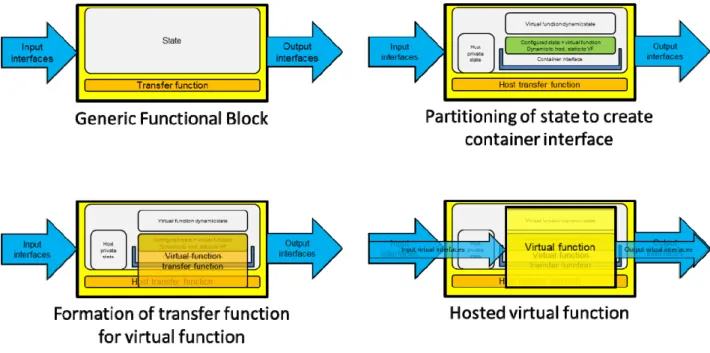
The interesting property from the perspective of virtualisation is the things that are predefined. The value ranges of the inputs, outputs, and state are all predefined, as is the transfer function. These are static to the functional block and defining of the functional block. Defining these static parameters fully specifies the functional block. The specific values of the inputs, outputs, and state are dynamic to the functional block and are not part of its specification. With this background to the formal definition of a functional block, this can be developed to formally define virtualisation. This is set out in the four steps shown in figure 7.
Figure 7: More detailed technical description of functional virtualisation
The first step shows a generic functional block with inputs, outputs, state, and a transfer function. The second step shows the state of the functional block partitioned into three distinct types of state:
• host private state which holds the dynamic state which is private to the host function;
• configured state which will be configured and then held constant and invariant during the life of the virtualised function and which defines the virtualised function;
• virtual function dynamic state which will hold the dynamic state of the virtualised function.
The third step shows how this fixed state combines with the host transfer function in order to define the transfer function of the virtualised function. This combination of the fixed state and the host transfer function allows the virtual function to execute.
The fourth step shows how the range of values defined for the host input and output interfaces are partitioned so that only those values which control the execution evolution of the virtual function are identified as belonging to the virtual interfaces of the virtual function. The input virtual interface is therefore defined as a subset of the range of values of the host function's input interface. Similarly, the output virtual interface is defined as a subset of the range of values of the host function's output interface. The behaviour of the virtual function as perceived through the virtual interfaces, is now exactly that of the virtual function.
With this formal definition of virtualisation, it demonstrates: • a virtual function is configuration of it host function;
• a virtual function is an abstract view of the host function when appropriately configured.
6.1.5
Standardizing Organisations Impacting Virtualisation and Associated
Interfaces
There does not appear to be many appropriate existing standards in this area and therefore an opportunity for new work. Appropriate bodies include:
• International Council on Systems Engineering (INCOSE).
• Object Management Group (OMG) work on Unified Modelling Language (UML) and related languages including SysML.
6.2
NFVI and Cloud Computing
The NFV white paper identified Cloud computing as an enabler for Network Function Virtualization ([i.11], page 9). The co-ordinated implementation of cloud and networking for enterprises, allowing on-demand services to be offered and providing capital efficiency for enterprise customers and network operators was also identified as a field of application for NFV ([i.11], page 7). Cloud computing supports a variety of different applications on a common infrastructure. The NFVI provides a common infrastructure that can support a variety of different fields of application as shown in figure 1.
Network Functions Virtualisation will leverage modern technologies such as those developed for cloud computing to deliver end-end network services using the NFVI. At the core of these cloud technologies are virtualisation
mechanisms: virtualisation of hardware by means of hypervisors, as well as the usage of virtual Ethernet switches (e.g. vSwitch) for connecting traffic between virtual machines and physical interfaces. Cloud infrastructures provide methods to enhance resource availability and usage by means of orchestration and management mechanisms, applicable to the automatic instantiation of VNFs in the network, to the management of resources by assigning VNFs to the correct CPU core, memory and interfaces, to the re-initialization of failed VMs, to snapshot VM states and the migration of VMs. Finally, the availability of open APIs for management and data plane control, like OpenFlow, OpenStack, OpenNaaS or OGF's NSI, provide an additional degree of integration of Network Functions Virtualisation and cloud infrastructure ([i.11], pages 9 and 10).
The NIST definition of cloud computing [i.10] is used here as the basis of a discussion of NFV in terms of essential characteristics, service models and deployment models. Through this discussion, NFV can be seen as a type of Private Cloud IaaS where VNFs are executed in support of the services that a Network Operator provides. The execution environment for VNFs is provided by the NFVI deployed in various NFVI-PoPs. Centralization of management and data is posited as a benefit of cloud computing [i.17], but NFV delivers end-end services a geographically distributed NFVI.
NOTE: An International Standard/Recommendation on Cloud Computing overview and vocabulary covering similar aspects than provided in [i.10] is under preparation in ISO/IEC and ITU-T.
6.2.1
Essential Characteristics of Cloud Computing applied to the NFVI
The NIST definition of Cloud Computing [i.10] identifies five essential characteristics of cloud services: on-demand self- service, broad network access, resource pooling, rapid elasticity and measured service. Because NFV encompasses these five characteristics, it could be considered an application of cloud technology. In order to facilitate the reuse of tools, technologies and operational processes from Cloud Computing installations, the NFVI should provide equivalent support of these essential characteristics.
6.2.1.1
On-demand self-service in NFVI
The consumer of the NFV is most typically the Network Operator. The Network Operator expects to be able to unilaterally provision and allocate existing deployed NFVI resource capacity such as server time and network storage. In some cases the VNFs or the management and orchestration functions coordinating them may be the entities provisioning computing capabilities on behalf of the Network Operator.
6.2.1.2
Broad network access in NFVI
NIST describes broad network access in cloud computing as providing capabilities that are available over the network and accessed through standard mechanisms that promote use by heterogeneous thin or thick client platforms.
NFVI-PoPs are expected to be accessed remotely (via the transmission and access network infrastructure). Virtualized network functions are expected to handle the network traffic of a variety of existing network elements and terminal types. The management and orchestration of virtualized network functions may be a type of virtualized network
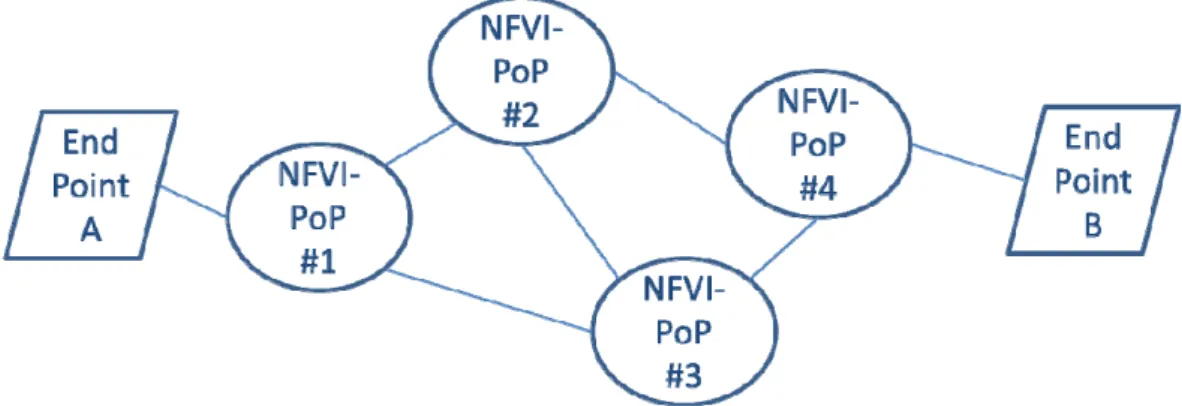
function as well. The network access capacity required at a particular NFVI-PoP will depend on the fields of application and the VNFs instantiated on the NFVI at that NFVI-PoP. Some VNFs may require location adjacent to specific types of network access facilities (e.g. the virtualised eNode B of use case #6 [i.3] and [i.4] would typically be located close to cellular towers). The NFV Architectural Framework [1] supports end-end network services delivered over a NFVI deployed in NFVI-PoPs as shown in figure 8.
Figure 8: Example of Broad Network Access to NFVI
6.2.1.3
Resource pooling in NFVI
While a single VNF might be deployed at a single NFVI-PoP, in general, the NFVI supporting the VNFs is expected to typically service multiple VNFs from different VNF providers in a multi-tenant model at one NFVI-PoP. Resource demands on the NFVI are expected to change dynamically with the service load (whether data plane or control plane traffic) processed by the VNF. Location independence is an objective in that specific VNFs should not be constrained to only run on dedicated NFVI hardware resources; some VNFs may be location specific if required by their network function e.g. due to latency requirements, or the location specific nature of distributed network functions.
6.2.1.4
Rapid elasticity in NFVI
Network Operators normally require rapid elasticity with the automated provisioning and release of the computing, storage and communication resources of the NFVI allocated to specific VNF instances. Rapid scaling could be triggered in response to the service load processed by the VNF, failover and recovery mechanisms, management and
6.2.1.5
Measured service in NFVI
Network Operators expect that the management and orchestration of VNFs will normally require the automatic control and optimization of NFVI resource usage by the VNFs. This optimization implies that the use of those resources by individual VNFs is metered in some fashion appropriate to the type of NFVI resource (e.g. storage, compute, communication).
6.2.2
Service Models impacting the NFVI
NIST definition of Cloud Computing [i.10] describes three service models: Software as a Service (SaaS), Platform as a Service (PaaS) and Infrastructure as a Service (IaaS). Service Models in the context of NFV are discussed in both NFV Use Cases [i.3] and [i.4], and NFV Virtualisation Requirements [i.5].
6.2.2.1 SaaS
The VNFs are software applications running on the cloud like infrastructure. These applications provide network functions processing data and control plane traffic for the network operator rather than just web Services. The VNFs are expected to typically be executed according to a private cloud model by the network operator. Some categories of VNFCs may be amenable to be executed in a third party cloud infrastructure and utilized by the network operator in a SaaS model. Use Case #2 [i.3] and [i.4] provides a Service Model description for Virtual Network Functions as a Service (VNFaaS). VNFaaS delivers a network function remotely. Whether the deployment and operation of VNFaaS places any additional requirements on the NFVI beyond those of any other VNF are currently considered beyond to the scope of the present document.
6.2.2.2 PaaS
NFV provides an opportunity for the network operator to significantly improve the speed with which new services and applications are developed and deployed. The PaaS model provides a service model consistent with deployment by network operators of services constructed from configurations of multiple VNF instances. Use Case #3 [1] provides a Service Model description of a Virtual Network Platform as a Service (VNPaaS). VNPaaS provides to the user of the service a larger scope of control than that provided by VNFaaS. Whether the deployment and operation of VNPaaS places any additional requirements on the NFVI beyond those of any other VNF are currently considered beyond the scope of the present document.
6.2.2.3 IaaS
In IaaS, the capability provided is the provisioning of compute, storage and communication resources so that applications can be run on them. Here, the VNFs are the applications intended to be run and the virtualization infrastructure in which they execute provides an IaaS for the Network Operator. Use Case #1 [1] provides a Service model description of Network Function Virtualisation as a Service (NFVIaaS). NFVIaaS permits a Service provider to fulfil, assure and bill for services delivered to end users across NFVIs that are independently administered. The NFVI should provide the appropriate authentication mechanisms to ensure that only authorized entities have access to NFVI resources.
6.2.3
Cloud Deployment Models impact on NFVI
NIST definition of Cloud Computing [i.10] identifies four deployment models: Private Cloud, Community Cloud, Public Cloud, or Hybrid Cloud. Support for specific Cloud Deployment models is not identified in the NFV Virtualisation Requirements discussion on Deployment Models (see clause 6.2 of [4]).
This clause describes NFV in the terms of the existing NIST Cloud Computing deployment models in order to describe the fit of NFV with this model. In order to meet specific requirement of NFV, notably security requirements, NFV has a number of further constraints on deployment which go beyond these cloud deployment models. The NFV deployment models required for security are describing in clause 5.1 of ETSI GS NFV-SEC 001 [6] and summarized in table 1 of this document.
6.2.3.1
NFVI as a Private Cloud Infrastructure
In a Private Cloud, the cloud infrastructure is provisioned for exclusive use by a single organization. The NFVI is expected to be deployed by the Network Operator for its own use in providing network services.
6.2.3.2
NFVI Community Clouds
In Community clouds, the cloud infrastructure is provisioned for exclusive use by a specific community of consumers from organizations that have shared concerns. A specific community of consumers has not yet been identified. It is possible that the ecosystem of vendors and a network provider with an NFVI, or the set of Network Operators with appropriate agreements could be considered a community. Formation of Community Clouds is beyond the scope of the present document.
6.2.3.3
Public Cloud and NFVI
With Public Clouds, the cloud infrastructure is provisioned for open use by the general public. The NFVIaaS is not expected to be available to the general public. It is not expected that a Network Operator would deploy VNFs within a Public Cloud due to the locality, latency and throughput requirements of most network functions.
6.2.3.4
Hybrid Cloud and NFVI
Hybrid Clouds have an infrastructure that is a composition of two or more distinct cloud infrastructures. NFV could be operated on a hybrid cloud deployment model where a Network Operator maintained an IaaS private cloud for its own services, but offered on a wholesale basis, VNFaaS for enterprises, or other Network Operators.
6.2.4 Standardizing
Organisations
for
Essential Characteristics of Cloud
Computing applied to the NFVI
Relevant standards bodies include:
• NIST has a number work items on cloud standardsincluding definition the services and deployment models outlined above [i.10].
• Open Data Centre Alliance (ODCA). The ODCA is defining usage models for cloud computing.
• ITU-T SG13 [i.21] is working on questions covering Cloud, SDN, and NFV, is hosting the ITU-T Joint Coordination Activity on Cloud (JCA-Cloud) and SDN (JCA-SDN).
• ISO/IEC JTC1 SC 38 [i.20] has a number of work items on cloud standard including Cloud Overview and Vocabulary and Reference Architecture.
• Open Networking Foundation (ONF) is developing architecture and interface standards of Software Defined Networks (SDN).
• OpenStack is an open source projects developing a cloud management system open source implementation.
• Open Grid Forum is creating standards for open distributed grid computing.
6.3
Domains and Inter-Domain Interfaces
At every phase of engineering of telecommunications, whether service architecture and design, network architecture and design, operations of service delivery, or operations of service maintenance, it is characterized by very high levels of complexity.
NOTE: Complexity is used here in fairly general terms and it not intended to the specifically associated with any particular normal definition or measurement method.
This complexity arises from a number of necessary features of telecommunications including:
• the very large number of interconnected physical components necessary to provide global, universal connectivity;
• the need to offer continuous, uninterrupted service (the global telecommunications network has been in continuous, uninterrupted operation of over 100 years);
• the need to interconnect many commercially, legally, and politically autonomous organisations.
Over the years telecommunications operators and vendors have founds ways of containing this complexity to achieve engineering solutions that are manageable, scalable, and evolvable.
One of the primary motivations and benefits of NFV is that it can improve the management of complexity through the separation of software from hardware. These can be separately developed and evolved greatly reducing the dependency between the two that is one of the many sources of complexity.
Lack of scalability is potential source of complexity and cost. This arises when there is a non-linear cost to the size of a 'unit' of resource and it is cost effective to have many smaller units of resource rather than a few larger units of resource. When this is the case, a complexity grows in the way in which all the smaller units should be interconnected and used in order to meet the overall requirements.
NFV will necessarily change some of the optimal size of resource units and will change some of the way in which efficient scaling can be achieved. Moreover, there is now a new relationship between units of software and units of hardware, which also create opportunity to improve the scalability of overall solutions.
The architecture of NFV generally and the NFV infrastructure specifically are defined and set out in a way to manage both complexity and scalability.
Two specific techniques used to manage complexity and scalability of the infrastructure are: • partitioning of NFV and its infrastructure into largely separable autonomous domains; • abstraction of systems and their interfaces (described in ETSI GS NFV-INF 007 [i.15]).
As part of the primary overall objective, NFV separates domains associated with VNFs from domains associated with the NFVI.
However, even within the NFVI, there is considerable merit in identifying specific domains with the NFVI. It is already the case that the purchase of servers with storage, network switches, and hypervisors are frequently decoupled. It is possible to conclude from this observation of the current market that there are already sufficient standards to support interworking between these functional domains. Most network switches from most network switch vendors will interconnect which most servers from most server vendors. Similarly, most hypervisors from the different hypervisor vendors will run on most servers from most server vendors. Such practical levels of interoperability require that the interfaces be both reasonably well understood and reasonably enduring.
The NFVI architecture fully supports these broad domains and fully supports the continued open supply between these domains. The NFVI is split into three primary domains.
• The compute domain (including storage) - which comprises the generic high volume servers and storage. • The hypervisor domain -which comprises the hypervisor and which:
- provides sufficient abstraction of the hardware to provide portability of software applications between different servers (this is potentially less significant for NFV that it is for public cloud);
- allocates the compute domain resources to the VMs;
- provides a management interface to the orchestration and management system which allows for the loading and monitoring of VMs.
• The infrastructure network domain - which comprises all the generic high volume switches interconnected into a network which can be configured to supply infrastructure network services.
It is also fully understood that the definition of these domains are neither precise nor orthogonal (ie there may be functional overlap). This possibility of some functional overlap between domains is accommodated in the architecture.
In addition, closely associated with these three NFVI domains are the NFV Management and Orchestration entities that are expected to run on the infrastructure as a set of modular, interconnected virtual machines. These entities perform all the automated orchestration and management operations needed to load and manage software appliances running on the infrastructure.
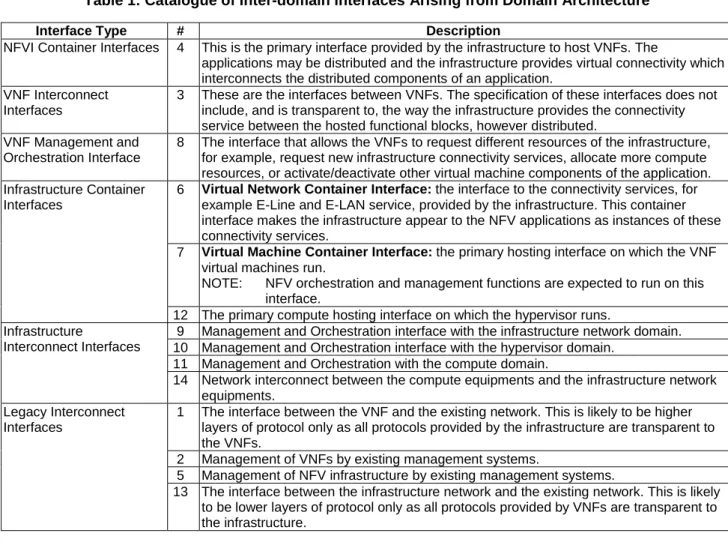
Figure 9 illustrates the application of the principle of domains to NFV and in particular to the NFVI. A number of points arise from this application of the principle of domains which are illustrated in this figure:
• The architecture of the VNFs is separated from the architecture hosting the VNFs, that is, the NFVI. • The architecture of the VNFs may be divided into a number of domains with consequence for the NFVI and
vice versa.
• Given the current technology and industrial structure, compute (including storage), hypervisors, and infrastructure networking are already largely separate domains and are maintained as separate domains with the NFVI.
• Management and orchestration tends to be sufficiently distinct from the NFVI as to warrant being defined as its own domain, however, the boundary between the two is often only loosely defined with functions such as 'element management functions' in an area of overlap.
• The interface between the VNF domains and the NFVI is a container interface and not a functional block interface (this is emphasized in this figure).
• The Management and Orchestration functions are also likely to be hosted in the NFVI (as virtual machines) and therefore also likely to sit on a container interface.
Figure 9: General Domain Architecture and Associated Interfaces