Guidance Volume One: Eligibility and How to Apply
(Version 4)
Publication date: 12 February 2015 Contact: RHI Operations Team Tel: 0845 200 2122
Email: [email protected]
Overview:
This is revised guidance for the non-domestic RHI and supersedes the version published on 8 August 2014. It covers the amendments to the scheme as proposed by the 2015 regulations laid before parliament on 15 December 2014. This amendment introduces a definition of ‘properly insulated’ for underground piping, a revised tiered tariff for biomethane injection, removal of ‘biomass as a primary fuel source’ criteria, plus changes to biogas and CHP provisions among other minor regulatory changes. It is also important to note that
regulations introducing new sustainability criteria for installations using biomass fuels have been introduced and will be coming into force in October 2015. For further information on how to comply with the upcoming sustainability requirements, please see here. It is important to familiarise yourself with these requirements in advance of them becoming mandatory in October 2015. This guidance will be updated with detailed information on biomass sustainability nearer the time.
This guidance sets out our procedures for administering the RHI under the regulations. The guidance is provided in two volumes. This document is volume 1 and explains eligibility for the RHI and how those hoping to join the scheme can become accredited or registered as applicable. Volume 2 describes the ongoing requirements for RHI participants, information on how periodic support payments are calculated and paid, and our compliance and
2
Contents
1. Our role in administering the scheme ... 5
RHI overview ... 5
Our role in administering the Non-domestic RHI ... 6
Our key functions ... 6
Publication of tariffs ... 7
Reporting... 8
Queries ... 8
Devolved Administrations ... 9
Treatment of personal data ... 9
2.
How to apply ... 13
Accreditation under the RHI ... 13
Before you apply ... 13
Making an application ... 14
Date of accreditation ... 15
Requests from us for further information or site inspection ... 16
How to apply when you have multiple plants ... 16
Location of the plant ... 18
Relocation of an accredited installation ... 18
Inspections and access to third party premises ... 19
3.
Preliminary accreditation ... 20
What does preliminary accreditation mean? ... 20
Who is eligible for preliminary accreditation? ... 21
Metering requirements ... 21
Administration of preliminary accreditation ... 21
Notification of preliminary accreditation ... 22
Circumstances under which preliminary accreditation conditions may be attached, amended, or preliminary accreditation withdrawn ... 22
Receiving full accreditation after preliminary accreditation ... 22
4.
General eligibility requirements ... 24
The owner of the installation must be the applicant ... 24
Installation capacity ... 24
What is an installation? ... 25
Date of completion of installation and first commissioning ... 27
What is the difference between the ‘installation’ and ‘commissioning’ of an eligible installation? ... 28
Transitional arrangements: installations commissioned between 15 July 2009 and 28 November 2011 ... 28
New plant ... 28
Installations heating one single domestic premises are ineligible... 29
Heat delivery medium ... 31
Microgeneration requirements (installations of 45kWth or less) ... 31
5.
Heat uses ... 33
Eligible heat uses ... 33
Evidence of Eligible Heat Use ... 36
3
6.
Solar thermal ... 39
General eligibility ... 39
7.
Geothermal energy ... 40
General eligibility ... 40
8.
Heat pumps ... 41
General eligibility ... 42
Installation capacity for ground source and water source heat pumps ... 43
Heat pumps with integrated electrical immersion ... 43
Coefficient of performance (COP) ... 44
Evidence of COP required during application for RHI accreditation ... 44
Design Seasonal Performance Factor (SPF) ... 45
Suitable forms of evidence for design SPF ... 45
Reversible heat pumps ... 49
Determination of heat pump installation capacity ... 49
9.
Solid Biomass (including solid biomass contained in waste) ... 51
General eligibility ... 51
Solid biomass boilers ... 52
Fossil fuelled and dual fuelled biomass plant ... 52
Ancillary and contaminated fuels ... 53
Air quality requirements ... 54
Best Practice ... 57
10.
Biogas combustion for heat ... 59
General eligibility ... 59
Metering requirements ... 61
FMS ... 62
11.
CHP (for solid biomass, solid biomass contained in waste, biogas and
geothermal) ... 63
General eligibility ... 63
Installation capacity for CHP systems ... 64
FMS ... 67
Heat meters ... 67
CHP systems first commissioned between 15 July 2009 and 28 November 2011 and registered on the CHPQA scheme ... 67
12.
Registration for biomethane producers ... 69
Biomethane as a developing technology ... 69
Existing regulatory framework ... 69
Biomethane registration requirements ... 70
Assurance ... 71
How to register ... 71
Inspecting the plant ... 72
Fuel measurement and sampling questionnaire ... 73
Metering volume ... 73
Measuring GCV ... 74
13.
Metering eligibility requirements ... 76
Introduction ... 76
4
What information must be supplied when applying for accreditation? ... 79
Steam measuring equipment (steam meters) ... 81
Meter placement and numbers of meters: all installations ... 83
Meter placement for installations where the heat transfer medium is a liquid (ie not steam) ... 88
Meter placement for installations where the heat transfer medium is steam ... 89
Isolated ineligible plants ... 91
More than one eligible installation connected to the same heating system ... 92
Location of meters on boilers with heat recirculation ... 92
Shared meters ... 92
Installations in series ... 93
Metering by difference ... 93
Installation of meters ... 94
Schematic diagram... 95
Independent report on metering arrangements (IRMA) ... 95
Appendix one – Glossary of RHI terms ... 100
Appendix two – RHI Emission Certificate ... 105
5
1. Our role in administering the scheme
This chapter outlines the policy context, provides a background to the scheme, and summarises the government’s and our involvement.
RHI overview
1.1. The Renewable Heat Incentive (RHI) is a world-first government financial incentive
scheme designed to increase the uptake of renewable heat technologies and reduce carbon emissions. It is a key way for the UK to meet its renewable energy target of 15 per cent by 2020, as required by the European Union.
1.2. The Secretary of State for Energy and Climate Change used powers contained in the
Energy Act 2008 (‘the Act’) to introduce the Renewable Heat Incentive (RHI) in Great Britain. The Renewable Heat Incentive Scheme Regulations 2011 came into force on 28 November 2011. The government is responsible for developing the underlying RHI policy including setting tariffs, establishing the legislative framework, and introducing any future changes to the scheme elements.
1.3. The government has appointed us to administer the RHI. Our E-Serve division has extensive experience in delivering similar environmental schemes and our aim is to make the RHI as effective and efficient as possible. A range of renewable heat technologies is supported under the RHI. These include:
solid biomass, including when contained in waste (including CHP) ground and water source heat pumps
air to water heat pumps geothermal (including CHP)
solar thermal (at capacities of less than 200 kWth)
biogas combustion (except from landfill gas but including CHP) biomethane injection
1.4. Payments are made on a quarterly basis over a 20 year period to the owner of the RHI installation or the producer of biomethane.
1.5. This guidance is for the non-domestic RHI scheme. Domestic applicants can now apply to the Domestic RHI. Further information on the Domestic RHI is available on our website1.
Please note you cannot apply to the domestic and non-domestic RHI for the same installation.
1
6 Our role in administering the Non-domestic RHI
1.6. The government, via the Department of Energy and Climate Change (DECC) is responsible for developing the underpinning RHI policy including setting tariffs, establishing the legislative framework, and introducing amendments to the scheme. Under the RHI Regulations we are the administrator of the RHI. Any queries about aspects of policy should be addressed to DECC.
Our key functions
1.7. There are eight sets of regulations relevant to the RHI scheme: the Renewable Heat Incentive Scheme Regulations 2011
the Renewable Heat Incentive Scheme (Amendment) Regulations 2012 the Renewable Heat Incentive Scheme (Amendment) Regulations 2013
the Renewable Heat Incentive Scheme (Amendment) (No.2) Regulations 2013 the Renewable Heat Incentive Scheme (Amendment) (No.3) Regulations 2013 the Renewable Heat Incentive Scheme (Amendment) Regulations 2014
the Renewable Heat Incentive Scheme (Amendment) Regulations 2015
the Renewable Heat Incentive Scheme and Domestic Renewable Heat Incentive Scheme (Amendment) Regulations 2015
1.8. The regulations detail our key functions with respect to the RHI. These include: accreditation of installations and registration of producers of biomethane
which meet the eligibility criteria, including verifying identity, bank details and ownership of an installation
publishing guidance for participants and prospective participants to
understand how to apply and how to comply with the conditions of the RHI making payments on a quarterly basis to participants for their eligible heat
output (kWhth) or biomethane produced
monitoring and enforcing compliance with the initial eligibility and ongoing requirements of the RHI as outlined in the regulations
undertaking inspections to ensure participants’ ongoing obligations under the RHI are being complied with
reporting to the Secretary of State on the progress of the RHI on a monthly, quarterly and annual basis
providing a review procedure that allows prospective, current and former participants to challenge our decisions in relation to the administration of the RHI if they believe our decisions are incorrect.
7 1.9. We will carry out these functions as efficiently and effectively as possible. We cannot,
however, act beyond the scope of the powers as laid down in the regulations. Scope of this guidance
1.10. We are responsible for publishing guidance on the governance and administration of the RHI, including our approach to ensuring compliance with the RHI, dealing with breaches of RHI requirements, and conduct of inspections and handling reviews of decisions. 1.11. This guidance does not claim to anticipate every scenario which may arise. Where a
scenario arises that is not addressed in this guidance, we will adopt an approach which we consider to be consistent with the relevant legislation. Any additional guidance we publish will be available on our website.
1.12. This guidance is not intended to provide comprehensive legal advice on how the regulations should be interpreted or itself to have legal effect. At all times, the onus is on the owner of an installation or producer of biomethane to ensure that he or she is aware of the requirements of the regulations. We will provide advice on the eligibility of technologies where we can. However, if a technology is new, developers might find it helpful to seek their own legal and technical advice before approaching us.
1.13. This guidance represents our approach to matters concerning the general administration of the scheme in accordance with the current regulations. Where there are future
changes to the regulations we will reconsider and revise our administrative arrangements accordingly.
Publication of tariffs
1.14. We will publish an adjusted tariff table on an annual basis to reflect changes in the Retail Prices Index (RPI).2 This will be published on or before 1 April each year for the period
commencing 1 April of that year and ending 31 March the following year.
1.15. With the introduction of the degression mechanism we will also publish tariff tables on a quarterly basis by 15 March, 15 June, 15 September and 15 December of each year. These tariff tables will show the tariffs for participants who join the scheme in the next tariff period, commencing after the date the tariff table is published, which will reflect any changes to individual tariffs announced by DECC.
1.16. DECC is required to publish any tariff change notice affecting the next tariff period by 1 March, 1 June, 1 September and 1 December of each year. Any reductions in tariffs announced by DECC will only affect those applicants who were registered as producers of biomethane, or whose installations were accredited after the commencement of the tariff period commencing after DECC’s tariff change notice is published3.
2 The general purpose domestic measure of inflation in the United Kingdom. More information available
from the Office of National Statistics (www.statistics.gov.uk)
3
8 1.17. Details and timings of the notices and tariff periods, and how degression will be
calculated, are set out in volume 2, chapter 8. Reporting
1.18. In addition to providing monthly reports to DECC on the uptake of the scheme, we will publish quarterly and annual reports on our website from the launch of the scheme. These public reports will include the following information:
aggregated details of accredited installations and fuel type aggregated details of the technology replaced
total amount of periodic support payments made in that reporting period total amount of heat generated for which payments have been made under the
RHI, as well as details of what this heat has been used for sustainability information for certain installations using biomass volume of biomethane injected by registered biomethane producers.
1.19. We will also publish the following aggregated information on the Ofgem RHI website on an ongoing basis:
the number of accredited RHI installations and registered biomethane producers
the technology and installed capacity of the installations
the total amount of heat generated and biomethane produced together with the total amount of periodic support payments made under each tariff.
1.20. We will publish current information on the scheme and provide the location or link to the public report.
1.21. We may also publish further information which we hold in relation to the performance of our functions under the regulations if requested to do so by the Secretary of State. Queries
1.22. Any queries relating to the scheme operation or applicant eligibility should be emailed to [email protected] with the nature of the query clearly marked. If you are an existing participant, please note in the query that you are a participant and your installation number. Written queries should be sent to the address on the front of this guidance, clearly marked for the attention of the RHI operational team. For telephone enquiries, the team can be contacted on 0845 200 2122. The phone line is open Monday to Friday, except public holidays. Please check the Ofgem RHI website for the opening hours of the phone line.
9 Devolved Administrations
1.23. In accordance with the Act, we can only make payments to eligible renewable heat installations that are generating heat in England, Wales or Scotland, or to biomethane producers injecting into the grid in these regions. Amendments to the relevant
legislation are a matter for the Secretary of State and Scottish ministers. Northern Ireland introduced the RHI in its own legislation and guidance, which came into effect on 1 November 20124. We administer the NI RHI, which differs from the England, Scotland
and Wales schemes in some respects, on behalf of the Northern Ireland government. The Isle of Man and the Channel Islands are excluded from the scheme. Separate guidance for the Northern Ireland scheme is published by the Northern Ireland Department of Enterprise, Trade and Investment.
Treatment of personal data
1.24. All personal data collected from participants will be processed in accordance with the Data Protection Act 1998. We are a public authority and must protect the public funds we handle, so we may use the information you have given us to prevent and detect fraud. As part of this process, your information may be supplied to a third party that conducts ID verification and bank account validity checks. We may also share this information, for the same reasons, with other government organisations involved in the prevention and detection of crime.Please note that some personal data will be shared with DECC for the purpose of monitoring the scheme and that, where appropriate, DECC may share that data with the Devolved Administrations.
Eligibility summary and checklist
Scheme eligibility1.25. Applicants need to meet a range of eligibility requirements. These include demonstrating that the heat is used for an eligible purpose, that metering arrangements are
appropriate, and that grants have not been received for certain purposes. Further information on how to do this can be found on the Ofgem RHI website.
1.26. The following checklists summarise the general eligibility criteria that needs to be satisfied before we can accredit your installation. For more detailed information, please see the technology specific chapters.
Table 1: General eligibility checklist
1) OWNERSHIP
- Identity verified - Bank details validated
4The Renewable Heat Incentive Scheme Regulations (Northern Ireland) 2012, as amended by the
10 - Permission to act for the others, where multiple owners
2) COMMISSIONING DATE
- Plant first installed and commissioned on or after 15 July 2009
except for air to water heat pumps and biogas more than or equal to200kWth which must be first commissioned on or after 4 December 2013)
- Commissioning date for CHP installations converted from electricity generation is the date of conversion
3) GRANTS
- Declare that any grants from public funding that have been or will be received for an eligible installation have been repaid or will be repaid by deduction to incentive payments in certain circumstances
4) NEW
- Plant was new at the time of installation (except for CHP conversions and equipment to produce biomethane)
5) MCS
- The plant with installation capacity of 45kWth or less has MCS or equivalent certification
6) PROVIDING HEAT
- Plant is providing heat for at least one eligible heat use (heating a space, heating water or carrying out a process inside a building, or cleaning or drying on a commercial basis outside of a building)
7) NON-SINGLE DOMESTIC REQUIREMENTS
- The installation is not providing heat to the same premises as an installation accredited under the Domestic RHI scheme
- The installation is not solely heating a single domestic premises 8) METERING ARRANGEMENTS
- The metering arrangements will provide accurate measurement of the heat output for eligible use and payment purposes
Technology specific eligibility criteria
In addition, further eligibility criteria apply in relation to both the size and technology type of your installation. The following table summarises the technology specific criteria.
Table 2: Eligible technologies and sizes and technology specific criteria Eligible
technology Technology-specific criteria
11
- MCS certification requirements apply for installations less than or equal to 45kWth
- Fuel eligibility requirements (see volume 2) - Air Quality requirements
Solid biomass in
waste All scales eligible - Must burn waste
- Fuel eligibility requirements (see volume 2)
Ground-source heat pumps Water-source heat
pumps
All scales eligible
- MCS certification requirements apply for installations less than or equal to 45kWth
- Must have a Coefficient of Performance (CoP) of at least 2.9 - Reversible heat pumps must only measure heating not cooling - Capacity of heat pumps to be specified based on design conditions - Must have a design Seasonal Performance Factor (SPF) of at least 2.5 - Must measure electrical input to the heat pump system
Air to water heat
pumps All scales eligible - Must not be designed to provide cooling
- Must not be designed to use heat which has been expelled from a building or from a process which generates heat
- MCS certification requirements apply for installations less than or equal to 45kWth
- Must have a Coefficient Performance (CoP) of at least 2.9
- Must have a design Seasonal Performance Factor (SPF) of at least 2.5 - Must measure electrical input to the heat pump system
Geothermal All scales eligible
- To count as geothermal, must generate heat using naturally occurring energy located and extracted from at least 500m beneath the surface of solid earth
Solar thermal Installations less than 200 kWth eligible
- MCS certification requirements apply for installations less than or equal to 45kWth
- Collector type must be flat plate or evacuated tube
Biogas
combustion All scales eligible (installations 200 kWth and above are eligible if first commissioned on or after 4 December 2013)
- Gas must be from anaerobic digestion, gasification or pyrolysis
- Participant must not use biogas from anaerobic digestion which is landfill gas
- May not generate heat from solid biomass - Fuel eligibility requirements (see volume 2)
CHP All scales eligible
- Must be one of the following technologies: deep geothermal, biogas, solid biomass contained in waste or solid biomass, and meet the criteria for those technologies.
- Must not have been accredited under the RO and at any time since it was accredited have been a ‘qualifying CHP station’ or be capacity in respect of which a declaration under Article 28(7) of the ROO 2009 (or Scottish equivalent) has been made
- Eligible if a new plant (‘combustion unit’) is added to an existing CHP system and the new plant was installed and first commissioned on or after 4 December 2013.
12
- If the relevant plant(s) use solid biomass, the installation is CHPQA certified and the relevant plant(s) were first commissioned on or after 4 December 2013 it will be eligible for the bespoke New Solid Biomass CHP tariff
Biomethane
injection All scales eligible - The existing regulatory framework external to Ofgem must be adhered to at all times. No further RHI-specific accreditation standards exist - Documents required to demonstrate that the biomethane produced
meets, or is expected to meet, all of the Health and Safety Executive requirements on gas safety.
Associated documents
The following documents support this publication. Energy Act 20085
DECC Renewable Heat Incentive Policy Document6
Renewable Heat Incentive: Impact Assessment7
Renewable Heat Incentive Scheme Regulations 20118
Renewable Heat Incentive Scheme (Amendment) Regulations 20129
Renewable Heat Incentive Scheme (Amendment) Regulations 201310
Renewable Heat Incentive Scheme (Amendment No.2) Regulations 201311
Renewable Heat Incentive Scheme (Amendment No.3) Regulations 201312
Renewable_Heat_Incentive_Scheme_(Amendment)_Regulations_201413
Renewable Heat Incentive Scheme (Amendment) Regulations 201514
5http://www.legislation.gov.uk/ukpga/2008/32/contents
6http://www.decc.gov.uk/assets/decc/what%20we%20do/uk%20energy%20supply/energy%20mix/re
newable%20energy/policy/renewableheat/1387-renewable-heat-incentive.pdf
7http://www.decc.gov.uk/assets/decc/what%20we%20do/uk%20energy%20supply/energy%20mix/re
newable%20energy/policy/renewableheat/1381-renewable-heat-incentive-ia.pdf
8http://www.legislation.gov.uk/uksi/2011/2860/contents/made 9http://www.legislation.gov.uk/uksi/2012/1999/contents/made 10http://www.legislation.gov.uk/uksi/2013/2410/contents/made 11http://www.legislation.gov.uk/uksi/2013/2410/contents/made 12http://www.legislation.gov.uk/uksi/2013/3179/contents/made 13http://www.legislation.gov.uk/uksi/2014/1413/contents/made
13
2.
How to apply
This chapter sets out what accreditation under the RHI means, what the process is for
applying to the scheme, and how to determine how many applications you need to complete. The registration process for biomethane producers is addressed separately in chapter 12.
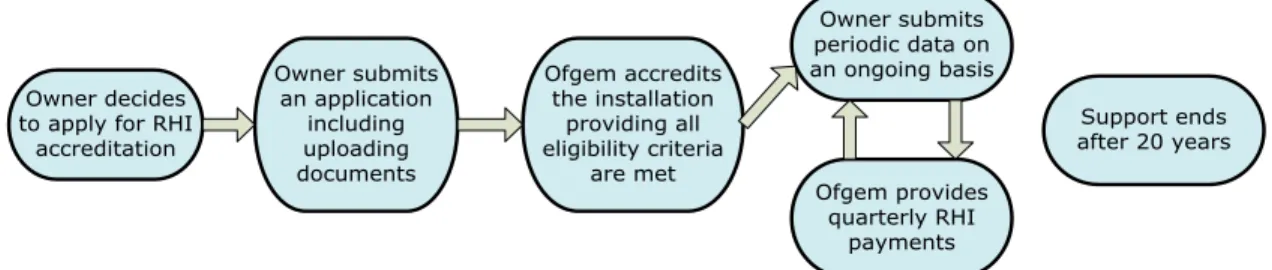
Figure 1: High level end-to-end process for an RHI participant
Owner decides to apply for RHI
accreditation
Support ends after 20 years Owner submits
periodic data on an ongoing basis Ofgem accredits
the installation providing all eligibility criteria
are met Owner submits
an application including uploading documents
Ofgem provides quarterly RHI
payments
Accreditation under the RHI
Overview
2.1. In order to receive support under the RHI, an eligible installation will have to be
accredited. Accreditation (which is defined in the regulations) is the term that we use to denote admission of an applicant to the RHI once we determine that the installation meets the eligibility criteria of the scheme and that the application for accreditation is properly made.
2.2. Biomethane producers are treated differently to other participants in the RHI. For full details on how to register as a biomethane producer for the RHI, please see chapter 12. 2.3. In order to gain accreditation for an installation, an applicant will have to demonstrate
that an installation meets the RHI eligibility criteria, including that the installation is of an eligible renewable heat technology type and size, the heat is used for an eligible purpose and that metering arrangements are appropriate. For further information on general and technology-specific eligibility requirements please see chapters 6 to 12. Information on eligible heat uses can be found in chapter 5, and the requirements for metering arrangements are explained in detail in chapter 13.
Before you apply
2.4. Before you apply, we recommend you follow the advice below to improve the likelihood of a smooth passage through the application process:
Read the relevant sections of this guidance in full. It provides detailed information on our approach to administering the scheme, eligibility
14 Prepare your accreditation application well. Gather relevant information
(eg technical specifications/photos of meters and plant, schematics, planning consents, invoices and commissioning documents) that you will need to provide, and it is recommended that you send the information in this way. This guidance provides information on the types of information we will need applicants to provide. In addition, we have provided a ‘Summary of Supporting Information for RHI Applicants’ on the Ofgem RHI website. If you are still unsure what is required, please contact the RHI enquiry line on 0845 200 2122 or email us at [email protected]. We will be moving to an 0300 number shortly in line with public sector best practise.
Send a high quality application. If your application is unclear or the accompanying documentation is illegible this can cause delays in processing your application until you can resubmit any clarifications. We recommend you provide clear, concise and complete information and ensure electronic
documents are high quality (eg easy to navigate, any scans are legible). This may affect the date from which you are eligible and receive payments from. Many applicants engage an expert to help with the installation and
application process. Having professional help may make the process faster and easier. In this case you can register them as an additional user on your account and they can carry out parts of the application on your behalf. Making an application
Figure 2: How to apply for accreditation
Creates account on RHI system
Enters installation information and provides supporting
documentation
Reviews application
Installation ACCREDITED
OWNER OFGEM
Requests further info
Installation NOT ACCREDITED
2.5. To apply for accreditation for an installation, you will need to apply online via the Ofgem RHI website (www.ofgem.gov.uk/RHI). If you are unable to apply online, please call us on 0845 200 2122 to discuss your requirements. We may provide paper applications in exceptional circumstances. We strongly recommend that you apply via the online system as this will allow us to process your application more quickly. All applicants are required to send in a separate hard copy form with their organisation’s bank account details at the same time as the application.
15 2.6. Accreditation can only be received once an eligible installation has been first
commissioned. For information on preliminary accreditation, please see the ‘preliminary accreditation’ section of this chapter below or the ‘preliminary registration’ section in chapter 12 for biomethane applicants.
2.7. When completing the RHI application process online, all accreditation questions relevant to your installation must be answered before you can submit your application. The information you will need to provide at the application stage will depend on the
technology type and size of your installation, and the complexity of your heat uses. You will also be required to provide supporting evidence as part of your application, which will depend on your technology type and other variables. All applicants will normally be required to provide evidence relating to the commissioning and purchase of their
equipment, which may take the form of receipts or invoices, as well as a commissioning certificate. We also advise you to take photographs of your meters showing the opening readings.
2.8. You will also have to declare that you (or the owner(s) you represent) will continue to meet the ongoing obligations required by the scheme, in order for us to accredit your installation. For further information on these obligations, please see volume 2.
2.9. You must ensure that the information you submit is accurate. If we subsequently find that accreditation information was incorrect we may need to take compliance action. Receiving a financial gain through knowingly submitting false information could
constitute fraud. Where we suspect this has happened we will pass information on to the relevant authorities for further action which may lead to prosecution.
Date of accreditation
2.10. The date of accreditation for your installation is the date from which your RHI payments will be calculated. If your application is successful, the date of accreditation will be the first date on which all three of the following requirements are satisfied:
the application is ‘properly made’ in accordance with regulation 22(2) and (3) of the RHI Regulations (including your supplying us with any information and/or documents relating to your application we have requested you supply) all RHI eligibility requirements applicable to the installation are satisfied the installation has been commissioned.
2.11. To ensure that the processing of your application can be completed in a timely manner, a hard copy of your bank details should be sent to us as soon as possible after you have completed your online application.
2.12. If in exceptional circumstances you are submitting a paper application, the same criteria as set out above will apply to determine whether your application is successful. We recommend that proof of posting/delivery should be obtained when submitting postal applications.
2.13. The RHI (Amendment) Regulations 2013 introduced a long term cost control mechanism, referred to within our guidance as the ‘degression mechanism’. This means that in
16 certain circumstances, set out in the RHI (Amendment) Regulations 2013, reductions
can be made to an individual tariff or tariffs.
2.14. The date of accreditation for your installation will determine the tariff you receive. Your application must meet all the requirements set out above particularly when notification of a tariff reduction has been announced. Further information on the degression
mechanism can be found in volume 2, chapter 8.
Requests from us for further information or site inspection
2.15. Once you have submitted your application and your identity and bank details have been verified, we will review all the information before making a decision as to whether the installation can be accredited. In some cases, we will need to contact you for further information to enable us to verify eligibility. After submitting your application please check for any follow-up communication from us.
2.16. Please note that before your installation is accredited, or you are registered as a
biomethane producer, we may arrange for a site inspection(s) so that we can be assured that it is eligible and should be accredited or that your biomethane production equipment should be registered.
Accreditation decision
2.17. If we are satisfied that the application has been properly made, that all of the relevant eligibility criteria have been met and that you are able to comply with the ongoing obligations of the scheme, we will accredit the installation and you will become a participant in the scheme. We will notify you in writing of the decision.
2.18. Once you are a participant in the scheme, you are able to receive support for your accredited installation. We will send you a statement of eligibility which will include or refer you to the following:
the date of accreditation
the applicable tariff rate for your installation
the process and timing for providing meter readings details of the frequency and timetable for payments
the tariff lifetime and the tariff end date for the installation
the terms and conditions for your ongoing participation in the scheme.
2.19. If your application is not successful, you will be notified in writing of the reason(s). You are entitled to ask for a review of this decision. For more information on how to request a review, please see volume 2, chapter 13.
17 2.20. Applicants should apply only once for each installation for which they wish to claim RHI
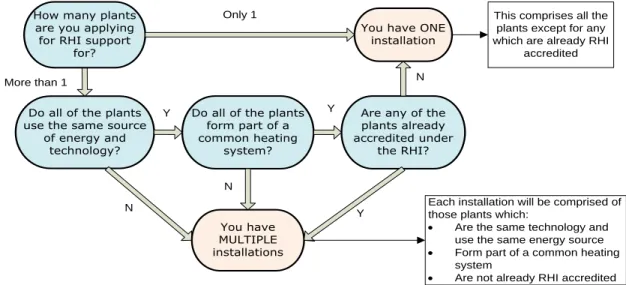
support. If you have multiple plants then you need to know whether these can be applied for separately or if they should be considered together as a single installation. 2.21. As provided in the regulations15, an installation can consist of one plant only unless two
or more plants making up an installation meet the following criteria: the plants meet the eligibility criteria
the plants use the same source of energy and technology (eg ground source heat pump)
the plants form part of a common heating system
none of the plants has already been accredited as an RHI installation. 2.22. In these cases, two or more plants will be regarded as a single installation for RHI
purposes. You should only make one application for that single installation in this instance.
2.23. Please see Figure 3 to assess whether you should submit single or multiple applications for RHI support.
Figure 3: Do I need to submit a single application for RHI support or multiple applications?
Do all of the plants use the same source
of energy and technology?
Are any of the plants already accredited under
the RHI? Do all of the plants
form part of a common heating
system?
You have MULTIPLE installations
You have ONE installation How many plants
are you applying for RHI support
for? Y N Y N Y N Only 1
More than 1
Each installation will be comprised of those plants which:
Are the same technology and use the same energy source
Form part of a common heating system
Are not already RHI accredited This comprises all the
plants except for any which are already RHI
accredited
2.24. Where an installation comprises more than one plant, we will consider the combined installation capacity of the plants when determining the appropriate eligibility criteria for the installation. For example, the independent report on metering arrangements (see chapter 13 for further information on the report) would be required if the combined
18 installation capacity of both boilers is equal to or greater than 1MWth (please see the
‘Installation Capacity’ section of chapter 4).
2.25. The combined installation capacity will also determine the tariff band applicable for the technologies which receive different tariffs based on their capacity. Furthermore, if one or more of the plants is already accredited under the RHI, the addition of a further plant may be treated as ‘additional capacity.’ Please refer to volume 2, chapter 10, for further information on how to apply for accreditation for the additional plant(s).
2.26. District heating – such as a central boiler for an apartment building, or a network of pipes delivering heat from a central installation to a number of local households or businesses – will be eligible for the RHI where the heat is produced by an eligible
installation. An installation supplying heat by way of district heating will be treated in the same way as any other RHI installation of that technology and fuel type which is
generating eligible heat. There is no uplift for district heating installations. For example a district heating sytstem served by a 600kWth biomass boiler will be treated the same way as a 600kWth boiler heating a single non-domestic building in terms of RHI eligibility and support levels.
2.27. Please see the ‘Inspections and access to third party premises’ section below for our approach to instances where the eligible heat use occirs on thid party premises not owned or controlled by the participant. We may also require you to provide evidence that domestic premises receiving heat from the heat distribution system are domestic and do not have ineligible uses.
Location of the plant
2.28. Accreditation is assigned to the installation at the location that is provided at application. An accredited installation can be relocated. Further information on the relocation of your accredited installation can be found in the section below and in volume 2, chapter 11. 2.29. A plant can be removed from in situ for maintenance or minor repairs, turned back on
and reconnected to the heating system, as long as the plant remains at the location for which it has been assigned accreditation. Removing a plant from in situ for these specified purposes will not be considered a relocation of the plant. Should your plant require major repairs or maintenance that must be conducted at a separate location from the plant’s accredited location, you must notify us before removing the plant from its accredited location.
Relocation of an accredited installation
2.30. If an accredited installation is relocated the participant/owner must notify us within 28 days of the installation being disconnected. You will be required to submit a photograph of the closing meter reading(s) for all RHI relevant meters. Once you have relocated your installation you will need to apply for accreditation via the RHI register. We will then assess if the installation’s eligibility criteria are still being met at the new location. 2.31. During this assessment we may request to see any of the information set out in
Schedule One to the regulations. The application and supporting documentation will be reviewed. Payments will resume from the date of accreditation of the installation at the new location subject to compliance with ongoing obligations, and will continue for the
19 duration of the 20 year lifetime given when the installation was first accredited in its
original location.
Inspections and access to third party premises
2.32. In order to ensure compliance with the scheme, we (or agents authorised on our behalf), will carry out a programme of site inspections of installations at the pre-accreditation stage and of accredited installations on an ongoing basis.
2.33. If the installation, and/or its associated infrastructure, is located on a third party premises not owned or controlled by you, the participant, you will be required, as a condition of accreditation, to ensure access (by contractual or other means) for us (or our authorised agents) to such premises for the purposes of inspection. This will include access to non-domestic premises that are served by the installation for the purpose of verifying eligible heat use. We may also require you to provide evidence (eg site plans for domestic premises or external photographs) that domestic premises receiving heat from the heat distribution system are in fact domestic and do not have ineligible uses. 2.34. Further information regarding our approach to the audit and inspection of accredited
installations can be found in volume 2, chapter 14.
2.35. For detailed information on how to apply for the RHI please see the easy guide to applying to the non-domestic RHI16.
20
3.
Preliminary accreditation
This chapter sets out what preliminary accreditation means, and who is eligible.
3.1. In certain cases, applicants who are proposing to construct or operate an installation can apply for preliminary accreditation. The government has decided to allow preliminary accreditation for certain proposed installations at the planning stage to give relevant applicants more certainty about future accreditation.
3.2. Biomethane producers are treated differently to other participants in the RHI. Instead of the accreditation of a renewable heating installation, the process for biomethane
producers is described in the regulations as ‘registration’. More information on biomethane registration can be found in chapter 12.
3.3. For detailed information on how to apply for the RHI please see the easy guide to applying to the non-domestic RHI17.
What does preliminary accreditation mean?
3.4. Preliminary accreditation means an individual or an organisation can submit plans and evidence for installations that have not yet been commissioned, demonstrating that once built, an installation would meet the eligibility criteria of the RHI scheme. If we are satisfied that the eligibility criteria would be met, that it is likely renewable heat will be generated at the plant and that certain planning requirements are met, we will grant preliminary accreditation, which may include conditions. It is only available for installations that have not yet been commissioned.
3.5. Preliminary accreditation can be considered as a form of ‘in principle’ agreement. It does not itself make the applicant a participant on the scheme, and no payments will be made on the basis of a preliminary accreditation. But it does give assurance that once the proposed installation is built and the owner applies for ‘full’ accreditation to the scheme, we will grant full accreditation providing that the installation is then built in line with the plans submitted, and other conditions are met as set out below.
3.6. There are no time limits on the validity of preliminary accreditation. However, receipt of preliminary accreditation is not a guarantee that a future ‘full’ accreditation application will be granted. In certain circumstances, which are specified in the regulations, we will not grant full accreditation. This includes where the legislation has changed since the preliminary accreditation in a way that means that, if the application for preliminary accreditation had been made after the change, it would have been refused. Similarly, preliminary accreditation does not guarantee that a specific tariff rate will be received if future regulation changes affect tariff rates.
21 Who is eligible for preliminary accreditation?
3.7. Preliminary accreditation is only available to applicants with the following technologies: geothermal
biogas
solid biomass and solid biomass contained in waste installations –with a capacity of 200kWth and above
solid biomass CHP installations which are eligible for the Solid Biomass CHP tariff (other CHP installations which fall under one of the technology types listed above are also eligible for preliminary accreditation as one of those technologies).
3.8. Applicants for preliminary accreditation must provide evidence that relevant planning requirements relating to the construction or operation of an installation are satisfied. This means that an installation has been granted the necessary planning permission, or that such planning permission is not required and appropriate evidence of this is
provided to us.
3.9. In the case of conditional planning permission, this should be provided along with an explanation of why it is conditional or we may not grant preliminary accreditation. We cannot grant preliminary accreditation unless the consent or permission is forthcoming or it is evidenced that consent or permission is not needed. Given time limits on planning consents and permissions, we will only grant preliminary accreditation if the consent or permission is current.
Metering requirements
3.10. As part of your preliminary accreditation application, you will be required to submit a schematic diagram detailing the proposed layout of your installation including positioning and the number of meters that will be used. Please see section ‘Schematic diagram’ in chapter 13 of this volume for further information on this requirement. You are not required at this stage to provide information regarding meter serial number(s), make(s) or model(s) of your meter(s), where these have not yet been selected. You will be required to provide an updated schematic with the full details if you later apply for full accreditation.
Administration of preliminary accreditation
3.11. All applicants who receive preliminary accreditation for an installation will be required to advise us of any material changes made to the installation. Applicants should contact us for advice if they are in any doubt as to whether the changes they are considering are material.
3.12. Please note that the eligibility requirement in relation to publicly funded grants also applies to applicants for and recipients of preliminary accreditation. Please refer to
22 chapter 4 of this guidance for further information where you are in receipt of a publicly
funded grant.
3.13. We may attach other conditions upon granting preliminary accreditation to an applicant. These will depend on the circumstances of the application and will be determined on a case by case basis.
Notification of preliminary accreditation
3.14. We will confirm preliminary accreditation in writing. Preliminary accreditation will in most cases be effective from the date we issue the notification letter to you or, in some
circumstances, a later date we may specify in the notice. The notification letter will also specify any conditions attached to the preliminary accreditation.
3.15. We may also contact applicants to specify any further information needed before preliminary accreditation can be granted.
3.16. If we decide to reject an application, we will write to you with an explanation of the reasons.
Circumstances under which preliminary accreditation conditions may be attached, amended, or preliminary accreditation withdrawn
3.17. The regulations set out circumstances in which, following the granting of preliminary accreditation, conditions may be attached or amended, or a preliminary accreditation can be withdrawn. These circumstances are:
there has been a material change(s) in circumstances since the preliminary accreditation was granted
the information contained in the original application was incorrect in a material respect
there has been a change in the applicable legislation since the date of preliminary accreditation, and that change is such that if the application for preliminary accreditation had been made after this change the preliminary accreditation would not have been granted
any conditions attached at the date of granting preliminary accreditation have not been complied with.
Receiving full accreditation after preliminary accreditation
3.18. Once an installation in receipt of preliminary accreditation has been built, the owner of the installation can apply for full accreditation. As part of their application for full accreditation the applicant should give the reference number of the preliminary
accreditation. The application for full accreditation should be made as a fresh application via the online RHI Register. The approved preliminary application should not be edited except as advised by us.
23 3.19. In assessing the application for full accreditation, we will take into account the
preliminary accreditation granted as explained in the next paragraph.
3.20. Where the installation has been built and commissioned in line with the original preliminary accreditation, preliminary accreditation has not been withdrawn and any conditions (including amended or additional conditions) set out in the preliminary accreditation continue to be complied with, we will grant full accreditation unless:
we consider the information on which the original preliminary accreditation was based was incorrect in a material respect such that, if we had known about it at the time of preliminary accreditation, we would not have granted the preliminary accreditation
there has been a material change in circumstances or a change in applicable legislation since the date of preliminary accreditation such that, in either case, if the application for preliminary accreditation had been made after the date of the change it would have been refused.
3.21. Please note, the preliminary accreditation will be restricted to the aspects of the installation you provided information for, and is not a guarantee of full accreditation.
24
4.
General eligibility requirements
This chapter sets out in more detail the general eligibility requirements for accreditation under the RHI that apply to all installations, plus defines some of the terms used under the RHI. See chapters 6 to 12 for the requirements for individual technologies.
The owner of the installation must be the applicant
4.1. It is a requirement that the owner, or where more than one person is the owner, one of the owners (the ‘representative owner’18) of an installation is the person making the
application for accreditation. An ‘owner’ in the context of the RHI is the
person/organisation with exclusive rights and liabilities in respect of an RHI installation. The owner, or the representative owner, is the person who will receive RHI payments for an accredited installation. We expect that the owner will normally be the
person/organisation who purchased and paid for the installation of the equipment. 4.2. The only exception to the above is in the circumstance of a ‘hire purchase agreement, a
conditional sale agreement or any agreement of a similar nature’. In these cases, the Act19 defines the ‘owner’ for RHI purposes to be the person in possession of the plant
under such an agreement, and it is this person who should apply for the RHI. We may require evidence from the applicant to verify that such an agreement is in place. We will interpret ‘any agreement of a similar nature’ to mean a contract providing for the
separation of legal ownership and physical possession, and containing provision (which may be subject to conditions) for the ultimate transfer of ownership to the person who has possession.
4.3. As part of the application for accreditation, the applicant will be required to declare that they are the owner, or representative owner, of the relevant eligible installation. Only one application will be accepted for any one eligible installation. We may request to see evidence of the agreement between multiple owners (such as a contract or signed letter of consent) as part of the accreditation process or as part of an audit.
4.4. Where the prospective participant is a company or public authority, an individual within that organisation should be nominated by the owner or representative owner to act on the organisation’s behalf when applying for accreditation under the RHI (‘nominated individual’).
Installation capacity
4.5. For the purposes of the RHI, the installation capacity will be the total installed peak heat output capacity of the installation. In most cases the installation capacity should be
18 Where there is more than one owner of an accredited RHI installation, the owner with the authority
to act on behalf of all owners is referred to as the representative owner.
25 simple to establish as it will be part of the information provided by the manufacturer.
Details of the installation capacity must be provided as part of the accreditation process. 4.6. Where there is no standard information from the manufacturer, eg for bespoke
equipment, you may have to provide us with technical evidence to prove the installation capacity as part of the accreditation process.
What is an installation?
4.7. The concept of ‘installation’ is important in order to work out which equipment must be new, or for which you must not have received a grant.
4.8. An ‘eligible installation’ is defined in the regulations as a plant (including any equipment, apparatus or appliance) which meets the eligibility criteria. The eligibility criteria include those set out in Part Two of chapter 2 of the regulations — which require that eligible installations must ‘generate heat’ using specified eligible sources of energy and technologies.
4.9. Determining the items of plant which are integral to the generation of heat (and which will, therefore, form an eligible installation) will depend on the particular facts and circumstances of each case. However, the tables at the start of each technology specific chapter show the position which we will usually adopt in assessing whether particular items of a plant form part of an ‘eligible installation’ for these purposes. Our
interpretation has taken into account DECC’s tariff calculations that were designed to compensate for the additional cost of a renewable heat technology installation as compared to the cost of a gas installation (fossil fuel counterfactual).
4.10. The following is a list of equipment which is usually not included in the definition of ‘eligible installation’ (NB the list is not exhaustive):
Heat (hot water/ liquid and steam) meters
Heat distribution system (eg pipes delivering heat to users, heating controls, pumps, valves, radiators/ heat distribution heat exchangers etc.)
Heat storage equipment
Other buildings housing the plant equipment (eg boiler house)
Foundations4.11. CHP plants have a specific regulation in reference to what is classed as ‘new’ for the RHI. See the ‘New plant’ section below for details.
4.12. Please note that in the case of fuel storage equipment such as hoppers for biomass boilers, we would expect at least one hopper to be new (to reflect the fact that storage equipment was anticipated in the tariff) – but it is acceptable for the applicant to also have additional storage equipment in place which is not new.
4.13. Please also note that although flue stacks would not be required to be new for RHI purposes, any new plant requires a health and safety assessment of the flue stack design (irrespective of the RHI).
26
RHI interaction with publicly funded grants
4.14. With one new exception, set out in 4.17 below, the regulations state that an eligible installation must not be accredited and a producer of biomethane must not be registered if a grant from public funds has been paid or will be paid in respect of any of the costs of purchasing or installing the eligible installation and such grant has not been paid back to the grant making body or person.
4.15. We will interpret the ‘costs of purchasing and installing an eligible installation’ as including the costs of purchasing and installing any equipment, apparatus or appliance which, in accordance with the ‘What is an Installation?’ section above, is considered to form part of the eligible installation. On this basis, we do not consider that such costs would generally extend to costs incurred in purchasing and installing plant which is not needed in order to generate heat.
4.16. As part of the accreditation process, you will be asked if public funds have been or will be received for the installation. If you declare that a grant has been, or will be, received (whether or not you consider the grant to be for the costs of purchasing or installing the installation) we may contact you for further information.
4.17. We are not prevented from accrediting an installation where the purpose of the grant is, or will be, to meet costs other than the costs of purchasing or installing the installation. What we consider to be a grant from public funds
4.18. A grant from ‘public funds’ can be a grant made by a public authority or by a person who is not a public authority but who is distributing funds on behalf of a public authority. Our consideration of whether or not a grant has been made from ‘public funds’ will include grants from Europe, central or devolved governments and public authorities at regional or local level.
4.19. We will take a common sense approach to determining what constitutes a ‘public authority’.
Repayment to grant making body or person
4.20. If you want to decline the grant offer or pay back a grant that has already been received for the purchase or installation costs of an installation, please contact the grant-making body or person directly. Before we can accredit your installation, you will need to provide evidence to us either that the offer has been declined or the grant has been repaid in full, except where the circumstances in paragraph 4.23 apply.
4.21. Please note that if you are intending to repay the portion of a grant which relates to the installation only, you may wish to agree the relevant amount with us first before making any repayment to the grant provider.
4.22. Participants have an ongoing obligation to notify us if any of the information provided in support of their application for accreditation was incorrect. If we become aware at a later date that the information provided at accreditation in relation to grants was incorrect, we may consider taking enforcement action. Where we find that incorrect information was
27 provided intentionally with the purpose of defrauding the scheme, we will refer the
matter to the appropriate authorities. Please see chapter 10 of RHI Guidance Volume 2 for further information on our approach to non-compliance within the scheme.
Repayment mechanism
4.23. The 2014 Amendment Regulations introduce a narrow range of circumstances in which, notwithstanding that a grant from public funds has been paid in respect of any of the costs of purchasing or installing the eligible installation and not repaid, we may
nevertheless decide to allow the eligible installation to be accredited or the producer of biomethane to be registered and allow the grant to be repaid through deductions to RHI payments. The circumstances in which we can make this decision are where the grant making body:
has refused to accept repayment of the grant has ceased to exist
where a grant was received from UK national lottery funds and the eligible installation was installed and first commissioned on or after 15 July 2009 but not later than 28 November 2014. For biomethane producers completion of the installation and injection of biomethane will need to have commenced within this timeframe.
4.24. If any of the circumstances in the above paragraph apply you will have to provide clear evidence in support so that we can decide whether to accredit your installation and allow repayment of the grant through your RHI payments. Volume 2, chapter 6 provides an example of how grant repayments will be calculated and deducted from RHI periodic support payments in these circumstances.
Date of completion of installation and first commissioning
4.25. The following technology types are only eligible if their installation was completed and they were first commissioned on or after 15 July 2009. Please see chapter 11 for exceptions to this rule for CHP plants:
Solid Biomass
Biogas below 200kWth
Ground and Water Source Heat pumps Geothermal
Solar collectors Energy from Waste
4.26. The following technology types are only eligible for accreditation if they were first commissioned on or after 4 December 2013:
28 Air to Water Heat Pumps
Biogas 200kWth and above
A CHP system which generates heat from either solid biomass, biogas or waste in combination with any other source of energy
4.27. For the technologies listed in 4.25, an installation will not be eligible if the installation of the plant was completed before 15 July 2009, even if the plant was commissioned afterwards. We will not consider applications where the installation of the plant was completed or the plant was first commissioned prior to this date. We may ask for
evidence of the date your plant installation was completed (eg purchase receipts) and of the commissioning date of your installation (eg a commissioning certificate). We may also ask for a photograph of your installation taken at the time it was installed for the purposes of accreditation checks and audit.
What is the difference between the ‘installation’ and ‘commissioning’ of an eligible installation?
4.28. ‘Installation’ means building and/or putting in place the relevant plant. At this stage, the plant has not begun generating heat. ‘Commissioning’ a plant means to carry out all necessary procedures and tests as constitute, at the time they are undertaken, the usual industry standards and practices to show that the plant is capable of operating and delivering heat to the premises or process for which it was installed. For smaller scale installations, installation and commissioning may happen on the same day. At the larger scale there is usually a significant testing period, so the date of installation and date of commissioning may be different.
Transitional arrangements: installations commissioned between 15 July 2009 and 28 November 2011
4.29. Installations that were installed and first commissioned on or after 15 July 2009 but before 28 November 2011 are eligible for the scheme and have to meet all the eligibility criteria for the RHI in the same way as installations commissioned after the start of the scheme. This includes the microgeneration requirements as discussed below in section ‘Microgeneration Requirements (installations of 45kWth or less)’ and the metering requirements which are discussed in chapter 13.
4.30. These installations will be eligible for the same 20 year period of support as installations commissioned after the start of the scheme, starting from the date of accreditation (which cannot be prior to the start of the scheme). Please note that payments will not be backdated to the date of first commissioning.
New plant
4.31. Your plant must be new to be eligible for the RHI. We interpret this requirement as applying to all of the ‘plant’ which can be regarded as constituting an ‘eligible
installation’; that is, any equipment, apparatus or appliance which is necessary for, and integral to, the generation of heat using eligible sources of energy and technologies. For
29 guidance on our approach to determining the scope of plant which can be considered
integral to the generation of heat, please refer to the table at the beginning of each technology specific chapter. For exceptions to this rule for CHP plants please refer to chapter 11.
4.32. We will interpret ‘new’ to mean plants that are new and have not been previously used. We will accept plant as being new if it has not been previously used before being
installed and first commissioned. Converted equipment will not be eligible for the RHI. Upon request, you should be able to provide us with delivery notes or purchase receipts as evidence that your plant is new.
Installations heating one single domestic premises are ineligible
4.33. Renewable heating installations serving a single private residential premises are noteligible for the non-domestic RHI. This includes single renewable heating units installed by a company, private landlord or registered social landlord, for use in an individual premises (These installations may be eligible for the domestic RHI scheme which launched on 9 April 2014).
4.34. You will not be eligible for the non-domestic RHI if you are applying for accreditation for an installation:
that is either accredited or for which an application has been made and not been withdrawn or rejected under the domestic RHI scheme
if the installation for which you are applying for accreditation supplies heat to the same property as an installation that is either accredited or for which an
application has been made and not been withdrawn or rejected under the domestic RHI scheme.
4.35. Only installations that provide heat to non-domestic premises, multiple domestic premises or a mix of domestic and domestic premises are eligible for the
non-domestic RHI. Domestic premises are defined in the regulations as ‘single, self-contained premises used wholly or mainly as a private residential dwelling where the fabric of the building has not been significantly adapted for non-residential use’20.
4.36. For example, an eligible installation could serve:
a single, non-domestic premises, eg a hairdresser multiple non-domestic premises, eg a shopping centre
multiple non-domestic and domestic premises (mixed use), eg office space and residential flats
multiple domestic premises, eg through a district heating system supplying a block of flats.
30 4.37. In interpreting the definition of ‘domestic premises’ and ‘single self-contained premises’
we shall take into account whether those premises are treated as separate and self-contained premises for Council Tax banding purposes21. Accordingly, where a premises
consists of a main property and other buildings such as outhouses, pool-houses, lean-to’s etc. which are together treated as one self-contained unit in single occupation for Council Tax, this would be likely to be treated as a ‘single self-contained’ premises for RHI purposes. Where such premises are ‘used wholly or mainly as a private residential dwelling where the fabric of the building has not been significantly adapted for non-residential use’, the premises will therefore be treated as ‘domestic’ for the RHI. Accordingly, where heat is generated for use solely in these premises, that heat would not be eligible for non-domestic RHI support as it is ‘for the use of one domestic premises’.
4.38. Similarly, where premises comprise a main property and adjoining property or properties (such as annexes, gatehouses, workers cottages etc.) which are themselves treated as self-contained units for Council Tax banding, each of these buildings is likely to be treated as ‘single self-contained’ premises for RHI purposes. Therefore, if each is ‘used wholly or mainly as a private residential dwelling where the fabric of the building has not been significantly adapted for non-residential use’, each will be treated as a separate ‘domestic premises’ under the non-domestic RHI.
4.39. On this basis, if each of these buildings is served by its own boiler, these boilers would not be eligible for support as each boiler would be generating heat ‘solely for the use of one domestic premises.’ However, if a single boiler provided heat to two or more self-contained units, this boiler would be treated as an installation serving multiple domestic premises and would be eligible for the non-domestic RHI, subject to all other eligibility criteria being met.
4.40. Premises which are business rateable, rather than being subject to council tax, will normally be regarded as non-domestic. We take into account that some properties, such as agricultural buildings, are exempt from paying these rates under Schedule 5 of the Local Government Finance Act 198822, and therefore there may be circumstances in
which premises which are not business rateable can still be regarded as being non-domestic.
4.41. In a situation of ‘a private residential dwelling where the fabric of the building’ has ‘been significantly adapted for non-residential use’, the Council Tax officer may decide that this makes all or part of the property business rateable. Therefore your premises may be viewed as non-domestic and eligible for the non-domestic RHI.
4.42. Further guides to help you understand your council tax banding or business rating are available from the Valuation Office Agency (VOA) publication pages23 on:
business rates24
21http://www.voa.gov.uk/corporate/publications/selfContainedUnits.html 22http://www.legislation.gov.uk/ukpga/1988/41/schedule/5
23http://www.voa.gov.uk/corporate/publications/index.html