DFID’s Private Sector
Development Work
Contents
Executive Summary
page 1
1
Introduction
page 2
2
Findings
page 9
Objectives
page 9
Delivery
page 16
Impact
page 20
Learning
page 27
3
Conclusions and Recommendations
page 33
Annex
page 37
Abbreviations
page 55
The Independent Commission for Aid Impact (ICAI) is the independent body responsible for
scrutinising UK aid. We focus on maximising the effectiveness of the UK aid budget for intended
beneficiaries and on delivering value for money for UK taxpayers. We carry out independent
reviews of aid programmes and of issues affecting the delivery of UK aid. We publish
transparent, impartial and objective reports to provide evidence and clear recommendations to
support UK Government decision-making and to strengthen the accountability of the aid
programme. Our reports are written to be accessible to a general readership and we use a
simple ‘traffic light’ system to report our judgement on each programme or topic we review.
Green: The programme performs well overall against ICAI’s criteria for
effectiveness and value for money. Some improvements are needed.
Green-Amber: The programme performs relatively well overall against ICAI’s
criteria for effectiveness and value for money. Improvements should be made.
Amber-Red: The programme performs relatively poorly overall against ICAI’s
criteria for effectiveness and value for money. Significant improvements should be
made.
Red: The programme performs poorly overall against ICAI’s criteria for
effectiveness and value for money. Immediate and major changes need to be
made.
G
G A
A R
Executive Summary
DFID sees developing the private sector as an essential means to economic development and poverty reduction. There is clear evidence to support the concept that private sector development (PSD) presents an opportunity for developing countries to exit from aid dependency. DFID’s PSD work encompasses macro approaches to trade policy and regulatory reform, mid-level development of market systems and micro support to small enterprises and individuals.The scale of the challenge is immense. DFID plans to spend £1.8 billion on economic development by 2015-16 – more than doubling the amount spent in 2012-13. This is the first of two reports on PSD. In this, we review the coherence of PSD rather than rate the specific country programmes we visited. In the second report, we will focus on how DFID works with the private sector.
Overall Assessment: Amber-Red
DFID’s approach is highly ambitious. It has not turned these ambitions into clear guidance for the development of coherent, realistic, well-balanced and joined-up country-level portfolios. The impact of individual programmes is positive (particularly at the micro-level) and DFID has demonstrated its ability to assist the poor through a range of interventions. When considered at a portfolio level, however, it is hard to identify the overall impact and what distinguishes DFID’s particular role in this area as an aid agency. Understanding and learning from the private sector is starting to permeate through DFID’s organisation but more can be done to leverage and to build on its relationships with the private sector.
Objectives Assessment: Amber-Red
DFID has identified PSD as key to meeting its overall objective to reduce poverty. The breadth of DFID’s focus and its expectations of what can be achieved through PSD are ambitious. Greater acknowledgement is required of the scale and complexity of the challenge, the elements that are not within DFID’s control and the aspects that DFID does not have the experience or expertise to address. There is no clear strategic link between ambitious overall objectives and project portfolios at the country level. DFID should develop realistic objectives that focus on its core strengths.
Delivery Assessment: Amber-Red
DFID’s ambition for PSD is not supported by practical guidance that can assist its staff to develop a consistent portfolio of programmes at the country level. Theories of change need to reflect the PSD context and business cases need to be flexible to cope with changing market
conditions during delivery. In particular, while we applaud DFID for being prepared to take risks and innovate, it needs to understand more clearly the nature of those risks and manage them actively during delivery, alongside delivery partners. The central management structures for PSD are unclear, with roles spread amongst different departments. DFID has built up the PSD cadre but there are still issues with levels of experience.
Impact Assessment: Amber-Red
Many of the projects we visited have had positive impacts on poor beneficiaries, although long-term sustainability is not assured. We saw targeted impact for the poorest, particularly in micro-level projects. Work at the mid- and macro-levels has been less focussed with mixed results. It is hard to measure the impact of programmes for systemic change and there is pressure to demonstrate results against measurable targets. In none of the countries we visited did we see a plan for – or assessment of – the cumulative impact of a balanced PSD portfolio on the private sector as a tool for economic growth and poverty reduction.
Learning Assessment: Green-Amber
Private sector thinking should be at the heart of DFID’s PSD work. We saw encouraging signs that PSD approaches are starting to spread throughout DFID’s activities. DFID has demonstrated good learning by doing and by sharing lessons across different countries but could do more to build its relationships with the private sector. This will give it a better understanding of the issues which affect businesses and entrepreneurs. The strengthening of the private sector cadre of advisors will bring more private sector experience into DFID.
Recommendation 1: DFID should clearly define and
articulate where it can add most value in PSD relative to other stakeholders. It should be more realistic in its ambitions and the impact it seeks to achieve.
Recommendation 2: DFID should provide clearer
guidance to its staff on how to design a coherent and well-balanced PSD country portfolio that matches its goals for an end to extreme poverty through economic development and transformational change.
Recommendation 3: DFID needs better to calibrate and
manage the risks associated with PSD and so innovate in a more informed fashion.
Recommendation 4: DFID needs to work harder to
understand the barriers and business imperatives faced by the private sector in participating in development. Wherever it operates, DFID needs to be clear how and where its interventions can address these barriers.
1 Introduction
Background to this review
1.1 This review considers DFID’s approach to private
sector development. Its purpose is to examine the rationale for, viability of and coherence of DFID’s PSD approach and portfolio.
1.2 DFID’s PSD activities are very diverse, ranging
from large-scale regulatory reform initiatives to
programmes seeking to develop specific
commercial sectors and to projects providing
microfinance for small businesses and
entrepreneurs. PSD is not just a programming stream in its own right: it is also considered the means to enable the sustainable delivery of other sets of activities, such as health and education.
1.3 This review is an example of ICAI’s more thematic
approach to reviewing DFID’s activities. It is an assessment of DFID’s overall approach to PSD and encompasses an overview of a number of
DFID projects in three particular countries at
different stages of private sector development as
case studies. Its aim is to draw conclusions about how well DFID is configured to support private sector development to reduce poverty and to discuss where DFID can add most value to PSD in its role as an aid agency. It does not focus on DFID’s use of the private sector as a delivery
mechanism for other objectives.1 A further ICAI
review of DFID’s PSD work will examine in more detail DFID’s work directly with the private sector. DFID sees PSD as a key way to tackle poverty
The opportunity and challenge of PSD
1.4 Worldwide, the private sector contributes
significantly to employment and accounts for a large share of economic activity. Around 90% of jobs in developing countries are embedded into the private sector, with the United Nations estimating that it accounts for 84% of GDP in developing countries.2 The majority of people in developing countries spend their economic lives in the private
1
We considered this in our Evaluation of DFID’s Bilateral Aid to Pakistan, ICAI, October 2012,
http://icai.independent.gov.uk/wp-content/uploads/2011/11/ICAI-Pakistan-Report_P11.pdf.
2
Private Sector Development: the key to economic growth. DDE Working Paper, Netherlands Ministry of Foreign Affairs, 2007; A. Heston, R. Summers and B. Aten, Penn World Table Version 7.1, Centre for International Comparisons of Production, Income and Prices at the University of Pennsylvania, July 2012,
https://pwt.sas.upenn.edu/php_site/pwt71/pwt71_form.php.
sector, most of them in the highly vulnerable informal sector.3
1.5 DFID’s very recent Economic Development
Strategic Framework builds on its earlier approach to PSD in emphasising the central role of economic development to reduce poverty. Describing the private sector as ‘the engine of growth’, DFID argues that no country has been able to eradicate poverty or graduate from aid without economic growth.4
1.6 DFID considers economic growth vital for creating
productive jobs and increasing the tax revenues that help developing countries fund their own
services and gradually reduce aid dependency.5
DFID sees the Economic Development Strategic Framework as ‘part of a broader shift to delivering longer-term, transformational and sustainable institutional change – as well as shorter-term, more immediate results which benefit poor people now’. PSD is a part of this process.6 It is difficult, however, to measure the direct impact on the very poorest in society of interventions which contribute to an enabling environment in which the private sector can flourish.
1.7 As well as the sheer scale of the ambition, the
challenge for DFID, as for other donors, is that PSD requires different things of an aid agency. PSD interventions frequently seek to facilitate rather than enact change. They also require DFID to work in partnership with the private sector. Doing this successfully will require changes in people, processes and culture. This review seeks to consider how well DFID is adapting to this new way of working.
3
Formal company structures are often rare and people’s employment and livelihood derive from small-scale activities at an individual or household level, such as farming.
4
Economic development for shared prosperity and poverty reduction: a strategic framework, DFID, January 2014,
https://www.gov.uk/government/uploads/system/uploads/attachment_data/file/276 859/Econ-development-strategic-framework_.pdf.
5
Economic development for a shared prosperity and poverty reduction: a strategic framework, DFID, January 2014,
https://www.gov.uk/government/uploads/system/uploads/attachment_data/file/276 859/Econ-development-strategic-framework_.pdf.
6
Economic development for a shared prosperity and poverty reduction: a strategic framework, DFID, January 2014,
https://www.gov.uk/government/uploads/system/uploads/attachment_data/file/276 859/Econ-development-strategic-framework_.pdf.
1 Introduction
PSD programming has evolved over time1.8 Over the past three decades, there has been an
evolution in donors’ activities to develop the private sector as part of their provision of development assistance. During the 1980s and 1990s, many programmes targeted deregulation and market reform. Later in the 1990s and subsequently, PSD programmes emphasised sustainable and pro-poor economic growth by working through markets and
small and medium enterprises (SME).7
1.9 From the late 1990s, PSD programming has
focussed on creating opportunities for the poor to access the market for goods and services: the so-called ‘making markets work for the poor’ (M4P) approach. Today, donors engage in a variety of interventions, including securing reform in the investment climate, strengthening the rule of law, enforcing property rights, supporting SMEs and promoting microfinance initiatives.8
PSD activities can intervene at different levels
1.10 There is no universally-agreed definition of different types of PSD programmes. The North- South Institute, however, provided a useful categorisation of PSD interventions which we
loosely adopt in this review.9 It divided PSD
programming into three different categories:
■ macro-level programmes aim to create a
fertile environment for the private sector to grow. These will typically consider the high-level financial, legal, regulatory or trading conditions in which the private sector operates;
■ mid-level programmes10 target interventions
to ‘make markets work’, aimed at addressing market failures and enhancing competitiveness.
These include transferring technological
7
The Private Sector Development Impact Assessment Initiative, United States Agency for International Development (USAID), 2007
http://www.value-chains.org/dyn/bds/docs/631/USAID%20PSD%20IA%20Initiative%20Overview%2 006.pdf.
8
Donor support to private sector development in sub-Saharan Africa: Understanding the Japanese OVOP programme, Overseas Development Institute (ODI), April 2008,
http://www.odi.org.uk/sites/odi.org.uk/files/odi-assets/publications-opinion-files/1726.pdf.
9
S. Kindornay and F. Reilly-King, Investing in the Business of Development, Bilateral Donor Approaches to Engaging the Private Sector, The North-South Institute and Canadian Council for International Co-operation, respectively, 2013,
http://www.nsi-ins.ca/wp-content/uploads/2013/01/2012-The-Business-of-Development.pdf.
10
Also referred to as meso-level programmes.
innovations and providing finance. Mid-level programmes will often look to strengthen particular value chains and improve the participation of the poor in markets; and
■ micro-level programmes work directly with
businesses and individuals, providing direct support and investment in areas such as infrastructure, technology and accreditation (to businesses) and health, education and training (to individuals).
How does DFID currently implement PSD?
The International Development Committee’s (IDC’s) 2006 report has guided DFID’s current approach to PSD
1.11 PSD work has been part of DFID’s mandate since its establishment in 1997. Until 2008, DFID’s PSD approach fell under its overarching poverty reduction mandate, set out in DFID White Papers of 1997,11 200012 and 2006.13 In the IDC’s review of DFID’s private sector development work in 2006, it recommended that DFID set out a clear and coherent private sector development strategy,
embodying a long-term vision.14
1.12 The IDC report praised DFID for developing ‘an array of innovative PSD policies and...showing intellectual leadership in pursuing investment
climate improvements simultaneously with
supporting market development strategies’.15 It
noted, however, that PSD needed to be integrated more effectively across DFID’s different policy areas and recommended that DFID increase its number of PSD advisors with business experience. It warned of the risk posed by over-innovation: ‘existing policies should be carefully assessed for scalability and sustainability before new policies
11
Eliminating World Poverty: A Challenge for the 21st Century, White Paper on International Development, 1997,
http://webarchive.nationalarchives.gov.uk/20050404190659/http:/www.dfid.gov.uk/ Pubs/files/whitepaper1997.pdf.
12
Eliminating World Poverty: Making Globalisation Work for the Poor, White Paper on International Development, 2000,
http://webarchive.nationalarchives.gov.uk/+/http:/www.dfid.gov.uk/Documents/publ ications/whitepaper2000.pdf.
13
Eliminating world poverty: making governance work for the poor, White Paper on International Development, 2006,
http://www.official-documents.gov.uk/document/cm68/6876/6876.pdf. 14
Private Sector Development: Fourth Report of Session 2005-06, House of Commons, IDC, July 2006, Vol. 1,
http://www.publications.parliament.uk/pa/cm200506/cmselect/cmintdev/921/921i.p df.
15
Private Sector Development: Fourth Report of Session 2005-06, House of Commons, IDC, July 2006, Vol. 1,
http://www.publications.parliament.uk/pa/cm200506/cmselect/cmintdev/921/921i.p df.
1 Introduction
are launched.’16 Our review covers DFID’s work in
PSD since the IDC’s 2006 report and considers many similar issues but, given the passage of time, it does not include a specific assessment of DFID’s response to the recommendations made in that report.
DFID’s approach to PSD continues to evolve
1.13 DFID’s 2008 strategy on private sector
development, Prosperity for All: Making Markets
Work,17 was written in response to the IDC’s report
and has formed the core PSD strategy document for DFID since its publication.
1.14 In 2011, DFID stated that its work would include engaging with firms directly and indirectly so that
they generate more jobs, opportunities,
income and services for poor people.18 The 2011
document also emphasised the importance of embedding private sector culture and expertise across DFID. As part of this process, the Private Sector Department was created within DFID in January 2011 to help to raise the level, extent and effectiveness of DFID’s engagement with the private sector and to design and implement a portfolio of PSD programmes. Its focus is to ‘help increase awareness and capability across DFID’s country offices and other departments on how to work with the private sector to build prosperity and get rid of extreme poverty’.19 This Private Sector Department is discussed further in Annex A5. 1.15 It is these two documents, published respectively
in 2008 and 2011, which this review has used as the benchmark with which to assess DFID, since these were the policy and strategy documents operative when the programmes studied by this review were developed. We have also considered the recently published Economic Development Strategic Framework in our assessment (see
16
Private Sector Development: Fourth Report of Session 2005-06, House of Commons, IDC, July 2006, Volume 1, page 77,
http://www.publications.parliament.uk/pa/cm200506/cmselect/cmintdev/921/921i.p df.
17
Private Sector Development Strategy, Prosperity for all: making markets work, DFID, 2008, http://www.enterprise-development.org/page/download?id=1727. 18
The Engine of Development: the private sector and prosperity for poor people, DFID, 2011,
https://www.gov.uk/government/uploads/system/uploads/attachment_data/file/674 90/Private-sector-approach-paper-May2011.pdf.
19
DFID Operational Plan 2011-2015, Private Sector Department, DFID, May 2011,
https://www.gov.uk/government/uploads/system/uploads/attachment_data/file/675 32/priv-sect-dept-1.pdf.
paragraph 1.19), which builds on these previous documents.
PSD is a substantial but imprecisely quantified component of DFID’s work
1.16 DFID states that currently ‘around a fifth of spend and substantial staff resources [are] focussed on
this [economic development] area’.20 DFID plans a
significant increase in expenditure on PSD-related work in the context of its new Economic Development Strategic Framework. DFID is forecasting that, by 2015-16, it will spend £1.8 billion a year on economic development activities,
more than doubling the amount spent in 2012-13.21
More detail on the Economic Development Strategic Framework is contained in Annex A7. 1.17 We found it impossible to identify how much DFID
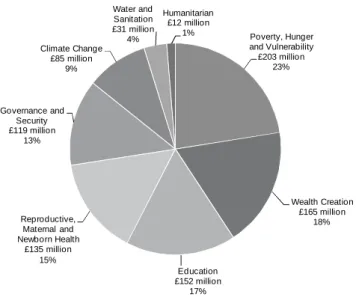
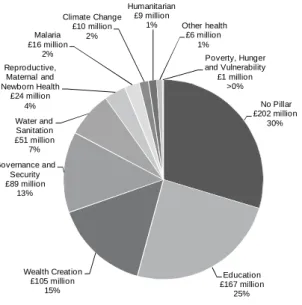
actually spends on PSD. DFID is unable precisely to quantify its spending on PSD because it is not captured as a discrete category of expenditure in DFID’s financial system (ARIES). We acknowledge that the need for an improved financial information system is already recognised by DFID. It therefore has to use spending on its wealth creation pillar as a proxy for its PSD work, although this is not a
perfect measure.22 The wealth creation budget was
£614 million in 2012-13, up from an estimated
£498 million in 2007-08; it is due to increase.23
1.18 Figure 1 on page 5 shows DFID’s largest areas of wealth creation expenditure by department and by office in 2012-13. It demonstrates that, while the majority of PSD expenditure is undertaken as part of country-level programmes (£341 million), a significant amount of PSD expenditure is managed
20
Economic development for a shared prosperity and poverty reduction: a strategic framework, DFID, January 2014,
https://www.gov.uk/government/uploads/system/uploads/attachment_data/file/276 859/Econ-development-strategic-framework_.pdf.
21
Economic development for a shared prosperity and poverty reduction: a strategic framework, DFID, January 2014,
https://www.gov.uk/government/uploads/system/uploads/attachment_data/file/276 859/Econ-development-strategic-framework_.pdf.
22
Bilateral Aid Review: Technical Report, DFID, March 2011,
https://www.gov.uk/government/uploads/system/uploads/attachment_data/file/214 110/FINAL_BAR_20TECHNICAL_20REPORT.pdf. This report established five pillars of activity, of which wealth creation was one with the others being direct delivery of the Millennium Development Goals (MDGs): governance and security; climate change; and humanitarian assistance.
23
Annual Report and Accounts 2012-13, DFID, June 2013,
https://www.gov.uk/government/uploads/system/uploads/attachment_data/file/208 445/annual-report-accounts2013-13.pdf and Economic development for shared prosperity and poverty reduction: a strategic framework, DFID, January 2014,
https://www.gov.uk/government/uploads/system/uploads/attachment_data/file/276 859/Econ-development-strategic-framework_.pdf.
1 Introduction
by central departments (£232 million) and some (£41 million) at a regional level. We see this as an indication that DFID is succeeding in introducing PSD as a delivery mechanism across DFID, rather than simply as a programming stream.
Figure 1: DFID’s Wealth Creation expenditure by department 2012-1324
DFID’s new Economic Development Strategic Framework will be key to PSD work in the future
1.19 In January 2014, DFID published its Economic Development Strategic Framework. Reiterating the 2008 emphasis on placing growth at the core of DFID’s work, this strategy is designed to give new impetus to DFID’s role of promoting economic development as a key mechanism for delivering growth and poverty reduction in the
developing world. It sees private sector investment and growth as central to success.25 Figure 2 shows a timeline
of selected key events relating to DFID’s approach and strategy on PSD since 2006. Figure 2: Timeline of selected DFID events since 2006
24
Data provided by DFID. 25
Economic development for a shared prosperity and poverty reduction: a strategic framework, DFID, January 2014,
https://www.gov.uk/government/uploads/system/uploads/attachment_data/file/276859/Econ-development-strategic-framework_.pdf.
Middle East and North Af rica Department
£7m
Asia Regional
£5m Af rica Regional
Department £29m
Regional Departments
£41m
Private Sector Department
£87m
Debt Relief £17m
Growth and Resilience Department
£8m
Other Central Departments (combined)
£19m
Central Departments
£232m
Tanzania £30m
Nigeria £28m Bangladesh
£61m
Af ghanistan £26m
India £23m
Nepal £16m Rwanda
£14m Southern
Af rica £14m Kenya
£12m DRC £11m
Country Offices £341m
Ethiopia £7m
Other Country Of f ices (combined)
£99m
Overseas Territories Department
£92m
Trade Policy Unit £9m
2006 2007 2008 2009 2010 2011 2012 2013 2014
IDC report on DFID Private Sector Development work
published
DFID publishes the Prosperity for All: Making
Markets PSD strategy
DFID creates the Private Sector Department
DFID publishes The Engine of Development: The private sector and prosperity for
poor people
DFID publishes the Economic Development Strategic Framework
1 Introduction
Methodology and focus of this review
This is a thematic review
1.20 Most of our previous reviews have focussed on particular DFID programmes or on country-wide activities. This review, by contrast, examines an entire programmatic theme, one which employs many different modes of operation in many
different countries, in line with the
recommendations of the Triennial Review of ICAI
published in December 2013.26 In our work, we
have reviewed various elements of DFID’s PSD approach. Whilst we comment on these individual components to some extent and use them to give a bottom-up analysis of DFID’s PSD work, the core of our work has been to provide a top-down assessment of the coherence of these elements within DFID’s overall approach to PSD. Is DFID’s PSD work helping to fulfil its stated ambition to
make the private sector the ‘engine of
development’?
1.21 In selecting elements of DFID’s work to scrutinise in detail, we have sought to focus on those things which would be illustrative of its wider PSD efforts. For this review, we carried out five main streams of work as follows:
■ mapping of DFID’s expenditure across the
various departments with responsibility for PSD activities and within country offices, insofar as the limitations of DFID’s financial systems allowed;
■ literature reviews, exploring the development of
PSD at DFID over time and investigating how far DFID’s PSD work builds on best practice;
■ a series of interviews to validate our findings
with senior DFID staff, third parties, PSD subject matter experts and others;
■ examining how successful DFID has been in
embedding private sector culture within the department; and
■ visits to three countries at different stages of
private sector development (Bangladesh,
26
Triennial Review of the Independent Commission for Aid Impact (ICAI), Cabinet Office, 2013,
https://www.gov.uk/government/uploads/system/uploads/attachment_data/file/266 693/ICAI-triennial-review-public-report-dec13.pdf.
Ethiopia and Tanzania) to assess the
cumulative impact of PSD activities, review key programmes, visit delivery locations and meet intended beneficiaries and programme staff.
Country visits supported our thematic work
1.22 We visited Bangladesh, Ethiopia and Tanzania as part of our review. In selecting the countries to visit, we took into account a number of factors, including:
■ prioritising countries where DFID’s PSD
portfolio is diverse in terms of programme type and management structures;
■ prioritising countries where there has been or is
significant PSD expenditure;
■ selecting countries which, collectively, have
demonstrated the development of DFID’s PSD efforts over time; and
■ prioritising countries that increase ICAI’s
coverage of DFID operating locations.
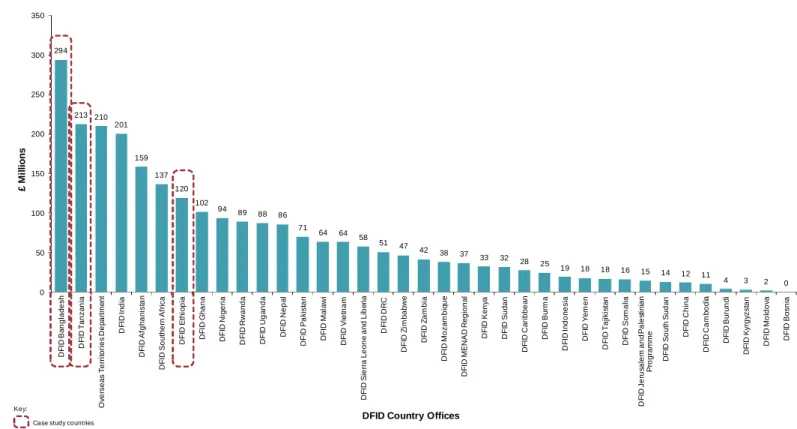
1.23 Figure 3 on page 7 highlights DFID’s PSD expenditure in the three countries we visited (using wealth creation expenditure as a proxy), in comparison with PSD expenditure in other country offices.27
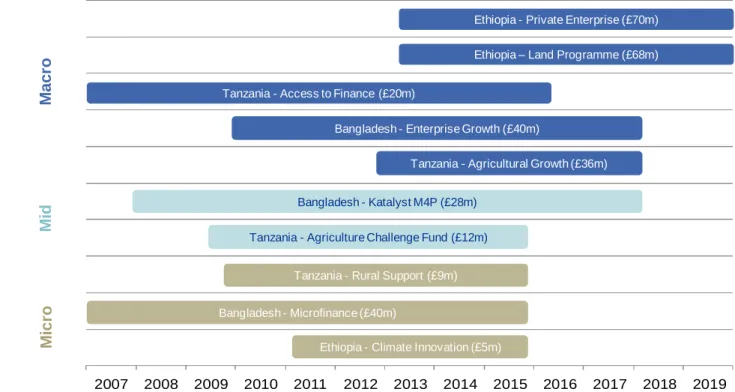
1.24 At the country level, we examined the degree to which DFID’s overarching PSD strategy supported the host country’s development goals and specific projects. These projects were selected to give a range of macro-, mid- and micro-level approaches and to provide insights into the development of DFID’s PSD programming over time. Collectively, they represent approximately £328 million of
expenditure.28 A summary of these projects is
provided in Figure 4 on page 7.
27
DFID’s work with the private sector will be considered in more detail in the second PSD review, to form part of ICAI’s Year 4 work plan.
28
1 Introduction
Figure 3: DFID Wealth Creation expenditure by country office, 2007-08 to 2012-1329
Figure 4: Historic and projected DFID expenditure of selected case study programmes, 2007-19
29
DFID wealth creation expenditure data provided by DFID. 294 213 210 201 159 137 120 102 94 89 88 86 71
64 64 58 51 47
42 38 37
33 32 28 25 19
18 18 16 15 14 12 11
4 3 2 0
0 50 100 150 200 250 300 350 D F ID B an g la de s h D F ID T an z an ia O v e rs e as T e rr it or ie s D e p ar tme nt D F ID Ind ia D F ID A fg ha ni s ta n D F ID S o uthe rn A fr ic a D F ID E thi op ia D F ID G ha n a D F ID N ige ri a D F ID R w a nd a D F ID U g an d a D F ID N e p al D F ID P a k is ta n D F ID Mal aw i D F ID V ie tn a m D F ID S ie rr a Le on e a nd Li b e ri a D F ID D R C D F ID Z im ba bw e D F ID Z a m bi a D F ID Mo z am b iq u e D F ID ME N A D R eg io n al D F ID K en y a D F ID S u da n D F ID C ar ib be an D F ID B ur m a D F ID Ind o ne s ia D F ID Y em e n D F ID T a jik is tan D F ID S om a lia D F ID J e ru s a le m a n d P a le st ini an P ro g ramme D F ID S o uth S u d an D F ID C h in a D F ID C a m bo d ia D F ID B ur un di D F ID K y rg y z s ta n D F ID Mo ld o v a D F ID B os n ia £ M il li o n s
DFID Country Offices Key:
Case study countries
2007 2008 2009 2010 2011 2012 2013 2014 2015 2016 2017 2018 2019 Bangladesh - Microfinance (£40m)
Bangladesh - Katalyst M4P (£28m)
Bangladesh - Enterprise Growth (£40m)
Ethiopia - Private Enterprise (£70m)
Ethiopia – Land Programme (£68m)
Ethiopia - Climate Innovation (£5m) Tanzania - Agriculture Challenge Fund (£12m)
Tanzania - Agricultural Growth (£36m)
Tanzania - Rural Support (£9m) Tanzania - Access to Finance (£20m)
M acr o M icr o M id
1 Introduction
1.25 Figure 5 provides short descriptions of the projects we reviewed.
Figure 5: Case study programmes
Bangladesh
Katalyst M4P: a long-established M4P programme, focussing on ‘catalysing’ change in agricultural value chains.
Regulatory and Investment Systems for Enterprise Growth (RISE): an investment climate reform programme, partly implemented by the International Finance Corporation (IFC). We will refer to this as the Enterprise Growth programme.
Promoting Financial Services for Poverty Reduction (PROSPER): a programme providing microfinance support to the ultra-poor in selected rural areas of the country. We will refer to this as the Microfinance programme.
Ethiopia
Climate Innovation Centres (CIC): a project which provides start-up capital to small businesses in the field of climate adaptation and green growth. We will refer to this as the Climate
Innovation project.
Private Enterprise Programme Ethiopia (PEPE): is a wide- ranging programme that is improving access to finance for the poor and SMEs and providing support to companies in identified priority sectors. We will refer to this as the Private Enterprise programme.
Land Investment for Transformation (LIFT): a newly -established land development programme targeting 14 million parcels of land throughout the country. We will refer to this as the Land
Programme.
Tanzania
Southern Agricultural Growth Corridor of Tanzania (SAGCOT): a programme which seeks to develop a growth corridor from Dar-es-Salaam south-west to the borders with Malawi, Zambia and Lake Tanganyika. We will refer to this as the Agricultural
Growth programme.
Coastal-Rural Support Programme (CRSP): a project which provides extension services and skills development for agricultural communities in southern Tanzania.30 We will refer to this overall DFID project as the Rural Support programme. Financial Sector Deepening Trust (FSDT): a project which aims to improve access to finance amongst the country’s poor. We will refer to this overall DFID project as the Access to Finance programme.
Tanzania Agribusiness Window (TZAW): the Tanzanian unit of the Africa Enterprise Challenge Fund (AECF), targeting mid-size businesses in the agriculture sector. We will refer to this overall DFID project as the Agriculture Challenge Fund programme.
30
Agricultural extension services are typically provided by government agencies to assist local farmers in increasing productivity and food security (for example,
providing training in new farming techniques); see:
http://www.fao.org/docrep/w5830e/w5830e03.htm.
Our work also focussed on the PSD cadre in DFID 1.26 One element of our work was to examine the
effectiveness of DFID's efforts to acquire and develop private sector skills. We also considered what contribution these skills make to DFID’s PSD approach now and how they might affect DFID’s programming choices in the future.
1.27 To this end, we circulated a questionnaire to the entire private sector cadre of advisors, of whom approximately one third are in the UK. We also conducted in-depth interviews with 23% of the cadre. We wanted to understand the longevity and depth of individuals’ experience of the private sector and their ability to apply this to their role in DFID. We received feedback from almost 50% of the cadre.
2 Findings
Objectives Assessment: Amber - Red
2.1 DFID has identified PSD as key to meeting its
overall objectives to reduce poverty. In its different PSD documents and in the new Economic
Development Strategic Framework, great
emphasis has been placed on the benefits that
PSD can bring.31 The breadth of DFID’s focus and
its expectations of what can be achieved through PSD are ambitious and it will not realise them on its own.
2.2 In 2011, DFID stated its ambition for its PSD work
as being to ‘transform the business environment’,32
in order ‘to help private enterprise work its miracles as the engine of development’. Further, DFID undertakes ‘to back approaches that have systemic impact’.
2.3 The combination of ambitious, high-level objectives
and a failure to define its role in the wider context means that DFID has not articulated what success would look like. DFID has not translated its aspirations into a focussed set of objectives that reflect its core competencies and the realities in which it operates. It often remains uncertain as to what extent its portfolio of PSD projects contributes towards its high-level objectives.
2.4 Paragraph 1.10 above outlines the different types
of PSD interventions that are available to DFID to achieve its aims. Given the focus on systemic change and transformation of the business environment, we believe that a successful PSD approach in a country would include:
■ a clear analysis of the fundamental challenges
in the business environment which hinder the private sector;
■ an assessment of which areas DFID sees itself
as best able to address and where this focus coheres with the work of the host government and other donors;
31
These strategic statements are considered in greater detail in the Appendix section on the new Economic Development Strategic Framework.
32
The Engine of Development: The private sector and prosperity for poor people, DFID, 2011,
https://www.gov.uk/government/uploads/system/uploads/attachment_data/file/674 90/Private-sector-approach-paper-May2011.pdf.
■ a risk assessment to determine the impact of
different interventions on the intended
beneficiaries, including any negative impacts;
■ the selection of a suite of programmes explicitly
designed to address these focal issues; and
■ the use of these programmes in a joined-up and
interacting fashion.
2.5 An example of what this might look like is set out in
Figure 6 on page 15. At present, however, we believe that DFID’s objectives in PSD are excessively ambitious and fail to reflect what is possible, given the complexity of the challenge.
DFID has been consistent in its view on the role of the private sector in development
2.6 DFID’s vision for the role of the private sector in development has been consistent over time: a strong private sector drives economic growth. It wants ‘private sector thinking to become as much part of DFID's DNA as [its] work with charities and
governments’.33
2.7 DFID stated in 2008 that the aim of its PSD
strategy is ‘to make markets function better and
with greater fairness’.34 It wants to create a
business environment which is conducive to investment and the growth of competitive firms.35 DFID also has wider objectives for PSD, including a role in the achievement of broader social and
environmental aims.36
2.8 DFID reinforced its message on the importance of
PSD in its recent Economic Development Strategic
Framework, published in January 2014.37 In it,
DFID states that the UK Government’s vision is to eradicate poverty and transform economies by helping poorer countries to achieve a secure,
33
The Engine of Development: The private sector and prosperity for poor people, DFID, 2011,
https://www.gov.uk/government/uploads/system/uploads/attachment_data/file/674 90/Private-sector-approach-paper-May2011.pdf.
34
Private Sector Development Strategy, Prosperity for all: making markets work, DFID, 2008, http://www.enterprise-development.org/page/download?id=1727. 35
The Engine of Development: The private sector and prosperity for poor people, DFID, 2011,
https://www.gov.uk/government/uploads/system/uploads/attachment_data/file/674 90/Private-sector-approach-paper-May2011.pdf.
36
Private Sector Development Strategy. Prosperity for all: making markets work, DFID, 2008, http://www.enterprise-development.org/page/download?id=1727. 37
Economic development for a shared prosperity and poverty reduction: a strategic framework, DFID, January 2014,
https://www.gov.uk/government/uploads/system/uploads/attachment_data/file/276 859/Econ-development-strategic-framework_.pdf.
2 Findings
financed and timely exit from poverty through economic development.
2.9 DFID, therefore, sees sustainable and inclusive
economic growth as the main driver through which countries can move away from a dependence on
aid.38 To that extent, its PSD work is a means to an
end rather than an end in itself.
DFID is ambitious in its goals for PSD but should be more realistic about the scale of the challenge
DFID cannot succeed in PSD on its own
2.10 DFID sets out a very broad and ambitious spectrum of activity for its PSD work. It lists the following as example areas, each of which is large and complex and poses significant challenges in a
developing country:39
■ reducing barriers, costs and risks of doing
business;
■ expanding markets and trade; and
■ pioneering and stimulating investment.
2.11 Similarly, one of the aims of DFID’s new Economic Development Strategic Framework is to ‘improve international rules for shared prosperity’.40 This overlaps with World Trade Organization (WTO) aims and encompasses issues which have proved complex and difficult over many decades and over which DFID’s influence is relatively small.
2.12 The success of PSD projects is often outside DFID’s control. For example, a review of the Business Environment Strengthening for Tanzania project, which ran in Tanzania from 2004 to 2010, concluded that the project’s failure stemmed from its ‘breadth of ambition and the institutional problems of how a single project can address issues that cover and cut across the purviews of
many government ministries and agencies’.41
38
The Engine of Development: The private sector and prosperity for poor people, DFID, 2011,
https://www.gov.uk/government/uploads/system/uploads/attachment_data/file/674 90/Private-sector-approach-paper-May2011.pdf.
39
The Engine of Development: The private sector and prosperity for poor people, DFID, 2011,
https://www.gov.uk/government/uploads/system/uploads/attachment_data/file/674 90/Private-sector-approach-paper-May2011.pdf.
40
Economic development for a shared prosperity and poverty reduction: a strategic framework, DFID, January 2014,
https://www.gov.uk/government/uploads/system/uploads/attachment_data/file/276 859/Econ-development-strategic-framework_.pdf.
41
Joint Irish Aid and DFID’s country programme evaluation Tanzania 2004/05 to
2.13 Similarly, the success of the Land Programme in Ethiopia, despite having had careful underlying analysis, depends on significant factors beyond DFID’s control. In particular, it will be necessary to develop an approach to land titling which will work in very politically and socially diverse areas of the country.
2.14 DFID cannot achieve its ambitious objectives alone; indeed, DFID’s 2008 PSD strategy notes that systemic change is ‘beyond [the] scope of a single firm or agency’. DFID, therefore, needs to identify the contributions that it is best able to make in the local context and to understand better how to influence or take better account of those factors it cannot control.
Although DFID is a significant donor, its resources are limited
2.15 DFID has committed to targeting £1.8 billion a year of its budget on economic development by
2015-16.42 Although DFID is a large donor, these
amounts are very small relative to the size of the private sector that it is looking to stimulate. Similarly, DFID is only one of a large number of actors in the PSD space. DFID’s ambition to transform economies so that they benefit the poor and share prosperity broadly has to recognise the limitations of its financial and other resources. DFID needs to decide on its strategic focus
It is unclear how DFID’s commitment to PSD relates to its shift to operating in fragile and conflict-affected areas
2.16 DFID has committed to using 30% of UK official development assistance (ODA) ‘to support fragile and conflict-affected states and tackle the drivers
of instability’.43 This represents a further challenge
for DFID, since the complexity of PSD is magnified enormously in fragile and conflict-affected states (FCAS), as our recent review of DFID’s growth and
2009/10, ITAD with Fiscus Ltd. and Verulam Associates Ltd., January 2001,
http://www.oecd.org/countries/tanzania/48156699.pdf. 42
Economic development for a shared prosperity and poverty reduction: a strategic framework, DFID, January 2014,
https://www.gov.uk/government/uploads/system/uploads/attachment_data/file/276 859/Econ-development-strategic-framework_.pdf.
43
Securing Britain in an Age of Uncertainty: The Strategic Defence and Security Review, HM Government, October 2010,
http://www.direct.gov.uk/prod_consum_dg/groups/dg_digitalassets/@dg/@en/doc uments/digitalasset/dg_191634.pdf.
2 Findings
livelihoods work in Afghanistan has shown.44 In
FCAS, the private sector is beset by many challenges, including ‘destroyed infrastructure ... capital flight ... fragmented markets ... displaced population ... [and] government that is fragile and risk averse’.45
2.17 The donor community has recognised only recently the need to focus on PSD as an early priority in
FCAS.46 There is a growing recognition that the
absence of a private sector causes an unhealthy
reliance on donor funding, which is not
sustainable.47 USAID points out that
‘conflict-affected environments often experience large inflows of aid assistance early on in the post-conflict phase, which drop sharply as soon as the conflict has drifted from public and political attention. Too often, there are no systems or strategies in place to build on these initial subsidies
to create lasting economic growth.48 To counter
this, as was argued in the 2011 World Development Report, ‘we need to put greater emphasis on early projects to create jobs, especially through the private sector’.49
2.18 There is, therefore, relatively little experience or evidence that DFID can build on in developing effective PSD programmes in FCAS. This applies even for the most basic of PSD-related tasks, such as job creation. The impact of such programmes remains unproven: the Overseas Development Institute (ODI) recently noted that ‘despite the centrality of employment creation as an instrument to promote stability in the fragile states policy
44
DFID’s Bilateral Support to Growth and Livelihoods in Afghanistan, ICAI, March 2014, http://icai.independent.gov.uk/wp-content/uploads/2014/03/ICAI-Report-
DFID%E2%80%99s-Bilateral-Support-to-Growth-and-Livelihoods-in-Afghanistan.pdf. As part of our review into DFID’s growth programmes in Afghanistan, we reviewed projects aimed at promoting economic growth and strengthening the private sector.
45
L. Curtis et al., Private Sector Development in Conflict-Affected Environments: Key Resources for Practitioners. The Donor Committee for Enterprise Development (DCED), 2010,
http://www.enterprise-development.org/page/download?id=1627. 46
World Development Report 2011: Conflict, Security and Development, World Bank, 2011,
http://siteresources.worldbank.org/INTWDRS/Resources/WDR2011_Full_Text.pdf 47
Bosnia and East Timor are examples. 48
Accelerating the Transition from Conflict to Sustainable Growth: Value Chain Development in Conflict-Affected Environments, USAID, 2008,
http://www.enterprise-development.org/page/download?id=1278.
49
World Development Report 2011: Conflict, Security and Development, World Bank, 2011, page xiii.
http://siteresources.worldbank.org/INTWDRS/Resources/WDR2011_Full_Text.pdf
discourse, no robust qualitative or quantitative evidence was found to illustrate this relationship’.50 2.19 Given these significant challenges, it is not clear to us whether DFID has reconciled its commitment to FCAS with its plans to increase the annual expenditure devoted to economic development activities by 2015-16 to £1.8 billion. If it wishes to do both, then considerable effort will need to be applied to developing effective strategies and approaches. In 2012-13, DFID spent an estimated £251 million in fragile states on wealth creation activities.51
What role can DFID most usefully play in PSD?
2.20 DFID has, in the past, identified its strengths which enable it to work effectively in PSD. These included its substantial resources, its decentralised and devolved structure and its large research and
development capacity.52 DFID is regarded by its
peer agencies as a leader in PSD: our interviews showed that other donors regard DFID very favourably and look to it for new ideas and practices in the PSD field. It is recognised, for example, as a leader in M4P interventions; at
business environment reform; in extending
financial services (such as microfinance schemes) to the poor; and at taking more risk.
2.21 DFID is, however, a development agency not a
private sector player. We believe that it is important, therefore, that DFID should align its priorities in the context of wider efforts and identify those areas of PSD where it can have the greatest impact for the poor. This does not mean that DFID should abandon its search for new and innovative approaches to delivering assistance to the poor. DFID should not, however, be attempting to address, singlehandedly, all the constraints to economic growth. DFID‘s status and influence permit it to do things to the economic development process which the private sector cannot do alone. It has good access to beneficiaries, convening
50
R. Holmes et al., What is the evidence on the impact of employment creation on stability and poverty reduction in fragile states: A systematic review, ODI, 2013, page 26,
http://r4d.dfid.gov.uk/pdf/outputs/systematicreviews/What_is_the_evidence_on_th e_impact_of_employment_creation_on_stability_and_poverty_reduction_in_fragile _states.pdf.
51
Data provided by DFID. 52
Private Sector Development Strategy: Prosperity for all: making markets work, DFID, 2008, http://www.enterprise-development.org/page/download?id=1727.
2 Findings
power, development know-how (about what works in these contexts) and a potentially greater appetite for initial market entry risk.
2.22 It was apparent from our interviews that many outside DFID have views on what roles DFID might usefully perform in PSD. What is less clear is whether DFID has the skills and capacities to play the role that others may wish.
2.23 An example of a potential role for DFID emerged from our interviews in Tanzania. At the time of our visit, in November 2013, DFID had announced four new trial partnerships with businesses and not-for-profit organisations to provide business and social enterprises with loans and equity capital. DFID is proposing to co-invest with Unilever, subject to satisfactory completion of due diligence processes, in a new tea plantation in the Southern Highlands of Tanzania and to finance three projects through a ‘patient capital’ vehicle focussing on agricultural opportunities (AgDevCo). 53
2.24 Patient capital is long-term capital investment, which has longer time horizons for the return of
capital.54 For example, one of DFID’s proposed
investments in Tanzania through AgDevCo is to provide up to a £6.7 million investment in Kilombero Plantations Limited, a rice producer that works with over 5,000 smallholder farmers in the remote Southern Highlands of Tanzania. The proposed investment will focus on expanding the plantation’s reach to poor farmers, while increasing irrigation capacity, leading to more efficient production and yields. DFID’s ability to provide long-term capital to commercial ventures has the potential to be a significant positive financing mechanism. Indeed, we spoke to people who suggested that financing from DFID can enable investments which would not have been possible through commercial funding structures.
2.25 The possibility of DFID developing its capacity to distribute returnable capital has also been
53
UK promotes business links in east Africa to end poverty, DFID, 2013,
https://www.gov.uk/government/news/uk-promotes-business-links-in-east-africa-to-end-poverty.
54
See, for example: http://acumen.org/investments/investment-model/.
proposed by the IDC.55 There are several issues
which DFID should continue work to address when considering the future provision of capital in the manner described above, including:
■ how does DFID address the eligibility of loan
finance as official development assistance under the rules of the Development Assistance
Committee of the OECD (DAC)? Specifically,
DFID should consider how loans on
concessional terms (which are ODA eligible) and repayments of loans (which count as ODA negative flows) impact on its commitments for ODA spending. Such consideration is a further reflection of the complexity associated with
PSD programming;56
■ does DFID have the correct skills to evaluate
and manage a loan portfolio when the bulk of its activity is in traditional grant-making activities? We observe elsewhere in this report that, whilst DFID has done much to expand the PSD cadre, it will need to ensure it has the right skills and resources to effectively manage an investment portfolio; and
■ how can DFID ensure that the provision of
lower-cost loans does not adversely affect the development of a commercial banking system or otherwise distort markets in an anti-competitive way in host countries? DFID will
need to weigh the advantages and
disadvantages of each investment on an individual basis and its impact on the local market.
2.26 DFID also needs to consider that its most appropriate role may not always be one of a funder: DFID may have other skills and aptitudes it can deploy. In Ethiopia, for example, there was wide-spread agreement that DFID has a unique position of trust with the Government. We
55
The Future of UK Development Co-operation: Phase 1: Development Finance, IDC, 13 February 2014,
http://www.publications.parliament.uk/pa/cm201314/cmselect/cmintdev/334/33403 .htm.
56
‘Repayments of the principal of ODA loans count as negative flows and are deducted to arrive at net ODA’. If the investment is successful and the loan repaid in full, the net flow over the period of the loan is zero. In the case of equity investments, provided they are deemed ODA eligible, the upfront investment counts as ODA. Upon sale of the asset, the reflow will count as negative ODA. The net impact will depend on whether the reflow is valued higher or lower than the original investment.’ Is it ODA? OECD, 2008,
2 Findings
considered that there was untapped potential to use that trust to effect greater change. For example, a number of those we interviewed commented that, whilst the Government was adept at responding to problems raised by well-placed individual companies, it was less good at systematising change. DFID might use its position as most-trusted advisor to push harder for implementation of actions to address specific issues for all companies.
Designing a well-balanced and coherent portfolio of PSD projects is key
The link between high-level objectives and a coherent portfolio at the country and project levels is weak
2.27 In 2011, DFID stated its aims for PSD as being ‘to make markets function better and with greater fairness…[to] enable poor people to find their own
way out of poverty’.57 Across our case study
countries, we found that, while there were good examples, there was scope for more consistent and systematic assessment of how these aims reflect local challenges and which programming types would best achieve a coherent and well-balanced portfolio of projects. Similarly, we did not observe a clear ‘theory of change’ at the portfolio level that expressed how the private sector needed to be re-configured to enable it most optimally to contribute to economic growth, stability and poverty reduction.
2.28 Although the development of individual country PSD programmes has, on the whole, been sound, we found that the logic of how individual projects fit together as components of a wider PSD scheme is missing. There is not, at present, a clear line of sight from the planning process through to a coherent portfolio of programmes, articulating how each programme contributes to the country objectives and specific challenges and to DFID’s overall PSD goals.
2.29 We saw some systematic analysis in the countries we visited. In Ethiopia, for example, we found that DFID’s portfolio has been carefully designed in the light of an analysis of the underlying causes of
57
Private Sector Development Strategy: Prosperity for all: making markets work, DFID, 2008, http://www.enterprise-development.org/page/download?id=1727.
economic issues and DFID’s strengths.58 DFID
aims to catalyse Ethiopian private sector
development by tackling binding constraints to growth but, while the rationale for and evidence of each programme is articulated in the business case, the overall strategy and coherence of the programmes and how the micro- and mid-levels contribute to the macro-level is not defined in one place. Similarly, despite significant work at a
detailed level for the Agricultural Growth
programme in Tanzania, a higher-level analysis of the importance of land issues to successful delivery of PSD programmes was missing.
2.30 We note that country offices are given guidance on how DFID centrally can help them prepare their submissions for future funding. We also note that DFID has recently introduced a Country Poverty
Reduction Diagnostic,59 which may provide staff
with the means to build a clear understanding of the context in which they design and deliver PSD projects. We considered, nevertheless, that the systems and guidance to inform decision-making on the ground were inadequate.
It is not clear whether the projects DFID has chosen are the most appropriate
2.31 The new Economic Development Strategic
Framework may provide the systems and guidance to allow DFID to build a coherent PSD programme with an appropriate match between types of intervention and sources of funding. Currently, however, the result of the gap in portfolio-level guidance is that it is unclear whether the projects being undertaken are the most appropriate. Although individual business cases contain an explanation for the choice of approach taken at the project level, DFID does not systematically explain why it has chosen to pursue some projects at the expense of other possible portfolio choices. There is currently an absence of a ‘theory of change’ that clarifies how DFID’s activities cohere as a
58
R. Hausmann, D. Rodrik and A. Velasco, Growth Diagnostics, John F. Kennedy School of Government, Harvard University, 2005,
http://www.hks.harvard.edu/fs/drodrik/Research%20papers/barcelonafinalmarch2 005.pdf.
59
This tool is being used by DFID country offices to develop strategies for its next funding allocation round (2015-16 to 2017-18) that tackle the most important constraints to poverty reduction and actively support countries’ transition from grant aid.
2 Findings
consistent endeavour in the way implied in its PSD strategy and related statements.
2.32 In our analysis of projects, we saw some good project design linked to the aim of economic empowerment. We noted, for example, that the Access to Finance programme in Tanzania has a clear central mandate to increase access for the poor to financial services and that it is innovative and flexible in the activities it delivers under this mandate. It was not clear to us during our field visit, however, how these activities fit together to form a coherent, overall package. It was also not clear whether DFID has assessed how best to balance the type of interventions through which it seeks to deliver its PSD programmes at different levels.
DFID needs to find an appropriate balance between short-term gains and long-term transformation
2.33 DFID’s difficulties are compounded by the need to demonstrate the impact of its work on reducing poverty. Transformational and systemic changes are long-term objectives. The link between a more conducive investment climate and improved lives for intended beneficiaries – the poor – is indirect and complicated. Ultimate beneficiaries are often not the direct target of interventions. This is particularly true for macro-level programmes, which include reform programmes designed to make changes to the regulatory environment for business in the expectation that this fosters growth that will ultimately benefit the poor.
2.34 In Bangladesh, for example, it is difficult to find evidence of direct impact on poor households from
macro-regulatory or investment-climate-type
interventions supported by the Enterprise Growth programme. During our visit to Bangladesh, we were told that these changes would also benefit the businesses of poor people. This is a plausible hypothesis, although we did not see specific data to support it. Such programmes do, however, have the potential to effect wider systemic change. The Agricultural Growth programme in Tanzania, for example if effective will transform the prospects for a large part of the country and its population. 2.35 On the other hand, programmes at the micro-level
typically work directly with poor people and their
economic activities. The benefits to these people are readily apparent but programmes of this type are not capable of delivering systemic change. This was true, for example, of the Access to Finance programme discussed in paragraphs 2.90 and 2.91.
2.36 We saw some evidence of an appropriate balance being built into a single programme. The Microfinance programme in Bangladesh works at the macro-level on the regulatory environment and at the micro-level on access to finance. Approximately half of the funds target poor beneficiaries through financial intermediaries and approximately one third is spent on ‘enabling’ work to improve regulation and capacity building.
2.37 DFID field staff, therefore, are having to balance the need to deliver tangible, immediate impact with
the wider objectives of longer-term
transformational change. It is likely that the lack of clear guidance for implementation (discussed in the Delivery section) and the complexity and novelty of much PSD programming is leading to other compromises.
2.38 Relevant objectives need to be determined for individual projects that collectively contribute to the overall transformation DFID is seeking to effect. That contribution is clearest for macro-level projects. In Ethiopia, for example, the business case for the Land Programme sets out a clear assessment showing how secure land titling will lead to greater investment by farmers in their land and so provide them with larger incomes. We observed this logic borne out when we visited a group of farmers outside Bahir Dar. At the other end of the spectrum, the issues of sustainability and scalability (discussed in the Impact section) mean that micro-level projects often have only a small impact on overall portfolio objectives.
2.39 Figure 6 on page 15 gives an illustration of what a well-balanced, joined-up and coherent portfolio might look like. It would require focussing efforts on fewer areas where DFID can really make a difference.