________________________________________________________________Maxim Integrated Products 1
_______________General Description
The MAX639/MAX640/MAX653 step-down switching regulators provide high efficiency over a wide range of load currents, delivering up to 225mA. A current-limiting pulse-frequency-modulated (PFM) control scheme gives the devices the benefits of pulse-width-modulated (PWM) converters (high efficiency at heavy loads), while using only 10µA of supply current (vs. 2mA to 10mA for PWM converters). The result is high efficiency over a wide range of loads.
The MAX639/MAX640/MAX653 input range is 4V to 11.5V, and the devices provide lower preset output volt-ages of 5V, 3.3V, and 3V, respectively. Or, the output can be user-adjusted to any voltage from 1.3V to the input voltage.
The MAX639/MAX640/MAX653 have an internal 1A power MOSFET switch, making them ideal for minimum-compo-nent, low- and medium-power applications. For increased output drive capability, use the MAX649/MAX651/MAX652 step-down controllers, which drive an external P-channel FET to deliver up to 5W.
________________________Applications
9V Battery to 5V, 3.3V, or 3V ConversionHigh-Efficiency Linear Regulator Replacement Portable Instruments and Handy-Terminals 5V-to-3.3V Converters
____________________________Features
♦ High Efficiency for a Wide Range of Load Currents ♦ 10µA Quiescent Current♦ Output Currents Up to 225mA ♦ Preset or Adjustable Output Voltage:
5.0V (MAX639) 3.3V (MAX640) 3.0V (MAX653)
♦ Low-Battery Detection Comparator ♦ Current-Limiting PFM Control Scheme
______________Ordering Information
Ordering Information continued on last page. * Contact factory for dice specifications.
MAX639/MAX640/MAX653
Low I
Q
, Step-Down DC-DC Converters
PART TEMP. RANGE PIN-PACKAGE MAX639CPA 0°C to +70°C 8 Plastic DIP MAX639CSA 0°C to +70°C 8 SO MAX639C/D 0°C to +70°C Dice* 1 2 3 4 5 8 7 6 MAX639 MAX640 MAX653 DIP/SO TOP VIEW VFB SHDN V+ LX VOUT LBO LBI GND
__________________Pin Configuration
GND MAX639 SHDN LX VOUTLBO LOW-BATTERYDETECTOR OUTPUT ON/OFF LBI LOW-BATTERY DETECTOR INPUT OUTPUT 5V 225mA INPUT 5.5V TO 11.5V V+ VFB
__________Typical Operating Circuit
MAX639ESA -40°C to +85°C 8 SO MAX639EPA -40°C to +85°C 8 Plastic DIP
MAX639/MAX640/MAX653
2 _______________________________________________________________________________________
ABSOLUTE MAXIMUM RATINGS
ELECTRICAL CHARACTERISTICS
(V+ = 9V for the MAX639, V+ = 5V for the MAX640/MAX653, ILOAD= 0mA, TA= TMINto TMAX, typical values are at TA= +25°C, unless otherwise noted.)
Stresses beyond those listed under “Absolute Maximum Ratings” may cause permanent damage to the device. These are stress ratings only, and functional operation of the device at these or any other conditions beyond those indicated in the operational sections of the specifications is not implied. Exposure to absolute maximum rating conditions for extended periods may affect device reliability.
PARAMETER MIN TYP MAX UNITS
91
Dropout Voltage 0.5 V
Output Voltage (Note 2)
2.88 3.00 3.12 V 3.17 3.30 3.43 94 87 91 85 Supply Current Supply Voltage 4.0 11.5 V 10 20 µA 4.80 5.00 5.20 Efficiency 89 % CONDITIONS MAX653 IOUT= 100mA, L = 100µH
MAX653, V+ = 4.0V to 11.5V, 0mA < IOUT< 100mA MAX640, V+ = 4.0V to 11.5V, 0mA < IOUT< 100mA
MAX639 MAX640
SHDN= V+, no load
MAX639, V+ = 6.0V to 11.5V, 0mA < IOUT< 100mA
V+...12V LX ...(V+ - 12V) to (V+ + 0.3V) LBI, LBO, VFB, SHDN, VOUT...-0.3V to (V+ + 0.3V) LX Output Current (Note 1) ...1A LBO Output Current ...10mA Continuous Power Dissipation (TA= +70°C)
Plastic DIP (derate 9.09mW/°C above +70°C) ...727mW SO (derate 5.88mW/°C above +70°C) ...471mW CERDIP (derate 8.00mW/°C above +70°C) ...640mW
Operating Temperature Ranges:
MAX639C_ _ ...0°C to +70°C MAX639E_ _ ...-40°C to +85°C MAX639MJA ...-55°C to +125°C Storage Temperature Range ...-65°C to +160°C Lead Temperature (soldering, 10sec) ...+300°C
IOUT= 100mA, L = 100µH IOUT= 25mA, L = 470µH IOUT= 100mA, L = 100µH IOUT= 25mA, L = 470µH IOUT= 100mA, L = 100µH IOUT= 25mA, L = 470µH Switch On-Time V+ = 9V, VOUT= 5V V+ = 6V, VOUT= 3V 42.5 50.0 57.5 V+ = 9V, VOUT= 3.3V V+ = 4V, VOUT= 3.3V µs 10.6 12.5 14.4 V+ = 9V, VOUT= 3V V+ = 4V, VOUT= 3V 14.2 16.7 19.2 7.5 8.8 10.1 60.7 71.4 82.1 7.1 8.3 9.5 MAX653 MAX639 MAX640 Switch Off-Time V+ = 9V, VOUT= 5V V+ = 6V, VOUT= 3V 14.6 17.2 19.8 V+ = 9V, VOUT= 3.3V V+ = 4V, VOUT= 3.3V µs 9.0 11.7 13.5 V+ = 9V, VOUT= 3V V+ = 4V, VOUT= 3V 16.6 19.5 22.4 13.3 15.6 17.9 13.3 15.6 17.9 14.6 17.2 19.8 MAX653 MAX639 MAX640
MAX639/MAX640/MAX653
__________________________________________Typical Operating Characteristics
(Circuit of Figure 3, internal feedback, L = 100µH, TA= +25°C, unless otherwise noted.)100 50 10µ 100µ 1 EFFICIENCY vs. OUTPUT CURRENT 60 MAX639-1
OUTPUT CURRENT (A)
EFFICIENCY (%) 70 80 90 1m 10m 100m L = 100µH V+ = 9V MAX639 MAX640 MAX653 100 50 10µ 100µ EFFICIENCY vs. OUTPUT CURRENT 60 MAX639-2
OUTPUT CURRENT (A)
EFFICIENCY (%) 70 80 90 1m 10m MAX639, V+ = 6V MAX640, V+ = 4.3V MAX653, V+ = 4V 100m L = 470µH 100 50 10µ 100µ EFFICIENCY vs. OUTPUT CURRENT 60 MAX639-3
OUTPUT CURRENT (A)
EFFICIENCY (%) 70 80 90 1m 10m MAX639 MAX640 MAX653 100m L = 470µH V+ = 9V
Note 2:Output guaranteed by correlation to measurements of device parameters (i.e., switch on-resistance, on-times, off-times, and output voltage trip points).
ELECTRICAL CHARACTERISTICS (continued)
(V+ = 9V for the MAX639, V+ = 5V for the MAX640/MAX653, ILOAD= 0mA, TA= TMINto TMAX, typical values are at TA= +25°C,
unless otherwise noted.) PARAMETER
V
0.4 1.2
MIN TYP MAX
mA VLBO= 0.4V
UNITS
LBO Leakage Current VLBO= 11.5V 0.001 0.1 µA
LBO Delay 50mV overdrive 25 µs
2.5 SHDNThreshold 0.80 1.15 2.00 V SHDNPull-Up Current 0.10 0.20 0.40 Ω µA SHDN= 0V V µA TA= +25°C TA= TMINto TMAX MAX639 MAX640/MAX653 2.8 LX Switch Leakage 0.003 1.0 30.0 VFB Bias Current 4.0 15.0 nA
VFB Dual-Mode Trip Point LX Switch On-Resistance 50 0.8 1.5 VFB Threshold 1.26 1.28 1.30 mV 1.24 1.28 1.32
LBI Bias Current 2 10
LBI Threshold 1.26 1.28 1.30
nA
1.24 1.28 1.32
LBO Sink Current 0.8 2.5
CONDITIONS
V+ = 6V, TA= TMINto TMAX, MAX639
V+ = 4V, TA= TMINto TMAX, MAX640/MAX653
V+ = 11.5V, VLX= 0V VFB = 2V V+ = 9V, TA= +25°C, MAX639/MAX640/MAX653 MAX6_ _C MAX6_ _E/M VLBI= 2V MAX6_ _C MAX6_ _E/M
0
10 MAX640 OUTPUT VOLTAGE RIPPLE vs.
INPUT VOLTAGE
25 100
MAX639-10
V+ (V)
OUTPUT VOLTAGE RIPPLE (mV)
7 75 150 3 4 5 6 8 9 11 12 IOUT = 25mA L = 100µH 125 50 L = 220µH L = 470µH 0 10 MAX653
OUTPUT VOLTAGE RIPPLE vs. INPUT VOLTAGE
25 100
MAX639-11
V+ (V)
OUTPUT VOLTAGE RIPPLE (mV)
7 75 150 3 4 5 6 8 9 11 12 ILOAD = 25mA 125 50 L = 220µH L = 470µH L = 100µH
MAX639/MAX640/MAX653
4 _______________________________________________________________________________________ 100 50 10µ 100µ 1 EFFICIENCY vs. OUTPUT CURRENT 60 MAX639-4OUTPUT CURRENT (A)
EFFICIENCY (%) 70 80 90 1m 10m 100m L = 100µH MAX639, V+ = 6V MAX640, V+ = 4.3V MAX653, V+ = 4V 100 10 MAXIMUM OUTPUT CURRENT vs.
INPUT VOLTAGE
200
MAX639-07
V+ (V)
MAXIMUM OUTPUT CURRENT (mA)
7 250 3 4 5 6 8 9 11 12 150 MAX640 MAX653 MAX639 L = 100µH 80 10 EFFICIENCY vs. INPUT VOLTAGE 85 95 MAX639-05 V+ (V) EFFICIENCY (%) 7 90 100 3 4 5 6 8 9 11 12 IOUT = 100mA MAX639 MAX640 MAX653 80 10 EFFICIENCY vs. INPUT VOLTAGE 85 95 MAX639-06 V+ (V) EFFICIENCY (%) 7 90 100 3 4 5 6 8 9 11 12 L = 470µH IOUT = 25mA MAX639 MAX640 MAX653 25 10 MAXIMUM OUTPUT CURRENT vs.
INPUT VOLTAGE
65
MAX639-08
V+ (V)
MAXIMUM OUTPUT CURRENT (mA)
7 75 3 4 5 6 8 9 11 12 55 MAX640 MAX653 MAX639 45 35 L = 470µH 0 10 MAX639 OUTPUT VOLTAGE RIPPLE vs.
INPUT VOLTAGE
25 100
MAX639-09
INPUT VOLTAGE (V)
OUTPUT VOLTAGE RIPPLE (mV)
7 75 150 5 6 8 9 11 12 L = 100µH 125 50 L = 220µH L = 470µH IOUT = 25mA
_____________________________Typical Operating Characteristics (continued)
(Circuit of Figure 3, internal feedback, L = 100µH, TA= +25°C, unless otherwise noted.)MAX639/MAX640/MAX653
0 70 MAX639 START-UP TIME vs. OUTPUT CURRENT 2 8 MAX639-12OUTPUT CURRENT (mA)
START-UP TIME (ms) 20 6 12 0 10 40 60 80 100 V+ = 5.5V 10 4 30 50 90 V+ = 9.0V V+ = 11.5V MEASURED FROM THE RISING EDGE OF V+ OR SHDN TO (VOUT = 5V). 0 70 MAX640/MAX653 START-UP TIME vs. OUTPUT CURRENT 2 8 MAX639-13
OUTPUT CURRENT (mA)
START-UP TIME (ms) 20 6 0 10 40 60 80 100 10 4 30 50 90 V+ = 9.0V V+ = 11.5V V+ = 5.0V
MEASURED FROM THE RISING EDGE OF V+ OR SHDN TO (VOUT = 3.3V)(MAX640) OR (VOUT = 3.0V)(MAX653). THE START-UP TIME DIFFERENCE BETWEEN THE MAX640 AND THE MAX653 IS NEGLIGIBLE. L = 100µH 0 30 MAX639 START-UP TIME vs. OUTPUT CURRENT 10 30 MAX639-14
OUTPUT CURRENT (mA)
START-UP TIME (ms) 0 5 15 25 40 20 10 20 V+ = 9.0V V+ = 11.5V V+ = 5.5V MEASURED FROM THE RISING EDGE OF V+ OR SHDN TO (VOUT = 5.0V) L = 470µH. 0 30 MAX640/MAX653 START-UP TIME vs. OUTPUT CURRENT 10 30 MAX639-15
OUTPUT CURRENT (mA)
START-UP TIME (ms) 0 5 15 25 40 20 10 20 V+ = 9.0V V+ = 11.5V V+ = 5.0V
MEASURED FROM THE RISING EDGE OF V+ OR SHDN TO (VOUT = 3.3V)(MAX640) OR (VOUT = 3.0V)(MAX653). THE START-UP TIME DIFFERENCE BETWEEN THE MAX640 AND THE MAX653 IS NEGLIGIBLE.
L = 470µH
_____________________________Typical Operating Characteristics (continued)
(Circuit of Figure 3, internal feedback, L = 100µH, TA= +25°C, unless otherwise noted.)0
7
NO-LOAD SUPPLY CURRENT vs. INPUT VOLTAGE
40
60 MAX639-16
INPUT VOLTAGE (V)
NO-LOAD SUPPLY CURRENT (
µ A) 4 50 70 0 1 2 3 5 6 11 12 MAX639, VOUT = 5V 10 30 20 9 8 10 MAX653, VOUT = 3V
MAX639/MAX640/MAX653
6 _______________________________________________________________________________________ MAX653 LINE-TRANSIENT RESPONSE A B A: VIN, 4V TO 8V, 2V/div B: VOUT, 100mV/div VOUT = 3V, ILOAD = 100mA10ms/div
A: VIN, 6V TO 11.5V, 2V/div B: VOUT, 100mV/div VOUT = 5V, ILOAD = 100mA
MAX639 LINE-TRANSIENT RESPONSE
A
B
10ms/div
_____________________________Typical Operating Characteristics (continued)
(Circuit of Figure 3, internal feedback, L = 100µH, TA= +25°C, unless otherwise noted.)A: ILOAD, 0mA TO 100mA, 50mA/div B: VOUT, 100mV/div, AC COUPLED VIN = 5V, VOUT = 3V MAX653 LOAD-TRANSIENT RESPONSE A B 1ms/div MAX639 LOAD-TRANSIENT RESPONSE A B
A: ILOAD, 0mA TO 200mA, 100mA/div B: VOUT, 100mV/div, AC COUPLED VIN = 9V, VOUT = 5V
MAX639/MAX640/MAX653
NAME FUNCTION
1 VOUT Sense Input for regulated-output operation. Internally connected to an on-chip voltage divider and to the variable duty-cycle, on-demand oscillator. It must be connected to the external regulated output. 2 LBO Low-Battery Output. An open-drain N-channel MOSFET sinks current when the voltage at LBI drops
below 1.28V.
3 LBI Low-Battery Input. When the voltage at LBI drops below 1.28V, LBO sinks current. PIN
4 GND Ground
______________________________________________________________Pin Description
5 LX Drain of a PMOS power switch that has its source connected to V+. LX drives the external inductor, which provides current to the load.
6 V+ Positive Supply-Voltage Input. Should not exceed 11.5V
7 VFB
8 SHDN
Dual-Mode Feedback Pin. When VFB is grounded, the internal voltage divider sets the output to 5V (MAX639), 3.3V (MAX640) or 3V (MAX653). For adjustable operation, connect VFB to an external volt-age divider.
Shutdown Input — active low. When pulled below 0.8V, the LX power switch stays off, shutting down the regulator. When the shutdown input is above 2V, the regulator stays on. Tie SHDNto V+ if shut-down mode is not used.
____________________Getting Started
Designing power supplies with the MAX639/MAX640/ MAX653 is easy. The few required external components are readily available. The most general applications use the following components:(1) Capacitors: For the input and output filter capaci-tors, try using electrolytics in the 100µF range, or use low-ESR capacitors to minimize output ripple. Capacitor values are not critical.
(2) Diode: Use the popular 1N5817 or equivalent Schottky diode.
(3) Inductor: For the highest output current, choose a 100µH inductor with an incremental saturation cur-rent rating of at least 600mA. To obtain the highest efficiencies and smallest size, refer to the Inductor Selection section.
_______________Detailed Description
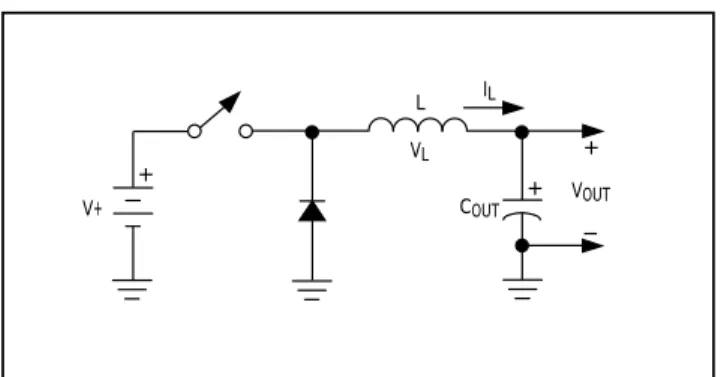
Figure 1 shows a simplified, step-down DC-DC con-verter. When the switch is closed, a voltage equal to (V+ - VOUT) is applied to the inductor. The current through the inductor ramps up, storing energy in the inductor’s magnetic field. This same current also flows into the output filter capacitor and load. When the switch opens, the current continues to flow through the inductor in the same direction, but must also flow through the diode. The inductor alone supplies current to the load when the switch is open. This current decays to zero as the energy stored in the inductor’s magnetic field isV+ VL L VOUT COUT IL
Figure 1. Simplified Step-Down Converter
SWITCH OFF MAX639 FG02 0V SWITCH ON 0A SWITCH OFF SWITCH ON IL AT 200mA/div VL AT 5V/div
MAX639/MAX640/MAX653
Figure 2 shows what happens to the ideal circuit of Figure 1 if the switch turns on with a 66% duty cycle and V+ = 3/2 VOUT. The inductor current rises more slowly than it falls because the magnitude of the voltage applied during tONis less than that applied during tOFF. Varying the duty cycle and switching frequency keeps the peak current constant as input voltage varies. The MAX639/MAX640/MAX653 control the switch (tON and tOFF) according to the following equations:
Equation (1) tON= 50µsV / (V+ - VOUT) Equation (2) tOFF≥50µsV / VOUT Equation (3) IPEAK= 50µsV / L
These three equations ensure constant peak currents for a given inductor value, across all input voltages (ignoring the voltage drop across the diode (D1) and the resistive losses in the switch and inductor). The variable duty cycle also ensures that the current through the inductor discharges to zero at the end of each pulse.
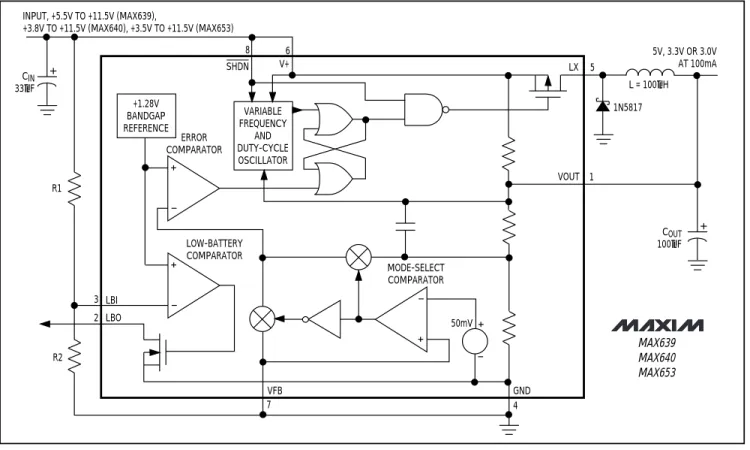
Figure 3 shows the MAX639/MAX640/MAX653 block dia-gram and a typical connection in which 9V is converted to 5V (MAX639), 3.3V (MAX640), or 3.0V (MAX653). The sequence of events in this application is as follows:
When the output dips:
(1) The error comparator switches high.
(2) The internal oscillator starts (15µs start-up time) and connects to the gate of the LX output driver. (3) LX turns on and off according to tON and tOFF,
charging and discharging the inductor, and sup-plying current to the output (as described above). When the output voltage recovers:
(1) The comparator switches low. (2) LX turns off.
(3) The oscillator shuts down to save power.
Fixed or Adjustable Output
For operation at the preset output voltage, connect VFB to GND; no external resistors are required. For other output voltages, use an external voltage divider. Set the output voltage using R3 and R4 as determined by the following formula:
R3 = R4 [(VOUT / VFB Threshold) - 1]
where R4 is any resistance in the 10kΩto 1MΩrange (typ-ically 100kΩ), and the VFB threshold is typically 1.28V.
8 _______________________________________________________________________________________ MAX639 MAX640 MAX653 VARIABLE FREQUENCY AND DUTY-CYCLE OSCILLATOR ERROR COMPARATOR LOW-BATTERY COMPARATOR +1.28V BANDGAP REFERENCE MODE-SELECT COMPARATOR COUT 100µF 1N5817 L = 100µH 5V, 3.3V OR 3.0V AT 100mA 5 1 LX VOUT 50mV GND 4 VFB 7 R2 2 3 LBO LBI R1 CIN 33µF INPUT, +5.5V TO +11.5V (MAX639), +3.8V TO +11.5V (MAX640), +3.5V TO +11.5V (MAX653) 8 6 SHDN V+
Low-Battery Detector
The low-battery detector compares the voltage on the LBI input with the internal 1.28V reference. LBO goes low whenever the input voltage at LBI is less than 1.28V. Set the low-battery detection voltage with resis-tors R1 and R2 (Figure 3) as determined by the follow-ing formula:
R1 = R2 [(VLB / LBI Threshold) - 1]
where R2 is any resistance in the 10kΩ to 1MΩrange (typically 100kΩ), the LBI threshold is typically 1.28V, and VLB is the desired low-battery detection voltage. The low-battery comparator remains active in shutdown mode.
Shutdown Mode
Bringing SHDN below 0.8V places the MAX639/ MAX640/MAX643 in shutdown mode. LX becomes high impedance, and the voltage at VOUT falls to zero. The time required for the output to rise to its nominal regu-lated voltage when brought out of shutdown (start-up time) depends on the inductor value, input voltage, and load current (see the Start-Up Time vs. Output Current graph in the Typical Operating Characteristics). The low-battery comparator remains active in shutdown mode.
__________Applications Information
Inductor Selection
When selecting an inductor, consider these four factors: peak-current rating, inductance value, series resistance, and size. It is important not to exceed the inductor’s peak-current rating. A saturated inductor will pull exces-sive currents through the MAX639/MAX640/MAX653’s switch, and may cause damage. Avoid using RF chokes or air-core inductors since they have very low peak-cur-rent ratings. Electromagnetic interference must not upset nearby circuitry or the regulator IC. Ferrite-bobbin types work well for most digital circuits; toroids or pot cores work well for EMI-sensitive analog circuits.
Recall that the inductance value determines IPEAKfor all input voltages (Equation 3). If there are no resistive loss-es and the diode is ideal, the maximum average current that can be drawn from the MAX639/MAX640/MAX653 will be one-half IPEAK. With the real losses in the switch, inductor, and diode taken into account, the real maxi-mum output current typically varies from 90% to 50% of the ideal. The following steps describe a conservative way to pick an appropriate inductor.
Step 1: Decide on the maximum required output current, in amperes: IOUTMAX.
MAX639/MAX640/MAX653
Table 1. Component Suppliers
MAXL001* 0.65 x 0.33 dia. 100 1.75 7300-13** 0.63 x 0.26 dia. 100 0.89 7300-15** 0.63 x 0.26 dia. 150 0.72 7300-17** 0.63 x 0.26 dia. 220 0.58 7300-19** 0.63 x 0.26 dia. 330 0.47 7300-21** 0.63 x 0.26 dia. 470 0.39 7300-25** 0.63 x 0.26 dia. 1000 0.27 PART NUMBER SIZE (mm) VALUE (µH) IMAX (A) CD54 5.2 x 5.8 x 4.5 100 0.52 CD54 5.2 x 5.8 x 4.5 220 0.35 CDR74 7.1 x 7.7 x 4.5 100 0.52 CDR74 7.1 x 7.7 x 4.5 220 0.35 CDR105 9.2 x 10.0 x 5.0 100 0.80 CDR105 9.2 x 10.0 x 5.0 220 0.54 PART NUMBER SIZE (inches) VALUE (µF) ESR (Ω) MAXC001* 150 0.2 267 Series** D SM packages 47 0.2 267 Series** E SM packages 100 0.2 PART NUMBER SIZE VF (V) SE014 SOT89 0.55 SE024 SOT89 0.55
INDUCTORS — THROUGH HOLE
0.2 0.27 0.36 0.45 0.58 0.86 2.00
INDUCTORS — SURFACE MOUNT
SERIES R (Ω) 0.63 1.50 0.51 0.98 0.35 0.69 Sumida Electric (USA)
637 East Golf Road Arlington Heights, IL 60005 (708) 956-0666
CAPACITORS — LOW ESR
VMAX (V) 35 10 6.3 * Maxim Integrated Products
**Matsuo Electronics 2134 Main Street
Huntington Beach, CA 92648 (714) 969-2491
SCHOTTKY DIODES — SURFACE MOUNT IMAX (A) 1 0.95 PART NUMBER SIZE (inches) VALUE (µH) IMAX (A) SERIES R (Ω)
* Maxim Integrated Products **Caddell-Burns
258 East Second Street Mineola, NY 11501-3508 (516) 746-2310 0.49 x 0.394 dia. Collmer Semiconductor 14368 Proton Road Dallas, TX 75244 (214) 233-1589
NOTE: This list does not constitute an endorsement by Maxim Integrated Products and is not intended to be a comprehensive
MAX639/MAX640/MAX653
Step 3: L = 50 / IPEAK. L will be in µH. Do not use an inductor of less than 100µH.
Step 4: Make sure that IPEAKdoes not exceed 0.6A or the inductor’s maximum current rating, whichever is lower.
Inductor series resistance affects both efficiency and dropout voltage. A high series resistance severely limits the maximum current available at lower input voltages. Output currents up to 225mA are possible if the induc-tor has low series resistance. Inducinduc-tor and series switch resistance form an LR circuit during tON. If the L/R time constant is less than the oscillator tON, the inductor’s peak current will fall short of the desired IPEAK.
To maximize efficiency, choose the highest-value inductor that will provide the required output current over the whole range of your input voltage (see Typical Operating Characteristics). Inductors with peak cur-rents in the 600mA range do not need to be very large. They are about the size of a 1W resistor, with surface-mount versions less than 5mm in diameter. Table 1 lists suppliers of inductors suitable for use with the MAX639/MAX640/MAX653.
Output Filter Capacitor
The MAX639/MAX640/MAX653’s output ripple has two components. One component results from the variation in stored charge on the filter capacitor with each LX pulse. The other is the product of the current into the capacitor and the capacitor’s equivalent series resis-tance (ESR).
The amount of charge delivered in each oscillator pulse is determined by the inductor value and input voltage.
It decreases with larger inductance, but increases as the input voltage lessens. As a general rule, a smaller amount of charge delivered in each pulse results in less output ripple.
With low-cost aluminum electrolytic capacitors, the ESR-induced ripple can be larger than that caused by the charge variation. Consequently, high-quality alu-minum-electrolytic or tantalum filter capacitors will mini-mize output ripple. Best results at reasonable cost are typically achieved with an aluminum-electrolytic capac-itor in the 100µF range, in parallel with a 0.1µF ceramic capacitor (Table 1).
External Diode
In most MAX639/MAX640/MAX653 circuits, the current in the external diode (D1, Figure 3) changes abruptly from zero to its peak value each time LX switches off. To avoid excessive losses, the diode must have a fast turn-on time. For low-power circuits with peak currents less than 100mA, signal diodes such as the 1N4148 perform well. The 1N5817 diode works well for high-power circuits, or for maximum efficiency at low high-power. 1N5817 equivalent diodes are also available in surface-mount packages (Table 1). Although the 1N4001 and other general-purpose rectifiers are rated for high cur-rents, they are unacceptable because their slow turn-off times result in excessive losses.
Minimum Load
Under no-load conditions, because of leakage from the PMOS power switch (see the LX Leakage Current vs. Temperature graph in the Typical Operating Characteristics) and from the internal resistor from V+ to VOUT, leakage current may be supplied to the output
10 ______________________________________________________________________________________ GND MAX639 MAX640 MAX653 SHDN 6 VOUT 4 LBI L = 100µH 3 1 5 CIN 100µF 1N5817 COUT 100µF VFB 7 R3 R4 8 V+ LX OUTPUT INPUT +4.0V TO +11.5V
Figure 4. Adjustable-Output Operation
MAX639 MAX640 MAX653
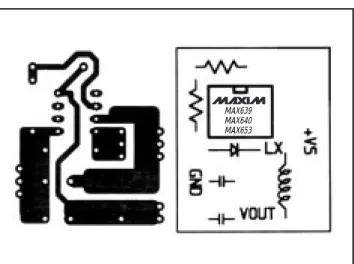
Figure 5. Through-Hole PC Layout and Component Placement Diagram for Standard Step-Down Application (Top-Side View)
capacitor, even when the switch is off. This will usually not be a problem for a 5V output at room temperature, since the diode’s reverse leakage current and the feedback resistors’ current typically drain the excess. However, if the diode leakage is very low (which can occur at low temperatures and/or small output voltages), charge may build up on the output capacitor, making VOUTrise above its set point. If this happens, add a small load resistor (typically 1MΩ) to the output to pull a few extra microamps of current from the output capacitor.
Layout
Several of the external components in a MAX639/ MAX640/MAX653 circuit experience peak currents up to 600mA. Wherever one of these components con-nects to ground, there is a potential for ground bounce. Ground bounce occurs when high currents flow through the parasitic resistances of PC board traces. What one component interprets as ground can differ from the IC’s ground by several millivolts. This may increase the MAX639/MAX640/MAX653’s output ripple, since the error comparator (which is referenced to ground) will generate extra switching pulses when they are not needed. It is essential that the input filter capac-itor’s ground lead, the MAX639/MAX640/MAX653’s GND pin, the diode’s anode, and the output filter capacitor’s ground lead are as close together as possi-ble, preferably at the same point. Figure 5 shows a suggested through-hole printed circuit layout that mini-mizes ground bounce.
Inverter Configuration
Figure 6 shows the MAX639/MAX640/MAX653 in a floating ground configuration. By tying what would nor-mally be the output to the supply-voltage ground, the
-3.3V (MAX640), or -3V (MAX653). Avoid exceeding the maximum differential voltage of 11.5V from V+ to VOUT. Other negative voltages can be generated by placing a voltage divider across COUT and connecting the tap point to VFB in the same manner as the normal step-down configuration.
Two AA Batteries to 5V, 3.3V, or 3V
For battery-powered applications, where the signal ground does not have to correspond to the power-supply ground, the circuit in Figure 6 generates 5V (MAX639), 3.3V (MAX640), or 3V (MAX653) from a pair of AA batter-ies. Connect the VINground point to your system’s input, and connect the output to your system’s ground input. This configuration has the added advantage of reduced on resistance, since the IC’s internal power FET has VIN+
MAX639/MAX640/MAX653
GND MAX639 MAX640 MAX653 SHDN LX VOUT -5V -3.3V OR -3V 4 V+ VFB L = 100µH 7 1 5 COUT 100µF VIN CIN 100µF 8 6 1N5817Figure 6. Inverting Configuration
MAX639 FG02
MAXIMUM OUTPUT CURRENT (mA)
0 V+ (V) TA = +25°C L = 100µH MAX639 0 20 40 60 80 100 160 1 2 3 4 5 120 140
Figure 7. Maximum Current Capability of Figure 6 Circuit
MAX639 FG02 EFFICIENCY (%) 84.0 V+ (V) TA = +25°C VOUT = -5V L = 470µH IOUT = 10mA 1.5 84.5 85.0 85.5 86.0 86.5 87.0 2.0 2.5 3.0 3.5 4.0 4.5 5.0 5.5 6.0
MAX639/MAX640/MAX653
_Ordering Information (continued)
________________________________________________________Package Information
PART TEMP. RANGE PIN-PACKAGEMAX640CPA 0°C to +70°C 8 Plastic DIP MAX640CSA 0°C to +70°C 8 SO MAX640C/D 0°C to +70°C Dice* MAX640ESA -40°C to +85°C 8 SO MAX640EPA -40°C to +85°C 8 Plastic DIP MAX640MJA -55°C to +125°C 8 CERDIP MAX653CPA 0°C to +70°C 8 Plastic DIP MAX653CSA 0°C to +70°C 8 SO MAX653C/D 0°C to +70°C Dice* MAX653EPA -40°C to +85°C 8 Plastic DIP MAX653ESA -40°C to +85°C 8 SO MAX653MJA -55°C to +125°C 8 CERDIP * Contact factory for dice specifications.
___________________Chip Topography
VFB V+ LBO VOUT SHDN GND 0.083" (2.108mm) 0.072" (1.828mm) LBI LX TRANSISTOR COUNT: 221 SUBSTRATE CONNECTED TO V+Maxim cannot assume responsibility for use of any circuitry other than circuitry entirely embodied in a Maxim product. No circuit patent licenses are implied. Maxim reserves the right to change the circuitry and specifications without notice at any time.
12 ____________________Maxim Integrated Products, 120 San Gabriel Drive, Sunnyvale, CA 94086 408-737-7600
© 1997 Maxim Integrated Products Printed USA is a registered trademark of Maxim Integrated Products.