More effective social
services
Draft Report
April 2015
The New Zealand Productivity Commission – Te Kömihana Whai Hua o Aotearoa
1Date: April 2015
The Commission – an independent Crown entity – completes in-depth inquiry reports on topics selected by the Government, carries out productivity-related research, and promotes understanding of productivity issues. The Commission aims to provide insightful, well-informed and accessible advice that leads to the best possible improvement in the wellbeing of New Zealanders. The Commission is bound and guided by the New Zealand Productivity Commission Act 2010.
To find out more about the Commission, visit www.productivity.govt.nz, or call +64 4 903 5150.
ISBN: 978-0-478-44012-6 (print) ISBN: 978-0-478-44013-3 (online)
Inquiry contacts
Administration Robyn Sadlier
T: (04) 903 5167
Other matters Geoff Lewis
Inquiry Director T: (04) 903 5157
Website www.productivity.govt.nz
Twitter @nzprocom
LinkedIn NZ Productivity Commission
1 The Commission that pursues abundance for New Zealand.
Disclaimer
The contents of this report must not be construed as legal advice. The Commission does not accept any responsibility or liability for an action taken as a result of reading, or reliance placed because of having read any part, or all, of the information in this report. The Commission does not accept any responsibility or liability for any error, inadequacy, deficiency, flaw in or omission from this report.
Terms of reference
NEW ZEALAND PRODUCTIVITY COMMISSION INQUIRY INTO ENHANCING
PRODUCTIVITY AND VALUE IN PUBLIC SERVICES
Issued by the Minister of Finance, the Minister of State Services (the “referring Ministers”).
Pursuant to sections 9 and 11 of the New Zealand Productivity Commission Act 2010, we hereby request that the New Zealand Productivity Commission (“the Commission”) undertake an inquiry into enhancing productivity and value in the state sector (focusing on the purchasing of social sector services).
Context
1. The Government is trying to bring greater clarity about results from public services (such as the 10 Better Public Services results), and develop smarter strategies and deeper capability to achieve
desirable outcomes. Government agencies need to know what actually drives poor outcomes and what concrete actions can prevent or alleviate harm. They need to become more intelligent and effective purchasers that can identify who their most exposed clients are, and better understand what goes on at the frontline. The agencies can then start making decisions to improve services and, thereby, outcomes for people and their communities.
2. There are significant gains to be made by challenging and improving the way in which social sector agencies identify need and purchase services. In particular, this will involve a more intelligent system that understands what impacts it is having and incentivises and enables innovation.
3. The Government has already taken some important steps – its world-first Welfare Investment Approach is a shift towards a smarter system. The new governance structures and ways of purchasing services in the Social Sector Trials and Whänau Ora are examples of innovations in commissioning services. 4. There is growing international awareness that difficult social problems are no longer just the domain of
governments and that tackling them in new and innovative ways to get better results will involve combining the expertise of public, social and private sectors.
5. Internationally, governments are demonstrating a much stronger focus on understanding outcomes and measuring value for money from social-service investment. New Zealand can benefit from the
experiences of countries such as the UK – for example in implementing payment-by-results contracts in social services.
Purpose and Scope
6. Having regard to the context outlined above, the referring Ministers request the Commission to carry out an investigation into improving outcomes for New Zealanders as a result of services resourced by the New Zealand state sector. In keeping with Better Public Services, the investigation will focus on the performance and potential improvement of social-sector purchasing/commissioning of services
(including services currently delivered by the state sector). The focus should be on the institutional arrangements and contracting mechanisms that can assist improved outcomes, rather than commenting on specific policies (such as benefit settings or early childhood education subsidies).
7. Two broad questions should guide the investigation. These focus on the way that state sector agencies select and organise their functions, and the tools they employ to achieve results:
What institutional arrangements would support smarter purchasing/commissioning?
- The Inquiry should provide an overview of emerging new commissioning arrangements both
internationally and within New Zealand, focusing on one or two representative agencies. How are population analytics, policy, purchasing, evaluation, different forms of relationships and other
relevant functions organised and incentivised? How effective are these arrangements at targeting services at particular clients, combining efforts with other agencies and achieving desired outcomes across the social sector?
- What lessons are there from the Government’s initiatives to date (e.g. BPS results and the welfare
investment model) and from other national or international innovations for bringing a greater performance focus to purchasing? What organisational features (e.g. internal purchase centres, external challenge) are most effective? How can agencies build and maintain better commissioning capability (skills and systems)?
What market arrangements, new technologies and contracting or commissioning tools would help achieve results?
- Provide an overview and assessment of the range of contracting mechanisms, purchase vehicles and
new technologies that have been employed in New Zealand or internationally to enable innovation and better results. Examples include outcome-based contracts, joint ventures, local devolution and the use of ICT to facilitate greater client focus and participation. What are the key themes of the innovations? What have been the general features of successful and unsuccessful approaches? What is the role of the community in innovation and/or ensuring that the new purchase arrangements work? How important is contestability or other performance mechanisms for ongoing improvement of outcomes?
- Looking at two to three specific outcome or service areas, what lessons are there for applying new
purchase mechanisms in New Zealand? How can any risks be managed? What are the barriers to adoption?
- Consideration should be given to the characteristics of the New Zealand provider market, and how
it differs from regular commercial markets and how the role of the community impacts on it. In particular, the inquiry should examine the openness, capacity and capability of current providers to manage new purchase models (e.g. financially-linked, results-based contracts), and how the Crown could influence the shape and long-term sustainability of the market in the future.
Analysis and Recommendations
8. The inquiry should explore academic research and international experience related to both questions. However, the focus should be on practical applications relevant to New Zealand circumstances. 9. The Commission should work with a couple of departments and/or Crown entities, reviewing current
approaches and ongoing changes to draw lessons and identify opportunities for change. It is expected that analysis and recommendations will provide useful guidance to Ministers and State Sector Chief Executives about how to improve the way services are commissioned.
Consultation
The Commission will also consult with non-government organisations and other providers, academics and international agencies as required.
Timeframes
The Commission must publish a draft report and/or discussion document, for public comment, followed by a final report that must be presented to referring Ministers by 30 June 20152.
Referring Ministers
Hon Bill English, Minister of Finance
Hon Dr Jonathan Coleman, Minister of State Services
2 Note: The inquiry timeframe has been extended to 31 August 2015.
About the draft report
This draft report aims to assist individuals and organisations to participate in the inquiry. It outlines the background to the inquiry, the Commission’s intended approach, and the matters about which the Commission is seeking comment and information.
This draft report contains the Commission’s draft findings and recommendations. It also contains a limited number of questions to which responses are invited but not required. The Commission welcomes
information and comment on all issues that participants consider relevant to the inquiry’s terms of reference.
Key inquiry dates
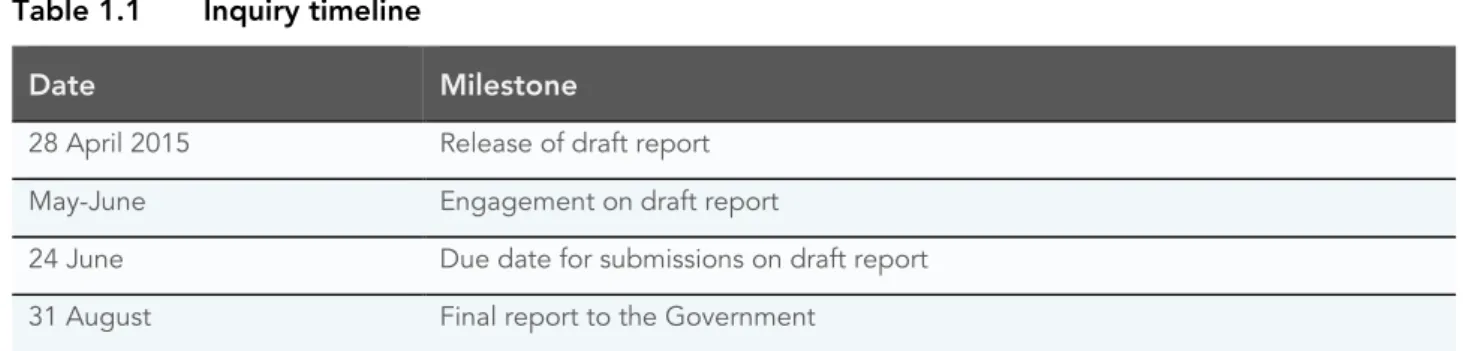
Receipt of terms of reference: 26 June 2014
Release of issues paper: 7 October 2014
Release of draft report: 28 April 2015
Draft report submissions due: 24 June 2015
Final report to the Government 31 August 2015
Contacts
Administrative matters: T: +64 4 903 5167
Other matters: Geoff Lewis
Inquiry Director T: +64 4 903 5157
Postal address for submissions: More effective social services inquiry
New Zealand Productivity Commission PO Box 8036
The Terrace
WELLINGTON 6143
Website: www.productivity.govt.nz
Why make a submission?
The Commission aims to provide insightful, well-informed and accessible advice that leads to the best possible improvement in the wellbeing of New Zealanders. Submissions help the Commission to gather ideas, opinions and information to ensure that inquiries are well-informed and relevant, and that its advice is relevant, credible and workable.
Submissions will help shape the nature and focus of this inquiry. Inquiry reports may cite or directly incorporate relevant information from submissions.
How to make a submission
Anyone can make a submission. It may be in written, electronic or audio format. A submission can range from a short letter on a single issue to a more substantial document covering many issues. Please provide supporting facts, figures, data, examples and documentation where possible. Every submission is
welcomed; however, identical submissions will not carry any more weight than the merits of the arguments presented. Submissions may incorporate relevant material provided to other reviews or inquiries.
Submissions may be lodged at www.productivity.govt.nz or emailed to [email protected]. Word or searchable PDF format is preferred. Submissions may also be posted. Please email an electronic copy as well, if possible.
Submissions should include the submitter’s name and contact details, and the details of any organisation represented. The Commission will not accept submissions that, in its opinion, contain inappropriate or defamatory content. The Commission has no power or jurisdiction to influence individual cases or disputes between parties.
What the Commission will do with the submissions
The Commission seeks to have as much information as possible on the public record. Submissions will become publicly available documents on the Commission’s website shortly after receipt, unless accompanied by a request to delay release for a short period of time.
The Commission is subject to the Official Information Act 1982, and can accept material in confidence only under special circumstances. Please contact the Commission before submitting such material.
Other ways to participate
The Commission welcomes engagement on its inquiries. It anticipates holding regional meetings and/or roundtables on the draft report in June 2015. Details of these will be notified to all those on the inquiry’s interested-parties list. Please telephone or send an email if you are not already on this list and would like to be added.
Contents
Terms of reference ... iii
About the draft report ... v
Key inquiry dates ... v
Contacts ... v
Why make a submission? ... v
How to make a submission... v
What the Commission will do with the submissions ... vi
Other ways to participate ... vi
Commonly used terms ... xi
Overview ... 1
Social services in New Zealand ... 2
New ideas in New Zealand and elsewhere ... 3
Assessing system performance and diagnosing its causes ... 4
Designing the institutional architecture ... 5
Better commissioning of services ... 7
Creating a system that learns and innovates ... 8
Leveraging data to improve social services ... 10
Social investment and insurance ... 10
Integrating services for better outcomes ... 11
Empowering clients and giving them more choice ... 12
Better purchasing and contracting ... 13
Empowering Mäori communities ... 14
Implementing change ... 14
The size of the prize ... 16
1 About this inquiry ... 18
1.1 What has the Commission been asked to do? ... 19
1.2 What are social services? ... 20
1.3 The Commission’s approach ... 22
1.4 Responses to the issues paper ... 23
1.5 A well-functioning social services system ... 24
1.6 Guide to this report ... 26
1.7 Next steps ... 28
Part 1: What the Commission has observed ... 29
2 Social services in New Zealand ... 30
2.1 Improving wellbeing through social services ... 31
2.2 A brief history of social services in New Zealand ... 31
2.3 Government expenditure on social services ... 33
2.4 The social services system ... 36
2.5 Social services – a client’s perspective ... 41
2.6 Observations on the market for social-services contracts ... 43
2.7 The system has several strengths but many weaknesses ... 44
2.8 Many reviews, few lasting solutions ... 51
2.9 Pressures on the system ... 52
2.10 Summary: an under-performing system under pressure ... 53
3 New ideas in New Zealand and elsewhere ... 54
3.1 More efficient investment in social services ... 55
3.2 Increasing choice and empowering service users ... 56
3.3 Better integrated services ... 59
3.5 Fresh ideas from new providers and investors ... 62
3.6 Commissioning to develop an effective managed market ... 66
3.7 Broad lessons ... 68
4 An assessment of the social services system ... 70
4.1 A well-functioning social services system ... 71
4.2 Symptoms of a poorly functioning system ... 72
4.3 Reasons for system weaknesses ... 74
4.4 Scope for system improvement ... 85
Part 2: What is needed for improvement ... 87
5 Institutional architecture ... 88
5.1 The broader context of social support ... 89
5.2 Governments have paid relatively little attention to institutional architecture ... 90
5.3 Broad architectural designs ... 91
5.4 Choosing between architectures ... 100
5.5 The enabling environment ... 101
5.6 System stewardship ... 103
6 Commissioning ... 106
6.1 From social objectives to service delivery ... 107
6.2 Choosing a service model ... 108
6.3 Innovative service models ... 118
6.4 Commissioning tasks and skills ... 119
6.5 Service stewardship ... 128
7 A system that learns and innovates ... 142
7.1 A system that learns ... 143
7.2 Innovation and why it is important ... 145
7.3 Generating and spreading innovation ... 148
7.4 Building a better evidence base ... 161
8 Leveraging data and analytics ... 169
8.1 Data and analytics can transform the social services landscape ... 170
8.2 New Zealand Data Futures Forum proposals ... 176
8.3 Building and using a better data infrastructure and analytic capability ... 178
8.4 Data sharing to support innovation ... 182
8.5 Implementing better data and analytics ... 183
9 Investment and insurance approaches ... 186
9.1 The Investment Approach ... 186
9.2 Insurance and social welfare ... 194
9.3 An insurance approach ... 196
10 Service integration ... 204
10.1 What is integration? ... 205
10.2 Deciding the level and extent of integration ... 208
10.3 Deciding how to integrate ... 210
10.4 Five design themes for improving integration ... 213
10.5 Fragmentation – seeing the symptoms and tackling the causes ... 217
11 Client choice and empowerment... 218
11.1 Types of choices ... 219
11.2 Who is best placed to make core choices?... 219
11.3 Who makes core choices in New Zealand’s social services system? ... 221
11.4 Problems with who currently makes core choices ... 222
11.5 Benefits of empowering clients to make core choices ... 224
11.6 Different ways to empower clients with core choices ... 226
11.7 Client-directed models in New Zealand and internationally ... 227
11.9 What do evidence and experience suggest? ... 232
11.10 What additional services may benefit from client choice? ... 237
11.11 Designing client-directed service models ... 241
11.12 Summary – choice can improve outcomes ... 243
12 Better purchasing and contracting ... 244
12.1 The challenge of designing and administering contracts ... 245
12.2 The framework for contracting out government service provision in New Zealand... 250
12.3 Issues raised by participants ... 253
12.4 Opportunities for improvement ... 261
13 The Mäori dimension ... 272
13.1 From deficits to empowerment... 273
13.2 Individual and collective aspirations ... 275
13.3 Duties of care within tikanga Mäori ... 275
13.4 A diverse range of Mäori organisations are involved in social services ... 276
13.5 What is the Treaty dimension? ... 277
13.6 Devolving the commissioning of social services to Mäori ... 279
13.7 Existing iwi involvement in commissioning social services ... 279
13.8 The potential for data analytics to assist in achieving Mäori aspirations ... 284
13.9 Issues for designing further devolution to Mäori ... 286
Part 3: Making it happen ... 290
14 Implementation ... 291
14.1 A long-term strategy for change ... 293
14.2 Responsibility and authority for implementation ... 297
14.3 Strengthening the incentives for implementation and sustained improvement ... 299
15 The size of the prize... 304
15.1 A system that meets the needs of all participants ... 304
15.2 Illustrating the benefits of system improvement ... 305
15.3 Conclusion ... 307
Summary of questions ... 308
Findings and recommendations ... 310
Appendix A Public consultation ... 325
Submissions ... 325
Engagement meetings ... 327
Conferences ... 330
Appendices B-F Additional material on the Commission’s website ... 331
References ... 332
Tables
Table 1.1 Inquiry timeline ... 28Table 2.1 Issues identified by selected reviews of social services ... 51
Table 4.1 Summary of weaknesses and their underlying causes ... 85
Table 5.1 Institutional architectures with New Zealand examples ... 91
Table 6.1 Service models with examples ... 109
Table 6.2 Service models: strengths and weaknesses ... 116
Table 6.3 Funding types and basis of government–provider relationship ... 130
Table 9.1 A family of investment approaches ... 192
Table 11.1 Who typically makes core choices? ... 222
Table 11.2 International examples of client-directed service models... 228
Table 11.3 Literature on concerns about client-directed service model ... 237
Figures
Figure 1.1 The diversity of social services and the outcomes they support... 22
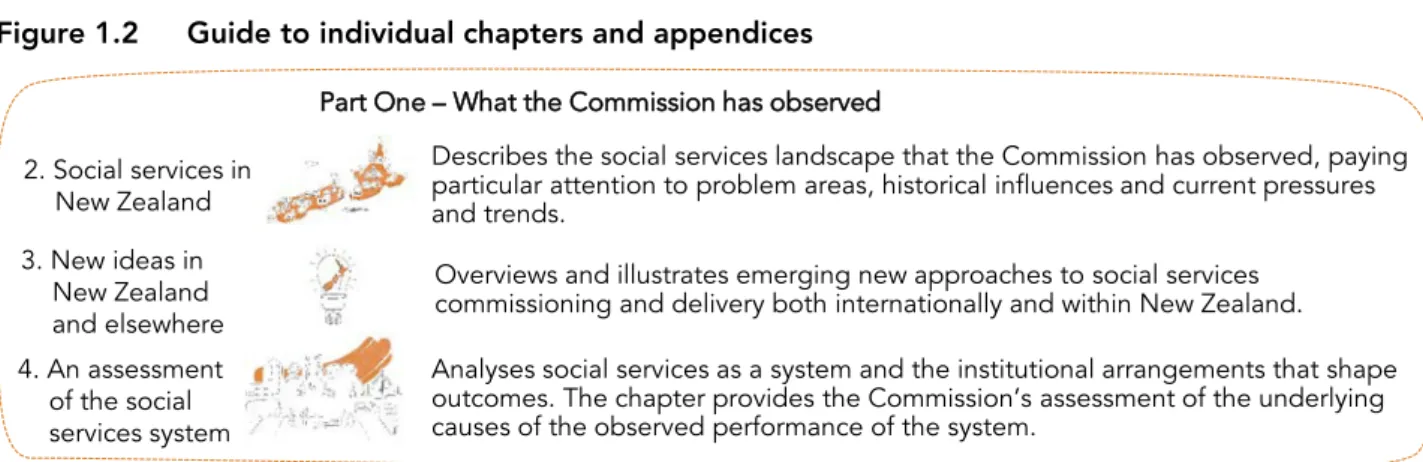
Figure 1.2 Guide to individual chapters and appendices ... 26
Figure 2.1 Estimated government expenditure on social services for 2014/2015 ... 33
Figure 2.2 Public social spending as a percentage of Gross Domestic Product, 2014 ... 34
Figure 2.3 Social expenditure on benefits in kind as a percentage of Gross Domestic Product, 2013 ... 35
Figure 2.4 Charity service providers, 2013 ... 36
Figure 2.5 Some elements of the social services system ... 37
Figure 2.6 Government funding and commissioning process ... 38
Figure 2.7 The flow of new initiatives over the past ten years ... 50
Figure 3.1 How a social bond works ... 63
Figure 4.1 Percentage of MSD contracted-out expenditure in 2014/2015 by contract duration ... 77
Figure 5.1 Considerations shaping delegation and devolution ... 94
Figure 7.1 A system that learns ... 144
Figure 7.2 Barriers to innovation in the public sector ... 150
Figure 7.3 Price and innovation: the innovation bell curve ... 157
Figure 8.1 Data value cycle ... 170
Figure 8.2 Different data-use scenarios for protecting privacy ... 177
Figure 10.1 Lessons on coordination and integration ... 209
Figure 10.2 Government integration initiatives announced since 2000 ... 212
Figure 11.1 Examples of core choices ... 219
Figure 11.2 Elements needed for good decision making ... 220
Figure 11.3 Key design elements of client-directed service models... 243
Figure 12.1 The continuum of contractual obligations... 247
Figure 13.1 Characterisations of Mäori social outcomes, 1986 and 2010 ... 274
Figure 13.2 Choices made by the five example iwi groups on how they wish to engage with commissioning ... 283
KEY
Q
QuestionsF
FindingsCommonly used terms
Term Description
allocative efficiency Maximum allocative efficiency requires the production, from a given amount of resources, of a set of goods and services that people most value.
client-directed budget A service model where the government allocates clients a “service budget” and permits them to choose the services they receive up to the value of the budget. Government funding follows the choices made by providers.
client-directed service models The client-directed budget and voucher service models.
commissioning A set of interrelated tasks that need to be undertaken to turn policy objectives into effective social services. Commissioning organisations should consider objectives, needs, funding, pricing, risk management, quality, eligibility,
performance measurement, information flows, provider market sustainability and interactions with other services; and choose an appropriate service model. (See Chapter 6)
competition for the market An approach to contracting whereby providers compete for contracts through a tendering process, and their service volume or market share is fixed for the duration of the contract.
competition in the market An approach to contracting whereby providers compete alongside each other to attract clients.
contestability The characteristic of a market where the opportunity to supply the good or service is open to all qualified providers.
contracting for outcomes Contacts that specify desired outcomes, and there is a risk of losing the contract if those outcomes are not achieved.
contracting for outputs Contacts that specify the outputs, and there is a risk of losing the contract if those outputs are not delivered.
contracting out A service model where the Government contracts a third party to provide specific social services.
decentralisation The transfer of substantial decision-making power to semi-autonomous organisations with separate governance.
demand-side Market activity, influences or conditions related to consumers of goods and services.
diffusion The process by which a new idea, technology or product is adopted across a society or economy.
dynamic efficiency Dynamic efficiency is achieved when optimal decisions are made on investment, innovation and market entry and exit, to create productive and allocative efficiency in the longer term.
economic profit The difference between revenue and costs, where all inputs (including capital) are valued at their opportunity cost (ie, what they could earn in their next most valued use).
economies of scale Reduction of cost per unit as the volume of production increases, due to large up-front or fixed costs being spread across more units.
for profit (FP) An organisation that earns profits for its owners.
government agency A broad set of government departments, Crown entities and other organisations (eg, the Police) involved in the delivery of social services.
Term Description
incumbent In economics, an incumbent firm is an established business with a strong position in the market.
information and
communications technology (ICT)
Telecommunications, broadcast media and information technology (IT). ICT is a more encompassing term than IT, and stresses the innovative role of unified communications and integrated digital networks in economic activity.
innovation The process of translating an idea or an invention into a good or service that has value.
institutional architecture The design of institutions that govern the operation of the social services system. It includes the roles and responsibilities of different organisations and rules around their interaction. Chapter 5 discusses three broad architectures: top-down control, decentralisation and social insurance. The main distinction between these architectures is who has the responsibility to design and commission services. intervention Services that intervene in a situation in order to alter the likely course of future
events.
managed market A “market” with more than one provider, where market share and prices are determined administratively.
market for social services A market is a setting in which parties voluntarily undertake exchanges. In the context of this inquiry, the market for social services refers to the provision of social services in exchange for payment. Funding could come from a government agency or another organisation (eg, a philanthropic trust). In some cases, clients partly or fully fund the service. The provision and purchase of social services meets the economic definition of a market, yet it has complex and distinctive features that make it different from simple markets. The term is used in the inquiry terms of reference.
monopoly A situation where one provider is the only supplier of a service. A monopoly is characterised by an absence of competition.
monopsony A market that has only one buyer and many would be sellers. non-government organisation
(NGO)
Any organisation involved in the social services system other than a government agency.
not for profit (NFP) An organisation that does not earn profits for its owners. Money earned by or donated to a NFP is used to pursue the organisations mission and objectives. outcome-focused contracting Contracting for outputs, in the context of clear intervention logic, outcome
measurement and a clear and upfront statement of the purpose of the contract. The purpose statement should be used as a basis for discussion aimed at improvement.
outcomes The longer-term consequences of an intervention or programme in terms of the ends sought (eg, better health or reduced re-offending).
outputs The amount of social services provided. Examples include hours of counselling, number of patients seen and the number of people attending training courses. payment for outcomes Contracting for outcomes, plus payments that vary according to performance
measures specified in terms of outcomes achieved.
payment for outputs Contracting for outputs, plus payments that vary according to performance measures specified in terms of outputs delivered.
productive efficiency Maximum productive efficiency requires that goods and services are produced at the lowest possible cost. This requires maximum output for the volume of specific inputs used, plus optimum use of inputs given their relative prices.
Term Description
purchasing The purchasing process identifies and selects non-government providers and agrees terms of supply though a contract. It includes calling for expressions of interest to supply social services, evaluating proposals from potential providers, completing due diligence, negotiating the terms of the contract and awarding the contract.
quality shading A situation where cost savings are achieved by reducing the quality of a services. Quality shading is a particular problem when it is difficult to observe or measure the quality of services being provided.
service model A way of conceptualising different approaches to services delivery. Chapter 6 explores seven different service models and their strengths and weaknesses. social insurance An insurance scheme organised by the state with compulsory membership, and in
which premiums are related to the ability to pay.
social services Services dedicated to enhancing people’s economic and social wellbeing by helping them lead more stable, healthy, self-sufficient and fulfilling lives. This inquiry is primarily concerned with social services that government provides, funds or otherwise supports.
system stewardship An overarching responsibility for the monitoring, planning and management of resources in such a way as to maintain and improve system performance. Relevant activities include monitoring system performance, identifying barriers to and opportunities for beneficial change, and leading the wider conversations required to achieve that change.
service stewardship The ongoing monitoring of service performance, and re-visiting design choices as necessary to improve performance.
social service agencies Government agencies that deliver social services. Often abbreviated to agencies in this report.
social service providers Non-government organisations that provide social services.
social services system The system of organisations, institutions and relationships through which social services are funded, coordinated and delivered.
social insurance Assigns both decision-making power and liability for future costs to an insurer. supply-side Market activity, influences or conditions related to producers of goods and
services.
transaction costs Costs incurred by the parties making an economic exchange, other than the amount paid directly for the good or service purchased. Transaction costs can include search costs such as the cost of tendering processes, bargaining costs such as the legal fees associated with drawing up a contract, and enforcement costs such as the cost of performance reporting and monitoring.
top-down control Primary decision-making power sits with the relevant minister or department head.
Box 1 Te ReoMäori used in the report
Te Reo Mäori is one of New Zealand’s three official languages – along with New Zealand English and New Zealand Sign Language. This draft report uses some terms that may be unfamiliar to international readers.
hui – literally a gathering or meeting. As used in this draft report, hui refers to a community meeting conducted according to tikanga Mäori (Mäori protocol).
iwi – often translated as “tribe”. Iwi are a collection of hapü (clans) that are composed of whänau
(defined below). The link between the three groupings is genealogical. kaupapa – purpose, mission, or approach.
kawanatanga – the features and actions of governing. koha – gift or donation.
köhanga reo – literally “language nests” – are pre-school Mäori culture and language immersion programmes.
körero kanohi ki te kanohi – conversing face to face. kura kaupapa Mäori – Mäori-medium schools.
manaakitanga – the process of showing respect, generosity and care for others. It has an overtone of hospitality towards those outside a group you identify with. In its simplest definition (hospitality), all Mäori groups or whänau will exercise manaakitanga at some time.
mana motuhake – a political concept, emphasising autonomy and self-government (see Box 13.1). mana whenua− the iwi or hapü who are recognised as deriving mana (authority/status) from their
ancestral connection to that particular stretch of land or coast.
mataawaka− refers to the Mäori population in one area that is connected to an iwi or hapü who holds mana whenua somewhere outside that area.
rangatiratanga – a contested term in the context of Te Tiriti o Waitangi (see below). It can refer to chieftainship or chiefly authority and leadership. Other interpretations include “sovereignty” and “autonomy”.
rohe – area.
rünanga – a governing body associated with an iwi. Te Puni Kökiri – the Ministry of Mäori Development.
Te Tiriti o Waitangi – The Treaty of Waitangi. The treaty signed by representatives of the British Crown and various Mäori chiefs at Waitangi on 6 February 1840. The Treaty is one of New
Zealand’s founding documents. The Treaty has English and Mäori versions. The translations do not strictly align.
tangata whenua – literally “the people of the land”. täonga – that which is precious or treasured. Te Ao Mäori – literally “the Mäori world”.
Te Hiku o Te Ika – the part of the Far North District that is north of the Hokianga. Te Waipounamu – the South Island.
te mana whakahaere – translated variously as the “power to manage”, “governance” or “authority”.
tikanga – literally “the things that are correct”. Sometimes translated as “protocol” or “customary practice,” tikanga is concerned with ways of correct action.
wänanga – publicly owned tertiary institutions that provide education in a Mäori cultural context. whakapapa – to make connection to place, and through that to people.
whänau – typically translated as “families”. Whänau may refer to nuclear or extended families. Whänau Ora – a government initiative emphasising the empowerment of whänau to become
self-managing. More broadly, Whänau Ora is an approach to delivering social services based on a Mäori concept of wellbeing, which aims to have the various needs of a whänau met holistically. whänaungatanga – a broad kinship concept that acknowledges inter-connectedness between
people and the environment, through whakapapa. It is from this inter-connectedness that specific obligations of care arise. Importantly, these duties are not just to direct kin; they can arise also through the inter-connectedness of all people in Mäori cosmology.
Overview
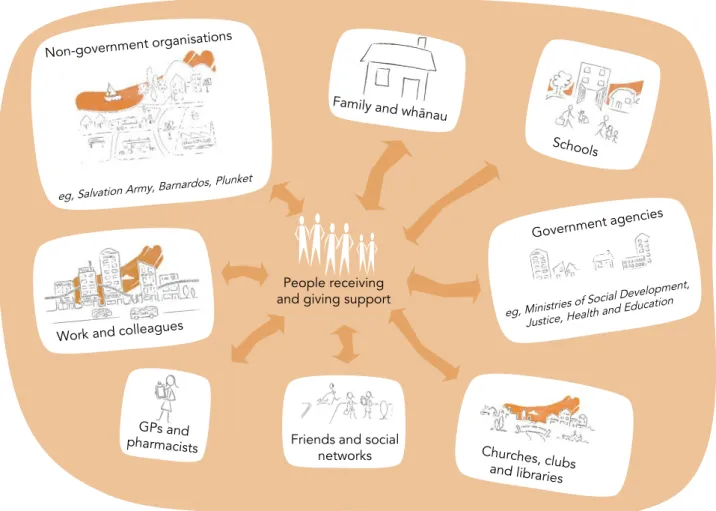
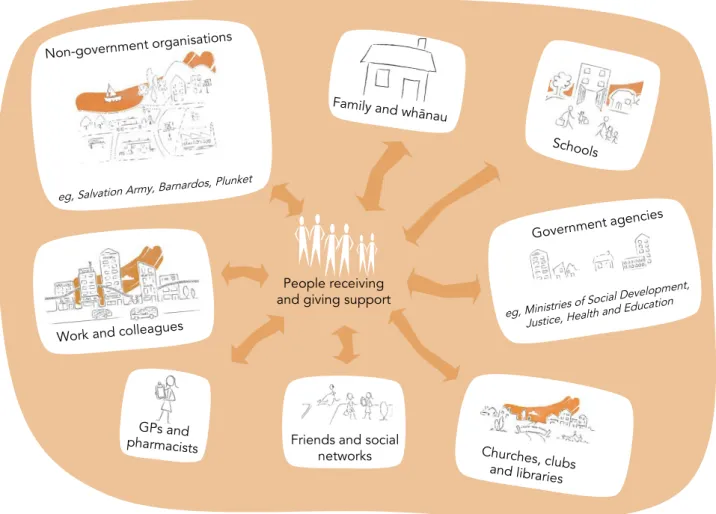
Social services help New Zealanders to live healthy, safe and fulfilling lives. They provide access to health services and education opportunities, and protect and support the most vulnerable. The quality of these services and their accessibility for those in need are crucial to the ongoing wellbeing of New Zealanders. Social services cover a wide variety of different activities. The Government funds them with the aim of improving a set of outcomes that people value, such as better health, less crime, and more and better jobs. Social services are only one influence among many that determine people’s outcomes. The relationships between all the influences and the outcomes are complex and often not fully understood. Other important influences include family, friends and community, work and colleagues, and early physical and social experiences.
Figure 0.1 Elements of the social services system
This inquiry is about how to make New Zealand’s government-funded social services more effective so as to improve people’s lives and raise social wellbeing.
The inquiry has examined (among other things):
the strengths and weaknesses of current approaches to commissioning and purchasing social services;
the lessons learnt from recent initiatives and new approaches, in New Zealand and overseas;
how social services can best target and help those with high needs and at risk of poor outcomes;
how to improve outcomes through better coordination of services within and between government
agencies and service providers;
Friends and social networks People receiving and giving support
how to take advantage of emerging opportunities offered by existing and new datasets, new information technologies and data analytics to learn about the effectiveness of different services for different groups, and to ensure that this learning spreads and is taken up widely by service providers; and
the institutional arrangements that would support smarter commissioning, purchasing and contracting of social services.
In the course of conducting this inquiry the Commission has been impressed with the hard work, perceptive thinking and commitment of the many people and organisations, both outside and within government, who help deliver social services to those in need.
The inquiry’s purpose is not to critique the performance of government agencies and service providers, but rather to make recommendations that will improve the system that all parties work within. Getting the system to function effectively will free up time, energy and resources to improve outcomes.
The Commission has drawn evidence from many sources including:
academic research, commissioned pieces of research, government reports and data;
134 submissions from different organisations and individuals including government agencies, not-for-profit (NFP) providers, for-not-for-profit (FP) providers and client groups;
more than 100 face-to-face meetings with a wide cross-section of interested parties; and
close engagement with the Ministry of Social Development (MSD) and the Ministry of Health to draw lessons from existing programmes.
The Commission has made 81 draft findings and 47 draft recommendations. Recommendations range from modest ways to improve commissioning and contracting to bold suggestions for changes in roles and responsibilities. At a time when the Government is strongly focused on more effective social services, the Commission believes this draft report will generate significant interest and welcomes submissions on it.
Social services in New Zealand
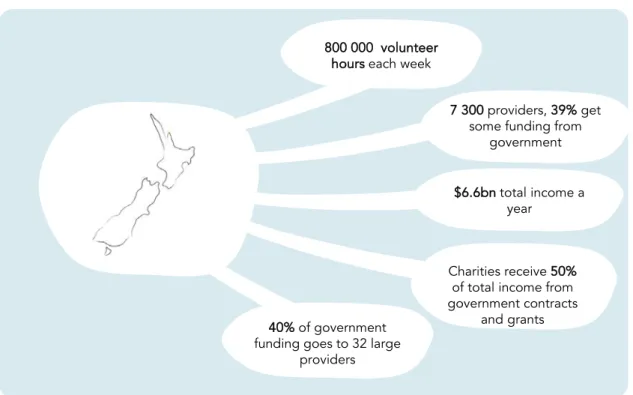
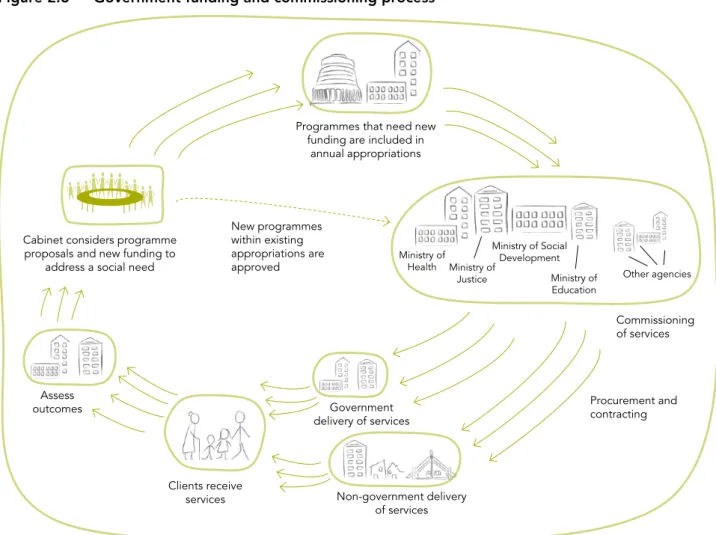
Central government spends around $34 billion a year on health, education and other social services. Most of this spending goes to universities, hospitals, schools and frontline departments, with the rest used to contract out services. For example, MSD is planning to spend 20% of its total expenditure on social services in 2014/2015 to pay for services that are contracted out.3
Social services are delivered by a mix of government, FP and NFP providers. History, population mix and geography have all influenced the landscape of service providers and funding arrangements under which they operate.
There have been numerous government reviews over the past 20 years that have identified remarkably consistent lists of issues, and proposed rather similar solutions. In light of this, the Commission has made a particular effort to identify the causes of problems rather than make proposals that simply tackle symptoms. The sheer size and complexity of the social services system makes generalisations difficult. Even so, the Commission’s broad observations are that the social services system has a number of positive attributes including:
social services workers, including a significant number of volunteers, are highly committed to improving the lives of clients and are driven by a sense of civic responsibility;
Governments, past and present, have shown a strong commitment to improving public services;
3 This excludes income support and benefit payments.
pockets of successful innovation exist in the use of data management and analytics;
government agencies widely acknowledge the importance of integrating services and the need to do better; and
government agencies are generally willing to launch trials and experiments.
The Commission has also observed a number of weaknesses in the social services system:
existing institutions are not well placed to deal with the multiple and inter-dependent problems experienced by many of New Zealand’s most vulnerable individuals and families;
government agencies generally know too little about the services (or interventions) that work well and those that do not;
evaluation of many social services is currently absent or of poor quality, or not given enough weight in subsequent decision making.
providers face poor incentives to experiment, and to share and adopt innovations;
clients often perceive government processes as confusing, overly directive, and unhelpful. For
providers, government processes can appear wasteful and disconnected from the real-world problems that providers struggle with;
services delivered by government agencies are often poorly coordinated;
opportunities are missed for early intervention to avoid the escalation of problems;
government agencies often tightly prescribe the activities of providers, making it difficult for providers to innovate or tailor services to the individual needs of clients; and
clients are often feel disempowered by the manner in which social services are commissioned and delivered.
The Commission has also observed a large “stock” of existing social services that continue to be funded and run in much the same way over decades, with little improvement in performance. A flow of new initiatives attracts much attention but has little effect on the existing stock or on outcomes. This suggests the system is not good at evaluating programmes, or expanding those that offer high effectiveness and removing those that do not.
Diagnosing the causes of system weaknesses and finding ways to overcome them is crucial in view of pressures on the system such as population ageing, the increasing demand for services, rising social expectations and the rising costs of delivering some services.
New Zealand is not the only country facing these pressures. Governments around the world are grappling with ways of improving the outcomes from their large expenditures on social services. There is also much to be learnt from innovative approaches to social services being applied in New Zealand and elsewhere.
New ideas in New Zealand and elsewhere
New approaches in New Zealand and elsewhere have sought to improve social services. They are instructive because they tackle some of the issues and problems described above.
Some schemes use data in sophisticated ways to test the effectiveness of different services for different types of clients. This can lead to large gains in effectiveness. MSD’s Investment approach is a good example.
Other schemes seek to empower clients and give them greater choice over which bundle of services best meets their needs, and who provides them. The new Australian National Disability Insurance Scheme allows
people with disabilities to choose a range of support to achieve their goals, within budgets determined by their level of need.
The Whänau Ora programme aims to empower families (whänau) to determine their own goals and choose a set of services and support to help achieve them. “Navigators” assist whänau to find the services and support they need.
Other new approaches emphasise sharpening incentives and stimulating innovation through some form of payment by results. Examples include social bonds and “contracting for outcomes”, which leave the means of achieving the results up to the provider.
One lesson from these initiatives is that social service programmes that give clients an entitlement to a level of support and a choice over how to spend it prompt providers to be responsive and to innovate. Yet such programmes also create pressures to expand entitlements, increasing programme costs. Programme designers need to carefully consider how to control cost pressures in such initiatives.
Other broad lessons for successful implementation of substantial, new social service programmes are the need for a well-articulated vision of the destination, careful staging and trials, meaningful engagement with affected parties, and independent evaluation to guide future design and build support.
Assessing system performance and diagnosing its causes
Focusing on the social services system (rather than specific services, programmes or providers) allows a broader understanding of the institutions and processes that shape the outcomes achieved from government-funded services.
As noted, while there are positive aspects of performance, many weaknesses exist. Diagnosing the causes of these weaknesses is an important and necessary step towards improving the system.
The Commission considers a well-functioning social services system would:
target public funds towards areas with the highest net benefits to society;
match the services provided to the needs of clients;
align incentives to improve the wellbeing of clients and those affected by their actions;
ensure decision makers (at all levels) have adequate information to make choices;
respond to changes in client needs and the external environment;
meet public expectations of fairness and equity;
be responsive to the aspirations and needs of Mäori and Pasifika; and
foster continuous experimentation, learning and improvement.
While many individual services succeed on one or more of these criteria, the system as a whole is under-performing.
No single factor can be pinpointed as the underlying cause of the system weaknesses observed by the Commission. Rather, these weaknesses are due to a combination of factors.
Many agencies and providers lack clarity about the objectives of the system and their part in it.
Few mechanisms exist to capture and analyse information on the impact and cost effectiveness of services.
Many government institutions were created in a different era of public administration and are not set up to deal with the complexity of modern demands on government-funded social services.
Previous attempts to reform the system have failed to address the underlying (institutional) causes of problems.
Those with decision rights often lack the required information, incentive and capability to make decisions consistent with efficient and effective social services.
Many contracts for social services are highly prescriptive, owing to traditional government accountability and delivery arrangements and aversion to political risk. This prescription works against innovation and responsiveness to client needs.
Heavy reliance on letting contracts to a single successful provider (competition “for the market” as opposed to several providers competing to attract clients “in the market”) disempowers clients by not giving them a choice of provider.
Ambiguity often exists around whether government agencies are purchasing services that they wish to fully specify, or contributing to programmes originated by non-government providers.
There is plenty of room to improve the purchasing and contracting of social services. But there are limits to the gains the government can achieve using the contracting-out model.
Government agencies have been largely unsuccessful in recognising and spreading the lessons from existing services and new initiatives.
Government agencies have overlooked their potential to shape and manage the market for social services contracts. Consequently, the market is not performing as well as it could.
The organisational cultures of providers and government agencies are often resistant to change.
Political pressures make it difficult for agencies to re-allocate funding away from under-performing programmes and initiatives.
An understanding of these causes is essential to improve the effectiveness of social services. The challenge is to design a well-performing system that takes them into account. Two design areas of great importance are the institutional architecture of the system and how to commission social services.
Designing the institutional architecture
Governments have paid considerable attention over the years to developing programmes and initiatives aimed at specific social services or client groups. Relatively little attention has been paid to the design of the overall system within which social services are delivered. Current arrangements contribute to many of the observed weaknesses.
Institutional architecture refers to the government’s high-level choices about the design of the social services system. The government organisations involved, their roles and authority, and the basis of their relationships with other system participants are all important design choices that can be varied. The onus is on the Government - acting on behalf of its citizens – to make these choices, and make them well.
Taking responsibility for institutional architecture is part of what the Commission is calling system stewardship. Government has a unique role in the social services system. It is the major funder of social services, and has statutory and regulatory powers unavailable to other participants. This is why the role of system steward falls to it. Other parts of the role include setting standards, investing in data infrastructure, monitoring overall system performance, improving capability, and prompting change when it under-performs.
Two broad architectural designs apply to social services. These relate to who has the responsibility to design and commission services. A crucial consideration in choosing who is which party has the authority, information, capability and incentives to make and implement decisions that maximise social returns. The Two broad designs are:
Top-down control means that primary decision-making power sits with the relevant minister or department head.
Decentralisation transfers substantial decision-making power to semi-autonomous organisations with separate governance. It is used to varying degrees, particularly in health and education (eg, District Health Boards, school boards, university councils). Social insurance is a special case of decentralisation. It assigns both decision-making power and liability for future costs to an insurer. (The Accident
Compensation Corporation (ACC) is perhaps the only New Zealand example.)
Top-down control of social services is common in New Zealand. To control risks, hold others accountable and maximise options to respond, governments often favour prescriptive service specifications and close, top-down control.
This approach is a good match to some clients and some services, but a poor match where clients have multiple, complex service needs.
Top-down control tends to dampen innovation, reduce coordination between agencies and limit
flexible adaptation to client needs and local circumstances.
In some cases, top-down control will be the appropriate option – largely for those services where state coercion is required (eg, statutory child protection). Where it remains the best option, the
implementation of top-down control could be improved.
Decentralisation should improve on top-down control where delegated decision makers have better information and incentives to maximise overall social returns. Well-designed organisations at arm’s length from ministers should face less intense political pressure to micro-manage for political reasons.
Governments have recognised situations – both inside and outside social services – where top-down control leads to poor societal outcomes and delegated decision making to organisations with varying levels of independence. A powerful example is the Reserve Bank.
Social services would be improved by greater and smarter use of delegation and devolution. Four variants exist based on geography, service area, community of interest and co-governance. Respective examples include District Health Boards (DHBs), Pharmac, Whänau Ora and the Te Hiku Social Accord. Ideally, subsidiary organisations should face strong incentives to intervene early to reduce future costs, and so deliver better long-term outcomes for clients. Delegating to social insurance organisations could fulfil this ideal. Liability for future costs better aligns the interests of insurers and insured, which should improve resource allocation across time.
A one-size-fits-all architecture across social services is not a viable proposition. The need to accommodate services with highly varied characteristics serving clients with wide variation in needs means that a social services system is likely to comprise several different architectures.
As the system steward, government has responsibility for the “enabling environment” for the social services system. Government is the major funder of social services, and only Parliament, led by the government of the day, can legislate and assign regulatory powers.
Budget appropriations can be broadly specified and in principle this allows efficient cross-service allocation and service integration. However, Governments typically do not take advantage of this opportunity and instead make narrowly specified budget appropriations for social services, using a variety of bases,
including departmental portfolio, issue, population group, geographical location and eligibility. This is one reason that attempts to devolve budget-allocation decisions within a top-down control architecture have had limited success.
Better commissioning of services
Commissioning is a set of inter-related tasks that need to be undertaken to turn policy objectives into effective social services. This report uses the term commissioning to emphasise that a wider range of skills and capabilities are required than suggested by the more commonly used terms procurement and
purchasing, and that a wider range of options are available to commissioning organisations than contracting out and in-house delivery.
Examples of social service commissioning organisations are government departments such as MSD and the Ministry of Health, crown entities such as DHBs, and non-government bodies such as the Whänau Ora commissioning agencies.
Effective commissioning is fundamental to well-functioning social services. Commissioning organisations need to make informed, deliberate choices. They should consider objectives, needs, cost effectiveness, funding, pricing, risk management, quality, eligibility, performance measurement, information flows, provider market sustainability and interactions with other services.
The commissioning of social services is a challenging task. It is not generally undertaken in New Zealand in a structured, consistent and effective way. Commissioning organisations should actively build the required skills, capability and knowledge base.
A key commissioning task is choosing an appropriate service model. The model should be chosen to match policy objectives, and the characteristics of the service and its intended clients. Considering a wide range of models increases the likelihood of a better match, and better service outcomes as a consequence.
This report explores seven conceptual service models. Each has strengths and weaknesses, and some models may only be applicable to relatively limited circumstances.
In-house provision is useful when statutory powers are required, or the service is most efficiently bundled with services that require statutory powers.
Contracting out is useful when providers offer specialised skills or capabilities, including access to difficult-to-reach clients.
Managed markets allow multiple providers to compete for market share. They can encourage investment and innovation, which are difficult to achieve in non-contestable systems.
Trust models capitalise on the intrinsic motivation of provider employees and organisations. They require careful design to ensure quality is adequately monitored through peer monitoring or regulatory oversight.
Shared-goals models appeal to intrinsic motivation of players and also pursue common ownership of problems and goals, and so encourage constructive and integrated problem solving and creative solutions. Shared goals models can be challenging to replicate.
Client-directed-budgets models offer much when the client (or their representative) is best placed to make service consumption decisions. These models motivate providers to offer good value to clients, encourage innovation and empower service clients.
Voucher models work by clients choosing among providers offering a bundle of services (such as a university or an early childhood education centre). Government funding flows to providers according to those choices.
Many of these models require a mental shift for commissioning organisations, from being in direct control to overseeing a set of services and enabling them to function well. This oversight includes ongoing monitoring of service performance, and re-visiting commissioning choices as necessary to improve performance.
Commissioning services on a service-by-service basis might be optimal for the specific services, but runs the risk of an inefficient and ineffective overall system. Important commissioning tasks include considering the needs of clients who require multiple services, and the appropriate grouping of services.
Funding practices
Government needs to clarify its objectives in funding services, and match the type of funding to those objectives. Legitimate options for funding include full funding, contributory funding, tied and untied grants, and no funding.
Government should always be explicit about the type of funding, the appropriate level of control that this funding brings, and the likely consequences of its funding decisions. Government should fully fund those services where it desires full control over service specification.
Government appears to under-fund some contracts with non-government providers for the delivery of fully specified social services. Long-term under-funding has undesirable consequences. Payments should be set at a level that allows an efficient provider to make sustainable return on resources deployed, encouraging investment by existing providers and entry by new providers.
Creating a system that learns and innovates
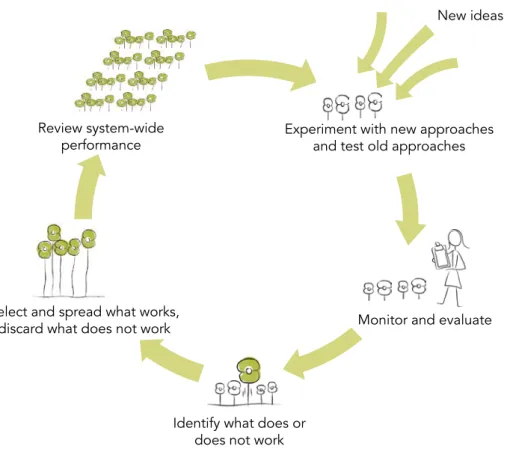
Social services deal with many problems that are complex and are not susceptible to one-off, all-time solutions. The complexity and uncertainty about solutions place a premium on a system that learns, that finds solutions to problems and finds new ways to improve the return on investment in social services. Key features of a system that learns are:
trying a variety of new ways of doing things;
tolerating trials that fail;
dealing with failure quickly;
identifying and selecting the variants that perform better; and
spreading the uptake of these more successful variants.
Different institutional architectures and service models have different strengths and weaknesses in trying and selecting new approaches. A centralised top-down architecture tends to generate fixed decisions about what works with too little tailoring to particular circumstances, and not enough bottom-up experimentation. A totally decentralised approach permits a lot of local experiments. But, in the absence of an effective selection mechanism across them, little pressure exists to select successful ones. New Zealand social services have examples of both problems.
A system that learns needs to have:
clear goals around improving the effectiveness of social services in terms of better outcomes for both clients and taxpayers;
strong incentives to find, and the flexibility to try, new ways of doing things;
information flows that provide ongoing feedback to service users, providers, commissioning organisations and citizens about what is working; and
the flexibility to take up successful innovations.
Choosing system architectures and service models that incorporate these features will increase learning and innovation in the social services system.
Figure 0.2 A system that learns
The role of government as the system steward importantly includes responsibility for ensuring that the social services system is an effective learning system. Government agencies are more likely to meet this challenge if they step back from being providers and procurers of services and focus on system-stewardship tasks: including clearly defining desired outcomes, promoting diverse approaches, monitoring them, and encouraging the spread of successful ones.
An effective learning system results in innovation – the introduction of new or significantly improved services or business processes, for the purposes of getting better outcomes from available resources. The social services, with some exceptions, lag far behind many other services in adopting innovative productivity-enhancing business models. Modern information and communications technology (ICT) often plays an essential role in such models.
Innovation in social services is often small scale, local, dependent on a few committed individuals and incremental; but there are some examples of disruptive innovation that have dramatically changed prevailing business models. One example is the Canterbury DHB’s development of its HealthPathways model which has now been adopted in several other healthcare systems in New Zealand and Australia. Risk aversion in government agencies and in NFPs, overly prescriptive contracts, capital constraints and “bare-bones” funding partly explain low levels of innovation in the social services.
Improved commissioning and contracting have the potential to reduce some of the current barriers to innovation.
The current evidence-base for system-wide learning is weak and needs to be strengthened. In practice, conventional evaluation of many social services is absent, of poor quality or not given enough weight in subsequent decision making. Effort should focus on making available timely, shared evidence on what is working, for whom and through which service providers.
Initiatives under way may improve the quality of evaluation. These are to be welcomed, but new
approaches are needed alongside that enable cost-effective monitoring and evaluation in real time across the system, using a wider range of information than is typically used in evaluations.
Experiment with new approaches and test old approaches
Monitor and evaluate
Identify what does or does not work Select and spread what works,
discard what does not work Review system-wide
performance
Leveraging data to improve social services
In an era of ICT and “big data”, exciting opportunities exist to use data and data analytics to create a learning system that increases the effectiveness of social services. A client-centred data infrastructure and analytics could support a range of decentralised service models and provide better information to support decisions made by both commissioning organisations and the users and providers of social services. Developments in data technology and analytics have transformed many service industries including banking, music, and publishing to name a few. The same developments have the potential to support new business models in social services that will bring substantial improvements in effectiveness.
A system that learns needs timely client-centred data and analytics to be available to decision makers at all points in the system. Cost-effectively collecting, sharing and analysing data across the social services system will greatly increase the capacity to design and commission effective services, and to target resources to where they have the strongest effect on improving outcomes.
The Social Sector Board (the chief executives of the main government departments responsible for social services) has started a project to integrate social sector data, including setting common standards. In the Commission’s view this work should include the design of institutions and processes to develop a
comprehensive, wide-access, client-centred data infrastructure accessible to commissioning organisations, providers, users and researchers of social services. Better use of linked, cross-agency data could increase the scope, power and accuracy of the Government’s investment approach to targeting social services as well as supporting better-integrated and tailored services for clients.
The New Zealand Data Futures Forum (NZDFF) has recommended a way to realise the potential benefits and mitigate the risks of sharing, linking and using data. The NZDFF recommended that the Government should establish an independent data council to act as the guardian of good practice in the sharing, linking and use of data in New Zealand.
The Government, and social services providers and users, should use the NZDFF recommendations to underpin their efforts to explore innovative approaches to social problems.
Government agencies should require providers that they contract with to capture information on their services in a consistent way. This will allow the patterns of individuals’ use of services to be tracked across time, and for service outcomes and provider performance to be identified. Commissioning organisations, purchasers and providers of social services should use this information to continuously improve their decisions.
Sharing government-held data with third-party providers would support innovative services to solve social problems. Statistics New Zealand currently allows researchers access to de-identified personal data in its Integrated Data Infrastructure. This is desirable, but should be taken further. Subject to individual consent, government agencies should provide access to identifiable personal data to trusted third parties.
Social investment and insurance
“Prepare rather than repair.” This simple and catchy idea is that well designed and targeted early interventions can reduce or eliminate adverse consequences at a later date. Ideally, individuals, their families and the social services system should act whenever they expect the resulting future benefits to exceed costs. But that will only happen if the relevant parties have the information and resources required, and face the right incentives.
The Government’s Investment Approach is an attempt to increase the effectiveness of social services through better investment and targeting of investment. It is also about providing information and incentives to support early intervention, rather than waiting for a crisis.
The Investment Approach adopts investment and insurance tools to prioritise clients and services and selects interventions based on expected reduction in future welfare liability (FWL). This liability is a proxy
measure for future net social benefits. While the proxy is imperfect, the Investment Approach is a significant improvement on traditional approaches.
FWL identifies the people for whom the gains might be greatest, but provides no guidance on effective interventions. Reliable information on interventions, including their cost and effectiveness, is also essential when applying an Investment Approach.
There is scope to refine the Investment Approach and to apply it more widely within and across different government-funded social service areas.
A further extension is to assign the financial risks associated with poor social outcomes to organisations that are better placed than government to manage and reduce those risks, including by making timely
investments. Such an “insurance approach” might offer strong incentives for timely and value-adding interventions.
Social insurance is an insurance scheme organised by the state, with compulsory membership and in which premiums are usually related to the ability to pay. The interests of social insurers such as the ACC can align better with the long-term wellbeing of individual New Zealanders than traditionally structured social service agencies. Social insurers have incentives to make timely and value-adding investments. For example, the ACC invests in a falls prevention programme to reduce the number of injuries and claims due to falls. A system with national insurers, each responsible for a narrow service area (or condition type), could offer these benefits, but limits the potential for improved service integration and resource allocation across service areas.
A bolder approach would be to have competition between multiple insurers, each with a wide focus. All citizens would be enrolled with one of these insurers, which would receive premium payments from the government based on the characteristics of their enrolled members. Insurers would face the actual costs of future social services delivery for their members. A multiple-insurer system could be attractive to existing health and life insurers, or possibly to iwi.
Some significant challenges face the designers of such a system, including how to determine premiums and rules for moving between insurers.
Some non-government organisations have the potential to become social insurers for enrolled populations. A social insurance approach is worthy of further consideration.
Integrating services for better outcomes
A key challenge in delivering social services to people with multiple and inter-related needs is making sure the services are combined and tailored to best address those needs. Integrated services offer clients a coordinated mix of services that tackle multiple needs in a timely, convenient and effective way.
The fragmentation of social services to the detriment of clients with complex needs is a long-standing issue that has proved difficult to resolve, despite many attempts. Fragmented delivery is usually a symptom of problems in the way social services are commissioned and contracted for.
A key question is the optimal extent and form of integration. It is possible to have too much integration, or the wrong kind of integration. The risk is that integrating on one dimension opens gaps in another. For example, improving the integration between mental-health and employment services could come at the cost of making it more difficult to have good links between mental-health and domestic-violence services. Organisations need to weigh up costs and benefits when deciding the extent and type of integration. The government should seek the combination of integrated and single-focused services with the highest net benefit.
Institutional arrangements and service models can support integration in different ways.
Provided it is done judiciously, government agencies exercising top-down control over services can merge government agencies, link contracting or service teams, or merge multiple contracts.