USING KNOWLEDGE IN SOCIAL CARE REPORT 10
Developing the evidence base
for social work and social care
practice
NOVEMBER 2005
Social Care Institute for Excellence
Developing the evidence base for social
work and social care practice
SCIE’s job is to base policy and practice
improvement on evidence. But whose job is it
to ensure that the evidence is available in the
first place?
This report outlines for the first time the
resources available to create the evidence base
in social work and social care, and compares
the position with health. The report calls for an
inquiry to make proposals for improving the
infrastructure for research and development for
social care.
This publication is available in an
alternative format upon request.
Peter Marsh and Mike Fisher
in collaboration with Nigel Mathers and Sheila Fish
Developing the evidence base for social work and
social care practice
First published in Great Britain in November 2005 by the Social Care Institute for Excellence
© SCIE 2005 All rights reserved ISBN 1-904812-30-9
Written by Professor Peter Marsh and Professor Mike Fisher in collaboration with Professor Nigel Mathers and Dr Sheila Fish
Produced by The Policy Press Fourth Floor, Beacon House Queen’s Road
Bristol BS8 1QU tel 0117 331 4054 fax 0117 331 4093 [email protected] www.policypress.org.uk
This report is available in print and online www.scie.org.uk
Social Care Institute for Excellence Goldings House
2 Hay’s Lane London SE1 2HB tel 020 7089 6840 fax 020 7089 6841 textphone 020 7089 6893 www.scie.org.uk
List of abbreviations v
Summary vi
1 Introduction 1
2 The context of modernisation 2
3 The nature of evidence and why we need it 3
3.1 Why do we need evidence? 3
4 Strategic frameworks for developing research 5 4.1 The comparison between social care and 6
primary care
4.2 Can strategic investment make a difference? 8
5 Evidence for practice 10
5.1 Why do we need social work evidence? 10 5.1.1 Social work as the core disciplinary base for 11
social care
5.1.2 Is social work research distinctive? 11 5.1.3 Research in or on social care? The need for 12
‘relevance squared’
5.2 The research relationship with service users 13 and carers
5.2.1 Reshaping the relationship with service users 13 and carers
6 The engagement with practice and practitioners 15
6.1 Practice and research 15
6.2 Encouraging the engagement between practice 17 and research production
6.3 Resources for research production 18 6.3.1 Health and social services expenditure and
staffing 18
6.3.2 Health and social care R&D 19 6.3.3 Summary of expenditure and staffing levels 21 6.3.4 Comparing health and social care research 22
investment
7 Conclusions 26
7.1 Resources 27
7.2 Priorities for knowledge production 28 7.3 Research workforce development 28
Appendix 1: The National Coordinating Centre for 31 Research Capacity Development
Appendix 2: Breakdown of total public expenditure on 33 health and social services by country
Appendix 3: Workforce data 34
Appendix 4: Research & Development expenditure 38 Appendix 5: Priorities for knowledge development 43
List of abbreviations
AHP Allied and health professions
BBSRC Biotechnology and Biological Sciences Research Council CAM Complementary and alternative medicine
CCETSW Central Council for Education and Training in Social Work CEBSS Centre for Evidence-based Social Sciences
CSSR Councils with Social Services Responsibility DEL Department of Employment and Learning DfES Department for Education and Skills DH Department of Health
EPSRC Engineering and Physical Sciences Research Council ESRC Economic and Social Research Council
FHS Family Health Services GP General practitioner
GSCC General Social Care Council HEFC Higher Education Funding Council
HEFCE Higher Education Funding Council for England HEFCS Higher Education Funding Council for Scotland HEFCW Higher Education Funding Council for Wales HRM Human resources management
JUC-SWEC Joint University Council’s Social Work Education Committee MRC Medical Research Council
NCC RDC National Coordinating Centre for Research Capacity Development NHS National Health Service
NICE National Institute for Clinical Excellence
OECD Organisation for Economic Co-operation and Development PSA Public Service Agreements
PSSC Personal Social Services Council PSSRU Personal Social Services Research Unit QR Quality-related Research
R&D Research and development RAE Research Assessment Exercise
RDSU Research and development support unit RSES Research scientist in evidence
SCIE Social Care Institute for Excellence
SHEFC Scottish Higher Education Funding Council
SIESWE Scottish Institute for Excellence in Social Work Education SWRC Social Work Research Centre
Summary
Summary of argument
In essence, this report presents a very simple case that:
•
modernisation requires a research infrastructure capable of shifting the basis of social care towards evidence-based policy and practice•
the infrastructure should comprise a research workforce, funding and national, strategic priorities•
no such infrastructure exists to support social work and social care. The report concludes that:•
an agency should be allocated the strategic role and resources to host an inquiry into and to develop, in collaboration with other stakeholders, a research infrastructure to support evidence-based policy and practice in social work and social care.Overview of the report
Background
The modernisation of social care places a high premium on evidence. At the level of central government, commitment to service reform is increasingly based on evidence about effectiveness rather than on any partisan political agenda. At the level of citizens, acceptance of professional expertise is increasingly tempered by a well-informed critique, supported by improved access to high-quality information. At the level of service providers, accountable, regulated services means ensuring that practice is based on evidence rather than on past practice or current patterns of service.
The value of research
Within the various kinds of evidence required to inform social care (including citizens’ views, practitioners’ experience, and organisational audit and inspection), that provided by research plays a special role. The best research is specifically designed to be as free as possible from bias in favour of any interest group or policy position, and potentially provides the most secure basis to inform national policy.
The need for research to be managed
In order to be of maximum value, the production of research has to be managed and properly resourced. Research production requires an infrastructure comprising a research workforce, funding and a framework of national, strategic priorities.
In order to explore the proper management and resourcing of research, the report draws a parallel between social care and general practice, and between their underpinning research disciplines of social work and primary care. The research infrastructure for primary care has been thoroughly overhauled following an inquiry in 1997 (known as the Mant Report),16 which provided a system for generating national, strategic priorities and relevant support programmes, including the establishment of the National Coordinating Centre for Research Capacity Development (NCC RCD).
Data on the impact of these reforms are available from the Research Assessment Exercises (RAE) for 1996 and 2001. During this period, the proportion of Departments of General Practice where the majority of research was of national or international excellence (RAE rating ‘4’ or above) rose from 31% to 88%.
No such measures have been taken to improve the research infrastructure that supports social care. The last review of the topic was in England in 1994, and this review was not followed by any measures to develop strategic thinking or resourcing. In comparison with primary care, therefore, research in social work demonstrates much less progress in achieving the kind of research infrastructure that would support excellence.
This is no one’s job and so no one is doing it.
While the proportion of Departments of General Practice producing a majority of research of national or international excellence nearly doubled during the period 1996-2001, only one third more Departments of Social Work achieved this improvement. The current position is that 88% of Departments of General Practice, but only 43% of Departments of Social Work produce research of national or international excellence (see Figure 1).
The comparison demonstrates two points: that significantly less research of national and international excellence is being produced to underpin social care, but also that investment in the infrastructure can produce significant changes in the medium term. Recent proposals for an Institute for Health Research and centres of excellence will strengthen the progress towards patient-centred research: social care research needs similar attention and investment.
Why is research from social work the most relevant evidence?
Employing the parallel with primary care, the report distinguishes between scientific research on causes (biological studies in the laboratory, for example), and research on what works in front-line practice (such as in the primary care clinic). Each kind of research has a specific focus and its own priorities. In social care, effective intervention in the front line requires research that derives directly from practice concerns and offers solutions designed and tested to be feasible in practice. While it is critical to
Figure 1: The comparative improvement in RAE rating ‘4’ or above for
Social Work and Primary Care 1996 and 2001
� �� �� �� �� ���
���� ����
����������� ������������ �
understand the causes of poor parenting or old-age abuse (for example), basic research of this kind does not of itself create an evidence base about effective intervention. As a practice research discipline, social work research (at its best) can do this.
Many research disciplines are also notorious for demarcating narrowly defined aspects of human experience. For example, building an evidence base for social care for children will draw on psychology, education and social policy, but this aspect of social care is not a primary concern of any of these individual disciplines. The best social work research seeks effective interventions to the issues facing social care.
The report further argues that social work research is relevant to the entire range of social work and social care issues. The rigour and relevance of the best social work research should be seen as informing the field of social care as a whole.
Social work research and the relationship with users and carers
The democratisation of welfare, and the move towards citizen participation in social care, requires a different kind of evidence production than one where the professional expertise and the priorities of providers take precedence. As citizens, people who use and provide services need to be directly involved in determining what kind of knowledge should be sought, what research processes should be used and what outcomes matter. The traditions of participatory and empowerment research that permeate the best social work research place it in a strong position to respond to this agenda.
Social work research and the relationship to practice and practitioners
Similarly, the modernisation of social care increasingly requires active collaboration with the social care workforce. Rather than simply seeking to enlighten a workforce portrayed as reluctant to engage in and to use research, more progressive approaches within social work research seek a collaborative partnership with the community of practitioners, identifying their research priorities, how new knowledge can be integrated with existing practice (or can most effectively challenge existing practice), and testing the day-to-day feasibility of interventions.
Most importantly, however, the report identifies the lack of practitioner engagement in research in social care and contrasts this with the promotion of ‘lecturer-practitioners’ in primary care (and other health professions). The current position is that the more social work researchers engage in research, the more divorced they become from practice: the report argues the need to reverse this arrangement so that practice more strongly informs research.
Resources for research production
Health and social care have different histories and traditions, and this gives rise to striking differences in resources for producing research. The report gives for the first time an account of the resources for social care knowledge production, and draws comparison with those available to support healthcare. The results of this comparison are telling.
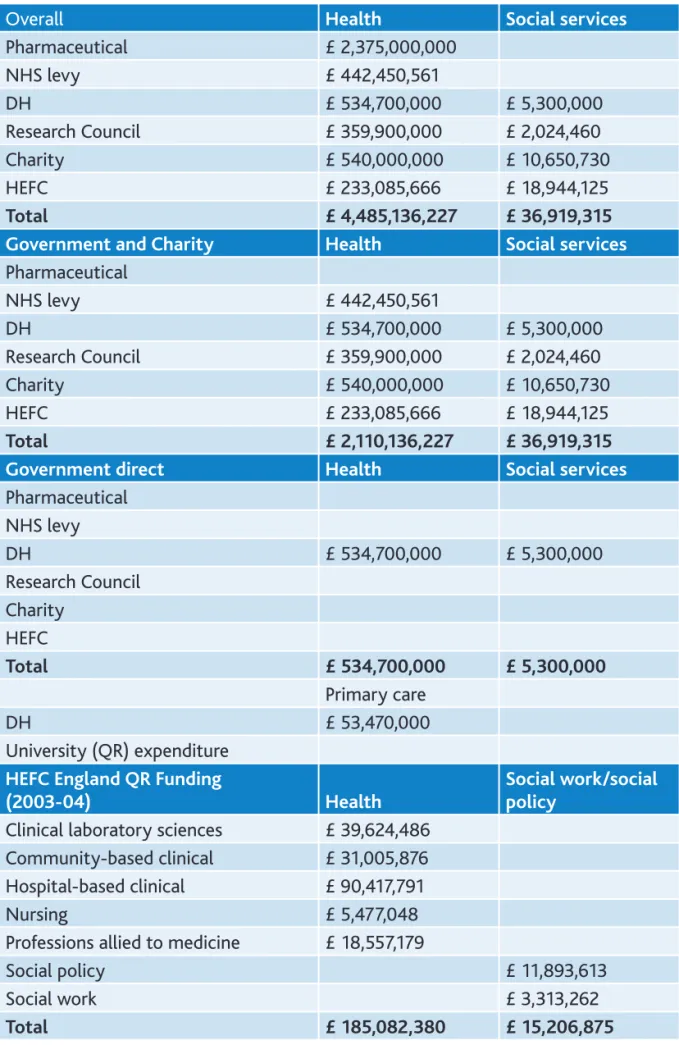
On every one of nine different comparators, the disparity in resources is substantial. For example, as a proportion of total annual spend, investment in research and development (R&D) runs at about 0.3% in social care compared with 5.4% in health. The overall annual spend per workforce member stands at about £25 in social care compared with £3,400 in health. Using the more specific comparison with primary care, the annual R&D spend per social worker is about £60, compared with £1,466 per general practitioner (GP); annual university research income from the Higher Education Funding Council (HEFC) Quality-related Research (QR) is £8,650 per social work researcher and £26,343 per primary care researcher (see Figure 2).
Research also requires a research workforce. Again, using primary care as a comparator, social work has about half the number of university-based researchers available to produce research-based knowledge.
Investment in healthcare research is designed to increase the health and competitiveness of the nation, and to reduce inequalities. New proposals for health research promise even greater (albeit targeted) investment. The current disparity between the health and social care research infrastructure reduces the effectiveness of social care in delivering welfare and in reducing inequalities stemming from social factors. In short, the disparity hinders the modernisation of social care.
2d) HEFC England QR income per GP and social work researcher (£)
���
���
� � ��
������ �����������
��
�����
� ����� �����
������ �����������
��
�����
� ����� ����� �� ������
������ �����
������
� ������ ������ ��
�����������
Figure 2: Selected comparisons between health and social care
research and development (R&D) expenditure
2a) R&D budget as a percentage of total 2b) R&D spend per staff member (£)
Conclusions
Modernisation provides a unique opportunity to shift the basis of social care towards evidence-based policy and practice. In order to achieve this shift, we need a modern, developed infrastructure for knowledge production producing one of the most valuable kinds of evidence – that from research.
Modern services require an integrated approach between the various agencies providing social and health care, and this in turn calls for each agency to have a well-developed evidence base for its interventions. Put very simply, integrated care will be hindered if social care cannot participate with its sister agencies in basing common policies and practices on evidence.
There are some encouraging signs. The establishment of the Social Care Institute for Excellence (SCIE) and its sister organisations provides a focus for the quality of evidence used to improve policy and practice. Work with the Economic and Social Research Council (ESRC) has provided an opportunity for the first time to obtain greater recognition and investment for social work research. The Joint University Council’s Social Work Education Committee (JUC-SWEC) has committed to preparing a national research framework by spring 2006. SCIE is also coordinating work to identify the strengths and weaknesses of UK social work research (in collaboration with the ESRC, JUC-SWEC and the Scottish Institute for Excellence in Social Work Education [SIESWE]). This work, also due in spring 2006, should inform the criteria used in the 2008 RAE to judge the quality of applied and practice-based social work research. In both Scotland and England, reviews of the role of social work provide an important opportunity to examine the resources for knowledge production and the part social workers should play in creating and using the knowledge base.
Recommendations
Policy makers, politicians and the research community have a clear opportunity to make a difference to the quality of the evidence supporting the reform of social care. What is required is to make a start on three key aspects:
•
Review the research infrastructure for social care. Ultimately, this requires a review paralleling the Mant Report for primary care. In preparation for this, SCIE could, in collaboration with its sister organisations, be allocated a medium-term role to coordinate infrastructure development, including identifying some of the key national research priorities and reviewing the options for a national programme of support to develop the social care research workforce. This work would need to recognise the different structures for research and the different agencies developing evidence-based policy and practice in each of the administrations within the UK. It would also need to take account of the development of the new framework for National Health Service (NHS) research.•
Support the research workforce. Initially, this might focus on increasing the role of the ESRC in developing the research skills base, so that social care can develop lecturer-practitioners and professional doctorates focusing on practice-based research; Care Councils should also examine their role in increasing the requirement that staff participate in research as part of their re-registration.•
Develop the resources for research. Rather than simply arguing for parity of resources with health, the report suggests that resource development should be seen as a long-term process, with an initial focus on maximising investment by ensuring existing programmes of research adequately reflect social work and social care research perspectives and priorities; reviewing the investment in improvement services in order to ensure they are accompanied by research to evaluate their effectiveness; ensuring that commissioners and providers (local authorities, trusts and the independent sector) provide for research funding alongside service provision.These are some of the measures that can be pursued in the short and medium term to generate the momentum for change towards a research infrastructure that is capable of supporting the modernisation of social care. The case for such change is clear. Doing nothing should not be an option, and the potential benefits for modernisation, and for service users and carers, should be a sufficient spur to action.
1 Introduction
The modernisation of Britain’s health and social care services inevitably calls attention to the quality of the knowledge base that can underpin change and development. Research evidence forms a cornerstone of this knowledge base. However, it is pointless to portray evidence in this way unless we have research that gives reliable and valid messages for policy and practice. This is a question of both scope and quality: does the research and development (R&D) agenda yield evidence that is relevant to the core priorities, and is that evidence of sufficient quality to underpin national policy making and to develop practice knowledge?
This report explores the infrastructure for building the knowledge base in social work and social care and in order to do this it draws on some comparisons with primary care. The reasons for this comparison are many. Both are practice-based, front-line services where the relationship with the public (patients, service users and carers) is at the heart of their concerns. They also share a fundamentally similar relationship between practice and knowledge production: social work can appear to be the poor relation of the social sciences in terms of funding and prestige, just as primary care appears to suffer in comparison with the biomedical sciences; both disciplines embrace the need for diverse approaches to generating knowledge (including qualitative research) that leaves them open to the charge of methodological eclecticism; in both cases, everyday practices often lack an explicit evidence base. Perhaps most critically for the purpose of the current report, the infrastructure for primary care research has been a significant focus for analysis and development1.
The report draws on earlier work based on the Research Assessment Exercise (RAE)2
and for the first time proposes a method of estimating the investment in R&D in social work and social care in comparison with that made in health care. This comparison is increasingly important as social and health care become more integrated and as social care practitioners attempt to elaborate the knowledge base for their work to their healthcare colleagues. While the term ‘social care’ describes the welfare sector to which this report applies, we argue that ‘social work’ is the core research discipline underpinning the knowledge base for policy and practice (there is no academic subject of social care). We therefore describe the infrastructure for ‘social work and social care’. Finally, the report argues for better connections between the practice of social work and social care and the R&D community if relevant and useful knowledge is to be produced.
2 The context of modernisation
Concern about the research infrastructure has grown in recent years in parallel with the emphasis on evidence-based practice,3,4 and this has highlighted the need for
‘practice-based evidence’. By practice-based evidence, we mean research directly derived from practice concerns and aimed at providing practice improvement. The policies of modernisation adopted over the past years have also brought an increased emphasis on the evidence base,5 with some commissioning of research to provide this,
but there is also a growing recognition that there is quite simply a lack of relevant and appropriate research that can help to move forward key policy developments: inter-professional practice and learning is one such example.6 From a central government
perspective, policy makers may question whether they can rely on the R&D community to have sufficient engagement with policy to deliver useful and timely evidence,7 and
the Cabinet Office Strategy Unit is increasingly encouraging a more applied approach to generating knowledge, including through the establishment of enhanced capacity for systematic review.8,9 New proposals from the English Department of Health (DH)
for the development of healthcare research give similar priority for research that is relevant to clinical practice.10
While there has been little increase in investment in social care research in recent years, there has been serious investment in the dissemination and utilisation of the limited research that is conducted. From early work by the Joseph Rowntree Foundation, with its innovative ‘Findings’ series, to the pioneering production of research reviews with clear application messages by the DH, there has been a growing knowledge base about the ways that knowledge itself can be disseminated. This has been partnered in more recent years by work on the ways that research can be utilised, as shown in the Social Care Institute for Excellence’s (SCIE’s) programmes and products, and the activities of ‘Research in Practice’ and ‘Making Research Count’. In Scotland, the Scottish Institute for Excellence in Social Work Education (SIESWE) has provided a focus for research utilisation relevant to education. This substantial dissemination and utilisation work has made the lack of attention to the development of the research products themselves all the more noticeable.
There is of course nothing new in noting the lack of strategic development, particularly in practice-based research.11 Modernisation and the growing integration of social care
with health care has, however, created a pressing need and an important opportunityto change and develop the infrastructure for the production of research knowledge in social care.
3 The nature of evidence and why we need it
So far we have been using ‘knowledge’ and ‘evidence’ without detailed definitions, and it is time to clarify the meanings we will attach to these terms and the implications for the focus of this report. Janet Lewis, the former Director of Research at the Joseph Rowntree Foundation, has succinctly captured the role of evidence in the knowledge base for social care in the formula:
Knowledge = evidence + practice wisdom + service user and carer experiences and wishes12 (italics added)
The importance of this definition is that there is no hierarchy: the three components will vary in importance depending on the question under consideration. Evidence, in this construction, is the product of research, defined as a form of structured enquiry capable of producing generalisable knowledge. The strength of this definition is that research-based knowledge should be of significant value in policy making because it is designed to deliver general messages of wide applicability. However, the capacity of research-based evidence to do this is limited unless we add that evidence deriving from research should be relevant and applied – that is, that it derives from and addresses practice concerns, and is potentially capable of translation into applicable ideas. This gives the formula:
Evidence = research findings + interpretation of the findings
Using these definitions, the focus of this report is on the infrastructure required to produce evidence from research. We acknowledge that much of what we would define as research is produced within the inspection and audit industry, or from public inquiries (that is, such knowledge derives from structured enquiry and is intended to deliver nationally relevant messages and thus to be generalisable). However, this work is not the subject of this report. We include such knowledge in our definition of research, but its production derives from a quite different infrastructure.
We also need to acknowledge that this report is not primarily about the production of the other two ingredients in Lewis’s definition of knowledge – practice wisdom and user and carer experiences and wishes. We will, however, argue that research-based evidence must engage with the interests of practitioners, of users and of carers, and indeed that it must take account of sources that report the experience of providing and receiving services.13,14 Of course, one way this already happens in producing
research-based evidence is through the activities of practitioners, users or carers in leading research.
3.1 Why do we need evidence?
We propose six main arguments for the need for evidence from research within the knowledge base for social care.
First, there is the major impact of the decisions of social care professionals on the immediate life chances of service users and carers (for example, in child protection). In these areas evidence from research can be literally a matter of life or death, and
having the best informed practitioners is vital to the immediate outcomes for highly disadvantaged people.
Second, there is the impact over time of decisions on the longer-term life chances of service users and carers(for example, children in care, or long-term carers). Decisions taken over the weeks or months will affect, for example, the educational outcomes for children in care, which are themselves of fundamental importance to their future. To give another example, they will affect the mental and physical health of disabled users and long-term carers, again with substantial implications for their quality of life. Best informed practice should be the right of people whose long-term outcomes depend in part on social care decisions.
Third, good evidence may produce a challenge to fundamental assumptions about social care, and this may bring substantial advantages to service users and carers. When Copernicus developed evidence that the Earth rotates around the Sun, the outcome was not simply a new theory of planetary movement but also the possibility of an entirely different understanding of our place in the universe. On a more relevant and personal scale, research has shown the value of the development of the Expert Patient Programme in healthcare, where people with long-term conditions manage their own care. This programme has the potential to revolutionise the concept of expertise and the relations between providers and patients. Evidence about the effectiveness of family group conferences has the similar potential to change fundamentally the role of the state in protecting children. Research on direct payments has helped to demonstrate the potential to place service users in control of service providers, rather than vice versa. The research has aided these major, and sometimes controversial, shifts in policies, which have the potential to enhance greatly the lives of service users and carers.
The importance of providing safeguards over compulsory or quasi-compulsory decision making is a fourth argument. There are substantial areas of social care where professionals have strong powers, or where the courts may make decisions regarding major aspects of people’s lives. Providing the best available evidence is an important component of these processes of control.
Fifth, the evidence is needed for an informed public, who can then engage better with relevant debates about services. Although, at present, there may be relatively few members of the public who actively engage in these debates, it is right that citizens have access to the best evidence.
Sixth, the evidence is needed for informed service user and carer communities, and individuals. Direct involvement in services and engagement with the development of services requires access to the best evidence.
These are six strong arguments for the development of the evidence base, and for shifting social services towards an evidence-based approach, instead of its historic reliance on an ‘authority-based’ approach.15 The arguments are remarkably similar
to those made for the need for evidence in healthcare (for example, the 1997 report for the DH on R&D in primary care).16 Investment in evidence is clearly of central
4 Strategic frameworks for developing research
We turn next to some crucial questions in the strategy for knowledge production in social care, and comparable strategies in primary care. How has the production of this evidence been managed in social care? What sort of strategic frameworks have been developed to enhance the applicability of evidence to policy and practice? Are there lessons from the strategic developments in primary care?
A framework for the development of research needs to address four key questions – it should:
•
clarify the scope of the field of knowledge to which it applies•
name the questions that need to be addressed if the framework is to progress the strategic development of the knowledge base•
define, in general terms at least, priorities for knowledge production and•
outline the key resource issues over a medium to long-term period to provide this knowledge production.Ideally, such a framework would be developed by drawing on a thorough analysis of the field, but there have been insuperable difficulties in doing that in social care, because of the scattered and incomplete data available (as we indicate in Appendices 3 and 4 in particular).
At present there is no overarching framework for prioritising or organising the knowledge base in social work and social care. The last major attempt to review R&D in this field was made in 1994 in England, and this report, A wider strategy for research & development relating to the personal social services, had little to build on.17 Indeed, we
have to look back to 1980 to find its distant relation – the Report by the Central Council for Education and Training in Social Work (CCETSW) and the Personal Social Services Council (PSSC), on a research strategy for the personal social services.18 Interim work
on the resources for personal social services research,19 and a review of the research
units funded by the DH20 formed part of the wider picture of policy-related R&D but
were not strategically linked. Other DH reports (the 1995 report Advancing research21
and the 1992 Research capacity strategy)22 primarily focused on healthcare and failed
to develop any strategic thinking specifically addressed to social work or to social care. The 1994 Wider strategy report17 referred to a pattern of personal social services that
has now been so comprehensively superseded that its main interest is simply that it gives historical corroboration to the neglect of the strategic research agenda for social work and social care. This neglect is also evident in the new proposals for National Health Service (NHS) research, which make little reference to social care.10
Despite this lack of strategy, social work research has occasionally made a significant impact. For example, the childcare research programme coordinated by the DH in the 1980s produced a degree of coherence on the core questions to be explored and a determined emphasis on relevance to practice (see, for example, two overviews in 1985 and 1991).23,24 For the first time, we began to see practice-based concepts
such as partnership being seriously explored through research. While this example shows how a coherent framework could produce influential, applied, practice-based
knowledge, it did not address the question of the infrastructure for research relevant to social care.
It is in one sense hardly surprising that research in social work and social care lacks a strategic framework. No publicly funded body has the task of developing one, no funding agency has the task of promoting it, and the plethora of relevant bodies has not so far offered a unified voice that could command widespread support. Unclear academic roots complicate the process: social work is an academic discipline, and thus receives public funding through the Higher Education Funding Councils (HEFCS), which provides some funding for research in a complex teaching/research distribution to universities, but no major research funder has had the responsibility to fund social work research as an academic discipline. The Economic and Social Research Council (ESRC), the major source of discipline-based, social science research funding,25 has
only recently (2004) recognised social work as a discipline in its own right for the monitoring of research proposals and the provision of research studentships, has now identified it as in need of extra support as an ‘emerging’ discipline. Social care does not exist as an academic discipline, and while the discipline of social policy has made a significant contribution to the knowledge base (and is recognised by the ESRC), it does not offer a focus on the practice of social care.
Major research units, such as the Personal Social Services Research Unit (PSSRU), and the former Centre for Evidenced-based Social Services (CEBSS), host work that is relevant to social work, but have no publicly funded role to develop it as a research discipline. Indeed, it is arguable that the only major research unit with such a publicly funded role is the Social Work Research Centre (SWRC) at the University of Stirling, whose title derives in part at least from the fact that the term ‘social work’ is used in Scotland to correspond to what is meant by ‘social services’ elsewhere.
4.1 The comparison between social care and primary care
The contrast with the history of developing a strategic framework for primary care is telling. As a result of the efforts of the Royal College of General Practitioners and the establishment of academic departments in all UK medical schools, the primary care clinical discipline with the greatest research capacity is general practice. However, in 1995 only 335 out of 31,950 general practitioners (GPs) had academic contracts and many of these were either part time or engaged mainly in teaching. The 1996 Government White Paper Primary care: Delivering the future26 recognised the need to
expand the knowledge base for primary care and made the commitment to increase NHS annual funding of R&D related to primary care from £25 million to £50 million. The key turning point, following the commitment to make knowledge production a priority, was the work over some 18 months of the National Working Group on R&D in primary care chaired by Professor David Mant. The publication by the DH in 1997 of the report of this group R&D in primary care,16 which complemented the Medical Research
Council’s (MRC) previously published topic review Primary health care,27 reaffirmed the
importance attached to primary care R&D by the government. This report set out in practical terms a strategy for the expansion of the primary care knowledge base. The overriding strategic objective for the NHS in 1997 was to increase the amount of high-quality R&D of importance to primary care in order to improve the high-quality and value for money of primary care services to patients.
The report set out guiding principles and specific objectives. The guiding principles were that:
1 High-quality patient care requires a sound evidence base derived from high-quality R&D.
2 High-quality R&D requires effective collaboration between NHS service providers and universities.
3 Any increase in primary care R&D activities in the NHS requires a parallel expansion of R&D capacity in the university sector.
4 Successful expansion of primary care R&D requires a coordinated approach from the NHS, MRC, universities and other funding organisations.
5 Expansion of R&D activities in primary care must build on and preserve existing expertise.
The strategic objectives were:
1 To increase the amount of high-quality R&D of importance to NHS primary care and thus to improve the quality and value for money of primary care services.
2 To increase the recruitment, development and retention of R&D leaders in primary care.
3 To increase the number of clinical staff with R&D expertise.
4 To increase the involvement of staff in non-clinical disciplines (for example, social and behavioural scientists, statisticians and economists).
5 To achieve an evidence-based culture in primary care.
The report set out 23 specific recommendations for the achievement of these objectives. The key recommendations included providing programme funding to support work of strategic importance, establishing young researcher awards to encourage fast tracking of able individuals at an early stage in their careers, establishing career scientist posts for established researchers and developing R&D networking arrangements in each region.
This report was followed up by further work by the R&D Workforce Capacity Development Group21 and in 2003 by the creation of a National Coordinating
Centre for Research Capacity Development (NCC RCD). The ground work for the 2003 development was established in 1996-98 and, as we shall discuss later, in around five years, substantial dividends were seen, for example in the impact on RAE quality indicators (and therefore associated university research funding) and in the establishment of the NCC RCD. This body has recently published its priorities for continuing research capacity development in primary care and it has distinguished three current levels of investment:
1 academic units
2 research and development support units (RDSUs) 3 clinical research networks.
Support is therefore available for both academic staffing and practitioners, with networks and units available for all (some further outline details of the NCC RCD and the personal award schemes are given in Appendix 1).
4.2 Can strategic investment make a difference?
The recognition of the problem in primary care and the strategic investment of resources do appear to have made a substantial difference. Clearly, personal awards are going to encourage practitioners who are conducting research, a point we will return to later, but at the aggregate research level, as shown in national indicators, there are major changes in primary care’s substantial research discipline, that of general practice, between 1996 and 2003, and these changes appear directly related to the strategic investment. It should be noted the figures that are available for primary care cover other areas as well (the ‘community-based clinical RAE category also has some public health and psychiatric submissions), but the growth that we will outline below was strongly driven by primary care.
The comparison between primary care and social work from 1996 to 2001 is stark. The 1996 RAE, departments rated ‘4’ or above:
•
7 Departments of General Practice (within the RAE category ‘Community-based clinical’)16•
11 Departments of Social Work2that is, 31% of the 22 Departments for Primary Care submitted under the RAE and 34 per cent of the 32 Departments of Social Work submitted.
Therefore, before the strategic development and investment in primary care the situation in the two academic areas looked broadly similar. However, the 2001 RAE revealed just how dramatically the situation had changed.
The 2001 RAE, departments rated ‘4’ or above:
•
24 Departments of General Practice (within the RAE category ‘Community-based clinical’)28•
13 Departments of Social Work2that is, 88% of the 27 returned Departments for Primary Care, and 43% of the 30 returned Departments for Social Work.
Table 1 shows the change over this five-year period.
There was therefore a significant improvement in the RAE ratings, but another way that changes in the strengths of disciplines may be reflected in the RAE process is in the choices made regarding the panel to which work is submitted. If a discipline is strong and has critical mass it will probably submit the great majority of its work to its own discipline panel; if it is weaker, with scattered resources in small units, it is likely to submit under other headings providing greater credibility and scale to other areas. The situation regarding submission levels in the 2001 RAE again indicates the relative strength of the primary care grouping, with increased submission numbers and nearly all of the work going to the relevant discipline panel.
RAE submission choices in 2001 were:
•
31 Departments of General Practice; 27 were returned under the relevant panel•
66 universities had Care Council registered social work programmes; 24 were returned under social work.The comparison is again stark: nearly all of the primary care group submitted their returns to their academic discipline panel, but under half of the social work group did so.
In passing we might also note a point that we will return to later, which is that it is very difficult to estimate the number of social work departments, units or staff members. In primary care there are reasonably accurate figures for academic staffing; in social work there are next to none.
A strategic approach, with some relevant investment, appears to generate a much broader base of good research. We shall return to these comparisons, and especially to the issue of volume of research, later in the report.
Table 1: Change in percentage of departments rated ‘4’ or above from
1996-2001
Rated ‘4’ or above:
Number % Number %
Primary care 7 31 24 88
Social work 11 34 13 43
5 Evidence for practice
We have argued so far that there is a clear need for evidence in social work and social care, and that a strategic framework to produce this evidence is lacking. We have made the comparison between social work and primary care, and noted the benefits of a strategic approach and appropriate investment in the latter area. But while there seems little doubt about the need for evidence, and the benefits of suitable planning to produce it, should this evidence for social care come from social work, or from a broad range of disciplines? Our argument here is that a wide range of disciplines can and should play a role in providing the evidence for policy analysis (particularly the discipline of social policy). However, just as primary care requires research from a discipline based in front-line practice, social care for similar reasons requires evidence from social work as the primary discipline rooted in social care practice.
5.1 Why do we need social work evidence?
First and foremost, social care is a practice discipline and, while it requires research from other areas to underpin it, it also requires research based in its own practice for its own development. To discover causes is not necessarily to discover cures, or, to take an example from basic science, what works in the laboratory is not necessarily what works in the clinic. This is fully accepted in health, where, for example, medical research needs to accompany biological research. In a similar fashion, social care needs accompanying social policy research, but it also needs social work research that is practice-based and that will deliver practice change.
Second, all disciplines have their own priorities, based on history, on current fashions, perhaps also on student demand and on international pressures. These priorities may or may not be relevant for social care, but because social work is rooted in social care, it shares the concerns and the pressures of social care practice.
Third, the focus of many disciplines is on discrete aspects of human experience, rather than on the need for an evidence base that addresses the many different issues facing social care. For example, building an evidence base for social care for children and families requires evidence from disciplines such as social policy, psychology and education, but none of these has a primary focus on social care. In contrast, the best social work research integrates knowledge from different disciplines to focus specifically on social care concerns.
Fourth, social work research is relevant to the entire range of social work and social care issues. Its focus is not just on the work of social workers, but on the practice of social care as a whole.
These are substantial reasons to develop social work research in order to improve the practice of social care. Research from social work is not the only relevant discipline, but, at its best, and because of its applied nature and of its relationship with users, carers and practitioners, it is in a position to develop the type of research that will underpin social care practice and service in the future.
In addition, the rigour of the best social work research is an important asset for wider knowledge production in social care. There is an established tradition of good quality research, albeit low in quantity, that provides a sound methodology, within its social science base, for the production of knowledge for social care.
These arguments will lead us to promote strongly the need for a new strategic approach to social work research, and accompanying investment. However, the enhancement of social work research capacity is also relevant to studies undertaken in other disciplines. Evaluations of new programmes, for example, from a discipline base outside social work, will produce more relevant practice knowledge if they are influenced by a strong perspective from social work research. Such a perspective will help to ensure that research focusing primarily on causes also pays attention to cures, and that the practice and implementation activities that need to accompany new programmes are spelled out and well tested. Strong social work research is thus likely to help other research disciplines to improve the relevance of their work to the business of developing practice and policy in social care.
5.1.1 Social work as the core disciplinary base for social care
It is critical to the case for social work research as a core discipline underpinning social care that the subject matter of social work research is not seen as limited to the activities of social workers. To reiterate the points made above, social work skills, knowledge and values are relevant to a wide range of social care activities and deserve study. Of course some activities require higher levels of skilled practice currently requiring (at least) a social work qualification, but we must not confuse ‘social work research’, with ‘research on what social workers do’.
5.1.2 Is social work research distinctive?
We are arguing for the importance of a strong social work research community to assist with knowledge production in social care. This offers, we suggest, a distinctive positive role in the production of relevant evidence. Some would argue it also offers a distinctive role regarding research methods. These debates have been well rehearsed in the papers from the Theorising Social Work Research Seminar Series (see papers at www.scie.org.uk/publications/misc/tswr/index.asp), which suggest that social work research methods have distinct qualities, particularly in the way they handle the relationships between individuals, groups and the community. Further distinctiveness is claimed in relation to its attention to participative practices and social justice in the conduct of research itself. The conclusion may be that the strategic framework should use this claim to distinctiveness to elevate the case for investment and recognition. However, modern forms of knowledge production are increasingly recognised as ‘methodologically interdisciplinary’,29 suggesting that the development of methods
benefits from less, not more, insularity, and that method distinctiveness is more about emphasis than uniqueness. Moreover, central government customers and commissioners may find the concern with methodological distinctiveness immaterial, in the sense that they commission research that assists policy and practice rather than the development of particular approaches. An important question, therefore, is whether there is value in claiming distinctiveness for social work research methods,
when the epistemological tide is running the other way and when this is not the key concern for at least some research users.
Two answers suggest themselves. First, it is important to analyse distinctiveness more closely, and to separate out the argument that social work and social care has its own knowledge base from that concerning the application of knowledge. No modern social science claims exclusive ownership of a knowledge base with fixed boundaries – indeed, it is a mark of a modern discipline that it draws on a wide range of appropriate knowledge. In social work and social care, the core approach is to “place the issue, problem or person at the centre of investigation…” and “to understand events through available knowledge”30(see also31). The distinctiveness lies not in the knowledge base,
but in the application of social science knowledge to social analysis and intervention. This is most emphatically not to say that social work and social care does not create its own knowledge – the theory and technology of task-centred practice or of family group conferences are sterling examples – but it is to say that it is unhelpful to seek an identity for social work and social care in the creation of exclusive knowledge.
Second, distinctiveness may be far less important in gaining recognition for knowledge production in social work and social care than relevance – that is, the contribution that the knowledge base makes to the understanding of social issues. In this sense, the role that social work has played in revealing child abuse, particularly sexual abuse, and in reducing violence towards children deserves recognition. So too does its work in documenting the effects of poverty, particularly on women, the effects of institutional care, particularly on children, and the effects of social policies that marginalise or exclude people.
Therefore, the argument is to concentrate on distinctiveness in terms of the way social work and social care generates and uses knowledge, rather than on a spurious and rather dated notion of an exclusive knowledge base. We need to concentrate on the focus of knowledge, and the usability of it. Relevance is the hallmark of social work research, not a particular approach to research methodology.
5.1.3 Research in or on social care? The need for ‘relevance squared’
Much of the research evidence for social work and social care practice can only be obtained by research involving practitioners and service users and carers. Resolving the difficult issues that are entailed in this should involve these groups directly. This is an example where social work research can be research in social care, rather than research
on social care. The values of social care need to be central to such involvement, and social work researchers are likely to be best placed to uphold those values. In addition, social work researchers will be well placed to understand the situations that are unique to social work (for example, legal requirements, and models of decision making with families). Social work researchers would be likely to approach the business of research with a set of skills and values relevant to the practitioners, service users and carers they will meet. But while this is a very important element of the arguments for the contribution of social work research, it is not the main one, which, as noted above, hinges around relevance.
Social care knowledge production needs research that can be used in practice. It needs research that begins and ends in practice: that begins with practice-relevant questions, and that ends with relevant material that can be applied in practice.
Relevance needs to be built in both during the design of the research and afterwards when useful ideas are being developed from it. Of course there are ‘translation’ issues from research studies, but they are significantly reduced if the research has at its heart knowledge and understanding of the practice that it is trying to improve.
There needs to be relevance in topic and relevance for the potential translation into action: thus good social work research will have ‘relevance squared’ at its heart.
5.2 The research relationship with service users and carers
The experiences, needs and wishes of service users and carers are central to the production of useful and relevant knowledge in social care. Social work research has engaged, quite substantially, with service users and carers, but how should this engagement develop within a new and invigorated focus on social care research knowledge production?
5.2.1 Reshaping the relationship with service users and carers
Knowledge production for social work and social care in the UK rightly has a reputation for rethinking the relationship with service users and carers. At the core of this reshaped relationship is the requirement that knowledge production incorporates attention to users’ and carers’ definitions of knowledge, process and outcomes. A key question in the development of a strategic framework for social work and social care knowledge is, therefore, the nature of the alliance with service users’ and carers’ movements. This work needs to be undertaken at a number of levels. First, the framework needs to recognise that many of those producing knowledge are themselves users or carers, and many are producing evidence of national relevance (in the sense of the product of structured investigation, see above). One way of recognising this knowledge is to review and summarise it, so that its further development may be planned: although several important reviews have been undertaken32-34, they all have limitations in the range of
substantive research addressed or in attention to methodological issues. Work by Carr has identified the common issues from a range of R&D on involving users in service improvement,35 and this work is now being extended to review the impact of carer
involvement. The user group ‘Shaping Our Lives’ is developing a national user network that will give the user movement greater potential to identify common themes across its member groups (see www.shapingourlives.org.uk).
Second, the ethical issues surrounding knowledge production and user and carer involvement must be addressed, and Butler’s work produced as part of the Theorising Social Work Research Seminar Series is a good starting point36 that will now need to
be set into the context of the Research Governance Framework (www.dh.gov.uk/ PolicyAndGuidance/ResearchAndDevelopment/). The central principle is to recognise the right of users and carers to be involved in all aspects of the knowledge production process, including setting the priorities for commissioning and standards for the ethical
Third, this principle has important consequences for the way social work and social care uses its resources. Alliances are required with the user and carer movements so that their resources to participate can be improved. Here it will not be enough to rest the case on ethical grounds: if inroads are to be made into areas of knowledge production such as commissioning, and the production of systematic reviews, where service users and carers currently play little part, the case will have to include attention to the methodological necessity of adopting the principles of involvement.13,37
6
The engagement with practice and practitioners
This report has argued strongly for the need for an engagement with practice in order to improve effective and useful knowledge production in social care. But what form should that engagement take, and how strong is it at present?
6.1 Practice and research
We have argued that research is one of the key components of best practice, and we have also argued that research that begins and ends in practice that is genuinely ‘practice-based evidence’ is lacking in social care. However, this problem with the research can be turned, and has been turned by some commentators, into accusations that poor research use by practitioners is a result of their lack of research-mindedness, and of their failure to read, to implement or to produce research (see, for example,38).
Most of this criticism emanates from a narrow view of evidence-based practice, and it is often underpinned by a simplistic understanding of the way knowledge should apply to practice. Shaw has summed up this problem as follows:
The assumption of most writers of this persuasion is that utilisation of evaluation findings is a relatively straightforward matter. Where it is a problem, it is typically put down to a breakdown in communication or the self-interested resistance of professionals. To regard theory and practice problems in this way is to relegate ‘practice’ to the subordinate, the acted-upon…39: 3
This unwillingness among some knowledge producers, primarily in the academic sector, to engage with the way practitioners use knowledge in practice, or to build collaborative partnerships with the practice community, stands in sharp contrast to work elsewhere. There is now a powerful body of research, derived from working alongside practitioners, on the nature of the practitioner/research relationship,40
on how practitioners reason,41-44 on the knowledge components of professional
expertise,45-47 and on the requirements for constructing knowledge as guidance for
practitioners.48 All but one of the researchers quoted in this paragraph work outside
the UK, suggesting that the UK academic community has something to learn from its international colleagues about engaging with practitioners.
Given the focus of this report on the research workforce, what does it mean for researchers to be engaged with practice? Rather than suggest some absolute view of this engagement (as, for example, providing direct services), it is more useful to consider a ‘gradient’of nearness to practice.
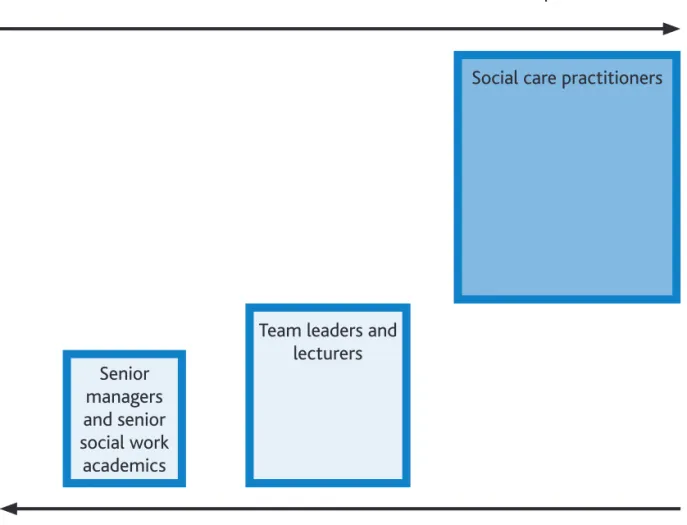
At one end of such a gradient, all researchers with a social work qualification will have an understanding of practice derived from their professional education and training. Senior managers, and senior social work academics, will fall into this group, and they probably are the farthest from practice of all those engaged with social work research. A more substantial group, comprising team leaders and lecturers, will be somewhat closer to practice. They will observe practice, talk to practitioners, and consider, sometimes in great detail, the elements of practice. They will meet service users and carers, but perhaps not all that often, for their engagement with practice is somewhat second-hand. It is the largest group, the practitioners, those directly responsible for
Figure 1 summarises these three groups with a suggestion of the relative size of each in the workforce, from the small group of senior staff to the much larger group of practice staff.
It has been argued earlier that the distinctive nature of social work research is the opportunity it creates for the research focus to be relevant to practice and the research to have a high potential for translation into practice. Therefore, we would ideally want the engagement with research production to rise as the closeness to practice rises. In social care the picture is precisely the opposite of this.
The nearer you are to practice the less likely you are to engage with the research production process.
Figure 1 shows that social work research is not making the most of its practice base. Closeness to practice is a major strength that is not being fully used in social work at present.
Figure 1: ‘Nearness to practice’ and engagement with the research
production process
Nearness to practice
Engagement with research production
Social care practitioners
Team leaders and lecturers Senior
managers and senior social work
The contrast with primary care is dramatic. The Society for Academic Primary Care states quite clearly that:
Direct clinical experience is important for academic general practitioners. Apart from its intrinsic benefits for patient care, it provides a source of ideas for both teaching and research, and evidence of credibility with full time colleagues.28:30
Senior academic staff with responsibility for research are close to practice because they are in practice. The influence of practice on research is thus direct and clear in primary care. Social work research can, and should, do better to integrate practice with research production.
6.2 Encouraging the engagement between practice and research
production
Having a substantial number of practitioners directly engaged in high-quality research work should certainly be one of the longer-term aims if we are to improve the knowledge base of social care. However, there is a model, which occurs in both social work and primary care, of engagement via lecturer-practitioners that could be enacted quite quickly, and which would provide a good, if not ideal, improvement for bringing practice closer research.
The lecturer-practitioner concept has been developed to combine professional activity in both the academic and practice components of the discipline by integrating theory, practice and the teaching of practice.49 This role is both highly skilled and crucial to the
development of a discipline. Such individuals can enter into the academy, challenge and encourage the relevance of research, and assist with its implementation. Some staff in these posts may also receive training to undertake research, beginning to build the skilled practitioner-researcher community that is needed in the longer term. The importance of the lecturer-practitioner’s role is acknowledged publicly in current healthcare policy,50 which states its intention to enhance the status of those
who provide practice-based teaching. While research has been undertaken primarily in relation to the lecturer-practitioner role in nursing (see, for example,51 there have,
until recently, been no cross-professional studies of lecturer-practitioners. Studies so far have been within the different professions including engineering, medicine and management,52 pharmacy, nursing and teacher education53, as well as healthcare,
teaching, law, theology and social work.54 The move to interprofessional working
creates further opportunities, while also adding some new challenges, for the lecturer-practitioner role.55 All of these studies have investigated access and recruitment, initial
professional education, assessment, approaches to teaching and learning and the interconnections between academic culture and the nature of disciplines.
Evidence from these studies, from experience in higher education and more recently the RDSUs based in trusts (for example, Trent RDSU), is that there is substantial pent-up demand from social services practitioners for engagement in research production, and that providing for this demand will produce a beneficial involvement of practice within the academy. The problem is not the lack of good quality staff, nor their ambitions, but rather the absence of opportunity and the funding to accompany it. The ESRC may well be one of the keys to providing funding for the development of
practitioner-lecturers, if it could be persuaded, given its current interest in social work, to provide better and more appropriate funding for the post-graduate work, fellowships and so on that would be needed.
6.3 Resources for research production
*The argument so far has been that there is significant need for social work research, that the nature of social work research resides in its relevance to policy and practice, and that there is substantial value in, and substantial need for, a strategic approach to developing social work research. We will now turn to the crucial question of the level of resources that should be devoted to such development, drawing on comparisons with the NHS, in general, and primary care, in particular.
Social work and social care is a major UK enterprise, with around £12 billion expenditure, a workforce of over one million (larger than the UK engineering workforce and in total rather greater than that of the NHS), and serving an estimated one million people each year (it serves 750,000 people each year in England alone). It plays a key role in fostering social coherence and represents a major commitment to a socially just society. What level of R&D funding is appropriate to underpin an enterprise of this size and importance?
6.3.1 Health and social services expenditure and staffing
In common with our arguments earlier, we will approach this question through a comparison with health. There are important qualifications to be made, especially when we turn to research expenditure, but the NHS and the social care sector have some substantial similarities in both their importance to the public, and the resources, both financial and human, that they deploy.
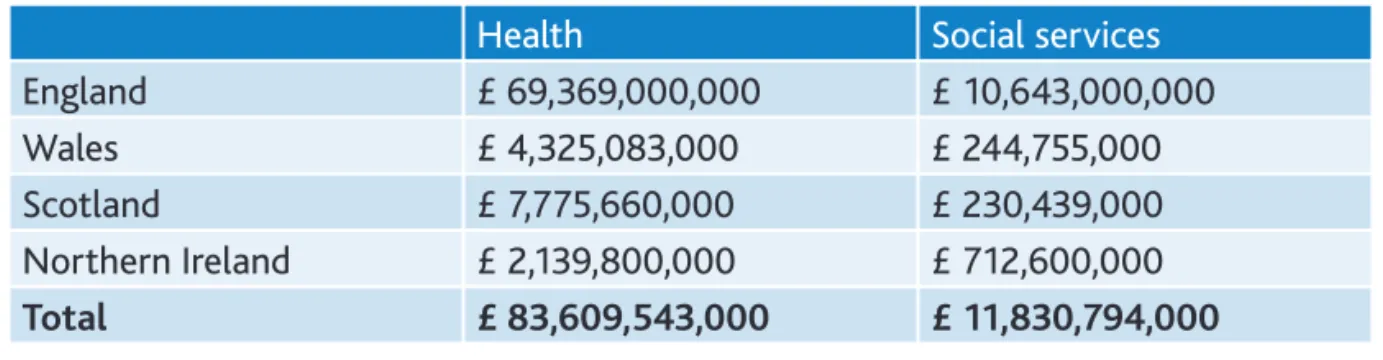
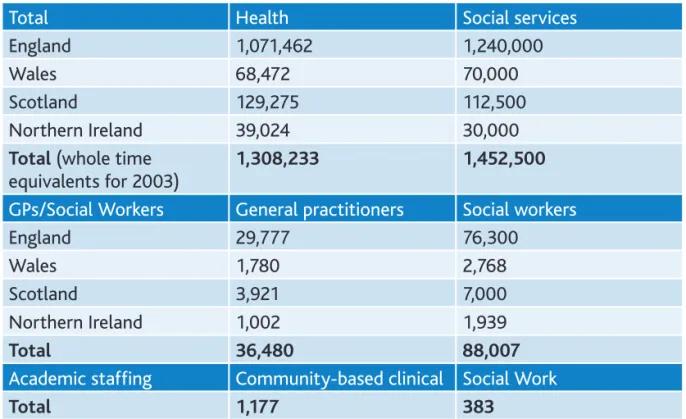
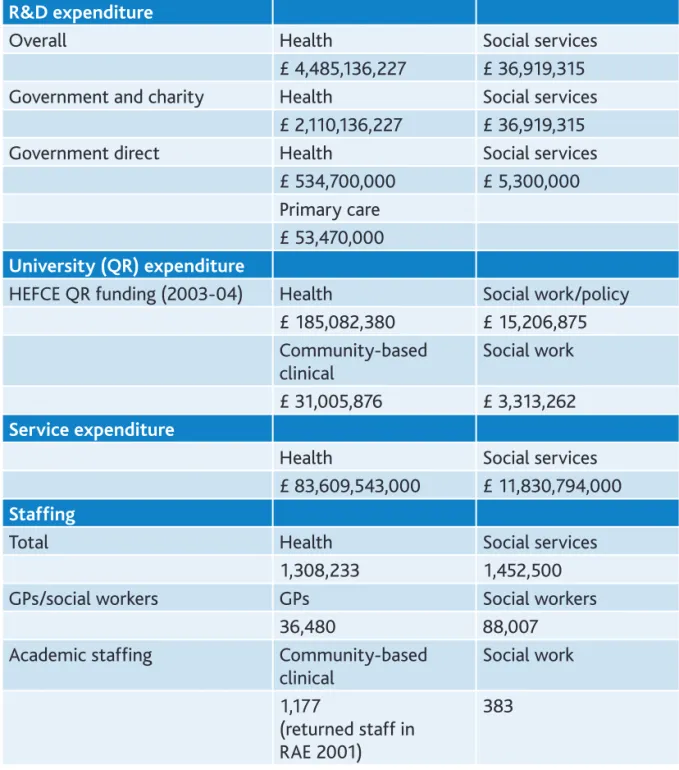
The overall service expenditures and the staffing levels are given in Tables 2 and 3. The figures generally relate to 2003-04, and full details of them, as for all of the figures in this section of the report, are given in the appendices. The staffing figures given here do not show the enormous differences in qualifications and skills between the NHS and the social care sector, but they do indicate the broad comparability of the two endeavours in total staff counts, and the difference in overall expenditure of around 8: 1. As we have shown earlier in the report, however, the ratio of practitioners to research staff is very different: using the comparison between primary care and social work, the latter has approximately twice as many practitioners, but half as many research staff.
Health Social services
England £ 69,369,000,000 £ 10,643,000,000
Wales £ 4,325,083,000 £ 244,755,000
Scotland £ 7,775,660,000 £ 230,439,000 Northern Ireland £ 2,139,800,000 £ 712,600,000 Total £ 83,609,543,000 £ 11,830,794,000