IEEE TRANSACTIONS ON INFORMATION THEORY, VOL. IT-24, NO. 1, JANUARY 1974
Bounds for Binary Codes of Length Less Than 25
81
M. R. BEST, A. E. BROUWER, F. JESSIE MAcWILLIAMS, ANDREW M. ODLYZKO, MEMBER, IEEE, AND
NEIL J. A. SLOANE, FELLOW, IEEE
Abstract-Improved bounds for A(n,d), the maximum number
of codewords in a (linear or nonlinear) binary code of word length
n and minimum distance d, and for A (n&u), the maximum number
of binary vectors of length n, distance d, and constant weight w in
the range n 5 24 and d 5 10 are presented. Some of the new values
are A (9,4) = 20 (which was previously believed to follow from the
results of Wax), A (13,6) = 32 (which proves that the Nadler code
is optimal), A (17,8) = 36 or 37, and A (21,8) = 512. The upper bounds
on A (n,d) are found with the help of linear programming, making
use of the values of A(n,d,w).
I. INTRODUCTION
T
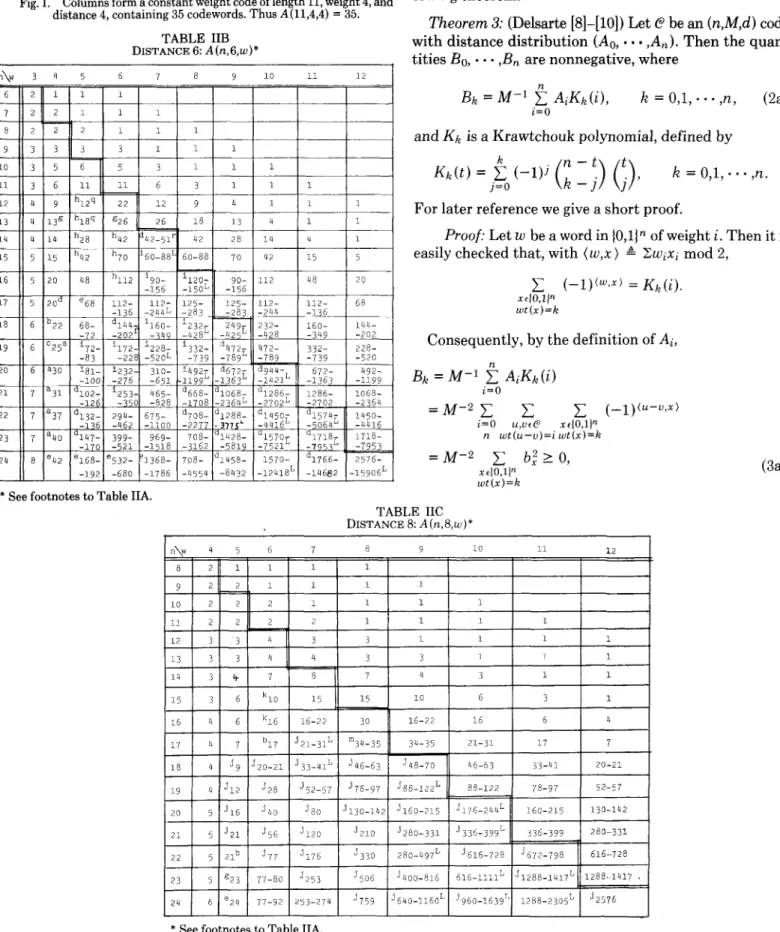
HE MAIN purpose of this paper is to present tables1 of two of the most basic functions in coding theory, namely:AW) * = maximum number of codewords in any
(linear or nonlinear) binary code of length n and minimum distance d between codewords (see Table I), and
A(n,d,w) = maximum number of codewords in any bi- nary code of length n, constant weight w and minimum distance d (see Table II),
in the range n I 24, d I 10. We also give a table of the function
T(wl,nl,wz,nz,d) = maximum number of codewords in a binary code of length nl + n2 and minimum distance d with exactly w 1 ones in the first nl coordinates and exactly ws ones in the last n2 coordi- nates (see Table III),
for nl + n2 I 24, d = 10.
All of the upper bounds on A (n,d) outside the Plotkin range n I 2d are obtained from modifications of Delsarte’s linear programming method by making use of the values of A(n,d,w). The tables of A(n,d,w) are important both because they lead to bounds on A(n,d), and because in their own right they give the size of the largest constant weight codes. They also give the solution to the following widely studied packing problem (see ErdGs and Hanani [17], Kalbfleisch and Stanton [36], Schijnheim [X],
Manuscript received September 9,1976; revised April 5,1977. M. R. Best and A. E. Brouwer are with the Mathematical Centre, Amsterdam, The Netherlands.
F. J. MacWilliams, A. M. Odlyzko, and N. J. A. Sloane are with Bell Laboratories, Murray Hill, NJ 07974.
l We would appreciate hearing of any improvements to the tables. (Send them for example to N. J. A. Sloane, Mathematics and Statistics Research Center, Bell Laboratories, Murray Hill, NJ 07974, USA.)
n 6 7 8 9 10 11 12 13 14 15 16 17 18 19 20 21 22 23 24
TABLE I
VALUESOF A(n,d) d=b
d=4 d-8 d=lO
4 6 =16 d20b d38 - 40 d72 - 80 d144 - 160
512 1024 =2048 d25b0 - 3276 d5120 - 6552 d9728 - 13104 d1g45b - 26208 d3b864 - 43690 d 73726 - 87380 d147456 - 173704 d294912 - 344636
2 1
2 1
2 2
4 2
6 2
12 2
24 4
32e 4
64 8
128 16
f256 32
256 - 340 36 - 37h 512 - 680 64 - 74 1024 - 1288 128 - 144 g2048 - 2372 256 - 279 g2560 - 4096 512
4096 - 6942 1024 8192 - 13774 2048 %6384 - 24106 i40g6
a Hamming code [24]. b Theorem 6.
d Constructed in [21], [35], or [57]. e Theorem 4.
f Nordstrom-Robinson code [46]. s Constructed in [55].
b Theorem 9. i Golay code (201.
j From a (24,48,12) Hadamard code. k Constructed by [l].
Stanton, Kalbfleisch and Mullin [59]): what is D(t,k,u), the maximum number of k-subsets of a u-set S, such that every t-subset of S is contained in at most one k-set? The answer is D(t,k,u) = A(u,2k - 2t + 2,k), so that Table II is also a table of values of D(t,k,u).
Two recent papers which also use the linear program- ming approach are Best and Brouwer [3] and McEliece, Rodemich, Rumsey, and Welch [43].
Earlier tables of bounds on A (n,d) were given in Johnson [33], McEliece et al. [42], and Sloane [53]. No table of A(n,d,w) seems to have been published before, although unpublished tables of upper bounds exist (e.g., Delsarte
et al. [12] and Johnson [32]). A table of A(n,d,w) was promised in Stanton et al. [59] but has never appeared. A table of upper and lower bounds on linear codes appears in Helgert and Stinaff [29].
The following notation is used in this paper. All codes are binary. An (n,M,d) code consists of M (11) binary vectors (called codewords) of length n such that any two OOlB-9448/78/0100-0081$00.75 0 1978 IEEE
‘ (Z) pus (I) qloq u! aP!s l3aI
aqs uo porn)0 PUB (p u8q~ ssal ‘ 992 6t.m UI aq$ ask?3 ap!s !@p UB s! punoq raddn
ol luanrfauo3 srapro 11
” ~03 yxa 0%
UMOU~
am saa!rlaur prmuep~~ z
.(p‘u)v 5 m = ‘ vz pm ‘ 0 7 ?v ‘1 = Oy sny&
‘ U‘ . . . ‘ 0 = ?
(1)
‘ 9z7u<w3! ‘ u
z=(sz‘u)v
1
9Z[
z‘qs!xa
‘ PZ 6 u 3! 4mxa (p’u)
v
sa@ puo2as ay? al!qM
‘ a~a!paumy s! uralroayq
7s.u~ aye
(p‘U)v
NO SaNflOa
‘ II
Sq pauyap (“y
‘ - . . ‘ Iv‘ Ov)
sraqumu [euoyer 30 aldn$-(1
+ u) aq? s!
6, 30 zgnq
-ysjp aauv)s?p ay&
*j = (&n)~s!p $eyJ
yms 3 2 R
SP JO M
-apoD 30 raqmnu aql
s! (n) ?v arayh ‘ ( 21
‘ . . . ‘0 = T ‘ ( n)?v)
sra2aqur 30 a1dt-y (1
+ u) aq$ ST n JogDaa 13 03
laadsar
T+J!M
2 30 uozyqysjp
v@ am ay& *apo9 (p
‘ @4) UB aq
3 la?
-(apoD ?q%!aM JUE~SUOD
e 30
.apoa ~alIn~-paa~ (g‘zs
‘ gr) aql30 sala~susr~ word 9
‘ [OZ] ‘ aI ’ LV3 (8‘96OP ‘ PZ) a’#
mOJd I aql30 salalsua~~ ‘ g1) (g‘ggz uosmqoa-moqsproN ‘ apoa ‘ [gp]
uroz~ ! aql tuora qJ!M u+ap-E = 1 ‘ & = 0 ‘ 91 = y y ‘g p = pauyqo aql may apoa uoswqox-moqsproN ‘ [gp]
‘ I v s .apoa a!1363
‘ [PI] ‘ [&I]) '(PZ‘8 ‘ 9)S ‘ (~z ‘ L‘s)s yvz‘9 ‘ 9)s ‘ (9z ‘ 9‘m ‘ (LT ‘ ~‘E)s ‘ (zr ‘ 99s suaMs
rauws aq7 pus 6 WaroaqA ~o+iY snoauqla~s!~ p wo!~mqsuo3
* LP aas,
t
! . OP aas q "V-AI uopg B
(m‘p ‘ qv :P amvasra
VII 3T8VLL
8L61 h?WflNVf ‘ I
'ON
‘ PZ-AI ‘ ?Oh ‘ h7103HcL NOILzVW~OdNI NO
SNOIXWSNVlLL 3331
BEST et al.: BOUNDS F O R BINARY CODES 83
11111111111100000000000000000000000 11100000000011111111100000000000000 00011100000011100000011111100000000 00010011000010011100011000011110000 00001000110010000011100110011101000 10000100101000010010010101010010110 01000110000100001001001010110001110 00100001100101001000100011001010101 00100010011000100110010000101001101 10010000010101000101000100100110011 01001001001000110000101001000101011
Fig. 1. Columns form a constant weight code of length 11, weight 4, and distance 4, containing 35 codewords. Thus A(11,4,4) = 35.
TABLE IIB
DISTANCE& A(n,G,w)*
3 4 2 1
$ 2 2 2 2 3 3 3 5 3 6 4 9 4 13g 4 14 5 15 5 20 5 2od 6 b22 6 '25" 6 230 7 a31 7 a37 7 % O
8 e42 24
-
* See footnotes to Table IIA.
and
A(46,26) = 86, A(n,26) = 1, if n < 26, (2)
where here and hereafter [ . ] denotes the largest integer not exceeding the enclosed number.
The linear programming approach is based on the fol- lowing theorem.
Theorem 3: (Delsarte [8]-[lo]) Let 19 be an (n,M,d) code with distance distribution (Ao, * . * ,A,). Then the quan- tities Be, . . s ,B, are nonnegative, where
n
& = M--l c A;&(i),
i=O
h = O ,l, -. . ,n, (24 and Kk is a Krawtchouk polynomial, defined by
Kk(t) =j$o(-l)i (1 1;) (f), h = O ,l,..*,n. For later reference we give a short proof.
Proof: Let w be a word in (O,lJn of weight i. Then it is easily checked that, with (w,x) 6 Zwix; mod 2,
&n (-l)( wax) = Kk (i).
wt(xj=k
Consequently, by the definition of Ai, n
& = M-l c A&(i) i=o
=M-2C c
i=o u,uce ~,,~l,n (-l)(“--uJ)
n wt(u--u)=i wt(xj=k = M-2 $I, b,2 2 0,
n (34
wt(x’)=k
TABLE IIC
DISTANCE 8: A(n,8,w)*
r *Z 91 2 *f *2 9 2 r9 *4 *E *2 hl 2 L w9 *9 *5 l f *2 El 2 hl 21 L “ 9 r9 a9 *5 l f x2 21 2 12 21 41 01 L *4 XL r9 *4 *4 *E *2 11 2 GE 02 27 61 41 01 9 *s 8 XL r9 w4 ~4 SE ~2 01 2 9f Of 81 01 12 91 ET 6 9 uh 6 XL x9 n9 x4 *h rf ~2 6 2 hh 2f 42 9T 6 hZ 12 91 17 8 w4 xh 6 8 *L *9 ~4 *h *h rf ~2 8 2 8s 8f 82 12 hl 8 h2 TZ 81 21 6 rL w4 xh 6 8 ;cL rL x5 %h uh rf *f r2 L 2 09 4h Of T2 4T IIT 9 T2 02 81 41 01 8 9 *h *h 6 rL *9 ~9 ~5 xh *h rf xf rf ~2 9 2 Oh Oh Of 22 Ll 27 8 9 02 Ll ST 21 01 8 9 r6 rh xf *9 u9 XG *G r4 *h x.h SE rf *f *2 ~2 4 2 Of h2 hZ 8T 91 2T 8 9 *h hl hT 21 01 B 9 9 u4 *h *f x2 x4 x4 w4 sir xh sh rh *f *f rf ~2 x2 ~2 h 2 l" 1, 02 61 8T Ll 97 51 hT fT 2T 02 6T 81 LT 91 41 hT ET ZT Tl OT 02 61 81 LK 91 47 hl El 21 TT 01 6 8 'U )99999999944444444444hhhhhhhhhhhhhzM &)~‘Zdzm ‘ ~tJ ‘ Im)J zIOdSCINnO~I3ddn 8111 3?BVLL X2 *2 *2 rh *f *2 *2 xh xh xf *f x2 "2 r8 XL rh *h *h *f *f ~2 ~2 21 x8 ~6 rL *h xh x9 *II *E rf *z rz 8K 11 u8 21~8 IL *h *h u9 19 rh rf rf ~2 ~2 92 81 11 XL Ll 11~8 nL *h rh XL r9 x9 sh uf rf r2 r2 9f 92 8T 1K w9 12 Ll 11 8 x9 xh *h ~8 rL u9 x9 wh rf *f u2 w2 Oh Of h2 41 01 19 02 02 51 01 L ~5 rh rh ~8 *L *L u9 ~4 uh xf *f r2 "2 Oh 2f h2 02 21 6 x9 02 9T 91 21 6 L ~4 rh r,, *6 x8 *L r9 x4 xh xh rf xE rz r2 6f Of h2 81 41 6 L ~9 12 SK 21 21: 6 8 9 r;4 xh SE *6 rL rL r9 x4 uh rh SE uf xf ~2 u2 f 92 02 91 21 01 9 9 *h hl iiT OT 6 9 9 r4 8 rh *f x2 ~9 r9 r4 ~4 wh rh xh rf rf rf r2 r2 12 : 12 02 61 81 LT 91 4T h1 22 12 02 67 87 LT 9T 4? hT ET 2T 22 12 02 61 81 Ll 91 51 hT El 21 TT 01 ‘ LLLLLLLL999999999994444444444444 ~(~~‘zd~m ‘ ~u ‘ ~m) J, ~10,s ScINnOFJ ?I3ddn VIII 3?EIVJ
‘ ( (?)
“ XV
7 +
(0)‘x)
I-A! = 93
‘ u‘ . . . ‘0 = q ‘ 0 7 9 ‘ u‘ . . . ‘p = J ‘ 0 7 !v
s~u!e.rfsuo~ ay? 0~ r)aafqns
uv+**-+ T+Pv + Pv = 7 az!uyxaw 0 % se 0s “v ‘ . . . ‘ l+Pv ‘ Pv salqe!Jea Iaar asooy3 :malqold
Bu!u.uusJrBord .mau!l
2~~~0~~03
aq? o$ uoynlos pmgdo ay3 s! (p‘u) *7 asoddns ‘ UV + . . . + r+pv + pv + T = (P ‘ U)V = w uaq& *p amqs!p umur~uyur pm u q@uaj 30 apoD lawgdo UB aq 9 $a1 ‘g ruaroay& Qdde
0,~
nap03 Imp ayq 30
uognq!wrp
qyB!a~
ay? si ug‘ . . . ‘08 pue ‘$0~ .IO apoD Imp ay?
07 &!uoIaq x raq$ayM uo kpuad -ap 0 JO j?q spmba rq uayc) ‘ ap03 raauy B s! &I 31 :a)o~
~(*‘n)(T-) a? = “ q arayM hT 1 El 1 2T 1 11 1 01 T 6 1 8 1 L 7 9 1 4 1 h T i 1 2 1 r--F 2-2 *(m‘oT ‘ u)v :01 amvasm aII 37~~ 8,X51 hZIVI1NVP ‘ 1 'ON ‘ PZ-LLLI 'TOA 'hXO3HL NOLLVWZIOdNI NO SNOIXWSNW~ 3331
BEST et al.: BOUNDS FOR BINARY CODES 85 TABLE IIIC
UPPERBOUNDSFOR T(~~~,n~,w~,n~,lO)*
id2333333333333344 444444444555555555
"* 6 7 8 9 10 11 12 13 14 15 16 17 18 8 9 10 II 12 13 14 15 16 17 18 10 11 12 13 14 15 16 17 It '1 "1
3 6 1* 2" 2* 3* 3* 3* 4* ii* 4* 4* 4* 4* iI* 2* 3" 4* 4* 6 6 7 8 9 10 12 4* 6 8 11 16 20 24 30 3' 3 7 2* 2* 3" 3" 3" 4' 0' 4* 5* 5* 5" 5" 3* 4* 5* 6 7 9 11 13 14 16 6 8 12 18 23 33 41 46 3 8 2* 2* 3* 3* 4* o* 5* 5' 5* 6* 6" 4* 5* 6 8 10 13 17 18 21 8* 11 18 24 32 48 56 3 9 3* 3" 3" II* 4* 5" fi* 6" 6* 7* 4* 6* 7 10 15 18 21 22 9 15 24 33 48 63 3 10 3* 3* 4" 4* 5* 6 7 7 8 iI* 7 10 13 18 20 23 12 20 30 43 53 3 11 3' 4" 4* 5" 6 7* 8 9 5* 7 11 16 21 25 14 22 36 54 3 12 4* 4* 5* 6* 7 8 9 G* 9 13 19 24 18 28 40 3 13 4% 4* 5" 6" 7 9 6* 9 15 19 18 30 3 14 4s 5* 5" 6" 8 6* 10 15 20 3 15 4' 5* 6% 7" 7 12
3 16 4* 5* 6" 8
* Bound is exact.
TABLE IIID
UPPERBOUNDSFORT(UI~JZ~,W~JZ~,~O)
~~8888888
n2 16 17 18 19 20 21 22 w1 "1
12 8 12 18 21( 40 52 70 13 12 18 27 36 60 78 14 16 24 36 48 80 15 20 30 45 60 I 6 22 36 54 17 22 38 18 22
w27777777
n2 14 15 16 17 18 19 20 Wl "1
2 4 10 14 1'3 30 36 48 GC 2 5 15 22 30 50 60 80 2 6 18 30 45 72 90 2 7 21 38 63 91 2 8 28 44 72
2 9 36 49 2 10 40
-
9 9 9 9 9
18 19 20 21 22
20 38 52 8211' 30 57 78123 40 76 104 50 95 60
0 8 8 8 8
16 17 18 19 20
24 36 54 72 12 40 60 go 120 60 90 135 76 115 88
1.1~6 6 6 6 6 6 6 7 7 7 7 7 n2 12 13 14 15 16 17 18 14 15 16 17 18 ql "1
3 6 10 1 10 16 24 2 3 34 44 44 60 80 30 30 44 44 60 100 60 100 120 120 3 7 14 25 35 49 70104 14 25 35 49 70104 42 70 105 153 3 8 21 21 37 37 56 56 74 101 74 101 56 100148 3 9 27 08 75 96 84 129 3 10 33 60 94 104 3 11 44 73
3 12 48
TABLE IIIE
UPPERBOUNDSFOR T(wl,nl,wz,nz,lO)*
4 4 4 4 4 4 4 114 5 5 5 5 5 5 5 6 6 6 6 6 8 9 10 11 12 13 14 15 16 10 11 12 13 14 15 16 12 13 lli 15 16
4* 6* 8 10 14 18 21 22 28 lo* 16 24 36 46 63 6' g* 12 18 21 29 31 37 la* 24 40 54 72 93 8 12 17 25 33 42 51 22 37 60 82 107 10 18 25 35 48 55 33 55 81108 14 21 33 48 63 42 66 102 18 29 '42 55 58 89
21 31 51 62
__---~ 361 48 73 96 125 48 77 106146 73 106 154
116
* Bound is exact.
Then plainly so bounds on A(n,d,w) can be used (see Table II). Some-
A(n,d) 5 1 + L*(n,d). times several such bounds can be combined, as the fol- This is the simplest version of the linear programming lowing example illustrates.
bound for binary codes (Delsarte [8]). Theorem 4: A(13,6) = 32, and so the Nadler code is op-
Often it is possible to impose additional constraints on timaL
the Bi. Certainly Proof: In 1959, Stevens and Bouricius [60] found
86 IEEE TRANSACTIONS ON INFORMATION THEORY, VOL. IT-24, NO. 1, JANUARY 1978
The former code was rediscovered by Nadler [45], and is usually referred to as the Nadler code. (See also Van Lint 1411.)
To prove A(13,6) _< 32, we proceed as follows. First ob- serve that, if we shorten a (13,M,6) code and then add an overall parity check, we get a (13,M,6) code @ in which all distances are even.
If (Ai) is the distance distribution of c?, then A0 = 1 and the remaining Ai’s are zero except (possibly) for Ag, As, Alo, and A12. The inequalities Bk 1 0 become
13 + As - 3As - 7Alo - llAlz 10, 13
( 2 > - 6AG - 2A8 + 18AIo + 54A12 2 0, 13
( 3 > - 6A6 + 14A8 - 14AIo - 154A12 2 0, 13
( 4 > + 15AG - 5As - 25Alo + 275A12 2 0, 13
( 5 > + 15AG - 25As + 63Alo - 197Acx 2 0, 13
( 6 > - 20As + 20A8 - 36Alo + 132A12 2 0. (5) Furthermore we have
A&U) 5 A(13,6,12) = A(13,6,1) = 1, A&) 5 A(13,6,10) = A(13,6,3) = 4.
However, these can be combined. For if A&U) = 1 then A&) = 0. So
Alob) + 4A&) 5 4,
and averaging over u gives
Al0 + 4A12 5 4. (6)
Actually (6) and the first two constraints of (5) turn out to be enough, and so we consider the problem: maximize
subject to
&+As+Alo+An
Agr0,A820,Alo10,AlaI0 and
13 + A6 - 3A8 - 7Alo - llA12 > 0, 78 - 6Ae - 2A8 + 18AIo + 54A12 10,
4 - Alo- 4A12?CO.
The dual problem is m inimize 13Ul + 78U2 + 4u3
subject to
Ul 2 0, u2 10, u3 2 0
and
1 + UI- 6~2 5 0, 1 - 3Ui - 2us _< 0,
1 - 7~1+ 18~2 - ~3 IO,
1 - 11~1 + 54~2 - 4~3 5 0.
(7)
Feasible solutions to these two problems are
As = 24, A8 = 3, Al0 = 4, Al2 = 0, (9)
1 16
U1=U2=-,U3=-.
5 5 (10)
In fact, since the corresponding objective functions are equal, i.e., since
it follows that (9) and (10) are optimal solutions. (These solutions are easily obtained by hand using the simplex method-see [18] or [52].) It follows that A(12,5) = A(13,6)
5 32. Q.E.D.
Remark: The following argument shows that (9) is the unique optimal solution. Let xs,xs,~ 10,~ 12 be any optimal solution to the primal problem. The ui of (10) are all pos- itive and satisfy the first three constraints of (8) with equality, but not the fourth. Hence, from the theorem of complementary slackness (Simonnard [52]), the xi must satisfy the primal constraints (7) with equality, and 3~12 = 0. These three equations have the unique solution
xs = 24,~s = 3, x10 = 4.
Thus (9) is the unique optimal solution. Therefore the distance distribution of a (13,32,6) code in which all dis- tances are even is unique. This result has been used by Goethals [19] to show that the code itself is unique and that there are exactly two nonequivalent (12,32,5) codes (cf. Nadler [45], Van Lint [41]).
If A(n,d) g 0 (mod 4), the right side of the Delsarte inequalities Bk 2 0 can sometimes be increased, as shown by Theorems 5 and 8.
Theorem 5: Let @ be an (n,M,d) code with M = A(n,d), and suppose that M is odd. Then
& 1 M-2 ; ,
0 k = O,l, . . . ,n. (104
Proof: If M is odd, then b, (in (3b)) is odd, and hence nonzero. From (3a) we get
& 1 M-2 C 6: 1 M-2 (;). Q.E.D.
nt{o,lp wt(x)=k
Remark: In the expression (2a) for Bk, the term corre- sponding to i = 0 (with A0 = 1) is M-l& (0) = M-1
0 L . Therefore the inequality (10a) enables us to rewrite (2a) as
M-l n
0
M 2 k + i ,$ A&(i) I 1 2 0, OIk<n.
This means that if no extra inequalities have been added, the optimal solution is simply (M - 1)/M times the original one, and hence Zr=&i 5 M - 1, lowering the bound by exactly one. If extra inequalities are added, the gain is in _ _ (8) general less.
BEST et al.: BOUNDS FOR BINARY CODES 87
As an application, we prove the following result. Theorem 6: A (9,4) = 20.
By induction on the weight of x it follows that, since bo = M = 2 (mod 4),
Proof: Golay [al] found a (9,20,4) code, thus A(9,4) L 20. A cyclic (8,20,3) code is given in Sloane and White- head [57]. To prove A(9,4) I 20, as usual let C?- be an (8,M,3) code with M = A(8,3) = A(9,4); and let C? be the (9,M,4) extended even weight code, which has distance distribution (Ao, . * a ,Ag) with A0 = 1 and Al = A2 = A3 = A5 = A7 = As = 0.
b, = 2 + 2(x,[) (mod 4). Now, for each k E (OJ, . -. ,n],
Bk = M-2 C b,2 2 2M-2 C (1 + (-l)(“,o)
rclO,lI” XC(O,lp
wt(r)=k wt(r)=k
First, we maximize A4 + A6 + A8 subject to Ai L 0, Bk 2 0, and A8 I 1. We obtain Ad + Ag + As I 201/3 and hence M I 21.
=
244-2((;) +&z(l)>.
Q.E.D.Suppose M = 21. Then, by Theorem 5, we can replace 9
&~Oby&~(?‘id k .
0 Since M is odd, it is obvious that A8 5 2ohr. Hence in this case, in spite of the extra in- equality, all constant terms occurring in the inequalities are multiplied by 2ohr, so
We mention the following immediate consequence of Theorem 8, which is weaker but easier to apply.
Corollary: Let c? be an (n,M,d) code with M = A(n,d), and suppose that M = 2 (mod 4). Then
Bk 2 2M-2 min
le{O,l, . . . ,n)
e.g., B2 2 (4/M2) ((9) - b2M). MS1+$.205<21.
Hence A(9,4) = 20. Q.E.D.
If A (n,d) = 2 (mod 4), then a positive lower bound for Bk can be obtained by noting that b, cannot be zero too often. For example, if ui, us, and ui + uz are distinct, then bul, bug, and bul+up cannot all be zero. The following linear inequality can be obtained in this way.
Theorem 7: Let @ be an (n,M,d) code with M = A(n,d), and suppose that M = 2 (mod 4). Then
4 n
Bk >--- 0 3M2 k ’
if (i) k is even and 0 < k 5 2/3n, or (ii) if d is even, k e n (mod 2), and l/pz 5 k < n.
A slightly stronger result is stated in the following the- orem.
Theorem 8: Let @ be an (n,M,d) code with M = A(n,d), and suppose that M s 2 (mod 4). Then there exists an 1 t {OJ, * * * ,n) such that
Bk
:
2 .2i’14-~ ((3+Kk(l)),
k = O,l, . . . ,n.(Since
IKk(l)l 5 (k”),
this also improves Theorem 3.) Proof: Since M is even, b, is even for each u t (O,l}“. Let cj be the jth unit vector in (0,l)“. Thenb, - b,+,j = C (1 - (-l)(“,ei))(-l)(u,“). use
Hence, for fixed j, the residue class of b, - b,+,j (mod 4) is even and independent of the choice of x.
Let J be the set of those j t (1,2, . . . ,n) for which b, - bz+ej E 2 (mod 4), and let 1~ ] JI and t = ZjcJ6?j. Then
bx - b,+ej E 2(ej,[) (mod 4).
For example, this corollary can be used to prove the upper bound in Theorem 9; the lower bound comes from 1561, 1571.
Theorem 9: A(17,8) = 36 or 37.
Table I gives the bounds on A(n,d). Many values come from Theorems 1 and 2. Otherwise the unmarked upper bounds are obtained by linear programming, as illustrated in Theorems 4 and 6. Other entries are explained by the key. The bounds A (9,4) I 20, A (10,4) I 39, A (11,4) I 78, and A(12,4) I 154 were claimed by Wax [63] in 1959. However, as we shall see in the next section, such bounds cannot be obtained by his method.
We conclude this section by repeating Elspas’s question [16]: can A(n,d) be odd and greater than one? From The- orem 2 and Table I we have the following theorem.
Theorem 10: If A(n,d) is odd (and greater than one), then A(n,d) 2 37. If Hadamard matrices exist of all orders congruent to O(mod 4), then A(n,d) is even whenever n I
2d.
III. THE END OF THE WAX BOUND
In 1959, Wax [63] computed a number of upper bounds for binary codes by a method used by Rankin [49] to obtain sphere packing bounds in Euclidean space (see also Rogers
[50]). Most of the bounds obtained were rather weak, but there were three special cases in which his “soft sphere model” seemingly yielded astonishingly good results. These were
A(8,3) 5 20,
A(9,3) < 39 (and hence A(10,3)‘1 78), A(11,3) I 154.
The first bound is confirmed by Theorem 6, but no proof of the other bounds is known.
88 IEEE TRANSACTIONS ON INFORMATION THEORY, VOL. IT-24, NO. 1, JANUARY 1978
We were unable to duplicate Wax’s calculations, and in fact in this section we shall establish a lower bound on the best upper bound that can be achieved with the soft sphere model, no matter which weight function is used. Since this lower bound is inconsistent with the data found by Wax, we may conclude that Wax’s results are-at least in the interesting cases mentioned above-erroneous.
We are now left with the following bounds for A(8,3), A(9,3), A(10,3), and A(11,3):
A(8,3) = 20, 38 5 A(9,3) I 40, 72 I A(10,3) I 80, 144 I A(11,3) _< 160. A. The Soft Sphere Model
Consider an (n,M,d) code as a subset of the vertices of the hypercube [O,l] n in Euclidean n-space lR n. The Eu- clidean distance between two code points is at least 4. Therefore the spheres with centers at the code points and radii R = r/z4 are disjoint. If V denotes the volume of the intersection of each sphere with the hypercube [O,l] n (by symmetry these volumes are all equal), then the number of code points evidently cannot exceed l/V. Hence A (n,d) I [l/V].
This method, called the “hard sphere model,” yields very modest results, e.g., A(9,3) 5 566 (and not 56.7 as in Wax [63]) or A(10,4) < 401.
In order to sharpen the bounds, the hard spheres are replaced by larger ones with variable mass density. As basic conditions, it is required that
(i) the density P(X) associated with a single sphere is nonnegative and depends only on the distance to the center of that sphere, and
(ii) in any configuration of (partly overlapping) spheres with centers at least 2R apart, the total density at each point does not exceed unity.
If p is the mass of the intersection of each sphere with the hypercube3, we now obtain
A(n,d) I [l/p].
The main problem is to determine a suitable density which satisfies the basic conditions (i) and (ii) and maxi- m izes the mass p. Rankin studied this problem in [49]. In order to simplify computations, he required in addition that
(iii) the spheres have radius R-\/2, i.e., p(r) = 0 if r L Rd.
The model described, with the conditions (i), (ii), and (iii), is called the “soft sphere model.” We shall denote the
s In case d 5 4, one may instead define p by 2-” times the mass of the whole sphere, since the configuration may be continued with period 2 in all directions in R”. However, this extended model is also included in our analysis.
least upper bound for A(n,d) that can be achieved with this model by A,(n,d). Our aim is to give a lower bound for &Wh
B. A Lower Bound for A,(n,d)
First we derive an upper bound for p. We define, for each positive integer m ,
ym = 42(m - 1)/m
(note: y1 = 0, yz = l), and the function u: [O,m] - [O,l] by
u(r) = 1
m ’ if Ry, I r< Ry,+l, m = 1,2,. . . ,n, 1
=-
n+l’ ifRy,+ 5 r <Rfi,
= 0, ifr kRv5.
Then we have the following lemma. Lemma 11: p I c.
Proof: We have to prove that p(r) I l/m if r > Ry, for m = 1,2, - - - ,n + 1. Let m e (1,2,. . . ,n + l]. Suppose m spheres with density function p are arranged so that their centers form the vertices of an (m - 1)-dimensional regular simplex in lR n with edges of length 2R. Then the distance from the center of gravity of the simplex to each of the vertices equals
Rd2(m - 1)/m = Ry,. (Proof by induction.)
The total density at the center of gravity equals mp(Rym). Hence p(Ry,) I: l/m and a fortiori p(r) 5 l/m
if r 1 Ry,. Q.E.D.
This estimate for p immediately gives rise to an upper bound on the mass p.
Lemma 12:
Proof: We denote the volume of the intersection of the n-dimensional hypersphere with radius r and center 0 in lRfl and the n-dimensional hypercube [OJ] n by B(r). The volume of the n-dimensional unit sphere will be denoted by J,. It is well-known (see Sommerville [57a, p. 1361, Feller [17a, p. 521) that
*n/2
Jn=---< ?yn/2e n/2
BEST et al.: BOUNDS FOR BINARY CODES 89
Hence Theorem 15: If a 2d X 2d Hadamard matrix exists,
S
RdZS
Rv’2Ir = p(r) dB(r) 5 u(r) dB(r) A(2d -2,d,d - 1) = d,
0 0
A(2d - l,d,d - 1) = 2d - 1,
=- JRJ2 B(r) da(r) I: - JR\/’ 2-V/ da(r) A(2d,d,d) = 4d - 2.
Theorems 16-18 are due to Johnson [30], [31]. Theorem 16:
* (RYmP +
’ (:)n
(y)“‘2&
(1%
(m
:l)m
. (2’m; l))n12 I ,“=‘,)
= (FIni & ($1 m(m’+ 1)
A(n,d,w) S dn
dn - 2w(n - w)
1
provided the denominator is positive.A slightly stronger result is given in the following theo- rem.
Theorem 17: Suppose A(n,d,w) = M, and define q and
r by
wM = nq + r, O_ir<n.
nl2 ‘1
+-
> Q.E.D.
Then
n+l ’ nq(q - 1) + 2qr 5 (w - d/2)M(M - 1).
This leads to the lower bound for A,(n,d). Theorem 13:
Theorem 18:
A(n,d,w) I 14A(n - l,d,w - 1)
I , (n I w L l),
W
A,hd) 1 [ (s)n’2fi
(l$, ,(,l+ 1)
A(n,d,w) 5 & A(n - l,d,w)IY
1
, (n > w L 0).m
( >
n/2 1 -1* m+l +- n-l-l
> 1
. Theorem 19: If n 1 w 1t,
then n n-lA(n,d,w) I --*p... n-t-l-l - A(n - t,d,w - t).
Proof: R = l/sfl and A, (n,d) = [l/g] for some density w w-l w-t+1
function p. Q.E.D.
If equality holds, then any optimal constant weight code
Examples: with parameters n,d,w is a t-design. In particular,
A,(8,3) 1 45, A,(9,4) 1 27,
A(n,26,w) = n(n - 1) - - - (n - w + 6)
A,(9,3) L 101, A,(10,4) L 56, w(w - 1) - * * 6
A,(I0,3) 2 238, A,(11,4) > 119, A, (lL3) 1 579, A,(12,4) 2 259.
IV. BOUNDS ON A(n,d,w)
The first two theorems are well-known (cf. Johnson ]331).
Theorem 14: Let d,w,n be integers, d # 0, w 5 n. Then,
(i) A(n,d - 1,~) = A(n,d,w), if d is even, (ii) A(n,d,w) = A(n,d,n - w),
(iii) A(n,d,w) = 1, ifd > 2w, , if d = 2w.
if and only if a Steiner system S(w - 6 + l,w,n) exists. (For a bibliography of Steiner systems up to 1973, see Doyen and Rosa [14].)
A. Optimal Constant Weight Codes
As noted in the introduction, the determination of A(n,d,w) is equivalent to determining L ,here u = n, k = w, and t = k + 1 - l/zd (if d is even). However, this requires the construction of (maximal partial) Steiner t - designs, which is trivial for t = 1, while for t = 2 the rec- ursive techniques of Hanani and Wilson are available (see, e.g., Wilson [64], [65]). For larger t, almost nothing is known (the best studied case being t = 3, k = 4). The known results are as follows.
90 IEEE TRANSACTIONS ON INFORMATION THEORY, VOL. IT-24, NO. 1, JANUARY 1978
2) t = 2: In this case, we must look for a maximal col- Hence for these values of n we have A(n,4,4) = Y! 1 0 . lection of w-subsets of an n-set such that no 2-subset is
covered twice (in other words, an edge-disjoint packing of Shortening these codes once gives A(n,4,4) = n(n - l)(n w-cliques in the complete graph on n points). If a balanced - 3)/24 for n = 1 or 3 (mod 6). Upon using triplewise bal- incomplete block design exists with parameters (b,u = n,r,k anced designs TBD((4,6];n) in which the blocks of size 6 = w,X = l), that is, an S(B,w,n), then obviously A(n,d,w) form a partition, it follows that A(n,4,4) = n(n2 - 3n - = b = o m * otherwise we must look for the nearest
6)/24 for n = 0 (mod 6) (cf. Brouwer [6]). Exact values for the case n E 5 (mod 6) are not known.
approximation to this Steiner system.
a) d = 4, w = 3: It has been shown by Kirkman [38] B. The Linear Programming Bound for A(n,d,w) in the cases n = 0, 1,2, or 3 (mod 6) and by Schonheim [51]
in the remaining cases that This bound is based on the following theorem.
Theorem 21: (Delsarte [9], [lo].) Let C? be an (n,M,26) for n s 5 (mod 6) code of constant weight w I n/2, having distance distri-
A(n,4,3) = bution (Ao, . . a ,AzW). Then the quantities Bo, . . . ,Bzw are
- 1, for n = 5 (mod 6), nonnegative, where now 1 w
(see also Guy [22], Spencer [58] and Swift [61]). The cases &k = - c &&k(i,n,w), M i=o k = 0, -.a ,w, n = 1 or 3 (mod 6) correspond to Steiner triple systems.
b) d = 6, w = 4: As has been shown by Hanani [26], the coefficients Qk (i,n,w) are given by there exist Steiner systems S(2,4,n) if and only if n z 1 or
4 (mod 12). In Brouwer and Schrijver [7], group divisible
&k(i,n,w)
= “,-“k”+‘: Ei(k) (It)/(!))
1
(” y “>,
1
designs GD(4,1,2;n) are constructed for each n = 2 (mod6), n # 8. In Brouwer [5], pairwise balanced designs
(11)
PBD((4,7*];n) are constructed for each n z 7 or 10 (mod and Ei(x) is an Eberlein (or dual Hahn) polynomial de- 12), n # 10,19. By using these and some similar con- fined by
structions, it follows that if we define
JBhW
- 1, for n = 7 or 10 (mod 12) otherwise,
then A(n,6,4) = JB(n,6,4) for all n with the exceptions of Aai 1 0, i = 6, - -. ,w, n = 8-11,17,19. The values of A(n,6,4) for n = 8-11 are
easily determined by hand, that of A(17,6,4) was deter- A0 = 1, A2 = A4 = ... = Az6-2 = 0, (12) m ined in Brouwer [4], and A(19,6,4) was determined by and
Phinney [47] and Stinson [60a].
We conjecture that, for t = 2, w fixed and n sufficiently &k 2 0, k =O,-..,w. (13)
large (i.e., n 2. no(w)), A(n,d,w) equals the Johnson bound Additional constraints on the Ai can be expressed in &t)ained by applying Theorems 14 and 18) (cf. Wilson terms of the function T(wl,nl,w2,n2,26) defined in Section
I (see Table III). Let u E @ and consider the codewords u c) d = 8, w = 5: As shown by Hanani [26], [27], there t CC? such that dist(u,u) = 2i. By a suitable permutation of exist Steiner systems S(2,5,n) if and only if n = 1 or 5 (mod the coordinates, we may assume that
20). Shortening these gives optimal codes for n = 0 or 4
(mod 20). -We -n-w-
The values of A(n,8,5) in Table II for n 5 15 follow from u=(ll...l ll...l oo...o OO...O),
the following observation. u = (11 e-.1 00 -**o 11 - * * 1 00 - * * 0).
Theorem 20: If d is even, X = w - d/2 and M I w/X + 1, hi+ +i-+
then A(n,d,w) > M if and only if n 1 w M - X 7 . 0
The number of such u’s is AQ~ (u), and by definition of T we have
Many more values of A(n,8,5) are known, but most lie
outside the range of the table. AZ;(U) I T(i,w,i,n - w,26), i = 6, . . . ,w,
3) t = 3, d = 4, w = 4: As shown by Hanani [25], Steiner so that
quadruple systems exist for each n = 2 or 4 (mod 6). Azi I T(i,w,i,n - w,26), i = 6, . . . ,w. (14) (See Delsarte [9], Eberlein [ 151, Hahn [ 231, and Karlin and McGregor [37] for these polynomials.)
As in the case of A(n,d), we obtain a bound on A(n,d,w) by maximizing A0 + A2 + - -. + AzW subject to the con- straints
BEST et al.: BOUNDS FOR BINARY CODES 91
Sometimes it is possible to say more, as the following ex- ample illustrates.
(e) If d = 2wi + 2~2, then Theorem 22:
A(17,8,7) I 31.
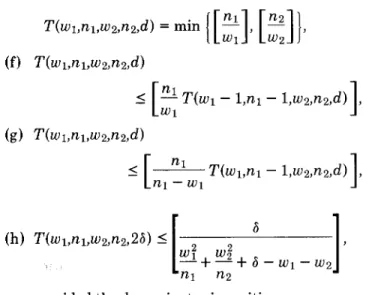
Th,nl,w,n2,4 = min ([ 21, [ $I],
Proof: Let @ be a code of length 17, distance 8, and constant weight 7. Suppose C? contains M = A(17,8,7) codewords. For u c c?, the only nonzero components of the weight distribution with respect to u are Ao(u) = 1, Am,
Alo( AI&), AM(U), and then
I nl T(wl - l,nl - l,ws,ns,d) ,
Wl
1
(g) Th,nl,w2,m,4
Ai = $ C Ai( uee We have
i = 0,8,10,12, 14.
5 ~ nl T(wl,nl - l,ws,ns,d) ,
nl - WI
1
A14(u) I A(10,8,7) = A(10,8,1) = 1, A12(u) I T(6,7,6,10,8) = T(1,7,4,10,8) = 5. These imply A12 I 5, A14 5 1 as in (14). But we can say more. For if A14(u) = 1, then A&u) I 2. Therefore, for all u t @,
09 Wwww2,2~) 5
6
W4 4
1
>
-+--+6-w1-w2
nl
n2Alz(u) + 3A14(u) < 5 and A14(u) 5 1, and so
provided the denominator is positive.
A slightly stronger result than Theorem 23(h) is the following.
A12 + 3A14 I 5 and A14 I 1. (15)
Linear programming with the constraints (12), (13), and
(15) gives the stated result. Q.E.D.
Table II gives the bounds on A(n,d,w). Upper bounds marked with an L are obtained by linear programming, as illustrated by Theorem 22. Unmarked lower and upper bounds are from Theorems 14-20. A useful technique for getting lower bounds is the following. Let ~9 be an (n,M,d) code, and I?* = a + @ = (a + u, u t c?) any translate of C?, with weight distribution Ai (0). Then
Theorem 24: Suppose T(wl,nl,wz,n2,26) = M, and de- fine qi,ri (i = 1,2) by
Mwi = qini + ri, 0 I ri < TZi. Then
2 (niqi(qi - 1) + 2qiri] 5 (~1 + ~2 - 6)M(M - l),
i=l
Ai(0) I A(n,d,i).
with equality if and only if all distances are 26.
There is also a linear programming bound for T(wl,nl,w2,n2,26), based on Theorem 25. Define the
left and right weights of a vector u = (~1, * * * ,u,,+,~) to be WL(U) = wt(ul, *a* ,Unl) and wR(u) = wt(unl+l, ---, UnJ.
This technique works well for example with the (short- ened) Nordstrom-Robinson and Golay codes. Other entries in the table are explained by the key. Letters on the left of an entry refer to lower bounds, on the right to upper bounds.
V. BOUNDS ON T(wl,nl,wz,nz,d)
Theorem 25: Let C? be an (nl + nz,M,26) code such that
WL(U) = wl, WR(u) = ws for all u 6 C?, and let
A2i,2j(U) = lb c ~2 :WL(u + u) = 2i,wR(u + u) = 2j)l, A2i,2j = $ C Azi,g(u).
u<e Then
T(wl,nl,wz,n2,d) is the maximum number of binary vectors of length nl + n2, having mutual Hamming dis- tance of at least d, where each vector has exactly w i’ones in the first nl coordinates and exactly wg ones in the last n2 coordinates. For example, we see that T(1,3,2,4,6) = 2, as illustrated by the vectors (lOOllOO), (0100011). Prop- erties of this function are given in the following theo- rems.
&a,21
= -
Aiz
jroA2i,2jQh( i,nl,wdQ~O’,m,wd 2 0,where Qk(i,n,w) is given in (11).
Theorem 23: (Johnson [34]).
(a) Th,nl,wmd = Tbwwww%
(b) Th,m,w2,nd = T(nl - wl,nw2,nd, Cc) T(O,nw2,w,d) = Ahdwd,
(4 T(wl,nl,w2m,d) 5 Ah& - ~WPJZ),
Proof: For v = 1,2, suppose (Xc”); Rt’, . . - ,RtJ) is an association scheme with intersection numbers p$, inci- dence matrices Dp), idempotents Ji(“), and eigenvalues Pk’(i), &b’(i) (cf. Delsarte [9], [lo], Sloane [54]). Then (X(l) X Xc2); Rij = R{l’ X Rj2’,0 I i I nl, 0 I j 5 n2) is an association scheme (the product scheme) with intersection numbers p$p$i, incidence matrices Dl(l) Q Dj”‘, idempo- tents Ji’) 8 Jy’, and eigenvalues Pg’(i)Pl”(j),
92 IEEE TRANSACTIONS ON INFORMATION THEORY, VOL. IT-24, NO. 1, JANUARY 1978
Johnson schemes. The result now follows from Theorem 1281 --, “Balanced incomplete block designs and related designs,”
3.3 of Delsarte [9] and Theorem 21 above. Q.E.D. Discrete Math., vol. ll,-pp. 255-369,1975.
(291 H. J. Helnert. and R. D. Stinaff. “Minimum-distance bounds for
& ,
Table III gives upper bounds on T(wl,nl,w2,m,lO). binary linear codes,” 344-356, May 1973. IEEE Trans. Inform. Theory, vol. IT-19, pp.
Entries marked with an asterisk (*) are exact. [30] S. M. Johnson, “A new upper bound for error-correcting codes,”
Note Added in Prooj? The first author has recently shown 1311
that A(9,3) = 40, A( 10,3) 5 79, A( 11,3) 5 158, A( l&3) > [32] 10 240, A(19,3) > 20 480, A(20,9) 5 54, and A(21,9) I [33] 89.
IEEE Trans. Inform. Theory, vol. IT-S, pp. 203-207, Apr. 1962.
-- “Improved asymptotic bounds for error-correcting codes,”
IEEE Trans. Inform. Theory, vol. IT-g, pp. 198-205, July 1963.
-- , unpublished tables, 1970.
-- “On upper bounds for unrestricted binary error-correcting
code;,” IEEE Trans. Inform. Theory, vol. IT-17, pp. 466-478, July
1971.
ill 121
131
141
[51
[‘31
171
W I PI W I [Ill t: ;j
[I41
[I51
1161
[I71
[341 REFERENCES
[351 W. 0. Alltop, personal communication.
M. R. Best, “The Wax bound for binary codes,” Math. Centre Report [361
ZW72, Amsterdam, 1976, (Preprint of Section III of this paper.) M. R. Best, and A. E. Brouwer, “The triply shortened binary
Hamming code is optimal,” Discrete Math., vol. 17, pp. 235-245, 1371
1977.
A. E. Brouwer, “A(17,6,4) = 20, or the nonexistence of the scarce [381
design SD(4,1;17,21),” Math. Centre Report ZW62, Amsterdam,
1975. 1391
-- “Optimal packings of Kd’s into a K,-the case n s 2 (mod
3),” Math. Centre Report ZW76, Amsterdam, 1976.
-- , “Some triplewise balanced designs,” Math. Centre Report !?!I
-- “Upper bounds for constant weight error-correcting codes,”
Disc;ete Math., vol. 3, pp. 109-124,1972.
D. Julin, “Two improved block codes,” IEEE Trans. Inform.
Theory, vol. IT-11, p. 459, July 1965.
J. G. Kalbfleisch, and R. G. Stanton, “Maximal and minimal cov-
erings of (k - I)-tuples by k-tuples,“Pacific J. Math., vol. 26, pp.
131-140, i968.. -
S. Karlin and J. L. McGregor, “The Hahn polynomials, formulas
and an application,” Scripta Math., vol. 26, pp. 3346,196l.
T. P. Kirkman, “On a problem in combinations,” Cambridge and
Dublin Math. J., vol. 2, pp. 191-204,1847.
V. I. Levenshtein, “The application of Hadamard matrices to a
problem in coding,” Problems of Cybernetics, vol. 5, pp. 166184,
1964.
Shen Lin, personal communication.
ZW77. Amsterdam. 1976. 141 l J. H. van Lint, “A new description of the Nadler code,” IEEE Trans.
A. E.’ Brouwer and A. Schrijver, “A group-divisible design
GD(4,1,2;n) exists if n q 2 (mod 6), n # 8 (or: ‘The packing of
cocktail party graphs with KJ’s),” Math. Centre Report ZW64, Amsterdam, 1976.
P. Delsarte, “Bounds for unrestricted codes, by linear program-
ming,” Philips Research Reports, vol. 27, pp. 272-289,1972.
--, “An algebraic approach to the association schemes of coding
theory,” Philips Research Reports Supplements, no. 10,1973.
~ ‘<The association schemes of coding-theory,” in Combinatorics,
M. Hall. Jr.. and J. H. van Lint, Eds. Amsterdam: Reidel. Dor- drecht, and Mathematical Cent& 1975, pp. 143-161.
__ “Properties and applications of the recurrence F(i + 1,k + 1,n
+ I)‘= qk+lF(i,k + 1,n) - qkF(i,k,n),” SIAM J. Appl. Math., vol.
31, pp. 262-270,1976.
P. Delsarte, W. Haemers, and C. Weug, unpublished tables, 1974. R. H. F. Denniston, personal communication.
J. Doyen and A. Rosa, “A bibliography and survey of Steiner sys-
tems,” Bolletino Unione Matematica Italiana, vol. 7, pp. 392419,
1973.
P. J. Eberlein, “A two parameter test matrix,” Math. Comp., vol.
18, pp. 296-298,1964.
B. El&as, “A conjecture on binary nongroup codes,” IEEE Trans.
Inform. Theorv. vol. IT-11. nn. 599-600. Oct. 1965.
P.‘Erdos, and ‘ii. Hanani, %n a limit theorem in combinatorical
analysis,” Publ. Math. Debrecen, vol. 10, pp. lo-13,1963.
[17a] W. Feller, An Introduction to Probability Theory and its Appli- 1531
cations. vol. 1.2nd Ed. New York: Wilev. 1960.
. .
1421 [431
[441
1451 [461
[18] F. A. F&ken, The Simplex Method of Linear Programming. New
York: Holt, Rinehart and Winston, 1961. (541
[19] J. M. Goethals, “The extended Nadler code is unique,” IEEE Trans.
Inform. Theory, vol. IT-23, pp. 132-135, Jan. 1977.
[20] M. J. E. Golay, “Notes on digital coding,” Proc. IRE, vol. 37, p. 657, [55]
June 1949.
1211 --, “Binary Coding,” IEEE Trans. Inform. Theory, vol. IT-4, 1561
_ _
pp. 23-28, Sept. 1954,
[22] R. K. Guy, “A problem of Zarankiewicz,” in Theory of Graphs (Proc.
Colloq., Tihany). New York: Academic, 1968, pp. 119-150. [571
Inform. Theory, vol. IT-18,-pp. 825-826, Nov. 1972.
R. J. McEliece, E. R. Rodemich, H. C. Rumsey, Jr., and L. R. Welch, unpublished tables, 1972.
-- “New upper bounds on the rate of a code via the Delsarte-
MacWilliams ineaualities.” IEEE Trans. Inform. Theory. vol.
IT-23, pp. 157-166, Mar. i977. -
N. S. Mendelsohn and S. H. Y. Hung, “On the Steiner systems
S(3,4,14) and S(4,5,15),” Notices Amer. Math. Sot., vol. 18, pp.
552-553,197l; Abstract 71T-A78 and p. 792: erratum, and Utilitas
Math., vol. 1, pp. 5-95,1972.
M. Nadler, “A 32-point n = 12, d = 5 code,” IEEE Trans. Inform.
Theory, vol. IT-8, p. 58, Jan. 1962.
A. W. Nordstrom and J. P. Robinson, “An optimum nonlinear code,”
Info. Control, vol. 11, pp. 613-616,1967. H. R. Phinney, personal communication.
M. Plotkin, “Binary codes with specified minimum distances,“ZEEE
Trans. Inform. Theory, vol. IT-6, pp. 445-450, Sept. 1960.
R. A. Rankin, “On the closest packing of spheres in n dimensions,”
Annals of Math., vol. 48, pp. 1062-1081,1947.
C. A. Rogers, Packing and Couering. Cambridge: Cambridge
University Press, 1964.
J. Schonheim, “On maximal systems of k-tuples,” Stud. Sci. Math.
Hungar., vol. 1, pp. 363-368,1966.
M. Simonnard, Linear Programming. Englewood Cliffs, NJ:
Prentice-Hall, 1966.
N. J. A. Sloane, “A survey of constructive coding theory, and a table
of binary codes of highest known rate,” Discrete Math., vol. 3, pp.
265-294,1972.
-, “An introduction to association schemes and coding theory,”
in Theory and Application of Special Functions, R. Askey, Ed. New York: Academic, 1975, pp. 225-260.
N. J. A. Sloane, S. M. Reddy, and C. L. Chen, “New binary codes,”
IEEE Trans. Inform. Theory, vol. IT-18, pp. 503-510, July 1972. N. J. A. Sloane and J. J. Seidel, “A new family of nonlinear codes
obtained from conference matrices,” Annals New York Acad. of
Sciences, vol. 175, pp. 363-365,197O.
N. J. A. Sloane and D. S. Whitehead, “A new family of single-error
[23] W. Hahn, “Uber Orthogonalpolynome, die q-Differenzen- correcting codes,” IEEE Trans. Inform. Theory, vol. IT-16, pp.
gleichungen geniigen,” Math. Nachr., vol. 2, pp. 4-34,1949. 717-719, Nov. 1970.
R. W. Hamming, “Error detecting and error correcting codes,” Bell [57a] D. M. Y. Sommerville, An Introduction to the Geometry of N Di-
Syst. Tech. J., vol. 29, pp. 147-160, Apr. 1950. mensions. New York: Dover, 1958.
H. Hanani, “On quadruple systems,” Canad. J. Math., voi. 12, pp. [58] J. Spencer, “Maximal consistent families of triples,” J. Combina-
145-157,196O. torial Theory, vol. 5, pp. l-81968.
- “The existence and construction of balanced incomplete block
designs,” Annals Math. Stat., vol. 32, pp. 361-386,196l.
[59] R. G. Stanton, J. G. Kalbfleisch, and R. C. Mullin, “Covering and
packing designs,” in Proc. 2nd Chapel Hill Conf. Combinatorial
1241 1251 WI
1271 --. “A balanced incomnlete block desien.” ibid.. vol. 36. D. 711. Mathematics and its Applications, R. C. Bose et al., Eds., Chapel
1965:
I
IEEE TRANSACTIONS ON INFORMATION THEORY, VOL. IT-24, NO. 1, JANUARY 1978 93 [SO] R. F. Stevens and W. G. Bouricius, “The heuristic generation of large
error-correcting codes,” unpublished memorandum, IBM Research [60a]
Center, Yorktown Heights, Aug. 1,1959.
D. Stinson, “Determination of a Packing Number,” preprint.
[61] J. C. Swift, “Quasi-Steiner systems,” Atti Acad. Naz. Lincei Rend.
CZ. Sci. Fis. Mat. Nutur. (a), vol. 44, pp. 40-44,1968.
[62] W. G. Valiant, “A(14,6,7) < 52 or the nonexistence of a certain constant weight code,” Math. Centre Report ZW71, Amsterdam, 1976.
[63] N. Wax, “On upper bounds for error detecting and error-correcting
codes of t-mite length,“IEEE Trans. Inform. Theory, vol. IT-5, pp.
168174,1959.
[64] R. M. Wilson, “The construction of group-divisible designs and partial planes having the maximum number of lines of a given size.” in Proc. 2nd Chapel Hill Conf. Combinatorial Mathematics and its Applications, R. C. Bose et al., Eds., Chapel Hill, NC, 1970, pp. 488-497.
[65] --, “An existence theory for pairwise balanced designs, I,” J.
Combinatorial Theory vol. 13A, pp. 220-2451972; “II,” ibid., vol.
13A, pp. 246-273,1972; “III,” ibid., vol. 18A, pp. 71-79,1975.
[66] E. Witt, “Uber Steinersche Systeme,” Abh. Math. Sem. Unio.
Hamburg, vol. 12, pp. 265-275,1938.
Some Results on Arithmetic Codes of Composite Length
TAI-YANG HWANG AND CARLOS R. I’. HARTMANN, MEMBER, IEEE
Abstract-A new upper bound on the minimum distance of hi-
nary cyclic arithmetic codes of composite length is derived. New
classes of binary cyclic arithmetic codes of composite length are
introduced. The error correction capability of these codes is dis- cussed, and in some cases the actual minimum distance is found.
Decoding algorithms based on majority-logic decision are proposed
for these codes.
I. INTRODUCTION
A
RITHMETIC CODES, first proposed by Diamond [l], are useful for error control in digital computation as well as in data transmission. They are particularly suitable for checking or correcting errors in arithmetic processors. Finding the minimum distance d of an arith- metic code is a major problem. Despite many similarities between cyclic arithmetic and cyclic block codes, no gen- eral lower bound analogous to the BCH bound for cyclic codes has been found for arithmetic codes. Thus in general, the determination of d still relies on a computer search. The search for a systematic way of constructing arithmetic codes is another major area of research. Three known classes of arithmetic codes are the high-rate perfect sin- gle-error correcting codes [2]-[4], the large-distance low- rate Mandelbaum-Barrows codes [5], [6], and the inter- mediate-rate intermediate-distance codes [7]. One of the interesting features of the codes introduced in [7] is that they can be decoded using majority-logic decisions.In this paper, we present a new upper bound on d for binary cyclic arithmetic codes of composite length. This bound is quite tight and gives a rather good estimation of the actual minimum distance. We also construct new classes of binary cyclic arithmetic codes. Many of these codes have intermediate rate and intermediate distance, and they can be decoded by majority-logic decisions.
Manuscript received November 3, 1976; revised April 25,1977. This work was supported by the National Science Foundation, under Grant ENG75-07709.
The authors are with School of Computer and Information Science, Syracuse University, Syracuse, NY 13210.
In Section II, we present the new upper bound on d. In Section III, we construct new classes of binary cyclic arithmetic codes. The decoding algorithms for these codes are given in Section IV. A discussion of the results is con- tained in Section V. Numerical examples are given in Appendix A. The conditions for the existence of codes in the classes constructed in Section III are given in Appendix B.
II. BOUND ON THE MINIMUM DISTANCE OF BINARY
CYCLIC ARITHMETIC CODES OF COMPOSITE LENGTH
A binary cyclic arithmetic code (or “AN code”) of length n is of the set of integers of the form AN, where A is a fixed integer, called the generator of the code, and N = O,l, . - - ,B - 1. The integer B is chosen so that AB = 2” - 1, where n is the multiplicative order of 2 modulo A. For a general background on binary cyclic AN code as well as for the definitions of arithmetic distance and arithmetic weight, the readers are referred to [8]-[lo].
The following theorem, which is a generalization of [ll, Theorem l], gives an upper bound on d.
Theorem 1: Let A generate a binary arithmetic code of
composite length n = nili, 1 < 11 < R. If B is divisible by either 2nl + 1 or by 2”1 - 1, then d 5 1i.
Proof: Let B = B1(2~l+ 1). By [12, Lemma 6.31, Ii is even. Thus
2” - 1
A&=---= 2(11-l)n1 - 2(11-2)n1 + - . . . + 2n1 - 1
2”1+ 1
is a codeword of arithmetic weight 11, W(AB1) = 11. Simi- larly, one can show that d I II when B = B~(2~l - 1).
Q.E.D. The following example will illustrate the application of Theorem 1.
Example 1: Let AB = 220 - 1 with A = 5.31.41. Thus, B = 3.5 * 11 and n = 20. We note that GCD(A,22 - 1) = 001%9448/78/0100-0093$00.75 0 1978 IEEE