management users may
expect
Karl M. Wiig
Explicit and systematic knowledge manage-ment (KM) methods are now recognized as important approaches to improve enterprise performance, either through knowledgeable people delivering work more effectively, or through other ways of leveraging intellectual capital (IC). Significant advances have been made during the last decade and we can expect further changes ± in entirely new directions or as refinements of present meth-ods. KM in part deals with human
understanding and mental models and how these are used in work. Consequently, it is exceedingly complex and we may see ad-vances for a long time to come ± for many centuries. However, we often may not as-sociate these changes with KM. Many will integrate systematic KM into daily work and no longer consider it to be ``knowledge management''.
We could focus on how KM methods and the KM market can be expected to develop. Instead, let us explore how future KM may affect organizations, people, and society where the real value of KM is realized. From that perspective, we are particularly interested in what explicit and systematic KM may come to mean from the perspectives of KM users and adopters.
In this article we focus on KM from the perspective of how it is conducted within the enterprise, but other views exist. One such view is that commercial KM also incorporates the marketplace of KM-related software, information and content services, professional information technology and KM-related ser-vices, and business process management. All of this may add up to sales of $13 billion in 1999 and approach $60 billion in 2003, if we are to believe recent forecast reports by Lazard FreÁres and others.
The business environment is under
pressure
Already, we see increased requirements for better knowledge in the workplace to deliver competitive knowledge-intensive work. De-mands have increased for customized and more sophisticated products and services. Globalization pressures have changed busi-ness ± and correspondingly work ± world-wide. Nations which earlier supplied manual The author
Karl M. Wiigis Chairman of Knowledge Research Institute, Inc, Arlington, Texas, USA. [email protected]
Keywords
Intellectual capital, Knowledge management, Organizational learning, Teamwork
Abstract
Globalization has placed businesses everywhere in new and different competitive situations where knowledge-able, effective behavior has come to provide the competitive edge. Enterprises have turned to explicit and systematic knowledge management (KM) to develop the intellectual capital needed to succeed. Further develop-ments are expected to provide considerable benefits resulting from changes in the workplace and in management and operational practices. Changes will partly come from information technology and artificial intelligence developments. However, more important changes are expected in people-centric practices to build, apply, and deploy knowledge and understanding for support of innovative and effective knowledge-intensive work. Much remains to be done. Next generation KM methods will still be crude. Our understanding of knowledge and how people use it to work has a long way to go. We need a "theory of knowledge" and perhaps a new theory of the firm to create a solid foundation for future KM. Still, users can expect significant benefits from KM as it develops over the next decades.
Journal of Knowledge Management Volume 3 . Number 2 . 1999 . pp. 155±165 #MCB University Press . ISSN 1367-3270
labor have started to compete with Europe, Japan, and North America by offering com-petent intellectually-based work. Thanks to the Internet, we find that knowledge workers everywhere can access the latest information on advanced concepts and methodologies, business issues, and technology. Granted, access is still far from uniform and most people in Africa, Asia, and South America may have to wait a long time. Even so, to maintain their viability, institutions and na-tions that have been accustomed to be intellectual leaders will need to build and apply intellectual capital much better ± they increasingly must manage knowledge sys-tematically. Expectations are that we will see further changes with considerable impacts.
Other developments also are causing changes in business and work. Among these, we find new cognitive science understandings of how people make decisions and work with their minds (Klein, 1998; Cannon-Bowers and Salas, 1999; Wiig and Wiig, 1999); advances in, and experiences with, new management and operational practices; im-provements in information technology (IT); and the creation of powerful and practical artificial intelligence (AI) techniques. We are learning what motivates individuals and how to integrate individual goals with those of the enterprise. We are discovering the value of new ways to organize work and interpersonal networking to maximize opportunities for people to deliver their best. In addition, we obtain practical experiences with how to manage knowledge in different KM are-nas[1].
With all these forces pressuring business, we have learned to prepare our workforce better, automate many routine functions, and organize work in ways that allow us to deliver higher quality products and services more effectively. We observe that the nature of work is changing. There is a shift towards more complex work as shown in Figure 1 with identifiable targets for intelligent automation in routine areas and potentials for application of greater understanding and expertise in more demanding work.
We will always wish that all work tasks should be handled competently and with outcomes that fulfill quality requirements. This requires that organization and system-atization of work and individuals apply all required resources effectively. Hence, among proactive enterprises, there are increased
efforts to make individuals and therefore, the enterprise itself, act as effectively as possible. Management teams are unwilling and un-able to devote attention and allocate resources to directions unless they promise to deliver clear and important benefits. Hence, they now ± and will continue to ± ask specific questions such as: ``Will active KM allow us to deliver a more competitive service para-digm?'' ± ``Will active KM make it possible to create more competitive products?'' ± ``Will active KM improve the effectiveness of work and thereby reduce operating costs, allow us to be more responsive, improve our market image, and otherwise become more success-ful?''
Enterprise success rests upon effective
and knowledgeable behavior
Effective behavior is vital. Sustained success and viability require effective execution of internal functions and interactions with en-vironment ± i.e. effective behavior. When individuals act effectively within an effective framework, the enterprise can act effectively ± operationally, tactically, strategically, and in support of markets. In practice, effective behavior means for both people and the organization's response to adjust actions to the context by improvising around given strategy, tactics, and policies. It also means to act creatively and responsibly in everybody's interest to achieve the best results possible. Often that requires collaboration ± in a collegial culture bypassing politics and bu-reaucracy. A major operational objective is to make the customer successful by customizing products and services to satisfy individual needs while at the same time implementing the enterprise goals.
The success of an enterprise depends on the interplay of many factors. Some are beyond influence or control by the enterprise while others are associated with the strategic moves that the leaders pursue. Still others ± and these we consider here ± are associated with how the enterprise arranges its internal affairs. Among these factors we find:
. The ability to deliver desired service paradigms by individuals, departments and business units, and by the overall enterprise[2].
. The capability of employees to deliver the workproducts for which they are respon-sible.
. The effectiveness of interpersonal work (teaming and networking) through coor-dination, cooperation, and collaboration. . How well work at all levels supports
implementation of enterprise strategy and direction.
. The ability to create, produce, and deliver superior products and services that match present and future market demands. . The effectiveness of outcome feedback on
how well workproducts perform ± in the marketplace as well as within the enter-prise.
. The degree to which innovations occur, are captured, communicated, and applied.
. The ability of individuals, teams, units, and the enterprise itself to deal with unexpected events, opportunities, and threats.
. The effectiveness of enterprise systems, procedures, and policies.
. The degree to which undesirable and dysfunctional personal or systems behaviors are controlled and corrected. All of these factors depend to significant degrees on effective availability and applica-tion of good knowledge. Consequently, broad and systematic management of knowledge and intellectual assets becomes a key support
activity to ensure enterprise success and viability.
Enterprises pursue different KM strategies aligned to their business strategies. Hansenet al.(1999) report two separate approaches which they call codification strategy and personalization strategy. These strategies fo-cus on automation and application of IT and on the learning organization respectively. Others discuss a third strategy ± strategic management of intellectual capital to build, manage, and exploit ``structural'', including knowledge-related, assets (Amidon, 1997; Edvinsson and Malone, 1997; Klein, 1998; Stewart, 1997; Sveiby, 1997). A fourth focus is also pursued ± the enterprise effectiveness strategy where the emphasis is on applying all and any available knowledge and intellectual assets in the best interests of the enterprise. These isolated, but complementary, strategies suggest that they are in fact separate tactical approaches within a comprehensive KM strategy as indicated in Figure 2. As organi-zations develop their KM practice further, we expect that during the next decade most enterprises will pursue all four thrusts as part of their overall KM strategy.
To be competitive over the next decade, proactive enterprises will increasingly manage knowledge systematically ± although many KM activities and functions may be implicit in each employee's and department's daily work and practice. As now, the enterprises
will continue to be motivated by several end-goals, the main ones being securing
short-term success and long-term viability. A particular KM objective in support of which-ever strategy the enterprise pursues, is to leverage the best available knowledge and other ICs to make people, and therefore the enterprise itself, act as effectively as possible to deal with operational, customer, supplier, and all other challenges to implement the enterprise strategy.
Expected knowledge management
developments
KM promotes development and application of tacit, explicit, and embedded intellectual capital; that is, leveraging understanding, action capabilities, and other intellectual assets to attain the enterprise's ultimate goals, e.g. to ascertain profitability, ensure long-term viability, or deliver quality services. This perspective of KM suggests a number of developments in coming years. They include: . A developing area of increasing insight is the role that understanding ± or meaning-connected knowledge ± and abstract mental models play in intellectual work. The 1990s notion that ``knowledge is actionable information'' and similar early perspectives will be displaced. Insights from emerging cognitive research and business experiences with the importance of deep knowledge will make it plain what, and how, people need to under-stand how to handle complex challenges competently.
. Future KM practices and methods will be systematic, explicit, and relatively
depen-dent upon advanced technology in several areas. However, overall, we expect KM to become more people-centric as the re-cognition spreads that it is networking of competent and collaborating people that forms the basis for the behavior and success of any organization. See Terry Winograd (1988), Cannon-Bowers (199) and Wellman (1999) for discussion. . By building on extensive experiences
from many organizations, the manner in which effective and active KM is orga-nized, supported, and facilitated will change. The more obvious changes will be associated with placement and orga-nization of the KM effort itself, be it with a high-level Chief Knowledge Officer (CKO) or with distributed effort. Changes that deal with reorganization of work and the abolishing of whole de-partments that are integrated into other operations, will be less apparent but prevalent.
. Management and operating practices will change to facilitate KM in many ways. Incentives will be introduced and disin-centives eliminated to promote
innovation, effective knowledge exchange (``sharing''), learning, and application of best knowledge in all work situations. Cultural drivers such as management emphasis and personal behaviors will be changed to create environments of trust and concerns for finding root causes of problems without assigning blame. . There will be efforts to embed KM
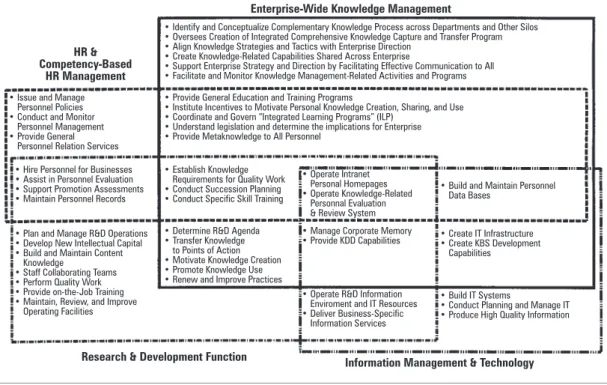
perspectives and considerations in regular activities throughout the enterprise. An example of how broadly KM may affect an organization is indicated in Figure 3. It highlights some sole and shared respon-sibility KM-related activities within research and development (R&D), hu-man resources (HR), information management and technology (IM & IT), and a KM supervisory function.
. New practices will focus on desired combinations of understanding, knowl-edge, skills, and attitudes (``KSAs'') when assembling work teams or analyzing requirements for performing work (Can-non-Bowers and Salar, 1998). The emphasis on complementary work teams will coincide with the movement towards virtual organizations where many partici-pants in in-house team work will be
Figure 2The four tactical perspectives of comprehensive knowledge management strategy
external workers who are brought in for limited periods to complement in-house competencies for specific tasks. The present use of consultants from large consulting houses is one manifestation but is expected to increasingly involve self employed external knowledge workers. . Most organizations will create effective approaches to transfer personal knowl-edge to structural intellectual capital (SIC). Increased transfer will allow better utilization and leveraging of the SICs. It will also have a positive side effect for external subject matter experts who may be able to provide, i.e. sell their expertise to many enterprises for continued use. We have already seen this in isolated instances, for example, with refinery operations experts.
. Comprehensive approaches to create and conduct broad KM practices will become the norm. For example, designing and implementing comprehensive multi-mode knowledge transfer programs will be common (Wiig, 1995). Such programs take systematic approaches to integrate all primary knowledge-related functions in-cluding: major internal and external knowledge sources; major knowledge transformation functions and repositories such as capture and codification func-tions and computer-based knowledge bases; major knowledge deployment
functions such as training and educa-tional programs, expert networks, knowledge-based systems (KBSs), etc., and the different knowledge application or value-realization functions where work is performed or knowledge assets are sold, leased, or licensed.
. Education and knowledge support cap-abilities such as expert networks or performance support systems (PSSs) will be matched to cognitive and learning styles and to dominant intelligences. That will facilitate workers, particularly full-time employees in all areas to perform more effectively. In addition, new, powerful, and highly effective approaches to elicitation and transfer of deep knowl-edge will be introduced. Such capabilities allow experts to communicate under-standings and concepts and facilitate building corresponding concepts, asso-ciations, and mental models by other practitioners (Wiig and Wiig, 1999). . One area of considerable value will be the
development of comprehensive and inte-grated processes for knowledge
development, capture, transformation, transfer, and application.
. KM will be supported by many artificial intelligence (AI) developments. Some of these are intelligent agents; natural lan-guage understanding and processing (NLU and NLP); reasoning strategies;
and knowledge representations and ontologies that will continue to develop and, by providing greater capabilities, will be relied on to organize knowledge and to facilitate knowledge application to im-portant situations (see Chandrasekaranet al.,1999).
. Information technology will continue to progress and will bring considerable change to many KM areas. They will include ``portable offices'' that roam any-where with their owners; communication handling systems that organize, abstract, prioritize, make sense of, and in many instances, answer incoming communica-tions; intelligent agents that not only will acquire desired and relevant information and knowledge, but will reason with it relative to the situation at hand.
To create broad and integrated capabilities, most of the changes that are introduced by these developments will not be stand-alone, but will be combined with other changes, many of which have focuses different from KM.
Enterprise benefits we can expect from
knowledge management
There are high expectations for strategic, tactical, and operational improvements when pursuing KM actively. Practical experiences with systematic and explicit KM reported by advanced and early adopter organizations indicate that benefits can be substantial. Most direct benefits tend to be operational while tactical and strategic benefits often are indir-ect and take longer to realize. Nevertheless, strategic advantages tend to move enterprises to pursue KM actively. It is interesting to note an increasing trend to pursue strategically oriented revenue enhancement instead of the early search for ``low-hanging fruits'' of operational improvements. During the com-ing years enterprise management teams will expect to obtain specific benefits resulting from KM advances, some of which are in early stages of use. Illustrative examples include the following.
Examples of strategic benefit expectations
(1) The enterprise will build an increasing competence to provide improved
enterprise service paradigms and ability to produce and deliver products and services with higher knowledge content than pre-viously possible. This may be achieved by: . having knowledge workers who
pos-sess and have access to better applicable knowledge;
. organizing work to facilitate applica-tion of best knowledge;
and can be expected to lead to greater market penetration and competitiveness. (2) The organization will develop a
broad-ening capability to create and deliver new products and services and a greater capacity to deliver products and services to new markets.
Examples of tactical benefit expectations
(1) The enterprise should experience faster organizational and personal learning by better capture, retention, and use of innovations, new knowledge, and knowl-edge from others and from external sources achieved by:
. more effective knowledge transfer methods between knowledge workers;
. more effective discovery of knowl-edge through KDD and other systematic methods;
. easier access to intellectual capital assets;
. more effective approaches to ascend Nonaka's knowledge spiral by trans-forming tacit personal knowledge into shared knowledge (Nonaka and Takeuchi, 1995);
and can be expected to lead to availability of more highly competitive knowledge. (2) There should be less loss of knowledge through attrition or personnel reassign-ments achieved by:
. effective capture of routine and op-erational knowledge from departing personnel;
. assembly of harvested knowledge in corporate memories that are easy to access and navigate; and can be expected to lead to greater ability to build on prior expertise and deep understanding.
(3) More knowledge workers will have effec-tive possession of, and access to, relevant expertise in the forms of operational knowledge, scripts, and schemata.
(4) Employees will obtain greater under-standing among of how their personal goals coincide with the enterprise's goals.
Examples of operational benefit expectations
(1) Employees will have access to, and be able to apply, better knowledge at points-of-action achieved by, for example: . educating employees in the principles
of their work (scripts, schemata, and abstract mental models);
. providing knowledge workers with aids to complement their own knowledge;
. training knowledge workers to oper-ationalize abstract knowledge to match requirements of the practical situations they deal with.
These changes can be expected to lead to lower operating costs caused by fewer mistakes, faster work, less need for hand-offs, ability to compensate for unexpected variations in the work-task, improved innovation - just to name a few of the operational benefits that often are re-ported.
(2) Operational areas will experience less rework and fewer operational errors. (3) The enterprise will achieve greater reuse
of knowledge.
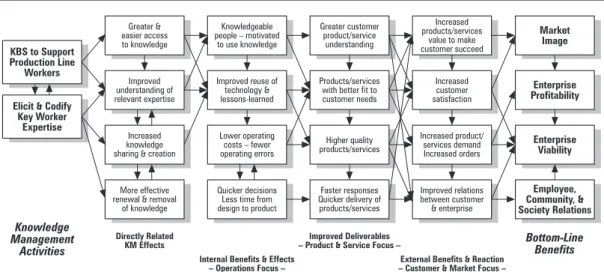
As a further illustration of how the enterprise may be affected by KM changes, we may consider the dynamic progression of effects from the initial KM activity until it has been translated into bottom-line benefits. Figure 4 shows the effects and benefits that can be
expected from creating and deploying knowledge based systems (KBSs) to support production workers in a plant that manufac-tures high technology products.
Realization of most of the examples indi-cated above will require noticeable changes within the enterprise. These developments will influence the culture which may change to promote greater initiatives and greater job satisfaction among employees. With increas-ing virtual organization operations, it will also tend to change the roles of permanent employees when outside expertise is imported with temporary employees.
The changing workplace
Not only do we expect the enterprise to change, but advances in KM practices will also change the workplace ± in many places drastically. Visible changes will be evident by increased application of, and reliance on, technology compared to the KM information focus of the 1980s and 1990s. However, less visible changes will be more important since they will tend to improve the way people work with their minds. The changes that people will experience in the workplace include: . Greater emphasis on performing work
using interdisciplinary teams with focus on ascertaining that the best mix of competencies and understanding will be applied to the work at hand. An example of the proficiency profile of such a team is indicated in Figure 5.
Figure 4Example of how knowledge management activities progress through internal and external event chains to deliver bottom-line benefits
. A major change is expected in the work-place resulting from the increasingly common temporary nature of many em-ployment situations. As greater emphasis is placed on assembling short-lived teams with requisite knowledge profiles to ad-dress specific tasks, this will lead people to have reduced allegiances to the tem-porary employer and increased efforts to improve their expertise to maintain and enhance personal competitiveness. . Good understanding of the need to rely
upon strong associations and conceptual knowledge to guide the direction of work. . Better understanding by knowledge
workers of how to influence implemen-tation of enterprise strategy by each small decision or act that is part of their daily work.
. Greater degree of collaboration and will-ingness to coordinate and cooperate with associates and other activities.
. Increased personal understanding by employees of how they personally benefit from delivering effective work.
. Greater job security and less hesitation and procrastination to undertake complex tasks after they build increased meta-knowledge and professional or craft knowledge about the work for which they are responsible.
. Increased reliance on automated intelli-gent reasoning to support work. As an example, when confronted with a com-plex situation, automation may assist knowledge workers by identifying and making available relevant support infor-mation and knowledge, making
preliminary sense of the situation, and locating and presenting suggestions for how to handle it.
. Intelligent agents deployed internally and externally will offload ``data detective work'' now required to locate and evalu-ate information required in many knowledge worker situations ranging from plant operators toad hocstrategic task forces.
. New organization of the physical work environment will change the way people work together and allow greater richness of interaction. The new work environ-ments will be designed to foster
knowledge transfer and exchange through networking and collaboration and facil-itate serendipity innovations.
In the aggregate, it can be expected that KM will lead to less effort to deliver present day service paradigms. However, as was indicated in Figure 1, work will change to satisfy the ever-increasing requirements for new features
and increased capabilities of products and services. Hence, personal job-related under-standing will be increased through better script and schema knowledge and work will expand to take advantage of the new cap-abilities. Even so, knowledge workers will feel more confident and have better understand-ing of jobs to be done. In addition, better knowledge support will allow more jobs to be done right the first time, adding to confidence and job satisfaction.
The knowledge market place and the
knowledge business
New approaches to trading knowledge in various forms have already emerged as a viable business for many parties. We see interesting examples. Lotus, the English car maker, reportedly receives greater revenues from advising other car makers on building engines than it receives from selling its own products. Individuals are able to advertise and sell marketable knowledge products world-wide over the Internet to recipients, either directly or through knowledge exchanges[3].
``Packaged knowledge'' has traditionally been passive and provided in the form of books or similar media that must be ``read'' by recipients. The market place will increasingly provide active forms of packaged knowledge that ± for example through reasoning ± will address frequently encountered problems of importance to business and the general public. Much of this knowledge will use powerful, perhaps semi-standardized repre-sentations and ontologies and apply reasoning capabilities that increasingly will be natural language-based. We already see emerging sources of prepackaged knowledge of this kind[4]. In the distant future, natural lan-guage processing supported by powerful information technology may be so advanced that knowledge can be communicated in free-form language. All these developments will allow users to incorporate knowledge quickly and reliably into their deliberations ± as long as these are explicit. For tacit evaluations and decisions ± which most are ± the obtained knowledge must be internalized in advance of being required. When the situation arises, it must already be resident in the person's mind in the form of tacit associations and mental models. In other words, knowledge workers
must have learned and internalized the requisite knowledge.
Electronic advisory or consulting services are already emerging. Knowledge-based sys-tems can be bought in areas ranging from tax advice for individuals to water treatment for thermal power plants. As the marketplace becomes more organized, and as we create capabilities or functions to validate such knowledge, we can expect that single indivi-duals with all kinds of expertise will capture and represent parts of it and present it for sale in the marketplace.
Individuals, as free agents to virtual cor-porations, will be able to trade their knowledge in ways which we now only can glimpse. Now, we normally see free agents as consultants that are asked to assist clients with particular problems. A likely next step is for experts, for a fee, to let clients harvest part of their knowledge to incorporate it into struc-tural IC.
A social phenomenon: the ying yang
battleground between influencers and
consumers
Within society, we will see numerous effects of systematic and deliberate management of knowledge. Most will have positive societal value as elaborate knowledge discovery pro-cesses provide powerful insights into preferences and behaviors of the general public by institutions that aim to serve public needs and demands. To make this knowledge more valuable for use, particularly when communicated to end-users whose behavior it is expected to alter, by combining it with advanced speech-act theory and other tech-niques, will allow the message to be communicated more effectively ± although not always honestly.
The effects of better KM will not always be positive and desirable. Consumer companies, political parties, and others, wish to gain greater understanding of how to influence their customers through advertising, sales tactics ± and some even through misinforma-tion and propaganda.
On the other hand, we also see an emerging availability of reliable expertise ± knowledge, insights, information, and explanations ± for direct access by consumers to give them understanding and insights to counter undue influences. This trend is expected to be
important to allow the average person to defend him/herself against the avalanche of ``influence information''. Consequently, we can expect to see a broad, world-wide, ``ying-yang battleground'' of subjective influencing countered by objective and vetted knowledge - where both sides draw upon extensive KM expertise to sharpen their weapons.
What might all this mean?
Much still needs to be done. Just to name a few areas: We really do not understand much yet about knowledge. Our understanding of the cognitive aspects of human functioning (as related to work) is marginal. There is not an accepted economic ``theory of knowledge''. We do not have a general understanding of how to undertake comprehensive and sys-tematic knowledge management within an organization. We may need an entirely new theory of the firm for us to manage knowledge effectively ± and to tie it properly to enterprise strategizing, tactics, and daily operations while recognizing that people and their behaviors contribute much more to the enterprise success than conventional assets. . It is already clear to advanced manage-ment teams that they need to manage knowledge-related activities systemati-cally and explicitly. They have numerous options and we see many different ap-proaches to applied KM. As the world gains further experience, we expect to see strong patterns of what works well and what may be questionable or only apply in specialized situations.
. A new competitive battleground is emer-ging ± where knowledge and ICs is the ammunition. We can foresee difficulties for ``old guard'' management teams who rely on tangible and visible aspects of work and on conventional wisdom. There will be greater differences between those that act proactively and those who follow. . New advances in KM, and adoption of
broad KM practices, will bring about great possibilities for creating new eco-nomically important products and services.
. From a KM perspective, we need to develop and capture more successful working methods and approaches ± in-cluding computer-based tools.
We hope that KM will become a great equalizer between the haves and have-nots, both within different nations and between nations. Clearly, the knowledge possessed by a person is a separator ± ``knowledge is power'' ± and good education provides a considerable edge. However, when working in the developing world, we have often found that people's mental machinery ± their in-telligence and attitude ± is a greater resource than what they know and understand. Given that, and the increasing levels of education in many developing nations, we have the po-tential that people everywhere can participate in the knowledge economy on more equal terms than before.
One key learning area is that we need to adopt greater people-centric perspectives of knowledge. To be viable, we need constant learning ± led by constant innovation. Tech-nology only goes so far ± it can only provide us with rudimentary reasoning devoid of inno-vation and with rather concrete analyses of the past through approaches such as knowl-edge discovery in databases. People are the real intelligent agents, those that see and act on new opportunities that really are creations of the mind. It is those opportunities that will bring the world forward.
In spite of all present limitations, KM is already very useful ± even when it is narrow in scope. The saving grace is that the playing field is quite level. For the next decade, most everyone is a beginner!
Notes
1 Typical ``KM arenas'' are KM activities associated with: ascertaining that effective quality work is delivered; augmenting people and (automated) work: educating employees; capturing, transform-ing, archiving knowledge; motivattransform-ing, facilitattransform-ing, permitting employees; creating cultural conditions; providing IT-based infrastructure; providing knowl-edge sharing; coordinating KM efforts;
conceptualizing, monitoring, guiding, and governing KM practices and results; and Managing capital components.
2 Service paradigms describe what the enterprise, and individual units and people within it, ideally should be able to do for external and internal customers and how units and people should appear to customers through their behavior.
3 Several knowledge trading operations are emer-ging. On the Internet they include:
Bright Online http:www.bright-future.com Giga Information Group http://www.gigaweb.com and
The Knowledge Exchange http://wwwknowledge-exchange.com
4 LearnerFirst, Inc. http://.www.learnerfirst.com is one organization that offers well-organized prepack-aged knowledge for application by end-users in several areas.
References
Amidon, D.M. (1997),Innovation Strategy for the Knowledge Economy, Butterworth-Heinemann, Boston, MA.
Edvinsson, L. and Malone, M.S. (1997),Intellectual Capital: Realizing Your Company's True Value by Finding its Hidden Brainpower, Harper Business. Cannon-Bowers, J.A. and Salas, E. (1998), ``Team
performance and training in complex environments: recent findings from applied research'',Current Directions in Psychological Research, March 1999, pp. 83-7.
Chandrasekaran, B., Josephson, J.R. and Benjamins, V.R. (1999), ``What are ontologies, and why do we need them?'',IEEE Intelligent Systems, Vol. 14 No. 1, pp. 20-6.
Hansen, M.T., Nohria, N. and Tierney, T. (1999), ``What's your strategy for managing knowledge?'',Harvard Business Review, Vol. 77 No. 2, March-April, pp. 106-18.
Klein, D.A. (1998),The Strategic Management of Intellectual Capital, Butterworth-Heinemann, Boston, MA.
Klein, G. (1998),Sources of Power: How People Make Decisions, MIT Press, Cambridge, MA.
Nonaka, I. and Takeuchi, H. (1995),The Knowledge-Creating Company: How Japanese Companies Create the Dynamics of Innovation, Oxford Uni-versity Press, New York, NY.
Stewart, T.A. (1997),Intellectual Capital: The New Wealth of Organizations, Currency Doubleday, New York, NY.
Sveiby, K.E. (1997),The New Organizational Wealth: Managing and Measuring Knowledge-Based Assets, Berrett-Koehler, San Francisco, CA.
Wellman, B. (1999), ``Living networked in a wired world'', IEEE Intelligent Systems, Vol. 14 No. 1, pp. 15-17. Wiig, E.H. and Wiig, K.M. (1999),On Conceptual Learning,
KRII-WP-1999-1, Knowledge Research Institute, Inc., Arlington, TX.
Wiig, Karl M. (1993),Knowledge Management Founda-tions: Thinking About Thinking ± How People and Organizations Create, Represent, and Use Knowl-edge, Schema Press, Arlington, TX.
Wiig, K.M. (1995),Knowledge Management Methods: Practical Approaches to Managing Knowledge, Schema Press, Arlington, TX.
Winograd, T. (1988),Byte, 13, 11 December, p. 256.
Further reading
Wiig, E.H. and Wilson, C.C. (1997),Visual Tools for Developing Language and Communication: Content, Use, and Interaction, Schema Press, Arlington, TX.