Automatic Traffic Lights Control Using ARM7 Based On CO
2Emissions
S.L.Siva Jyothi
#1, K.Rajasekhar
#2, P.Harika
#3, M.S.Madhan Mohan rao
#4 ECE Department, BVC Engineering College, Odalarevu1[email protected] 2[email protected] 3[email protected]
Abstract—
Monitoring and controlling of city traffic is becoming a difficult task in most of the city. With the ever increasing number of vehicles on the road, the Traffic Monitoring Authority has to find new methods of overcoming such a problem. Present Traffic Light Controllers (TLCs) is based on microcontroller and microprocessor which have limitations because it uses the pre-defined hardware, which is functioning according to the program that does not have the flexibility of modification on real time basis Due to the fixed time intervals of green, orange and red signals the waiting time is more and vehicle uses more fuel. This proposed project makes use of Networks along with Embedded Technology. This paper aims to design a safe and efficient traffic flow by reducing the effect of CO2emitted from vehicles at
that region and assign the right way which minimizes the delay or waiting time at road.
The CO2 level emitted from vehicles in all
directions will be transmitted through CO2sensor
we used in our system which is to sense the Carbon di-oxide emissions from the vehicles. The receiver at the TLC will receive the information. The information from all directions is transmitted and received through the Zigbee wireless communication. Based on CO2levels, the traffic
light indication will be given in the appropriate directions. The status will be shown in LCD and SMS alert will be sent to the Traffic Control Room using Global System for Mobile Communications (GSM).
Keywords— Intelligent Transportation Systems (ITS), Traffic Light Controller (TLC), CO2, Zigbee, Global System for Mobile
Communications (GSM).
I INTRODUCTION
In the fast emerging world, vehicles become mandatory for all purposes. Increased car use and road goods movements have highlighted not only the problem of congestion as a threat to economic growth but also as a substantial contributor to global warming[4].
The vehicle emissions [2] pollute the atmosphere thereby leading to many hazardous effects. Traffic consumes energy, and generates noise and harmful emissions. The quality of the air we breathe is diminished mainly by traffic emissions, because the exhaust emissions are released at a low level. Carbon dioxide emissions from traffic are a worldwide problem. Vehicular traffic is the main source of disturbing environmental noise. With the increase in the amount of traffic the noise carries increasingly greater distances.
The Intergovernmental Panel on Climate Change (IPCC) is correct about man-made CO2 causing temperature increases with melting of ice caps and sea level rises. IPCC claims they are now 95% certain global warming is being caused by increasing CO2from human activity. It was set up in 1988 by a small group of scientists who were already convinced that rising CO2 levels were the prime factor in global temperature rise.
concentrations of greenhouse gas in the atmosphere may increase from 425 parts per million volume (ppmv) CO2-equivalent today to 935 ppmv CO2 -equivalent in 2100. This could cause global temperature to rise by more than 3°C by 2100.So it becomes essential need to develop a system which reduces the emission of CO2 from vehicles. This project involves a real time traffic lights control scheme for reducing vehicular CO2emissions[3]. Real time CO2 emission values are obtained by wireless communication. Usually, vehicles follow stop-and-go[6] driving scheme. This will consume more fuel
and emit moreCO2than constant speed driving.After smoothing vehicles' travels, more vehicles can pass intersections with less waiting time and fewer short-time stops. This results in drastic reduction of vehicular emissions. The average waiting time, and the effect of vehicular emissions on the environment & public on road is greatly reduced by this project This project consists of two ARM7TDMI based LPC2148 microcontrollers, ZIGBEE Transmitter and Receiver, Power Supply Relay Circuits, CO2sensors, Buzzers, GSM & Traffic Lights.
In this system we are going to interface CO2 sensors, driver circuits with relays and ZIGBEE transmitter and a buzzer with the Microcontroller at the Transmitter Section attached at the road divider. The Zigbee transmitter transmits the CO2levels. And in the Receiver section at the Traffic Lights we are going to interface GSM, Buzzer, Zigbee. Receiver section controls the traffic lights by what it receives from the Zigbee signal. Traffic Lights were to release the signal & GSM modem, to send the SMS alerts and to change the time interval of traffic lights in normal conditions
II PROPOSED SYSTEM DESIGN AND COMPONENTS
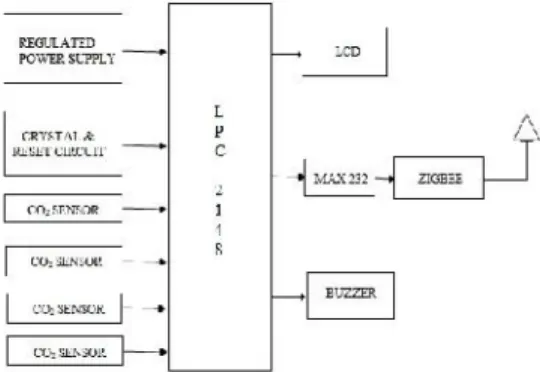
The Hardware architecture depicts the proposed design of an embedded Traffic Control System that includes Transmitter and Receiver sections which were shown in the figures 1.1 &1.2. The elements of the system consist of various subsystems. The microcontroller, power circuitry, Zigbee system, GSM and CO2 sensors, are the crucial systems. The proposed system can be designed and the transmitter section can be mounted at the road side whereas the receiver section at the traffic lights. This requires a clear vision of the desired system goals. Various system parameters are thus needed to be evaluated based on the design to be practically implementable.
Figure1.1 Transmitter Section
Figure 1.2 Receiver Section
MICROCONTROLLER: The microcontroller used in the Transmitter and Receiver Sections with user input interface can be preferably ARM7TDMI based LPC2148 microcontroller, which is having 512KB flash memory and 8 to 40 KB of SRAM and several peripherals. The ARM7TDMI-S is a general purpose 32-bit microprocessor. A unique accelerator architecture and a 128-bit wide memory interface enable 32-bit code execution at the maximum clock rate.
CO2 SENSORS: It senses the Carbon di-oxide emissions from the vehicles.
LCD: The status of CO2 levels will be shown on LCD.
BUZZER: Whenever the CO2 level crosses the threshold limit then buzzer will give indication at the transmitter side and at the receiver side, at the time of releasing the signal it will work.
ZIGBEE TECHNOLOGY: The levels of CO2
emitted by vehicles from all directions is transmitted and received through the Zigbee wireless communication. The Zigbee will communicate
using RS232 protocol with microcontrollerII HARDWARE DESIGN
ARM ARCHITECTURE:
The ARM core uses RISC architecture[9]. Its design philosophy is aimed at delivering simple but powerful instructions that execute within a single cycle at a high clock speed. The RISC philosophy concentrates on reducing the complexity of instructions performed by the hardware because it is easier to provide greater flexibility and intelligence in software rather than hardware. As, a result RISC design plays greater demands on the compiler. In contrast, the traditional Complex Instruction Set Computer (CISC) relies more on the hardware for instruction functionality, and consequently the CISC instructions are more complicated.
FEATURES:
32/16-bit RISC architecture (ARM v4T)
32-bit ARM instruction set for maximum
performance and flexibility
16-bit Thumb instruction set for increased code
density
Unified bus interface, 32-bit data bus carries
both instructions and data
Three-stage pipeline 32-bit ALU
Very small die size and low power consumption Fully static operation
Coprocessor interface
Extensive debug facilities (Embedded ICE
debug unit accessible via JTAG interface unit)
ADVANTAGES:
Generic layout can be ported to specific process
technologies
Unified memory bus simplifies SOC(System on
chip) integration process
ARM and Thumb instructions sets can be mixed
with minimal overhead to support application requirements for speed and code density
Code written for ARM7TDMI-S is
binary-compatible with other members of the ARM7 Family and forwards compatible with ARM9, ARM9E and ARM10 families, thus it's quite easy to port your design to higher level microcontroller or microprocessor
Static design and lower power consumption are
essential for battery -powered devices
Instruction set can be extended for specific
requirements using coprocessors
Embedded ICE-RT and optional ETM units
enable extensive, real-time debug facilities ZIGBEE:
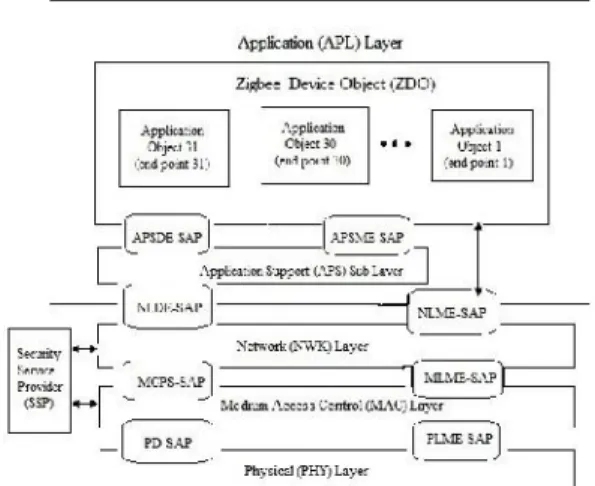
ZigBee is a technology of IEEE 802.15.4 Protocol. Zigbee Protocol layers are shown in figure 2.1. Low complexity, low cost, low power consumption, low transmitting rate, high reliability, wireless short distance transmission (compared with global Internet), and being capable of ad-hoc networks are all its features. It is suitable for the fields of automatic control and remote control, and it can be embedded in many different devices. In short, ZigBee[7] is a wireless ad-hoc networks capable communication technology which is cheap and low power consumption. The low cost allows the technology to be widely deployed in wireless control and monitoring applications, the low power-usage allows longer life with smaller batteries, and the mesh networking provides high reliability and larger range.
The principle of ZigBee is not very complex. Devices using ZigBee technology can automatically connect to other devices around them. Those devices form a lot of data paths, so different nodes can transfer their information to the end-users through the different paths. A simple ZigBee network is shown in below figure 2.2.
2.2. A Simple ZigBee Network
The ZigBee Alliance, the standards body that defines ZigBee, also publishes application profiles that allow multiple OEM vendors to create interoperable products. The current list of application profiles are:
Home Automation.
ZigBee Smart Energy
Commercial Building Automation
Telecommunication Applications
Personal, Home, and Hospital Care
Toys
CO2SENSORS:
Sensitive material of MQ-7 gas sensor is SnO2, which with lower conductivity in clean air. It make detection by method of cycle high and low temperature, and detect CO2 when low temperature (heated by 1.5V). The sensor’s conductivity is more higher along with the gas concentration rising. When high temperature (heated by 5.0V), it cleans the other gases adsorbed under low temperature. The below figure 3 shows the CO2sensor
Figure 3: CO2Sensor
MQ-7 gas sensor has high sensitivity to Carbon Monoxide and Carbon dioxide. The sensor could be used to detect different gases contains CO2, it is with low cost and suitable for different application.
Character Configuration:
Good sensitivity to Combustible gas in wide range
High sensitivity to Natural gas Long life and low cost Simple drive circuit
Applications:
Domestic gas leakage detector Industrial CO detector Portable gas detector
LIQUID CRYSTAL DISPLAY:
GSM:
Global System for Mobile Communications GSM[15] is a digital wireless network standard designed by standardization committees from major European telecommunications operators and manufacturers. The GSM standard provides a common set of compatible services and capabilities to all mobile users across Europe and several million customers worldwide. The GSM Modem is shown in figure 4. The basic requirements of GSM[15] have been described in five aspects.
Figure 4: GSM Modem
Services: The system shall provide service portability, i.e., mobile stations or mobile phones can be used in all participating countries. The system shall offer services that exist in the wire line network as well as services specific to mobile communications. In addition to vehicle-mounted stations, the system shall provide service to Mss used by pedestrians and /or on board ships.
Quality of Services and Security: The quality for voice telephony of GSM shall beat least as good as the previous analog systems over the practical operating range. The system shall be capable of offering information encryption without significantly affecting the costs to users who do not require such facility. Radio Frequency Utilization .the system shall permit a high level of spectrum efficiency and state-of-the-art subscriber facilities. The system shall be capable of operating in the entire allocated frequency band, and co-exist with the earlier systems in the same frequency band.
Network: The identification and numbering plans shall be based on relevant ITU recommendations. An international standardized signalling system shall be used for switching and mobility Management. The existing fixed public networks should not be significantly modified.
Cost: The system parameters shall be chosen with a view to limiting the cost of the complete system, in particular the Mss.
IV SOFTWARE DESIGN AND DEVELOPMENT
The software[11]we use here is Keil µvision 4
IDE (Integrated Development Environment) .This is a virtual platform where we can execute code and check our desired results. For executing the code we have to choose the controller LPC 2148. After checking the results virtually we will dump the code into controller to verify results.
Figure 5: Selection of LPC 2148 in KEIL
Figure 6: Verifying code for bugs in KEIL
V RESULT
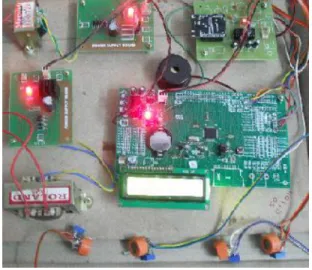
CO2sensors sense the values and this will be stored in LPC2148. CO2 values from all sides will be compared with the threshold value. If the CO2 level crosses the threshold then the buzzer will give the indication and those values are transmitted through Zigbee. The receiver at the Traffic lights will receive the information through the Zigbee wireless communication and traffic light indication will be given in that appropriate direction. The status will be shown in LCD and SMS alert will be sent to the Traffic Control Room using Global System for Mobile Communications (GSM). If the traffic is very less then this system will be worked on fixed time interval. This time will be set by messaging that time interval eg:60µs to GSM module. Now, the traffic light controller will give the signal based on the timing.
Figure 7: Transmitter
Figure 8: Receiver
VI CONCLUSION
The design and architecture of a new concept of Traffic Lights Control System is very Efficient and can be used as a replacement for the Present Traffic System.By using this System, we can effectively reduces the traffic congestion and CO2 emissions resulting in reduced Air Pollution. The proposed combination of various working units makes a real-time system that reduces the effects of CO2, waiting time of vehicles and Fuel efficiency for vehicles is maintained by reducing the Traffic Lights time interval through SMS.
VII FUTURE SCOPE OF THE PROJECT
The methodology of controlling the vehicle movement at TLCs using GSM and CO2 levels employed in this project for controlling the effects of vehicular emissions, can be used in the future with small improvements for Traffic System using GPRS by which Fuel consumption and/or emissions could be monitored and wherever the vehicle may be, feedback will be given to optimise driving style and vehicle behaviour, for controlling the robots in military applications such as bomb diffusion where humans find it difficult to work.
REFERENCES
1. C. Cai, Y. Wang, and G. Geers, “Adaptive traffic signal control using vehicle-to-infrastructure communication: A technical note,” in Proc. Int. Workshop Comput. Transp. Sci., San Jose, CA, 2010,pp. 43–47.
2. C. Sommer, R. Krul, R. German, and F. Dressler, “Emissions versus travel time: Simulative evaluation of the environmental impact of ITS,” in Proc. IEEE Veh. Technol. Conf., Taipei, Taiwan, May 2010,pp. 1–5.
3. “Carbon dioxide emissions from the generation of electric power in the United States,” Dept. Energy Environ. Protection Agency, Washington, DC, 2000.
5. K. Ahn, H. Rakha, A. Trani, and M. V. Aerde, “Estimating vehicle fuel consumption and emissions based on instantaneous speed and acceleration levels,” J. Transp. Eng., vol. 128, no. 2, pp. 182–190,Mar./Apr. 2002.
6. H. Rakha and Y. Ding, “Impact of stops on vehicle fuel consumption and emissions,”J.Transp. Eng., vol. 129, no. 1, pp. 23–32,Jan./Feb. 2003.
7. Rathod K,Parikh N,Parikh A,Shah V, “Wireless automation using Zigbee protocols”, Ninth International Conference on IEEE, Wireless and Optical Communications Networks (WOCN), 2012.
8. David Seal, “ARM Architecture Reference Manual”, Second Edition, Addison Wesley, 2001.
9. Steve furber, “ARM System-on-chip Architecture”, Second Edition, Addison-Wesley, Published 2000.
10. Tianmiao Wang, ”the Design and Development of Embedded System Based on ARM Micro System and µC/OS-II Real- time Operating System” Tsinghua University Press, 2003.
11. Andrew N.Sloss, Dominic Symes, Chris Wright, “ARM system developer’s guide: designing and optimizing system software,”American: Elsevier PteLtd, 2005, pp. 1-306.
12. “Fixed Point Arithmetic on the ARM” ARM DAI 0033A,Advanced RISC Machines Ltd (ARM) 1996 [pdf].
13. Nagarajan R,Dhanasekaran R, “Implementation of wireless data transmission in monitoring and control”, International Conference on IEEE, Communications and Signal Processing (ICCSP), 2013.
14. Palanisamy. S, Kumar. S.S, Narayanan J.L, “Secured wireless communication for industrial automation and control”, 3rd International Conference, Electronics Computer Technology (ICECT), Volume: 5, 2011.
15. Michel Mouly and Marie-Bernadette Pautet: GSM System for Mobile Communications, published by the authors 1992, ISBN 2-9507190-0-7.
16. Wang Tianmiao, “The embedded system design and the example”, Beijing: Tsinghua University Press, 2003.
17. Zhou Ligong, “ARM embedded system foundation course”, Beijing, University of Aeronautics and Astronautics publication 2005.
18. Liu Shuguang, Liu Yong, Huang Xinbo, “The Application of RTOS in Microcomputer Protection Device”. Sch. of Electron. & Inf. Eng., Xi'an Polytech. Univ., Xi'an, China.
19.
http://www.microbuilder.eu/Tutorials/LPC2148.a spx.