Effectiveness of the South Baltic Cross-border Co-operation
Programme 2007 - 2013; challenges and aims for the
Programme for the time period 2014-2020
Final Report
© ECORYS Polska Sp. z o.o. Łucka 2/4/6 00-845 Warszawa T +48 22 339 36 40 F +48 22 339 36 49 E [email protected] W www.ecorys.pl
Final Report
Table of contents
List of tables ... 5 List of abbreviations ... 7 Summary ... 9 1. Introduction ... 151.1. Aim of the report...15
1.2. Structure of the report ...15
2. General information about the research ... 17
2.1. Context of the research ...17
2.2. Aims of the research ...19
3. Results of the evaluation ... 21
3.1. Part I - The level of achievement of Programme objectives provided in the Operational Programme and the future shape of the Programme in the period 2014-2020 ...21
3.1.1. Objectives, products and results ...21
3.1.2. Partnerships ...45
3.1.3. Future shape of the Programme...57
3.2. Part II - Effectiveness of the projects implementing system that is defined within the Programme documents...95
3.2.1. Projects implementation ...95
3.2.2. Administrative structure ... 111
4. Conclusions and recommendations ... 117
Appendix 1 – Case studies ... 123
Final Report
List of figures
Fig.1.Eligible area of the South Baltic Programme... 17
Fig. 2. Sum of points ascribed to the activities ... 39
Fig.3. Sum of points ascribed to the thematic groups ... 39
Fig. 4. Types of institutions taking part in the South Baltic Programme as AOs ... 50
Fig.5. Types of the activities undertaken by the Associated Organisations in the projects within the South Baltic Programme [%]. ... 51
Fig.6. Types of AOs from the Kaliningrad Oblast. ... 53
Fig.7.Types of the activities undertaken by the Associated Organisations from the Kaliningrad Oblast in the projects within the South Baltic Programme [%]. ... 54
Final Report
List of tables
Table 1.Eligiblearea of the South Baltic Programme ... 18
Table 2. Number of projects supported in each of the Programme priority axis and measures ... 19
Table 3.Programme result indicators and their level of achievement (in green: indicators probable to be achieved) ... 23
Table 4. The most common outputs of the projects led by the German... 25
Table 5. The most common results of the projects led by the German ... 26
Table 6. The most common outputs of the projects led by the Danish ... 27
Table 7. The most common results of the projects led by the Danish ... 28
Table 8. The most common outputs of the projects led by the Swedish ... 29
Table 9. The most common results of the projects led by the Swedish ... 30
Table 10. The most common outputs of the projects led by the Polish ... 31
Table 11. The most common results of the projects led by the Polish ... 32
Table 12. The most common outputs of the projects led by the Lithuanian ... 33
Table 13. The most common results of the projects led by the Lithuanian ... 34
Table 14. Most common outputs in the Programme’s measures ... 35
Table 15. Most common results in the Programme’s measures ... 35
Table 16. Results of the finished projects ... 37
Table 17. Activities included in the research ... 38
Table 18. Results of the crowdsourcing ... 41
Table 19. Functions of the AOs in the projects implemented within the South Baltic Programme ... 50
Table 20.Types of AOs from the Kaliningrad Oblast ... 53
Table 21.Types of AOs from the Kaliningrad Oblast and their functions in projects ... 55
Table 22. Compliance between the EU Strategy for the Baltic Sea Region and The South Baltic Programme . 59 Table 23. Compliance between flagship projects (initiatives) of the Europe 2020 Strategy and The South Baltic Programme... 61
Table 24. Compliance between the investment priorities and The South Baltic Programme ... 65
Table 25. Comparison of the thematic scope f chosen strategic documents ... 71
Table 26. Comparison of the thematic scope of chosen ETC programmes ... 75
Table 27. Comparison of selected rules in chosen ETC programmes ... 80
Table 28. Possible future thematic areas of the South Baltic Programme ... 86
Table 29. Comparison between the results of the analyses conducted within the report and the expertise Challenges and aims for the cross-border cooperation programmes involving Poland ... 88
Table 30. Average results the quality assessment of the rejected projects ...101
Table 31.Average point value in the quality assessment in the analysed calls ...103
Table 32. Changes in the total point values scored in the quality assessment in project that were two times rejected ...103
Table 33. Differences between data from the payment application the expenses planed in the application form ...105
Table 34. Differences between the date of the first payment application the expenses planned for the corresponding period in the application form ...107
Table 35. Recommendations table ...117
Table 36. List of the respondents of the ITI interviews ...145
Table 37.List of respondents - Associated Organisations ...156
Final Report Table 39. Experts invited to take part in the forum ...161 Table 40. List of projects studied ...162
Final Report
List of abbreviations
AOs - Associated Organisations CPE - Centre of European Projects ETC - European Territorial Cooperation FLC - Fists Level Control
GIS - Geographic Information System
ITC - Information and Communication Technologies ITI - Individual Telephone Interview
JTS – Joint Technical Secretariat LNG – Liquid Natural Gas MA – Managing Authority MC – Monitoring Committee
NGO – Non-governmental organization OWE – Offshore Wind Energy
PPP – Public Private Partnership R&D - Research and Development SC – Steering Committee
SME - Small and medium enterprises SSI – Semi-Structured Interview
Final Report
Summary
The main objective of the evaluation titled: “Effectiveness of the South Baltic Cross-border Co-operation Programme 2007 - 2013; challenges and aims for the Programme for the time period 2014-2020” was to assess the implementation and achievements of the South Baltic Programme. Two detailed objectives of the research were formulated as follows:
1. To assess the level of achievement of Programme objectives provided in the Operational Programme and the future shape of the Programme in the period 2014-2020
2. To assess effectiveness of the projects implementing system that is defined within the Programme documents.
In the evaluation, a variety of research methods has been used. The CAWI surveys, ITI interviews, SSI interviews, Crowdsourcing, Forum of experts, desk research and case studies were conducted. Interviewed were representatives from the Management Authority, Monitoring and Steering Committee, Joint Technical Secretary, National and Regional Contact Points and Euroregions, the Lead Beneficiaries and Partners of accepted projects, Associated Organizations, organisations, whose projects were rejected, potential beneficiaries of the Programme and potential recipients of the projects’ effects.
The report is divided into two main parts which correspond with the detailed objectives of the evaluation. Within each of the parts further thematic areas were delimited.
Part I - The level of achievement of Programme objectives provided in the Operational Programme and the future shape of the Programme in the period 2014-2020
The implementation of the Programme is successful and the overall objective of the South Baltic Programme will be achieved. The Programme strongly contributes to creation of cross border networks and undertaking joint actions within them. It has rather “soft” than infrastructural character. The extensive know-how which was built within the Programme can be further used in the future initiatives.
Taking into account the results of analyses conducted within the evaluation following thematic areas should be continued in the next programming period: R&D, innovation; energy, energy efficiency; youth, education, life-long learning; entrepreneurship development, competitiveness of SMEs.
Detailed findings
1. Objectives, products and results Objectives of the Programme
The risk of not achieving target values in case of three indicators does not influence the generally successful implementation of the Programme. It is important to stress that in these three cases the indicators will be for surely achieved in more than 50%, which is a positive result. Their achievement is also still possible if next calls for projects from the priority axis 1 will be opened. If so, the next call should first of all be opened for projects concerning measure 1.2 Integration of the higher education and labour market. Three indicators in case of which there is a risk that the target values will be not achieved:
• Number of projects with politically welcomed and promoted results (Priority 1) (estimated level of achievement 67%)
Final Report • Number of projects strengthening liaisons between higher education and labour market institutions of
the South Baltic regions (estimated level of achievement 70%)
In some thematic areas the implementation of the Programme was even more effective than expected. The Programme contributes very strongly to the creation of cross border networks (the corresponding indicator achieved in over 240%), when undertaking joint actions was one of the most important aspects the Programme objective. The Programme is also particularly successful in strengthening cross-border cooperation between the SME’s (over 100% of the indicators target value).
Outputs and results of the projects and the Programme
The Programme outputs are much differentiated. Taking into account all Programme measures the most common type of outputs are the thematic expertise reports. This indicates that in the projects implemented in the current Programme an extensive know-how was built, which could and should be further used in the future projects. The results of the Programme are less differentiated than the outputs. Looking at all measures the most common results are long term cooperation agreements and new extended cooperation networks. It indicates the “soft” rather than infrastructural character of the Programme. The partnerships and cooperation built within the projects are also valuable assets for the future projects and will facilitate the future partnerships. To a significant extent, the future South Baltic Programme should build on the current Programme, both when it comes to the substantive issues and projects implementation schemes (partnerships).
Complementarity of the projects
The complementarity level of the projects supported within the South Baltic Programme is high both within the Programme measures and between projects implemented within different measures also with projects implemented within chosen ETC Programmes1. No cases were found in which the content of the project would duplicate the actions undertaken within other initiative.
2. Partnerships
Finding partners, duration of the partnerships
A significant number of the partnerships was created for the needs of the Programme. At the same time the beneficiaries declared they want to continue the partnerships in the future. The opportunity to create new cross-border networks and exchange experiences was also in the opinion of the beneficiaries one of the most important advantages resulting from participation in the Programme. Because of that the structure of partnerships (the number of the new ones and continued) should be assessed as positive.
Tasks division between the partners, the efficiency of communication
Most of the participants declare that they know each other’s role in the project and that all partners are actively involved in the implementation of the projects. The communication between the partners is rather informal. Problems that occurred in the partnership resulted from: cultural differences, language barriers, organisational changes and engagement in too many projects at the same time. Generally they do not significantly affect the implementation of the projects.
Future cooperation
1
1) The Baltic Sea Region Programme 2007-2013, 2) European Territorial Co-operation Objective Cross-border Co-operation Programme Lithuania-Poland 2007-2013, 3) Central Baltic Interreg IVa Programme, 4) Mecklenburg-Vorpommern/Brandenburg –Zachodniopomorskie Cross-border Cooperation Programme.
Final Report The Beneficiaries confirmed that they are planning to continue the cooperation with the current partners after the end of the projects as well. However in the majority of cases there are no detailed plans of such cooperation, also no plans about sources of financing for the partnership. The Beneficiaries of the South Baltic Programme are also interested in creating new partnerships with other organisations.
Possible instruments and activities supporting the partnerships
To support the partnerships within the Programme following actions could be undertaken: simplifying the rules of participation in the Programme, standardising of rules for all countries, providing more support in pre-financing, preparing a list of recommended partners, organising partners meetings, providing external support for partnerships and encouraging potential partners to join the Programme by providing more information about the regions and the Programme itself. In the future programming period all NGOs should have the possibility to become a Lead Beneficiary. The participation of private companies in the Programme should be reinforced (not only as AOs).
The Associated Organisations in The South Baltic Programme
AOs are engaged in the majority of the projects realized within the South Baltic Programme. The level of involvement of the AOs from Kaliningrad Oblast is rather low. The participation of the AOs from the private sector is slightly less common than of the ones from the public sector. In the case of Kaliningrad Oblast the public institutions are prevailing. AOs role in the project is differentiated in engagement level and scope. Generally the Lead Beneficiaries are satisfied with the cooperation with AOs, although they are sometime less active than expected. The activity of AOs from the Kaliningrad Oblast is limited due to shortage of financial means. Apart from financial shortages the Russian AOs are highly interested in participation in the Programme.
3. Future shape of the Programme
Contribution to achieving the objectives of Strategy for the Baltic Sea Region
In the Strategy for the Baltic Sea Region there are five thematic areas that are not implemented by the South Baltic Programme. These concern: clean shipping, agriculture, forestry and fisheries, maritime safety and security, major emergencies and cross-border crime.
Contribution to implementation of the Strategy Europe 2020
In its current shape the implementation of the South Baltic Programme contributes to the achievement of almost all of the objectives of the Europe 2020 Strategy, though supporting projects concerning thematic areas accordant with the flagship initiatives. The exception are actions aiming at facilitation connection to high speed internet.
Differences between the Programme and other ETC programmes covering/ bordering eligible area of the South Baltic Programme
In the scope of the South Baltic Programme there are some similarities to the analysed transnational cooperation programme - the Baltic Sea Programme. When it comes to the analysed cross-border programmes there is a significant difference, mainly in the character of the supported initiatives. The projects implemented within the South Baltic Programme have soft rather than infrastructural character (as in the other cross –border Programmes). The South Baltic Programme can be therefore seen as transitional between the transnational and cross-border programmes or as a linking point between them. It is also important to stress the unique character of the activity 2.4 Local community activities. All of the actions realized within this measure are specific for the South Baltic Programme and the measure itself has an innovative character.
Final Report Beneficiaries’ plans for the future
Most of the participants are satisfied with the current scope of the Programme and are interested in participating in the future in the Programme with the same scope.
Priorities and activities of the Programme that should be taken into account for the next programming period
Taking into account the thematic focus of the draft proposal of General regulation previewed within the paragraph 9 and the results of analyses conducted within the evaluation following thematic areas should be continued in the next programming period: R&D, innovation; energy, energy efficiency; youth, education, life-long learning; entrepreneurship development, competitiveness of SMEs.
Recommendations resulting from the first part of the report Objectives, products and results
For the next programming period clear definition of more detailed but closed list of outputs and results indicators which will make the aggregation possible;
Partnerships
The rules of participation in the Programme (concerning the formal status of the Lead Beneficiary) should be changed. All NGOs (not only bodies governed by public law) should have the possibility to become a Lead Beneficiary. The minimal budget for the projects or certain thematic areas (currently 50 000 euro) should be lowered;
The rules of participation in the Programme (concerning the formal status of the Partner) should be changed. There should be a possibility of Public Private Partnership (PPP) in the Programme; Future shape of the Programme
The future shape of the Programme should include: R&D, innovation; energy, energy efficiency; youth, education, life-long learning; entrepreneurship development, competitiveness of SMEs.
Part II - Effectiveness of the projects implementing system that is defined within the Programme documents
The overall assessment of the projects implementing system is positive, although there are some possible changes which could be introduced to increase its effectiveness. Most problems in the implementation system occur at the FLC level and are referred to the certification process. Important changes needed in the system concern introducing a seed money facility for projects preparation and the system of advance payments. Both on the application as well as on the implementation stage there is a need for stronger support for the potential beneficiaries and beneficiaries by the Contact Point. In order to meet those needs the Contacts Points should be financially strengthened.
Detailed findings
1. Project implementation
Problems in the project preparation phase
The main problems on the application stage were connected with following issues:
• understanding formal rules of project preparation (cost eligibility, cost sharing between partners, required formal documents),
Final Report • finding projects partners,
• cost of project preparation - the desired amount of the seed money should be between 20 000 and 40 000 Euro.
In response to these problems it is recommended to strengthen the support provided to the potential beneficiaries in the projects preparation phase by the Contact Points in terms of workshops, consultations and partners search – promoting wider use of the projects partners’ data base.
Assessment criteria
The current projects assessment process and the applied assessment criteria are in the opinion of the evaluator sufficient to provide the selection of the most suitable projects and the criteria are properly adjusted to the types of the projects. No changes in the project assessment criteria are suggested.
Reasons of projects rejection
Within the South Baltic Programme application rejection rate is high – 58%. The share of the applications rejected for formal reasons is low (7% of the rejected applications), so activities undertaken to reduce the rejection rate should concentrate on the substantial quality of the applications. It was observed that the potential beneficiaries had problems with presenting the logical framework of the projects and defining the future benefits resulting from the projects (after projects’ completion). These two issues should be stressed during the workshops and seminars for potential beneficiaries.
Reasons for lack of interest in applying for funding
All of the potential beneficiaries who didn’t apply for funding heard about the South Baltic Programme before. The most common reason for not applying was that the requirements are too high and application procedure too complicated and therefore too much time and money consuming. The main suggested change in the Programme is to simplify the Programme rules and procedures.
Delays in the projects implementation
The analysis of the project application forms and the list of payments showed that there are delays in implementation of some projects. This was confirmed by the Lead Beneficiaries in the interviews. In some of the projects the delays are caused by too optimistic preparatory phase. The unexpected changes in the projects environment can also affect the implementation in the negative way. In general the occurring delays don’t significantly affect the implementation of the Programme.
Reporting progress on the JST and MA level; Project Progress Reports reimbursement (interim payment) and reimbursement of the final Project Progress Reports (final payment)
The complaints about the certification project process referred more to the FLC than to reporting process at the JST or MA level. Some of the respondents were also dissatisfied with the long waiting time that passes between the acceptance of expenses and reimbursement, but the monitoring data doesn’t show significant delays. If the process was longer than the average then it resulted from the need of clarification. It can be assumed that the Beneficiaries are mainly dissatisfied with the length of the expenditures certification by the FLC, which was not a subject of detailed analysis within the evaluation.
Final Report 2. Administrative structure
Contribution of the administrative structure to the achievement of Programme goals and the Support of the Contact Points and Regional Contact Points
To increase the contribution of the administrative structure of the Programme to the achievement of Programme goals numerous suggestions were given by the respondents, e.g.: expanding the possibilities of Regional Contact Points and Contact Points in the areas concern promotion and information though increasing the financing for Regional Contact Points and Contact Points activities, hiring more staff for these organisations, hiring more international staff for JTS, introducing advance payments system or, providing the funds for projects pre-financing and capacity building. There is also a need for support in finding partners and wider promotion of projects results.
Recommendations resulting from the second part of the report Projects implementation
Creating for a seed money facility that would offer grants for projects preparation up to 50 000 euro;
Including the topics concerning projects logic and long term sustainability of the project results in the workshops and seminars for potential beneficiaries;
The Beneficiaries must prepare at the preparation stage a risk analysis for the project implementation period2;
Administrative structure
The Contact Points should be strengthened in terms of financial and human resources; Introducing the system of advance payments;
Data base of projects partners, which participated the Programme should be elaborated. It should contain information about the willingness to cooperate and the areas of interest. The data base should also include information about the other organisations which showed interest in the Programme and / or participated in Programme’s events. The data base should be used in during trainings and consultations for the potential Beneficiaries as an example how to find partners; The data base with the information about the completed project should be elaborated and
popularised among the potential beneficiaries of the South Baltic Programme in the next programming period. The data base should contain information if the beneficiary is willing to cooperate in the future in implementation of similar projects.
2
Although the general suggestion is to simplify the rules of participation in the Programme, introducing obligatory risk analysis will have a positive influence on the projects implementation.
Final Report
1.
Introduction
1.1. Aim of the report
The aim of the report is to present the results of the evaluation “Effectiveness of the South Baltic Cross-border Co-operation Programme 2007 - 2013; challenges and aims for the Programme for the time period 2014-2020”. The methodology of the research was previously agreed with the Client in the methodological report. Based on the results of the research the report presents a list of suggestions and recommendation, which can be used when planning the scope of The South Baltic Programme in the future programming period.
1.2. Structure of the report
The report consists of four main chapters. The first chapter is of introductory character and presents the aims of the report. The second chapter refers to the general information about the research. This includes the context of the research - basic information about The South Baltic Programme and the aims of the evaluation. The third part of the report presents the results of the research. It is divided into two main parts:
Part I - The level of achievement of Programme objectives provided in the Operational Programme and the future shape of the Programme in the period 2014-2020
Part II - Effectiveness of the projects implementing system that is defined within the Programme documents
The last chapter of the report focuses on the recommendations resulting from the conducted research. In the appendix 1 are the case studies of selected projects. The detailed description of the methodology adopted in the evaluation can be found in appendix 2.
Final Report
2.
General information about the research
2.1. Context of the research
The main objective of the South Baltic Programme is to strengthen the sustainable development of the South Baltic region through joint actions which increase the competitiveness and enhance integration among people and institutions. This objective is implemented through two priority axes:
I. Economic competitiveness, and II. Attractiveness and common identity.
The first axis focuses on actions promoting integration of economic and labour markets in the area, co-operation in technical and higher education, transfer of knowledge and know-how between public and private actors, and better transport connectivity. The second axis comprises actions connected with management of environmental threats, promotion of sustainable economic use of natural resources and cultural heritage with particular attention to tourism, development of renewable energy sources and energy saving, as well as local initiatives supporting people-to-people contacts.
Within both priority axes financial support can be acquired by beneficiaries from Denmark, Germany, Lithuania, Sweden and Poland (table 1), as it shown on the map below (fig. 1).
Fig.1.Eligible area of the South Baltic Programme Source: South Baltic Programme
Final Report Table 1.Eligiblearea of the South Baltic Programme
Country Regions supported within the Programme
Poland szczeciński, koszaliński, słupski, gdański, Gdańsk – Gdynia – Sopot, elbląski (adjacent area)
Sweden Kalmar, Blekinge, Skane, Kronoberg (adjacent area)
Denmark Bornholm, East Zealand and West / South Zealand (adjacent area)
Lithuania Klaipeda; Taurage and Telsiai (adjacent areas)
Germany Bad Doberan, Greifswald, Kreisfreie Stadt, Nordvorpommern, Nordwestmecklenburg,
Ostvorpommern, Rostock, Kreisfreie Stadt, Rügen, Stralsund, Kreisfreie Stadt, Uecker-Randow, Wismar, KreisfreieStadt
According to the Programme Manual, the Lead Beneficiary in the South Baltic Programme must be either: a national (governmental), regional or local authority or their association, or an institution that will need to provide evidence that:
it is established under public or private law for the specific purpose of meeting needs in the general interest, not having an industrial or commercial character,
it has legal personality,
and it is financed, for the most part, by the State, regional or local authorities, or other bodies governed by public law; or it is subject to management supervision by those bodies; or having an administrative, managerial or supervisory board, more than half of whose members are appointed by the State, regional or local authorities, or by other bodies governed by public law3.
Project partners must in turn fulfil the first two of the above listed criteria.
The project applications are submitted by a Lead Beneficiary in cooperation with project partners. Each application has to undergo a two-stage assessment. First stage of the assessment covers the formal issues. The second stage focuses on strategic and operational features of a project (quality assessment). The assessment is conducted in a 4-point scale and covers following issues:
1. Contribution to the Programme Measures and regional strategic plans; 2. Relevance of the subject tackled and adequateness of the work plan; 3. Innovativeness of the project approach and methodology;
4. Impact on the socio-economic development of the eligible area; 5. Cross-border impact;
6. Scope and strength of project partnership; 7. Impact on the situation of the target group; 8. Dissemination of project results;
9. Durability of the project results;
10. Contribution to the EU Baltic Sea Region Strategy and its Action Plan; 11. Contribution to the renewed Lisbon Strategy and the Gothenburg Strategy;
12. Compliance with horizontal policies (equal opportunities, impact on the environment, information society);
13. Project management capacity and capacities to implement the project;
3
Final Report 14. Budget quality.
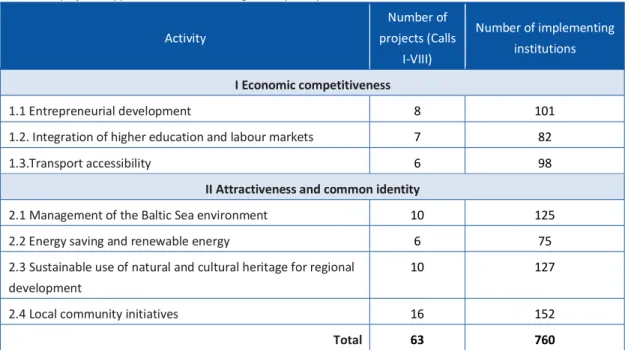
In the last eight calls for proposals 64 projects were chosen, and 63 are currently implemented4 by 760 Partners (incl. the Lead Beneficiaries). Out of this group 15 projects were finished. Table 2. presents the number of projects implemented within each of the Programme priority axes and measures.
Table 2. Number of projects supported in each of the Programme priority axis and measures
Activity Number of projects (Calls I-VIII) Number of implementing institutions I Economic competitiveness 1.1 Entrepreneurial development 8 101
1.2. Integration of higher education and labour markets 7 82
1.3.Transport accessibility 6 98
II Attractiveness and common identity
2.1 Management of the Baltic Sea environment 10 125
2.2 Energy saving and renewable energy 6 75
2.3 Sustainable use of natural and cultural heritage for regional development
10 127
2.4 Local community initiatives 16 152
Total 63 760
The Managing Authority is responsible for implementation of the Programme. This function belongs to the Polish Ministry of Regional Development, Territorial Cooperation Department. The Managing Authority has asked the Joint Technical Secretariat to do the day-to-day management of the implementation of the Programme. The Certifying Authority Department within the Ministry of Regional Development is responsible for financial certification. The function of the Audit Authority belongs to the Polish Ministry of Finance.
The Joint Technical Secretariat is located in Gdańsk. There are Contact Points in the region from the eligible area. The Monitoring Committee and Steering Committee were established according to the European Union rules of programmes implementation. The Monitoring Committee consists of representatives of the involved Member States and monitors the implementation of the Programme. The Steering Committee consists of representatives of the participating countries and selects and monitors the operations.
2.2. Aims of the research
Based on the Terms of Reference, the main objective of the evaluation is to assess the implementation and achievements of the South Baltic Programme. Two detailed objectives of the research were formulated as follows:
1. To assess the level of achievement of Programme objectives provided in the Operational Programme and the future shape of the Programme in the period 2014-2020.
2. To assess effectiveness of the projects implementing system that is defined within the Programme documents.
4
One project - - WINDUP was first chosen in the IV call but one partner withdrawn and the contract was cancelled. The project was accepted in the VII, when a new partner was found.
Final Report
3.
Results of the evaluation
3.1. Part I - The level of achievement of Programme objectives
provided in the Operational Programme and the future shape of
the Programme in the period 2014-2020
3.1.1. Objectives, products and results
This subchapter analyses the present and future effects of the South Baltic Programme. First the achievement of the results on the Programme level is analysed. In the second part of the chapter the project results are analysed divided into priorities and measures. Detailed description of the results of chosen projects can be found in the case studies. Following research questions are answered in the chapter:
To what extent have the objectives of the Programme been achieved (bearing in mind specified indicators)?
What are the results of projects completed and what are the anticipated results of undergoing projects (divided into priorities and measures), especially in the following areas:
- entrepreneurship development
- high education and labour market integration - improvement of transport accessibility
- environment management in the Baltic Sea Area
- renewable energy development and energy saving activities
- sustainable use of natural resources and cultural heritage in the regional development - local societies initiatives development
Are the projects implemented within the South Baltic Programme complementary to each other and are they complementary to projects realised within other programmes implemented in the South Baltic region? If, yes, how does it influence the results of the projects?
To what extent have the objectives of the Programme been achieved? (bearing in mind specified indicators)?
The analysis done in this subchapter is based on Annual Implementation Report for 2011, the application
forms for the projects approved in the 8th call and the list of projects submitted in the 9th call.
The main objective of the South Baltic Programme is to strengthen the sustainable development of the South Baltic region through joint actions which increase the competitiveness and enhance integration among people and institutions. The achievement of this objective is measured trough the result indicators. For each of the priority axes both universal as well as specific results were defined. The results indicators on the Programme level refer to the number of projects of meeting a certain criteria.
The level of result indicators achievement of the Programme level is one of the subjects presented in the Annual Implementation Report. The table 3. below in columns no. 2-4 presents the achievement of result indicators till the end of 2011. There are six indicators with 0% level of achievement. In other cases the level of achievement differs between 7% and 47%.
Final Report In the annual report there is also an estimation of the indicators achievement level, taking into account all approved projects (calls no. 1 –7)5. From this point of view the overall level of target values achievement is estimated 92%. In case of six indicators the target value has already been reached. In the other six cases it differs between 50 and 90 %. The lowest achievement values refer to following indicators (for the Priority axis I):
Number of projects with politically welcomed and promoted results (67%); Number of projects unlocking public and private investments (57%);
Number of projects strengthening liaisons between higher education and labour market institutions of the south Baltic regions (50%).
The column 6 presents the estimation of the indicator values taking into account 3 projects, which were chosen in call no. 8.: HERRING, SBTP and REGFOOD. The information about the assumed values of the indicators were taken from the application forms. In this estimation the target values will be achieved in case of 7 indicators.
The 9th call for projects was closed in October 2012. It concerned only the measure 2.4. The 13 projects which were submitted, requested for 3 191 378,29 euro. The total available founding within this call was 1 300 000 euro. The average requested founding was about 245 500 what means that about 5 project can be chosen for financing.
Taking into account the projects from the 9th call, it can be assumed that the target value of the indicator Number of projects with politically welcomed and promoted results will be reached or almost be reached. The same refers to the indicator Number of projects intensifying intercultural dialogue and better involving broader public in cross-border activities.
In the announcement for the 9th call of proposals it is stated that for all measures apart from 2.4 there are no more financial sources available. If this stays unchanged it can be assumed that in the case of 3 indicators the target values won’t be reached. They are:
Number of projects with politically welcomed and promoted results (Priority 1) (estimated level of achievement 67%)
Number of projects unlocking public and private investments (estimated level of achievement 57%)
Number of projects strengthening liaisons between higher education and labour market institutions of the south Baltic regions (estimated level of achievement 70%)
5
Final Report Table 3.Programme result indicators and their level of achievement (in green: indicators probable to be achieved)
1. 2. 3. 4. 5. 6. Indicator Ac h ie ve m e n t u p t o 2 0 1 1 Ta rge t Le ve l o f ac h ie ve m e n t u p t o 2 0 1 1 P la n n e d le ve l o f ac h ie ve m e n t 2 0 1 1 a cc o rd in g to P ro gr am m e p ro gr e ss r e p o rt P la n n e d le ve l o f ac h ie ve m e n t 2 0 1 2 P ri o ri ty 1
Number of projects with politically welcomed and promoted
results 1 15 7% 60% 67%
Number of projects creating cross-border networks based on
formal agreements 1 7 14% 214% 243%
Number of projects unlocking public and private investments 0 7 0% 57% 57%
Number of projects contributing to intensified cross-border relations between small and medium size enterprises in the South Baltic area
0 7 0% 114% 114%
Number of projects strengthening liaisons between higher education and labour market institutions of the South Baltic regions
0 10 0% 50% 70%
Number of projects contributing to improved quality and interoperability of transport connections and services in the South Baltic area
1 5 20% 120% 120% P ri o ri ty 2
Number of projects with politically welcomed and promoted
results 5 30 17% 73% 77%
Number of projects creating cross-border networks based on
formal agreements 7 15 47% 280% 287%
Number of projects unlocking public and private investments 0 7 0% 129% 129%
Number of projects improving Institutional capacity in the
management of the Baltic Sea environment 0 10 0% 90% 100%
Number of projects increasing commitment to renewable
energy sources and energy saving patterns 0 4 0% 125% 125%
Number of projects demonstrating more efficient use of natural and cultural heritage of the South Baltic area for regional development
3 10 30% 100% 100%
Number of projects intensifying intercultural dialogue and
better involving broader public In cross-border activities 4 20 20% 85% 85%
Source: own elaboration based on the Programme progress report 2011
Based on the data presented above and the simulation done for the projects of the 9th call, it shows that the overall objective of the South Baltic Programme will be achieved. The risk of not achieving target
Final Report values in the case of three indicators does not influence the generally successful implementation of the Programme. It’s important to stress that in the three mentioned above cases the indicators will be for sure achieved in more than 50%, which is a positive result. Their achievement is still possible if next calls for projects from the priority axis 1 will be opened. If so, the next call should be first of all opened for projects concerning measure 1.2 Integration of the higher education and labour market.
In some thematic areas the implementation of the Programme was even more effective than expected. The Programme contributes very strong to the creation of cross border networks (the corresponding indicator achieved in over 240%), when undertaking joint actions was one of the most important aspects the Programme objective. The Programme is particularly successful in strengthening cross-border cooperation between the SME’s (over 100% of the indicators target value).
Sustainable development is particularly specified in the Programme’s objective and sustainability should be a characteristic of all actions undertaken within the Programme. From this point of view is also important to stress that the indicators concerning renewable energy, energy saving patters and efficient use of natural resources will be achieved.
What are the results of projects completed and what are the anticipated results of undergoing projects? The answer to the research question was divided into tree thematic areas: A) Outputs and results of all approved projects, B) Outputs and results of the completed projects, C) Assessment of the outputs and results in the opinion of the potential recipients of projects effects.
A) Outputs and results of all approved projects
The information presented in this subchapter is based on the results of the individual telephone interviews with Lead Beneficiaries and Programme partners. During the interviews the Lead Beneficiaries and Project Partners were asked to indicate the outputs and results which were or will be achieved in their projects. Also their opinion about the most important outputs and results was gathered. The data is presented for each Programme country separately, in form of a table and a correspondent description. A detailed description of the outputs and results of selected projects can be found in appendix 1 in form of case studies.
Final Report Germany
1. Projects outputs
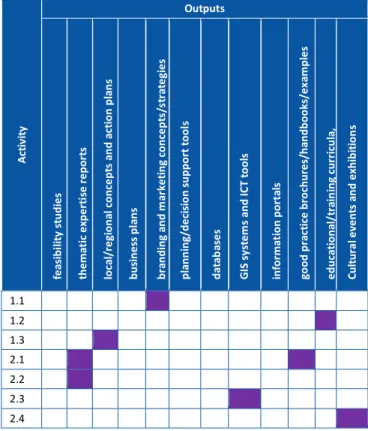
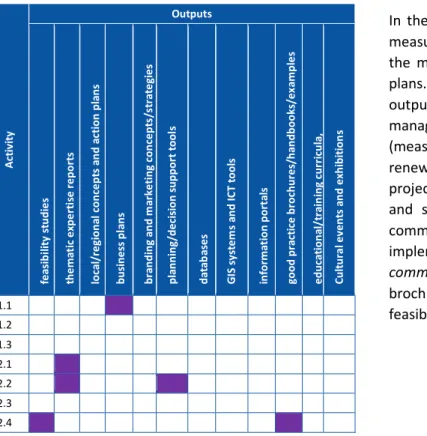
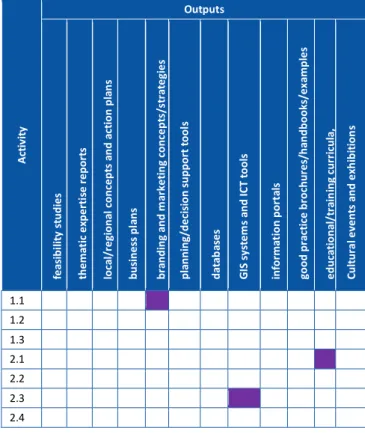
Table 4. The most common outputs of the projects led by the German Beneficiaries Ac ti vi ty Outputs fe as ib il it y s tu d ie s th e m at ic e xp e rt is e r e p o rt s lo ca l/ re gi o n al c o n ce p ts a n d a ct io n p la n s b u si n e ss p la n s b ra n d in g an d m ar ke ti n g co n ce p ts /s tr at e gi e s p la n n in g/ d e ci si o n s u p p o rt t o o ls d at ab as e s GI S sy st e m s an d IC T to o ls in fo rm at io n p o rt al s go o d p ra ct ic e b ro ch u re s/ h an d b o o ks /e xa m p le s e d u ca ti o n al /t ra in in g cu rr ic u la , C u lt u ra l e ve n ts a n d e xh ib it io n s 1.1 1.2 1.3 2.1 2.2 2.3 2.4
For the German respondents the most important outputs are as follows: handbooks, data bases, best practice reports, local and regional action plans, marketing concepts.
When it comes to the outputs of the measure 1.1 projects, German respondents showed mainly business plans that were worked out. In projects concerning integration of higher education and labour market (measure 1.2) education/training curricula are elaborated. On the field of the transport accessibility (measure 1.3) the most commonly achieved outputs were local/regional concepts and action plans. In the projects implemented within the measure 2.1 Management of the Baltic Sea Environment new thematic expertise reports and good practice brochures / handbooks / examples were developed. The most often indicated output in measure 2.2 was the thematic expertise report. GIS systems and ICT tools are the most common output of the projects concerning sustainable use of natural and cultural heritage (measure 2.3). Within the measure 2.4 Local community initiatives many cultural events and exhibitions were and will be organised.
Final Report 2. Projects results
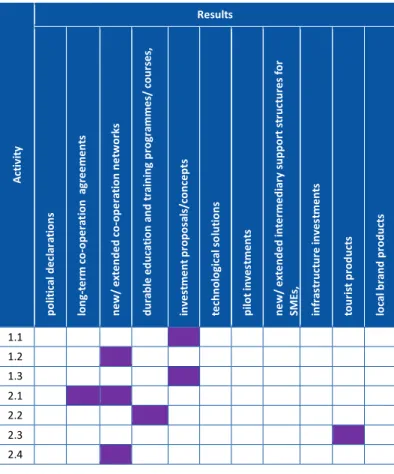
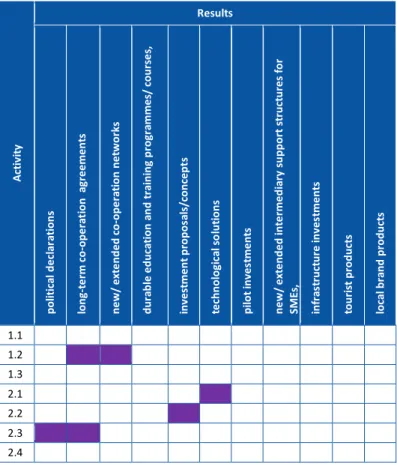
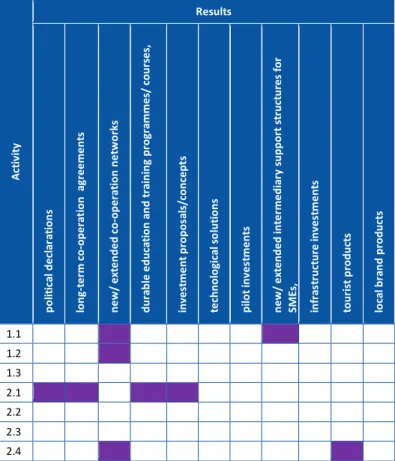
Table 5. The most common results of the projects led by the German Beneficiaries Ac ti vi ty Results p o lit ic al d e cl ar at io n s lo n g-te rm c o -o p e ra ti o n a gr e e m e n ts n e w / e xt e n d e d c o -o p e ra ti o n n e tw o rk s d u ra b le e d u ca ti o n a n d t ra in in g p ro gr am m e s/ c o u rs e s, in ve st m e n t p ro p o sa ls /c o n ce p ts te ch n o lo gi ca l s o lu ti o n s p ilo t in ve st m e n ts n e w / e xt e n d e d in te rm e d ia ry s u p p o rt s tr u ct u re s fo r SM Es , in fr as tr u ct u re in ve st m e n ts to u ri st p ro d u ct s lo ca l b ra n d p ro d u ct s 1.1 1.2 1.3 2.1 2.2 2.3 2.4
For the German respondents the most important results concerned knowledge, experience exchange and network creation. Furthermore investments, master and action plans and marketing concepts were also assessed as important. The beneficiaries mentioned also strengthening the liaisons between higher education and labour market and new touristic offers.
In the measure 1.1 Entrepreneurial development - the most often indicated type of result was investments proposal and technical solutions. Investments proposals/concepts also resulted from the projects implemented within the measure 1.3 Transport accessibility. The most common results of the projects concerning integration of higher education and labour market (measure 1.2), local community initiatives (measure 2.4) and the management of the Baltic Sea Environment (measure 2.1) are new/extended co-operation networks. To the results of the measure 2.1 also belong long term co-operation agreements. In the measure 2.2 Energy saving and the renewable energy the projects contribute to durable education and training programmes/courses. The most common result in the measure 2.3 Sustainable use of natural and cultural heritage are the touristic products.
Final Report Denmark
1. Projects outputs
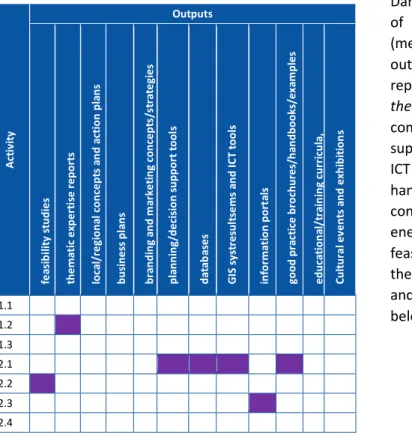
Table 6. The most common outputs of the projects led by the Danish Beneficiaries Ac ti vi ty Outputs fe as ib il it y s tu d ie s th e m at ic e xp e rt is e r e p o rt s lo ca l/ re gi o n al c o n ce p ts a n d a ct io n p la n s b u si n e ss p la n s b ra n d in g an d m ar ke ti n g co n ce p ts /s tr at e gi e s p la n n in g/ d e ci si o n s u p p o rt t o o ls d at ab as e s GI S sy st re su lt se m s an d IC T to o ls in fo rm at io n p o rt al s go o d p ra ct ic e b ro ch u re s/ h an d b o o ks /e xa m p le s e d u ca ti o n al /t ra in in g cu rr ic u la , C u lt u ra l e ve n ts a n d e xh ib it io n s 1.1 1.2 1.3 2.1 2.2 2.3 2.4
In the opinion of the Danish respondents the most important outputs are different tools and systems for decision support.
Within the projects implemented by the Danish beneficiaries concerning integration of higher education and labour market (measure 1.2) the most often indicated output referred to thematic expertise reports. In the measure 2.1 Management of the Baltic Sea Environment to the most common outputs were planning / decision support tools, databases, GIS systems and ICT tools and best practice brochures / handbooks / examples. In project concerning energy saving and the renewable energy (measure 2.2) there are many feasibility studies that were worked out. In the measure 2.3 Sustainable use of natural and cultural heritage the information portals belong to the most common outputs.
Final Report 2. Projects results
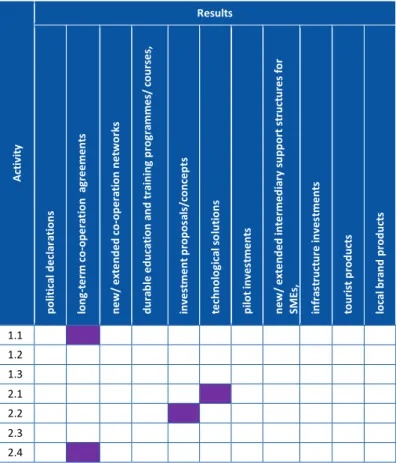
Table 7. The most common results of the projects led by the Danish Beneficiaries Ac ti vi ty Results p o lit ic al d e cl ar at io n s lo n g-te rm c o -o p e ra ti o n a gr e e m e n ts n e w / e xt e n d e d c o -o p e ra ti o n n e tw o rk s d u ra b le e d u ca ti o n a n d t ra in in g p ro gr am m e s/ c o u rs e s, in ve st m e n t p ro p o sa ls /c o n ce p ts te ch n o lo gi ca l s o lu ti o n s p ilo t in ve st m e n ts n e w / e xt e n d e d in te rm e d ia ry s u p p o rt s tr u ct u re s fo r SM Es , in fr as tr u ct u re in ve st m e n ts to u ri st p ro d u ct s lo ca l b ra n d p ro d u ct s 1.1 1.2 1.3 2.1 2.2 2.3 2.4
As the most important results the Danish beneficiaries listed cross-border networking and cooperation, knowledge exchange and new technical solutions.
When it comes to the results, the most common are long term co-operation agreements, which prevail in measure 1.2 Integration of higher education and labour market and 2.3 Sustainable use of natural and cultural heritage. In measure 1.2 also new cooperation networks were created and in 2.3 political declarations worked out. The projects concerning the management of the Baltic Sea environment resulted mostly in new technological solutions (measure 2.1). On the field of energy saving and the renewable energy (measure 2.2) new investments proposal/concepts were prepared.
Final Report Sweden
1. Projects outputs
Table 8. The most common outputs of the projects led by the Swedish Beneficiaries Ac ti vi ty Outputs fe as ib il it y s tu d ie s th e m at ic e xp e rt is e r e p o rt s lo ca l/ re gi o n al c o n ce p ts a n d a ct io n p la n s b u si n e ss p la n s b ra n d in g an d m ar ke ti n g co n ce p ts /s tr at e gi e s p la n n in g/ d e ci si o n s u p p o rt t o o ls d at ab as e s GI S sy st e m s an d IC T to o ls in fo rm at io n p o rt al s go o d p ra ct ic e b ro ch u re s/ h an d b o o ks /e xa m p le s e d u ca ti o n al /t ra in in g cu rr ic u la , C u lt u ra l e ve n ts a n d e xh ib it io n s 1.1 1.2 1.3 2.1 2.2 2.3 2.4
In the opinion of the Swedish projects’ leaders the most important outputs are feasibility studies, good practice brochures, planning/decision support tools and local actions plans.
In the projects implemented within the 1.1 measure led by the Swedish beneficiaries the most common output are the business plans. Thematic expert reports prevail in the outputs achieved in the projects concerning management of the Baltic Sea environment (measures 2.1) and energy saving and the renewable energy (measure 2.2). In the projects from the measure 2.2 also planning and support tools are created. The most common outputs in the projects implemented within the measure 2.4 Local community initiatives are good practice brochures / handbooks / examples and feasibility studies.
Final Report 2. Projects results
Table 9. The most common results of the projects led by the Swedish Beneficiaries Ac ti vi ty Results p o lit ic al d e cl ar at io n s lo n g-te rm c o -o p e ra ti o n a gr e e m e n ts n e w / e xt e n d e d c o -o p e ra ti o n n e tw o rk s d u ra b le e d u ca ti o n a n d t ra in in g p ro gr am m e s/ c o u rs e s, in ve st m e n t p ro p o sa ls /c o n ce p ts te ch n o lo gi ca l s o lu ti o n s p ilo t in ve st m e n ts n e w / e xt e n d e d in te rm e d ia ry s u p p o rt s tr u ct u re s fo r SM Es , in fr as tr u ct u re in ve st m e n ts to u ri st p ro d u ct s lo ca l b ra n d p ro d u ct s 1.1 1.2 1.3 2.1 2.2 2.3 2.4
When asked which of the achieved or potential results are the most important the Swedish beneficiaries indicate first of all the cross-border aspect in form of networks, knowledge and know-how exchange, cultural exchange. Important is also the gained acceptance of local communities, what makes the continuation of some projects possible.
In the projects led by Swedish organisations concerning the development of enterprises (measure 1.1) the most common result was creation new long term agreements. Similar situation was in the case of projects implemented within the measure 2.4. agreements concerning cooperation are the most common result. Within the projects concerning energy saving and the renewable energy (measure 2.2) there are new infrastructure investments planed. The projects implemented within the measure 2.1 Management of the Baltic Sea Environment have in many cases technical character. Their most common result are technological solutions.
Final Report Poland
1. Projects outputs
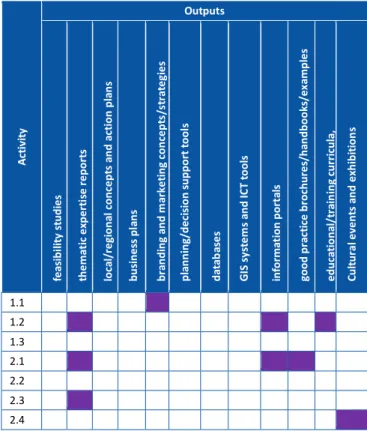
Table 10. The most common outputs of the projects led by the Polish Beneficiaries Ac ti vi ty Outputs fe as ib il it y s tu d ie s th e m at ic e xp e rt is e r e p o rt s lo ca l/ re gi o n al c o n ce p ts a n d a ct io n p la n s b u si n e ss p la n s b ra n d in g an d m ar ke ti n g co n ce p ts /s tr at e gi e s p la n n in g/ d e ci si o n s u p p o rt t o o ls d at ab as e s GI S sy st e m s an d IC T to o ls in fo rm at io n p o rt al s go o d p ra ct ic e b ro ch u re s/ h an d b o o ks /e xa m p le s e d u ca ti o n al /t ra in in g cu rr ic u la , C u lt u ra l e ve n ts a n d e xh ib it io n s 1.1 1.2 1.3 2.1 2.2 2.3 2.4
When it comes to the most important outputs indicated by the Polish Beneficiaries they could be divided into two groups. In the first one the educational and training programs will be included. They strengthen the integration and knowledge exchange. Second group are market analyses, which identify the most promising areas and new technologies.
In the case of the projects led by Polish organizations, in measures: 1.2 Integration of higher education and labour market, 2.1 Management of the Baltic Sea environment and 2.3 Sustainable use of natural and cultural heritage the most common outputs were thematic expertise reports. In the measure 1.2 also information portals and educational and training curricula were worked out. In the measure 2.1 also information portals and good practice brochures / handbooks / examples were created. The projects concerning entrepreneurial development (measure 1.1) focused on branding and marketing concepts / strategies. Within the measure 2.4 Local community initiatives cultural events and exhibitions were organized.
Final Report 2. Projects results
Table 11. The most common results of the projects led by the Polish Beneficiaries Ac ti vi ty Results p o lit ic al d e cl ar at io n s lo n g-te rm c o -o p e ra ti o n a gr e e m e n ts n e w / e xt e n d e d c o -o p e ra ti o n n e tw o rk s d u ra b le e d u ca ti o n a n d t ra in in g p ro gr am m e s/ c o u rs e s, in ve st m e n t p ro p o sa ls /c o n ce p ts te ch n o lo gi ca l s o lu ti o n s p ilo t in ve st m e n ts n e w / e xt e n d e d in te rm e d ia ry s u p p o rt s tr u ct u re s fo r SM Es , in fr as tr u ct u re in ve st m e n ts to u ri st p ro d u ct s lo ca l b ra n d p ro d u ct s 1.1 1.2 1.3 2.1 2.2 2.3 2.4
The Polish Beneficiaries indicated the cooperation networks, promotion of the region and knowledge exchange between specialists in different fields as most important results.
In measures 1.2 Integration of higher education and labour market, 2.4 Local community initiatives the most common results were the new new/extended co-operation networks. In the projects realized within the measure 1.1 Entrepreneurial development new/extended co-operation networks and new/extended intermediary support structures for SMEs were created. The most common results in the measure 2.1 Management of the Baltic Sea
Environment were differentiated and
included: political declarations, long-term operation agreements, durable education and training programmes / courses and new investment proposals / concepts. Projects from the measure 2.3 Sustainable use of natural and cultural heritage focused on touristic products.