Batteries in HP notebooks
Executive summary... 2
What is a battery pack? ... 2
Qualifying the right battery cell ... 2
Testing... 3
Qualification testing ... 3
Battery construction... 3
Battery Management Unit... 4
Additional controls... 5
Charging technologies ... 5
HP Fast Charge Technology ... 5
Charging process ... 6
Executive summary
In response to recent public concerns over the safety of Lithium-Ion batteries used in notebook
computers, this document describes the enhanced technologies and processes used to help protect HP notebooks.
HP’s commitment to quality and design excellence is clearly demonstrated in the process for selecting, designing, constructing, and utilizing batteries for HP notebooks. To minimize risk and help ensure long-term battery performance, battery cells are carefully selected and stringently tested. Battery packs are robustly constructed, with multiple redundant safety circuits, and are individually tested – alone and in-system – before reaching the customer. Charging technologies strictly adhere to cell
manufacturers’ recommendations so as not to exceed a safe maximum charging rate.
What is a battery pack?
HP uses battery packs (also known as “batteries”) manufactured by various established vendors; each battery pack contains a number of battery cells as well as associated electronics. It is common for battery pack vendors to use cells from a variety of manufacturers.
To help ensure safety and reliability, these batteries must meet or exceed stringent HP quality and safety standards and must pass rigorous testing. Moreover, HP adheres strictly to industry standards for safety while continuing to implement unique design improvements to further enhance battery safety and performance.
Qualifying the right battery cell
So that the right cell can be selected and qualified for a particular battery design, HP engineers develop extensive – and conservative – standards for the cells to be deployed in this battery. HP then thoroughly tests cells to ensure they can meet these standards – a process that can take as long as year. For example, cells receive overcharge testing at multiple charge rates to determine if, in the event of a failure, the cells would fail safely. Cells are also tested at a range of environmental temperatures to help ensure long-term reliability.
Battery cells frequently fail to meet specified criteria during initial testing. Up to 80% undergo process and/or design modifications to comply with HP requirements; over 15% never achieve a passing grade and are rejected. This qualification testing gives HP a high level of confidence that the cells deployed in HP notebook batteries will not overheat, creating a hazard to customers.
HP is aware of no other notebook OEM with such an exhaustive cell qualification process – a process that is part of HP’s commitment to creating industry-leading battery solutions.
Despite the rigor of these tests, HP understands that no make or model of battery cell is totally immune from failure or overheating. To mitigate risk, HP designs safety into battery construction and
Testing
Cells and batteries are tested at multiple stages of the development and productions process: cells are qualified for a particular battery design; then each battery is tested after being assembled and, prior to shipment, is retested in-system. HP has made a significant investment in highly-customized equipment for cycle-life and battery testing.
Qualification testing
HP performs thorough qualification tests before batteries are accepted for use in HP notebooks. Test criteria include:
• Fuel gauge accuracy and functionality
Voltage, current, temperature, capacity; communications, status
• Protection circuit functionality
Over-voltage, under-voltage, current, over-temperature, short circuit
• Environmental
ElectoStatic Discharge (ESD) protection, drop test, shock and vibration
• System integration
– Charging functionality
– Battery thermals during maximum system loading
– Inrush current tolerance – Critical hibernation
– Non-operational thermal shock
Even though each battery design meets rigorous test and design criteria, HP builds additional safety features into our batteries to minimize potential battery hazards, achieving industry-leading levels of protection for our customers.
Battery construction
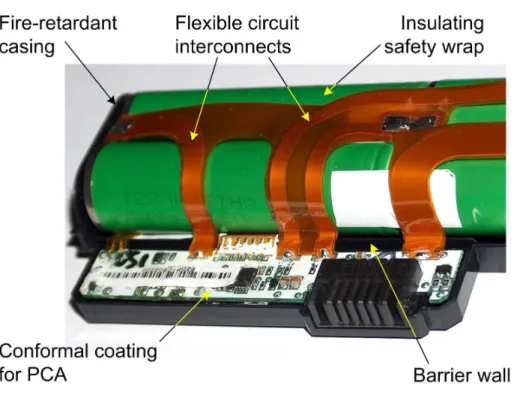
In addition to only accepting high-quality cells, HP designs and creates battery packs that further optimize safety. Strict process and quality controls are backed by a physical construction that includes the following safety measures:
• An insulating safety wrap is used to enclose the cells
• A fire-retardant casing, which conforms to rigorous safety standards, encloses the entire battery • Barrier walls isolate cells from the Printed Circuit Assembly (PCA), presenting a liquid and thermal
barrier
• The PCA has a conformal coating to protect circuitry from potential shorts
• Internal wiring and connections are designed to prevent pinching and potential short circuits Figure 1 shows several of the key construction features required by HP.
Figure 1.HP notebook batteries feature a number of built-in safety features built into their construction
HP has created – and continues to develop – proprietary technologies1to improve battery safety. Additional protection is provided through the Battery Management Unit.
Battery Management Unit
Each battery contains a Battery Management Unit (BMU) that includes multiple levels of circuitry designed to identify and safeguard against potential battery events. The BMU provides protection in the unlikely event that one of the following abnormal conditions should occur:
Condition Over-voltage Under-voltage Over-current Over-temperature Cell-imbalance
Number of redundant protection levels
Three One Three Two One
Should signs of a problem be detected, HP provides two immediate and automatic remedies within the battery: a circuit breaker and a fuse, either of which can remove the load from the battery. Even though batteries have been designed and constructed with safety in mind and provide layers of redundancy in case something should go wrong, still more controls are provided at the system level.
Additional controls
HP notebooks feature the following controls to mitigate the risk of overheating or overcharging batteries:
• HP notebooks are designed to minimize heat within the system, with the needs of the battery being a key consideration in this process. Unlike some competitors’ products, each HP notebook’s thermal solution is designed to maintain the entire battery pack at a safe operating temperature and create a consistent temperature gradient across the pack. An inconsistent gradient can lead to the
premature aging of certain cells, causing an imbalance and accelerating capacity loss.
• The power load on the system is managed so that, if battery over-heating were detected, the system would initially be throttled; if the over-heating were to continue, the system would be shut down. Note that, in the event there is insufficient power to run the system, a controlled shutdown would occur to avoid the risk of data loss.
• HP Info Center provides a battery diagnostic utility that can verify battery functionality and health. • HP battery charging technologies are designed to minimize risk and ensure excellent long-term
performance.
In addition, the battery team at HP maintains design guidelines that are regularly updated based on field experience, industry direction, and competitive analysis. All battery packs are designed to conform to these guidelines and are tested accordingly. Furthermore, HP battery cells and batteries comply with current industry standards (as listed inAppendix A).
HP also takes an active role in the industry, supporting the development of safer battery technologies and encouraging vendors to enhance their products.
Charging technologies
HP provides the following battery-charging technologies, which are described below: • HP Fast Charge Technology
• HP Enhanced Fast Charge Technology
HP Fast Charge Technology
To minimize risk and help ensure excellent long-term performance, HP Fast Charge Technology includes the following features:
• Charge rates comply with recommendations provided by Lithium Ion cell manufacturers. • Proven industry-standard algorithms control battery voltage and charging current.
• Redundant safety mechanisms in both the battery pack and the notebook itself help prevent over-charging.
Charging process
The rate at which current is supplied to a battery determines charging time; over-charging, however can cause long-term damage to battery cells.
To help ensure batteries are not over-charged, HP Fast Charge Technology applies the maximum recommended charge rate only until a carefully-selected target voltage has been reached – typically after around 45 minutes, when the battery is approximately 55% charged. At this point, the current-taper phasebegins.
During the current-taper phase, HP Fast Charge Technology continues to charge the battery, slowly reducing the charging current to maintain the target voltage. When the charging current has tapered off to a specified level – after an additional 45 minutes or so – the current-taper phase is complete. After approximately 90 minutes of charging (fast charge and current-taper), the battery is now around 90% charged. When the 90% level is reached, the amberChargeLED turns green, indicating that the battery is nearly fully charged.
Completion of charging to 100% can take approximately another 30 minutes, at which time the
ChargeLED is turned off.
HP Enhanced Fast Charge Technology
HP Enhanced Fast Charge Technology can optimize overall charge time on notebooks deploying an HP Extended Life Battery.
The charge sequence is as follows:
1. The primary battery fast-charges to 90% of its capacity within 90 minutes.
2. The HP Extended Life Battery fast-charges to 90%.
3. The primary battery continues to charge to 100%.
4. The HP Extended Life Battery continues to charge to 100%.
Appendix A – Industry standards
HP battery cells and batteries comply with the following current industry standards: • IEEE 1625
Institute of Electrical and Electronics Engineers (IEEE) 1625 – guidelines for design, manufacture and testing of Lithium-Ion battery cells and packs
(http://standards.ieee.org/announcements/pr_1625.html) • UL 1642
Underwriters Laboratories (UL) 1642 – standard for safety for Lithium batteries (http://ulstandardsinfonet.ul.com/scopes/scopes.asp?fn=1642.html)
• UL2054
Standard for safety for household and commercial batteries
(http://ulstandardsinfonet.ul.com/scopes/scopes.asp?fn=2054.html) • IEC 61960
International Electrotechnical Commission (IEC) 6190 – for secondary cells and batteries containing alkaline or other non-acid electrolytes – secondary Lithium cells and batteries for portable
applications • IEC 62133
For secondary cells and batteries containing alkaline or other non-acid electrolytes – for sealed secondary cells and for batteries made from them, for use in mobile applications
© 2006 Hewlett-Packard Development Company, L.P. The information contained herein is subject to change without notice. The only warranties for HP products and services are set forth in the express warranty statements accompanying such products and services. Nothing herein should be construed as constituting an additional warranty. HP shall not be liable for technical or editorial errors or omissions contained herein.