2008 Wireless LAN Series
State-of-the-Market Report
October 2008: WLAN Deployment Trends Page 2-1
WLAN Deployment Trends
Networks, Devices, Security
Introduction and Summary
This report, the second in a series, discusses enterprise deployment trends pertaining to Wi-Fi networks, devices and security. The trends reflect partial results of the fifth annual wireless LAN (WLAN) survey conducted by the Webtorials Editorial/Analyst Division. Responses were gathered in August 2008 from several hundred members of the Webtorials subscriber base who said they currently played a role in their organizations’ WLAN implementations.
The results showed that WLANs of some flavor have been deployed throughout the common areas of many respondents’ organizations (83%). Like last year, fewer companies (55%) have covered individual workspaces with Wi-Fi infrastructure. Virtually all respondents said that some number of their employees carried at least one Wi-Fi-enabled device; in fact, 47% of respondents said that at least half of their organization’s employee population had one or more Wi-Fi devices, up from just 34% last year. Among the other noteworthy developments:
• Next-generation 802.11n products, though still in pre-standard form, are gaining respect as
enterprise requirements grow and the IEEE standards ratification process continues to languish.
• WLAN deployments currently outpace broadband/3G cellular adoption and, according to user
plans, will continue to do so.
• Data-only client devices such as laptops remain far and away the most largely deployed
Wi-Fi access devices. However, dual-mode smartphones are poised for growth and will outpace deployment of single-mode Wi-Fi voice handsets by nearly two times.
• Centralized management of Wi-Fi networks has grown dominant, though some pockets of
independent, individually managed wireless access points (APs) remain active and mesh is attracting new interest.
• Security remains enterprises’ biggest concern when scaling their Wi-Fi deployments, even
though organizations are growing sophisticated in their own security measures and don’t seem to fear noncompliance with governance mandates.
The remainder of this report examines each of these trends in more detail. This is the second document in the 2008 Wireless LAN Series, with other publications including additional documents, demographics,
2008 Wireless LAN Series
State-of-the-Market Report
October 2008: WLAN Deployment Trends Page 2-2
Pre-Standard 802.11n Gains Respect
Pre-standard, or “Draft N,” 802.11n networks are being more largely embraced in their current form than they were last year. More than a third of respondents (38%) now say they intend to deploy 802.11n ahead of standards ratification in some form, compared to 17% in 2007.
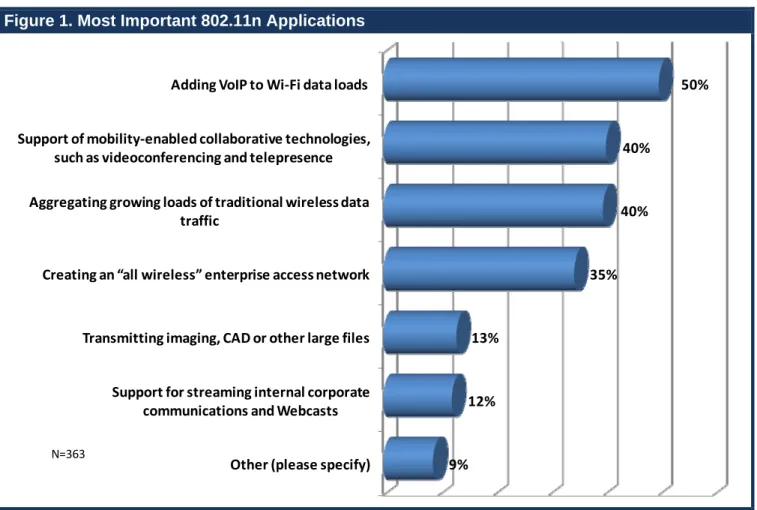
Last year, the number of respondents currently needing the bandwidth afforded by 802.11n (100Mbps+ throughput) and planning to deploy it ahead of formal standards ratification was just 1%. That figure jumped to 16% this year. Similarly, in 2007, 15% of respondents said they would tinker with Draft N deployments in controlled pilots or in limited areas of the company. That percentage grew to 22% in 2008. The reasons for the attitude shift? The standards process continues to experience delays while data loads in general continue to grow, as do enterprise plans for adding VoIP traffic to their wireless networks (Figure 1).
Figure 1. Most Important 802.11n Applications
Other (please specify) Support for streaming internal corporate
communications and Webcasts Transmitting imaging, CAD or other large files Creating an “all wireless” enterprise access network Aggregating growing loads of traditional wireless data
traffic
Support of mobility‐enabled collaborative technologies,
such as videoconferencing and telepresence Adding VoIP to Wi‐Fi data loads
9% 12%
13%
35% 40%
40%
50%
N=363
Increasing volumes of traditional data traffic and adding VoIP to the mix will drive 802.11n deployments, but plans for new applications and going “all wireless” also add fuel to the business justification.
2008 Wireless LAN Series
State-of-the-Market Report
October 2008: WLAN Deployment Trends Page 2-3
The figure also shows that support for collaborative applications such as videoconferencing and telepresence are making strong contributions toward driving 11n deployments (40%). So is enterprise anticipation of eventually using 802.11n to create an all-wireless enterprise access network (35%), though 61% had no plans to build an all-wireless network right away.
Despite the 11n excitement, a limited volume of 802.11n has actually been deployed. Nearly two thirds of respondents (62%) said none of their users currently use 11n and just 22% said that between 1% and 10% of their users were 11n-enabled.
But the formal IEEE standards process delays with the 802.11n standard are forcing enterprises to consider products not strictly defined as standard but that the Wi-Fi Alliance industry consortium has certified as interoperable. As of late September 2008, the Alliance had Wi-Fi-certified 415 products, both consumer and enterprise class, as interoperable based on the 802.11n Draft 2.0 set of specifications, adding a margin of comfort as to the utility and investment protection of early products. The Alliance began Draft N certification in June 2007, shortly after last year’s Webtorials WLAN State-of-the-Market survey was completed. According to the official IEEE 802.11 working group project timelines as of late
September 2008, the IEEE 802.11 Working Group approval for 802.11n is expected in January 20101.
Network Preferences
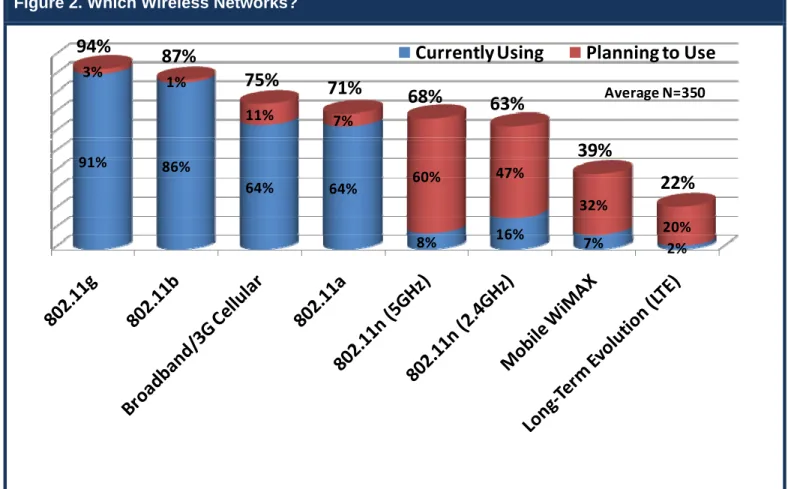
Most enterprises surveyed (91%) were using 802.11g, the 2.4GHz, 54Mbps standard WLAN that is backward compatible with 11Mbps 802.11b networks. 802.11b was in use by 86% of respondents. Use of the 5GHz frequency band, however, is rising. This year, 64% of respondents reported having 802.11a networks in use, up from 48% last year. 802.11a and cellular data network usage has been about even: Last year, 45% said they were using traditional cellular data networks, a percentage that also grew to 64% this year.
Going forward, however, plans change. Enterprises intend to largely halt deploying 802.11a/b/g networks and begin using 802.11n in the 5GHz range (60%), which affords more channels for network design flexibility and is currently less crowded, as well as in the 2.4GHz range (47%). These numbers dwarf traditional mobile WAN use (Figure 2), though nearly a third (32%) plan to use newer mobile WiMAX services. Another 20% expressed plans to use Long-Term Evolution (LTE), a nascent platform not yet commercialized that will move today’s CDMA-based networks to GSM-based broadband technology, which is standard around the world.
1
2008 Wireless LAN Series
State-of-the-Market Report
October 2008: WLAN Deployment Trends Page 2-4
Management and Architectural Attitudes
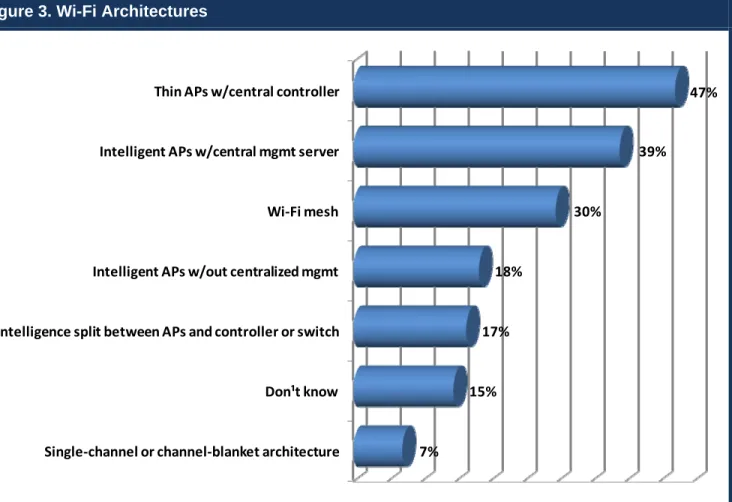
About the same percentage of respondents continue to migrate to thin APs with a centralized controller architecture as last year (47% are using or planning to use). A healthy number are also going the route of controller-less intelligent APs albeit with a centralized management and security provisioning system (39%). Standalone intelligent APs that are individually managed, rather than centrally managed, continue to persevere in 18% of respondents’ organizations, down from 27% last year.
Fewer respondents than last year indicated an intention to move to newer “split” or “hybrid” architectures that move some latency-sensitive capabilities out of the controller to the AP or Ethernet switch (17% in 2008 compared with 23% in 2007). Meanwhile, respondents have grown more interested in mesh networking; 30% indicated current or planned use of Wi-Fi mesh this year compared with 23% last year (Figure 3).
Figure 2. Which Wireless Networks?
91% 86%
64% 64%
8% 16% 7% 2%
3%
1%
11% 7%
60% 47%
32%
20%
Currently
Using
Planning
to
Use
Average N=350
94%
87%
75%
71%
68%
63%
39%
22%
Dominant networks in use today are 802.11g and 802.11b networks, though enterprises plan to move to 802.11n, particularly in the less cluttered 5GHz band, and to broadband mobile WAN services as they become available.
2008 Wireless LAN Series
State-of-the-Market Report
October 2008: WLAN Deployment Trends Page 2-5
The increased interest in mesh is likely being fueled by a couple of factors. For one, most of the Draft 802.11n products that have hit the market support mesh transmission, whereby APs communicate over the air to one another directly, as in a wired router network, without each AP having to be cabled back to a LAN switch. Combining 802.11n speeds with mesh creates an effective backhaul technology for lower-speed WLAN access networks and contributes to enterprises’ stated intentions to strive toward all-wireless networking by “uncabling” a significant portion of the enterprise network.
Figure 3. Wi-Fi Architectures
Single‐channel or channel‐blanket architecture Don¹t know Intelligence split between APs and controller or switch Intelligent APs w/out centralized mgmt Wi‐Fi mesh Intelligent APs w/central mgmt server Thin APs w/central controller
7%
15% 17%
18%
30%
39%
47%
2008 Wireless LAN Series
State-of-the-Market Report
October 2008: WLAN Deployment Trends Page 2-6
Nagging Security Challenges
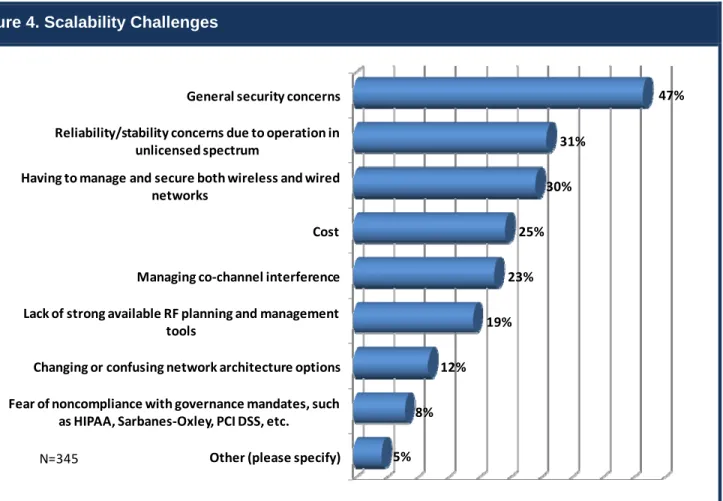
Webtorials WLAN survey respondents consistently have cited security concerns relating to several aspects of Wi-Fi deployment, despite both industry and enterprise implementation progress with the latest security mechanisms. For example, 47% of respondents cited “general security concerns” as the one of the two biggest challenges to scaling Wi-Fi deployments throughout most or all of their organizations. In a fairly distant second place were reliability and stability concerns related to Wi-Fi’s operation in unlicensed spectrum (31%).
Still, a mere 8% cited fear of noncompliance with governance mandates such as HIPAA, SOX, PCI DSS and others as a challenge to scaling their Wi-Fi deployments, which are security related (Figure 4).
And the sophistication of enterprise deployment of the many layers of security required is growing rapidly. This year, a very respectable 47% of respondents said they had deployed WPA2/802.11i, the tightest form of WLAN authentication security, compared to 41% last year. Use of wireless VLANs, IPSec or SSL VPNs over their WLANs, and wireless intrusion detection/prevention systems either from a third party or their primary WLAN supplier stayed about the same as last year, each falling between a respectable 36% and 40%.
Figure 4. Scalability Challenges
Other (please specify) Fear of noncompliance with governance mandates, such
as HIPAA, Sarbanes‐Oxley, PCI DSS, etc. Changing or confusing network architecture options Lack of strong available RF planning and management
tools
Managing co‐channel interference Cost Having to manage and secure both wireless and wired
networks
Reliability/stability concerns due to operation in
unlicensed spectrum
General security concerns
5% 8%
12% 19%
23% 25%
30% 31%
47%
N=345
General concerns about RF security and management accounted for the lion’s share of perceived challenges to scaling Wi-Fi deployments enterprise-wide.
2008 Wireless LAN Series
State-of-the-Market Report
October 2008: WLAN Deployment Trends Page 2-7
Conclusion
From an infrastructure perspective, 802.11g and b networks have become pervasive, at work in nearly all the respondents’ organizations. Forward-thinking enterprises are now looking more closely at
pre-standard 802.11n networks, in part because their bandwidth and coverage needs are rising while ratification dates for the standard keep getting delayed.
VoIP promises to play a large role in Wi-Fi growth: Webtorials members cite VoIP as one of the key drivers of their need for 802.11n bandwidth, yet deployments have been somewhat delayed because key standards that contribute to quality of service, 802.11r and 802.11k, have only just been ratified. Use of VoIP-enabled Wi-Fi handsets will likely further pick up next year, once the Wi-Fi Alliance’s Voice-Enterprise certification program gets going in mid 2009.
Given that management and security rank high on respondents’ list of scalability concerns, it’s no wonder that the popularity of centralized Wi-Fi management and security has picked up. Still, old habits die hard, and pockets of standalone, unmanaged APs remain and will likely linger into the foreseeable future.
A Word from the Sponsor – Motorola
Motorola offers a comprehensive portfolio of wireless LAN (WLAN) infrastructure solutions designed to enable the truly wireless enterprise, regardless of the size of your business - from large enterprises with locations all over the world to branch offices and small businesses. Delivering internet protocol (IP) coverage to virtually all spaces both indoors and outdoors, Motorola's innovative wireless enterprise portfolio includes fixed broadband, mesh and enterprise WLAN solutions. With time-proven resiliency, security and performance equal to or greater than that of a wired network, Motorola’s solutions substantially reduce network deployment and maintenance costs, and ensure the availability of
cost-effective wireless connectivity in every corner of the enterprise. The result is the truly wireless enterprise
- offering full mobility at a fraction of the cost of a traditional wired network.
2008 Wireless LAN Series
State-of-the-Market Report
October 2008: WLAN Deployment Trends Page 2-8
About the Webtorials
®Editorial/Analyst Division
The Webtorials® Editorial/Analyst Division, a joint venture of industry veterans Steven Taylor and Jim
Metzler, is devoted to performing in-depth analysis and research in focused areas such as Metro Ethernet and MPLS, as well as in areas that cross the traditional functional boundaries of IT, such as Unified Communications and Application Delivery. The Editorial/Analyst Division’s focus is on providing actionable insight through custom research with a forward looking viewpoint. Through reports that examine industry dynamics from both a demand and a supply perspective, the firm educates the marketplace both on emerging trends and the role that IT products, services and processes play in responding to those trends.
For more information and for additional Webtorials® Editorial/Analyst Division products, please contact
Jim Metzler at [email protected] or Steven Taylor at [email protected].
Primary author of this Webtorials State-of-the-Market Report Series is independent technology analyst
Joanie Wexler ([email protected]).
Published by Webtorials Editorial/Analyst
Division
www.Webtorials.com
Division Cofounders:
Jim Metzler
Steven Taylor
Professional Opinions Disclaimer
All information presented and opinions expressed in this publication represent the current opinions of the author(s) based on professional judgment and best available information at the time of the presentation. Consequently, the information is subject to change, and no liability for advice presented is assumed. Ultimate responsibility for choice of appropriate solutions remains with the reader.
Copyright © 2008, Webtorials
For editorial and sponsorship information, contact Jim Metzler or Steven Taylor. The Webtorials Editorial/Analyst Division is an analyst and consulting joint venture of Steven Taylor and Jim Metzler.