STATE OF CALIFORNIA Edmund G. Brown Jr., Governor
PUBLIC UTILITIES COMMISSION
505 VAN NESS AVENUE SAN FRANCISCO, CA 94102-3298
March 14, 2016
Advice Letters: 3366-E & 3366-E-A
Russell G. Worden
Managing Director, State Regulatory Operations
Southern California Edison Company
8631 Rush Street
Rosemead, CA 91770
SUBJECT: Proposed Modifications to California Solar Initiative Program
Handbook to Incorporate Changes to Performance-Based Incentive
Payment Structure in compliance with Decision 15-12-023
Dear Mr. Worden:
Advice Letters 3366-E and 3366-E-A are effective as of February 16, 2016.
Sincerely,
Edward Randolph, Director
Energy Division
Russell G. Worden
Managing Director, State Regulatory Operations
February 16, 2016
ADVICE 3366-E
(Southern California Edison Company - U 338-E)
ADVICE 68
(Center for Sustainable Energy®)
ADVICE 4794-E
(Pacific Gas and Electric Company - U 39 M)
PUBLIC UTILITIES COMMISSION OF THE STATE OF CALIFORNIA
ENERGY DIVISION
SUBJECT:
Proposed Modifications to California Solar Initiative Program
Handbook to Incorporate Changes to Performance-Based
Incentive Payment Structure in compliance with Decision
15-12-023
PURPOSE
In accordance with Commission Decision (D.)15-12-023 issued on December 17, 2015,
Southern California Edison Company (SCE), on behalf of the California Solar Initiative
(CSI) Program Administrators (PAs),
1hereby submits this advice filing to propose
modifications to the CSI Program Handbook to incorporate changes to the
Performance-Based Incentive (PBI) payment structure in compliance with D.15-12-023.
BACKGROUND
D.06-08-028 adopted the PBI payment structure for the CSI program and mandated that
the PAs pay any solar facility receiving the PBI incentive rate for its actual output. The
current PBI payment structure ensures ratepayer subsidies for solar are based on
effective system design, installation, and ultimately on performance and not simply the
1 The CSI PAs are Pacific Gas and Electric Company (PG&E), Southern California Edison
ADVICE 3366-E
(U 338-E) - 2 - February 16, 2016
rated capacity of the physical components. The PAs were directed to award these
incentives monthly, over a five-year period, without exceeding their individual CSI
budgets. The five-year period was categorized as a “short payment period”, as
compared to the other proposed longer payment periods, and seen as beneficial
specifically for administrative purposes.
Under the current rules, projects participating in PBI will continue receiving payments
after the CSI program has concluded, potentially requiring the PAs to process PBI
payments for as many as seven years or more past the sunset of the CSI program.
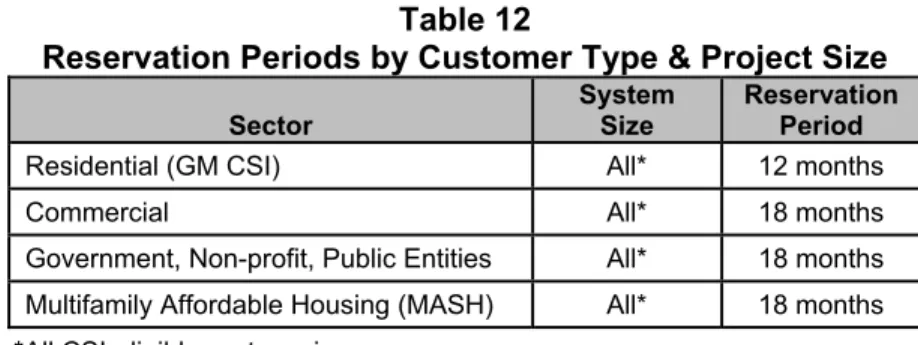
More specifically, the initial reservation period for the Residential sector is 12 months
and 18 months for the Non-Residential sector. School or Community College Districts,
University of California, and California State Universities are allowed to take up to three
180-day extensions. Each of these initial timeframes is then followed by 60 months of
payments to complete the PBI timeline. Under this current protocol, the latest potential
PBI payment end date for a Community College District project, for example, will be
December 2024, which is eight years after the sunset of the CSI program. Moreover,
this date potentially could be extended further should PBI reporting be interrupted due
to communication errors, or if the application is suspended at any time during the review
process.
D.15-12-023 was signed by the Commission at its December 17, 2015 Commission
Meeting, granting the Petition for Modification of the Performance-Based Incentive
Payment Structure by the Program Administrators of the California Solar Initiative to
allow for an expedited lump-sum buyout for eligible PBI projects post CSI sunset.
2In
accordance with D.15-12-023, the CSI PAs hereby propose amendments to the CSI
Program Handbook to incorporate this change to the PBI payment structure.
PROPOSED MODIFICATIONS TO CSI PROGRAM HANDBOOK
The proposed revisions to the current version of the CSI Program Handbook are
summarized below and included in Attachment A to this advice filing.
Incorporates the modified PBI reporting durations adopted in D.15-12-023
The following sections have been expanded to include clarifying language that a PBI
projects’ reporting timeline may range from two to five years, as opposed to the former
five-year minimum, and is dependent on the projects’ eligibility for the Expedited Lump
Sum Buyout incentive structure.
ADVICE 3366-E
(U 338-E) - 3 - February 16, 2016
Integrates the Expedited Lump Sum Buyout incentive structure and process adopted in
D.15-12-023
The following sections and tables have been added and/or expanded to provide
definitions, explanations, and examples of the PBI Lump Sum Buyout process, payment
terms, and dispute resolution.
Affected Sections: 1.9; 3.3; 3.3.1; 3.3.1.1; 3.3.1.2; 3.3.1.3; 4.7.2.2; Table 10; Table 11;
Appendix A “Definitions”; Appendix E.
Clarifies the PMRS and PDP requirements for projects eligible for the PBI Expedited
Lump Sum Buyout incentive structure adopted in D.15-12-023
Due to the reporting duration changes resulting from the Expedited Lump Sum Buyout
incentive structure, the CSI PAs find it necessary to clarify the PMRS and PDP
requirements that remain enforceable within the PBI Program.
Affected Sections: 4.11.3.2; 5.2; 10
Refers readers to the California Solar Statistics webpage regarding the current status of
each PA’s acceptance of new PDP applications
The PAs are no longer accepting new PDP applications, as agreed upon during a 2015
CSI Working Group meeting. This addition to the Handbook refers readers to the
California Solar Statistics (CSS) webpage for the current status of each PA’s
acceptance of new PDP applications.
Affected Section: 10
Includes updates to the Program Administrator Contact Information and Other Useful
Resources
SCE has updated its PA contact phone number for the CSI Program, and updated links
to the new Solar Contractor database and the CPUC website have also been
incorporated.
Affected Section: 1.8; 10
TIER DESIGNATION
Pursuant to Ordering Paragraph 2 of D.15-12-023 and General Order (GO) 96-B,
Energy Industry Rule 5.1, this advice letter is submitted with a Tier 1 designation.
ADVICE 3366-E
(U 338-E) - 4 - February 16, 2016
EFFECTIVE DATE
This advice filing will become effective on February 16, 2016, the same date filed.
NOTICE
Anyone wishing to protest this Advice Letter may do so by letter sent via U.S. mail, by
facsimile or electronically, any of which must be received no later than March 7, 2016,
which is twenty (20) days after the filing of this Advice Letter. Protests should be
submitted to:
CPUC Energy Division
Attention: Tariff Unit
505 Van Ness Ave., 4
thFloor
San Francisco, CA 94102
Email:
[email protected]
Copies of the protest should also be sent to the attention of the Director, Energy
Division, Room 4004, at the address shown above.
A copy of the protest should also be sent via e-mail and U.S. mail to the addresses
shown below on the same date it is mailed or delivered to the Commission:
For SCE:
Russell G. Worden
Managing Director, State Regulatory Operations
Southern California Edison Company
8631 Rush Street
Rosemead, California 91770
Facsimile: (626) 302-4829
E-mail:
[email protected]
Michael R. Hoover
Director, State Regulatory Affairs
c/o Karyn Gansecki
Southern California Edison Company
601 Van Ness Avenue, Suite 2030
San Francisco, California 94102
Facsimile: (415) 929-5544
ADVICE 3366-E
(U 338-E) - 5 - February 16, 2016
For CSE:
Sachu Constantine
Director of Policy
Center for Sustainable Energy®
9325 Sky Park Court, Suite 100
San Diego, CA 92123
E
‐
mail:
[email protected]
For PG&E:
Erik Jacobson
Director, Regulatory Relations
c/o Megan Lawson
Pacific Gas and Electric Company
77 Beale Street, Mail Code B10C
P.O. Box 770000
San Francisco, California 94177
Facsimile: (415) 973
‐
7226
E
‐
mail:
[email protected]
There are no restrictions as to who may file a protest, but the protest shall set forth
specifically the grounds upon which it is based and must be received by the deadline
shown above.
In accordance with General Rule 4 of GO 96-B, SCE is serving copies of this advice
filing to the interested parties shown on the attached GO 96-B and R.12-11-005 service
lists. Address change requests to the GO 96-B service list should be directed by
electronic mail to
[email protected]
or at (626) 302-3719. For changes to
all other service lists, please contact the Commission’s Process Office at
(415) 703-2021 or by electronic mail at
[email protected]
.
Further, in accordance with Public Utilities Code Section 491, notice to the public is
hereby given by filing and keeping the advice filing at SCE’s corporate headquarters.
To view other SCE advice letters filed with the Commission, log on to SCE’s web site at
ADVICE 3366-E
(U 338-E) - 6 - February 16, 2016
For questions, please contact Kathy Wong at (626) 302-2327 or by electronic mail at
[email protected]
Southern California Edison Company
/s/ Russell G. Worden
Russell G. Worden
RGW: kw:cm
CALIFORNIA PUBLIC UTILITIES COMMISSION
ADVICE LETTER FILING SUMMARY
ENERGY UTILITY
MUST BE COMPLETED BY UTILITY (Attach additional pages as needed) Company name/CPUC Utility No.: Southern California Edison Company (U 338-E)
Utility type: Contact Person: Darrah Morgan
ELC GAS Phone #: (626) 302-2086
PLC HEAT WATER E-mail: [email protected]
E-mail Disposition Notice to: [email protected]
EXPLANATION OF UTILITY TYPE
ELC = Electric GAS = Gas
PLC = Pipeline HEAT = Heat WATER = Water
(Date Filed/ Received Stamp by CPUC)
Advice Letter (AL) #: 3366-E Tier Designation: 1
Subject of AL: Proposed Modifications to California Solar Initiative Program Handbook to Incorporate
Changes to Performance-Based Incentive Payment Structure in compliance with Decision 15-12-023
Keywords (choose from CPUC listing): Compliance
AL filing type: Monthly Quarterly Annual One-Time Other
If AL filed in compliance with a Commission order, indicate relevant Decision/Resolution #: Decision 15-12-023
Does AL replace a withdrawn or rejected AL? If so, identify the prior AL: Summarize differences between the AL and the prior withdrawn or rejected AL: Confidential treatment requested? Yes No
If yes, specification of confidential information:
Confidential information will be made available to appropriate parties who execute a nondisclosure agreement. Name and contact information to request nondisclosure agreement/access to confidential information:
Resolution Required? Yes No
Requested effective date: 2/16/16 No. of tariff sheets: -0- Estimated system annual revenue effect: (%):
Estimated system average rate effect (%):
When rates are affected by AL, include attachment in AL showing average rate effects on customer classes (residential, small commercial, large C/I, agricultural, lighting).
Tariff schedules affected: None
Service affected and changes proposed1:
Protests and all other correspondence regarding this AL are due no later than 20 days after the date of this filing, unless otherwise authorized by the Commission, and shall be sent to:
CPUC, Energy Division Attention: Tariff Unit 505 Van Ness Avenue
San Francisco, California 94102
E-mail:
[email protected]
Russell G. Worden
Managing Director, State Regulatory Operations Southern California Edison Company
8631 Rush Street
Rosemead, California 91770 Facsimile: (626) 302-4829
E-mail: [email protected]
Michael R. Hoover
Director, State Regulatory Affairs c/o Karyn Gansecki
Southern California Edison Company 601 Van Ness Avenue, Suite 2030 San Francisco, California 94102 Facsimile: (415) 929-5544
Attachment A
California Solar Initiative Program Handbook
February 2016
February 2016 Handbook:
What’s New
This February 2016 version of the Handbook includes modifications offered in Decision
15-12-023 Granting the Petition for Modification of the Performance-Based Incentive
Payment Structure by the Program Administrators of the California Solar Initiative,
signed by the Commission at its December 17, 2015 Commission Meeting.
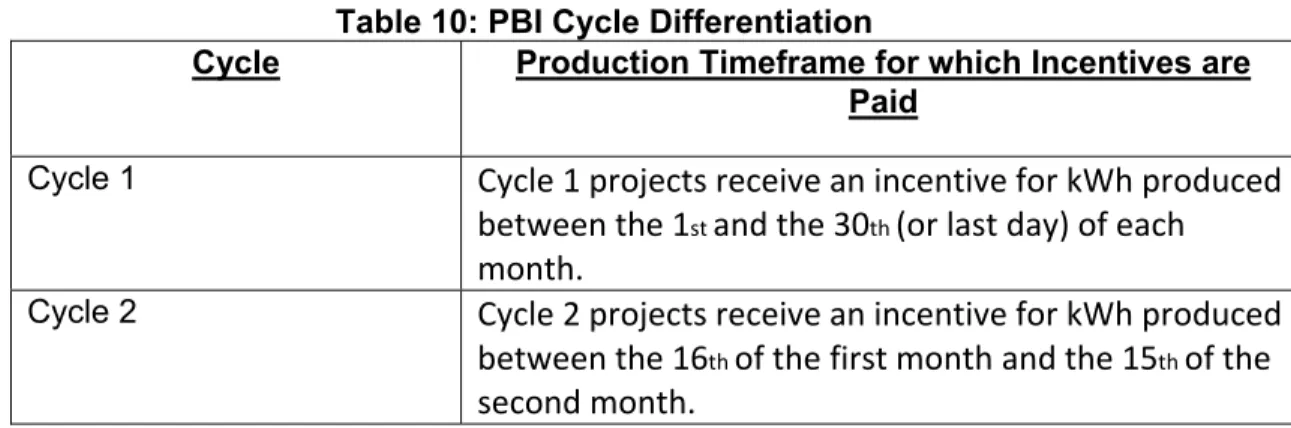
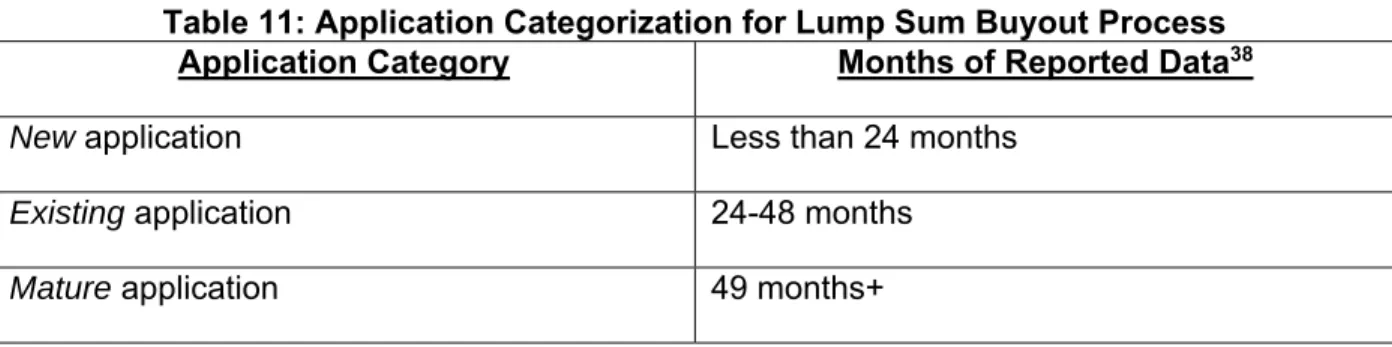
The following sections have been expanded to address the modified PBI reporting
duration, ranging from two-five years: 1.1.4; 1.5; 2.5; 3; 3.3; 4.7.2.2; 5.2; 5.5.2.
The following section has been added and/or expanded to explain the PBI Lump Sum
Buyout Process, Payment Terms, and Dispute Resolution: 3.3.1; 3.3.1.1; 3.3.1.2;
3.3.1.3; 4.7.2.2
The following tables have been added to explain the PBI Lump Sum Buyout Process:
10; 11.
The following sections have been expanded to clarify the PMRS and PDP requirements
that remain enforceable within the PBI Program: 4.11.3.2; 5.2; 10.
Section 1.8 has been modified to reflect the current contact phone number for SCE, the
updated link to the new solar contractor database, and the updated link to important
program information and proceedings on the CPUC website.
Section 1.9, ‘Acronyms’, has been expanded to include “Performance Factor (PF)”.
Section 10 has been expanded to include reference to the California Solar Statistics
webpage for the current status of each PAs acceptance of new PDP applications and
has been modified to reflect the current contact phone number for SCE.
Appendix A, ‘Definitions’ have been expanded to include “CSI Sunset Date (CSI-GM)”;
“PBI Existing Application”; “PBI Lump Sum Buyout”; “PBI Mature Application”; “PBI New
Application”; ”Performance Factor” and “Program Closure Date” .
Appendix E has been added to provide examples of PBI Lump Sum Buyout calculations
for
New
applications and
Existing
applications, within the PBI program.
The California Public Utilities Commission (CPUC) prohibits discrimination in employment, its regulatory programs, and activities on the basis of race, national origin, color, creed, religion, sex, age, disability, veteran status, sexual orientation, gender identity, or associational
preference. The CPUC also affirms its commitment to providing equal opportunities and equal access to CPUC regulated facilities and programs. For additional information or to file a complaint, contact the State Personnel Board, Office of Civil Rights, Discrimination Complaint Monitoring and Analysis, Kristen Trimarche (916) 653-1621.
Photo Credits: San Pasqual Avocado Company Courtesy: Center for Sustainable Energy
Table of Contents
1. Introduction: California Solar Initiative Program ... 1
1.1 Program Overview ... 1
1.2 California Solar Initiative Statewide Eligibility ... 8
1.3 CSI Application Process ... 8
1.4 Getting Started with Solar ... 9
1.5 Getting Paid: A Quick Guide to CSI Incentives ... 11
1.6 CSI Program Forum and Future Program Changes ... 12
1.7 CSI Handbook Structure ... 12
1.8 CSI Program Administrator Contact Information and Other Useful Resources ... 13
1.9 Acronyms ... 17
Program Section ... 20
2. Program Eligibility Criteria and Requirements ... 21
2.1 CSI Program Participants ... 21
2.2 Generation System Equipment Eligibility ... 26
2.3 Energy-Efficiency Requirements ... 31
2.4 Warranty Requirements ... 35
2.5 Performance and Permanency Requirements ... 36
2.6 Interconnection to the Electric Utility Distribution System ... 37
2.7 Metering Requirements ... 38
2.8 Inspection Requirements ... 39
2.9 Measurement and Evaluation Requirements ... 39
2.10 CSI Program Database Requirements ... 39
2.11 Additional Requirements and Terms ... 40
3. California Solar Initiative Incentive Structure ... 41
3.1 GM CSI Program Incentive Trigger Mechanism ... 41
Table of Contents
3.4 Incentive Limitations ... 52
4. Application Process for CSI Projects ... 57
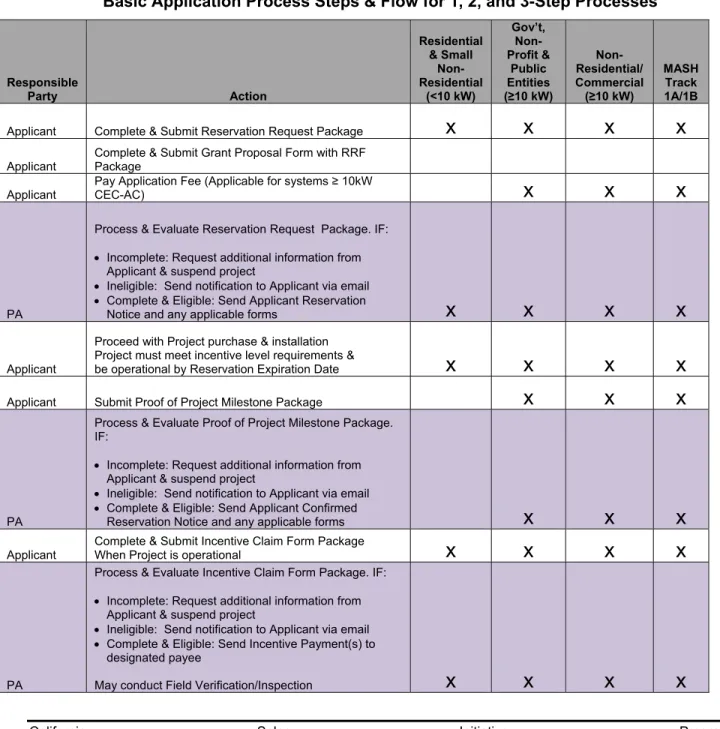
4.1 1-, 2- & 3-Step Application Processes ... 57
4.2 1-Step Application Process ... 59
4.3 2-Step Application Process for GM CSI Small (< 10 kW) Non-Residential and All Residential Projects ... 61
4.4 3-Step Application Process for Large Non-Residential Projects (≥10 kW) ... 65
4.5 Application Process for MASH Projects ... 73
4.6 Changes to Reservations ... 79
4.7 Incentive Payment Process ... 81
4.8 System Changes Affecting Incentive Amount ... 85
4.9 CSI Project Review ... 85
4.10 Notifications, Sanctions and Dispute Resolution ... 89
4.11 Application Forms and Documentation ... 92
4.12 Expended Budget Guidelines ... 101
Technical Section ... 104
5. Metering Requirements ... 105
5.1 EPBB Metering Requirements ... 106
5.2 PBI Metering Requirements ... 106
5.3 Minimum Metering Equipment Requirements ... 107
5.4 Minimum Communication Requirements ... 110
5.5 Minimum Performance Monitoring & Reporting Capability Requirements ... 111
5.6 Advanced Metering Infrastructure (AMI) Coordination ... 112
5.7 CSI Program Administrator Liability ... 112
6. Equipment Certification, Rating Criteria & Design Factor Calculations ... 113
6.1 Equipment Certifications and Rating Criteria ... 113
Table of Contents
6.3 Design Factor Calculation: Expected Performance Based Buydown (EPBB) Incentive
(GM CSI) ... 115
7. Field Verification ... 118
8. Surface Orientation Factors for California Locations ... 120
9. Example PTC Rating for Glazed Solar Collector ... 122
10. CSI PBI Data Transfer Rules ... 124
11. California IOU SPC Tables (ref 2007 SPC Procedures Manual, Appendix C. January 31, 2007) ... 145
Appendices ... 148
Appendix A: Definitions ... 149
Appendix B: Additional Requirements and Terms ... 163
Appendix C: Inverter Integral 5% Meter Performance Specification and Test Requirements .. 167
Appendix D: Single-Family Affordable Solar Homes (SASH) PROGRAM HANDBOOK ... 206
California Solar Initiative Program
1.
Introduction: California Solar Initiative Program
1.1 Program
Overview
The California Solar Initiative (CSI) is overseen by the California Public Utilities Commission (CPUC or Commission) and provides incentives to customers in investor-owned utility (IOU) territories of Pacific Gas and Electric Company (PG&E), Southern California Edison (SCE), and San Diego Gas & Electric (SDG&E). These three utilities represent about 68 percent of
California’s electric load. The CSI provides cash back for solar energy systems for existing homes, as well as existing and new commercial, industrial, government, non-profit, and
agricultural properties – within the service territories of the three above-listed IOUs. The CSI has a budget of $2,167 million over 10 years, and the goal is to reach 1,940 megawatts (MW) of installed solar capacity by 2016. This goal includes 1,750 MW from the general market (GM) CSI program, which provides incentives for photovoltaic (PV) and other solar electric generating technologies. The goal also includes 190 MW from the two low-income residential incentive programs, the Multifamily Affordable Solar Housing (MASH) Program and the Single-family Affordable Solar Homes (SASH) Program.
This CSI Program Handbook describes the detailed requirements for receiving funding for the installation of solar energy system projects under the CPUC-managed incentive programs, including the MASH and SASH Programs. Note that SASH Program details are found in its Handbook, attached hereto as Appendix D.
The CSI Program builds on nearly 10 years of State solar rebates offered to customers in California IOU territories. Former solar incentive programs included the Emerging Renewables Program (ERP) and the Self-Generation Incentive Program (SGIP). In August 2004, Governor Schwarzenegger widened State support for solar generation technologies and announced the Million Solar Roofs program. In 2006, the CPUC collaborated with the California Energy Commission (CEC) to develop the framework of the CSI Program through 2016. In August 2006, Governor Schwarzenegger signed Senate Bill 1 (Murray), which authorized the CPUC’s CSI Program.1 In January 1, 2007, the CSI Program launched and began operating under the CSI Program Handbook. PG&E and SCE act as Program Administrators (PAs) in their
respective service territories, and the Center for Sustainable Energy (CSE) is the PA in SDG&E territory. The CEC separately administers the New Solar Homes Partnership (NSHP) Program for residential new construction – and they have a separate program handbook. California’s publicly owned utilities administer solar programs in their respective territories.
1.1.1
CSI Program Budget
The total CSI Program budget is $2,167 million, $1,950 million for the GM CSI Program, $108.3 million for the MASH Programand $108.3 million for the SASH Program. The CSI Program budget as authorized by the CPUC for each Program Administrator is shown in
Table 1
(numbers rounded). Program Goals for capacity were originally established by the Commission
California Solar Initiative Program
in 2006 in Decision (D.) 06-12-033. The program budget for incentives was also established in D.06-12-033, and modified in 2010 in D.10-09-046.
The CSI Program will be offered until the Program Administrator territory megawatt targets have been reached or until the allocated incentive budget for each Program Administrator territory has been spent, whichever occurs first. CSI projects will not receive a reservation if funding is not available and will be placed on a waitlist.
Once the incentive budget becomes fully subscribed within each Program Administrator territory, the incentive amount per application will be capped at the reserved amount in Step 1 (Reservation Request step). System modifications resulting in an increase in the incentive amount during the PPM or ICF step will not be paid.
Conversely, if the system modification results in a decrease in the incentive amount during the ICF step, the lower of the PPM confirmed reservation amount and the revised incentive will be paid.
Table 1
CSI Program Budget by Program Administrator, 2007-2016 ($ millions) Program Administrator % of Total Budget Budget (in millions) PG&E 43.7% $ 946 SCE 46.0% $ 996 CSE2/SDG&E 10.3% $ 223 Total 100% $ 2,165
1.1.1.2 Mechanisms to Forecast Remaining GM CSI Budget Funds
Due to budgetary constraints (D.10.09.046), the Program Administrators may be unable to guarantee a CSI incentive once CSI funding becomes expended for a specific customer sector of a Program Administrator’s territory. Hence, the CSI Program Administrators created a CSI Weekly Budget Report which provides a snapshot of the forecasted remaining incentive budget, including the amount of funds and megawatts remaining in each sector, as well as an estimate of how far the remaining incentive budget will last through the step table. The CSI Weekly Budget Report is available on the California Solar Statistics website:
http://www.californiasolarstatistics.org/reports/budget_forecast/ .
Given the high levels of program participation, the rapid pace of incentive steps reduction and the fact that payments to PBI participants are greater than forecasted in D.06-08-028, a “buffer”
California Solar Initiative Program
must be established to assure that adequate funds are available to provide incentive payments for overproducing PBI projects. The CSI PAs collectively agreed to set aside a certain percent of the currently available funds. The method for calculating the PA specific incentive dollars
anticipated was performed by aggregating all currently committed Residential and Non-
Residential PBI incentives in PowerClerk, and then multiplying it by 1.06 (a 6% increase). The 6% reserve amount is a value derived from the Itron impact evaluation study published in the 4th quarter of 2010. The Itron study found on an aggregate basis that there was a 6% higher
capacity factor for all the PBI projects that were reviewed. Given that PBI project overproduction has demonstrated high variability throughout the PA service territories, each PA may choose to adjust their respective overproduction incentive reserve amount and set aside an additional amount to the “buffer” to ensure the incentive budget is not overspent.
Remaining incentive funds have been forecasted in the Weekly Budget Report to determine at which step funds would be exhausted after applying the 6% reserve for each CSI PA’s
respective sectors (Residential and Non-Residential). However, it does not include the buffer adjusted for each PA territory.
The methodology used to forecast the amount of MW incentivized by the remaining funds, utilized the current participation rates in each of the PAs respective EPBB/PBI and Customer Sectors (Residential/Commercial/Government/Non-Profit). Under the assumption that the current participation rates will continue for the foreseeable future the remaining incentive funds have been determined for each PAs currently unsubscribed steps.
1.1.2
Eligible Customer Segments and MW Targets
All customer segments are eligible for the CSI Program.
Table 2
shows the MWs expected to be generated by customer sector in the GM CSI Program. An additional 190 MW is expected from the residential MASH and SASH Programs, for a total of 1,940 MW of installed solar capacity by 2016.3 GM CSI MW targets for each PA are shown inTable 3
below (numbers rounded).Customer sectors are residential and non-residential. Customer segments include residential, commercial, and government and non-profit. For the purpose of the CSI Program, the
commercial segment includes agricultural and industrial customers.
3 Currently, the GM CSI program is scheduled to end December 31, 2016, and the MASH and SASH programs end December 31, 2015.
California Solar Initiative Program Table 2
GM CSI MW Target Allocations by Customer Sector Customer Sector MW Percent
Residential 578 33%
Non-Residential 1173 67%
Total 1,750 100%
1.1.3 Currently
Applicable
Incentive Levels, MW Targets
and Step Triggers for CSI Program
The currently applicable incentive levels available in each PA territory are available at www.csi-trigger.com. The incentive levels available through the GM CSI Program are divided into 10 "steps". Each step is for a targeted amount of MWs. As the program receives reservations in each step, it works towards the "trigger" when the next step (i.e., a lower incentive level) is offered. The incentive levels available reduce automatically over the duration of the program based on the volume of MW of solar reservations issued. Projects are counted toward the MW goals once they are deemed eligible, have paid an application fee (if applicable), and have received notice their reservation has been approved. CSI Incentive levels available at any particular time may vary by PA service territory, depending on the pace of solar demand in that territory. Additionally, incentive levels may differ for residential and non-residential customer sectors based on the demand by each.
Table 3
displays the incentives available for each "step" by PA service territory and customer sector. The incentive levels for the low-income residential programs are not subject to change based on MW Targets and Step Triggers, but at thediscretion of the CPUC, may be lowered or raised based on market changes.
Table 3
GM CSI MW Targets by Program Administrator and Customer Class
PG&E (MW) SCE (MW) CSE (MW) Step MW in Step Res Non-Res Res Non-Res Res Non-Res 1 50 - - - - 2 70 10.1 20.5 10.6 21.6 2.4 4.8 3 100 14.4 29.3 15.2 30.8 3.4 6.9 4 130 18.7 38.1 19.7 40.1 4.4 9.0 5 160 23.1 46.8 24.3 49.3 5.4 11.0 6 190 27.4 55.6 28.8 58.6 6.5 13.1 7 215 31.0 62.9 32.6 66.3 7.3 14.8 8 250 36.1 73.2 38.0 77.1 8.5 17.3 9 285 41.1 83.4 43.3 87.8 9.7 19.7 10 350 50.5 102.5 53.1 107.9 11.9 24.2
California Solar Initiative Program Total 1750 252.4 512.3 265.6 539.5 59.5 120.8 Total by Utility 764.8 805.0 180.3 Percent 43.7% 46.0% 10.3%
1.1.4 Incentive
Structure
The GM CSI Program offers two types of incentives: Expected Performance Based Buydown (EPBB) and Performance Based Incentives (PBI). The EPBB incentives are paid based on verified solar energy system characteristics such as location, system size, shading, and
orientation. The PBI incentive is a flat cents-per-kWh payment for all output from a solar energy system over its initial two-five years4 of operation. The amount of the EPBB or PBI incentive depends on the Reserved incentive payment level(s), which will be reduced automatically over the duration of the CSI Program in 10 steps, based on the volume of MW of solar reservations issued by each Program Administrator. The EPBB and PBI levels are directly tied to the 10 steps as outlined in
Table 4
. See Sections 1.5 (Getting Paid) and 3.1 (GM CSI Program Incentive Trigger Mechanism) for more detail. Incentive information for the MASH and SASH Programs is found in Section 1.1.5 (Special Funding for Low Income Projects). To find the incentive rate currently available in your Program Administrator’s service territory, see www.csi-trigger.com.Table 4
GM CSI PBI and EPBB Payment Amounts by Step
EBPP Payments (per watt) PBI Payments (per kWh) MW Step Statewide MW in
Step Residential Commercial
Gov't/
Nonprofit Residential Commercial
Gov't/ Nonprofit
1 50* n/a n/a n/a n/a n/a n/a
2 70 $ 2.50 $ 2.50 $ 3.25 $ 0.39 $ 0.39 $ 0.50 3 100 $ 2.20 $ 2.20 $ 2.95 $ 0.34 $ 0.34 $ 0.46 4 130 $ 1.90 $ 1.90 $ 2.65 $ 0.26 $ 0.26 $ 0.37 5 160 $ 1.55 $ 1.55 $ 2.30 $ 0.22 $ 0.22 $ 0.32 6 190 $ 1.10 $ 1.10 $ 1.85 $ 0.15 $ 0.15 $ 0.26 7 215 $ 0.65 $ 0.65 $ 1.40 $ 0.09 $ 0.09 $ 0.19
8 250 $ 0.35 $ 0.35 $ 1.10 $ 0.05 (a)/ $ 0.044 (b) $ 0.05 (a)/ $0.044 (b) $ 0.15(a)/ $ 0.139 (b)
9 285 $ 0.25 $ 0.25 $ 0.90 $ 0.03 (a)/ $ 0.032 (b) $ 0.03 (a)/ $ 0.032 (b) $ 0.12(a)/ $ 0.114 (b)
10 350 $ 0.20 $ 0.20 $ 0.70 $ 0.025 $ 0.025 $ 0.088
California Solar Initiative Program
*The first 50 MW are allocated under the 2008 SGIP and are not pro-rated by customer class or service territory.
1.1.5
Special Funding for Low Income Programs
The CPUC has allocated 10 percent of the overall CSI Program budget, or $216 million, to incentives for affordable housing/low-income residents. This amount is divided equally between two programs, one for single-family residences (SASH) and one for multifamily residences (MASH). The CPUC adopted the framework for the SASH Program in Commission Decision (D.) 07-11-045, and for the MASH in D.08-10-036.
The MASH Program offers incentives for solar energy system installations on existing multifamily affordable housing that meets the definition of low-income residential housing established in Pub. Util. Code § 2852.a.2. There were two tracks originally offered in the MASH program: Track 1 and Track 2. As a result of the higher demand of the Track 1 incentive program, D.11-07-031 reallocated all unreserved Track 2 incentive budget to Track 1 and closed the Track 2 program
Track 1 provides fixed, up front, capacity-based EPBB incentives. It offers two incentive levels, Track 1A for systems that offsets common area load and Track 1B for systems that offsets tenant load. D.11-07-031 reduced the Track 1 incentive levels for any new MASH Reservation Requests that are reviewed after July 14, 2011. Please see Table 6 for Track 1A and 1B incentive levels.
California Solar Initiative Program Table 5
MASH Track 2 Incentive Budget Allocations
SCE PG&E CSE
MASH Track 2 Budget $9,200,000
MASH Track 2 Budget $8,740,000
MASH Track 2 Budget $2,060,000 Maximum Award Per Cycle
$1,840,000
Maximum Award Per Cycle $1,748,000
Maximum Award Per Cycle $412,000
The SASH Program provides fully subsidized 1 kW solar energy systems to single-family very low-income households and highly subsidized systems to other single-family low-income households (both as defined in Pub. Util. Code § 2852). GRID Alternatives, a non-profit solar organization, manages the SASH Program5 on the Commission's behalf.
All incentives offered through the MASH and SASH Programs are EPBB. There are no PBI payments for these programs. MASH and SASH incentive rates are fixed and will not increase or decrease based on “triggers” as for the GM CSI Program. Tables 6 and 7 below outline MASH and SASH EPBB payment amounts.
Table 6
MASH EPBB Payment Amounts by Track
Track 1A Common Area (per watt) Track 1B Tenant (per watt) Track 2 (per watt) Reservation Requests Reviewed before July
14, 2011
$ 3.30 $ 4.00 $ Varies
Reservation Requests Reviewed on and after
July 14, 2011
$1.90 $2.80 closed
Table 7
SASH EPBB Payment Amounts*
California Solar Initiative Program
Federal Income Tax Liability
Qualifying Low- Income CARE Eligible
Homeowners (per watt)
Qualifying Low- Income Homeowners
not eligible for CARE (per watt)
$0 $7.00 $5.75
$1 to $1000 $6.50 $5.25
$1001 + $6.00 $4.75
* EPBB Payments for SASH Applicants qualifying for partial subsidies. Fully subsidized projects are also available for qualifying very low-income households.
Application forms for these two programs are available online at Go Solar California
(www.GoSolarCalifornia.ca.gov). SASH information and materials are also available from Grid Alternatives (www.gridalternatives.org; (866) 921-4696; [email protected]).
1.1.6
Other Solar
Electric Generating Technologies
Other solar electric generating technologies include, but are not limited to, electric displacing solar thermal (generally defined as solar forced air heating and solar cooler or air conditioning) and electric generating solar thermal (generally defined as dish Stirling, solar trough and concentrating solar technologies). The CPUC has included the budget for other solar electric generating technologies within the overall CSI budget, but capped the budget for electric displacing solar electric generating technologies at $100.8 million. Any MW from other solar electric generating technologies will be counted toward and paid at the currently applicable step level. Non-PV systems are not eligible for SASH Program incentives.
1.2
California Solar Initiative Statewide Eligibility
Nearly all residential, commercial, government and non-profit customers of the state’s three investor-owned electric utilities—SCE, PG&E and SDG&E—are eligible for the incentives provided through the California Solar Initiative for solar energy systems from 1 kilowatt (kW) up to 1 MW.
Customers of municipal utilities may also qualify for similar incentives through their municipal service provider.
1.3 CSI
Application
Process
The CSI application process is simple. It begins by completing a quick, free energy efficiency audit. After doing so, select a Solar Contractor, who will then help you determine the correct system size for your premises. They also will fill out the incentive Reservation Request Package and submit it to one of the Program Administrators—SCE, PG&E or CSE (for SDG&E
California Solar Initiative Program
customers). The Program Administrator will then reserve the incentive amount based on the size of your solar project.
Once your system is installed, you or your Solar Contractor will contact the utility for permission to connect your system to its electric grid. After your system is inspected and approved, you or your Solar Contractor will fill out the Incentive Claim Form (ICF) package and submit it to the Program Administrator for payment. Then you will receive a check from the PA for your incentive amount.
More information about the California Solar Initiative is available from our Consumer Guide, available at
http://www.gosolarcalifornia.ca.gov/tools/marketing/csi_prgm_info_guide.php.
1.4 Getting Started with Solar
1. Energy Efficiency Self-Audit: Right-Size Your System
Making your home or business energy efficient before you Go Solar is an essential first step. Energy-saving actions—such as changing incandescent bulbs to compact fluorescent lamps (CFLs), and replacing old, inefficient appliances—are the best way to save energy and money while providing real, lasting benefits to the environment.
Energy efficiency measures also help reduce the size of the solar energy system you need, saving you thousands of dollars in up-front installation costs.
You will need to complete a simple energy efficiency survey or audit of your home or business prior to applying for CSI Incentives. If you will be working with a contractor, they may be able to assist with your energy audit and energy efficiency goals.
Your California Solar Initiative Program Administrator can provide you with an easy online audit form:
CSE (for SDG&E customers): www.gosolar.energycenter.org
PG&E: www.pge.com/csi
SCE: www.sce.com/csi
Eligible MASH and SASH participants are also encouraged to participate in the CPUC’s Low Income Energy Efficiency (LIEE) program. For more information on the LIEE Program, please visit: http://www.cpuc.ca.gov/PUC/energy/consumers/liee.htm.
California Solar Initiative Program
Licensed contractors are your key to getting the most productive solar energy system for your home or business. Typically, the Solar Contractor will apply for the CSI Incentives on your behalf and arrange for your system to be interconnected to your utility company’s power grid. The Solar Contractor may also apply for local permits.
The California Solar Initiative provides a list of Solar Contractors online at
http://www.gosolarcalifornia.ca.gov/database/search-new.php. Searching for a Solar Contractor by zip code is the fastest way to find a Solar Contractor closest to you, although any licensed contractor may work on your project. Solar Contractors typically provide free site evaluations, comprehensive quotes and payback information.
A Solar Contractor should be able to evaluate factors that will affect your PV system
performance, such as the roof size, orientation (tilt and direction) of the system, shading and other factors.
Just as if you were doing any other type of home improvement, you will want to contact at least three Solar Contractors to help ensure you receive the most competitive bid for your project. It is customary for a Solar Contractor to visit your home to help you plan the location and size of your system, as well as choose the incentive type best for you.
You can verify the Solar Contractor is using a valid contractor’s license by contacting the Contractors State License Board (www.cslb.ca.gov) or 1-800-321-2752.
3. Apply for Incentives
You or your Solar Contractor will submit a Reservation Request Package along with any supporting documentation to your California Solar Initiative Program Administrator.
After the Program Administrator receives your RRF, they will reserve funds based on the size and estimated performance of your solar project. These funds will be reserved for a specified period of time during which you must install your solar energy system. Please remember that there is a deadline by which you must interconnect your system and submit your Incentive Claim Form (ICF).
Reserving your incentive early ensures your access to the highest applicable incentive. As more solar energy systems are purchased and installed by California consumers, the amount of available incentive dollars decreases, as does the incentive level.
4. Install Your System
As part of the installation process, your Solar Contractor generally handles any permits required by the city or county. Once the required permits are acquired, a typical residential installation can be completed in three to five days.
Once the system is installed, the city or county will inspect the system. After your new system passes inspection, the utility must be notified to interconnect your system to the grid. Once interconnected, the Program Administrator may also inspect your system as part of program quality control efforts.
California Solar Initiative Program
Now that your system is interconnected, you can begin reaping the benefits of solar power generation and Net Energy Metering (NEM). Each month, electricity you produce in excess of your own consumption will be sent back to the utility grid and credited to your account for up to one yearly billing cycle. These credits are used to offset some or all of your annual electric consumption from the utility.
Building Permits
Solar contractors should seek building permits from applicable local government permit offices. For solar installations on manufactured homes (mobile home parks), solar contractors must contact the California Housing and Community Development Agency, the permit issuing agency for solar panels on mobile homes, at http://www.hcd.ca.gov/codes/
5. Claim Your Incentive
Once your system has been purchased, installed and is operational, you or your Solar
Contractor will submit the Incentive Claim Form (ICF) along with any supporting documentation, including a verification of project cost and a calculation of the expected system output (if there are any changes from the time of your reservation request). The Program Administrator will verify that your system has been properly connected to the utility electric grid before sending your California Solar Initiative incentive payment. Don’t forget to apply for any applicable tax credits.
1.5
Getting Paid: A Quick Guide to CSI Incentives
There are two types of incentives available to residential and non-residential customers through the California Solar Initiative Program: the Expected Performance-Based Buydown (EPBB) and the Performance-Based Incentive (PBI). Both incentives reward high-performance systems— the EPBB is a one-time, up-front payment based on a system’s expected performance; PBI payments are based on a system’s actual performance and paid out within two-five years6. Table 8 below discusses the difference between the two incentives.
Table 8
EPBB and PBI Incentives
EPBB PBI
Intended for residential and small business customers
Ideal for large commercial, government and non-profit customers
GM CSI Systems less than 30 kW and all MASH and SASH systems
Mandatory for all systems 30 kW and greater Systems less than 30 kW can opt-in to PBI* Incentive paid per Watt based on your
system’s expected future performance (factors include CEC-AC system rating, location, orientation and shading)
Incentive paid based on the actual energy produced by your solar energy system in kilowatt-hours
California Solar Initiative Program
One-time lump sum up-front payment Sixty payments over five years7
*Systems that may opt-in to PBI include: All small single and dual-axis trackers and fixed tilt systems > 10kW
1.6
CSI Program Forum and Future Program Changes
Commission Decision (D.) 06-08-028 directed that a CSI Program Forum should “provide a public venue for interested parties to identify and discuss ongoing issues related to CSI administration and implementation.” The CPUC Energy Division, in partnership with the
Program Administrators, hosts quarterly public Program Forums in rotating locations throughout the state. Anyone interested in discussing any aspect of the CSI Program is invited to attend one of these Program Forums and share their comments and ideas. Many of the ideas suggested in these Program Forums have formed the basis for CSI Program Handbook
changes. If the Program Forum achieves consensus for more substantive changes beyond the level of the Program Handbook, the Forum may designate a member to file a petition to modify a Commission order or decision relating to the CSI Program.
Information on upcoming CSI Program Forums can be found at
http://www.gosolarcalifornia.ca.gov/news_media/newsletter/. Interested parties should also sign up for the CSI Newsletter.
1.7
CSI Handbook Structure
Following this introduction, the CSI Handbook is divided into two primary sections: Program and Technical. The Program Section includes the less technical information about the CSI Program, including descriptions of eligibility and participation, incentive structure and application processes. As its name implies, the Technical Section includes more technical Program
information, such as metering requirements, formulas for incentive and system rating
calculations, surface orientation factors, PTC ratings, and data transfer rules. Appendices of acronym and term definitions follow these Sections. This structure is intended to make the Handbook more useful and accessible.
California Solar Initiative Program
1.8
CSI Program Administrator Contact Information and
Other Useful Resources
California Solar Initiative Program Program Administrators
Pacific Gas and Electric Company (PG&E)
Telephone:
Solar Customer Service Center: (877) 743-4112
Fax: (415) 973-2510
Mailing Address: PG&E Solar and Customer Generation (CSI)
P.O. Box 7433
San Francisco, CA 94120-7433 Overnight Mail: 245 Market St
Mail Code: N7R
San Francisco, CA 94105-1797
www.pge.com/solar
PG&E offers solar classes: www.pge.com/solarclasses Email: [email protected]
Southern California Edison (SCE)
Telephone: (800)655-4555
Mailing Address: Attn: CSI Program Administrator
SCE Customer Solar & Self-
Generation
Southern California Edison
P.O. Box 800
Rosemead, CA 91770-0800
www.sce.com/CSI/
Email: [email protected]
Center for Sustainable Energy (CSE) –
Telephone: (858) 244-1177
Fax: (858) 244-1178
Mailing Address: Attn: CSI Program
9325 Sky Park Ct., Suite 100 San Diego, CA 92123-1502
www.energycenter.org
CSE solar events and classes www.energycenter.org/events
Email: [email protected] SASH Program Manager
GRID Alternatives
Telephone: (510) 652-4730
Toll free: (866) 921-4696
Fax: (510) 225-2585
Mailing Address: 1171 Ocean Ave. Suite 200 Oakland, CA 94608
www.gridalternatives.org
California Solar Initiative Program Utility Interconnection & NEM Contacts
Pacific Gas and Electric Company (PG&E)
Telephone:
Solar Customer Service Center: (877) 743-4112
www.pge.com/gen Email: [email protected]
Southern California Edison (SCE)
Telephone: (626) 302-9680
Mailing Address: CSI NEM Program Administrator
SCE Customer Solar & Self-
Generation
Southern California Edison P.O. Box 800
Rosemead, California 91770- 0800
Email: [email protected]
San Diego Gas & Electric (SDG&E)
Telephone: (858) 636-5585
Mailing Address: Net Metering Team San Diego Gas & Electric PO Box 129831, CP52F San Diego, CA 92123-9749
Telephone: (858) 636-5581
Mailing Address: Ken Parks
San Diego Gas & Electric PO Box 129831, CP52F San Diego, CA 92123-9749 www.sdge.com/business/self_genera tion.shtml Email: [email protected] Email: [email protected]
Other Useful Resources
Go Solar California is the CSIstatewide consumer website which includes information on the CPUC, CEC, and POU programs, including the CSI Program
Handbook
www.GoSolarCalifornia.ca.gov
Information on upcoming CSI Program Forums and a sign-up form for the CSI Newsletter are available on the Go Solar California site.
http://www.gosolarcalifornia.ca.gov/n ews_media/newsletter/
California Solar Initiative Program
The California Solar Initiative provides a list of Solar Contractors online
www.gosolarcalifornia.ca.gov/databa se/search-new.php
Verify that a Solar Contractor is using a valid contractor’s license by contacting the Contractors State License Board
www.cslb.ca.gov
The CSI Program Administrators use an online tool to calculate the up-front Expected Performance Based Buy down (EPBB) incentive, known as the EPBB Calculator
www.csi-epbb.com
The CSI Program Administrators use an online application tool and reporting database, known as
PowerClerk
www.csi.powerclerk.com
Up-to-date information about the program's current incentive level, or "step" can be found on the online CSI
Trigger Tracker
www.csi-trigger.com
Links to important program information and CPUC regulatory proceedings related to the CSI Program
http://www.cpuc.ca.gov/General.aspx ?id=6043
California Solar Statistics contains data information about the progress of the CSI program
www.CaliforniaSolarStatistics.ca.gov PV system components must be certified by the
California Energy Commission. Lists of CEC-certified eligible equipment are available on the Go Solar California site or through the CEC Call Center
www.gosolarcalifornia.org/equipment (800) 555-7794
The California Energy Commission’s New Solar Homes Partnership (NSHP) Program site provides information on the program and how to participate
http://www.newsolarhomes.org/
Information on federal tax credits for solar installations can be found on the Go Solar California site
www.gosolarcalifornia.ca.gov/consu mers/taxcredits.php
California Solar Initiative Program
1.9 Acronyms
This section provides a list of acronyms used in this Program handbook.
AB (as in AB 1407, AB 2466, AB 2724, etc.):Assembly Bill
AC: Alternating Current
AMI: Advanced Metering Infrastructure
BIPV: Building Integrated Photovoltaic
BTU: British Thermal Units
CSE: Center for Sustainable Energy
CEC: California Energy Commission
CEC-AC: California Energy Commission Alternating Current, refers to inverter efficiency rating
CPUC: California Public Utilities Commission
CSI: California Solar Initiative
CSLB: Contractors State License Board
DC: Direct Current
ERP: Emerging Renewables Program
EPBB: Expected Performance-Based Buydown
ESCO: Energy Service Company
IDR: Interval Data Recorder
IOU: Investor-Owned Utility
KW: Kilowatt
KWH: Kilowatt-hour
LIEE: Low Income Energy Efficiency
California Solar Initiative Program M&E: Measurement and Evaluation
M&V: Measurement and Verification
MW: Megawatt
NABCEP: North American Board of Certified Energy Practitioners
NEM: Net Metering
NEMA: NEM Aggregation pursuant to a utility NEM tariff
NRTL: Nationally Recognized Testing Laboratory
NSHP: New Solar Homes Partnership
PBI: Performance-Based Incentives
PDP: Performance Data Provider
PF: Performance Factor
PG&E: Pacific Gas and Electric Company
PIER: Public Interest Energy Research
PMRS: Performance Monitoring and Reporting Service
PTC: PVUSA Test Conditions
PV: Photovoltaic
PY: Program Year
RFP: Request for Proposal
SASH: Single-Family Affordable Solar Homes
SB (as in SB 1):Senate Bill
SCE: Southern California Edison Company
SDG&E: San Diego Gas & Electric Company
California Solar Initiative Program SOF: Surface Orientation Factor
STC: Standard Test Conditions
California Solar Initiative Program
P
ROGRAM
S
ECTION
California Solar Initiative Program
2.
Program Eligibility Criteria and Requirements
The CSI Program offers monetary incentives for eligible systems up to the first 1,000 kW (1 MW) CEC-AC8 of generating capacity or displaced grid electric load. To qualify for incentives, all CSI Program eligibility criteria must be satisfied. The effective dates for the CSI Program are January 1, 2007 through December 31, 20169, or until the CSI Program budget has been fully reserved for each Program Administrator, whichever comes first.
2.1
CSI Program Participants
Any retail electric distribution customer of PG&E, SCE, or SDG&E is eligible to install a solar energy system project (Project) and receive incentives from the CSI Program. Eligible participants in the CSI Program must be current electric distribution customers of Program Administrator at the facility (Project Site) where the Project will be installed. Within the nomenclature of the CSI Program, the person who applies for an incentive is referred to as a Host Customer, a System Owner, and/or Applicant. Other participants include Solar
Contractors and Equipment Sellers. The SASH Program has different definitions and criteria for its participants than the GM CSI Program, information on which is provided in Appendix D.
2.1.1 Applicant
The Applicant is the entity that completes and submits the CSI Program application and serves as the main contact person for the CSI Program Administrator throughout the application process. Host Customers may act as the Applicant or they may designate a third party to act as the Applicant on their behalf. Applicants may be third parties (i.e., a party other than the
Program Administrator or the utility customer) such as, but not limited to, engineering firms, Solar Contractors, equipment distributors, energy service companies (ESCO) and equipment lessors.
2.1.2 Host
Customer
Any retail electric distribution customer of PG&E, SCE or SDG&E is eligible to install a solar project and receive incentives from the CSI Program and, therefore, can be a Host Customer. For the GM CSI, the Host Customer is, in most cases, the utility customer of record at the location where the generating equipment will be located. Any class of customer (industrial, agricultural, commercial, or residential) is eligible to be a Host Customer. For MASH, the Host Customer may also be the owner of or persons/entity responsible for, the property where the generating equipment will be located. The Project Site must be within the service territory of,
8 California Energy Commission Alternating Current is PTC Rating x Number of Modules x Inverter Efficiency
9 Currently the GM CSI program is scheduled to end December 31, 2016, and the MASH and SASH programs are scheduled to end December 31, 2015.
California Solar Initiative Program
and receive retail level electric service10 from, PG&E, SCE, or SDG&E. Municipal electric utility customers are not eligible to receive incentives from the designated Program Administrators. If a Host Customer ceases to be a retail level electric distribution customer of PG&E, SCE, or SDG&E, they will not be eligible to receive any remaining unpaid PBI payments.
In circumstances where the Host Customer is not on the Electric Service Provider Account, a letter of explanation must be sent to the Program Administrator explaining the relationship of the Host Customer to the person(s) who is on the utility service bill and interconnection agreement. This letter is waived for the MASH Program.
The Host Customer is the incentive reservation holder. The Host Customer may act as the Applicant and/or System Owner. The Host Customer alone will retain sole rights to the incentive reservation and corresponding incentive reservation number. The Host Customer has the right to designate the Applicant, energy services provider, and/or Solar Contractor to act on their behalf. The Host Customer also has the right to change these parties at any given time with prior written notice to the Program Administrator. However, the Host Customer shall be party to the CSI Program contract.
The Host Customer or Applicant is encouraged to submit the CSI application as early as possible in the process in order to confirm the reservation amount. All Projects must meet all eligibility requirements in order to receive the CSI Incentives.
2.1.3 System
Owner
The System Owner is the owner of the generating equipment at the time the incentive is paid. For example, when a vendor sells a turnkey system to a Host Customer, the Host Customer is the System Owner. In the case of a third-party-owned system (or leased system, for example), the third party (or lessor) is the System Owner.
The System Owner should be designated on the Reservation Request Package, if known at that time, and on the Incentive Claim Form. If different from the Host Customer, the System Owner shall also be a party to the CSI Program contract. The Program Administrator may require documentation substantiating equipment ownership.
2.1.4 Solar
Contractor
Except for those systems that are self-installed, all systems must be installed by appropriately licensed California contractors in accordance with rules and regulations adopted by the State of California Contractors State Licensing Board (CSLB). Solar installation contractors must have an active A, B, C-10, or a C-46 license for photovoltaic (PV) systems. Please see Section 2.4 for Warranty Requirements of Self-Installed systems and Section 4.11.3.8.1 for required documentation of Self-Installed systems.
10 “…retail level electric service…” means that the Host Customer pays for and receives distribution services, as defined by their respective utility rate schedule.
California Solar Initiative Program
Although not required, solar installation contractors are encouraged to become certified by the North American Board of Certified Energy Practitioners (NABCEP). For additional information on NABCEP, go to www.nabcep.org.
In all cases, systems must be installed in conformance with the manufacturers’ specifications and with all applicable electrical and building codes and standards.
The Program Administrator will verify that the Solar Contractor has an active license with the California Contractors State Licensing Board (CSLB), in accordance with the above
requirement, during application process review.
2.1.4.1 Suspended Solar Contractor License
If it is determined that a contractors’ CSLB license was suspended during the application process or that the Solar Contractor has been suspended from the CSI Program, the following will occur:
Reservations will not be confirmed and all applications associated with the contractor will be suspended;
No CSI Incentive payment will be made unless the system was interconnected prior to the suspension;
All parties identified on the application will be notified of the suspension;
If the system has not yet been installed, the Host Customer will be able to hire a new contractor without losing its current incentive reservation and apply for an extension, if necessary.
Incentive payments will not be made to contractors whose license is expired or suspended
If a suspended license occurs under a qualifying bond individual or responsible managing officer, as designated by the CSLB and has previously been suspended from the Program under a different company name, the new company will also be suspended from the Program If it is determined that an Applicant, System Owner, Seller, and/or Host Customer is suspended from the program, the Program Administrator will notify all parties involved in the application of the suspension. The Program Administrator will determine whether the project can be paid incentives or whether the project is ineligible to be paid incentives. If the project is deemed to be payable, the Program Administrator, in most cases, will only pay the Host Customer for the project.
2.1.5 General
CSI
Eligibility Guidelines
The following Customer segments and associated Project sizes are generally used to determine incentive types, application processes and Program eligibility:
California Solar Initiative Program
GM CSI:
Residential: All Project sizes; Retrofit projects only, no new construction
Small Non-residential: Projects <10kW; Retrofit and new construction projects
o Commercial (including agricultural and industrial) o Government, Non-profit and Public Entities
Non-residential: Projects ≥ 10 kW; Retrofit and new construction projects
o Commercial (including agricultural and industrial) o Government, Non-profit and Public Entities
MASH:
Residential - Multi-family low-income: All eligible Project sizes (1kW – 5 MW); Retrofit projects only, no new construction
Eligibility under Pub. Util. Code Section 2852 (a)(3) defines “low-income residential housing” as one of the following:
o Multifamily residential complex financed with one or more of the following:
low-income housing tax credits
tax-exempt mortgage revenue bonds
general obligation bonds
local, state, or federal loans or grants AND for which either of the following applies:
the rents of the occupants who are lower income households do not exceed those prescribed by deed restrictions or regulatory agreements pursuant to the terms of the financing or financial assistance; or
the affordable units have been or will be initially sold at an affordable housing cost to a lower income household, and those units are subject to a resale restriction or equity sharing agreement pursuant to the terms of the financing or financial assistance
2. Multifamily residential complex in which at least 20% of the total housing units are sold or rented to lower income households AND either of the following applies:
The rental housing units targeted for lower income households are subject to a deed restriction or affordability covenant with a public entity or nonprofit housing provider organized under Section 501(c)(3) of the Internal Revenue Code that has as its stated purpose in its articles of incorporation on file with the office of the Secretary of State to provide affordable housing to lower income households that ensures that the units will be available at an affordable rent for a period of at least 30 years; or
The housing units have been or will be initially sold at an affordable cost to a lower income household, and those units are subject to a resale
California Solar Initiative Program
restriction or equity sharing agreement, for which the homeowner does not receive a greater share of equity than described in paragraph (2) of subdivision (c) of Section 65915 of the Government Code, with a public entity or nonprofit housing provider organized under Section 501(c)(3) of the Internal Revenue Code that has as its stated purpose in its articles of incorporation on file with the office of the Secretary of State to provide affordable housing to lower income households.
SASH:
Residential - Single-family low-income: All eligible Project sizes (see Appendix D, SASH Handbook for details); Retrofit projects only, no new construction
The following are noteligible for incentives under the CSI Program:
Customers who have entered into utility contracts for distributed generation (DG) services (e.g., DG installed as a distribution upgrade or replacement deferral) and who are receiving payment for those services. This does not include third-party ownership arrangements, i.e., power purchase agreements, which are allowed.
Customers who have entered into agreements that entail the export and sale of electricity from the Host Customer Site. This does not include net energy metering agreements, which are allowed.
Customers who have received a final interconnection authorization letter more than 12 months prior to submitting a CSI Reservation Request Package.
Publicly-owned or investor-owned gas, electricity distribution utilities or any electrical corporation (ref. Public Utility Code 218) that generates or purchases electricity or natural gas for wholesale or retail sales.
Residential new construction systems are not eligible for the CSI Program and should apply to the California Energy Commission’s New Solar Homes Partnership Program.
2.1.5.1 Eligibility for Applicants Participating Concurrently in the CSI Program and NEM Aggregation pursuant to a Utility NEM Tariff
The eligibility for applicants participating concurrently in the CSI Program and NEM Aggregation pursuant to a Utility NEM Tariff for an incentive based on the aggregated system will be based on current Reservation status in the CSI Program.
New applications: Any applicant participating in NEM Aggregation pursuant to a Utility NEM Tariff who have not yet submitted an application for a CSI incentive should submit the initial CSI reservation to reflect the aggregated system, and should supply physical address, account and meter information for all accounts (Generating and all Aggregated Accounts(s)) that are part of the NEM Aggregation arrangement, as filed with the Utility, not only in the application, but also on all supporting documents, including, but not limited to, the Reservation