A Budget 2016 policy decisions
Overview
A.1 Our Economic and fiscal outlook (EFO) forecasts incorporate the expected impact of the policy decisions announced in each Budget and Autumn Statement. In the run-up to each statement, the Government provides us with draft estimates of the cost or gain from each policy measure it is considering. We discuss these with the relevant experts and then suggest amendments if necessary. This is an iterative process where individual measures can go through several stages of scrutiny. After this process is complete, the Government chooses which measures to implement and which costings to include in its scorecard. We choose whether to certify the costings as ‘reasonable and central’, and whether to include them – or alternative costings of our own – in our forecast.
A.2 In this forecast, we have certified all the costings of tax and annually managed expenditure (AME) measures that appear in the Government’s main policy decisions scorecard as reasonable and central.
A.3 In November, we were unable to certify the financial transaction costing for the additional sale of RBS shares in 2020-21 as it was submitted more than three days after the mutually agreed deadline for us to be informed of new policies. We included it in our forecast on the basis that the calculation was relatively straightforward – at the prevailing share price the Government owned a sufficient number of shares to raise the £5.8 billion costing in 2020-21. We have subsequently certified the methodology, though the change in share price means the original costing is no longer plausible, which has been reflected in our new forecast.
A.4 The costings process worked reasonably efficiently, with fewer measures submitted just before the deadline than has been the case in recent fiscal events. However, as in November, there were a very large number of measures submitted for scrutiny.
A.5 Table A.1 reproduces the Treasury’s scorecard, with further details set out in Chapter 4 and in the Treasury’s Budget 2016 policy costings document, which summarises very briefly the methodologies used to produce each costing and the main areas of uncertainty within each. A.6 In Box 4.3 of our November EFO we discussed the challenge of estimating interactions
between HMRC-administered tax credits and DWP-administered benefits in the run-up to a fiscal event. In November, we made a large, but neutral, reallocation of spending between tax credits and universal credit to bring the treatment of the July measures into line with the approach in our baseline forecast.
211 Economic and fiscal outlook
Budget 2016 policy decisions
A.7 During the challenge process for this forecast it was revealed that November’s costing of the effect on DWP benefits spending of reversing July’s tax credit measures had been estimated incorrectly. This was the second successive scorecard containing errors in welfare spending measures that affect both HMRC and DWP administered benefits – with July’s errors mostly due to insufficient time for scrutiny and November’s due to HMRC analysts not being permitted to discuss the costings with their DWP counterparts.
A.8 At future fiscal events, if similar circumstances were to arise we would be unlikely to certify packages of measures as ‘reasonable and central’. We would return to the costings at the next fiscal event when they could be estimated using the full forecast models and discussed with all relevant analysts.
Uncertainty
A.9 In order to be transparent about the potential risks to our forecasts, we assign each certified costing a subjective uncertainty rating, shown in Table A.1. These ratings range from ‘low’ to ‘very high’. In order to determine the ratings, we have assessed the uncertainty arising from each of three sources: the data underpinning the costing; the complexity of the modelling required; and the possible behavioural response to the policy change. We take into account the relative importance of each source of uncertainty for each costing. The full breakdown that underpins each rating is available on our website. It is important to
emphasise that, where we see a costing as particularly uncertain, we see risks lying to both sides of what we nonetheless judge to be a reasonable and central estimate.
Economic and fiscal outlook 212
Budget 2016 policy decisions
Table A.1:
Treasury scorecard of policy decisions and OBR assessment of the
uncertainty of costings
Head
2016-17 2017-18 2018-19 2019-20 2020-21 Uncertainty
1 Resource spending adjustment Spend 0 0 0 +3,500 - N/A
2 Capital spending: accelerate investment plans3 Spend 0 -760 -970 +1,585 +150 N/A
3 Public Service Pensions: update to discount rate Spend 0 0 0 +1,970 +2,005 Medium-high
4 Personal Allow ance: increase to £11,500 in April
2017 Tax 0 -1,665 -1,945 -1,945 -1,985 Medium
5 Higher Rate Threshold: increase to £45,000 in
April 2017 Tax 0 -365 -595 -565 -600 Medium
6 Lifetime ISA and raise ISA limit to £20,000 Spend * -170 -330 -590 -850 Very high 7 Savings: remove w itholding tax obligations Tax 0 -260 -45 -100 -120 Medium-low
8 Financial Advice Markets Review : increase tax
relief on employer provided pension advice Tax 0 -10 -10 -5 * High
9 Soft Drinks Industry Levy Tax 0 0 +520 +500 +455 Medium-high 10 Education: doubling the school sports premium Spend 0 -110 -190 -190 - N/A 11 Education: longer school day and breakfast clubs Spend -5 -85 -250 -350 - N/A
12 Education: full academisation and accelerate
transition to National Funding Formula Spend -75 -260 -195 -110 - N/A 13 Education: Northern Pow erhouse Spend -10 -25 -25 -20 - N/A
14 Student Loans: postgraduate loans for part-time
and distance learning Spend 0 0 0 +5 +5 Medium-low
Spending and efficiency
Personal Tax and Savings
Childhood Obesity and Education
15 Business Rates: permanently double the Small
Business Rate Relief and extend thresholds Tax 0 -1,575 -1,410 -1,420 -1,460 Medium-low
16 Business Rates: increase threshold for higher
multiplier to £51,000 Tax 0 -125 -110 -110 -115 Medium-low
17 Business Rates: sw itch from RPI in April 2020 Tax 0 0 0 0 -370 Low 18 Corporation Tax: reduce to 17% in April 2020 Tax 0 0 0 -120 -945 Medium-low 19 Corporation Tax: restrict relief for interest Tax 0 +920 +1,165 +995 +885 Medium-high 20 Corporation Tax: w ithholding tax on royalties Tax +210 +165 +115 +120 +125 Medium-high
21 Corporation Tax: extend scope of hybrid
mismatch rules Tax +15 +265 +255 +215 +200 Medium-high
22 Corporation Tax: reform loss relief Tax 0 +395 +415 +295 +255 High
23 Corporation Tax: further restrict use of banks'
pre-2015 losses Tax +330 +520 +465 +375 +315 Medium-high
24 Corporation Tax: implement agreed patent box
nexus approach Tax 0 +15 +25 +35 +45 Medium
25 Corporation Tax: extend first year allow ance
and low er emission thresholds for business cars Tax 0 0 +5 +35 +80 Medium
26 Corporation Tax: defer bringing forw ard
payment for large groups for tw o years Tax 0 -6,000 -3,850 +5,965 +3,600 Medium-low
27
Stamp Duty Land Tax for non-residential property: reform freehold and leasehold premium regime to slice and increase leasehold rate over £5m
Tax +385 +515 +535 +560 +590 Medium-high
Business Tax
213 Economic and fiscal outlook
Budget 2016 policy decisions
28
Capital Gains Tax: reduce basic rate to 10% and main rate to 20% excluding residential property and carried interest
Tax -105 -630 -605 -670 -735 Medium-high
29 Entrepreneurs Relief: extend to long-term
investors in unlisted shares Tax * +5 -25 -40 -60 Medium
30 Capital Gains Tax: lifetime limit under Employee
Shareholder Status Tax 0 0 0 +10 +35 High
31 Capital Gains Tax: extend reliefs Tax -45 -20 -40 -40 -40 Medium 32 Self Employed: abolish Class 2 NICs Tax 0 0 -355 -360 -360 Medium
33 Sharing Economy: £1,000 allow ance for both
trading and property income Tax 0 -15 -235 -195 -200 Medium-low
34 Oil and Gas: abolish Petroleum Revenue Tax and
reduce Supplementary Charge to 10% Tax -165 -265 -225 -155 -200 Medium-high
35 North Sea Seismic Survey Spend -15 0 0 0 - N/A
36
Business Energy: abolish Carbon Reduction Commitment and offsetting increase to Climate Change Levy
Tax 0 0 0 +425 +35 Medium-low
37 Carbon Price Support Rate: cap at £18/tCO2 in
April 2019 and uprate in April 2020 Tax 0 0 0 0 +25 Medium-low
38 Corporation Tax: update technologies w ith
access to enhanced capital allow ances Tax * +5 +5 +5 +5 Low
39 Disguised remuneration: tackling historic and
new schemes Tax +100 +335 +645 +1,235 +215 Very high
40 Off-payroll w orking: transfer liability to public
sector employers Tax 0 +265 +65 +105 +120 High
41 Loans to participators: align rates w ith dividend
higher rate Tax +15 +80 +80 +70 +65 Medium
42 Removing employer tax advantage of different
forms of remuneration: pay-offs over £30,000 Tax 0 +45 +420 +470 +485 Medium-high
43 Offshore Property Developers: tackle avoidance
and evasion Tax +130 +435 +550 +640 +520 Medium-high
44 Stamp Duty Land Tax on additional properties:
exemptions Tax +45 +55 +60 +65 +70 High
45 Corporation Tax: removing the renew als
allow ance Tax +5 +5 +5 +5 +5 Low
46 Value Added Tax: tackling overseas trader
evasion Tax 0 +65 +130 +315 +365 High
47 Value Added Tax: extend reverse charge to
electronic communications services Tax +115 +105 +90 +75 +60 Medium 48 Gambling Duties: reform treatment of freeplays Tax -20 +45 +90 +100 +110 Medium-low
49 Asset Managers: reform treatment of
performance aw ards Tax +15 +210 +115 +90 +65 Medium-high
50 Border Force: Illicit Tobacco Strategy Tax -5 +20 +25 +30 +45 High 51 Landfill Tax: tackling w aste crime Tax 0 +5 +10 +20 +30 Medium-high
52 Tax Free Childcare and Employer Supported
Childcare: updated roll-out and grandfathering Tax +20 -35 -155 -120 -85 Medium-high 53 DWP and HMRC operational and policy measures Spend -35 -50 +5 +45 +30 Medium-low
Enterprise
Energy and Environm ent
Avoidance, Evasion, Im balances, and Operational Measures
Economic and fiscal outlook 214
Budget 2016 policy decisions
54 Fuel Duty: freeze in April 2016 Tax -440 -435 -445 -445 -450 Medium-low 55 Alcohol Duty: freeze for beer, spirits and cider Tax -85 -85 -85 -85 -85 Low
56 Heavy Goods Vehicles: freeze VED and Road
User Levy Tax -5 -5 -5 -5 -5 Low
57 Hand-rolling Tobacco: increase by RPI+5% Tax +10 +10 +10 +10 +10 Low
58 Aggregates Levy: freeze rates Tax -5 -5 -5 -5 -5 Low
59 Package Recycling Target: reform Tax +5 +10 +5 0 -5 Medium-low
60 Flood Defence and Resilience: additional
investment Spend -80 -200 -205 -205 - N/A
61 Insurance Premium Tax: increase by 0.5% in
September 2016 Tax +80 +200 +205 +205 +210 Medium-low
62 City Deals Spend -145 -60 -10 -10 - N/A
63 Smart Motorw ays: M62 Spend * * -75 -115 - N/A
64 Office for National Statistics: Bean Review Spend -5 -10 0 0 - N/A
65 Enterprise Zones: extend enhanced capital
allow ances Tax 0 0 0 0 -5 Medium
66 Cathedral Repairs Fund Spend -5 -5 0 0 - N/A
67 Additional Cultural Investment Spend -25 -30 -15 -15 - N/A
68 Other local grow th measures Spend -5 -5 -10 -5 - N/A
69 Local Government Assets: receipts flexibility Spend +100 +250 +380 +380 +190 Medium-high
70 Help to Save Spend 0 0 0 -20 -70 High
71 Education: Mentoring for disadvantaged pupils Spend -5 -5 -5 -5 - N/A
72 Right to Buy: pilots Spend 0 -35 -35 -5 0 Medium-low
73 Personal Independence Payments: aids and
appliances Spend +15 +590 +1,190 +1,300 +1,280 Medium-high
74 Pay to Stay: introduce taper and make voluntary
for housing associations Spend 0 +260 +205 +260 +305 Medium
75 Social Rent dow nrating: one year deferral for
supported housing Spend -15 -20 -20 -25 -25 Low
76 Benefit Cap: exemption for recipients of carers
and guardians allow ance Spend -10 -20 -20 -20 -20 Medium-low
77 Local Housing Allow ance: implement for new
tenancies from April 2017 Spend 0 0 -60 -25 -15 Low
TOTAL POLICY DECISIONS +285 -7,550 -4,770 +13,915 +4,175
M emo: TOTAL POLICY DECISIONS
(excluding the impact of CT payment date measure)4
+285 -1,550 -920 +7,950 +575
Total tax policy decisions (excluding the
impact of CT payment date measure)4 +645 -960 -470 +330 -2,760
Total spending policy decisions -360 -590 -450 +7,620 +3,335 *negligible
4
This measure changes the timing of corporation tax payments by larger groups. As it represents a cash-flow impact, its effect over the scorecard period is broadly neutral.
2
At Spending Review 2015, the government set departmental spendng plans for RDEL for years up to 2019-20. RDEL budgets have not been set for most departments for 2020-21. Given this, RDEL figures are not set out for 2020-21.
3 This measure is fiscally neutral over the scorecard period. Figures may not sum to zero due to rounding.
Duties
Local Grow th
Previously announced m easures
1
Costings reflect the OBR’s latest economic and fiscal determinants.
215 Economic and fiscal outlook
Budget 2016 policy decisions
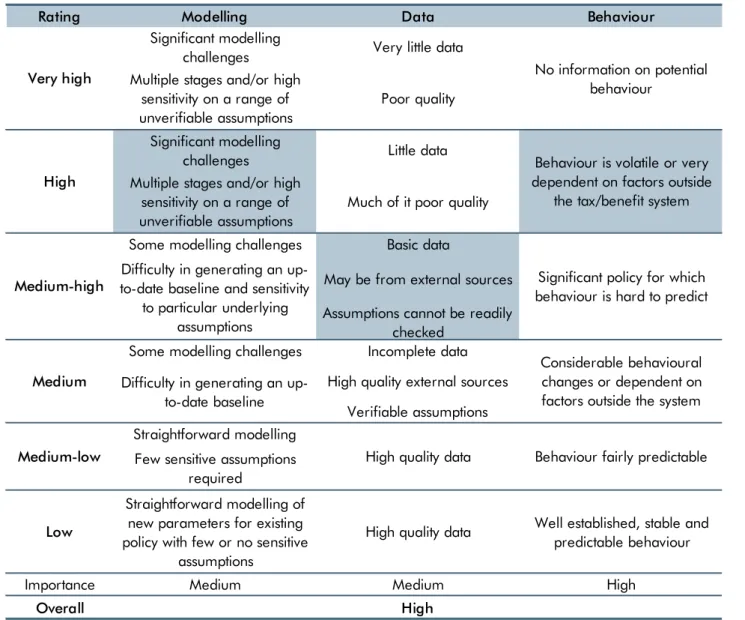
A.10 Table A.2 shows the detailed criteria and applies them to a sample policy measure from this Budget: ‘help to save’. It is expected to cost around £70 million in 2020-21. This measure introduces a regular saver account into which the Government will match an individual’s savings at a rate of 50 per cent on monthly balances. The maximum monthly contribution limit is £50 and it has a 2-year term until maturity. Users can then choose to save for a further two year term. This is available to low income earners receiving either working tax credits or equivalent universal credit benefits.
A.11 We consider the modelling for this measure to be a ‘high’ source of uncertainty as it uses multiple stages of assumptions about the expected number of eligible individuals and when users of the accounts will withdraw their savings.
A.12 The data used consists of two datasets. First, working tax credits administrative data are used, which are relatively certain. Second, the Family Resources Survey is used for the universal credit population. As this is a sample of the population, it is less certain. We consider the data to be a ‘medium-high’ source of uncertainty.
A.13 The behavioural response consists of two key assumptions to which the costing is highly sensitive. First, the proportion of eligible individuals that will choose to use these accounts. Second, the amount these individuals will save and for how long they will continue to do so. Both are based on information from previous schemes of a similar nature, but still require a large degree of judgement. These behaviours can also be volatile, as demonstrated by previous schemes. We therefore judge this to be a ‘high’ source of uncertainty.
A.14 Taking all these judgments into account, we gave the costing an overall rating of ‘high’.
Economic and fiscal outlook 216
Budget 2016 policy decisions
Table A.2:
Example of assigning uncertainty rating criteria: ‘help to save’
A.15 Using the approach set out in Table A.2, we have judged eight measures in the scorecard to have ‘high’ uncertainty around the central costing. Two were judged to have ‘very high’ uncertainty. Together, these scorecard measures represent 13.0 per cent of those in the Budget by number and 8.3 per cent by absolute value (in other words ignoring whether they are expected to raise or cost money for the Exchequer). In net terms, they are expected to raise the Exchequer £3.7 billion in total over the forecast period. The measures are:
• ‘lifetime ISA and raise ISA limit to £20,000’ – this measure receives a ‘very high’ uncertainty rating. The majority of the Exchequer impact of this measure can be attributed to the introduction of the lifetime individual savings account (ISA). This introduces a new type of ISA into which individuals can save up to £4,000 a year and receive a 25 per cent top-up from the Government. The Lifetime ISA is not subject to tax when accessed but there will be a charge on early withdrawals. There is an option to withdraw the full amount for first-time homebuyers. The main source of uncertainty is the behavioural impact, because the cost of the top-up is extremely sensitive to it. In particular, assumptions are made about: the number of people choosing to use the
Rating Modelling Data Behaviour
Significant modelling
challenges Very little data
Multiple stages and/or high sensitivity on a range of unverifiable assumptions
Poor quality Significant modelling
challenges Little data
Multiple stages and/or high sensitivity on a range of unverifiable assumptions
Much of it poor quality
Some modelling challenges Basic data
May be from external sources Assumptions cannot be readily
checked
Some modelling challenges Incomplete data
High quality external sources Verifiable assumptions Straightforward modelling
Few sensitive assumptions required
Low
Straightforward modelling of new parameters for existing policy with few or no sensitive
assumptions
High quality data Well established, stable and predictable behaviour
Importance Medium Medium High
Overall High
Medium-low High quality data Behaviour fairly predictable
Medium-high Significant policy for which
behaviour is hard to predict
Medium
Difficulty in generating an up-to-date baseline and sensitivity
to particular underlying assumptions
Difficulty in generating an up-to-date baseline
Considerable behavioural changes or dependent on factors outside the system
Very high No information on potential
behaviour
High
Behaviour is volatile or very dependent on factors outside
the tax/benefit system
217 Economic and fiscal outlook
Budget 2016 policy decisions
lifetime ISA; how much they choose to save; and when they choose to withdraw. There is little information that can be used to inform these assumptions and the behaviour is dependent on a variety of other factors, which amplifies the uncertainty;
• ‘financial advice markets review: increase tax relief on employer provided pension advice’ – this measure receives a ‘high’ uncertainty rating. This policy increases the value and amount in scope of tax-relieved employer provided pensions advice. The main uncertainty is within the behaviour. Estimating the behavioural impact on this costing requires a number of assumptions to be made, including: the number of new individuals taking up the scheme; the amount current users increase their usage of it; and the potential for rapid growth in the number of users in the initial years. These responses depend on a variety of factors outside the tax system and are difficult to predict. The lack of data on existing users’ employer-provided pension advice also contributes to the uncertainty, leading to a ‘high’ rating overall;
• ‘capital gains tax: lifetime limit under employee shareholder status’ – this measure receives a ‘high’ uncertainty rating. From Budget 2016, this introduces a lifetime limit on the capital gains an individual can make on shares acquired through employee shareholder status arrangements that are exempt from capital gains tax. The main source of uncertainty in this costing is from the absence of good quality data on the lifetime gains that may breach this limit. In particular, this costing is sensitive to the size of the upper end of the distribution – those with the highest lifetime gains. Due to the lack of data, assumptions are required to model the affected population. The costing is highly sensitive to changes in these assumptions;
• ‘disguised remuneration: tackling historic and new schemes’ – this measure receives a ‘very high’ uncertainty rating. Each component of it is highly uncertain. The measure tackles the use of tax avoidance schemes – often through the use of employee benefit trusts – that affect income tax and national insurance contributions. There is very limited data from which to estimate the size of the tax base, so some unverifiable assumptions are needed to derive it. The behavioural response is arguably even more uncertain, as the measure is targeted at quite aggressive tax avoiders, who can be expected to seek alternative avoidance options. There is also uncertainty over the modelling, which has multiple stages;
• ‘stamp duty land tax on additional properties: exemptions’ – this measure receives a ‘high’ uncertainty rating. It makes a number of changes to the Autumn Statement 2015 measure ‘stamp duty land tax: higher rates on additional property’, which also received a ‘high’ uncertainty rating. The original costing was based on a highly uncertain tax base and behavioural impact. This means identifying the taxpayers affected by the changes in exemptions cannot be done with any degree of certainty. The costing relies on a number of difficult to verify assumptions and judgements;
• ‘value added tax: tackling overseas trader evasion’ – this measure receives a ‘high’ uncertainty rating. It tackles the unpaid VAT from purchases through online
marketplaces sourced from outside the European Union. There are two particular Economic and fiscal outlook 218
Budget 2016 policy decisions
uncertainties. Some elements of the costing have a very high behavioural response. Many of the suppliers that are caught are likely to be replaced by others, while some will restructure their operations through alternative countries or set up as new
companies. As with all measures targeting uncollected tax, there is significant data uncertainty. The tax base cannot be precisely estimated and is derived from import data using assumptions and judgement;
• ‘off-payroll working: transfer liability to public sector employers’ – this measure receives a ‘high’ uncertainty rating. The measure targets workers in the public sector engaged through an intermediary, usually a personal service company, which enables them to pay less tax and national insurance contributions. The main source of
uncertainty is behaviour, but there is also a lack of good data and some complex modelling. There are a variety of potential behavioural responses, which depend on a number of factors. These are estimated using assumptions and judgement. The uncertainty around data makes it difficult to identify the affected population;
• ‘border force: illicit tobacco strategy’ – this measure receives a ‘high’ uncertainty rating. It provides the Home Office with additional resources. The yield depends on how effective the additional resource will be at stopping illicit tobacco entering the UK. The most uncertain part of the costing is the behavioural element. This includes both a displacement effect, as criminals learn how to circumvent the new strategy, and the response of individuals who will now be forced to buy higher priced duty paid goods. Combined, these effects significantly reduce the estimated yield of the measure;
• ‘corporation tax: reform loss relief’ – this measure receives a ‘high’ uncertainty rating. The measure restricts the amount of brought forward losses a business is able to offset against taxable profits, but it also widens the use of losses from different types of income streams for the same purpose. The yield from this measure is based on
uncertain assumptions around the profitability of companies over the scorecard period. In particular, we consider the modelling to be both complex and important for the costing. If companies make higher or lower than expected gross profits over the next few years then the yield from this measure could be considerably higher or lower;
• ‘help to save’ – this measure receives a ‘high’ uncertainty rating. The measure and the sources of uncertainty around it are described from paragraph A.10.
A.16 We have judged 43 scorecard measures to have between ‘medium-low’ and ‘medium-high’ uncertainty around the central costing, with a further 9 having ‘low’ uncertainty. That means that 55.8 per cent of the Budget scorecard measures have been placed in the medium range (79.7 per cent by absolute value) and 11.7 per cent have been rated as low (just 1.2 per cent by absolute value).
A.17 Chart A.1 plots these uncertainty ratings relative to the amount each policy measure is expected to raise or cost. One feature of the distribution of measures by uncertainty is that the spending measures are typically assigned lower uncertainty ratings, while the tax raising measures typically have higher uncertainty ratings than the tax cuts. This is particularly true
219 Economic and fiscal outlook
Budget 2016 policy decisions
for the measures that aim to raise money from companies and from high income and wealth individuals that are already actively planning their affairs to reduce their tax
liabilities. This pattern has been apparent in most recent Budgets and Autumn Statements.
Chart A.1:
OBR assessment of the uncertainty of scorecard costings
-2000 -1500 -1000 -500 0 500 1000 Tax measures -2000 -1500 -1000 -500 0 500 1000 Level of uncertainty Spending measures
Low Low medium Medium Medium high High Very high
A ver ag e y ield (+ ve) o r c os t (-ve ): 2 01 5-16 t o 2 02 0-21 ( £ m illio n)
Economic and fiscal outlook 220
Budget 2016 policy decisions
Longer-term uncertainties
A.18 For most policy costings, the five-year scorecard period is sufficient to give a representative view of the long-term cost or yield of a policy change. Typically, that effect is either zero – because the policy has only a short-term impact that has passed by the end of the scorecard period – or it would be reasonable to expect the impact at the end of the forecast to rise broadly in line with nominal growth in the economy thereafter. In this Budget, the final year effects of most scorecard measures are representative of the longer-term cost or yield. A.19 However, there are six measures where the scorecard costing is not representative of the
longer term and where the long-term effects are particularly uncertain. These are:
• ‘corporation tax: defer bringing forward payment for large groups for two years’ – this measure changes the start date of a measure announced in the July 2015 Budget. It alters the timing of when large companies pay quarterly corporation tax (CT)
instalments. As it has no effect on CT liability, the long-term yield would in effect be zero. Moreover, if CT receipts were recorded in the public finances data in accruals terms – aligned with the timing of the economic activity that gave rise to the liability – rather than cash terms (when the tax is paid) our baseline forecast would change and the yield from this measure within the forecast period would also in effect be zero;
• ‘capital gains tax: lifetime limit under employee shareholder status’ – this introduces a lifetime limit on the gains that individuals entering employee shareholder status arrangements can accumulate before being liable to pay CGT. It is expected to raise £35 million in 2020-21. Beyond the scorecard period, the yield is expected to continue rising as gains are realised over time. By the end of the 2020s this could rise to around £200 million a year;
• ‘oil and gas: abolish petroleum revenue tax and reduce supplementary charge to 10%’ – this measure reduces the rate of petroleum revenue tax (PRT) from 35 per cent to 0 per cent and the corporation tax supplementary charge from 20 per cent to 10 per cent. Within the scorecard period the cuts in tax rates reduce receipts by an average of £200 million a year. In the longer term, we would expect there to be a yield from the PRT measure when the field is decommissioned since losses are carried back against PRT paid on previous profits. With less PRT paid because of the rate cut, there will be less PRT to be claimed back once fields are decommissioned. Indicative modelling suggests a yield peaking at less than £½ billion in the early 2030s;
• ‘corporation tax: reform loss relief’ – this measure restricts the amount of brought forward losses a business can offset against taxable profits, but it also widens the use of losses from different types of income streams for the same purpose. The first element raises yield in the short term by raising taxable profit, but since no losses will actually be disallowed against future use, the long-term yield will erode over time. The second element reduces firms’ tax liability, so while the measure raises yield during the scorecard period, by the late 2020s it is expected to generate a cost to the Exchequer;
221 Economic and fiscal outlook
Budget 2016 policy decisions
• ‘corporation tax: further restrict use of banks' pre-2015 losses’ – this measure alters the existing bank-specific loss-relief restriction so that the proportion of profits in a year against which losses brought forward by banking companies can be set is reduced from 50 to 25 per cent. This raises around £400 million a year during the scorecard period since banks will be able to use less of their accumulated stock of losses. However, this policy does not disallow losses, so these can still be set against future profit beyond the scorecard period. This policy should be broadly revenue neutral on a company-by-company basis in the long run;
• ‘help to save’ – this measure introduces a regular saver account with a government top-up of 50 per cent on monthly balances, a maximum monthly contribution limit of £50, and a 2-year term until maturity. Second term accounts begin to mature beyond the scorecard period, so the cost peaks at around £100 million in 2022-23 when the first group of second term accounts begin to mature. A steady state cost of around £80 million is expected from 2023-24.
Small measures
A.20 The BRC has agreed a set of conditions that, if met, allow OBR staff to put an individual policy measure through a streamlined scrutiny process. These conditions are:
• the expected cost or yield does not exceed £40 million in any year;
• there is a good degree of certainty over the tax base;
• it is analytically straightforward;
• there is a limited, well-defined behavioural response; and
• it is not a contentious measure.
A.21 A good example of a small measure announced in this Budget is the ‘aggregates levy: freeze rates’. The aggregates levy is usually increased in line with the retail prices index (RPI). This measure freezes the aggregates levy rate in 2016-17. The yield of this costing is around £5 million a year, and the data used to estimate the tax base are of high quality. The modelling is straightforward as it is a simple change in the levy rates in 2016-17 only. The behavioural effect is negligible as demand for aggregates will not change by a
significant amount in response to such a small levy change. It is not considered to be a contentious measure.
A.22 By definition, any costings that meet all these conditions will have a maximum uncertainty rating of ‘medium’.
Economic and fiscal outlook 222
Budget 2016 policy decisions
Update on previous measures
A.23 We cannot review and re-cost all previous measures at each fiscal event (the volume of them being simply too great), but we do look at any where we are informed that the original (or revised) costings are under- or over-performing, and at costings that we have previously identified as subject to particular uncertainty. For this forecast we have considered:
• ‘tax repatriation from Jersey, Guernsey, and Isle of Man’ – this Budget 2013 measure announced a disclosure facility with the crown dependencies and was originally costed to raise £1,050 million from 2013-14 to 2017-18. This was made up of two main elements: the voluntary disclosure of unpaid past tax liability (which would run from 2013-14 to 2016-17) and an information exchange agreement whereby from 2016 onwards HMRC would receive annual information on UK resident account holders that would generate future compliance yield. We lowered our forecast of the total yield to £800 million in November, but also changed the profile having considered evidence from HMRC on the extent to which any initial yield lost through lower disclosures would be recouped through additional compliance activity in later years. The disclosure facility closed on 31 December 2015 and HMRC has informed us that there were far fewer disclosures than expected. They believe this is due to a number of factors, including HMRC campaigns being less effective and with less coverage than expected and a perceived lack of awareness from those targeted. HMRC is also now less optimistic about how much of the lost yield can be recouped through additional compliance activity, on the basis that they are unlikely to be able to work the higher number of additional cases on top of existing workloads. Taking both factors into account, we have lowered the costing for this measure by a further £530 million;
• ‘income tax: transferable marriage allowance’ – take-up for this Autumn Statement 2013 measure has been much lower than initially assumed. We have incorporated a take-up rate of 12 per cent for 2015-16 compared with over 70 per cent in the
original costing. We assume that take-up eventually rises to around 50 per cent by the end of the forecast period. Lower take-up is likely to reflect issues with HMRC’s IT systems, a lack of awareness of the allowance (e.g. reflecting limited initial advertising) and possibly a reluctance by those eligible to engage with HMRC. The lower take-up rate has boosted receipts by £400 million in 2015-16. The improvement in receipts is smaller in future years, because taxpayers will be able to claim for previous years as take-up increases;
• ’voluntary national insurance contributions’ – the yield from this Budget 2014 measure has been much lower than expected. This measure enabled pensioners to acquire additional state pension in exchange for a lump sum national insurance payment at an actuarially fair price. Take-up has been much lower than expected, although the average amount contributed has been higher. We now expect receipts of around £65 million in both 2015-16 and 2016-17, compared with original estimates of £435 million in both years;
223 Economic and fiscal outlook
Budget 2016 policy decisions
• pensions flexibility – receipts from pension withdrawals relating to this Budget 2014 measure are expected to be around £900 million for the whole of 2015-16, around £200 million higher than assumed in the original costing;
• HMRC digital – HMRC has announced a number of measures in this area. The Autumn Statement 2013 measure ‘HMRC: extending online services’ had two elements: putting inheritance tax (IHT) online for customers and agents and a new system allowing charities to register jointly with HMRC and the Charity Commission. The IHT element was originally expected to go live in October 2015, with full coverage from March 2016. We have been told that it will not be fully operational until March 2017. The charities element was due to be implemented from 2015-16, but this has been delayed to April 2017. The Autumn Statement 2014 measure announcing the capital gains tax digital calculator – part of the ‘HMRC: operational measures’ package – was scheduled for an August 2015 implementation date. HMRC has informed us that this is currently on track. The Autumn Statement 2015 measure ‘making tax digital’ also remains on track;
• HMRC compliance – the large July 2015 Budget package also remains largely on track, although it is too early to assess the effectiveness of the individual measures;
• tax free childcare – this was announced as ‘additional funding for childcare’ at Budget 2014 with a September 2015 start date. It was delayed by 18 months following a legal challenge to the Government’s decision to deliver the scheme through National
Savings and Investments. A further change to rollout has been announced at this Budget. This keeps the February 2017 start date, but rolls the policy out more gradually between February and September 2017;
• ‘error and fraud: additional capacity’ – this measure sought to bring in private sector support for HMRC tax credits compliance activity. It was part of the Autumn Statement 2013 measure ‘tax credits: improving collection and administration’. Overall savings from the measure are now around £400 million compared to the original costing of £1.1 billion. This is the same as we estimated in November, reflecting two offsetting factors. Monitoring information shows that actual performance in 2015-16 has been lower than expected, but this is offset by the November reversal in July’s tax credits cuts, which increased the tax credits spending forecast and therefore the amount of error and fraud that will be within scope of the measure;
• Royal Bank of Scotland – the Government announced that it would raise £5.8 billion in 2020-21 from the sale of RBS shares. The sharp fall in the RBS share price since then means we now expect no sale proceeds in 2020-21;
• ‘diverted profits tax’ – this Autumn Statement 2014 measure targeted multinationals that used contrived tax arrangements and was expected to raise around £300 million a year from 2016-17 onwards. Our forecast assumes that yield from the measure will be close to that scored when the measure was announced. However, we now expect that around two-thirds of the yield will come through higher CT payments (as firms Economic and fiscal outlook 224
Budget 2016 policy decisions
restructure their tax affairs) rather than via the diverted profits tax itself. Yield from multinationals using such tax arrangements is highly uncertain, so we will need to look again at the yield and the split between CT and diverted profits tax in each forecast;
• partnerships – the Budget 2013 and Autumn Statement 2013 anti-avoidance measures on partnerships were due to yield £1 billion in 2015-16. Preliminary data from January income tax self-assessment returns suggest partnership income did not grow as strongly as expected. We will return to this in our next forecast.
Departmental spending
A.24 We do not scrutinise costings of policies that reallocate spending within departmental expenditure limits (DELs) or the DEL implications of measures that affect receipts or AME spending. Instead, we include the overall DEL envelopes for current and capital spending in our forecasts, plus judgements on the extent to which we expect them to be over- or
underspent in aggregate. DEL totals were set in November’s Spending Review, and have been adjusted in this Budget. We have assumed underspending relative to those totals across the forecast.
A.25 We also discussed with the Treasury the process by which it would cut departmental spending in 2019-20 relative to the firm plans that were set in November’s Spending Review, given the role that those cuts would play in the Government achieving its desired budget surplus in that year.
A.26 In the July Budget and November Autumn Statement, we asked the Treasury to provide assurance on the funding of a number of HMRC and DWP operational measures. For this forecast, we checked again that these had been fully funded.
A.27 For this Budget, we have sought assurance from the Treasury on the funding of a number of measures. It has confirmed that the measures below have been funded on the scorecard up to and including 2018-19 (2019-20 for ‘border force: illicit tobacco strategy’). It has also confirmed that from 2019-20 onwards, funding for these measures will be prioritised in the next Spending Review. The measures are:
• ‘value added tax: tackling overseas trader evasion’: £24 million to HMRC to recruit staff in 2017-18 to support the collection of unpaid VAT from online purchases;
• ‘disguised remuneration: tackling historic and new schemes’: £19 million to HMRC to recruit staff across 2018-19 to 2020-21 to support legislation tackling disguised remuneration tax avoidance schemes;
• ‘offshore property developers: tackle avoidance and evasion’: £7 million to HMRC to recruit staff in 2016-17 for operational activity against property-related tax avoidance and evasion using offshore structures;
225 Economic and fiscal outlook
Budget 2016 policy decisions
• ‘DWP and HMRC operational and policy measures’: £22 million to DWP to recruit presenting officers across 2016-17 to 2017-18 to support the department in personal independent payments and employment and support allowance tribunals;
• ‘border force: illicit tobacco strategy’: £31 million to Border Force to recruit officers to improve the seizure of illicit tobacco at customs ports; and
• ‘landfill tax: tackling waste crime’: £2 million to HMRC to recruit operational staff from 2016-17 to work on landfill tax evasion.
Indirect effects on the economy
A.28 This Budget contains a number of policy changes that we have judged to be sufficiently large to justify adjustments to our central economic forecast. These include:
• fiscal policy – the Government has loosened fiscal policy in the short term, reflecting net tax reductions and increases in DELs, both current and capital. The Government has then increased the pace of fiscal tightening significantly in 2019-20, accounted for by net tax increases and lower spending on welfare, public services and capital
investment. To reflect these changes in our economy forecast we have applied the same ‘multipliers’ we have used in previous forecasts. These are larger the shorter the period is between a policy being announced and implemented. They imply a 0.1 per cent point boost to real GDP growth in 2017-18 and 0.1 per cent point reductions in both 2018-19 and 2019-20. These effects are sufficient to push the economy slightly above its potential level in 2017 and 2018 and slightly below in 2019, with the output gap closing by the end of 2020. The Government adjusted its plans for capital
investment in 2020-21 after we closed our economic forecast. At this horizon we would assume that the multiplier has tapered to zero, so incorporating this adjustment would have no effect on our forecast for real GDP, although it would have had a small effect on the composition of expenditure;
• ‘corporation tax: reduce to 17% in April 2020’ and ‘corporation tax: restrict relief for interest’ – these two measures are expected to affect the cost of capital faced by firms and therefore business investment. The first is expected to lower the cost of capital but the second – which restricts the amount of corporate interest payments that affected groups will be allowed to offset against corporation tax liability – will raise the cost of capital. We also adjusted our forecast to reflect one additional measure, but the Government informed us that it would not be going ahead after our final economy forecast had been closed. As a result, our business investment forecast is around 0.5 per cent higher in 2020-21 than would be consistent with the final policy package announced in the Budget;
• ‘removing employer tax advantage of different forms of remuneration: pay-offs over £30,000’ – this will impose employer National Insurance Contributions on termination payments over £30,000. In the near term we expect the additional cost to employers to be reflected in lower wages and profit margins, with the majority of the cost passed Economic and fiscal outlook 226
Budget 2016 policy decisions
through to wages by the end of the forecast period. This implies a reduction in total wages and salaries of 0.1 per cent by 2020-21;
• ‘lifetime ISA and raise ISA limit to £20,000’ – this introduces a new ISA product for the under-40s, described above. Holders of lifetime ISAs will be allowed to make 100 per cent withdrawals for first-time house purchases up to £450,000. This is more likely than not to lead to higher demand for the relatively fixed supply of housing in the UK, and so to higher prices. We have therefore added 0.3 per cent to the level of house prices by the end of the forecast, although the effect of this policy is highly uncertain;
• ‘soft drinks industry levy’ – on the basis of the Government’s revenue target for this levy, this implies rates of 18 pence or 24 pence per litre unit charge according to sugar content, which we expect to be passed entirely onto the price paid by consumers. It is expected to add around a quarter of a percentage point to CPI and RPI inflation in 2018-19;
• other measures affecting inflation – we have also made small adjustments for several other policies. The effects of these measures are small and broadly offsetting, and taken together imply almost no change to our CPI forecast. Measures that are expected slightly to increase CPI inflation across the forecast period include ‘hand-rolling tobacco: increase by RPI plus 5%’ and ‘insurance premium tax: increase by 0.5% in September 2016’, ‘value added tax: tackling overseas trader evasion’ and ‘value added tax: extend reverse charge to electronic communications services’. Other policies are expected to reduce CPI inflation slightly, including ‘fuel duty: freeze in April 2016’ and ‘alcohol duty: freeze for beer, spirits and cider’. The ‘business energy: abolish carbon reduction commitment and offsetting increase to climate change levy’ measure is also expected to lower inflation: while the net effect of these energy policies is to increase costs for medium sized companies, they reduce costs for large
companies that make up a higher proportion of turnover. We expect this fall in costs to be passed through to consumers; and
• measures affecting housing associations’ finances. We expect these measures to affect housing associations’ future housebuilding decisions, reducing total residential
investment by 0.7 per cent by 2020-21.
227 Economic and fiscal outlook
Budget 2016 policy decisions
Economic and fiscal outlook 228