Volume 1, Issue 1, 2019
ISSN: 2688-7061 (Online)
24
Designing Mobile Learning App to Help High School Students to Learn
Simple Harmonic Motion
Bima Pambayun
Widya Mandala Catholic University, Indonesia
Johanes V D Wirjawan
Widya Mandala Catholic University, Indonesia
Herwinarso Herwinarso
D Widya Mandala Catholic University, Indonesia
Anthony Wijaya
Widya Mandala Catholic University, Indonesia
Budijanto Untung
Widya Mandala Catholic University, Indonesia
Elisabeth Pratidhina
Widya Mandala Catholic University, Indonesia, [email protected]
Abstract
: The tremendous development of information and communication technology, especially the existence of smartphone, has a huge impact on people lifestyle. Smartphone technology allows several of applications to make life easier. Most of teenagers in Indonesia have been familiar with smartphone technology which can be potentially used on educational field. In this study, we have developed mobile learning apps to help high school students in learning simple harmonic motion. In the past time, students who want to study physics by themselves usually only could rely on traditional books. With this mobile learning app, high school students can study anywhere and anytime. The developed mobile learning apps have been tested to a group of students consists of 34 high school students. We used one-group pre-test-and-post-test design to investigate the use of mobile learning app impacts on the students’ learning achievements. The average N-gain score of 0.33 shows that there is a medium gain of students’ learning achievements.Keywords: Smartphone, Mobile learning, High school physics, Simple harmonic motion
Introduction
Physics is a subject that related to our daily life. It also becomes basis for the development of current technology that we used in daily life. Due to its importance, physics is given in school curricula. In Indonesia, physics as a part of science subject is introduced since elementary school. However, in high school, science is specifically separated into chemistry, biology, and physics.
Students usually learn physics from the information that they got in the classroom from their teacher. In the class, students may miss some information from their teacher. Students also do not have much opportunity to practice problem solving in the classroom due to the limited time. Thus, outside the classroom, students still need to learn physics by themselves.
Study shows that multimedia works better than textbook (Stelzer et al., 2014, 2013). Multimedia has some advantages as learning resource. It is possible to provide more physics visualization. Visualization is important as a bridge between mathematical or numerical analysis result and the physical interpretation. Multimedia provide variety of audio-visual images, which can show physical processes and phenomena vividly (Jian-hua, 2012). Moreover, multimedia is more interactive than traditional textbook, direct feedback is possible to be included in multimedia. Compared to traditional textbook, multimedia nowadays is more flexible to be used anytime and anywhere. Rapid development of computer technology gives rise to the use of multimedia in learning process (De Witte, Haelermans, & Rogge, 2015; Merchant, Goetz, Cifuentes, Keeney-Kennicutt, & Davis, 2014; Suppes & Morningstar, 1969). Computer assisted learning in science education have been studied since few years ago (Bayraktar, 2001; Chang, 2001; Tsai & Chou, 2002). Some researches indicate that students’ achievement increases with the use of personal computer in science education (Erdoğan & Dede, 2015; Ferguson & Chapman, 1993; Powell, Aeby, & Carpenter-Aeby, 2003). Moreover, scientific problem skill can be stimulated with the use of computer in learning science (Rivers & Vockell, 1987).
The tremendous development of computer technology also rises the variety of multimedia in learning process. In more advanced level, recently multimedia becomes more flexible due to the impressive development of computer technology in the form of mobile phone. Computer is now packed as a small device called smartphone. Smartphone allows various multimedia that can be used for education. Some educators have developed smartphone assisted learning in science education (Arista et al., 2018; Astra, Nasbey, & Nugraha, 2015; Wang, Wu, & Hsu, 2017). The flexibility of multimedia is supported by advanced information and communication technology, especially, the presence of smartphone. In this study, we try to develop a learning resource in the form of smartphone app to assist high school students in learning simple harmonic motion. Simple harmonic motion contains some mathematic equation and analysis that potential to make students misunderstanding the physical concept. That is why multimedia learning resource is needed for this material.
Methods
We employ research and development method within 4D models in this study. 4D model consists of four stages, i.e. define, design, develop, and disseminate [8]. In the define stages, we do student, task, and concept analysis. In the define stages, we design the prototype of simple harmonic motion learning media in the form of mobile learning app. The mobile learning app is design by using Adobe Flash CS 6. Develop stages includes expert validation and field testing of our developed learning media. According to expert validation the prototype is feasible to be tested to high school students, but minor revision is still needed. After we revise the prototype of the mobile app, the mobile app is tested to a group of students consists of 34 students. The respondents are 10th grader at SMA N 7 Surabaya. Students’ responds after using the learning media are obtained through questionnaire. In the questionnaire, students are asked to choose whether they “strongly agree”, “agree”, “disagree”, or “strongly disagree” with the statements. Students’ responds are converted into a numerical data such as given in Table 1.
Table 1. Conversion of Questionnaire Responds to Numerical Data
Responds Score
Strongly agree 1
Agree 2
Disagree 3
Strongly disagree 4
After converted to numerical data, we find the average score of each statement and interpret it to qualitative description, such as shown in Table 2.
Table 2 Conversion of Score to Qualitative Description (Interval 1-4)
Interval Description
> Very Good
< ≤ Good
< ≤ Fair
< ≤ Poor
≤ Very Poor
The impact of the use of the mobile app as learning resource is investigated through one group pre-test and post-test design. We use one group pre-post-test and post-post-test design to investigate the impact of the use of the smartphone app on students’ physics performance. We give students a pre-test before they use the smartphone app and a post-test after they use the smartphone app as learning media. The improvement of physics performance is analyzed by finding the normalized gain score using the following formula (Hake, 1998):
Results and Discussion
Developmental Testing
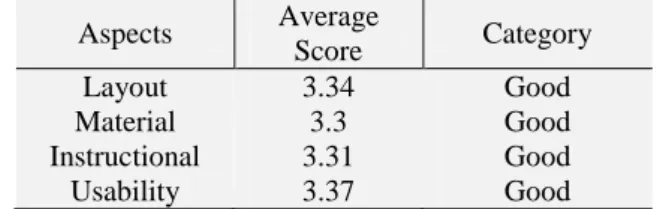
The mobile app has been validated by expert. Experts evaluate the instructional, content, usability, and layout of the mobile app. According to the expert validation, the mobile app is feasible to be used as learning resource by high school students. However, some minor revision is needed. Before, the mobile app is tested to high school students, we revise the mobile app according to experts’ suggestions. We did field testing to 34 high school students. The students’ opinion about the mobile app use as simple harmonic motion learning resource is gathered through questionnaire. The statements in the questionnaire mainly can be classified to 4 categories, i.e. layout, material, instructional, and usability. The students’ answer is converted into score (see Table 1). The average score of each aspect is converted into qualitative description; the criteria of qualitative description are given in Table 2. The recapitulation of students’ opinion about the mobile app is shown in Table 3. According to students’ respond, they agree that this media has good quality in the aspects of layout, content, instructional, and usability. Overall, they agree that the mobile app is interesting, clear, helpful, and easy to be used. Students’ opinion which is written in the questionnaire is used as consideration for the final revision of mobile app.
Table 3. Average Score Recapitulation of Students’ Questionnaire
Aspects Average
Score Category
Layout 3.34 Good
Material 3.3 Good
Instructional 3.31 Good
Usability 3.37 Good
Students are given a pre-test before they use the mobile app as learning resource. After they use the mobile app as learning resource, they are given a post-test. From the pre- and post-test result, we can calculate the normalized gain (see equation 1). The average normalized gain score is 0.33. Even though the improvement is not significant, the normalized gain score still can be classified as medium gain (Hake, 1998).
Table 4. Result of Pre- and Post-Test Average Score
of Pre-Test
Average Score of Post-Test
Average N-Gain
Score
8.76 39.5 0.33
Product
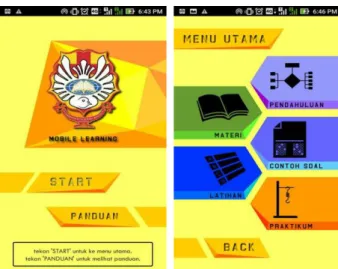
Figure 1. Layout of Beginning Part and the Main Menus in the Mobile App
The learning purpose is given in the introduction. The scope of the material which is covered in the mobile app is also shown in the concept map (see Figure 2).
Figure 2. Introduction in the Mobile App Contains Learning Purpose and Concept Map
The material contains concept explanation, mathematical derivation, example of physics phenomena, etc. It is presented in verbal explanations, figures, and some animations. Figures and animations are given to visualize and emphasis the physical meaning of mathematical and concept explanation. They also show the examples of physical phenomena in daily life.
Figure 3. Materials in the Mobile App
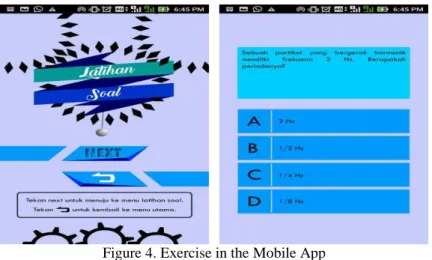
Figure 4. Exercise in the Mobile App
This study is still a preliminary study which needs more comprehensive investigation on the mobile app impacts in the physics learning process. In this study, we just investigated the impact of the use of mobile app on the cognitive aspects, whereas physics definitely not only includes cognitive aspects. Future study on this mobile app use in the physics learning is still required.
Conclusions
A study has been conducted to develop mobile app as leaning resource to help students in learning simple harmonic motion. The smartphone app has been validated by experts. It also has been tested to a group of students. The students give positive responds to the mobile app. They state that the media has good quality on the aspects of layout, content, instructional, and usability. The impact of the mobile app use on students’ achievement has been investigated. It shows positive impact, since according to pre- and post-test that has been conducted to 34 students, there is N-gain score of 0.33 which can be categorized as medium gain score. However, this study needs a further investigation since our investigation is limited only to cognitive achievement.
Acknowledgement
This work is supported by Grant from the Indonesian Ministry of Research and Higher Education with contract number 115AI/WM01.5/N/2018.
References
Arista, F. S., Education, P., Program, P., Kuswanto, H., Education, P., & Program, P. (2018). Virtual Physics Laboratory Application Based on the Android Smartphone to Improve Learning Independence and Conceptual Understanding, 11(1), 1–16.
Astra, I. M., Nasbey, H., & Nugraha, A. (2015). Development of an Android Application in the Form of a Simulation Lab as Learning Media for Senior High School Students.
Bayraktar, S. (2001). A meta-analysis of the effectiveness of computer-assisted instruction in science education. Journal of Research on Technology in Education, 34(2), 173–188.
Bradshaw, G. L. (2005). Multimedia Textbooks and Student Learning, 1(2).
Chang, C. (2001). Comparing the Impacts of a Problem-Based Computer-Assisted Instruction and the Direct-Interactive Teaching Method on Student Science Achievement. Journal of Science Education and Technology, 10(2), 147–153.
De Witte, K., Haelermans, C., & Rogge, N. (2015). The effectiveness of a computer-assisted math learning program. Journal of Computer Assisted Learning, 31(4), 314–329.
Erdoğan, Y., & Dede, D. (2015). Computer Assisted Project-Based Instruction: The effects on Science Achievement, Computer Achievement and Portfolio Assessment. International Journal of Instruction, 8(2), 177–188.
mechanics test data for introductory physics courses. American Journal of Physics, 66(1), 64–74. Jian-hua, S. (2012). Explore the Effective Use of Multimedia Technology in College Physics Teaching, 17,
1897–1900.
Merchant, Z., Goetz, E. T., Cifuentes, L., Keeney-Kennicutt, W., & Davis, T. J. (2014). Effectiveness of virtual reality-based instruction on students’ learning outcomes in K-12 and higher education: A meta-analysis. Computers and Education, 70, 29–40.
Powell, J. V., Aeby, V. G., & Carpenter-Aeby, T. (2003). A comparison of student outcomes with and without teacher facilitated computer-based instruction. Computers and Education, 40(2), 183–191.
Rivers, R. H., & Vockell, E. (1987). Computer simulations to stimulate scientific problem solving. Journal of Research in Science Teaching, 24(5), 403–415.
Stelzer, T., Brookes, D. T., Gladding, G., Mestre, J. P., Stelzer, T., & Brookes, D. T. (2014). Impact of multimedia learning modules on an introductory course on electricity and magnetism Impact of multimedia learning modules on an introductory course on electricity and magnetism, 755(2010), 5–10. Stelzer, T., Gladding, G., Mestre, J. P., Brookes, D. T., Stelzer, T., Gladding, G., … Brookes, D. T. (2013).
Comparing the efficacy of multimedia modules with traditional textbooks for learning introductory physics content Comparing the efficacy of multimedia modules with traditional textbooks for learning introductory physics content, 184(2009).
Suppes, P., & Morningstar, M. (1969). Computer-Assisted Instruction. Science, 166(3903), 343–350.
Tsai, C. C., & Chou, C. (2002). Diagnosing students’ alternative conceptions in science. Journal of Computer Assisted Learning, 18(2), 157–165.