*Correspondence to Author: Jamal Bayed Salim. Department of Medical Microbiology, Faculty of Medicine and health Sciences, University of Kassala, Kassala, Su-dan.
Email: abumusab2008 @gmail.com
How to cite this article:
Salim et al.,. The effect of Transfer
Factor as Immunotherapy compar-ing with the effect of BCG in Mice challenged with Mycobacterium tu-berculosis. American Journal of Mi-crobiology and Immunology, 2017; 2:1
eSciPub LLC, Houston, TX USA. Website: http://escipub.com/
American Journal of Microbiology and Immunology
(ISSN: 2474-2910)
Research Article AJMI 2017 2:1
The effect of Transfer Factor as Immunotherapy comparing
with the effect of BCG in Mice challenged with
Mycobacteri-um tuberculosis
Background: Transfer Factor (TF) is an immune modulator which stimulates the cellular arm of the immune system (killer lymphocytes), activates immune cytokine synthesis and
regu-lates immune function (Lawrence, 1955).TF is very effective in
those diseases in which CMI plays a relevant role in protection and control of the disease, such as intracellular bacterial diseas-es (tuberculosis). ( Estrada Parra, et al1955). TF are low molec-ular weight products from immune cells that are able to transmit the ability to express delayed-type hypersensitivity (DTH) and cell mediated immunity (CMI) from sensitized donors to non immune recipients (Kirkpatrick, 2000). Objectives:The aim of
this experimental study is to determine the protective efficacy of
transfer factor (TF) as immunotherapy for mice in comparison to BCG. Materials and methods:A total number of 102 mice
were examined for their immunopotency and protective efficacy of Transfer factor (TF) comparing to the protective efficacy of
BCG single and second repeated dose against challenge dose of M. tuberculosis (107 CFU) . A number of 20 mice were immu-nize with the attenuated strain of M. bovis, Bacillus Calmette-Guérin (BCG). After 21 days of BCG spleens of 10 tuberculous mice were removed aseptically for the preparation of TF. To
evaluate the effect of TF 3 groups of inbred BALB/c male mice
Jamal Bayed Salim.1,Ahmed K. Bolad2, Hamid Suliman A..2 andss Mujeeb A.Kabbashi3
1Department of 1- Department of Medical Microbiology, Faculty of Medicine and health Sciences
University of Kassala, Kassala, Sudan; 2Al- Neelain University, Faculty of Medicine; 2University of
Khartoum, Faculty of Medicine; 3Department of Medical Microbiology, Faculty of Medical Labora-tory Sciences, University of Sciences &Technology, Khartoum, Sudan
were injected with TF and challenged with virulent M. tuberculosis, followed by
anoth-er 3 groups of inbred BALB/c male mice
which were immunized with BCG single and second repeated dose. All mice with BCG and TF were tested for tuberculin skin test (TST) so as to determine susceptibility and resistance against tuberculosis, sus-ceptible groups of mice were challenged with virulent M. tuberculosis.Followed by study of humoral response by immuniza-tion of a group of mice with immune serum and challenged with M. tuberculosis H37Rv
strain. Followed by an experiment of group A and B for the susceptibility and resistance of the strains of mice. A group of dead mice For histological study of the infected lungs were examined. Results: After three weeks of observations the mice of experiment(1) were tested for tuberculin skin test and the results were positive. Effectiveness deter-mination of TF as protective efficacy was
(83.3%). while effectiveness determination
and protective efficacy of BCG first dose
and boosting dose were (50%) and (70%)
respectively. Humoral immunity response against M. tuberculosis showed negative
reaction hence mortality rate was 100%,
group B mice were resistant for BCG (Swiss white strain) and the results of histological study of the infected lungs showed lung ba-cilli that was M. tuberculosis. Conclusions:
The results indicated that administration of murine transfer factor (mTF) extracted and prepared from spleen of animal model (mice) as immunotherapy for challenged
mice of MTB (H37Rv) showed a better
results enhanced immune response in re-spect to delayed type hypersensitivity , sur-vival rate and mortality rate suggesting that
efficacy of mTF as immunotherapy for
tu-berculosis. Repeat dose of BCG enhanced
immune response in respect to delayed
type hypersensitivity , survival rate (70%) and mortality rate (30%), suggesting that
efficacy of BCG vaccine may improve and give better results if booster doses are giv-en.
Key words: Transfer Factor (TF),BCG ,Mice and M. tuberculosis.
Introduction
Transfer Factor (TF) is an immune modulator. The main function of these peptides in the body is to provide immune protection against microbes (bacteria, viruses, fungi, and protozoa), cancer-ous cells and other antigens capable of disturb-ing vital processes in the body. It stimulates the cellular arm of the immune system (killer lympho-cytes), activates immune cytokine synthesis and regulates immune function (Lawrence, 1955).
TF have been demonstrated to be very effective
in those diseases in which CMI plays a relevant role in protection and control of the disease, such as intracellular bacterial diseases (tubercu-losis, leprosy) and parasite infections (leishmani-asis, toxoplasmosis) .( Estrada Parra, et al1955). TF or leucocyte dialysates are low molecular weight dialysable products from immune cells that are able to transmit the ability to express delayed-type hypersensitivity (DTH) and cell mediated immunity (CMI) from sensitized donors to nonimmune recipients (Kirkpatrick, 2000).In 1955, Lawrence discovered that a dialyzed of vi-able leukocytes obtained from a healthy donor presenting a positive percutaneous tuberculin test was able to transfer to a healthy receptor the ability to respond to this pathogen. Lawrence named these molecules as Transfer Factor. TF is composed of peptide obtained from
devel-opment of autoimmune reactions. TF improves
cellular immunity in patients with immune defi -cits due to their responses are mediated by
anti-gen-specific, inducer, and suppressor/regulatory
activities contained in this fraction. Tuberculosis (TB)is primarily a chronic lung infection that is one of the most potent and wide-spread human infections today, and a major cause of death from bacterial pathogens (Lawn, and Zumla;2011). ).
It affects more young adults and therefore
has a high impact on the socioeconomic sta-tus of people (Zakham et al., 2012).Although TB is a serious global health problem, several med-ical advances have been made in the past150 years to facilitate prevention and control of TB. In general, TB mortality started to decrease in most industrialized countries during the 20th century,
probably due to a better socioeconomic status including improved nutrition and living conditions (Lienhardt, 2012) TB re-emerged during the 1990s both in developing and several industri-alized countries partly due to the HIV/AIDS pan-demic and also because of an increased emer-gence of drug resistant M. tuberculosis strains (Dheda, et al;2010).
Transfer factor (TF) is shown to be capable of
transferring antigen-specific cell-mediated im -munity (CMI) to T lymphocytes and therefore TF can successfully be used as treatment for
M.TB. and specially for MDR-TB and supple -mentary for conventional chemotherapy. The BCG based vaccine can provide stimulation of both innate and acquired immunity.(Schreiber,
et al; 2010). The incidence of TB is high inspite of primary vaccination in neonatal period and therefore requires consideration for repeated
im-munization of BCG. Researches concerning TF
are going on .
Materials and methods
A total number of 102 mice were examined for
their immunopotency and protective efficacy of
Transfer factor (TF) comparing to the protective
efficacy of BCG single and second repeated
dose against challenge dose of M. tuberculosis
(107 CFU) . A number of 20 mice were immunize
with the attenuated strain of M. bovis, Bacillus Calmette-Guérin (BCG). After 21 days of BCG spleens of 10 tuberculous mice were removed aseptically for the preparation of TF. ). Three groups of mice were used n= 12 for each group
(36mice), the groups were T1,T2 andT3 The mice
of group T1and T2 were given transfer factor (TF) and the mice of group T1and T3 were challenged with M. tuberculosis. Followed by an experiment contains three groups of mice each of ten mice
n = 10 (30mice). The first group(A) were immu
-nized with BCG first dose (I.P) for 21 days. The
second group (B) were immunized with BCG (I.P)
as first dose for 15 days and boosting dose (sec -ond dose) for 15 days. The third group(C) were not immunized with BCG. All the three groups were challenged with virulent M. tuberculosis. All mice with BCG were tested for tuberculin skin test (TST) so as to determine susceptibility and resistance against tuberculosis.
All the three groups were challenged with (0.5ml) virulent M. tuberculosis H37Rv strain (American Type Culture Collection, ATCC 35718) M. tuber-culosis.107(CFU) .
Another group of mice n=6 for the study of hu -moral response by immunization of mice with immune serum and challenged with M. tubercu-losis Following by two groups of mice n=10 for each group A and B for the susceptibility and resistance of the strains of mice by immunization of mice with BCG for 21 days and testing by
tu-berculin skin test (TST). The efficacy was based
on a survival rate of challenged mice, mortality rate and bacterial load of M. tuberculosis in the lungs of infected mice.
Mycobacterium tuberculosis strain
Virulent M. tuberculosis H37Rv strain (Ameri -can Type Culture collection) and. M. bovis BCG (Bacille Calmette Guerin) Collection strain 1011 were obtained from Kassala TB center (Kassala University) and Kassala Ministry of health.
Animals
Inbred BALB/c (8–12 weeks old) mice were
ob-tained from Veterinary Research Laboratories
in Khartoum, Swiss mice (males 20-25grams) were obtained from Professor Hamid Suliman (Un. of Khartoum.) All the mice were maintained in standard cages under sterile conditions and were fed commercial mice chow and water . All animals were housed and maintained in accor-dance with protocols approved by the Institution-al AnimInstitution-al Care.
Preparation of murine transfer factors (mTF)
Calmette-Guérin (BCG) by intrapritoneal (i.p) route with 0.5 ml of a 10 fold dilution of BCG. After 21 days
success of immunization was confirmed by tu -berculin skin test. After 21 days of BCG spleens of 10 tuberculous mice were removed aseptical-ly, chopped and grunt with clean sterile glass beads or sand and cell extract of immunized an-imals were distributed in 10ml normal saline or
phosphate buffer saline (PBS) were used. The
cell suspension was centrifuged to remove cel-lular debris at 1500 rpm for 15 minutes and the upper layer were collected in sterile test tubes.
RPMI 1640 media were added to the layer mixed
well and then centrifuge at 2000 rpm for 2 hours till the separation of the component and appear-ance of middle layer. This middle layer which is T mphocyte was collected with Pasteur pipette in test tubes and kept in deep freezer (-700c) and
removed next day or till used. Keep The test tube was thawed by keeping in room temperature before returning to the deep freezer (-700c).The
process of freezing and thawing was repeated 18 times. The suspension was then centrifuged
at 40000 rpm for 30 minutes or 5000 rpm for 4
hours. The upper layer which is the transfer fac-tor (TF) was then separated.
Tuberculin skin Test procedure:
Intradermal injection of mice with 0.2 ml of
puri-fied protein derivative (PPD) and then induration
and swelling were observed in the skin of tested mice after 24-72 hours.
All the three groups were challenged with (0.5ml) virulent M. tuberculosis H37Rv strain (American Type Culture Collection, ATCC 35718) M. tuber-culosis.107(CFU) .
Challenge dose:
Preparation of different concentration of M. tu-berculosis by McFarland 0.5 and colony forming unit (CFU) of 102 ,103,104, upto 109.
McFarland standards were made by mixing
specified amounts of Barium chloride and Sul -furic acid together. Mixing the two compounds forms a Barium Sulfate precipitate, which causes turbidity in the solution. A 0.5 McFarland
stan-dard is prepared by mixing 0.05 ml of 1.175%
barium chloride dihydrate (BaCl2•2H2O), with
9.95 ml of 1% sulfuric acid (H2SO4).The standard was compared visually to a suspension of ria in sterile saline or nutrient broth. If the bacte-rial suspension was too turbid, it was then diluted
with more saline. If the suspension was not turbid enough, more bacteria was added.
Preparation of inoculum for LD50 determina-tion of M. tuberculosis
On the day of inoculation the optical densi-ty(O.D.540nm) of bacterial suspension of M. tuber-culosis was adjusted to 1.35 and 1ml of suspen -sion then serial dilutions (100 ,101 ,102,103,104, up
to 109) were prepared in saline, for each dilution
6 mice of each group were inoculated with 0.5ml intrapritoneally.Inoculation of 0.5 ml of different
concentrations 102,103,104, up to 109 of M.
tuber-culosis. McFarland 0.5 intrapritoneally in a group
of 6 mice for each concentration to determine
the LD50.The concentration of the suspensions
which kills 50% of the mice is the LD50.
The control group received normal saline 0.5ml intrpritoneally. Observations of the two groups were done for one week after the inoculation of
different concentrations of M. tuberculosis and the normal saline were recorded. Lethal dose (LD50) concentration which kills 50% of the mice
was recorded .
Another group of mice n=6 for the study of hu -moral response by immunization of mice with immune serum and challenged with M. tubercu-losis Following by two groups of mice n=10 for each group A and B for the susceptibility and resistance of the strains of mice by immunization of mice with BCG for 21 days and testing by
tu-berculin skin test (TST). The efficacy was based
on a survival rate of challenged mice, mortality rate and bacterial load of M. tuberculosis in the lungs of infected mice.
Preparation of mice tissues for histopathol-ogy
For histological study, the lungs from four dead mice after receiving BCG immunization for 21 days and then challenged by M. tuberculosis for
3 weeks later, and then were fixed by absolute ethanol, embedded in paraffin, sectioned and
stained with haematoxylin and eosin
(Hernan-dez-Pando, et al;1996) In these slides the area
of granuloma and the percentage of lung area
affected by pneumonia were determined. Results
Table 1 The results of tuberculin skin test reaction (TST)
Type of mouse strain No. of mice/group TST reaction BALB/c inbred susceptible mouse 10 Positive Swiss out bred resistant mouse 10 Negative
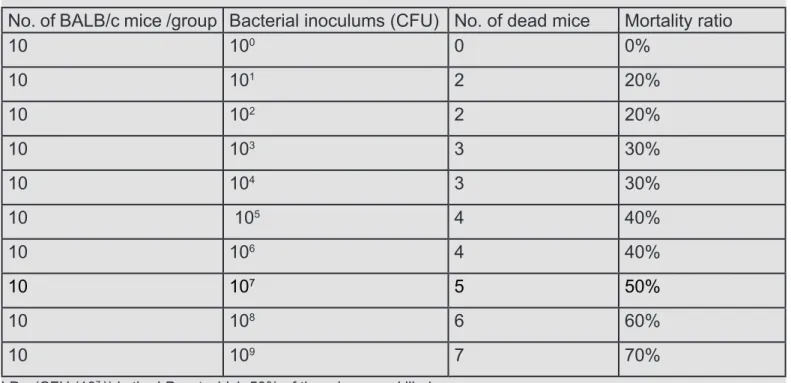
Table 2 Shows the results of LD50 determination
No. of BALB/c mice /group Bacterial inoculums (CFU) No. of dead mice Mortality ratio
10 100 0 0%
10 101 2 20%
10 102 2 20%
10 103 3 30%
10 104 3 30%
10 105 4 40%
10 106 4 40%
10 107 5 50%
10 108 6 60%
10 109 7 70%
LD50 (CFU (107 )) is the LD
50 at which 50% of the mice were killed.
Table(3)The results of Effectiveness determination of murine Transfer Factor in mice challenged
with M. tuberculosis
Group of mice Number of BALB/c mice/ group
Dose of T.F./
mouse Chal-lenge dose of M.tb.
No.of dead mice
Mortality
rate% Protective efficacy%
T1 12 0.5ml 0.5ml 2 (2/12)
16.7%
(10/12)
83.3%
T2 12 0.5ml _ 0 0% 100 %
T3 (control) 12 _ 0.5ml 12 (12/12)
100%
A total number of 10 inbred BALB/c mice were tuberculin skin test (TST) positive after immuni-zation with BCG while 10 out bred Swiss white mice were negative for TST.
Results of LD50 concentration:
Table(2)shows the groups mice inoculated
with different concentrations of M. tuberculosis. (102,103,104, up to 109) and the normal
saline(-control group) for one week showed that the group of colony forming unit (CFU)(100)
exhib-ited no death of mice. Mice given (101) and(102)
were exhibited 2deaths out of 10 (2/10) i.e.
mor-tality ratio 20% The groups of (103 ) and (104 )
showed 3 deaths out 10 (3/10)i.e. mortality ratio 30%.In the groups given(105) and(106 ) 4deaths out 10 (4/10) mice showed mortality ratio 40%
,In the groups given CFU (107 ) of mice showed
5deaths out of 10 (5/10)with mortality ratio 50%.
This showed that the lethal dose (LD50) which
killed 50% of the total number of the mice.
Results of the response of murine transfer factor (mT.F) in protection against challenge.
The results of the groups of mice which were
injected with mTF were exhibited in Table (3).
The control group (T3) which were not
immu-nized with mTF exhibited 100% mortality after 24 hours of virulent HRv37 with M .tuberculo-sis. The second group (T2 ) which received mTF but not challenged with M. tuberculosis survived
100%. The third group (T1) which received mTF and challenged with M. tuberculosis 10 out of 12
(10/12) mice survived after 3 weeks of observa -tion and (2/12) were died and hence protec-tion
of T.F immunopotency was 83.3%.
Results of vaccination with single and re-peated (booster dose) of BCG in mice
Survival mice in group (A) were 50%, group (B) 70% and group(C) 0%.The mortality rates for (A) 50%, (B) 30% and (C) 100%. The immunopoten
-cy and protective effica-cy of BCG first dose and boosting dose were (50%) and (70%) respec
-tively, and mortality rates of BCG first dose and boosting dose were (50%) and(30%) respec -tively .For Group(C) which were not immunized
100% mortality and 0% protective efficacy after
challenge dose of M. tuberculosis.
Results of immunopotency of transfer fac-tor (T.F) comparing with BCG immunization against challenge dose of Mycobacterium
tu-berculosis
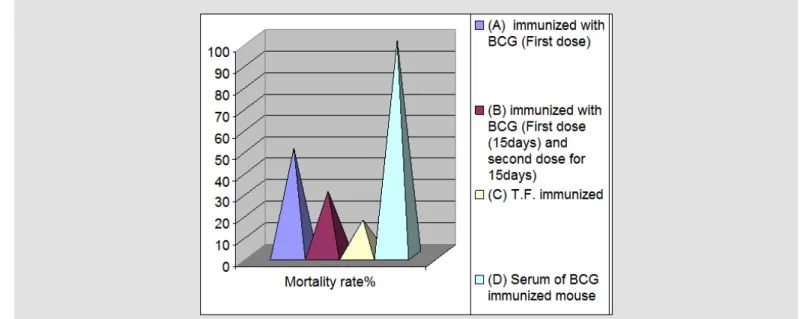
The comparison between TF and BCG immuni-zation results are shown in Figure (1).
The results of Humoral response of mice against Mycobacterium tuberculosis.
The result was death of the mice within 24hours, and mortality rate of humoral response of mice against Mycobacterium tuberculosis was 100% compared with 50% BCG first dose ,30% BCG boosting dose and 16.7% mortality rate of trans -fer factor (TF) .
Results of lung histopathology of mice
All slides of dead mice stained with haematox-ylin and eosin showed lung bacilli that Was M. tuberculosis.
Discussion
Since the discovery of Transfer Factor (TF) by Sherwood Lawrence in1955, more than 70 years ago Transfer Factor has been found to be very
effective in those diseases in which CMI plays a
relevant role in protection and control of the dis-ease , such as viral infections (herpes simplex, varicella zoster), intracellular bacterial diseases (tuberculosis, leprosy) and parasitic infections (leishmaniasis, toxoplasmosis) and some types of cancer. Transfer Factor (TF) are protein that transfer the ability to express cell mediated im-munity from immune donors to non-immune re-cipients. TF treatment were found to selectively
affects cytokine production in response to anti
-genic stimulation (Alvarez and Kirkpatrick; 1996).
In this study transfer factor obtained from the spleen of mice which were immunized by BCG intrapritoneally (I.P.) for twenty one days. The peak of immune protection in this animal model reached in day 21.This agree with a study done by Fabre (2004)in Mexico, used Transfer Factor as immunotherapy and supplement of chemo-therapy in experimental pulmonary tuberculosis. (Fabre.et al;2004). The current study found that
the effect of administration of murine transfer fac -tor (TF) on survival of challenged mice was
ma-jority (83.3%) comparing with maximum (100%)
Table 4 The results of single and repeated (booster doses) of BCG vaccination in mice challenged with M. tuberculosis .
Group of mice Number of
mice/group No.of surviv-al mice after challenge dose of M.tb.
No.of dead
mice Protective efficacy% Mortality rate%
(A) immunized with
BCG (First dose) 10 5 5 50% 50%
(B) immunized with BCG (First dose (15days) and repeated
dose for 15days)
10 7 3 70% 30%
(C)only challenge dose
of M.tb.) 10 0 10 0% 100%
Figure 1 The results of immunopotencyof transfer factor (T.F) comparing with BCG immunization against challenge dose of M. tuberculosis
Figure 2 Shows Humoral response of mice against Mycobacterium tuberculosis compared with
infected via the trachea with Mycobacterium tu-berculosis H37Rv and treated with mTF showed a significant 95% survival when compared with the control group, which exhibited 100% mortal -ity. Mexican team of investigators have shown that treatment of mice infected with M. tubercu-losis with a murine tuberculosis- specific TF
restored expression of the Th1 cytokine pat-tern and resulted in inhibition of bacterial
prolif-eration, significant increase of DTH, and animal
survival (Fabre, et al., 2004) The efficiency of
TF was highly depended on the dose and, to its source (murine ,human or bovine),colostrums is rich in transfer factor.4lifeTransfer Factor, Amer-ican company is famous and well known in the production of TF.
The efficacy of BCG against challenge dose of
M. tuberculosis was 50% and mortality rate was 50% The obtained results are similar to previ -ous studies done by Turner; et al in 2001.Who demonstrated used low-dose aerosol infection of
M. tuberculosis to compare chronic tuberculosis. Susceptible mice, which are often able to con-tain bacterial growth in the liver and spleen, are unable to restrict growth in the lung. While granulomas in resistant mice are well organized, consisting of aggregated lymphocytes and mac-rophages, lesions in susceptible mice are often poorly organized, necrotic and contain few lym-phocytes. This implies that susceptible strains have a defect in recruiting or retaining lympho-cytes in the lung. The production of cytokines crucial for the control of tuberculosis ,such as IFNg, is usually diminished in susceptible mice,
resulting in a general delay in the effect or phase
of the adaptive immune response. In many
cas-es, susceptible mice are deficient in maintaining
a single dose.(Flynn et al.,1995).
Conclusion
The results indicated that administration of mu-rine transfer factor (mTF) extracted and prepared from spleen of animal model (mice) as immuno-therapy for challenged mice of M. tuberculosis
(H37Rv) showed a better results enhanced im -mune response in respect to delayed type
hyper-sensitivity , survival rate was (83.3%) and mor
-tality rate (16.7%), comparing with (50%) and (70%) survival rate of BCG single and repeat
-ed dose respectively suggesting that efficacy
of mTF as immunotherapy for tuberculosis.The results obtained in this current study in animal
model (mice) suggest that repeat dose of BCG enhanced immune response in respect to
de-layed type hypersensitivity , survival rate (70%) and mortality rate (30%), suggesting that effica -cy of BCG vaccine may improve and give better results if booster doses are given.
Inbred strains of mice exhibit varied patterns of susceptibility following infection with virulent M tuberculosis. Susceptible mice have progres-sive fulminate disease resulting in their prema-ture death; in contrast, resistant mice are able to control bacterial replication, limit lung injury and survive longer.
References
Alvarez-Thull L, Kirkpatrick C H.(1996) Profiles of
cytokine production in recipients of transfer factors.
(Biotherapy 9(1-3) 55-9.
Dheda, K., Kunst H, Gibson., The immunology of
tu-berculosis: from bench to bedside.Respirology,2010. 15(3): p. 433-50.
Estrada Parra S, Chavez Sanchez R, Ondarza Agu
-ilera R, Correa MB, Serrano MA, Monges NA, Cal -va PC (1995). Immunotherapy with transfer factor
of recurrent herpes simplex type1. Arch Med Res. 26:S87–S92.
Fabre R A, Perez T M, Aguilar, L D, Rangel M J, Estrada-Garcia I, Hernandez-Pando R, and Estrada
Parra S (2004). Transfer factors as immunotherapy and supplement of chemotherapy in experimental
pulmonary tuberculosis Clin Exp Immunol 136(2): 215-223.
Flynn JL, Goldstein MM, Triebold KJ, Sypek J, Wolf
S, BloomBR.(1995) IL-12 increases resistance of
BALB/c mice to Mycobacterium tuberculosis infec-tion. J Immunol;155
Hernandez-Pando R, Orozco EH, Sampieri A, Pavón
L, Velasquillo C, Larriva-Sahd L, Madrid MW. Cor-relation between kinetics of Th1/Th2 cells and pa-thology in a murine model of experimental pulmonary
tuberculosis. Immunology. 1996;89:26–33.
Kirkpatrick, C. H. (2000). “Transfer factors: Identifica -tion of conserved sequences in transfer factor
mole-cules”. Molecular medicine (Cambridge, Mass.) 6 (4): 332–341.
Lawrence HS (June 1965). “Transfer factor and au -toimmune disease”. Ann. N. Y. Acad. Sci. 124 (1):
56–60.
Lienhardt, C., Global tuberculosis control: lessons learnt and future prospects.Nature reviews.
Microbi-ology, 2012. 10(6): p. 407-16.
An investigation of the antimicrobial impact of drug combinations against Mycobacterium tuberculosis strains. Turk. J. Med. Sci. 41(4): 719-724.
Lawn, S.D. and A.I. Zumla, Tuberculosis.Lancet,
2011. 378(9785): p. 57-72.
Schreiber F, Huo Z, Giemza R, Woodrow M, Fen -ner N, Stephens Z,(2010). An investigation of clini-cal and immunologiclini-cal events following repeated aerodigestive tract challenge infections with live Mycobacterium bovis Bacille Calmette
Guerin.Vac-cine.;28(33):5427–31.
Zakham F, Lahlou O, Akrim M, Bouklata N, Jaou-hari S, Sadki K, (2012). Comparison of a DNA
Based PCR Approach with Conventional Methods
for the Detection of Mycobacterium tuberculosis in Morocco. Mediterr. J. Hematol. Infect. Dis