Effect of feeding various probiotics on performance, blood
properties, egg quality, and yolk fatty acid composition of
laying hens
Md Rakibul Hassan
1, Shabiha Sultana
1, Md Obayed Al Rahman
1, Md Ataul Goni Rabbani
1,
Nathu Ram Sarker
1, Yu Chan Ju
2, Kyeong Seon Ryu
3*
1Poultry Production Research Division, Bangladesh Livestock Research Institute, Savar, Dhaka, Bangladesh, 2Department of Agricultural Economics, College of Agricultural and Life Science, Chonbuk National University, Jeonju, 561-756, Republic of Korea, 3Department of Animal Science, College of Agricultural and Life Science, Chonbuk National University, Jeonju, 561-756, Republic of Korea
ABSTRACT
The present experiment was conducted to evaluate the effects of different kinds of probiotics on the performance, blood properties, egg quality, and yolk fatty acid composition of laying hens. A total of 360 Lohmann light laying hens were randomly divided into four groups with 5 replicates of 18 birds in each replicate pen. Birds had ad libitum access to feed (contain 2740 kcal/kg metabolizable energy and 16.2% crude protein) and water throughout the study. The experiment lasted 21 weeks.Treatment included (1) control (basal diet without probiotics), (2) inoculation of 0.1% P (probiotics) with basal diet (B), (3) inoculation of 0.1% probiotics with ginseng (PG), and (4) inoculation of 0.1% probiotics with sulfone in the diet respectively. Egg production, egg weight, and feed intake in each treatment were recorded daily, and egg quality was measured every 4 weeks interval. Results indicated that 0.1% PG supplemented with basal diet had increased egg production. Feed intake was significantly reduced by the probiotic feeding (P < 0.05). Egg weight, egg mass, and feed conversion ratio were not influenced by the supplementation of probiotics in the diet. In egg quality, eggshell color, albumen height, Haugh unit, yolk color, and eggshell strength were not altered by the probiotic treatments. However, serum total cholesterol and triglyceride content was reduced significantly by the addition of PG into the diet compared to control. On the other hand, saturated and unsaturated fatty acid contents were not influenced by the feeding of probiotics in the diet. In conclusion, feeding dietary supplementation of 0.1% PG probiotics did decrease serum cholesterol without affecting performance and egg quality of laying hens.
Keywords: Blood properties and laying hens, Egg quality, Performance, Probiotics
Submitted: 15-01-2019, Accepted: 05-02-2019, Published: 29-03-2019
INTRODUCTION
During the past decades, poultry industry has become the most expanding sector throughout the world. The intensive system of poultry production causes stress to the birds which hamper the immunity and productivity of chicken.[1] To solve this, commercial farms are widely using probiotics in animal and poultry ration. After using antibiotic, increased growth performance, lower mortality, and higher immune response in broilers are well evident.[2] However, regular use of antibiotics in the feed leads to the development of antibiotic
resistant pathogenic bacteria,[3] thereby causing resistance to medicines, persistence of infections and retentions of antibiotic in different body parts of chicken which is recognized as a serious public health problem.[4] Moreover, wide usage of antibiotics leads to higher drug resistance to the pathogens in animal body which can be spread to human and causes detrimental effect. With growing concerns about antibiotic resistance and safety of livestock products for
consumers, there is a great interest in finding alternatives
to antibiotics for poultry production. Concerning the issues, priority has been given to produce substitutes for increasing
Address for correspondence: Kyeong Seon Ryu, Department of Animal Science, College of Agricultural and Life Science, Chonbuk National University, Jeonju, 561-756, Republic of Korea. E-mail: [email protected]
Original Article
the microbial growth either using useful microorganisms or non-digestible elements.
At present, the use of probiotics in the feed is very popular to improve growth and productive performances including body weight, daily weight gain, and dressing percentage.[5] Several
factors are directly involved with the efficacy of probiotic in
the diet of laying hens which include conformation of microbial species, supplementary dose, system and level of addition, composition of diet, age of birds, genotype, and environmental stress issues.[6] The supplementation of probiotics to
laying hens has been found to improve feed efficiency, egg
production, egg quality, nutrient digestibility, modulation
of intestinal microflora, pathogen growth inhibition, and gut
mucosal immunity.[7-9] Zhang et al.[10] reported that the dietary supplementation of 0.01% probiotic improved egg production and egg quality. Contrariwise, various opposing results were also described on the effects of supplementing probiotic on
egg production and feed conversion efficiency.[11-13] Probiotic supplementation may also play an important role in altering the lipid metabolism and reduce the cholesterol content both in egg yolk[14] and serum.[15] The effectiveness of probiotic application may depend on factors such as microbial species composition (e.g., single or multi-strain), livability, supplemental administration dose, method and frequency of application, diet composition, bird age, and environmental stress factors. Therefore, the present experiment was conducted to evaluate the effects of different kinds of probiotics on the performance, blood properties, and egg quality and yolk fatty acid composition of laying hens.
MATERIALS AND METHODS
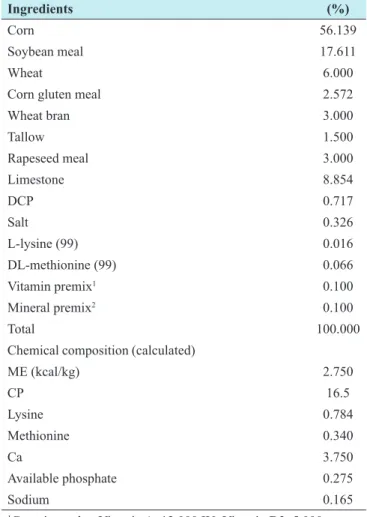
A total number of 360 Lohmann light laying hens were randomly divided into four groups with 5 replicates and 18 birds in each replicate pen. Treatment included (1) control (basal diet without probiotics), (2) inoculation of 0.1% P (probiotics) with basal diet (B), (3) inoculation of 0.1% probiotics with ginseng (PG) and (4) inoculation of 0.1% probiotics with sulfone (PS) in the diet, respectively. The temperature in the hen house was kept between 20 and 32°C. The light schedules were similar to the guidelines set in the Lohmann Commercial Management Guide. Birds had ad libitum access to feed (contain 2740 kcal/kg metabolizable energy and 16.2% crude protein) and water throughout the study (29–50 weeks). The basal diets are shown in Table 1. All other management of laying hens and experimental procedures were conducted in accordance with the Institutional Animal Care and Use Committee at Chonbuk National University, Korea.
Egg production, egg weight, and feed consumption were recorded on daily basis throughout the laying period. Egg mass was calculated by multiplying egg weight by egg production rate. The feed conversion ratio (FCR) was determined as a
gram of feed consumed per gram of egg mass produced (g of feed/g of egg mass). At the termination of the trial, 30 eggs were arbitrarily collected from each treatment to determine the egg quality parameters. Breaking strength of the eggshell was assessed using an egg multitester device (QC-SPA, TSS, Cambridge, UK). The result was expressed as a unit of compression pressure applied to unit eggshell surface exterior area (kg/cm2). After that, each egg was weighed cautiously and then broken separately on a glass plate, and the color of egg shell, albumin height, Haugh unit, and yolk color was determined using egg quality equipment (QCM+ System, TSS).
At 50 weeks of age, 10 blood samples were collected from each group and allowed to clot for 2 h at room temperature and were centrifuged (1500 rpm for 15 min at 4°C), and the serum was
Table 1: Ingredient (%) and composition of the experimental basal diets
Ingredients (%)
Corn 56.139
Soybean meal 17.611
Wheat 6.000
Corn gluten meal 2.572
Wheat bran 3.000
Tallow 1.500
Rapeseed meal 3.000
Limestone 8.854
DCP 0.717
Salt 0.326
L-lysine (99) 0.016
DL-methionine (99) 0.066
Vitamin premix1 0.100
Mineral premix2 0.100
Total 100.000
Chemical composition (calculated)
ME (kcal/kg) 2.750
CP 16.5
Lysine 0.784
Methionine 0.340
Ca 3.750
Available phosphate 0.275
Sodium 0.165
collected and stored at −80°C until analysis. The samples were
used to measure serum cholesterol, triglyceride (TG), high-density lipoprotein cholesterol, and low-high-density lipoprotein by
the Konelab 20 Analyzer (Thermo Fisher Scientific, Vantaa,
Finland) following the manufacturer’s guidelines.
Determination of fatty acid composition, 1 g of fresh egg yolk was weighed accurately in a glass tube and disintegrated in 4 mL of methanol-benzene (1:4, v/v). From that point, 200 mL of acetyl chloride was gradually included over a time
of 1 min and tubes were firmly shut with Teflon-lined tops
and subjected to methanolysis at 100°C for 1 h. Subsequently giving a cooling time of 15 min at room temperature, 2 mL of 6% K2CO3 was included the tubes followed by the expansion of 2 mL hexane for the vortex. Then, the tubes were jerked and centrifuged at 1700 g for 20 min. An aliquot of the upper stage hexane contained unsaturated fatty acid (UFA) methyl esters (FAME) was infused into the chromatograph. Unsaturated fats were chromatographed as methyl esters on a 30-m fused silica section having an inner distance across of 0.25 mm. The section was well-coated with 0.20 mm SupelcoTM 10. Investigation was performed on an Agilent Technologies 6890N, a gas chromatograph, outfitted with a fire ionization identifier. Helium was utilized as a bearer
gas and nitrogen as a make-up gas. The split proportion was 100:1. The infusion port temperature in stove condition and the indicator was 240°C. The section temperature ascended in a stepwise way from 180°C up to 230°C at the rate of 3°C/
min and afterward holds for 15 min. The fatty acids identified
using a FAME standard and were expressed as percentage of total known FAME.
All data were analyzed by analysis of variance using the GLM procedure of SAS[16] with a predetermined significance level of P < 0.05. To compare means among the treatment groups, Duncan’s multiple range tests were used.[17]
RESULTS AND DISCUSSION
The effect of feeding probiotics on production performances of laying hens is presented in Table 2. The results indicated that 0.1% PG supplemented with basal diet had increased egg production than other three groups, but the effect did not reach
to the significant level. In addition, chickens receiving diets
containing probiotic and PS tended to have lower (P < 0.05) feed intake than the control group. Egg weight, egg mass, and
FCR were not influenced by the supplementation of probiotics
into the diet.
This result is consistent with previous studies which reported that supplying a probiotic mixture in the diet had no
significant impact on egg production and egg quality.[18] In other investigations, Kurtoglu et al.[19] and Kalavathy et al.[15]
reported that significant (P < 0.05) increases egg production after supplying a probiotic mixture in the diet. These differences might be due to the supplementation of different bacteria strains with different concentrations, the form of probiotics, and the ages of the hens.
Table 2: Effect of feeding probiotics on the performance of laying hens
Traits Treatments (%) SEM P value
Control PP PG PS
Egg production 86.76 87.19 88.31 86.93 0.39 0.598
Egg weight 68.12 67.40 67.52 67.18 0.21 0.864
Egg mass 59.10 58.75 59.62 58.39 0.35 0.735
Feed intake 139.04a 133.73b 136.35ab 133.04b 1.06 0.037
FCR 2.353 2.276 2.288 2.279 0.02 0.382
a,bValue with the same letters in the row are not significantly different at 5% level, PP: Probiotics, PG: Probiocs with ginseng, PS: Probiotics with sulfone, FCR: Feed conversion ratio, SEM: Standard error of the mean
Table 3: Effects of feeding probiotics on egg qualities
Traits Treatments (%) SEM P value
Control PP PG PS
Egg shell color (%) 24.53 24.43 24.86 24.76 0.31 0.941
Albumin height (mm) 8.31 8.38 8.38 8.06 0.12 0.642
Haugh unit 88.97 89.40 88.87 88.34 0.67 0.593
Yolk color 7.10 6.97 7.10 6.80 0.07 0.517
Egg shell breaking strength (kg/cm2) 4.79 4.91 4.73 4.76 0.11 0.436
The egg quality data for the laying hens receiving the experimental diets are shown in Table 3. Laying hens receiving
either PG or sulfone did not significant effects on egg shell
color, albumen height, Haugh unit and yolk color of egg. On the
other hand, eggshell breaking strength was not influenced by
receiving PG or sulfone in the diet. In previous, Panda et al.[7] found that eggshell quality was improved using probiotic in laying hens. Recently, Ren et al.[20] stated that yolk height, yolk color, and Haugh units were not affected by probiotic treatments. In another experiment, Abdelqader et al.[21] mentioned that the development of eggshell parameters was connected to the promoting effect of probiotics on metabolic processes as well as calcium utilization. Therefore, this variation might be due to trace mineral content and utilization with microbial supplementation in the diet of laying hens.
Analysis of blood serum parameters is shown in Table 4.
Statistically significant difference in total cholesterol and TG
content was observed in the group treated with PG. Serum total
cholesterol and triglyceride content was reduced significantly
by the addition of PG into the diet compared to control. The present results are consistent with the results of Mansoub[22] who reported that total cholesterol and TGs were decreased in the probiotic-treated group. A similar effect of probiotics on serum cholesterol level has been found in broilers.[23] Therefore, the reduction level of cholesterol could be due to cholesterol assimilation by the Lactobacillus cells[24] or to the co-precipitation of cholesterol with deconjugated bile salts, thereby decreasing pH level in the intestinal tract, which leads to reduce serum cholesterol.[25]
In the present experiment, the composition of fatty acid was
not significantly influenced by the dietary treatments [Table 5]. Myristic acid (C14:0), Palmitic acid (C16:0), palmitoleic acid (C16:1n7), oleic acid (C18:1n9) and linolenic acid (C18:3n3) were found numerically higher in the group treated with probiotic and ginseng compared with control, probiotic, and probiotic with sulfone-treated group. Stearic acid (C18:0) and linoleic acid (C18:2n6) and (C20:1n9) were not affected in the dietary treatments.
The saturated fatty acid (SFA) was decreased and UFA was increased in the dietary groups compared with the control
except PG. Similarly, monounsaturated fatty acid (MUFA) was higher and polyunsaturated fatty acid was lower in the dietary treatments than that of control group. Higher UFA and SFA ratio (UFA/SFA) was found in group treated with 0.1%
PS probiotic in the diet. In previous study, Yalçın et al.[26] reported that Saccharomyces cerevisiae supplementation in diets for laying hens increased total SFA and the SFA/UFA
ratio which corresponds with the present findings. On the
other hand, Kalavathy et al.[15] found that hens fed diets with Lactobacillus culture had very little potential to modify the fatty
acid composition of the egg yolk. In another experiment, Yalçın
et al.[26] also stated that C
18:1n9 and MUFA levels increased, and the other fatty acid parameters were not affected by yeast
Table 4: Effects of feeding probiotics on blood composition of laying hens
Traits Treatments (%) SEM P value
Control PP PG PS
GOT 166.80 172.00 149.20 176.20 1.93 0.096
Total cholesterol 117.60a 116.40a 72.20b 97.60ab 2.91 0.013
TG 1,276.80a 1,277.40a 764.60b 1,033.20ab 26.91 0.004
HDL-cholesterol 41.40 42.80 40.2 42.40 0.47 0.642
PP: Probiotics, PG: Probiocs with ginseng, PS: Probiotics with sulfone, HDL: High-density lipoprotein, TG: Triglyceride, SEM: Standard error of the mean
Table 5: Effect of feeding probiotics on the fatty acid composition of eggs
Traits Treatments (%) SEM P value Control PP PG PS
C14:0 0.33 0.32 0.34 0.31 0.01 0.782 C16:0 26.55 25.61 26.90 25.75 0.29 0.815 C16:1n7 2.68 2.68 3.05 2.57 0.14 0.614 C18:0 13.01 12.67 11.84 12.37 0.45 0.593 C18:1n9 38.09 38.59 39.75 39.59 0.94 0.481 C18:2n6 13.11 12.70 12.27 12.99 0.43 0.647 C18:3n3 0.21 0.24 0.24 0.25 0.01 0.682 C20:1n9 0.31 0.28 0.30 0.29 0.01 0.724 C20:3n9 0.24 0.24 0.25 0.26 0.01 0.469 C20:4n6 4.15 4.28 3.92 4.32 0.17 0.534 C22:6n3 1.28 1.36 1.12 1.26 0.05 0.316 SFA1 39.88 38.61 39.09 38.43 0.38 0.923 UFA2 60.11 61.39 60.91 61.57 0.49 0.729 MUFA3 41.10 42.55 43.11 42.46 0.82 0.158 PUFA4 19.01 18.84 17.80 19.10 0.33 0.237 UFA/SFA 1.51 1.59 1.56 1.61 0.02 0.643 Values are means±standard error, 1Saturated fatty acid,
culture supplementation. This disparity was attributed due to the
sample state between the present study and previous findings.
CONCLUSION
The present study demonstrated that 0.1% probiocs with ginseng showed positive effects on egg production and egg quality. It also decreased the serum cholesterol without affecting performance and egg quality of laying hens. Further follow-up studies should be conducted to investigate PG addition of >0.1% in laying hens diet.
REFERENCES
1. Foley SL, Lynne AM, Nayak R. Salmonella challenges: Prevalence in swine and poultry and potential pathogenicity of such isolates. J Anim Sci 2008;86:E149-62.
2. Attia YA, Zeweil HS, Alsaffar AA, El-Shafy AS. Effect of non-antibiotic feed additives as an alternative to flavomycin on broiler chickens production. Arch Geflügel 2011;75:S40-8.
3. Sorum H, Sunde M. Resistence to antibiotics in the normal flora of animals. Vet Res 2001;32:227-41.
4. Andremont A. Consequences of antibiotic therapy to the intestinal ecosystem. Ann Fr Anesth Reanim 2000;19:395-402.
5. Chattopadhyay MK. Use of antibiotics as feed additives: A burning question. Front Microbiol 2014;5:334.
6. Mikulski D, Jankowski J, Zdunczyk Z, Juskiewicz J, Slominski BA. The effect of different dietary levels of rapeseed meal on growth performance, carcass traits, and meat quality in turkeys. Poult Sci 2012;91:215-23.
7. Panda AK, Rao SS, Raju MV, Sharma SS. Effect of probiotic (Lactobacillus sporogenes) feeding on egg production and quality, yolk cholesterol and humoral immune response of white leghorn layer breeders. J Sci Food Agric 2008;88:43-7. 8. Youssef AW, Hassan IM, Ali IM, Mohamed MA. Effect of
probiotics, prebiotic and organic acids on layer performance and egg quality. Asian J Poult Sci 2013;7:65-74.
9. Chung SH, Lee J, Kong C. Effects of multi strain probiotics on egg production and quality in laying hens fed diets containing food waste product. Int J Poult Sci 2015;14:19-22.
10. Zhang ZF, Cho JH, Kim IH. Effects of Bacillus subtilis UBT-MO2 on growth performance, relative immune organ weight, gas concentration in excreta, and intestinal microbial shedding in broiler chickens. Livest Sci 2013;155:343-7.
11. Zarei M, Ehsani M, Torki M. Dietary inclusion of probiotics, probiotics and symbiotic and evaluating performance of laying hens. Am J Agric Boil Sci 2011;6:249-55.
12. Afsari M, Mohebbifarn A, Torki M. Effects of dietary inclusion of olive pulp supplemented with probiotics on productive
performance, egg quality and blood parameters of laying hens. Annu Res Rev Biol 2014;4:198-211.
13. Sobczak A, Kozłowski K. The effect of a probiotic preparation containing Bacillus subtilis ATCC PTA-6737 on egg production and physiological parameters of laying hens. Ann Anim Sci 2015; 15:711-23.
14. Xu CL, Ji C, Ma Q, Hao K, Jin ZY, Li K. Effects of a dried
Bacillus subtilis culture on egg quality. Poult Sci 2006;85:364-8. 15. Kalavathy R, Abdullah N, Jalaludin S, Ho YW. Effects of
Lactobacillus cultures on growth performance, abdominal fat deposition, serum lipids and weight of organs of broiler chickens. Br Poult Sci 2003;44:139-44.
16. Statistical Analysis Software (SAS). Institute, Guide for Personal Computers, Version 9.1. USA: Statistical Analysis Software Institute, Cary, NC; 2002.
17. Steele RG, Torrie JH. Principles and Procedures of Statistics: A Biometrical Approach. 2nd ed. New York: McGraw-Hill Book Co.; 1980.
18. Balevi T, Uçan US, Coşkun B, Kurtoglu V, Cetingül IS. Effect of dietary probiotic on performance and humoral immune response in layer hens. Br Poult Sci 2001;42:456-61.
19. Kurtoglu V, Kurtoglu F, Seker E, Coskun B, Balevi T, Polat ES,
et al. Effect of probiotic supplementation on laying hen diets on yield performance and serum and egg yolk cholesterol. Food Addit Contam 2004;21:817-23.
20. Ren YT, Zhou LW, Guo ZW, Wen CL. The effect of Bacillus amyloliquefaciens on productive performance of laying hens. Ital J Anim Sci 2018;17:436-41.
21. Abdelqader A, Al-Fataftah A, Das G. Effects of dietary Bacillus subtilis and inulin supplementation on performance, eggshell quality, intestinal morphology and microflora composition of laying hens in the late phase of production. Anim Feed Sci Technol 2013;179:103-11.
22. Mansoub NH. Effect of probiotic bacteria utilization on serum cholesterol and triglycrides contents and performance of broiler chickens. Glob Vet 2010;5:184-6.
23. Mohan B, Kadvel R, Natarajan A, Baskaran M. Effect of probiotic supplementation on growth, nitrogen utilization and serum cholesterol in broilers. Br Poult Sci 1996;36:395-401.
24. Gilliland SE, Nelson CR, Maxwell C. Assimilation of cholesterol by Lactobacillus acidophilus. Appl Environ Microbiol 1985; 49:377-81.
25. Klaver FA, Van der Meer R. The assumed assimilation of cholesterol by Lactobacilli and Bifidobacterium bifidium is due to their bile salt-deconjugating activity. Appl Environ Microbiol 1993; 59:1120-4.
26. Yalçin S, Yalçin S, Cakin K, Eltan O, Dağaşan L. Effects of dietary yeast autolysate (Saccharomyces cerevisiae) on performance, egg traits, egg cholesterol content, egg yolk fatty acid composition and humoral immune response of laying hens. J Sci Food Agric 2010;90:1695-701.