1
A Study towards Implementation of Public
Hub Transportation: A Case Study of
Penang Central
Muna Norkhairunnisak Ustadi, a,* Nor Atiqah Mohammad Shopi, a
a
Maritime Management Section, Universiti Kuala Lumpur, Malaysian Institute of Marine Engineering Technology, Jalan Pantai Remis, 32200 Lumut, Perak.
*Corresponding author: [email protected]
Abstract
Public transport hubs are infrastructures meant to be easily accessed by the citizens. The location of hub should be close with other interconnected links to minimize the fare rates that need to be paid by commuters to reach their next modes. This paper discusses the available literature on transportation network systems, validating the application of the „Hub Concept‟ in reorganizing transportation network in urban areas. This paper also highlights the general account and previous experiences of the hub service level to be implemented at Penang Central and designing an efficient public transportation network in selected area. This shows that most of the respondents who use public transport as their modes of transportation agreed and satisfied with the service level at Penang Central. The passengers/users also agreed with the questions provided. This will help to support the implementation of public transportation hub in that area. The efficiency of a hub not only falls under the facilities provided but it also involves the behavior of operators/workers who serve the passengers at the hub. As the population of the Penang area increases by the year, the need for transportation is indeed important. The Penang Central will benefit the investors who already performed entire fundamental logistics solution and facilities and services on air, land and sea. Last but not least, the study firmly indicates the need for integrated and sustainable public transportation system for northern Peninsular Malaysia.
Keywords: Public Transport, Hub and Spoke Concept
1. INTRODUCTION
Public transport hubs are infrastructures meant to be easily accessed by the citizens. The location of hub should be close with other interconnected links to minimize the fare rates that need to be paid by the passenger to reach their next modes. Travelling using public transport is cheaper as compared to the private vehicles. For those people who face financial challenge living in urban areas, public transportations are the most economical mode for
commuting. A public transport hub is a place where the passengers interchange their transport modes. Public transports for road and waterways include bus, taxi, motorcycle, rickshaw, bicycles, ships and ferry, which are managed under transport hubs such as bus stations, taxi stations, bus stops and ferry terminal. The public transports capacity demand in Northern Peninsular Malaysia is rising rapidly due to the increase in population. Public transports are chosen by the people who seek for freedom, opportunity and those who simply cannot afford to
2
have their own-private vehicles (Azfizan et. al, 2013).
The location of the hub and its design are important to maximize passenger convenience and ease of travel. Hub with fully functional facilities would offer significant reductions in journey times and attract passengers to use the public transport. Implementing efficient hub concept will offer the passengers/users with many benefits. Not only that, efficient hub concept allows the country to gain more revenue and good source of economy. This hub concept has been used by many developed countries such as United Kingdom, China and Japan, as it can minimize the cost of travelling and reduce the traffic congestion. To form integrated public transport hub, the location must have interconnected links with other major regional (spoke) hubs, either by using the same modes or different mode of transport. Concern is always focused on the facilities and equipment used at the hub and the operations. All this characteristics are vital component to serve as an efficient hub. Malaysian population growth is growing at a pace too fast, hence boosting the vehicle population.
Nowadays, many hubs of public transport face challenges such as people shifting into their private car, economics changes and demand of public transport. Population in Penang is increasing, so as the needs for transportation. As the cost of living increases, people should plan to avoid traffic congestion by shifting to public transportation during peak hours. Moreover, by using the public transport, there will be no time wasting and overspend on cost of transportation. This research paper presents some recommendations for solving traffic problems and increasing travelling efficiency by the application of hub concept of „hub and spoke‟ transport system that requires rearranging and re-planning of the transport modes and links for public transport network at Penang Central.
2. SCOPE OF REVIEW
The concepts of transportation systems have evolved over the years. Less efficient systems have matured into development of new and efficient facilities like integrated link systems, hub and
spokes networks and multi-modal systems. Haggett in Tony (2006), stated that the core concept of transportation system and relationship between transport nodes, networks and demand have undergone a strategic reformation. This paper discusses the available literature on transportation network systems, validating the application of the „Hub Concept‟ in reorganizing transportation network in urban areas. This paper also highlights the general account and previous experiences on the hub service level to be implemented at Penang Central, and design of efficient public transportation network in selected areas. Penang is located at the northwest coast of Malaysia, to the south of Kedah and to the north of Perak. It has two parts; Penang Island and Seberang Perai, with Penang Island connected to the Mainland via the Penang Bridge and Georgetown via Butterworth ferry.
The state of Penang covers 1,065 square kilometers, with the island occupying 310 square kilometers and the mainland occupying 755 square kilometers (Azfizan Aziz et.al, 2013, p.3). The recent 2013 population and housing census have recorded an overall population of 1.647 million people setting up residence in the island state (Shohaimay et.al, 2013, para. 2).
Table 1 shows Penang estimated population by Ethnic Group (Anon., 2014, para. 3). The population in Penang increases every year, thus the need for vehicles to move from one location to another also increases. Hence, the government has planned various strategies to fulfill the need for transportation in the urban areas. One of their plans is to make Penang Central as an integrated hub for public transportation.
3
Table 1. Population in Penang by Ethnic Group (Anon., 2014, para. 3)
YEAR /
ETHNIC GROUP
2011 2012 2013
Malaysian: 1,493.7 1,514.2 1,532.3
Malay 648.7 662.1 674.4
Others Bumiputera 6.4 6.5 6.6
Chinese 674.9 679.8 683.4
Indian 159.0 161.1 163.1
Others 4.6 4.7 4.8
Non-Malaysian Citizens
107.3 111.6 115.4
Total 1,601.0 1625.8 1,647.7
2.1 Hub Concept Treatment
Modern transport needs to be efficient, sustainable and functionally integrated to meet passenger‟s demand. According to Aldukali Salem I. Amselati, et.al (2011), factors like travel time, cost, distance from home to public transport and distance from home to work influence the users to shift from private vehicles to public transport in Malaysia. Hence, the companies which manage transport hubs should improve the service quality to attract more passengers to shift to public transport modes. According to Tony (2006), transportation system may include nodes, terminals and locations. These three components can be optimized, functionally linked and better managed by configuring and reorganizing the core relationship components. The most important transportation hub characteristic is the design to cater the need of communities from the starting point of origin to other end destinations.
In identifying potential transport hub location, a number of characteristics need to be considered. Those characteristics include capability to host one or more modes of transit, enhancement of transit service, having inter-regional destination, market demand to attract supportive levels of mix use or intensive development and has land available for different types of development in and around transport hub (Woxenius J., 2002). These theories of transportation system demonstrate that nodes are essential components to be interlinked with networks. Figure1 below shows the transportation system in concepts.
Figure 1. Transportation System in Concept
Figure 1 (adapted from Tony, 2006, p. 29) shows the three core relationships components of transportation system and friction. According to Tony (2006), locations are defined as the place where socio-economic activities exist. The demand for movements and traffic arise in this area. The access links to these areas may face friction, which in general is a function of the accessibility to nodes to the demands they cater to (p. 29).
2.2 Hub Concept for Public Transport
4
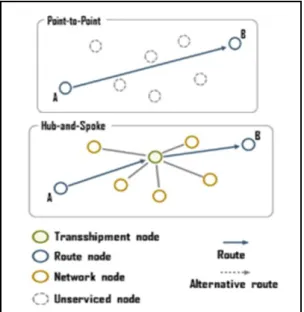
in Tony, 2006, p.32), gives a diagrammatic representation of a „point-to point‟ and ‟hub and spokes‟ concept applicable to road public transport. Users who use their own private vehicles in everyday life apply the concept of direct connection or „point-to- point‟ while users that using public transportation practice the use of „hub and spokes‟.
Figure 2. Point-to-Point vs. Hub and Spoke Systems
A point-to-point concept connects different places in direct ways and there are a number of links which result in increase of the traffic congestion. In application of hub system, the direct links are split into separate connections in order to increase accessibility for public transportations such as buses and taxis. By using those public transports, users get the benefit in reduction of travel cost and help in minimizing traffics congestion and pollution. A transport hub is a key location where several routes and means of transport converge and diverge (Starkey P., 2007). For example, when travelling from point A to B, the point-to-point concept gives a direct connection. On the other hand, from point A to B under the hub and spoke system, user needs to travel to central point first and then change over to go to point B. A study was conducted in selected areas of research in Northern Peninsular Malaysia, where a user decided to travel from Kuala Kedah (as point A) to Penang Island (as point B). Along her journey from Kuala Kedah, she travelled using bus. After arriving at the bus terminal at Penang Central (as central point), the
user needed to change over to ferry to go to Penang Island. Thus, users who rely on direct connection need to be convinced about the reliability, efficiency and costs of the hub options. This may change their mind to use from direct route to hub journey.
3. METHODOLOGY
The research was done in order to test the hypotheses. In order to identify the efficiency of the selected area as hub transportation system, data and information about the method used in the future were gathered. This research focused on workers and students in the Penang state who travel using public transport on weekday basis. Figure 3 below shows the population and sample for research area.
Target population:
Penang state residents
Specific population:
Passenger and users who travel using public transport in Penang
Sample: Workers and students in
Penang state who travelling using public transport in weekly basis
Figure 3. Populations and sample for research area
5
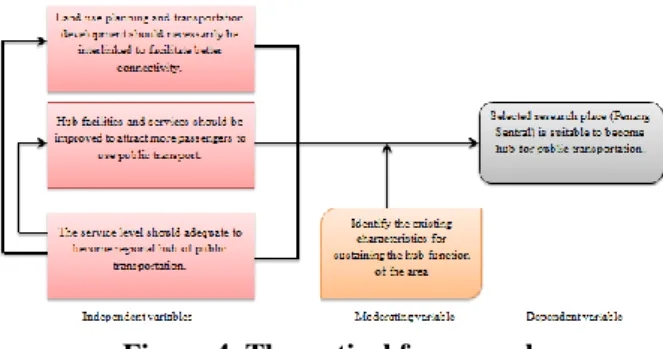
The research results were then analyzed by using the Statistical Package for the Social Sciences (SPSS) method. In this method, correlation analysis is used to investigate two variables to measure the relationship between them. The two variables are tested to identify their relationship. If the two variables are related to each other, then the variables are said to be correlated. It is used to discover the possibility of a link between variables prior to the research outcome. This analysis may help in deriving the degree and the direction of the relationships. The theoretical framework for this research is constructed as in Figure 4 below.
Figure 4. Theoretical framework
4. RESULTS AND DISCUSSION
The hypothesis to determine the strength of relationship between variables between Characteristics of Penang Central (X) and Transportation Links Connected (Y) is shown below:
i. Ho (Null): (P ≤ 0.05) There is no relationship between the factors in becoming the hub for public transportation.
ii. H1: (P > 0.05) There is relationship between factors in becoming the hub for public transportation.(CLAIM)
Table 2 shows the result gathered from the correlation test, in which the Pearson‟s r is0.661, which is close to 0 than 1. The variables analyzed are “Characteristics of Penang Central” and “Transportation Links” which seem to be correlated to each other. There is Moderate Positive
relationship between these two variables. It means that we need to reject Ho (Null) and accept H1. Both factors of Characteristics and Transportation Links have a significant relationship that affects the possibility of Penang Central to become a public transportation hub.
Table 2. Correlation result Transport-ation Links Connected
Charac-teristics of Penang Central Transport-
ation Links Connected
Pearson Correlation
1 .661**
Sig. (2-tailed)
.000
N 50 50
Charac-teristics of Penang Central
Pearson Correlation
.661** 1
Sig. (2-tailed)
.000
N 50 50
This shows that most of the respondents who use public transport as their modes of transportation had chosen to “Agree”, or in other words were satisfied with the service level of Penang Central. The users also agreed with the questions provided. This will help to support the implementation of public transportation hub in that area. The efficiency of a hub not only falls under the facilities provided but it also involves the behavior of operators who serve the passengers at the hub. They also give a big influence in attracting users to use their services. From this, Penang Central is seen to have all the characteristics to become the major hub for public transport. The users also agree with the questions provided. This will help to support the implementation of public transportation hub in that area. These characteristics are important to cater the need and demand of the public transport among users.
6
5.CONCLUSION
The study finds that public transportation in Penang Central is growing all over the year. Despite the breadth of issue and examples covered in this study, several clear themes related to the implementation of hub public transport stand out as the conclusion. Applying the hub concept in the Penang Central appears to be a possible option for tackling the traffic congestion in that area. This study also provides relevant hub concept treatment that can be implemented in Penang. Based on the data that had been analyzed, there are potentials that Penang Central is capable to become the hub for the public transportation. As the population of the Penang area increases by the year, the need for transportation to move is indeed important. The area will benefit the investor who already performed entire fundamental logistics solution and facilities and services on air, land and sea. Last but not least, the study firmly indicates the need for integrated and sustainable public transportation system for northern Peninsular Malaysia. The need of advanced technology in servicing the operations of the hub is also important as it will increase user‟s accessibility. Efficient ticket vendor machines will minimize the waiting time in queuing when buying the tickets from the operators.
6. ACKNOWLEDGEMENT
This work is supported by Universiti Kuala Lumpur under the Short Term Research Grant Scheme (STRG), Grant Code: UniKL/IRPS/str12081.
7. REFERENCES
[1] Aldukali Salem I. Amselati, Riza Atiq O.K Rahmat, and Othman Jaafar. (2011). An overview of urban public transport in Malaysia. Journal of Social Sciences, 6, 24-33.
[2] Tony, T. (2006). Application of the hub concept to urban public transport in Hong Kong: A case study of north point. Journal of
HKU Scholars Hub, 1, 1-148. Retrieved from
http://hub.hku.hk/bitstream/10722/52872/6/Fu llText.pdf
[3] Woxenius, J. (2002). Conceptual Modeling of an Intermodal Express Transport System,
International Congress on Freight Transport Automation and Multimodality: Delft, The Netherlands. Retrieved from https://people.hofstra.edu/geotrans
[4] Starkey, P. (2007). A Methodology for Rapid Assessment of Rural Transport Services. Journal of Sub-Saharan Africa Transport Policy Program, 87-A, 1-94. Retrieved from www.worldbank.org
[5] Woxenius, J. (2002). Conceptual Modeling of an Intermodal Express Transport System, International Congress on Freight Transport Automation and Multimodality: Delft, the Netherlands. Retrieved from https://people.hofstra.edu/geotrans
[6] Anonymous. (2014, March). Population.
Penang Institute. Retrieved from
http://www.theedgemalaysia.com/managemen t/263161-multi-billion-ringgit-penang-sentral-project-redesigned.html
[7] Shohaimay and Lyana. (2013,November). Multi billion ringgit Penang Sentral project redesign. Retrieved from http://www.theedgemalaysia.com/managemen t
[8] Timothy, T. (2009, January). Arriving in Penang by Ferry. Retrieved from http://www.penangtraveltips.com/arriving-by-ferry.htm
[9] Balvin Kaur and Rahmat. (2013, November). Stalled Penang Project an Eyesore. Retrieved from
http://www.nst.com.my/streets/northern/stalle d-penang-sentral-project-an-eyesore
[10] Shohaimay and Lyana. (2013,November). Multi billion ringgit Penang Sentral project redesign. Retrieved from http://www.theedgemalaysia.com/managemen t