Selection and Assignment of Machines:
a Parallel Approach
Jos´e Francisco Ferreira Ribeiro
Department of Computer Science, University of S ˜ao Paulo at S ˜ao Carlos, Brazil
In this paper, a two-phase method is presented for selection of machines to be kept on the shop floor and assignment of parts to be manufactured on these machines. In the first phase, dynamic programming or a heuristic procedure identifies a set of feasible solutions to a knapsack problem. In the second phase, implicit enumeration technique or a greedy algorithm solves an assignment problem. The proposed method is written in language C and runs on a parallel virtual machine called PVM-W95. The results obtained from the parallel implementation on several examples which are found in the literature, as well as examples generated at random, were used to establish a comparison with the sequential algorithm and to perform a speedup analysis.
Keywords: job shop production, assignment problem,
optimization techniques, parallel virtual machine.
1. Introduction
This article proposes a parallel implementation of a two-phase method including optimization algorithms for solving (1) the problem of the
selection of machines to process jobs on parts in a job shop production system and (2) the
problem of the assignment of parts to be manu-factured in the shop to the machines chosen in phase (1). These two problems belong to the
class of NP-complete combinatorial problems
1]. Polynomial algorithms are available for
reduced size instances only; however, these re-duced size instances can be optimally solved by complete search. This approach cannot be used for solving large-scale instances and the use of heuristic algorithms2] for solving large-scale
instances becomes a widely employed rule. The method implemented here desires to use available resources in the best manner. For this
purpose, it attempts to find the best matching be-tween parts and a subset of available machines in the shop. The machines are selected among those available and parts are assigned to these machines, leading to the construction of an inci-dence matrixparts machines]. This problem
is solved in two steps: searching feasible solu-tions to the knapsack optimization problem for the choice of the set of machines, followed by an implicit enumeration procedure or a greedy algorithm for the assignment of parts to the ma-chines chosen, leading to a solution which is either optimal or feasible2]. Parameters such
as duration of operations and machine capacity are taken into account.
Parallel implementation of the proposed method is performed in this work with the objective to solve simultaneously all optimization problems on the types of machines available in the shop. In fact, for the types of machines available in the shop, such as lathe, miller, drill, etc., a prob-lem Xi]completely independent of the problem
Xj], where i and j are two different types of
ma-chines, must be solved. In terms of computa-tional time, the gain is considerable: for solving
m problems related to m types of machines, the
computational time is approximate to the time spent to solve the biggest of these problems, if
m nodes of processing are available.
The proposed two-phase method was written in language C and was executed on the Parallel Virtual Machine for Windows95, called PVM-953]. The PVM-W95 is a software system that
2. Problem Statement
The problem consists in finding an assignment of the parts to the machines available in the shop. Consider a set of r parts and a set of m machine types:
(1) For each part i(i=1 to r):
nbi]is the number of units to be
manufac-tured.
gi] is the number of operations of the
pro-duction sequence.
ty pei k], k=1 to gi]is the type of machine
used for the kthoperation on part i.
Note that any type of machine may appear
many times in the production sequence of part i.
durationi k], k=1 to si], is the duration of
the kthoperation on part i, given with respect to the reference machine of the correspond-ing type.
(2) For each type of machine j(j=1 to m):
tj]is the number of machines available. srj s], s= 1 to tj], is the speed ratio of the
sth machine of type j, given with respect to the reference machine.
Speed ratio of the reference machine equals
1.
capj s]=srj s] period is the capacity of
the sth machine of type j, s=1 to m.
Reference machine capacity is the lowest in
the type.
Period is the total duration of work in the
shop.
costj s], s =1 to tj], is the utilization cost
of the sthmachine of type j.
pj s], s =1 to tj], is the penalty weight for
the sth machine use.
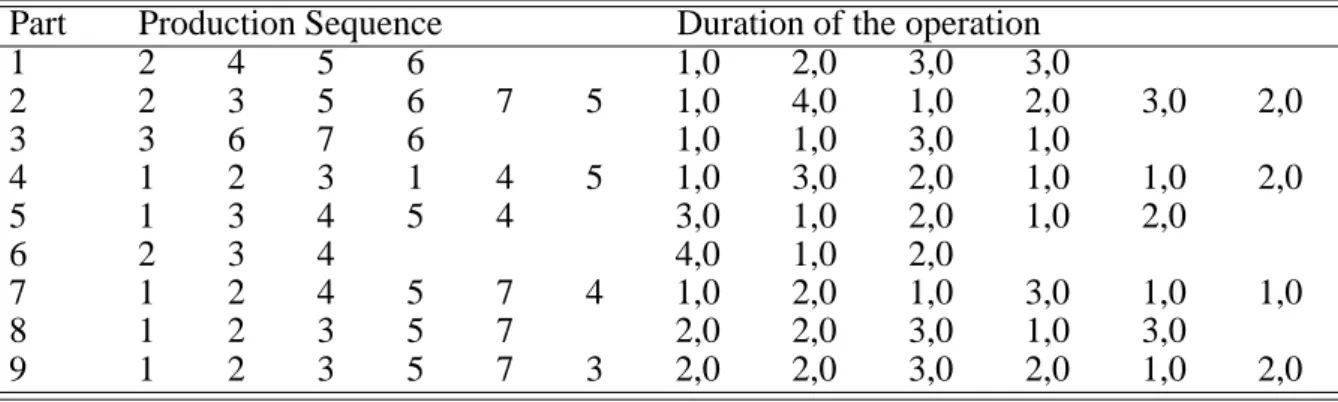
Tables I and II show an example where nbi]=1 (i=1 to r). This example will be used
through-out this paper to illustrate the proposed method.
Part Production Sequence Duration of the operation
1 2 4 5 6 1,0 2,0 3,0 3,0
2 2 3 5 6 7 5 1,0 4,0 1,0 2,0 3,0 2,0
3 3 6 7 6 1,0 1,0 3,0 1,0
4 1 2 3 1 4 5 1,0 3,0 2,0 1,0 1,0 2,0
5 1 3 4 5 4 3,0 1,0 2,0 1,0 2,0
6 2 3 4 4,0 1,0 2,0
7 1 2 4 5 7 4 1,0 2,0 1,0 3,0 1,0 1,0
8 1 2 3 5 7 2,0 2,0 3,0 1,0 3,0
9 1 2 3 5 7 3 2,0 2,0 3,0 2,0 1,0 2,0
Table I. Production sequences and duration.
Type of Machine Number of Machines Speed Ratio
N1 N2 N3 N4
1 2 1,0 1,2
2 3 1,0 1,3 1,2
3 4 1,0 1,2 1,2 1,1
4 3 1,0 1,1 1,0
5 2 1,0 1,1
6 2 1,2 1,0
7 3 1,0 1,1 1,1
3. Load Matrix [Parts Types of Machines]
Given the production sequences of the parts to be manufactured, the duration of operations and the number of units to be manufactured for each part, the elements of the load matrix
parts machines]are given by:
loadi j]=nbi] X
durationi k] (1)
kjty pei k]=j
In the example proposed the load matrix is given in Table III.
T 1 T 2 T 3 T 4 T 5 T 6 T 7 Part 1 0,0 1,0 0,0 2,0 3,0 3,0 0,0 Part 2 0,0 1,0 4,0 0,0 3,0 2,0 3,0 Part 3 0,0 0,0 1,0 0,0 0,0 2,0 3,0 Part 4 2,0 3,0 2,0 1,0 2,0 0,0 0,0 Part 5 3,0 0,0 1,0 4,0 1,0 0,0 0,0 Part 6 0,0 4,0 1,0 2,0 0,0 0,0 0,0 Part 7 1,0 2,0 0,0 2,0 3,0 0,0 1,0 Part 8 2,0 2,0 3,0 0,0 1,0 0,0 3,0 Part 9 2,0 2,0 5,0 0,0 2,0 0,0 1,0
Table III. Load matrix parts ty pes o f machines].
4. Selection of Machines
First, the machines which will remain effective in the workshop are chosen, irrespective of the process of assignment of parts to machines, but only in accordance with the global load accepted by each type of machine(see Table III).
The choice of machines is done separately for each type of machine j. This choice is made for feasible solutions to the knapsack problem
(KNS)detailed below.
KNS
Minimize
t j] P
s=1
cj s] ms (2)
subject to
8 > > > > <
> > > > :
t j] X
s=1
capj s] ms
r
X
i=1
loadi j] (3)
ms =
1 if machine s is chosen
0 otherwise (4)
where cj s]is an optimization criterion, for
ex-ample:
number of machines in the workshop
cj s]=1 (j=1 to tj]) (5)
total capacity of machines in the workshop
cj s]=capj s](j=1 to tj]) (6)
total utilization cost of machines in the
work-shop
cj s]=costj s](j=1 to tj]) (7)
Objective-function of KNS minimizes the se-lected optimization criterion. Constraint (3)
insures that the workshop machine capacity is sufficient to carry out the global part workload and the constraint(4)yields the possible values
of ms.
The search for a solution is performed by sub-jecting possible combinations of machines to the principal constraint using dynamic program-ming or heuristic enumeration and by listing feasible combinations according to their de-creasing objective-function value. Some of the combinations found feasible for this problem are set aside a posteriori verification of the as-signment of parts.
Dynamical programming generates all the pos-sible combinations of machines and is used for small size problems (less than 100 variables).
This technique is based on the Belman’s opti-mality principle: an optimal trajectory is com-posed of optimal parts2]. Then all the optimal
parts are generated and the best trajectories are recovered from the list with best solutions. A heuristic procedure is used when the dimension of the problem requires very large calculating time. It uses the branch and bound technique
(5 minutes)or after reaching a determined
num-ber of feasible solutions(10 solutions).
Once the machines are chosen, the assignment issue is of a size less than, or equal to that of the assignment problem to be solved when all the initially available machines are taken into ac-count. The existence of a feasible assignment of parts to the machines chosen must subsequently be verified.
5. Assignment of Parts to Machines
The assignment of parts to machines from the combination proposed by KNS is obtained through the solution of the problem PM01j stated bellow.
PM01
j
Minimize
r
P
i=1
t j] P
s=1
pj s] xis (8)
subject to
8 > > > > > > > > > <
> > > > > > > > > :
r
X
i=1
load i j] xiscap j s](s=1 to t j]) (9)
tj] X
s=1
xis=1(i=1 to r) (10)
xis =
1 if part i is assigned to machine s
0 otherwise (11)
where pj s]is a penalty weight for the s
th
ma-chine use. Such weights can be introduced in
the objective function of PM01 to direct assign-ment of parts to some machines(e.g. the fastest
or least expensive ones)at the operator’s choice.
Constraint(9)ensures that each machine is able
to produce the parts it has been attributed with; constraint(10)establishes indivisible nature of
the operations that have to be performed on the parts; constraint(11)yields possible values of
xis.
Solution of PM01 is obtained by implicit enu-meration 2] if the number of variables is less
than approximately fifty. Otherwise, a greedy algorithm2] is used to obtain the assignment.
In the case where the assignment is not valid for the first KNS solution, the second is tried, and so on, until a successful assignment is achieved.
Implicit enumeration was proposed by Balas
2] for the resolution of integer problems with
variables 0/1 in a faster manner. Greedy
algo-rithm 2] allows to solve an integer
program-ming problem very quickly, because it does not re-evaluate the decisions taken at each step. The greedy procedure consists of taking the best de-cision at each step and making this dede-cision final, obtaining, then, solutions very quickly, without guaranteeing optimality.
Incidence matrixpart machines]
represent-ing the assignment obtained is then presented to the operator(see Table IV, where all penalty
weights equal 1). The latter may modify the
assignment and introduce new machines, etc.
M1 M2 M3 M4 M5 M6 M7 M8 M9 M10 M11 M12
T1 T2 T2 T3 T3 T4 T4 T5 T5 T6 T7 T7
N1 N1 N3 N1 N4 N1 N3 N1 N2 N2 N1 N2
P1 0,0 1,0 0,0 0,0 0,0 2,0 0,0 3,0 0,0 3,0 0,0 0,0
P2 0,0 1,0 0,0 4,0 0,0 0,0 0,0 0,0 2,8 2,0 3,0 0,0
P3 0,0 0,0 0,0 0,0 0,9 0,0 0,0 0,0 0,0 2,0 3,0 0,0
P4 2,0 3,0 0,0 2,0 0,0 1,0 0,0 2,0 0,0 0,0 0,0 0,0
P5 3,0 0,0 0,0 1,0 0,0 4,0 0,0 1,0 0,0 0,0 0,0 0,0
P6 0,0 0,0 3,3 0,0 0,9 0,0 0,2 0,0 0,0 0,0 0,0 0,0
P7 1,0 2,0 0,0 0,0 0,0 2,0 0,0 3,0 0,0 0,0 1,0 0,0
P8 2,0 2,0 0,0 3,0 0,0 0,0 0,0 1,0 0,0 0,0 3,0 0,0
P9 2,0 0,0 1,7 0,0 4,6 0,0 0,0 0,0 1,8 0,0 0,0 0,9
6. Parallel Approach
The use of parallel computing for solving se-lection and the assignment problems described above is evident: for each machine j in the workshop (j = 1 to r), i.e., for each column
of the incidence matrix parts machines] an
optimization problem must be solved. These problems are completely independent and its treatment can be made simultaneously if a par-allel computer is available.
6.1. Parallel Virtual Machine
Distributed parallel computing offers a higher performance to the applications that do not need a large parallel machine, but demand a higher power than these offered by a sequential ma-chine4, 5, 6]. The PVM – Parallel Virtual
Ma-chine and the MPI – Message Passing Interface are two examples of environment for message passing that allow us to build parallel virtual machines in workstations, generally machines RISC with Unix operational system6, 7].
Although personal computers (PCs) and
Win-dows operational system are nowadays being widely used, research works exploiting parallel computing in this environment have been re-ported only recently. Three works have been reported so far: WPVM 8] from the
Univer-sity of Coimbra, Portugal; the WPVM from the PVM-team 9], USA; and the PVM-W95 3]
from the University of S˜ao Paulo, Brazil. These works present alternative solutions for possess-ing parallel computpossess-ing on a network of PCs running the Windows of 32 bits.
6.2. PVM-W95
The PVM-W95 is a message passage environ-ment that offers required resources for develop-ing concurrent programs usdevelop-ing the C or C++
programming language, on a network of PCs running the Windows95/NT operating systems.
This environment is entirely compatible with the original PVM platform for UNIX systems
3]. The PVM-95 was developed entirely based
on the original source code. The significant
difference between the PVM-95 and the origi-nal PVM resides in the use of object-oriented concepts: abstraction, encapsulation, polymor-phism and inheritance 10]. The PVM-95 is
composed of two main modules: a daemon and a library of routines with the PVM interface3].
7. Parallel Implementation
The proposed method was written in language C and was executed in the PVM-W95. Computer network has NS processing nodes: one is re-sponsible for the master process and the others for slave processes. These NS-1 nodes execute the method for solving the assignment problem for each type of machine.
In order to establish the minimum number of processors necessary for solving the problem, one of the processors realizes a test on the set of feasible solutions obtained by the solution of KNS for all types of machines and verifies if the optimal solution is evident without ne-cessity to solve PM01j. Otherwise, this pro-cessor builds the corresponding mathematical problems to solve PM01j for each type of ma-chine and calculates their number of variables and constraints: based on this data, the pro-gram distributes the problems to solve to the available processors. If the number of types of machines is greater than NS-1, distribution of these supplementary problems is obligatory, al-locating them first to the processors responsible for solving the problems of smaller size, and to the others afterwards.
The objective-function chosen for KNS is the number of machines in the shop and the penalty established for the machines in PM01j is equal to 1 for all machines. The mathematical model KNS is solved by dynamic programming and PM01jby implicit enumeration when the opti-mal solution for the assignment is not evident. Communication between the master process and slave processes makes use of the routines which are specific for each kind of data. Such routines transform certain data (e.g., an integer value)
using an inverse routine, which takes the data in ASCII and gets the same integer value that was sent.
The pseudo code s&a-par, below, summarizes the main steps of the parallel implementation. pseudo code s&a-par
construction of KNS mathematical models KNS solving (by dynamical programming
or heuristic procedure)
allocation of machine types to the processors for each type of machine j
1. construction of the PM01jmathematical models
2. model solving (by implicit enumeration
or greedy algorithm)
end for
end pseudo code s&a-par
8. Computational Results
Parallel implementation was tested in 10 job shop production systems found in the litera-ture and in 2 examples generated at random
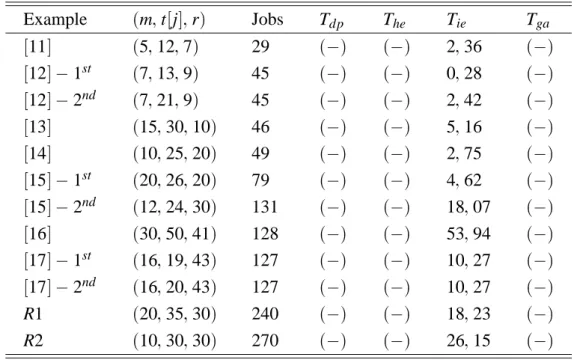
(R1 R2). Table V below shows the result of
computational tests realized. In the 1st col-umn, reference of the problem chosen is given
(there can be more than one tested example from
the same reference: 2 examples were extracted from the references12, 15, 17]); in the 2
ndthe
triplet(m tj] r), where m is the number of
the type of machines available in the shop, tj]
is the number of machines available for plan-ning and r is the number of parts; in the 3rd the total number of jobs to process is given. In the other columns, Tdp is the time to run the
sequential program, spent for the choice of ma-chines by dynamic programming and Theis the
time by heuristic enumeration; Tie is the time
spent for the assignment of parts to machines by implicit enumeration and Tgr is the time of
the greedy algorithm. In this Table, the cha-racter(;)means computational time less than
0,01. Computational times are given in seconds
(all PCs utilized in the PVM-W95 are Pentium,
200 MHz, 64 Mbytes).
Table VI compares the time, in seconds, to run the program using one processor and the num-ber of processors initially established.
Table VII describes the speedup of the algo-rithm(Sp=Sequential Time/Parallel Time).
Table VIII gives the Efficiency (Sp / Number
of Processors).
Example (m tj] r) Jobs Tdp The Tie Tga
11] (5 12 7) 29 (;) (;) 2 36 (;)
12];1
st
(7 13 9) 45 (;) (;) 0 28 (;)
12];2
nd
(7 21 9) 45 (;) (;) 2 42 (;)
13] (15 30 10) 46 (;) (;) 5 16 (;)
14] (10 25 20) 49 (;) (;) 2 75 (;)
15];1
st
(20 26 20) 79 (;) (;) 4 62 (;)
15];2
nd
(12 24 30) 131 (;) (;) 18 07 (;)
16] (30 50 41) 128 (;) (;) 53 94 (;)
17];1
st
(16 19 43) 127 (;) (;) 10 27 (;)
17];2
nd
(16 20 43) 127 (;) (;) 10 27 (;)
R1 (20 35 30) 240 (;) (;) 18 23 (;)
R2 (10 30 30) 270 (;) (;) 26 15 (;)
Example 11] 12] 12] 13] 14] 15] 15] 16] 17] 17] R1 R2
Sequential
Time 2,40 0,31 2,49 5,20 2,82 4,65 18,15 53,98 10,34 10,34 18,32 26,30 Parallel
Time 1,76 0,11 2,25 4,61 1,93 4,28 5,55 38,72 5,49 5,49 5,55 5,82 Number of
Processors 2 3 2 2 2 2 4 2 2 2 5 5
Table VI. Comparison between sequential and parallel computational times.
Example 11] 12] 12] 13] 14] 15] 15] 16] 17] 17] R1 R2
Sp 1,36 2,82 1,11 1,13 1,46 1,09 3,27 1,39 1,88 1,88 3,30 4,52
Table VII. Speedup.
Example 11] 12] 12] 13] 14] 15] 15] 16] 17] 17] R1 R2
Efficiency 68,0 94,0 55,5 56,5 73,0 54,5 81,8 69,5 94,0 94,0 66,0 90,4
Table VIII. Efficiency(%).
9. Conclusions
With parallel implementation of the two-phase method proposed for solving the assignment problem of parts to machines, some important conclusions were reached:
The method presented here allows to obtain
good results while maintaining algorithmic simplicity and making effective use of par-allel computing facilities.
The method uses a combination of exact
and approximate algorithms for solving the problem and obtaining an optimal or feasible solution within a very reasonable computa-tional time.
Implementation is efficient, because in the
tests accomplished, efficiency in most of the examples was above 66%.
Implementation has better performance when
the size of the problems increases.
Acknowledgment
This work has been supported by the Ministry of Science and Technology of Brazil through CNPq – Brazilian Center for Research and De-velopment of Science and Technology.
References
1] M.R. GAREY, D.S. JOHNSON, Computers and in-tractability: a guide to the theory of NP-complete-ness, Freeman, 1979.
2] C.H. PAPADIMITRIOU, K. STEIGLITZ, Combinatorial optimization: algorithms and complexity, Prentice
Hall, 1982.
3] M.J. SANTANA, P.S.L. SOUZA, R.H.C. SANTANA,
S.R.S. SOUZA, Parallel Virtual Machine for Win-dows95, Proceedings 3rdEuroPVM’96, 1996.
4] G.S. ALMASI, A. GOTTLIEB, Highly parallel com-puting, Benjamin Cummings, 1994.
5] A. GEIST, A. BEGUELIN, J. DONGARRA, W. JIANG,
R. MANCHEK, V. SUNDERAM, PVM: Parallel Virtual
Machine – a user’s guide and tutorial for networked parallel computing, MIT Press, 1994.
6] A. GEIST, A. BEGUELIN, J. DONGARRA, W. JIANG, R.
MANCHEK, V. SUNDERAM, PVM3 User’s guide and
reference manual, Technical Report Oak National
Laboratory, 1994.
7] O.A. MCBRYAN, An overview of message passing
environments, Parallel Computing, 20(1994), pp.
417–444.
8] A. ALVES, L. SILVA, J. CARREIRA, J.G. SILVA,
WPVM: parallel computing for the people,
9] M. FISHER ANDJ. DONGARRA, Another
architec-ture: PVM on Windows95/NT, Proceedings 3
rd
EuroPVM’96, 1996.
10] K. IRVINE, C++ and Object-Oriented Program-ming, Prentice Hall, 1997.
11] J.F.F. RIBEIRO, B. PRADIN, A methodology for
cel-lular manufacturing design, International Journal
of Production Research, 31(1993), pp. 235–250.
12] A.B. NORONHA, J.F.F. RIBEIRO, C.M. RIBEIRO, Job
Shop Scheduling with Disjunctive Constraints,
Brazilian Journal of Management and Production
(in Portuguese), 3(1996), pp. 204–219.
13] H.M. CHAN ANDD.A. MILNER, Direct clustering
algorithm for group formation in cellular manufac-ture, Journal of Manufacturing Systems,(1)1981,
pp. 399–416.
14] G. SRINIVASAN, T.T. NARENDAN, B. MAHAVEDAN,
An assignment model for the part-families prob-lem in group technology, International Journal of
Production Research, 28(1):145–152(1990).
15] G. HARHALAKIS, R. NAGI ANDJ.M. PROTH, An
ef-ficient algorithm in manufacturing cell formation for group technology applications, International
Journal of Production Research, 28 (1990), pp.
185–198.
16] K.R. KUMAR AND A. VANELLI, Strategic
subcon-tracting for efficient disaggregated manufacturing,
International Journal of Production Research, 25
(1987), pp. 1715–1728.
17] J.L. BURBIDGE, The introduction of group techno-logy, John Wiley, 1975.
Received: January, 2003 Accepted: December, 2003 Contact address:
Jos´e Francisco Ferreira Ribeiro USP – University of S˜ao Paulo Department of Computer Science Av. Trabalhador SaoCarlense, 400 13560-970 Sao Carlos Brazil e-mail:[email protected]
![Table IV. Incidence matrix parts machines ] .](https://thumb-us.123doks.com/thumbv2/123dok_us/8045728.2130462/4.892.131.791.881.1125/table-iv-incidence-matrix-parts-machines.webp)