Original Research Article
Black Sea fish and shellfish as essential source of vitamin B
12Diana A. Dobreva
1*, Albena V. Merdzhanova
1, Mona D. Stancheva
1,
Doychin I. Terziyski
2, Veselina Z. Panayotova
1INTRODUCTION
Vitamin B12 is essential for the human body - the synthesis of red blood cells, DNA, some neurotransmitters and metabolites. It is responsible for maintaining the activity of the immune system, supports a number of processes in the central and peripheral nervous system and plays a key role in the implementation of key processes and protects against many diseases.
All water-soluble vitamins (B-group and C), with the exception of vitamin B12, were found in organisms of plant origin. Sources of biologically active forms of
cobalamins were only organisms of animal origin and some bacteria. Vegetable foods were considered not to contain biologically active forms of vitamin B12.1 Compared to those of other vitamins, the vitamin B12 molecule is the largest (molecular mass of 1355.4 g.mol -1) and the most complex. The term “vitamin B12” is a
generic name that includes all potentially biologically active forms – “cobalamines” (a group of cobalt-containing compounds).2 As the main sources of vitamin B12 were considered meat, milk, eggs, and fish and crustaceans.3,4 They mainly contain two forms of vitamin methylcobalamine and 59-deoxyadenosylcobalamine, which function as coenzymes in methionine biosynthesis,
ABSTRACT
Background: Vitamins are very important for the human body because they are necessary for many biological absorption processes of other nutrients, for cells and tissues growth and repair. Because of this, there are many recommendations on daily vitamins intake, approved by the different country and world food organizations. Usually under the term "vitamin B12" is understood only cyanocobalamin, but actually this name is general and covers all potentially biologically active "cobalamins"- a group of cobalt-containing compounds. Animal foods, as different meat, milk, eggs, fish and shellfish are considered as the main dietary sources of this vitamin. They contain different forms (methylcobalamin and deoxyadenosylcobalamin) of vitamin B12 in different amounts. There is limited information in the scientific literature about the vitamin B12 content in black sea fish and shellfish. The aims of the present work were to determine and compare vitamin B12 contents as well as relative daily intake of vitamins in different fish and shellfish species from Black Sea waters.
Methods: Vitamin B12 was analysed spectrophotometrically. The method for quantitative analysis includes extraction from the edible tissue and enzymatic hydrolysis to release the cobalt ions.
Results: The quantities of vitamin B12 found in the edible tissue of the analysed samples ranged from 0.63 μg.100 g-1 ww to 21.5 μg.100 g-1 ww.
Conclusions: The observed results confirm that all fish and molluscs samples deliver significant quantities of the water-soluble vitamin B12.
Keywords: Cyanocobalamin, UV-Vis, Spectrometry, Cobalt-complexes, Mussel 1
Department of Chemistry, Medical University of Varna, Varna, Bulgaria 2Institute of Fisheries and Aquaculture, Plovdiv, Bulgaria
Received: 31 May 2018
Accepted: 28 June 2018
*Correspondence:
Dr. Diana A. Dobreva, E-mail: [email protected]
Copyright: © the author(s), publisher and licensee Medip Academy. This is an open-access article distributed under the terms of the Creative Commons Attribution Non-Commercial License, which permits unrestricted non-commercial use, distribution, and reproduction in any medium, provided the original work is properly cited.
as well as in the metabolism of fatty acids in mammalian cells.2,5 The absorption and bioavailability of vitamin B12 in the body strongly depends on the gastrointestinal absorption of the different individuals.1 On consuming or supplementing with excessive doses, the amount that exceeds absorption body's ability was release through the urine.6 Most often, vitamin B12 deficiency in the human body was usually caused by malabsorption, combined with inadequate dietary intake.7-9
Studies conducted among a vegan group indicate that they need additional vitamin B12 intake because they do not consume foods of animal origin.8 Vegetarians do not suffer from a severe lack because they regularly consume dairy products and eggs, which contains some of the daily vitamin B12 needed.
The need from vitamin B12 quantitation is based on the requirement of clinical analysis (control of blood serum and plasma levels), food analysis (amount in different food matrices), and pharmaceutical substance analysis. Vitamin B12 can be quantitated by various methods such as microbiological, colorimetric, spectrophotometric, atomic absorption, atomic emission and liquid chromatographic.10 The choice of a suitable method for quantitative analysis depends on different factors: sample type, purpose of analysis, pre-treatment procedure, time of analysis, type and quantities of reagents, sensitivity of the method, and the price. The most commonly used method for quantification of vitamin B12 in complex matrices like blood and serum, characterized by high resolution and sensitivity, is high performance liquid chromatography (HPLC).11,12 However, in routine food analysis, the spectrophotometric method also provides the necessary sensitivity. It is characterized by speed, high sensitivity and accuracy, and relatively low cost. The analysis is to determine the content of cobalt ions in the aqueous sample extract by means of a colorimetric reaction.13 The quantitative analysis of the vitamin B12, in the selected fish and shellfish species, was performed by a spectrophotometric method.
There is limited information in the scientific literature about the cyanocoblamin’s content in Black Sea fish and shellfish. Because of this, the aims of the present work were to determine and compare vitamin B12 contents as well as relative daily intake of vitamins in different fish and shellfish species from Black Sea waters.
METHODS
Reagents and instrumentation
All used reagents were with analytical grade purity, purchased from Sigma Aldrich – cobalt (II) chloride (CoCl2), acetate buffer (0.1 M, pH 4.0), sodium cyanide (NaCN), α-amylase, pepsin, pyrogallol red, nitric acid (conc. HNO3), sulfuric acid (conc. H2SO4), water and ethanol. For the purposes of the experiment, from the listed reagents were prepared the following solutions: 1
mg.ml-1 cobalt (II) solution in 0.09 M nitric acid, 0.02% pyrogallol red, 1% NaCN.12,14
The spectrophotometric analysis of vitamin B12 was performed on a Hach Lange DR3900 spectrophotometer. It is a single-ray instrument operating in the visible area of electromagnetic spectrum. The quantitative determination of the Co (II) content in the aqueous extracts of the analyzed samples was carried out by measuring their absorption. For this purpose, the spectrophotometer was calibrated by measuring the intensity of Co (II) and pyrogallol red complex in solutions with increasing concentration. Upon construction of the calibration curve, five different standard solutions of CoCl2 in aqueous nitric acid were used in a concentration range of 0.025-0.4 μg/ml.
The colored complex of each of the five solutions was synthesized directly in the glass cuvette of the apparatus. Their absorption was measured at λmax =475 nm. In the cuvette were mixed 1 ml of the corresponding cobalt solution and 0.5 ml of a 0.02% solution of pyrogalol red. The absorption was read as measured against a blank sample (distilled water with 0.5 ml pyrogallol red solution). The described procedure was used to measure the absorptions of the 5 standard solutions of Co (II). With the obtained data was constructed the calibration curve (Figure 1). The shown linearity of the method was 0.9846.
Samples
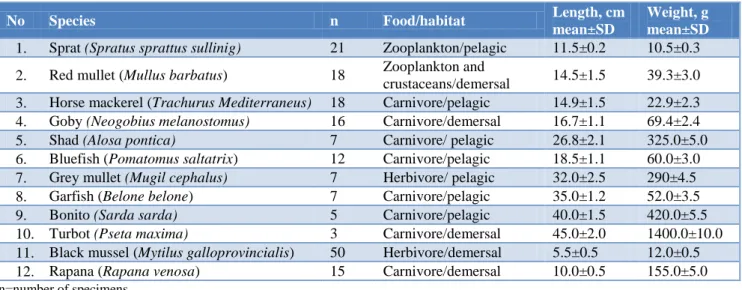
All samples - ten Black Sea fish (garfish, sprat, grey mullet, horse mackerel, bonito, bluefish, goby, turbot, shad and red mullet) and shellfish (black mussel and rapana) were used as samples for the present study (table 1). The fish and mollusk species were purchased from Varna local fish markets. All samples were immediately frozen and stored at -20oC in a home fridge. Biometric characteristics as mean weight (g) and mean length (cm) were determined and presented in Table 1.
Samples preparation
Before quantitative spectrometric analysis of vitamin B12, it is necessary to extract from samples. The enzymatic hydrolysis is a traditionally used method for complex matrices. Heudi et al used the enzymes α-amylase and pepsin, 1% NaCN, at pH ~ 4 acetic acid buffer.12 Under these conditions the samples were hydrolyzed for 3 hours at 37оС. Thereafter, the enzymes were deactivated by prolonged (35 min) heating at 100 - 120° C.
conc. H2SO4 =10:1 was added to a portion of the collected filtrate and the resulting solution was evaporated to near dryness. The residue was neutralized and transferred to a measuring flask and distilled water was added to the mark. The solution was used to perform a spectrophotometric quantitative analysis of the cobalt
ions content. Four parallel samples were processed for each fish species, mussel and rapana (two with and another two without a standard additive). The evaluation of the extraction procedure was carried out using the method of standard addition.
Table 1: Biometrical and biological characteristics of analyzed fish and shellfish.
No Species n Food/habitat Length, cm
mean±SD
Weight, g mean±SD
1. Sprat (Spratus sprattus sullinig) 21 Zooplankton/pelagic 11.5±0.2 10.5±0.3
2. Red mullet (Mullus barbatus) 18 Zooplankton and
crustaceans/demersal 14.5±1.5 39.3±3.0 3. Horse mackerel (Trachurus Mediterraneus) 18 Carnivore/pelagic 14.9±1.5 22.9±2.3 4. Goby (Neogobius melanostomus) 16 Carnivore/demersal 16.7±1.1 69.4±2.4 5. Shad (Alosa pontica) 7 Carnivore/ pelagic 26.8±2.1 325.0±5.0 6. Bluefish (Pomatomus saltatrix) 12 Carnivore/pelagic 18.5±1.1 60.0±3.0 7. Grey mullet (Mugil cephalus) 7 Herbivore/ pelagic 32.0±2.5 290±4.5 8. Garfish (Belone belone) 7 Carnivore/pelagic 35.0±1.2 52.0±3.5 9. Bonito (Sarda sarda) 5 Carnivore/pelagic 40.0±1.5 420.0±5.5 10. Turbot (Pseta maxima) 3 Carnivore/demersal 45.0±2.0 1400.0±10.0 11. Black mussel (Mytilus galloprovincialis) 50 Herbivore/demersal 5.5±0.5 12.0±0.5 12. Rapana (Rapana venosa) 15 Carnivore/demersal 10.0±0.5 155.0±5.0 n=number of specimens.
Spectrophotometric analysis
Quantitative determination of cobalt ions in samples was performed analogously to standards. The analyzed solution was prepared directly in the spectrophotometer’s cuvette. Combine 1 ml of sample and 0,5 ml of 0,02% pirogalol red solution. The absorption of resulting complex was measured against a blank sample (distilled water with 0.5 ml pyrogalol red). The amount of cobalt ions was determined by the built-in standard curve.
RESULTS
Table 2: Vitamin В12 content in black sea fish and
shellfish.
No Species Vitamin В12, μg.100g-1ww
1 Sprat 0.75 ± 0.07
2 Horse mackerel 5.75 ± 0.48
3 Goby 21.50 ± 4.60
4 Grey mullet 5.70 ± 0.80
5 Shad 18.88 ± 3.70
6 Bluefish 13.20 ± 3.10
7 Bonito 6.05 ± 1.40
8 Turbot 19.50 ± 4.30
9 Garfish 0.63 ± 0.08
10 Red mullet 17.40 ± 2.20
11 Black mussel 22.35 ± 3.81
12 Rapana 19.05 ± 2.60
Quantitative determination of the content of Co (II) in ten fish species and Black Sea mussel and rapana was carried
out. The data obtained from the analysis were recalculated and they are shown in Table 2 as micrograms vitamin B12 per 100 grams of raw edible tissue (μg.100g-1ww) of the test specimens (mean±standard deviation).
DISCUSSION
The shown data variety was in the range of 0.63 μg.100 g -1ww to 22.35 μg.100 g-1ww. Half of the fish analyzed
species showed a content of this vitamin below 10 μg100 g-1 ww, the lowest values were calculated of 0.75 μg.100 g-1 ww in sprat and 0.63 μg.100 g-1 ww in garfish. With exception of shad (18.88 μg.100 g-1 ww), all other fish with high levels of vitamin B12 were demersal species - 21.5 μg.100 g-1ww for goby, 19.50 μg.100 g-1 ww for turbot, 17.40 μg.100 g-1ww for red mullet and rapana (19.05 μg.100 g-1 ww) and mussel (22.35 μg.100 g-1
ww).
There are only few studies in the scientific literature presenting results for cyanocobalamin content in raw edible fish or shellfish tissues.11,16 Ahmadnia and collective investigated vitamin B12 content in grey mullet fish and the kilka (similar to sprat fish). The found amounts were significantly higher than our data - 13 μg.100 g-1 ww for grey mullet and 5.7 μg.100 g-1 ww for kilka.
Some databases also present results for the cyanocobalamine content in fish and shellfish - whole food catalog and USDA food composition database. The first of them showns data for bluefish (5.39 μg.100 g-1 ww), shad (0.15 μg.100 g-1 ww) and turbot (2.20 μg.100 g-1 ww).17 The results were several times higher than ours.
The USDA food composition database shows quantities of vitamin B12 for eel, mackerel and turbot – 3.00 μg. 100 g-1 ww, 13.67 μg.100 g-1 ww and 2.20 μg.100 g-1 ww, respectively.18 The presented values for eel (like garfish) and mackerel were close to those obtained in our study, while the content of the shad was lower. The data for vitamin B12 content in rapana are very scarce in the scientific literature. The Japanese database presents a result for the amount of vitamin B12 in rapana tissue which is close to that in our research.
Results for cyanocobalamin in mussel were published by Ramasamy Santhanam in the book Nutritional Marine Life, as well as in the American database The Self Nutrition Data. Their results are close to those found in our study - 12 μg. 100 g-1 ww and 17 μg. 100 g-1 ww, respectively.19
The estimation of the edible tissue of the analyzed Black Sea fish and shellfish as a source of vitamin B12 was based on the comparison of the specified amount of vitamins in the recommended daily intake tables for Bulgaria.20 The comparison was made for the age group up to 60 years.
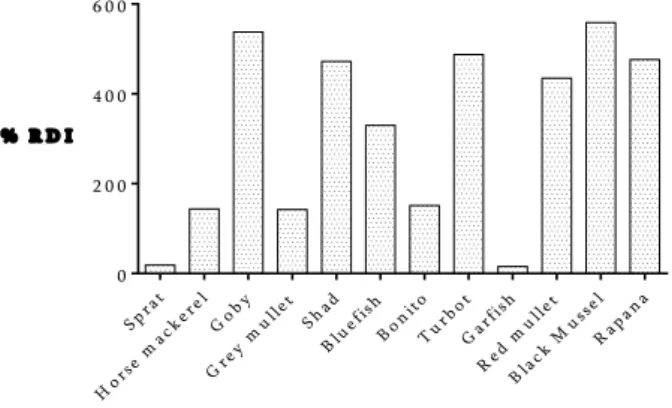
The results shown in Figure 1 represent a percentage of the recommended daily intake (RDI) for vitamin B12 (for 100 grams of edible tissue).
Figure 1: Percentage of the RDI* of vitamin B12 in
Black Sea fish and shellfish.
*Relative daily intake (RDI).
Almost all of analyzed fish and shellfish, excluding sprat and garfish, provide significant amounts of vitamin B12 above the RDI. One hundred grams of edible tissue of gray mullet, bonito and horse mackerel contain almost doubled amounts of RDI. In red mullet, turbot, shad,
goby, black mussel and rapana, the quantities were almost seven times higher than the required daily intake.
CONCLUSION
The vitamin B12 content was studied in twelve Black Sea samples of animal origin - ten fish and two molluscs. With the exception of two fish species (sprat and garfish), all others provide significant amounts of the analyte. With a significantly higher content of cyanocobalamin were distinguished all demersal fish, rapana and mussel. Recalculated with RDI, they provide over 500% of the required daily amount of vitamin B12. Bluefish, gray mullet, bonito and horse mackerel contain much less cyanocobalamin, but they also provide significantly more than 100% RDI.
Funding: No funding sources Conflict of interest: None declared Ethical approval:Not required
REFERENCES
1. Watanabe F. Vitamin B12 Sources and Bioavailability. Exp Biol Med. 2007;232:1266–74. 2. O’Leary F, Samir S. Vitamin B12 in Health and
Disease. Nutrients. 2010;2:299-316.
3. Scott J. Bioavailability of vitamin B12. Eur J Clin Nutr. 1997;51(1):49-53.
4. Watanabe F, Bito T. Vitamin B12 sources and microbial interaction. Exp Biol Med (Maywood). 2018;243(2):148-58.
5. Farquharson J, Adams J. The forms of vitamin B12 in foods. Br J Nutr. 1976;36(1):127-36.
6. Food and Nutrition Board: Institute of Medicine. Vitamin B12. In Dietary reference intakes for thiamin, riboflavin, niacin, vitamin B6, folate, vitamin B12, pantothenic acid, biotin and choline. National Research Council, Ed. Washington, DC, USA: National Academy Press; 1998: 306-356. 7. Ribarova F. Food and vitamins. Sofia, Bulgaria
2007.
8. Weir DG, Scott JM. Cobalamins physiology, dietary sources and requirements. In: Sadler M, Strain JJ, Caballero B, eds. Encyclopedia of human nutrition. Volume 1. San Diego, CA: Academic Press; 1998;394–401.
9. Hill HAO, Pratt JM, Thorp RG, Ward B, R. Williams JP. The Chemistry of Vitamin B12 - the co-ordination of biologically important molecules. Biochem J. 1970;120:263-9.
10. Karmi O, Zayed A, Baraghethi S, Qadi M, Ghanem R. Measurement of vitamin B12 concentration: a review on available methods. II OAB-India. 2011;2(2):23-32.
11. Lebiedzinska A, Marszall ML, Kuta J. Reversed phase high performance liquid chromatography method with coulometric electrochemical and ultraviolet detection for the quantification of S pra
t
Ho r se m
a ck e rel
Go b y
Gre y m
u lle t
S ha d Blu
e fis h
Bo n ito
Tu r b ot
Ga r fish
Re d mu l
let
Bla c k M
u sse l
Ra p a na 0
2 0 0 4 0 0 6 0 0
vitamins B1, B6 and B12 in animal and plant foods. J Chromatogr A. 2007;1173:71-80.
12. Heudi O, Kilinc T, Fontannaz P, Marley E. Determination of vitamin B in food products and in premixes by reversed-phase high performance liquid chromatography and immunoaffinity extraction. J Chrom A. 2006;1101:63-8.
13. Divarova V, Racheva P, Lekova V, Gavazov K, Dimitrov A. Spectrophotometric determination of cobalt(II) in a liquid-liquid, extraction system containing 4-(2-thiazolylazo) resorcinol and 2,3,5-triphenyl-2h-tetrazolium chloride. J Chem Tech Met. 2013;48(6):623-30.
14. Chohan ZH, Farooq MA. Spectrophotometric Determination of Cobalt(II) Using N-(2-pyrrolylmethylene)- 2,4, 6-triamino-1,3,5- triazine as a Chromogenic Reagent. J Chem Soc Pak. 2001;23(3):168-70.
15. Eskandari H, Ghaziaskar HS, Ensafi AA. A sensitive and simple extractive-Spectrophotometric method for the determination of microgram amount of cobalt by using a-Benzilmonoxime. Anal Sci. 2001;17:327-31.
16. Ahmadnia A, Sahari MA, Barzegar M, Seyfabadi SJ, Abdollahi M. Vitamins Contents of some
Commercially Important Fish Species from South Caspian Sea. Am-Eur J Sust Agr. 2008;2(3):285-293.
17. Whole Food Catalog, 2010. Available at: http://wholefoodcatalog.info/nutrients/. Accessed on 21 May 2016.
18. USDA Food Composition Databases, 2018. Available at: https://ndb.nal.usda.gov/ndb/ nutrients/index. Accessed on 20 May 2018.
19. Santhanam R. Nutritional Marine Life. CRC Press 15.12.2014.
20. Ordinance no 1 / 22.01.2018 г., Ministry of health, the physiological norms of nutrition of the population. Available at: http://www.mh. government.bg/media/filer_public/2018/02/13/nared ba1-22-01-2018-fiziologicni-normi-hranene-naselenie.pdf. Accessed on 20 May 2018.