Color Histogram and Multi-resolution
LMEBP Joint Histogram for Multimedia
Image Retrieval
K. Prasanthi Jasmine
1, P. Rajesh Kumar
2, K. Naga Prakash
3Research Scholar, Department of Electronics and Communication Engineering, Andhra University, Visakhapatnam, India1
Professor& HOD, Department of Electronics and Communication Engineering, Andhra University, Visakhapatnam, India2
Professor, LBR College of Engineering, Mylavaram, Andhra Pradesh, India 3
ABSTRACT:In this paper, color histogram and multi-resolution local maximum edge binary patterns (LMEBP) joint histogram are integrated for content based image retrieval (CBIR). The local region of image is represented by LMEBP, which are evaluated by taking into consideration the magnitude of local difference between the center pixel and its neighbors. This LMEBP differs from the existing LBP in a manner that it extracts the information based on distribution of edges in an image. Further the joint histogram is constructed between uniform two rotational invariant first three LMEBP patterns. The color feature is extracted by calculating the histogram on RGB spaces. The experimentation has been carried out for proving the worth of our algorithm. It is further mentioned that the databases considered for experiment are Corel-1K and MIT VisTex. The results after being investigated show a significant improvement in terms of their evaluation measures as compared to previously available spatial and transform domain methods on their respective databases.
KEYWORDS: Color; Texture; Feature Extraction; Local Binary Patterns; local maximum edge binary patterns; Image Retrieval.
I.INTRODUCTION
Digital media is evolving so digital data archives in scientific, industrial, medical, environmental, educational, entertainment, web image searching and other applications. For accessing digital images in these applications it is required to have an efficient algorithm. Before 1990 text based image retrieval was being used for this pur-pose. To reduce the amount of labor for image annotation and different interpretation of image by different persons, in early 1990 CBIR came into picture [1]. Still there remain some challenging problems that attract the researchers‟ interest towards CBIR. Generally in CBIR, visual features related to color, shape, texture, and spatial layout are extracted in the form of color histogram [2], color coherence vector [3], color correlogram (CC) [4], Gabor transform [5] etc. These are arranged as multidimensional feature vectors and construct the feature database. For similarity/distance measurement many methods have been developed like Euclidean distance, city-block distance etc. Selection of feature descriptors and similarity/distance measures affect retrieval performances of an image retrieval system significantly. Moghaddam et al. proposed the Gabor wavelet correlogram (GWC) for CBIR [6, 7]. Ahmadian et al. used the wavelet transform for texture classification [8]. Moghaddam et al. introduced new algorithm called wavelet correlogram (WC) [9]. Saadatmand et al. [10, 11] improved the performance of WC algorithm by optimizing the quantization thresholds using genetic algorithm (GA). Birgale et al. [12] and Subrahmanyam et al. [13] combined the color (color histogram) and texture (wavelet transform) features for CBIR. Subrahmanyam et al. proposed correlogram algorithm for image retrieval using wavelets and rotated wavelets (WC+RWC) [14].
illumination changes. In SIFT the locations of extrema in difference of Gaussian (DoG) correspond to most stable feature with respect to scale variance, and are identified as interest feature points or keypoints. For each keypoint sequel HOG descriptor are calculated. Thus HOG feature is assumed to be originated from SIFT descriptor. HOG feature descriptor is introduced by Dalal et al. [16] in 2005 for solving the problem of pedestrian detection in static images. Ojala et al. proposed the local binary patterns (LBP) for texture description [17] and these LBPs are converted to rotational invariant for texture classification [18]. Pietikainen et al. proposed the rotational invariant texture classification using feature distributions [19]. Ahonen et al. [20] and Zhao et al [21] used the LBP operator facial expression analysis and recognition. Heikkila et al. proposed the background modeling and detection by using LBP [22]. Huang et al. proposed the extended LBP for shape localization [23]. Heikkila et al. used the LBP for interest region description [24]. Li et al. used the combination of Gabor filter and LBP for texture segmentation [25]. Zhang et al. proposed the local derivative pattern for face recognition [26]. They have considered LBP as a nondirectional first order local pattern, which are the binary results of the first-order derivative in images. Abdullah et al. [27] proposed fixed partitioning and salient points schemes for dividing an image into patches, in combination with low-level MPEG-7 visual descriptors to represent the patches with particular patterns. Jhanwar et al. [28] have proposed the motif co-occurrence matrix (MCM) for content based image retrieval. C H Lin et al. [29] combined the color feature, k-mean color histogram (CHKM) and texture features, motif co-occurrence matrix (MCM) and difference between the pixels of a scan pattern (DBPSP). Subrahmanyam et al. [30] have proposed the local maximum edge binary patterns (LMEBP) for image retrieval and object tracking applications. Their method extracts the features by taking into consideration the magnitude of local difference between the center pixel and its neighbors.
To improve the retrieval performance in terms of retrieval accuracy, in this paper, we combine the color (HSV histogram) and texture (LMEBP joint histogram) features. The experiments have been carried out on Corel-1K and MIT Vistex databases for proving the worth of our algorithm. The results after investigation show a significant improvement in terms of their evaluation measures as compared to other existing color & texture and spatial and transform domain features.
The organization of the paper as follows: In section 1, a brief review of image re-trieval and related work is given. Section 2, 3 and 4 presents a concise review of local binary patterns, local maximum edge binary patterns and HSV histogram calculation respectively. Section 5, presents the proposed system framework and similarity meas-ure. Experimental results and discussions are given in section 6. Based on above work conclusions are derived in section 7.
II.
LOCAL BINARY PATTERNSThe LBP operator was introduced by Ojala et al. [17] for texture classification. Success in terms of speed (no need to tune any parameters) and performance is reported in many research areas such as texture classification [17-19], face recognition [24-26], object tracking [30], image retrieval [31] and finger print recognition.
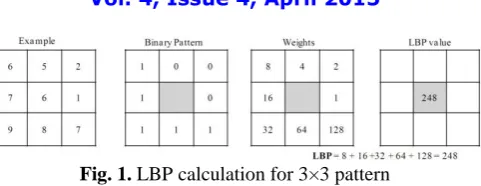
Given a center pixel in the 3×3 pattern, LBP value is computed by comparing its gray scale value with its neighborhoods based on Eq. (1) and Eq. (2):
( 1) ,
1
2 ( ( ) ( ))
P i P R i c
i
LBP f I g I g (1)
1 0
( ) 0
x f x
else (2)
where I g( c)denotes the gray value of the center pixel, I g( )i is the gray value of its neighbors, Pstands for the number of neighbors and R, the radius of the neighborhood.
Fig. 1. LBP calculation for 3×3 pattern
III.LOCAL MAXIMUM EDGE BINARY PATTERNS
Subrahmanyam et al. [30] have proposed the local maximum edge binary patterns (LMEBP) for image retrieval and object tracking applications. In proposed LMEBP for a given image the first maximum edge is obtained by the magnitude of local difference between the center pixel and its eight neighbors as shown below:
'
( )i ( c) ( );i 1, 2,...,8
I g I g I g i (3)
' ' '
1
arg
max ( 1) , ( 2) ,..., ( 8) ii I g I g I g (4)
where, max(x) calculates the maximum value in an array ‘x’.
If this edge is positive, assign „1‟ to this particular center pixel otherwise „0‟.
1
'
( ) ( )
new
c i
I g f I g (5)
1 0
( ) 0
x f x
else (6)
The LMEBP is defined as:
1 2 8
( ( )) new( ); new( );... new( )
c
LMEBP I g I g I g I g (7)
The uniform pattern refers to the uniform appearance pattern which has limited discontinuities in the circular binary presentation. In this paper, the pattern which has less than or equal to two discontinuities in the circular binary presentation is considered as the uniform pattern and remaining patterns considered as non-uniform patterns.
The distinct values for given query image is P P( 1) 3by using uniform patterns [31]. But these features are not rotational invariant. The rotational invariant patterns 2
,
(LMEBPP Rriu ) can be constructed by adding all eight patterns in the each row [31]. The distinct values for a given query image is P2by using rotational invariant patterns
2 ,
( riu )
P R
LMEBP . After LMEBP calculation, the joint histogram is constructed between first, second and third LMEBPs for feature vector generation.
IV. PROPOSED SYSTEM FRAMEWORK
In this paper, a new algorithm is proposed by calculating the joint histogram between the multi-resolution rotational invariant LMEBP subimages. Finally, feature vector is constructed by concatenating the features collected using joint histograms.
Algorithm:
Input: Image; Output: Retrieval results.
1. Load the input image.
2. Calculate the three multi-resolution images using Gaussian filter bank.
3. Calculate the LMEBP on each multi-resolution image and make them into rotational invariant. 4. Calculate the joint histogram between them.
5. Form the feature vector by concatenating histograms. 6. Calculate the best matches using Eq. (1.3).
7. Retrieve the number of top matches.
A. Similarity Measurement
, ,
1 , ,
( , ) 1
LgT i Q i
i T i Q i
f f D Q T
f f (8)
where Q is query image, Lg is feature vector length, T is image in database; fI i, is th
i feature of image I in the database,
, Q i
f is ithfeature of query image Q.
V. EXPERIMENTAL RESULTS AND DISCUSSIONS
For the work reported in this paper, retrieval tests are conducted on Corel-1K and MIT VisTex and results are presented in the following subsections.
A. Corel-1K Database
Corel database [35] consists of large number of images of various contents ranging from animals to outdoor sports to natural images. These images have been pre-classified into different categories each of size 100 by domain professionals. Some researchers think that Corel database meets all the requirements to evaluate an image retrieval system, due its large size and heterogeneous content. We have collected 1000 images to form database Corel–1K. These images are collected from 10 different domains namely Africans, beaches, buildings, buses, dinosaurs, elephants, flowers, horses, mountains
and food. Each category has NG(100) images with resolution of either 256×384 or 384×256.
In all experiments, each image in the database is used as the query image. For each query, the system collects n database images X=(x1, x2, …, xn) with the shortest image matching distance computed using Eq. (10). If the retrieved image xi=1,
2, …., n belongs to same category as that of the query image then we say the system has appropriately identified the expected image else the system fails to find the expected image.
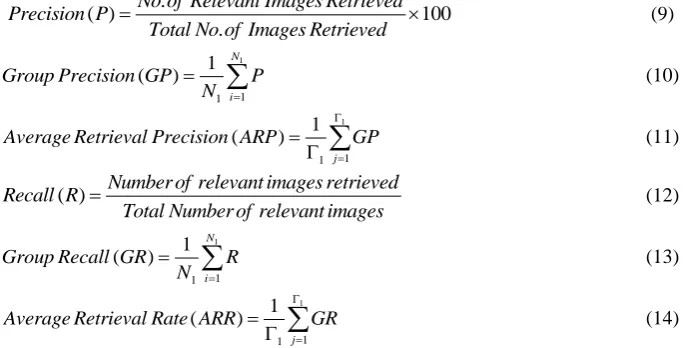
The performance of the proposed method is measured in terms of average precision, average recall and average retrieval rate (ARR) as shown below:
.
( ) 100
.
No of Relevant Images Retrieved
Precision P
Total No of Images Retrieved (9)
1 1 1 1 ( )
N iGroup Precision GP P
N (10)
1 1 1 1 ( )
jAverage Retrieval Precision ARP GP (11)
( )Number of relevant images retrieved
Recall R
Total Number of relevant images (12)
1 1 1 1 ( )
N iGroup Recall GR R
N (13) 1 1 1 1 ( )
jAverage Retrieval Rate ARR GR (14) whereN1is number of relevant images and 1is number of groups.
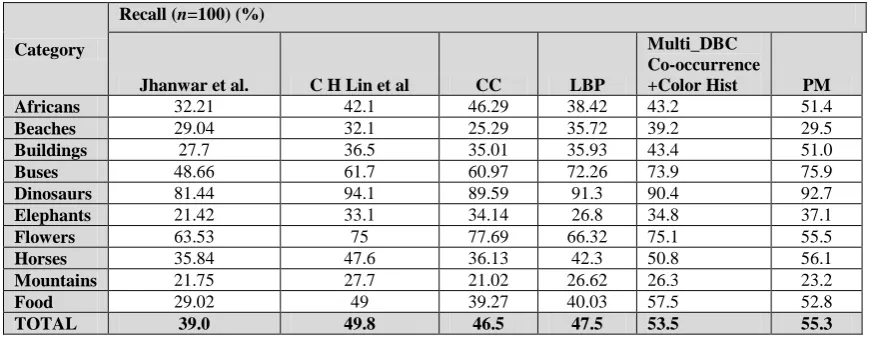
Table 1 and Table 2 summarize the retrieval results of various methods in terms of average retrieval precision and average retrieval rate respectively. Fig. 3 (c) summarize the performance of proposed method with different distance measures in terms of average retrieval rate.
Table 1. Results of all techniques in terms of precision on Corel–1K database. PM: MultiJoint_LMEBP_HSV_Hist
Category
Precision (n=20) (%)
Jhanwar et al. C H Lin et al CC LBP
Multi_DBC Co-occurrence
+Color Hist PM
Africans 53.15 68.3 80.4 56.9 72.1 82.5
Beaches 43.85 54 41.2 51.95 55.1 49.25
Buildings 48.7 56.2 55.6 61.65 76.1 81.25
Buses 82.8 88.8 76.7 95.15 99.9 94.85
Dinosaurs 95 99.3 99 98.5 99.5 99.4
Elephants 34.85 65.8 56.2 39.9 54.0 66.45
Flowers 88.35 89.1 92.9 89.5 93.4 87.25
Horses 59.35 80.3 76.5 65.65 84.8 91.4
Mountains 30.8 52.2 33.7 37.45 38.6 36.2
Food 50.4 73.3 70.6 65.75 88.5 81.05
TOTAL 58.7 72.7 68.2 66.2 76.2 76.9
n–Number of top matches considered
Table 2. Results of all techniques in terms of recall on Corel–1K database. PM: Multi-Joint_LMEBP_HSV_Hist
Category
Recall (n=100) (%)
Jhanwar et al. C H Lin et al CC LBP
Multi_DBC Co-occurrence
+Color Hist PM
Africans 32.21 42.1 46.29 38.42 43.2 51.4
Beaches 29.04 32.1 25.29 35.72 39.2 29.5
Buildings 27.7 36.5 35.01 35.93 43.4 51.0
Buses 48.66 61.7 60.97 72.26 73.9 75.9
Dinosaurs 81.44 94.1 89.59 91.3 90.4 92.7
Elephants 21.42 33.1 34.14 26.8 34.8 37.1
Flowers 63.53 75 77.69 66.32 75.1 55.5
Horses 35.84 47.6 36.13 42.3 50.8 56.1
Mountains 21.75 27.7 21.02 26.62 26.3 23.2
Food 29.02 49 39.27 40.03 57.5 52.8
TOTAL 39.0 49.8 46.5 47.5 53.5 55.3
B. MIT VisTex Database
The MIT VisTex database is used in our experiment which consists of 40 different textures [36]. The size of each texture is512 512 . Each 512 512 image is divided into sixteen 128 128 non-overlapping sub-images, thus creating a database of 640 (40 16) images. The performance of the proposed method is measured in terms of average retrieval rate (ARR) is given by Eq. (15).
.
100 .
No of Relevant Images Retrieved ARR
Total No of Relevant Images in Database
(15)
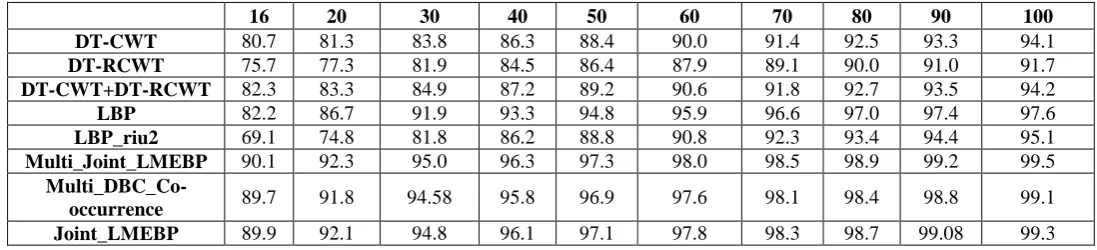
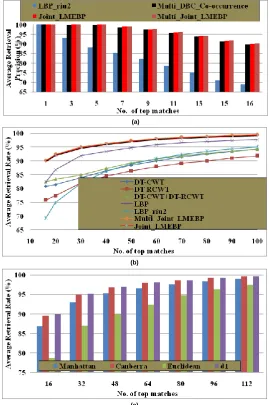
This database is used to compare the performance of the proposed method (Multi_Joint_LMEBP+color hist.) with LBP and other existing methods. Fig. 2 (a) & Table 3 illustrate the retrieval results of proposed method and other existing methods in terms of average retrieval precision. From Fig. 2 (b) & Table 3 it is evident that the proposed method is outperforming the other existing methods
Table 3: Performance of various methods in terms of ARP on MIT VisTex database.
1 3 5 7 9 11 13 15 16
LBP_riu2 100 93.0 88.3 85.3 82.0 78.5 74.9 71.0 69.1
Multi_Joint_LMEBP 100 99.9 99.8 99.3 97.7 96.2 94.2 91.7 90.2
Multi_DBC_Co-occurrence 100 99.7 99.6 98.6 97.2 95.7 93.7 91.2 89.7
Joint_LMEBP 100 99.9 99.9 98.9 97.5 96.0 94.0 91.5 90.0
Table 4: Performance of various methods in terms of ARR on MIT VisTex database.
16 20 30 40 50 60 70 80 90 100
DT-CWT 80.7 81.3 83.8 86.3 88.4 90.0 91.4 92.5 93.3 94.1
DT-RCWT 75.7 77.3 81.9 84.5 86.4 87.9 89.1 90.0 91.0 91.7
DT-CWT+DT-RCWT 82.3 83.3 84.9 87.2 89.2 90.6 91.8 92.7 93.5 94.2
LBP 82.2 86.7 91.9 93.3 94.8 95.9 96.6 97.0 97.4 97.6
LBP_riu2 69.1 74.8 81.8 86.2 88.8 90.8 92.3 93.4 94.4 95.1
Multi_Joint_LMEBP 90.1 92.3 95.0 96.3 97.3 98.0 98.5 98.9 99.2 99.5
Multi_DBC_Co-occurrence 89.7 91.8 94.58 95.8 96.9 97.6 98.1 98.4 98.8 99.1
Joint_LMEBP 89.9 92.1 94.8 96.1 97.1 97.8 98.3 98.7 99.08 99.3
Table 5: Performance of proposed method with various distance measures in terms of ARR on MIT VisTex database.
16 32 48 64 80 96 112
Manhattan 86.82 92.94 95.26 96.63 97.56 98.35 99.01
Canberra 89.59 94.97 96.76 97.97 98.58 99.20 99.60
Euclidean 78.70 86.87 89.97 92.30 94.73 96.34 97.45
(a)
(b)
(c)
Figure 2 Comparison of proposed method with LMEBP, LBP, DBC and other exiting transform domain methods in terms of: (a) average retrieval precision, (b) average retrieval rate and (c) performance of proposed method using various distance measures MIT
VisTex database .
VI.CONCLUSION
In this paper, a new image indexing and retrieval algorithm is proposed by combining joint histogram between first three Multi_Joint LMEBPs and color histogram on HSV spaces. The experiments have been conducted on Corel-1K and MIT VisTex databases for proving the worth of our algorithm. The results after being investigated show a significant improvement in terms of their evaluation measures as compared to previously available color, texture and combined color and texture features for image retrieval.
REFERENCES
[1] Y. Rui and T. S. Huang, Image retrieval: Current techniques, promising directions and open issues, J.. Vis. Commun. Image Represent., 10 39– 62, 1999.
[2] A. W.M. Smeulders, M. Worring, S. Santini, A. Gupta, and R. Jain, Content-based image retrieval at the end of the early years, IEEE Trans. Pattern Anal. Mach. Intell., 22 (12) 1349–1380, 2000.
[4] Ying Liu, Dengsheng Zhang, Guojun Lu, Wei-Ying Ma, Asurvey of content-based image retrieval with high-level semantics, Elsevier J. Pattern Recognition, 40, 262-282, 2007.
[5] J. R. Smith and S. F. Chang, Automated binary texture feature sets for image retrieval, Proc. IEEE Int. Conf. Acoustics, Speech and Signal Processing, Columbia Univ., New York, pp.2239–2242, 1996.
[6] H. A. Moghaddam, T. T. Khajoie, A. H Rouhi and M. Saadatmand T., Wavelet Correlogram: A new approach for image indexing and retrieval, Elsevier J. Pattern Recognition, vol.38 , pp.2506-2518, 2005 .
[7] H. A. Moghaddam and M. Saadatmand T., Gabor wavelet Correlogram Algorithm for Image Indexing and Retrieval, 18th Int. Conf. Pattern Recognition, K.N. Toosi Univ. of Technol., Tehran, Iran, pp.925-928, 2006.
[8] A. Ahmadian, A. Mostafa, An Efficient Texture Classification Algorithm using Gabor wavelet, 25th Annual international conf. of the IEEE EMBS, Cancun, Mexico, pp.930-933, 2003.
[9] H. A. Moghaddam, T. T. Khajoie and A. H. Rouhi, A New Algorithm for Image Indexing and Retrieval Using Wavelet Correlogram, Int. Conf. Image Processing, K.N. Toosi Univ. of Technol., Tehran, Iran,vol. 2 pp.497-500,2003.
[10] M. Saadatmand T. and H. A. Moghaddam, Enhanced Wavelet Correlogram Methods for Image Indexing and Retrieval, IEEE Int. Conf. Image Processing, K.N. Toosi Univ. of Technol., Tehran, Iran, pp.541-544, 2005.
[11] M. Saadatmand T. and H. A. Moghaddam, A Novel Evolutionary Approach for Optimizing Content Based Image Retrieval, IEEE Trans. Systems, Man, and Cybernetics, 37 (1) ,pp139-153, 2007 .
[12] L. Birgale, M. Kokare, D. Doye, Color and Texture Features for Content Based Image Retrieval, International Conf. Computer Grafics, Image and Visualisation, Washington, DC, USA, pp.146 – 149, 2006.
[13] M. Subrahmanyam, A. B. Gonde and R. P. Maheshwari, Color and Texture Features for Image Indexing and Retrieval, IEEE Int. Advance Computing Conf., Patial, India, pp.1411-1416, 2009.
[14] Subrahmanyam Murala, R. P. Maheshwari, R. Balasubramanian, A Correlogram Algorithm for Image Indexing and Retrieval Using Wavelet and Rotated Wavelet Filters, Int. J. Signal and Imaging Systems Engineering,vol.4,no.1,pp.27-34,2011.
[15] D.G. Lowe, Distinctive Image Features from Scale-Invariant Keypoints, Int. J. Computer Vision, 60 (2) ,pp.91–110, 2004.
[16] N. Dalal and B. Triggs, Histograms of Oriented Gradients for Human Detection, IEEE Conf. Computer Vision and Pattern Recognition (CVPR), INRIA Rhone-Alps, Montbonnot, France,vol. 2 pp.886–893, 2005.
[17] T. Ojala, M. Pietikainen, D. Harwood, A comparative sudy of texture measures with classification based on feature distributions, Elsevier J. Pattern Recognition, vol.29 (1): pp.51-59, 1996.
[18] T. Ojala, M. Pietikainen, T. Maenpaa, Multiresolution gray-scale and rotation invariant texture classification with local binary patterns, IEEE Trans. Pattern Anal. Mach. Intell., 24 (7):pp. 971-987, 2002.
[19] M. Pietikainen, T. Ojala, T. Scruggs, K. W. Bowyer, C. Jin, K. Hoffman, J. Marques, M. Jacsik, W. Worek, Overview of the face recognition using feature distributions, Elsevier J. Pattern Recognition, 33 (1):pp. 43-52, 2000.
[20] T. Ahonen, A. Hadid, M. Pietikainen, Face description with local binary patterns: Applications to face recognition, IEEE Trans. Pattern Anal. Mach. Intell., 28 (12): pp.2037-2041, 2006.
[21] G. Zhao, M. Pietikainen, Dynamic texture recognition using local binary patterns with an application to facial expressions, IEEE Trans. Pattern Anal. Mach. Intell., 29 (6): 915-928, 2007.
[22] M. Heikkil;a, M. Pietikainen, A texture based method for modeling the background and detecting moving objects, IEEE Trans. Pattern Anal. Mach. Intell., 28 (4):pp. 657-662, 2006.
[23] X. Huang, S. Z. Li, Y. Wang, Shape localization based on statistical method using extended local binary patterns, Proc. Inter. Conf. Image and Graphics, pp.184-187, 2004.
[24] M. Heikkila, M. Pietikainen, C. Schmid, Description of interest regions with local binary patterns, Elsevie J. Pattern recognition, 42: pp.425-436, 2009.
[25] M. Li, R. C. Staunton, Optimum Gabor filter design and local binary patterns for texture segmentation, Elsevie J. Pattern recognition, 29:pp. 664-672, 2008.
[26] B. Zhang, Y. Gao, S. Zhao, J. Liu, Local derivative pattern versus local binary pattern: Face recognition with higher-order local pattern descriptor, IEEE Trans. Image Proc., 19 (2): pp.533-544, 2010.
[27] A. Abdullah, R. C. Veltkamp and M. A. Wiering, Fixed Partitioning and salient points with MPEG-7 cluster correlogram for image categorization, Pattern Recognition, 43,pp. 650-662, 2010.
[28] N. Jhanwara, S. Chaudhuri, G. Seetharamanc, and B. Zavidovique, Content based image retrieval using motif co-occurrence matrix, Image and Vision Computing 22, pp.1211–1220, 2004.
[29] C H Lin, Chen R T, Chan Y K A., Smart content-based image retrieval system based on color and texture feature, Image and Vision Computing 27 ,pp.658-665, 2009.
[30] Subrahmanyam Murala, R. P. Maheshwari, R. Balasubramanian, “Local Maximum Edge Binary Patterns: A New Descriptor for Image Retrieval and Object Tracking,” Signal Processing, vol. 92, pp. 1467–1479, 2012.
[31] Subrahmanyam Murala, R. P. Maheshwari, R. Balasubramanian, “Sign and Magnitude Patterns for Image Indexing and Retrieval,” International Journal of Computational Vision and Robotics (IJCVR), 1 (3): pp.279 – 296, 2010.
[32] Marko Heikkil, MattiPietikainen, and Cordelia Schmid, Description of interest regions with local binary patterns, Pattern Recognition, 42: pp.425–436, 2009.
[33] Cheng-Hao Yao, Shu-Yuan Chen, Retrieval of translated, rotated and scaled color textures, Pattern Recognition, 36: pp.913 – 929, 2003. [34] Valtteri Takala, Timo Ahonen, and Matti Pietikainen, Block-Based Methods for Image Retrieval Using Local Binary Patterns, SCIA 2005,
LNCS 3450:pp. 882–891, 2005.