and Management Studies
ISSN: 2313-7401 Vol. 2, No. 1, 44-52, 2015
http://www.asianonlinejournals.com/index.php/AJSSMS
Education, Health and Housing in Ogoni Community: Does
Government or Oil Firms Intervention Matter?
Ojide Makua Chukwu Gabriel
1*---
Ikpeze Nnaemeka I.
21
Socio-Economics Unit, International Institute of Tropical Agriculture, Ibadan, Oyo State, Nigeria
2
Department of Economics, Faculty of Social Sciences, University of Nigeria, Nsukka, Enugu State, Nigeria
Abstract
This work is licensed under a Creative Commons Attribution 3.0 License
Asian Online Journal Publishing Group
Contents
1. Introduction ... 45
2. Methodology... 45
3. Results and Discussion ... 47
4. Conclusion ... 51
5. Acknowledgement ... 51
References ... 52
This paper examines the impact of interventions of government and Oil companies on the social wellbeing (education, health and housing) of Ogoni community in Niger Delta Region of Nigeria. Measurement of such impacts is an essential requirement for policy formulation and strategic planning. Primary data used in this study were collected through a survey of 400 households using a multistage sampling technique. The results reveal that government interventions in provision/renovation of school building and provision of scholarship have positive effect on school completion in the community. Making basic education free is a good policy; but if the households would need their children to be involved in income generation, such policy may fail. Thus, empowering the household heads and other working-class adult members of the household to raise enough income for the household would help the children become available to benefit from free education policy or even household-funded education.
1. Introduction
Crude oil is one of the natural resources accessible for development of Nigeria economy which also poses unintended detrimental effects on people and other natural resources. Oil exploration activities, sometimes, result in the disruption of social and communal harmony, the loss of human livelihood and life, as well as the introduction of new diseases. These and other consequences can negate the positive benefits of economic development projects such as oil exploration. However, oil firm through it co-operate social responsibility activities and government through it intervention programmes can minimize such negative externalities.
Oil exploration activities in Nigeria are mainly carried out in the Niger Delta region. Rivers State is one of the Niger Delta States. Ogoni community (also referred to as Ogoniland) is in Rivers state. The Ogoni group includes a large number of dialects which can be grouped into four namely Khana, Gokana, Eleme and Ogoi.
Apart from the need for an in-depth and intensive study, the choice of Ogoniland for this paper is based on the fact that the community was among the first places where oil was found in a commercial quantity in Nigeria – Shell began drilling in Ogoniland in 1958 (NEST, 1991) .
The Ogoni people are a distinct indigenous minority nationality living in an area of 1,000 square kilometers on the south eastern fringe of the Niger Delta Region of Nigeria. Using an average population growth rate of 2.50 (2007 – 2010) and 831,726 population published by the National Bureau of Statistics (2006), the 2010 population of Ogoni people is estimated to be around 914,899 (Saro-Wiwa, 1995; UNPO, 2009; World Bank, 2010). Ogoniland is made up of four local government areas (LGA) namely Eleme, Gokana, Khana, and Tai. The population of each of the LGAs is as shown in table 1.
Table-1. Number of inhabitants by LGA (2010 estimate)
LGA Inhabitants
Eleme 209,972
Gokana 251,711
Khana 323,639
Tai 129,577
Total 914,899
Source:National Bureau of Statistics (2006) and World Bank (2010)
The impacts of oil and gas exploration activities have been of concern to government regulatory agencies, oil companies as well as the host communities (Ukoli, 2001). Ofuoku et al. (2008) studied the social impact of oil production on small holder farmers in oil-producing communities of the Central zone of Delta State, Nigeria. However, they were rather interested in environmental problems experienced in the communities. Using data collected from a sample of 120 respondents, they identified soil erosion, noise pollution, bush burning, land degradation/pollution, water pollution, air pollution, massive deforestation and acid rain as the major environmental problems experienced in the area.
Okoye et al. (2010) examined the impact of oil and gas production on the socio-economic development of the Niger-Delta Region of Nigeria with focus on the role of oil industry operation and government. They used the chiefs and title-holders in Ogba community in Rivers State as their survey sample, questionnaire as the major instrument for data collection, and chi-square as statistical tool. They found that the impacts of the operators and the government towards the socioeconomic development of the region were not significant.
One of the most recent published researches on Ogoniland is the environmental assessment conducted by United Nations Environment Programme (UNEP, 2011) which covered level of contaminated land, groundwater, surface water, sediment, vegetation, air pollution, public health, industry practices and institutional issues. The study was conducted using field observations and scientific investigations (laboratory analysis) methodology to examine soil contamination, groundwater contamination, naturally occurring radioactive materials, surface water and sediment contamination, fish contamination, oil contaminants on vegetation, damage to mangroves, and air pollution and public health.
Unlike the aforementioned studies, this paper seeks to ascertain if intervention activities of government and Oil companies in Ogoniland have significant impacts on education, health and housing in the community. This study is based on the concept of „participatory development‟. Participatory development is concerned about what the people themselves perceive to be their challenges, interests and needs (OECD, 1995; UNDP, 2006). Thus, the null hypotheses tested in this paper are:
H0: Government interventions in Ogoniland do not have significant effect on social wellbeing of the
community
H0: Oil companies‟ interventions in Ogoniland do not have significant effect on social wellbeing of the
community
Three aspects of social wellbeing considered in this paper are education, health and housing.
2. Methodology
Primary data was used for this research. The data was obtained using a multistage sampling method. Interview schedule was adopted as the survey instrument. The sampling units were households in Ogoni community.
The total number of households in Ogoni community in the Niger Delta Region is as shown in table 2:
Table-2. Number of inhabitants by LGA (2010 estimate)
LGA Inhabitants Total No. of Regular Households
Eleme 209,972 45,397
Gokana 251,711 54,422
Khana 323,639 69,973
Tai 129,577 28,015
Total Population 914,899 197,807
Source:National Bureau of Statistics (2006) and World Bank (2010)
The sample size was determined using 95 percent degree of accuracy. The sample size formula specified by Yamane (1967), was applied which is stated in equation 1:
s = required sample size.
N = the population size.
e = the degree of accuracy expressed as a proportion (.05).
Using the above formula, 400 was obtained as the sample size. This sample size was distributed in proportion to number of households in each local government in Ogoniland as shown in table 3.
Table-3. Sample Size distributed in proportion to LGA Population
LGA Total No. of Regular Households Sample Size (Household)
Eleme 45,397 92
Gokana 54,422 110
Khana 69,973 141
Tai 28,015 57
Total Population 197,807 400
Structured interview schedule was predominately closed ended questions to enhance response rate and easy merging of data from all the four local government areas. The interview schedule consists of 57 questions. The questions were developed based on reviewed literature and preliminary interviews. Some multiple choice questions also allowed respondents to comment further where necessary. Given the sensitive nature of this survey, indigenes of Ogoni community, were used as enumerators. They were trained on general techniques for successful questionnaire administration. Also, they were given detailed review of each question – why the question and expected range of responses – and how to ask the question to avoiding „leading question‟ bias. In addition, they were instructed to adequately explain to the respondents the purpose of the survey as to avoid, as much as possible, biased responses. The use of educated indigenes of Ogoni community enhanced communication and reduced security risks given the emotional and political nature of the subject of interest and the study area. The questions were asked by the enumerators who filled-in the responses into the interview schedule. This reduced the chances of misinterpreting the questions.
The respondents in each of the selected household were the head of the household or its representative (who must be a spouse or adult son/daughter, where an adult is a person not less than 18 years old). The interview schedule used in this study includes sections on demography, socioeconomic related issues, and environment related issues, as well as government and oil firms‟ intervention activities.
2.1. Pilot Stage and Test of the Instrument
Research experts (including an indigene of Ogoni community) conducted the face and content validation of the interview schedule. The reliability of the instrument was determined during the pilot study of 30 households randomly selected in Tai local government area (which is one of the local government areas of the study). The interview instrument was administrated to the 30 households. Their responses were tested using Split-half reliability index – coefficient alpha (Cronbach, 1951). In split-half technique, the coefficient alpha is calculated using equation 2 (Allen and Yen, 1979):
where N = number of items ∑Var(Yi) = sum of item variances
Var(X) – composite variance
Using SPSS, the coefficients alpha for the different sections of the instrument was computed for the responses from the 30 plot households. On the average, the research instrument achieved about 83% reliability.
2.2. Model Specification
The “Driving forces – Pressure – State – Impact - Response model” (DPSIR) framework has been extensively applied in socioeconomic and environmental studies (Walmsley, 2002; Odermatt, 2004; Fistanic, 2006; Amajirionwu et al., 2008). Despite its extensive use in socioeconomic and environmental researches, the DPSIR framework has not been widely used in empirical studies (Bell and Etherington, 2009). Nonetheless, the DPSIR framework is globally recognized as a means of identifying meaningful indicators of cause-and-effect relationships (Smeets and Weterings, 1999; Walmsley, 2002; Bell and Etherington, 2009).
This study, therefore, evaluates the social aspects of DPSIR framework using ordinal logit model as stated in equation 3.
3
...
...
*
kx
k
ky
1
...
...
)
(
1
N
e
2N
s
2 ... ...
] ) (
) ( 1
)[ 1 (
X Var
Y Var N
N
i
where y* is an unobserved, continuous, underlying tendency behind the observed ordinal response (rating). The Xk
represent the independent variables, while the βk represent the associated parameters. The error term (εk) captures
stochastic (unobserved) variation. It is assumed to be distributed logistically.
Relating the unobserved y* to Y through a series of “cut points”, is as represented in equation 4:
where Y is the rating and the μ‟s represent thresholds of y* that delineate the categories of the ordered response variable. These threshold parameters are restricted to be positive where each one is greater than the previous. The first parameter μ1 is normalized to 0 so that one less parameter has to be estimated. That is not a problem because the
scale of the latent variable is arbitrary (Borooah, 2001).
To avoid confusion and misinterpretation of estimates, Y is restricted to a five-point Likert item or less – measuring impacts of oil companies‟ interventions and government interventions on social wellbeing of Ogoni community. Using equation 3, equation 5 was estimated. Variables are as defined in table 4.
Table-4. Definition of Variables
Variable Code Description
AP Air pollution (very low=1, low=2, mild=3, high=4, very high=5)
DDH Demand for housing (very low=1, low=2, average=3, high=4, very high=5) Education School completion by household members (primary and secondary schools) OS Oil Spillage (very low=1, low=2, mild=3, high=4, very high=5)
Health Predominance of diseases in household (not too often=3, somewhat often=2, very often=1) Housing Cost of housing (<N1000=1, N 1000 - N 3999=2, N 4000 - N 6,000=3, > N 6000=4)
Income Household income (18000 & Below=1, 18100 - 50000=2, 50100 - 100000=3, 100100 – 250000=4, > 250,000=5)
CCGG to GIw below were coded as: low=1, average=2, high=3, very high=4
CSRhe Corporate Social Responsibility of oil firms towards provision of healthcare services CSRho Corporate Social Responsibility of oil firms towards housing in the community
CSRsb Corporate Social Responsibility of oil firms towards provision or maintenance of school building
CSRsch Corporate Social Responsibility of oil firms towards provision of scholarship GIhe Government intervention in provision of healthcare services
GIho Government intervention in provision of housing facility in the community GIsb Government intervention in provision and maintenance of school building GIsch Government intervention in provision of scholarship
3. Results and Discussion
Household survey was conducted in all the four local government areas (LGAs) in Ogoni community. The survey started in December 3, 2013 and ended in January 17, 2014. Given that a scheduled survey method was used, responses from sample size of 400, as specified, were successfully collected. Thus, 100 percent of the sample size was obtained. Analysis of gender distribution of respondents in all the four local government areas of Ogoni community (pooled data) indicate that an average of 51.3% of the household representatives were male (Table 5). The proportion of female respondents (70.7%) was relatively higher in Eleme compared to the other three local government areas. Tai had the highest male respondents (64.9%) followed by Gokana (54.5%). Most of the respondents in the community (in the four LGAs) were within the age range of 26 – 35 years (35.8%) and 36 – 50 year (26%). About 6.3% of the respondents were 51 year and above (table 6).
Table-5. Respondents Sex
Male (%) Female (%)
Tai 37 (64.9) 20 (35.1)
Eleme 27 (29.3) 65 (70.7)
Gokana 60 (54.5) 50 (45.5)
Khana 81 (57.4) 60 (42.6)
Pool 205 (51.3) 195 (48.8)
Table-6. Respondents Age range
18-25 years (%) 26-35 years (%) 36-50 years (%) 51-65 years (%) 66 years & above (%)
125 (31.3) 143 (35.8) 107 (26.8) 18 (4.5) 7 (1.8)
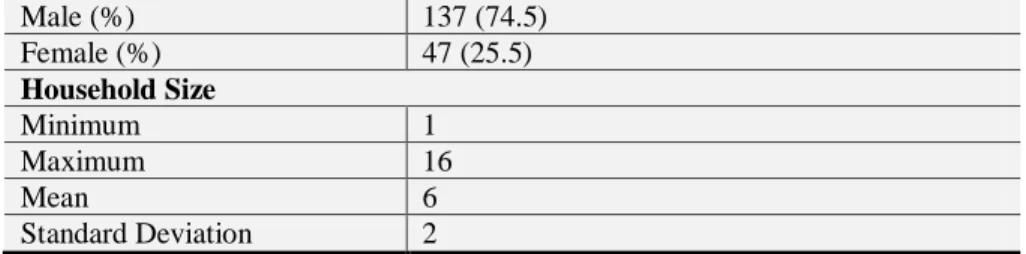
Greater proportion (54%) of the respondents was household head. Table 7 indicates that the 46% non-household head respondents were wife (22.8%), son (34.8%) and daughter (42.4). The gender distribution of household house heads, where respondents are not household heads, is as shown in table 8.
Table-7. Category of Respondent
Household head (%) 216 (54.0)
Non-Household head (%) 184 (46.0) Non household head
Wife (%) 42 (22.8)
Son (%) 64 (34.8)
Daughter (%) 78 (42.4)
Table-8. If Respondent is not Household head, sex of household head
Male (%) 137 (74.5)
Female (%) 47 (25.5)
Household Size
Minimum 1
Maximum 16
Mean 6
Standard Deviation 2
Table 8 also indicates that the average household size in the community is 6 persons with 2 as standard deviation. Majority (81.5%) of the households surveyed were indigenes of Ogoniland; while the rest are indigenes who are residing in Ogoni community (table 9). Eleme had the highest proportion (53.3%) of non-indigenes. On other hand, Tai and Gakana had 96.5% and 96.4% indigenous households respectively. About 79.5% of the households had lived in the community beyond 10 years (table 10).
Table-9. Status of Household head in the community
Ogoni indigene (%) 326 (81.5)
Not Ogoni indigene (%) 74 (18.5)
Status of household head in the community
Tai (%) Eleme (%) Gokana (%) Khana (%)
Ogoni indigene 55 (96.5) 43 (46.7) 106 (96.4) 122 (86.5)
No Ogoni indigene 2 (3.5) 49 (53.3) 4 (3.6) 19 (13.5)
Table-10. Duration of the household in the LGA
Below 5 years (%) 5 - 10 years (%) Above 10 years (%)
28 (7.0) 54 (13.5) 318 (79.5)
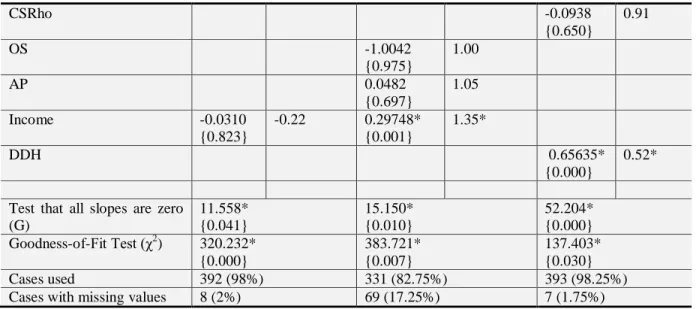
Analysis of literacy level of household heads reveals that only about 3.8% of the household heads in the community had no formal education. Majority of the household heads were literate with primary school (10.3%), secondary school (26.3%), national diploma (22.8) and first degree/post graduate degree (37%). The results of the estimated ordinal logit models are presented in table 11.
Table-11. Ordinal Logistic Analysis of Social Impact Models
Education Health Housing
Variable Value 1, 2, 3 1, 2, 3 1, 2, 3, 4
Predictor Coef Odds Ratio Coef Odds Ratio Coef Odds
Ratio
Const (1) -2.9873*
{0.000}
-1.1444* {0.005}
04960 {0.210}
Const (2) -18155*
{0.000}
1.0445* {0.010}
4.2991* {0.000}
Const (3) 6.8190*
{0.000}
GIsb 0.7705*
{0.003}
3.02*
GIsch 0.6028*
{0.019}
1.83*
GIhe 0.1365
{0.391}
1.15
GIho -0.2454
{0.203}
0.78
CSRsb 0.2964
{0.289}
1.34
CSRsch 0.0264
{0924}
1.03
CSRhe -0.0331
{0.841}
0.97
CSRho -0.0938 {0.650}
0.91
OS -1.0042
{0.975}
1.00
AP 0.0482
{0.697}
1.05
Income -0.0310
{0.823}
-0.22 0.29748* {0.001}
1.35*
DDH 0.65635*
{0.000}
0.52*
Test that all slopes are zero (G)
11.558* {0.041}
15.150* {0.010}
52.204* {0.000} Goodness-of-Fit Test (χ2) 320.232*
{0.000}
383.721* {0.007}
137.403* {0.030}
Cases used 392 (98%) 331 (82.75%) 393 (98.25%)
Cases with missing values 8 (2%) 69 (17.25%) 7 (1.75%)
Notes: p-values are in parentheses – {}; percentages in brackets – (); * represents 5% significant
A.
Impact on Education (School Completion – Primary and Secondary)
I.
Overall Model:
In this model, 98 percent of the observations were used while the rest were excluded due to missing values. The goodness-of-fit test, Chi-square (χ2= 320.232) with p-value (0.000), indicates that the model is appropriate for the data. Similarly, the overall relationship between the independent variables and the dependent variable is significant. This is because the statistic G (11.558), with p-value of 0.041, indicates that there is sufficient evidence to conclude that at least one of the estimated coefficients in the model is different from zero. Thus, the independent variables are simultaneously significant.
The model examined five factors namely government intervention in provision/renovation of school building (GIsb), government intervention in provision of scholarship (GIsch), corporate social responsibility of oil firms in term provision/renovation of school building (CSRsb), corporate social responsibility of oil firms in term provision of scholarship (CSRsch), and household income. The p-values of the predictors indicate that for 0.05 alpha-level, there is sufficient evidence to conclude that government intervention in provision/renovation of school building (GIsb) and government intervention in provision of scholarship (GIsch) significantly impact education (school completion) in the community. These government interventions are positively associated with school completion. On the other hand, the result indicates that corporate social responsibility of oil firms in term of provision/renovation of school building (CSRsb), corporate social responsibility of oil firms in term of provision of scholarship (CSRsch) and household income are not among the significant factors affecting education (school completion) in the community.
Therefore, the null hypotheses about government interventions were rejected with the conclusion that government interventions, in terms of provision of scholarship (GIsch) and provision/renovation of school building (GIsb), have positive and significant effects on the social wellbeing of Ogoni community in terms of school completion. On the contrary, the null hypotheses about corporate social responsibility of oil firms in term of provision of scholarship (CSRsch) and provision/renovation of school building (CSRsb) were accepted with the conclusion that corporate social responsibility activities of the oil companies, in terms of provision of scholarship (CSRsch) and provision/renovation of school building (CSRsb) do not have significant effect on the social wellbeing of Ogoni community in terms of school completion.
II.
Marginal Effect of Individual Predictors on the Log-odds of the Dependent Variable:
The result indicates that a unit increase in government intervention in provision of scholarship (GIsch) would result in about 0.603 unit increase in the log-odds of being in a higher category of school completion while the other variables in the model are held constant. Likewise, each unit increase in government intervention in provision/renovation of school building (GIsb) would result in about 0.77 unit increase in the log-odds of being in a higher category of school completion given that the other variables are held constant in the model.
III.
Cumulative Predicted Probabilities for each Score Category and Probabilities for the
Individual Scores of the Dependent Variable at the means of the Independent Variables
Keeping the estimated parameters fixed (that is β = 0), the cumulative predicted probabilities for each of the three categories and probabilities for the individual scores of school completion in the community were calculated (table 12).
Table-12. Cumulative Predicted Probabilities of school completion
Predictor Coeff Score Cum Prob(score)
Prob
(individual score)
Const (1) -2.9873 1 0.048003 0.048003
Const (2) -18155 1 or 2 0.139975 0.091972
Cumulative scores (3) 1 or 2 or 3 1 0.860025
B.
Impact on Health
I.
Overall Model:
In this model, 82.75 percent of the observations were used while the rest were excluded due to missing values. The goodness-of-fit test, Chi-square (χ2= 383.721) with p-value of 0.007, indicates that the model is appropriate for the data. Similarly, the overall relationship between the independent variables and the dependent variable is significant. This is because the statistic G (15.15), with p-value of 0.01, indicates that there is sufficient evidence to conclude that at least one of the estimated coefficients in the model is different from zero. Thus, the independent variables are simultaneously significant.
The model examined five factors namely government intervention towards the provision of healthcare services (GIhe), corporate social responsibility of oil firms towards the provision of healthcare services (CSRhe), oil spill (OS), air pollution (AP) and household income. The p-values of the predictors indicate that for 0.05 alpha-level, there is sufficient evidence to conclude that only household income significantly impact on health status of the community. On the other hand, the result indicates that government intervention towards the provision of healthcare services (GIhe), corporate social responsibility of oil firms towards the provision of healthcare services (CSRhe), oil spill (OS) and air pollution (AP) are not among the significant factors affecting health status in Ogoni community. Therefore, the null hypotheses about government interventions in healthcare services delivery and corporate social responsibility activities of the oil companies in healthcare services delivery were accepted with the conclusion that these interventions from government and oil companies in healthcare delivery do not have significant impact on the social wellbeing of Ogoni community in terms of health status.
II.
Marginal Effect of Individual Predictors on the Log-odds of the Dependent Variable:
The result indicates that a unit increase in household income would result in about 0.30 unit increase in the log-odds of being in a higher category of health status (predominance of diseases tending towards „Not too often‟) while the other variables in the model are held constant. In other words, increase in household income increases the log-odds of the household being in the category where diseases related to environmental factors are not experienced too often in the household.
III.
Cumulative Predicted Probabilities for each Score Category and Probabilities for the Individual
Scores of the Dependent Variable at the means of the Independent Variables
Keeping the estimated parameters fixed (that is β = 0), the cumulative predicted probabilities for each of the three categories and probabilities for the individual scores of health status in the community were calculated (table 13).
Table-13. Cumulative Predicted Probabilities of health status
Predictor Coeff Score Cum Prob(score)
Prob
(individual score)
Const (1) -1.1444 1 0.241513 0.241513
Const (2) 1.0445 1 or 2 0.739717 0.498204
Cumulative scores (3) 1 or 2 or 3 1 0.260283
Table 13 indicates that the health status probability of Ogoni people has a form of normal distribution ranging
from very often to not too often in terms of frequency at which diseases related to environmental factors occur in households (see figure 1). The probability of such diseases occurring very often in household is about 0.242; while the probability of such diseases occurring not too often in household is about 0.26. The probability of such diseases occurring somewhat often in household is about 0.5. The regression result suggests that oil spill and air pollution are not significant detrimental factors to health status in the community. In addition, it indicates government and oil firms interventions towards the provision of healthcare services have not contributed significantly to the health status of the community. Household income was identified as the major determinant of health status in the community.
Figure-1. Probability at which diseases related to environmental factors occur in households
C.
Impact on Housing (Cost of Housing)
I.
Overall Model:
In this model, 98.25 percent of the observations were used while the rest were excluded due to missing values. The goodness-of-fit test, Chi-square (χ2= 137.403) with p-value (0.03), indicates that the model is appropriate for the
0.242
0.498
0.26
0 0.1 0.2 0.3 0.4 0.5 0.6
very often somewhat often not too often
Pr
ob
ab
ility
of i
nd
ivi
du
al
sco
re
How often does any household member suffer disease related to environmental factors?
data. Similarly, the overall relationship between the independent variables and the dependent variable is significant. This is because the statistic G (52.204), with p-value of 0.000, indicates that there is sufficient evidence to conclude that at least one of the estimated coefficients in the model is different from zero. Thus, the independent variables are simultaneously significant.
The model examined three factors namely government intervention in provision of housing (GIho), corporate social responsibility of oil firms in term provision of housing (CSRho) and demand for housing (DDH). The p-values of the predictors indicate that for 0.05 alpha-level, there is sufficient evidence to conclude that only demand for housing (DDH) significantly impact cost of housing in the community. On the other hand, the result indicates that government intervention in provision of housing (GIho) and corporate social responsibility of oil firms in term of provision of housing (CSRho) are not among the significant factors affecting cost of housing in Ogoni community. Therefore, the null hypotheses about government and oil companies‟ interventions in terms of provision of housing were accepted with the conclusion these government and oil companies‟ interventions do not have significant effect on the social wellbeing (in terms of cost of housing) of Ogoni community.
II.
Marginal Effect of Individual Predictors on the Log-odds of the Dependent Variable:
As stated above, only demand for housing (DDH) significantly impact cost of housing in Ogoniland. It is positively associated with cost of housing in the community. For instance, the result indicates that a unit increase in demand for housing would result in about 0.66 unit increase in the log-odds of being in a higher category of cost of housing while the other variables in the model are held constant.
III.
Cumulative Predicted Probabilities for each Score Category and Probabilities for the Individual
Scores of the Dependent Variable at the Means of the Independent Variables
Keeping the estimated parameters fixed (that is β = 0), the cumulative predicted probabilities for each of the four categories and probabilities for the individual scores of housing in the community were calculated (table 14).
Table-14. Cumulative Predicted Probabilities of Cost of Housing
Predictor Coeff Score Cum Prob(score)
Prob
(individual score)
Const (1) 04960 1 0.621519 0.621519
Const (2) 4.2991 1 or 2 0.986601 0.365082
Const (3) 6.8190 1 or 2 or 3 0.998908 0.012307
Cumulative scores (4) 1 or 2 or 3 or 4 1 0.001092
Table 14indicates that households in Ogoni have greater probability (0.621519) of being in the lowest category
of cost of housing. The regression result, however, indicates that demand for housing positively affects cost of housing in the community. In other words, increase in demand for housing in the community increases cost of housing.
4. Conclusion
In the light of „participatory development‟, this paper examined the impact of intervention activities of government and Oil companies on the social wellbeing (in terms of education, health and housing) of Ogoni people. The results reveal that government interventions in provision/renovation of school building and provision of scholarship have positive effect on school completion in the community. However, government interventions in healthcare service delivery and housing in Ogoniland do not have significant impact in the community. Likewise, corporate social responsibility activities of the oil companies in Ogoniland do not have significant impacts on education, health and housing in the community. Household income was established as the major determinant of health status in the community. The result suggests that households with higher income would suffer little or no environmental related diseases. Also, the result indicates that demand for housing is a significant determinant of cost of housing. In line with the law of demand and supply, increase in demand increases costing of housing in Ogoni community. Given their high literacy level, it can be inferred that the household heads in Ogoniland can contribute meaningfully to community development. Therefore, development agencies willing to improve the social wellbeing of Ogoni people should consider engaging the household heads during the formation of development programmes for the community to ascertain community priorities. Involving these household heads from the conception of these development programmes through the implementation stage would improve the chances of such programmes impacting significantly on the members of the community.
School completion rate in Ogoni community is relatively high. However, having 10% of the household with, at least, a member who did not complete junior secondary school would have long run adverse effect on the community. Government should increase effort towards ensuring that every member of the community is given basic education. Many of the affected household blamed the development on lack of fund. Making basic education free is a good policy; but if the households would need their children to be involved in generating income for the household, the policy may fail. Thus, empowering the household heads and other working-class adult members of the household to raise enough income for the household would help the children become available to benefit from free education or even household-funded education. Of course, the result has shown that such increase in household income would enhance household health status in the community.
5. Acknowledgement
1. Prof. Stall Madueme, University of Nigeria, Nsukka 2. Asst. Prof. O. Onyukwu, University of Nigeria, Nsukka 3. Dr. Emmanuel Nwosu, University of Nigeria, Nsukka
4. Dr. Augustus Legborsi – An indigene of Ogoniland, River State, Nigeria
References
Allen, M.J. and W.M. Yen, 1979. Introduction to measurement theory. Monterey, CA: Brooks/Cole.
Amajirionwu, M., N. Connaughton, B. McCann, R. Moles, J. Bartlett and B. O'Reaan, 2008. Indicators for managing biosolids in Ireland. J. Environ Manage, 88(4): 1361-1372.
Bell, S. and L. Etherington, 2009. Connecting the global and local: Europe‟s regional seas. J. Law Soc, 36(1): 75-93.
Borooah, V.K., 2001. Logit and probit: Ordered and multinomial models. Sage university papers series on quantitative applications in the social sciences. Thousand Oaks, CA: Sage. pp: 7-138.
Cronbach, L.J., 1951. Coefficient alpha and the internal structure of tests. Psychometrika, 16(3): 297-334. Available from
http://link.springer.com/article/10.1007%2FBF02310555#page-1 [Accessed October 20, 2013].
Fistanic, I., 2006. Sustainable management of brackish karst spring pantan (Croatia). Acta Carsol, 35(2): 65-72.
National Bureau of Statistics, 2006. Retrieved from federal Republic of Nigeria, 2006 population census. Available from
www.nigerianstat.gov.ng/nbsapps/Connections/Pop2006.pdf [Accessed February 2, 2012].
NEST, 1991. Nigeria‟s threatened environment: A national profile. Ibadan, Nigeria: Nigerian Environmental Study / Action Team. pp: 229. Odermatt, S., 2004. Evaluation of mountain case studies by means of sustainability variables - A DPSIR framework as an evaluation tool in the
context of the North-South discussion. Mt. Res. Dev, 24(4): 336-341.
OECD, 1995. Retrieved from organization for economic cooperation and development. Available from www.oecd.org/home/ [Accessed June 20, 2011].
Ofuoku, A.U., F.N. Emuh and O.M. Agbogidi, 2008. Social impact assessment of crude oil pollution on small scale farmers in oil producing communities of the central agricultural zone of Delta State, Nigeria. Journal of Agriculture and Rural Development. Available from
http://aessweb.com/journal-detail.php?id=5005 [Accessed July 15, 2010].
Okoye, E.I., C.O. Akenbor and S.O. Enaini, 2010. Oil and gas production and the socio-economic development of the Nigeri-Delta Region of Nigeria. International Journal of Sustainable Development, 5(3): 42-49.
Saro-Wiwa, K., 1995. Complete statement by Ken Saro-Wiwa to Ogoni civil disturbances tribunal. Roslindale, Assachusetts: Rat Haus Reality Press.
Smeets, E. and R. Weterings, 1999. Environmental indicators: Typology and overview. Technical Report No. 25. European Environment Agency, Copenhagen, Denmark.
Ukoli, M., 2001. Environmental factors in the management of the oil and gas industry in Nigeria. Central bank of Nigeria. Trhèse De Doctorat, Univ, Aix-Marseille ІІ, France. Available from http://www.cenbank.org/out/Publications/occasionalpapers/rd/2001/Owe-01-2.PDF
[Accessed Februry 10, 2010].
UNDP, 2006. Niger Delta human development Report. United Nations Development Program.
UNEP, 2011. United nations environment programme. Available from www.unep.org [Accessed March 3, 2012].
UNPO, 2009. Ogoni. Retrieved from United Nation. Available from http://www.unpo.org/members/ogoni.htm [Accessed August 16, 2012]. Walmsley, J.J., 2002. Framework for measuring sustainable development in catchment systems. Environ Manage, 29(2): 195-206.
World Bank, 2010. Available from http://www.worldbank.org [Accessed January 10, 2013].
Yamane, T., 1967. Statistics: An introductory analysis. 2nd Edn., New York: Harper and Row. pp: 258.