Aliso: A Journal of Systematic and Evolutionary Botany
Volume 23 | Issue 1
Article 28
2007
Systematics of the Tribe Stipeae (Gramineae)
Using Molecular Data
Surrey Jacobs
Royal Botanic Gardens, Sydney, New South Wales, Australia
Randall Bayer
Centre for Plant Biodiversity Research, Canberra, Australia
Joy Everett
Royal Botanic Gardens, Sydney, New South Wales, Australia
Mirta Arriaga
Museo Argentino de Ciencias Naturales "Bernardino Rivadavia", Buenos Aires, Argentina
Mary Barkworth
Utah State University, Logan
See next page for additional authorsFollow this and additional works at:
http://scholarship.claremont.edu/aliso
Part of the
Botany Commons, and the
Ecology and Evolutionary Biology Commons
Recommended Citation
Jacobs, Surrey; Bayer, Randall; Everett, Joy; Arriaga, Mirta; Barkworth, Mary; Sabin-Badereau, Alexandru; Torres, Amelia; Vázquez, Francisco; and Bagnall, Neil (2007) "Systematics of the Tribe Stipeae (Gramineae) Using Molecular Data,"Aliso: A Journal of Systematic and Evolutionary Botany: Vol. 23: Iss. 1, Article 28.
Systematics of the Tribe Stipeae (Gramineae) Using Molecular Data
Authors
Surrey Jacobs, Randall Bayer, Joy Everett, Mirta Arriaga, Mary Barkworth, Alexandru Sabin-Badereau, Amelia
Torres, Francisco Vázquez, and Neil Bagnall
Aliso23, pp. 349–361
!2007, Rancho Santa Ana Botanic Garden
SYSTEMATICS OF THE TRIBE STIPEAE (GRAMINEAE) USING MOLECULAR DATA
SURREYJACOBS,1,9RANDALLBAYER,2JOYEVERETT,1MIRTAARRIAGA,3MARYBARKWORTH,4ALEXANDRUSABIN-BADEREAU,5 AMELIATORRES,6FRANCISCOVA´ ZQUEZ,7ANDNEILBAGNALL8
1Royal Botanic Gardens, Sydney, New South Wales 2000, Australia;2Centre for Plant Biodiversity Research and
Australian National Herbarium, GPO Box 1600, Canberra, Australian Capital Territory 2601, Australia;3Herbario,
Museo Argentino de Ciencias Naturales ‘‘Bernardino, Rivadavia,’’ Av. A. Gallardo 470, 1405, Buenos Aires, Argentina;
4Department of Biology, Utah State University, Logan, Utah 84322-5305, USA;5‘‘Babes-Bolyai’’ University, Faculty of
Geography, Department of Environment, Str. Clinicilor 5-7, 3400 Cluj-Napoca, Romania;6Herbario, Museo de La Plata,
Paseo del Bosque s/n, 1900 La Plata, Buenos Aires, Argentina;7Departado Producio´n Forestal y Pastos, Servicio de
Investigacio´n y Desarrollo Tecnolo´gico, Apartado 22, E 06080 Badajoz, Spain;8CSIRO, Division of Livestock Industry,
120 Meiers Road, Indooroopilly, Queensland 4068, Australia
9Corresponding author ([email protected])
ABSTRACT
Internal transcribed spacer (ITS) sequences have been determined for a wide range of stipoid grasses (Poaceae, Pooideae, Stipeae).Narduswas confirmed as the most appropriate outgroup.Anisopogonis consistently included among the stipoid genera.LithachneandOryzaform a clade and are clearly not close to Stipeae, and there is no support for includingBrachyelytrumwithin Stipeae. Ampelodesmos andDiarrhenado appear among the core taxa in some analyses, but their positions are unstable and the evidence for retaining them is limited. So far there is inadequate support for rejecting them from Stipeae, so they should be included in any comprehensive study of the tribe. The ITS phylogeny supports a narrow interpretation ofJarava,one that includes only species with clear adaptations to anemophilous diaspore dispersal. There is no support forAchnatherums.l. being a monophyletic group, nor are there any clear and consistent groups within it.Nassella, Hesperostipa, andPiptochaetium remain well supported. The data support some internal groupings withinNassella,but the sample size is small. It may be worthwhile investigating subgeneric relationships withinNassella. Anemanthele always appears associated with, and sometimes within,Austrostipa, but its position is inconsistent. We recommend continuing to recognize it at the generic level because of its distinctive morphological characters.Stipas.s. shows some cohesion, but the results also suggest that some species currently included in the genus do not belong in it, suggestions that are supported by other studies. There has been no advance in understandingPiptatherum.The data support some of the subgeneric groupings withinAustrostipa,but suggest that others should be combined.Austrostipasubgen.Falcateaeis well supported, in part by a shared deletion. Additional species ofStipas.s. andPiptatherum are being sequenced to broaden the sampling of these two genera.
Key words: Achnatherum,Gramineae, ITS,Nassella,Pooideae,Stipa,Stipeae, systematics.
INTRODUCTION
The tribe Stipeae (Gramineae, Pooideae) has had a fluid circumscription, possibly due, at least partially, to the effect of reduced spikelet structure on the number of available dis-tinctive morphological characters. A list of the generic names that have been used in Stipeae may be found at http:// herbarium.usu.edu/stipeae/genera.htm. Barkworth (1990, 1993) reviewed the use of these names prior to 1990. Her account was updated in Jacobs et al. (2000).
Recently, however, the major area of uncertainty has been in the circumscription ofStipas.l. itself. Generic segregates ofStipa are gradually being accepted with many treatments recognizing the new or revised genera (Torres 1997; Pen˜ail-illo 2002; Wheeler et al. 2002; Valde´s-Reyna and Barkworth 2002; Barkworth et al. in press), but the disposition of many species is still under active investigation, for example, the recent reinstatement ofMacrochloa Kunth and the descrip-tion of Celtica F. M. Va´zquez & Barkworth (Va´zquez and Barkworth 2004). The situation posed by limited morpho-logical characters has been helped by the availability of nu-clear DNA sequence data, particularly internal transcribed
spacer (ITS) studies (Jacobs et al. 2000). This contribution updates the story for Stipeae following recent additions to the species sampled for ITS. Given the continuing contro-versies and changes in generic interpretation within the tribe, it seems appropriate to review the present situation before discussing the results of the recent ITS studies.
It should be noted that some taxonomists (e.g., Curto 1998; Renvoize 1998) do not accept the dismemberment of
Stipa,preferring to retain the genus in a sense very similar to that used by Bentham (1882) and Hackel (1887).
Recognition and interpretation of Achnatherum remains the most difficult aspect of the taxonomy of Stipeae. Keng (cited in Tsvelev 1977) was the first to expandAchnatherum
1794) has priority over Achnatherum (Palisot de Beauvois 1812). Acceptance of Matthei et al.’s (1998) circumscription would require transferring all species of Achnatherum to
Jarava.
Jacobs and Everett (1997) also recommended recognition of Jarava, but in a narrower sense than that adopted by Matthei et al. (1998), restricting it to South American species distinguished by having nonplumose awns, lemmas that are usually thinner than those in other stipoid genera and have an apical pappus of long hairs, and paleas that are much shorter than the lemmas. More recently, Pen˜ailillo (2002) concluded that Achnatherum and Jarava, at least as repre-sented in South America, are closely related, but that they should be treated as separate genera, with Jaravabeing in-terpreted as including species with long hairs on their lem-mas or awns or with other adaptations for wind dispersal of their diaspores such as cleistogamous axillary aerial pani-cles. In his synopsis of the genus, Pen˜ailillo (2002) listed 53 species, all of which traditional treatments would place in
Stipasubgen. Jarava(Ruiz & Pav.) Trin. & Rupr., Pappos-tipaSpeg., orPtilostipa Speg. All species ofJarava(sensu Pen˜ailillo 2002) are confined to South American except one,
J. speciosa (Trin. & Rupr.) Pen˜ailillo, that also grows in northwestern Mexico and the southwestern United States.
Oryzopsisis another genus whose interpretation remains controversial. Many taxonomists (e.g., Bentham 1882; Hack-el 1887; Hitchcock 1935, 1951; Johnson 1945; Sy¨vulescu et al. 1972) have interpreted it as including both Eurasian and North American taxa, but several others (e.g., Tsvelev 1976; Tutin et al. 1980; Cope 1982) have restricted the genus to North American taxa.
Freitag (1975), after comparing the morphology of the North American Oryzopsis asperifolia (the type species of
Oryzopsis) with Eurasian species ofOryzopsiss.l., conclud-ed that the Eurasian species belongconclud-ed in Piptatherum, pro-posing three sections (Mileaceum Roshev. ex Freitag, Pip-tatherum,andVirescentiaRoshev. ex Freitag). He also drew attention to the isolation of P. miliaceum (L.) Coss. from other members of the genus. Several taxonomists have since followed Freitag in placing the Eurasian species of Oryzop-siss.l. inPiptatherum(e.g., Tsvelev 1976; Tutin et al. 1980; Cope 1982).
Freitag (1975) did not examine any North American spe-cies ofOryzopsis other than O. asperifolia.Developmental and morphological data support its treatment as a unispecific genus (Kam and Maze 1974; Barkworth 1983; Kuo et al. 1983; Barkworth and Everett 1987; Everett 1990). If such a treatment is accepted, the problem becomes one of deter-mining where the excluded North American species belong. Barkworth (1993) placed some of them in Piptatherum,
some in Achnatherum, and left the status of three species (O. canadensis(Poir.) Torr., O. exiguaThurb., andO. pun-gens(Torr.) Hitchc.) unresolved.
Curto (1998) recommended includingOryzopsis canaden-sisinStipasect.Lasiagrostis(Link) Hack. (!Achnatherum) and leaving O. pungens and O. exigua with O. asperifolia
in Oryzopsis. He noted that all three species have fused styles and short glumes, a combination of characteristics not observed in other members of Stipeae. Dorn (2001), on the other hand, transferred O. canadensis, O. exigua, and O. pungensto Piptatherum.Morphological and anatomical
ob-servations suggest that the inclusion of O. exigua in Pip-tatherumis more problematic than inclusion ofO. canaden-sisandO. pungens(M. E. Barkworth unpubl. data). The ITS data analyses by Jacobs et al. (2000) separatedO. asperifolia
from the other species ofOryzopsiss.l., placing it in a clade sister to a clade containing the two Eurasian species (as Pip-tatherum) examined, not in a clade with the other North American species.
No new genera have been published since Jacobs et al. (2000), but it has been drawn to our attention that the name
Nicoraella,which Torres published in 1997, is a superfluous name forAnatherostipaPen˜ailillo, published in 1996. There will, however, probably be more changes in generic inter-pretation within the tribe in the near future.
Following on from Jacobs et al. (2000) the number of taxa sampled was increased in an attempt to answer some of the questions raised in that study. Of particular interest (for both evolutionary and nomenclatural reasons) were the relation-ships between (i)Achnatherums.s. andJarava,(ii) Oryzop-sisandPiptatherum,and (iii) the remaining species inStipa
s.s.
MATERIALS AND METHODS
Plant Material
DNA was extracted from 123 samples representing 96 species and 11 genera of stipoid grasses (Achnatherum, Ane-manthele, Anisopogon, Austrostipa, Hesperostipa, Jarava, Nassella, Oryzopsis, Piptatherum, Piptochaetium,andStipa
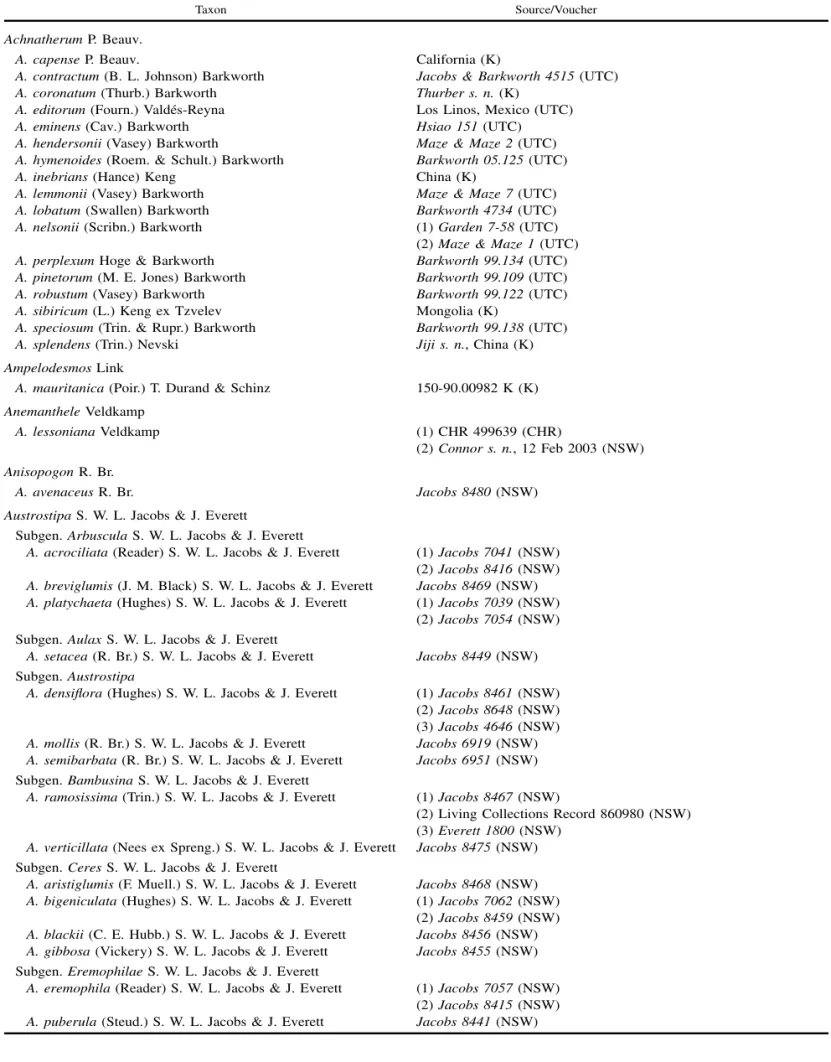
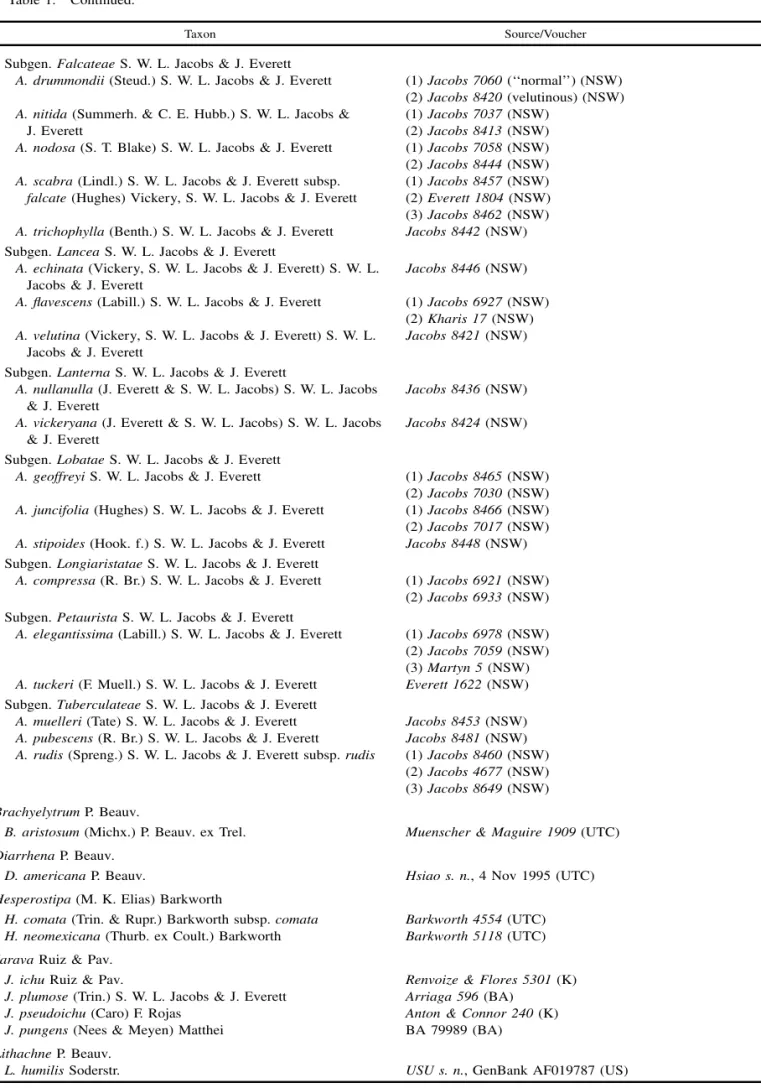
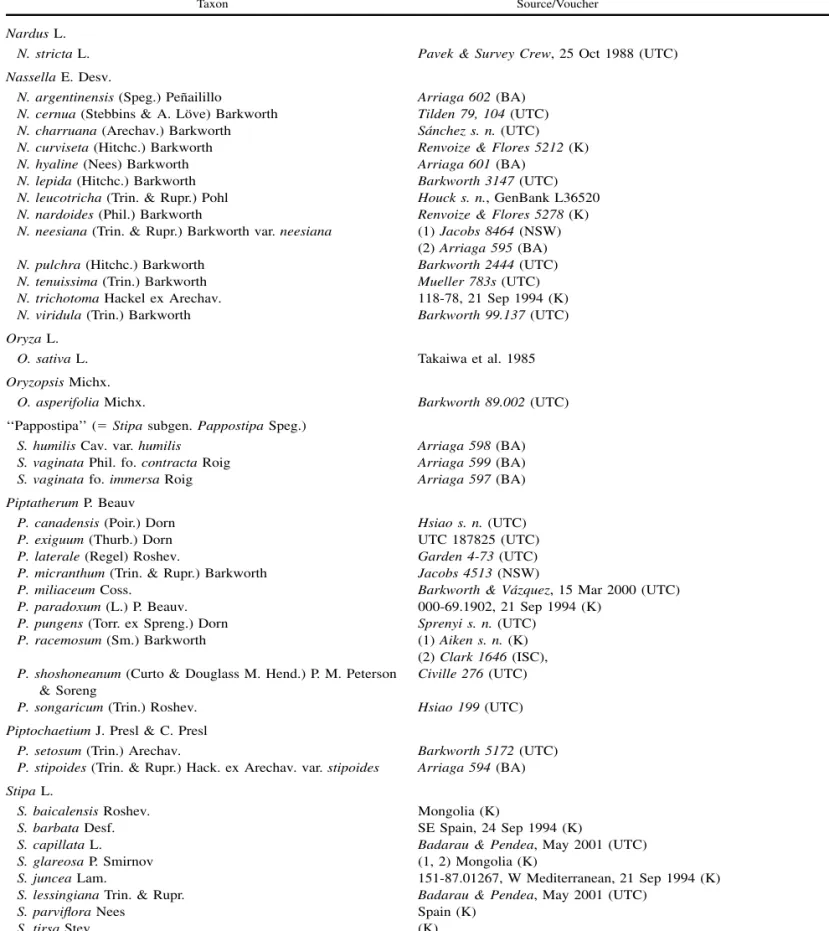
s.s.), as well as one species each of Ampelodesmos, Bra-chyelytrum, Diarrhena, Lithachne, Nardus, and Oryza. Of this last group of six genera, Nardus and Oryza were in-cluded only as outgroups and the remaining four genera were included as they have been, at some stage or other, often only by word of mouth, suggested as being part of, or related to, Stipa. We thought it may be possible to shed light on such suggestions, or simply test these genera as potential outgroups. Some stipoid species were represented by several duplicate and a few triplicate samples. Vouchers are mostly lodged at NSW and UTC; details of voucher and source material are in Table 1.
DNA Extraction, Amplification, and Sequencing
de-VOLUME 23 Systematics of Stipeae 351
naturation (94!C for 1 min), primer annealing (48!C for 1 min), and extension (72!C for 2 min). A 7 min final exten-sion cycle at 72!C followed the 30thcycle to ensure the com-pletion of all novel strands. The ITS region was amplified using primers ITSL (Hsiao et al. 1994) and ITS4 (White et al. 1990). Herbarium specimens were amplified in two frag-ments, using the internal primers ITS2 and ITS3 (White et al. 1990) in conjunction with ITSL and ITS4, respectively.
The double-stranded PCR products were then used as tem-plates in cycle-sequencing reactions. The sequencing primers were the same as the PCR amplification primers. The dou-ble-stranded PCR products were sequenced using the di-deoxy chain termination method with the use of the Big Dye Terminator RR Kit! (Perkin-Elmer Applied Biosystems, Wellesley, Massachusetts, USA) and an ABI automated se-quencer in the Division of Plant Industry, CSIRO. Sequenc-ing reactions used 55!C annealing temperatures. The cycle-sequencing protocol followed manufacturer’s instructions. Sequences were assembled using Sequencher" 3.0 (Gene Codes Corporation, Ann Arbor, Michigan, USA).
DNA Sequence Analysis
Sequences were first aligned using ClustalW (Australian National Genomic Information Service, University of Syd-ney, New South Wales). Multiple alignment parameters were set at the default values: opening penalty of 10, gap-extension penalty of 5, and gap-separation penalty of 8. Se-quences were secondarily manually aligned using MacClade vers. 4.03 (Maddison and Maddison 2001) and analyzed us-ing PAUP* vers. 4.0b10 (Swofford 2002). To detect and re-move random pairing a stepwise alignment strategy was used (Hsiao et al. 1998, 1999). This strategy required align-ing sequences of closely related groups first, then alignalign-ing the full sequence data set manually. Sequences of newly add-ed taxa or taxa of questionable affinities were alignadd-ed vari-ously with the sequences of the other taxa, each time fol-lowed by a parsimony analysis. If such taxa proved topo-logically unstable in these analyses, every attempt was made to find potentially pairing or closely related sequences to optimize the alignment and provide more robust results. The final alignment was further optimized manually. This process eliminated most of the random pairings of taxa and was crit-ical for sequence alignment of the variable DNA region. Some sequences obtained from different sources proved con-sistently different. The differences in most cases could be reduced to a single base position and the effect removed by deleting that single position from the analysis. Gaps were treated as additional characters if the gaps occurred in more than one species and if there appeared to be any possibility of taxonomic information in the character. The gaps that were not scored were mostly in the outgroup genera. The sequence alignments were too large to be included here, but they are available upon request to Surrey Jacobs or Joy Ev-erett.
We used several options in PAUP* to analyze the data matrix. Heuristic searches were used initially but took sev-eral days and the results obtained rarely differed substan-tially from those obtained using distance methods. In most analyses the neighbor-joining option was used, and the data were resampled via jackknifing with 10,000 replicates and
37% deletion. As well, for Austrostipa, the most-parsimo-nious trees were determined using a heuristic search algo-rithm with random taxon entry, 5000 replicates, saving only 100 trees each replicate, tree-bisection-reconnection (TBR) branch swapping, and the random-stepwise-addition option generating a majority-rule tree.
Various genera were used as outgroups—Brachyelytrum, Lithachne, Lygeum, Nardus,andOryza—both singly and in various combinations. Results from Hsiao et al. (1999) in-dicated all of these genera were potential outgroups. In prac-tice, all produced similar results. Narduswas the genus we used most frequently as the outgroup because its sequence was closest to those of the stipoids and could be aligned with more confidence.
After the initial analyses more detailed analyses were con-ducted on some of the clades. Some sequences that appeared problematic were identified in the earlier analyses and omit-ted from the subsequent analyses in an attempt to obtain results for hypotheses generation. One of these sequences was for Austrostipa stipoides that did not appear stable in any analysis. Another was the second sample of A. rudis,
which was a large partial sequence but clearly had to be deleted when results from the other two samples were in-cluded. For detailed analysis of the more derived clades,
Hesperostipawas a logical genus to use as an outgroup (Ja-cobs et al. 2000).
RESULTS AND DISCUSSION
Aligning ITS proved fairly straightforward for all of the Stipeae core taxa, and forNardus.The other genera caused a few more problems in alignment, withLithachneand Ory-zabeing the most difficult, but even here we were satisfied with the final alignment. There were 654 bases with 39 in-sertions/deletions (indels) scored, making a total of 693 char-acters. There were six incomplete sequences, forAustrostipa geoffreyi1,A. rudis3,A. scabra3,Nassella argentinensis, N. hyalina,andPiptatherum racemosum2.
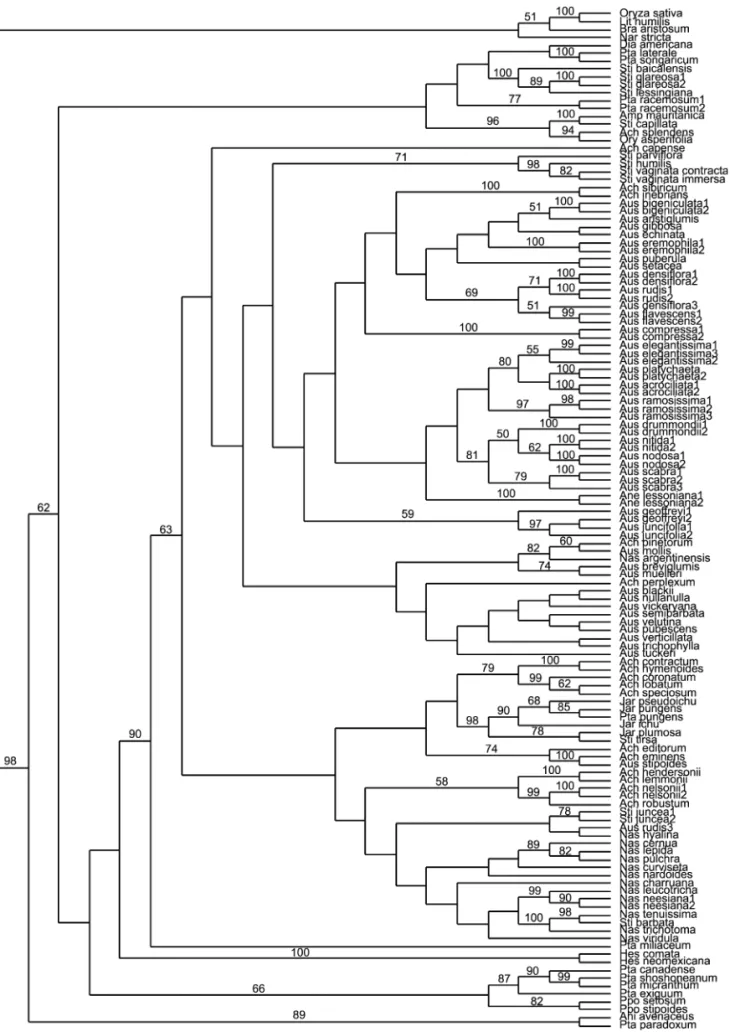
Nardus was confirmed as the most appropriate outgroup based on the sampling used in this study. Hsiao et al. (1999), based on ITS, found that the core stipoid genera ( Achnath-erum, Austrostipa, Nassella, Oryzopsis, PiptathAchnath-erum, Pip-tochaetium,and Stipa) were part of a monophyletic lineage that also included Ampelodesmos, Anisopogon, and Diar-rhena. Brachyelytrum, Lithachne, Nardus, and Oryza di-verged before the clade above didi-verged from other pooid genera. The larger data set in this study and the more rig-orous scoring of indels support the inclusion ofAnisopogon
among the stipoid genera.LithachneandOryzaform a clade and are clearly not close to Stipeae (Fig. 1). There is no support for includingBrachyelytrumwithin Stipeae.
Ampelodesmosand Diarrhenado appear among the core taxa in some analyses (Fig. 1, 2), but their positions are unstable and the evidence for retaining them is weak using morphological data. Likewise, there is inadequate support for rejecting them from Stipeae, and they should be included in any comprehensive study of the tribe. These data thus only weakly support Decker’s (1964) suggestion of retaining
Table 1. Study taxa and source/voucher information. Some of the earlier studies (e.g., Hsiao et al. 1999) recorded minimal information for the vouchers; these data are presented as recorded. Some sequences were taken from the literature and some from GenBank, and the relative information is presented for these. For more recent vouchers, information is provided on collector and number (or date or locality if number not available) and the herbarium (in parentheses) where the main specimen is lodged.
Taxon Source/Voucher
AchnatherumP. Beauv.
A. capenseP. Beauv. California (K)
A. contractum(B. L. Johnson) Barkworth Jacobs & Barkworth 4515(UTC)
A. coronatum(Thurb.) Barkworth Thurber s. n.(K)
A. editorum(Fourn.) Valde´s-Reyna Los Linos, Mexico (UTC)
A. eminens(Cav.) Barkworth Hsiao 151(UTC)
A. hendersonii(Vasey) Barkworth Maze & Maze 2(UTC)
A. hymenoides(Roem. & Schult.) Barkworth Barkworth 05.125(UTC)
A. inebrians(Hance) Keng China (K)
A. lemmonii(Vasey) Barkworth Maze & Maze 7(UTC)
A. lobatum(Swallen) Barkworth Barkworth 4734(UTC)
A. nelsonii(Scribn.) Barkworth (1)Garden 7-58(UTC) (2)Maze & Maze 1(UTC)
A. perplexumHoge & Barkworth Barkworth 99.134(UTC)
A. pinetorum(M. E. Jones) Barkworth Barkworth 99.109(UTC)
A. robustum(Vasey) Barkworth Barkworth 99.122(UTC)
A. sibiricum(L.) Keng ex Tzvelev Mongolia (K)
A. speciosum(Trin. & Rupr.) Barkworth Barkworth 99.138(UTC)
A. splendens(Trin.) Nevski Jiji s. n., China (K)
AmpelodesmosLink
A. mauritanica(Poir.) T. Durand & Schinz 150-90.00982 K (K)
AnemantheleVeldkamp
A. lessonianaVeldkamp (1) CHR 499639 (CHR)
(2)Connor s. n., 12 Feb 2003 (NSW)
AnisopogonR. Br.
A. avenaceusR. Br. Jacobs 8480(NSW)
AustrostipaS. W. L. Jacobs & J. Everett
Subgen.ArbusculaS. W. L. Jacobs & J. Everett
A. acrociliata(Reader) S. W. L. Jacobs & J. Everett (1)Jacobs 7041(NSW) (2)Jacobs 8416(NSW)
A. breviglumis(J. M. Black) S. W. L. Jacobs & J. Everett Jacobs 8469(NSW)
A. platychaeta(Hughes) S. W. L. Jacobs & J. Everett (1)Jacobs 7039(NSW) (2)Jacobs 7054(NSW) Subgen.AulaxS. W. L. Jacobs & J. Everett
A. setacea(R. Br.) S. W. L. Jacobs & J. Everett Jacobs 8449(NSW) Subgen.Austrostipa
A. densiflora(Hughes) S. W. L. Jacobs & J. Everett (1)Jacobs 8461(NSW) (2)Jacobs 8648(NSW) (3)Jacobs 4646(NSW)
A. mollis(R. Br.) S. W. L. Jacobs & J. Everett Jacobs 6919(NSW)
A. semibarbata(R. Br.) S. W. L. Jacobs & J. Everett Jacobs 6951(NSW) Subgen.BambusinaS. W. L. Jacobs & J. Everett
A. ramosissima(Trin.) S. W. L. Jacobs & J. Everett (1)Jacobs 8467(NSW)
(2) Living Collections Record 860980 (NSW) (3)Everett 1800(NSW)
A. verticillata(Nees ex Spreng.) S. W. L. Jacobs & J. Everett Jacobs 8475(NSW) Subgen.CeresS. W. L. Jacobs & J. Everett
A. aristiglumis(F. Muell.) S. W. L. Jacobs & J. Everett Jacobs 8468(NSW)
A. bigeniculata(Hughes) S. W. L. Jacobs & J. Everett (1)Jacobs 7062(NSW) (2)Jacobs 8459(NSW)
A. blackii(C. E. Hubb.) S. W. L. Jacobs & J. Everett Jacobs 8456(NSW)
A. gibbosa(Vickery) S. W. L. Jacobs & J. Everett Jacobs 8455(NSW) Subgen.EremophilaeS. W. L. Jacobs & J. Everett
A. eremophila(Reader) S. W. L. Jacobs & J. Everett (1)Jacobs 7057(NSW) (2)Jacobs 8415(NSW)
VOLUME 23 Systematics of Stipeae 353
Table 1. Continued.
Taxon Source/Voucher
Subgen.FalcateaeS. W. L. Jacobs & J. Everett
A. drummondii(Steud.) S. W. L. Jacobs & J. Everett (1)Jacobs 7060(‘‘normal’’) (NSW) (2)Jacobs 8420(velutinous) (NSW)
A. nitida(Summerh. & C. E. Hubb.) S. W. L. Jacobs & J. Everett
(1)Jacobs 7037(NSW) (2)Jacobs 8413(NSW)
A. nodosa(S. T. Blake) S. W. L. Jacobs & J. Everett (1)Jacobs 7058(NSW) (2)Jacobs 8444(NSW)
A. scabra(Lindl.) S. W. L. Jacobs & J. Everett subsp.
falcate(Hughes) Vickery, S. W. L. Jacobs & J. Everett
(1)Jacobs 8457(NSW) (2)Everett 1804(NSW) (3)Jacobs 8462(NSW)
A. trichophylla(Benth.) S. W. L. Jacobs & J. Everett Jacobs 8442(NSW) Subgen.LanceaS. W. L. Jacobs & J. Everett
A. echinata(Vickery, S. W. L. Jacobs & J. Everett) S. W. L. Jacobs & J. Everett
Jacobs 8446(NSW)
A. flavescens(Labill.) S. W. L. Jacobs & J. Everett (1)Jacobs 6927(NSW) (2)Kharis 17(NSW)
A. velutina(Vickery, S. W. L. Jacobs & J. Everett) S. W. L. Jacobs & J. Everett
Jacobs 8421(NSW) Subgen.LanternaS. W. L. Jacobs & J. Everett
A. nullanulla(J. Everett & S. W. L. Jacobs) S. W. L. Jacobs & J. Everett
Jacobs 8436(NSW)
A. vickeryana(J. Everett & S. W. L. Jacobs) S. W. L. Jacobs & J. Everett
Jacobs 8424(NSW) Subgen.LobataeS. W. L. Jacobs & J. Everett
A. geoffreyiS. W. L. Jacobs & J. Everett (1)Jacobs 8465(NSW) (2)Jacobs 7030(NSW)
A. juncifolia(Hughes) S. W. L. Jacobs & J. Everett (1)Jacobs 8466(NSW) (2)Jacobs 7017(NSW)
A. stipoides(Hook. f.) S. W. L. Jacobs & J. Everett Jacobs 8448(NSW) Subgen.LongiaristataeS. W. L. Jacobs & J. Everett
A. compressa(R. Br.) S. W. L. Jacobs & J. Everett (1)Jacobs 6921(NSW) (2)Jacobs 6933(NSW) Subgen.PetauristaS. W. L. Jacobs & J. Everett
A. elegantissima(Labill.) S. W. L. Jacobs & J. Everett (1)Jacobs 6978(NSW) (2)Jacobs 7059(NSW) (3)Martyn 5(NSW)
A. tuckeri(F. Muell.) S. W. L. Jacobs & J. Everett Everett 1622(NSW) Subgen.TuberculateaeS. W. L. Jacobs & J. Everett
A. muelleri(Tate) S. W. L. Jacobs & J. Everett Jacobs 8453(NSW)
A. pubescens(R. Br.) S. W. L. Jacobs & J. Everett Jacobs 8481(NSW)
A. rudis(Spreng.) S. W. L. Jacobs & J. Everett subsp.rudis (1)Jacobs 8460(NSW) (2)Jacobs 4677(NSW) (3)Jacobs 8649(NSW)
BrachyelytrumP. Beauv.
B. aristosum(Michx.) P. Beauv. ex Trel. Muenscher & Maguire 1909(UTC)
DiarrhenaP. Beauv.
D. americanaP. Beauv. Hsiao s. n., 4 Nov 1995 (UTC)
Hesperostipa(M. K. Elias) Barkworth
H. comata(Trin. & Rupr.) Barkworth subsp.comata Barkworth 4554(UTC)
H. neomexicana(Thurb. ex Coult.) Barkworth Barkworth 5118(UTC)
JaravaRuiz & Pav.
J. ichuRuiz & Pav. Renvoize & Flores 5301(K)
J. plumose(Trin.) S. W. L. Jacobs & J. Everett Arriaga 596(BA)
J. pseudoichu(Caro) F. Rojas Anton & Connor 240(K)
J. pungens(Nees & Meyen) Matthei BA 79989 (BA)
LithachneP. Beauv.
Table 1. Continued.
Taxon Source/Voucher
NardusL.
N. strictaL. Pavek & Survey Crew, 25 Oct 1988 (UTC)
NassellaE. Desv.
N. argentinensis(Speg.) Pen˜ailillo Arriaga 602(BA)
N. cernua(Stebbins & A. Lo¨ve) Barkworth Tilden 79, 104(UTC)
N. charruana(Arechav.) Barkworth Sa´nchez s. n.(UTC)
N. curviseta(Hitchc.) Barkworth Renvoize & Flores 5212(K)
N. hyaline(Nees) Barkworth Arriaga 601(BA)
N. lepida(Hitchc.) Barkworth Barkworth 3147(UTC)
N. leucotricha(Trin. & Rupr.) Pohl Houck s. n., GenBank L36520
N. nardoides(Phil.) Barkworth Renvoize & Flores 5278(K)
N. neesiana(Trin. & Rupr.) Barkworth var.neesiana (1)Jacobs 8464(NSW) (2)Arriaga 595(BA)
N. pulchra(Hitchc.) Barkworth Barkworth 2444(UTC)
N. tenuissima(Trin.) Barkworth Mueller 783s(UTC)
N. trichotomaHackel ex Arechav. 118-78, 21 Sep 1994 (K)
N. viridula(Trin.) Barkworth Barkworth 99.137(UTC)
OryzaL.
O. sativaL. Takaiwa et al. 1985
OryzopsisMichx.
O. asperifoliaMichx. Barkworth 89.002(UTC)
‘‘Pappostipa’’ (!Stipasubgen.PappostipaSpeg.)
S. humilisCav. var.humilis Arriaga 598(BA)
S. vaginataPhil. fo.contractaRoig Arriaga 599(BA)
S. vaginatafo.immersaRoig Arriaga 597(BA)
PiptatherumP. Beauv
P. canadensis(Poir.) Dorn Hsiao s. n.(UTC)
P. exiguum(Thurb.) Dorn UTC 187825 (UTC)
P. laterale(Regel) Roshev. Garden 4-73(UTC)
P. micranthum(Trin. & Rupr.) Barkworth Jacobs 4513(NSW)
P. miliaceumCoss. Barkworth & Va´zquez, 15 Mar 2000 (UTC)
P. paradoxum(L.) P. Beauv. 000-69.1902, 21 Sep 1994 (K)
P. pungens(Torr. ex Spreng.) Dorn Sprenyi s. n.(UTC)
P. racemosum(Sm.) Barkworth (1)Aiken s. n.(K) (2)Clark 1646(ISC),
P. shoshoneanum(Curto & Douglass M. Hend.) P. M. Peterson & Soreng
Civille 276(UTC)
P. songaricum(Trin.) Roshev. Hsiao 199(UTC)
PiptochaetiumJ. Presl & C. Presl
P. setosum(Trin.) Arechav. Barkworth 5172(UTC)
P. stipoides(Trin. & Rupr.) Hack. ex Arechav. var.stipoides Arriaga 594(BA)
StipaL.
S. baicalensisRoshev. Mongolia (K)
S. barbataDesf. SE Spain, 24 Sep 1994 (K)
S. capillataL. Badarau & Pendea, May 2001 (UTC)
S. glareosaP. Smirnov (1, 2) Mongolia (K)
S. junceaLam. 151-87.01267, W Mediterranean, 21 Sep 1994 (K)
S. lessingianaTrin. & Rupr. Badarau & Pendea, May 2001 (UTC)
S. parvifloraNees Spain (K)
S. tirsaStev. (K)
still remain unresolved. It is possible relevant species are now extinct.
The differences between sequences from replicate samples of the same species were surprisingly large in some cases.
This was most obvious in Austrostipawhere there was the
most multiple sampling. The greatest infraspecific variation
was 12 base pairs (bp) for the three samples ofA. densiflora,
followed by eight for the three samples ofA. rudisand six
for both sets of three samples each ofA. elegantissimaand
VOLUME 23 Systematics of Stipeae 355
Fig. 1. Neighbor-joining tree showing the basal portions of the tree in Fig. 2, including the positions of the contentious generaDiarrhena, Ampelodesmos,andAnisopogon.Jackknife values!50% are included.
Achnatherum
In Jacobs et al. (2000) the results supported the concept of Achnatherum being distinct from Stipa s.s., while sug-gesting that Achnatherum, whether interpreted in its tradi-tional sense or in the expanded sense, is not monophyletic. While there is limited support for the clade as a whole, there is virtually no support for any internal structure. The more recent analyses demonstrate that the North American Ach-natherum species sort into two weakly supported clades (clade 1: A. contractum, A. coronatum, A. hymenoides, A. lobatum,andA. speciosum; clade 2:A. hendersonii, A. lem-monii, A. nelsonii,andA. robustum) and are not monophy-letic in (Fig. 2, 3). There are three other more or less con-sistent clades (Fig. 2, 3):
(i) One of A. editorum and A. eminens, both of which grow in Mexico withA. eminensextending into the south-western United States. This clade also includes Austros-tipa stipoides, which has a very different sequence that does not appear to readily align with anything. It is quite possible that A. stipoides is either a hybrid or polyploid and more sequences are required to determine what the situation is here.
(ii) A Eurasian clade represented here byA. inebriansand A. sibiricum,both of which are Asian species.
(iii) A third clade comprises Jarava s.s. (J. ichu, J. plu-mosa, J. pseudoichu,and J. pungens).
Achnatherum perplexum, A. pinetorum, A. splendens(with Oryzopsis asperifolia),Stipa capillata,andS. parvifloraare separately unstable with regard to position in different anal-yses (Fig. 2, 3).
It is not immediately obvious from these analyses what the best taxonomic groupings are. The jackknife values are low, but there is more support for recognition ofJaravas.s. than for the alternative broader circumscription (Pen˜ailillo 2002), some suggestion of a core group of North American species, the possibility of a Eurasian group, but there are too many single outliers to place any confidence in any
extrap-olation yet. Further sampling is required to sort out the op-timum treatment.
There is no support for the suggestion thatAchnatherum contractum is a hybrid between Achnatherum and Piptath-erum(Schechter and Johnson 1968; Schechter 1969) though, of course, a single ITS sequence will not necessarily detect that event.
Anemanthele
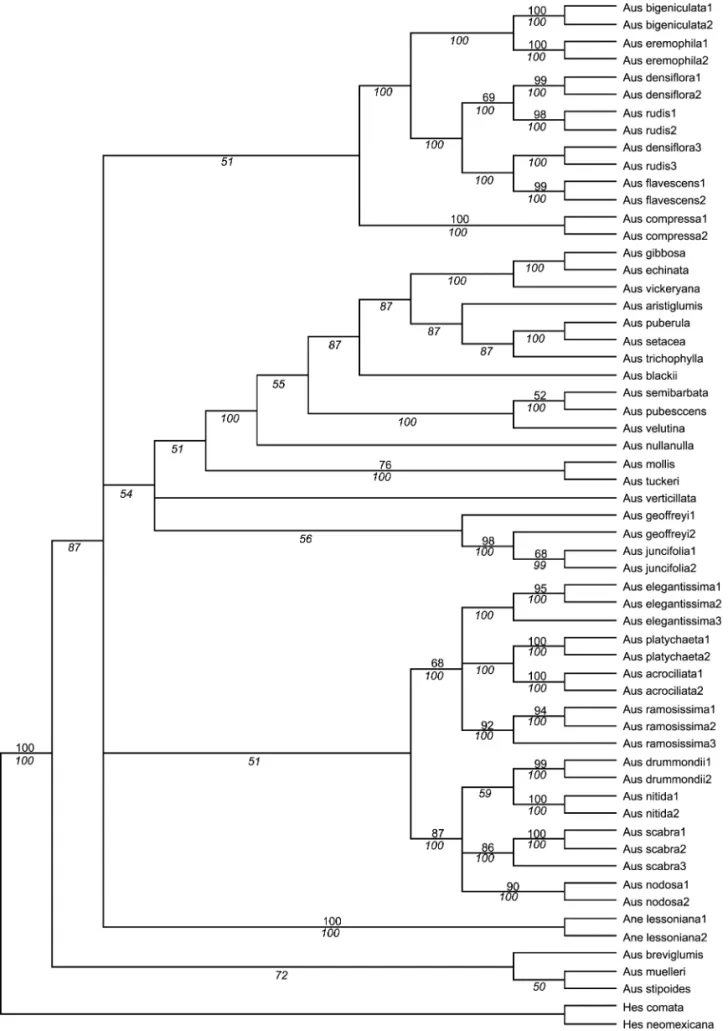
The monotypicAnemantheleis distinguished by its single stamen and characteristic hilum, though there is some doubt about the hilum character being as distinct as originally stat-ed (Veldkamp 1985; Everett 1990). Barkworth and Everett (1987) included Anemanthele in their concept of Achnath-erum; Jacobs and Everett (1997) retained it as distinct. Var-ious ITS analyses show it included in Austrostipa(Fig. 2– 4), but never in a consistent position. Because of the insta-bility and the morphological differences, we suggest retain-ingAnemanthele,at least for now.
Austrostipa
Fig. 2. Neighbor-joining tree derived from analysis of most of the samples. Jackknife values!50% are included. Ach!Achnatherum; Amp! Ampelodesmos; Ane!Anemanthele; Ani !Anisopogon; Aus! Austrostipa; Bra! Brachyelytrum; Dia!Diarrhena; Hes!
VOLUME 23 Systematics of Stipeae 357
Fig. 3. Neighbor-joining tree derived from analysis of those species included in the contentiousAchnatherums.l. clade. Jackknife values !50% included. While there is limited support for the clade as a whole, there is virtually no support for any internal structure. Ach"
Achnatherum; Ane "Anemanthele; Aus"Austrostipa; Hes"Hesperostipa; Jar"Jaravas.s.; Nar"Nardus; Nas"Nassella; Sti"
VOLUME 23 Systematics of Stipeae 359
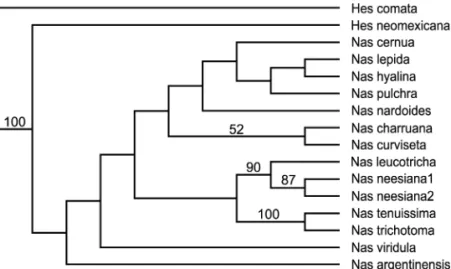
Fig. 5. Neighbor-joining tree derived from analysis ofNassella.While there is some jackknife support (values!50% shown) for some of the branches, such support is meaningless considering the low level of sampling. It does suggest there may be benefit in more intensive sampling. Hes"Hesperostipa; Nas"Nassella.
any structure; however, by using multiple replicates (5000) of 100 trees, it was possible to identify some consistent groupings (Fig. 4).
When Jacobs and Everett (1996) establishedAustrostipa,
they also suggested a subgeneric classification with 13 sub-genera. Testing subgeneric classifications is not easy with sequence data as the differences are often too few, and the potential problems caused by hybrid origins (multiple ITS copies) and multiple genomes (polyploidy) are most obvious although we have no direct evidence of this. This may be why the ITS data failed to recover the subgeneric classifi-cation suggested by Jacobs and Everett (1996) (Table 1, Fig. 2–4). Subgenus Falcateae (here represented by A. drum-mondii, A. nitida, A. nodosa, and A. scabra) is well sup-ported as monophyletic, characterized in part by a four base-pair deletion. SubgenusLobateae(A. geoffreyi, A. juncifolia) is supported, although A. geoffreyi1 has an incomplete se-quence and one of the other species in the subgenus, A. stipoides, has a problematic sequence and will need to be resampled. The position of the sequence suggests that A. stipoidesmay have a hybrid origin. SubgenusLongiaristatae
(A. compressa) is also distinct, but is only represented by one species here.
The ITS phylogeny also suggests that some subgenera could be reassessed and possibly some combined, for ex-ample subgen.Austrostipa(A. densiflora, A. mollis, A. semi-barbata) combined with subgen. Tuberculateae (A. pubes-cens, A. rudis), and subgen.Bambusina(A. ramosissima, A. verticillata) combined with subgen.Arbuscula(A. acrocilia-ta, A. breviglumis, A. platychaeta). Species of subgen. Aus-trostipaandTuberculateaehave similar growth forms, sim-ilar-sized florets, and more or less similar lemma surfaces, and grow on sandy or sandstone-derived soils; the main dif-ferences between the two are the long-hairy awns and more densely pubescent lemmas of subgen. Tuberculateae. Spe-cies of both subgen.Bambusinaand subgen.Arbusculahave a characteristic shrubby growth form often with multiple branching at the nodes, but there are differences in floret size and awn length between the two subgenera.
Hesperostipa
As in Jacobs et al. (2000) there is strong support for Hes-perostipa(Fig. 2).
Jarava
Jarava was first recognized by Ruiz and Pavo´n (1794), but, until recently (Jacobs and Everett 1997), was treated as a section of the genusStipa(Caro and Sa´nchez 1973) along with many genera now recognized as distinct. The diaspores are wind dispersed and have a range of morphological char-acters that distinguish them from the rest of Achnatherum
(Jacobs and Everett 1997). The results to date do not support Pen˜ailillo (2002) in his expansion of the circumscription of
Jaravato include many South American stipoid species; the species in Fig. 3 he has transferred to Jarava are A. spe-ciosum, S. humilis,and S. vaginata.
Nassella
Nassellaremains monophyletic except for a single outlier (Fig. 2, 3), and that outlier (N. argentinensis) is an incom-plete sequence. There is some evidence of subgeneric group-ings, sufficient to suggest that further sampling may be in-formative (Fig. 5). While there is some jackknife support for some of the branches such support is meaningless consid-ering the low level of sampling. Some species of Stipas.s. are included in the clade (Fig. 2, 3) and this further supports the suggestion below that much work is yet to be done.
OryzopsisandPiptatherum
Oryzopsis into more than one genus, but the polyphyly of
Achnatherum indicates that more work is required to fully resolve the situation.
Jacobs et al. (2000) suggested that there was some support for the subgeneric groupings in Piptatherum. That support appears to have evaporated with the slightly larger data set (Fig. 1, 2). Although there is still no clear solution, species ofOryzopsisandPiptatherumare now tending to group to-gether with some species ofStipas.s. that diverge early from the rest of the species. There is little information on the grouping of Piptatherum species at present. Some of the groups have high jackknife values, but their relationships to each other are not clear.
‘‘Pappostipa’’ (Stipasubgen.Pappostipa)
There is no support for includingStipa subgen. Pappos-tipa (Stipa humilis and S. vaginata in this analysis) with
Jaravas.s. (Pen˜ailillo 2002) (Fig. 2, 3). Indeed, there is no support for the monophyly ofPappostipawith the inclusion of S. parviflora in the clade. As many of the Stipa species appear alone in apparently unrelated clades this may be a reflection of insufficient sampling of Stipa s.s. rather than reflecting actual relationship.
Piptochaetium
As in Jacobs et al. (2000) there is strong support for Pip-tochaetium(Fig. 2), but so far there have only been sequenc-es obtained for specisequenc-es with long-cylindrical florets. Sam-pling of some with almost spherical florets is required to confirm the monophyly of the genus.
StipaSensu Stricto
Stipas.s. is represented by a small clade of three species in the analysis (S. baicalensis, S. glareosa, and S. lessingi-ana) while four other species (S. barbata, S. capillata, S. juncea,andS. tirsa) are scattered (Fig. 2), and their relative positions remain reasonably stable, altering only slightly with different analyses using different combinations of taxa in the data sets. The lack of monophyly is a surprising result as it has always been assumed thatStipa s.s. is a homoge-nous group and the number of species sampled was based on that assumption. There is some reflection on geography; the first three species have a mainly Asian distribution, while
S. barbata, S. juncea, and S. tirsa have a more European distribution, withS. tirsaconnecting the two. Stipa tirsa be-longs to sect.Stipa,whereas, all of the others belong to sect.
LeiostipaDumort. Va´zquez and Barkworth (2004) recently reinstated Macrochloa and described Celtica, defined on morphological data, and studies are continuing on other spe-cies in this group. The results from the ITS analyses are not adequate to suggest anything more than the need to include more species from each of the sections of Stipa s.s. in any further analyses. There is obviously a need to examine even this new narrowly defined genus in more detail. The narrow-er intnarrow-erpretation of Stipa is defined by comparatively large one-flowered spikelets (usually!1 cm long), long, (!5 cm) long-hairy (pennate) awns, and lemmas not particularly in-durate.
Overall Phylogeny
There is little support for the suggestion of two distinct lineages of American Stipeae (Barkworth and Everett 1987). All analyses suggest that, of the core genera, members of thePiptatherum/Oryzopsis complex are among the earliest-diverging lineages, along with some species of Stipa s.s. from the Americas and Eurasia distributed through the trees.
Hesperostipa is next to diverge, and a logical genus to use as an outgroup when analyzing subsequent groups. All anal-yses indicate thatAustrostipais probably the most recently derived genus or group. The data clearly suggest a Eurasian origin for the tribe as the early branches are all essentially European and most of the next-diverging branches (with the exception ofHesperostipa) contain both European and New World species.
ACKNOWLEDGMENTS
We would like to thank Chris Quinn for his generous help in analyzing the data. This is a product of the Stipoid Work-ing Group, a collaboration of people interested in the phy-logeny and biology of the stipoid grasses. Details can be obtained from the author listed for correspondence.
LITERATURE CITED
BARKWORTH, M. E. 1983.PtilagrostisGriseb. in North America and
its relationship to other taxa in the Stipeae (Gramineae).Syst. Bot.
8: 395–415.
. 1990.Nassella(Gramineae, Stipeae): revised interpretation and nomenclatural changes.Taxon39: 597–614.
. 1993. North American Stipeae (Gramineae): taxonomic changes and other comments.Phytologia74: 1–25.
, K. M. CAPELS, S. LONG,ANDM. B. PIEP(editors). In press. Magnoliophyta: Commelinidae (in part): Poaceae, Part 1. Flora of North America, Vol. 24. Oxford University Press, New York, USA.
, ANDJ. EVERETT. 1987. Evolution in the Stipeae:
identifi-cation and relationships of its monophyletic taxa, pp. 251–264.In
T. R. Soderstrom, K. W. Hilu, C. S. Campbell, and M. E. Bark-worth [eds.], Grass systematics and evolution. Smithsonian Insti-tution Press, Washington, D.C., USA.
BAYER, R. J., D. E. SOLTIS, AND P. S. SOLTIS. 1996. Phylogenetic inferences in Antennaria (Asteraceae: Gnaphalieae: Cassiniiae) based on sequences from nuclear ribosomal DNA internal tran-scribed spacers (ITS).Amer. J. Bot.83: 516–527.
BENTHAM, G. 1882. Notes on Gramineae.J. Linn. Soc., Bot.19: 14–
134.
CARO, J. A.,ANDE. SA´ NCHEZ. 1973. Las especies deStipa (Grami-neae) del subge´neroJarava. Kurtziana7: 61–116.
COPE, T. A. 1982. Poaceae, pp. 1–678.In E. Nasir and S. I. Ali [eds.], Flora of Pakistan, No. 143. Pakistan Agricultural Research Council and University of Karachi, Islamabad and Karachi, Pak-istan.
CURTO, M. 1998. A newStipa(Poaceae: Stipeae) from Idaho and Nevada.Madron˜o45: 57–63.
DORN, R. D. 2001. Vascular plants of Wyoming, Ed. 3. Mountain West Publishing, Cheyenne, Wyoming, USA. 412 p.
DECKER, H. F. 1964. Affinities of the grass genus Ampelodesmos.
Brittonia16: 76–79.
EVERETT, J. 1990. Systematic relationships of the Australian Stipeae
(Poaceae). M.S. thesis, School of Biological Sciences, University of Sydney, Australia.
FREITAG, H. 1975. The genusPiptatherum(Gramineae) in Southwest
VOLUME 23 Systematics of Stipeae 361
. 1985. The genusStipa(Gramineae) in southwest and south Asia.Notes Roy. Bot. Gard. Edinburgh42: 355–489.
HACKEL, E. 1887. Gramineae, pp. 1–97.InA. Engler and K. Prantl [eds.], Die natu¨rlichen Pflanzenfamilien nebst ihren Gattungen und wichtigeren Arten, insbesondere den Nutzpflanzen . . . II. Teil. 2. Abteilung. W. Engelmann, Leipzig, Germany.
HITCHCOCK, A. S. 1935. Manual of the grasses of the United States, Ed. 1. USDA Misc. Publ. 200, U. S. Gov. Print. Off., Washington, D.C., USA. 1040 p.
. (Revised by A. Chase.) 1951. Manual of the grasses of the United States, Ed. 2. USDA Misc. Publ. 200, U. S. Gov. Print. Off., Washington, D.C., USA. 1051 p.
HSIAO, C., N. J. CHATTERTON, K. H. ASAY,ANDK. B. JENSEN. 1994. Phylogenetic relationships of 10 grass species: an assessment of phylogenetic utility of the internal transcribed spacer region in nuclear ribosomal DNA in monocots.Genome37: 112–120.
, S. W. L. JACOBS, N. P. BARKER, AND N. J. CHATTERTON. 1998. A molecular phylogeny of the subfamily Arundinoideae (Poaceae) based on sequences of rDNA.Austral. Syst. Bot. 11: 41–52.
, , N. J. CHATTERTON,ANDK. H. ASAY. 1999. A mo-lecular phylogeny of the grass family (Poaceae) based on the se-quences of nuclear ribosomal DNA (ITS).Austral. Syst. Bot.11: 667–688.
JACOBS, S. W. L., M. E. BARKWORTH, AND C. HSIAO. 2000. Rela-tionships within the stipoid grasses (Gramineae), pp. 75–82.InS. W. L. Jacobs and J. Everett [eds.], Grasses: systematics and evo-lution. CSIRO Publishing, Collingwood, Victoria, Australia.
,ANDJ. EVERETT. 1996.Austrostipa,a new genus, and new names for Australasian species formerly included inStipa (Gra-mineae).Telopea6: 579–595.
, AND . 1997. Jarava plumosa (Gramineae), a new combination for the species formerly known as Stipa papposa. Telopea7: 301–302.
JOHNSON, B. L. 1945. Cytotaxonomic studies inOryzopsis. Bot. Gaz.
107: 1–32.
KAM, Y. K.,AND J. MAZE. 1974. Studies on the relationships and evolution of supraspecific taxa utilizing developmental data, II. Relationships and evolution ofOryzopsis hymenoides, O. vires-cens, O. kingii, O. micrantha,andO. asperifolia. Bot. Gaz.135: 227–247.
KUO, P-C., S. WANG,ANDS. LU. 1983. Evolution of spikelet mor-phology and generic relationships of the tribe Stipeae in China. Acta Bot. Boreal.-Occid. Sin.3: 18–27. [In Chinese.]
MADDISON, D. R.,ANDW. P. MADDISON. 2001. MacClade: analysis of phylogeny and character evolution, vers. 4.03. Sinauer Asso-ciates, Inc., Sunderland, Massachusetts, USA.
MATTHEI, O., C. MARTICORENA, R. RODRı´GUEZ, M. KALINARROYO, M. MUN˜ OZ, F. A. SQUEO,ANDG. ARANCIO. 1998. Nuevas citas y nuevas combinaciones en Poaceae para la flora de Chile.Gayana, Bot.54:189–192.
PALISOT DEBEAUVOIS, A. M. F. J. 1812. Essai d’une nouvelle agros-tographie; ou nouveaux genres des Gramine´es; avec figures repre´-sentant les caracte`res de tous les genres. Fain, Paris, France. 182 p.
PEN˜AILILLO, P. 1996. Anatherostipa, un nuevo ge´nero de Poaceae (Stipeae).Gayana, Bot.53: 277–284.
. 2002. El ge´nero JaravaPav. (Stipeae-Poaceae): delimita-cio´n y nuevas combinaciones.Gayana, Bot.59: 27–34.
RENVOIZE, S. A. 1998. Gramı´neas de Bolivia. Royal Botanic Gar-dens, Kew, Richmond, Surrey, UK. 644 p.
RUIZ, H.,ANDJ. PAVO´ N. 1794. Flora peruvianae, et chilensis prod-romus. De o´rden del Rey, en la imprenta de Sancha. Madrid, Spain. 153 p.
SHECHTER, Y. 1969. Electrophoretic investigation of the hybrid origin ofOryzopsis contracta. Advancing Frontiers Pl. Sci.23: 19–25.
,ANDB. L. JOHNSON. 1968. The probable origin ofOryzopsis contracta. Amer. J. Bot.55: 611–618.
SWOFFORD, D. L. 2002. PAUP*: phylogenetic analysis using parsi-mony (*and other methods), vers. 4.0b10. Sinauer Associates, Inc., Sunderland, Massachusetts, USA.
SY¨VULESCU, T., E. I. NYA´ RA´DY, A. BELDIE, I. MORARIU,ANDA. NYA´ R-A´ DY. 1972. Flora Reipublicae Socialisticas Romania. Editio Aca-demiae Reipublicae Socialisticae Romania.
TAKAIWA, F., K. OONA,ANDM. SUGIURA. 1985. Nucleotide sequence of the 17S–25S spacer region from rice rDNA.Pl. Molec. Biol.
4: 355–364.
TORRES, M. A. 1997.Nicoraella(Gramineae) un nuevo ge´nero para Ame´rica del Sur.Monogr. Comis. Invest. Ci. Prov. Buenos Aires
13: 69–77.
TSVELEV, N. N. 1976. Grasses of the Soviet Union [Zlaki SSSR], Parts I and II. Nauka Publishers, Leningrad, Russia. [Translated from Russian. Published for the Smithsonian Institution Libraries, and the National Science Foundation, Washington, D.C., by Am-erind Publishing Co. Pvt. Ltd., New Delhi, India. 1983.] 1196 p. . 1977. On the origin and evolution of feathergrasses (Stipa L.), pp. 139–150.InProblemii ekologii, geobotaniki, botaniiches-koi, goegrafio i floristickii. Nauka, Leningrad, Russia. [In Russian. Translated by K. Gonzalez for M. E. Barkworth. Copy on file in Department of Botany Reprint Collection, Smithsonian Institution, Washington, D.C., USA.]
TUTIN, T. G., V. H. HEYWOOD, N. A. BURGES, D. M. MOORE, D. H. VALENTINE, S. M. WALTERS, AND D. A. WEBB (editors). 1980. Flora Europaea, Vol. 5. Cambridge University Press, Cambridge, UK. 452 p.
VALDE´S-REYNA, J.,ANDM. E. BARKWORTH. 2002. Poaceae II, Pooi-deae: tribu Stipeae. Flora de Veracruz 127. Instituto de Ecologı´a, Veracruz, Mexico.
VA´ZQUEZ, F. M.,AND M. E. BARKWORTH. 2004. Resurrection and emendation ofMacrochloa (Gramineae: Stipeae).J. Linn. Soc., Bot.144: 483–495.
VELDKAMP, J. F. 1985.AnemantheleVeldk. (Gramineae: Stipeae), a new genus from New Zealand.Acta Bot. Neerl.34: 105–109. WHEELER, D. J. B., S. W. L. JACOBS,ANDR. D. B. WHALLEY. 2002.
Grasses of New South Wales. University of New England, Ar-midale, New South Wales, Australia. 445 p.