Intelligent Web Information Retrieval based on User
Navigational Patterns
Anupama Prasanth
Research Scholar Karpagam University
Coimbatore
M. Hemalatha,
Ph.D. ProfessorDepartment of Computer Sceince Karpagam University
ABSTRACT
The foremost mission of any information retrieval algorithm is the efficient extraction of user interests. The rapid growth of web data, intense competition and user’s option to choose from several alternatives increases this issue. In this context Web usage mining can provide valuable contributions in terms of ideas and methods, as it fissures useful knowledge from the pattern of user interactions with the Web. The user interest can be identified by analyzing the access pattern of user browse, the web pages they save, collect, or print. These valuable information’s are available in server logs, which can be exploited to satisfy user needs by optimizing the document-retrieval task. This article is a review conducted in the field of web usage mining and its latest works for supporting the research on efficient information retrieval based on user access pattern. This survey analyzes 25 released information retrieval models to find out the major mining techniques applied in them and also to analyze the effect of diverse parameters like feedbacks, time, content, frequency etc in information retrieval. The goal of this survey is to find the best composition of features to be included in an efficient information retrieval model. Using those features a new retrieval model is then proposed.
General Terms
Information Retrieval, Web Usage Mining.
Keywords
Information retrieval, User navigational patterns, Web usage mining, Web personalization, Retrieval parameters.
1.
INTRODUCTION
World Wide Web is become a huge storeroom of web pages and links. The internet users can search out huge quantity of data from WWW. Millions of pages are added to the web day by day and its growing incredibly. Various surveys roughly estimated that around one million new pages are added and 600GB of data changes per day [1]. The manner of internet usage in business has been changed by the innovative application of e-services like e-commerce, e-learning, e – banking etc. In this scenario it is necessary to focus in providing more and more features and tailored products and services according to the specific individual needs to maintain loyal customers.
The majority of web users are non experts, so they cannot cope up with the rapid development of computer technologies. The rapid growth of the web data, intense competition and user’s option to choose from several alternatives forced to realize the necessity of intelligent web information retrieval. Information retrieval can be achieved by applying web mining techniques.
Basically web mining is an unmitigated edition of data mining. Web mining techniques enables to work upon
On-Line and helps in storing the data in server database and web log [2] [3]. Web mining is categorized into three phases, based on which part of the web is to mine: Web Content Mining, Web Structure Mining and Web Usage Mining. Out of these three web usage mining is mainly concern because which is purely based on user access pattern. The main purpose of using mining algorithms is to accept user query and retrieve more relevant information according to that, so compare with other web mining phases, the basic concept behind web usage mining is the hit elements in the result page is on the basis of user browsing behavior [4][5]. Also it provides a friendlier environment after reducing the problems of information overload. It is nothing but a task of providing web pages based on needs and interest of individual users by collecting information about their preferences.
The research on web mining has been almost started in 1996, and large numbers of papers are published with the overview of what has happened in the area of Web Mining since 1996. Web mining, its categories, Web Structure Mining, Web Content Mining, Web Usage Mining, and a survey focuses on one of its category, web content mining, is presented in the article [6]. A survey [7] presents the commercial solutions of web Usage mining focusing on WebSIFT[8] project. The applications of soft computing techniques like, neural networks, fuzzy logic, genetic algorithms, and rough sets, on used in Web Mining is presented in the article [9]. These are some major milestones in the history of Web Mining.
This article is a review conducted in the field of web usage mining and its latest works for supporting the research in the field of information Retrieval. In contrast with [6], [7] and [9], here the focal point is on Web Usage Mining, specifically on the mining techniques applied various research results reported in the literatures. The paper is organized as follows. Initially, it discusses web usage mining and its processes. After that an overview on Mining techniques is cited. Next a cross reference among the typical techniques employed and the parameters considered for access behavior analysis is presented. In the next part the paper proposed a new IR model incorporating all major features. Then finally, the future research trends in this area are stated.
2.
WEB USAGE MINING
patterns from Web Access logs. The target domain of a particular web site can be organize more better way by analyzing the registration data getting after processing web logs and customized data. If we reorganize the website according to the web logs information provides much better navigational paths and page stay time, also based on different parameters it is possible to cluster web users.
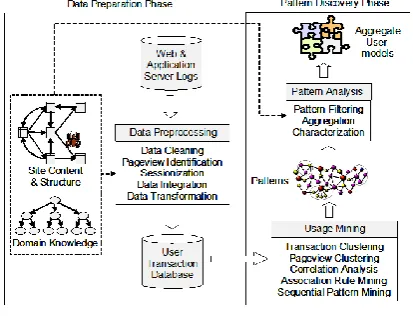
In view of its use in user click pattern analysis, and basically being a data mining process, the data from web logs and other sources cannot use directly for analyzes so its process is divided into several stages: Collect data then pre-process it, after that discover patterns from that then analyze it.
In the data collection stage, the usage data are collected from various sources like, Web servers, client machines, web logs, proxy servers and packet sniffers. So many efficient techniques are available to collect these data.
[image:2.595.63.270.399.557.2]Web server logs maintain the browsing behavior of a site visitor. These records clearly reflect the details of multiple user access of a website. Packet sniffer technology also can be used to collect usage data from server logs. The packet sniffer technology can directly extract the usage data from TCP/IP packets which helps to analyze the network traffic of web server. The problems in collecting caching and session identification can be solved by collecting access data at client level [13]. This also provides the actual view time of a page. The actual HTTP requests from multiple clients to multiple web servers can get only from proxy server access collection. It also reduces the loading time and at client /server network traffic [7].
Figure 1: Web Usage Mining Process
The chances of having noise in these data are very high, so in the next stage, pre-processing stage, consists of several cleaning and preparation subtasks like data cleaning, integration, normalization, transformation, feature extraction and selection. In this stage, process begins with identifying incomplete, incorrect, inaccurate, irrelevant data and removes or replaces them. After that remove the repeated and redundant data and represent it in canonical form. Then convert the source data into the format of destination data and extract relevant attributes from the data set and prepare those data for pattern discovery process.
In the pattern discovery stage, the hidden patterns of user behavior are revealed using statistical, database, and machine learning operations. The synopsis of Web resources, sessions, and users are also discovered. In order to automate the construction of user models, the learning methods are applied.
The knowledge representation is the final stage. In this stage it further processes the discovered patterns and statistics into an aggregate user model. This mode goes into the visualization or report generation tools as input. In general this is the overall process of web usage mining and it is illustrated in Fig. 1.
3.
USER NAVIGATIONAL PATTERNS-
A ROAD MAP
Web usage mining is a kind of mining techniques in logs. It can be applied in two main streams: personalized vs. impersonalized [6]. Web personalization is based on intelligent web server which is capable to understand the various user information needs and priorities. On the other hand, by knowing the user navigation patterns, the information providers can overview the progress of the effectiveness on their Web sites, which results in adapting the Web site design or by biasing the user’s behavior towards satisfying the goals of the site. This survey is mainly focuses on learning user navigational patterns. Advanced techniques are emerging to conduct a more sophisticated discovery and analysis of patterns.
Most of the navigational pattern analysis techniques are focus on information in the web page, duration of each usage, frequency etc. These observations are enough to capture the common interests among web users. The approach Query Logs for Query Recommendation (QLQR)[14] states that the accurate model developed from web page browsing and clicking history enables to predict user actions and intends. There are different approaches of user behavior modeling. The major drawback in this approach is the quality of the information in the web pages; Some of the experiments reveal that the information retrieval quality relies on precision rate and recall ratio. So these two factors also have to consider along with other parameters for satisfying user needs.
A study conducted in Access Behavior and Personalized Information Retrieval (AB&PIR), [15] to analyze how the user interest is relate to access behavior, which reveals that the main aspects which affect the interest of user’s on a page are its document structuring and time when the page accessed.. Users give importance to the pages where the feature term present in its main areas like title, headings etc than in content. Same way the subjects who have given importance before may not be interested at present the degree of likeness attenuate with time running out. The experimental results shows that the systems which use these two factors for modeling user interest base, effectively catch user interests.
Efficient web information retrieval (EWEBIR)[16] states that the relevance of the document from users perspective can somewhat overcome the problems of low precision and recall. The larger size of the log file is the major issue in web usage mining. Log files are the growing in faster rate because of the remarkable use of internet. So mining the log files according to the user requirement is difficult. The approach Knowledge based Personalized Recommendation Service System (KBPRSS) [17] states that filtering or clustering the mass data will somewhat can be a solution to this problem. Cluster the internet users based on their similarity in usage pattern and maintain a cache of web document for each of these group helps to identify the relevance in their perspective.
(CWPIEP) [18], indicate that in the classification task, the same word have different impact in different context. Thus the documents can be extracted with the help of web page classification and this gives more semantically meaningful result than keyword based methods. The approach, Identify Interested Users Using Naïve Classification (IUNC) [19], stated that Naïve Bayesian classifier is also perfectly works in identifying user interest,. The experiment result shows that this method gives improvement in time and memory utilization too.
The Website Information Filter (WebSIFT) system [8], is designed to perform Web Usage Mining from server logs, which helps in identifying server sessions and inferring cached page references. Also this system performs content and structure information from a website in order to identify potentially interesting results from mining usage data. This uses structure information in effective filtering the discovered rules.
Several researches, hierarchical cluster based preprocessing methodology, (HCPM) [20] and Predicting Users’ Browsing Behaviors by using FPCM Clustering (PUBBFPCM) [21], proves the importance of user click history and its measures in web user categorization or web session clustering. These methods proposed a session clustering framework in the preprocessing level of web usage mining. So in the preprocessing phase the log data are converting into numerical data, so that the web log is clustered using swam optimization, so more structured user session information can be obtained by this hierarchical cluster method.
There are several factors that influence the user interests in the web site. If we consider more factors, the more precisely we can represent the user interests. Fuzzy clustering in web log files is an efficient approach states in incremental web log mining (IWLM) [23], is to analyze the behavior of users. In WUMFC [24], the researcher, cluster similar web pages by considering two factors, the page click number and web browsing time. Here the researcher suggests a method to improve customer loyalty and get more customers by recommending web pages and by enhancing web structure.
The enhanced fuzzy clustering method that used in web servers is presented in, WUMFCITG [25], is an efficient technique which examines the data collected from web servers and identifies the clusters that have common interests and behaviors.
The significant technique expected from web usage mining is the forecasting of the user’s browsing pattern. This result can be used for many applications. In user interest hierarchy for context in personalization (UIP) [26] and Web user clustering from access log using belief function (WUCALBF) [27] uses divisive hierarchical clustering technique to group web site users according to their interest and personalize web contents according to the group to which the user belongs. One of the effective clustering technique to cluster based on users browsing behavior is hierarchical agglomerative. The usage of Two Levels of Prediction Model framework is explained in [21], this works better for general cases. But it has a major drawback, heterogeneity. This can be overcome by applying Fuzzy Possibilistic algorithm for clustering. The experimental result shows that the proposed technique results in higher hit rate.
The conventional method of Information Retrieval system, presented in Personalized Information Retrieval (PIR) [28] is that, even if the query submitted by different users at different
context it will retrieve the same list of result. This can be overcome by applying user feedback mechanism or web personalization. Web Personalization approach take a step further to better satisfy the user needs is proved in an approach machine learning approach to web personalization (MLWP) [29].
Feedback mechanism can do a lot in IR is proved in the method proposed in Adaptive information retrieval system via modeling user behavior (AIRUB) [30] system. The proposed system modeled information needs using computational intelligence through interactive reinforcement learning. It combines both qualitative user relevance feedback with quantitative measures of the relevance of retrieved documents.
An Intelligent web personalization system called WAPPS[31] and SEWEP [32] uses sequential access pattern mining[33]. This system uses CS-mine to mine frequent sequential web access pattern and this pattern is stored in a compact tree structure, pattern tree. This is used for matching and generating online recommendations [34]. This system shows very good performance with high satisfaction and applicability.
The approaches association rule discovery from web usage data (ARD) [35] and association rule mining for recommender systems (ARMRS) [36] presents an effective method for web personalization by discovering association rules from click stream. In which the click stream data has taken in the early stage and store frequent itemsets in an efficient data structure. It uses a very scalable recommendation algorithm, so without generating all association rules for itemsets, it generates recommendations. The experiment shows that this framework can provide an effective alternative to standard collaborative filtering mechanism [37] for personalization.
WEBMINER [38], one of the oldest pattern miners presented with another concept, in which the discovery of patterns are based on the association and sequential pattern from the web data. But WEBMINER simply proposes statistically dominant paths, Web Utilization Miner (WUM) presented [39] can avoid these drawbacks by integrating query processor to the miner. WUM has used an innovative technique for user interest pattern generation. They include a mining language, MINT, as an interface for providing desired characteristics to the experts which leads to generate specific interesting patterns, while pruned out uninteresting patterns..
The importance of pages in web usage mining as well as page recommendation systems is dissimilar in different sessions. Some methods evaluate the importance of pages by assigning various weights for each time. The approach presented in Efficient Weighted Algorithm for Web Information Retrieval System (WAWIRS) [40] proposes an efficient weighted algorithm for web information retrieval system. In this approach they assign weights to pages based on three factors, time spend by user on each page, visiting frequency and click event done. An experiment done by the authors proves that the accuracy of the system is depending on the parameters considered, when number of parameters increases accuracy also increases.
3.1
Modeling Parameter Selection- Analysis
and Interpretations
From the 25 popular known good solutions have been analyzed, the most critical parameters they have used for access behavior were identified. All these known solutions of IR have been used different filtering parameters. They have not categorized these parameters but give only the description and use them in their model.
There are many common parameters among the selected models. It is evident that 64% of models considered clustering
as the mining technique for grouping the usage data. Application of other techniques is very less compared to this. In case of access behavior modeling parameters it is observed that 52% of models gives importance to frequency of usage of page for filtering the usage data. The parameter content got 485 preference and similarly 44% of approaches selected time factor also for filtering usage data. The usage of other behavior parameters are very low.
Table1. User Navigational Pattern: A reference between techniques and access behavior parameters
Approaches
Technique Access Behavior Modeling Parameter
C
LUS
TE
R
IN
G
SE
Q
UE
N
TIA
L
A
C
C
ES
S PA
TT
ER
N
C
LA
SS
IF
IC
A
TIO
N
A
SS
O
C
IA
TION
R
UL
E M
IN
IN
G
A
G
G
R
EG
A
TION
C
O
N
TE
N
T
N
O
. O
F PA
G
ES
FR
EQ
UE
N
C
Y
FA
IL
URE
R
EQ
UE
ST
D
URA
TION
FE
ED
BA
C
K
TIM
E
WEBSIFT √ √ √ √
ODLWU √ √ √
QLQR √ √ √ √
AB&PIR √ √ √
EWEBR √ √ √
WPIEP √ √
IUNC √ √ √ √
HCPM √ √ √
IWLM √ √
PUBBFPCM √ √ √
WUMFC √ √ √
WUMFCITG √ √ √ √
UIP √ √
WUCALBF √ √ √
PIR √ √
WUCAL √ √
AIRUB √ √
WAPPS √ √ √
SEWEP √ √ √ √
PARD √ √ √
ARMRS √ √
WEBMINER √ √ √ √ √ √
WUM √ √ √ √
WAWIRS √ √ √ √ √
4. PROPOSED INFORMATION
RETRIEVAL MODEL
The analysis on the most promising solutions for information retrieval designs enlighten that the user behavior can be best model by incorporating the parameters frequency, content and time and the grouping can be performed by using the most accepted technique, Clustering. Content parameter shows the similarity in content rather than keywords, tags or description. Frequency denotes the number of times appears. Time parameter shows the difference between the last date when the page accessed before and current date. Based on this analysis a new model can be suggest by combining these three factors and clustering technique, figure 2, it’s clear which will provide most relevant pages corresponding to the user query gives the page weight by analyzes the content.
Figure2: Proposed IR Model
5.
CONCLUSION
Web Mining is powerful technique used to extract the information from past behavior of users. Web Usage Mining plays an important role in this approach. Its user navigational pattern analysis can contribute a lot in determining user interest. The current survey is based on some researches done in user navigational pattern analysis to identify the most critical parameters for access behavior. The survey results that Content, Frequency and Time are the parameters which have been applied in almost all recognized approaches. Since it is a
huge area, so this survey could able to cover only some major works on web usage mining, mainly focuses on mining techniques and behavior analysis parameter.
6.
FUTURE WORK
As a future work the actual implementation of the IR model incorporating the parameters need to be done to show the impact of these parameters on feature prioritization.
7.
REFERENCES
[1] Chakrabarti,S, “Data mining for hypertext: A tutorial survey”, ACM SIGKDD Explorations, 2000.
[2] I-Hsien Ting, "Web Mining Techniques for On-Line Social Networks Analysis: An Overview", Studies in Computational Intelligence, 2009
[3] Kavitha Sharma, Gulshan Shrivastava and Vikas Kumar, “Web Mining: Today and Tomorrow”, 3rd International Conference on Electronics Computer Technology; 2011.
[4] Kumar, Gyanendra, Neelam Duhan, and A. K. Sharma, "Page ranking based on number of visits of links of Web page", 2011 2nd International Conference on Computer and Communication Technology (ICCCT-2011), 2011.
[5] Chu-Hui Lee, “Two levels of Prediction Model for User’s Browsing Behavior”, International Multi-Conference of Engineers and Computer Scientists, 2008.
[6] R. Kosala and H. Blockeel, “Web mining Research: A Survey”
[7] Jaideep Srivastava, Robert Cooley, Mukund Deshpande, Pang-Ning Tang, “Web Usage Mining: Discovery and Applications of Usage Patterns from Web Data”, ACM SIGKDD explorations, 2000
[8] Robert Cooley, Pang Ning Tang and Jaidfeep Srivastava, “WEBSIFT, Website Information Filter System”, Supported by NSF, Jun 13, 1999
[9] Shankar K. Pal, Varun Talwar, Pabithra Mitra, “Web Mining in soft computing framework: relevance, state of the art and future directions” IEEE Transactions on Neural Networks, Volume 13, Issue 5, 2002
[10]R. Cooley, B. Mobasher, and J. Srivastava, “Web Mining: Information and Pattern Discovery on the World Wide Web”, Proceeding of International Conference on Tools with Artificial Intelligence, Newport Beach, CA, 558-567, 1997.
Web Server Logs
Data Selection: Parameters – Frequency, Content and Time
Pattern Tree Construction
Pattern Tree Recommendation
Rules generation Recommendation
[11]Shahnaz Parvin Nina, Md. Mahamudur Rahaman, Md. Khairul Islam Bhuiyan, Khandakar Entenam Unayes Ahmed, ”Pattern Discovery of Web Usage Mining”; International Conference on Computer Technology and Development, 2009.
[12]Sanjay Kumar Malik; “Information Extraction Using Web Usage Mining , web Scrapping and Semantic Annotation”; 2011 International Conference on Computing Intelligence and Communication Networks, Oct 2011.
[13]H.K. Dai, B. Mobasher, “Using ontologies to discover domain-level web usage profiles”, Proceedings of the 2nd Semantic Web Mining Workshop at ECML/PKDD 2002, Helsinki, Finland, August 2002
[14]Z. Zhang, O. Nasraoui, “Mining Search Engine Query Logs for Query Recommendation”, Proceedings of the 15th International Conference on World Wide Web, May 23 – 26, 2006.
[15]Zhu, Zhen, Jing-yan Wang, Mei-lan Chen, and Ren-gen Huang, “User Interest Modeling Based on Access Behavior and its Application in Personalized Information Retrieval", 2010 3rd International Conference on Information Management Innovation Management and Industrial Engineering, 2010.
[16]Indrajit Mukherjee, Samudra Banerjee, Pradeep Kumar Gupta, P.k mahanti, V. Bhatacharya , “Efficient web information retrieval based on usage mining”, 2011
[17]Liu Xuanchun, Jiancun Zhou, “Research on Knowledge based Personalized Recommendation Service System Retrieval Service”, Energy Procedia; 2011.
[18]Ki Soon, Selangor, Sang Ho Lee, “Classifying web Pages using Information Extraction Patterns - Preliminary Results and Findings”, LaySoongil University, Seoul, Korea.
[19]A. K. Santra, S. Jayasudha, “Classification of Web Log Data to Identify Interested Users Using Naïve Classification”, International Journal of Computer Science Issues, Vol. 9, Issue 1, No 2, January 2012
[20]Hussain Tasawar, Asghar Sohail and Fong Simon, "A hierarchical cluster based preprocessing methodology for Web Usage Mining", 6th International Conference on Advanced Information Management and Service (IMS), Pp. 472-477, 2010.
[21]R. Khanchana and M. Punithavalli, “Web Usage Mining for Predicting Users’ Browsing Behaviors by using FPCM Clustering”, IACSIT International Journal of Engineering and Technology, Vol. 3, No. 5, October 2011
[22]Ming –Syan Chen, Jong Soo Park, Philip S. Yu, “Efficient data mining for path traversal patterns”, IEEE Transactions on Knowledge and Data Engineering Vol 10, No. 2, March/April 1998.
[23]T. Kamdar, “Creating adaptive web servers using incremental web log mining”, Master’s thesis, Computer Science Department, University of Maryland, Baltimore County, 2001
[24]Yaxiu Yu and Xin-Wei Wang, "Web Usage Mining Based on Fuzzy Clustering", International Forum on
Information Technology and Applications, Pp. 268-271, 2009.
[25]Jianxi Zhang, Peiying Zhao, Lin Shang and Lunsheng Wang, "Web usage mining based on fuzzy clustering in identifying target group", ISECS International Colloquium on Computing, Communication, Control, and Management, Vol. 4, Pp. 209-212, 2009
[26]H.R. Kim, P.K. Chan, “Learning implicit user interest hierarchy for context in personalization”, Proceedings of the 2003 International Conference on Intelligent User Interfaces, ACM Press, pp. 101–108, 2003.
[27]Y. Xie, V.V. Phoha, “Web user clustering from access log using belief function”, Proceedings of the First International Conference on Knowledge Capture (K-CAP 2001), ACM Press, pp. 202–208, 2001
[28]M. Rami Ghorab, Dong Zhou, Alexander O'Connor, and Vincent Wade, “Personalized Information Retrieval: Survey and Classification”, Springer; Volume 23, Issue 4, Sept 2013.
[29]C.R. Anderson, “A machine learning approach to web personalization”, Ph.D. thesis, University of Washington, 2002
[30]Saeedeh Maleki Dizajio, Jawed Siddiqu Yasaman Soltan Zadeh, Fazilathur Rahman; “Adaptive information retrieval system via modeling user behavior”; Journal of Ambient Intelligence and Humanized Computing, Volume 5; Issue 1 Feb 2014.
[31]Xiaogang Wang, Yan Bai, Yue Li, “An Information Retrieval Method Based On Sequential Access Patterns”, Asia-Pacific Conference on Wearable Computing Systems, 2010.
[32]M. Eirinaki, M. Vazirgiannis, I. Varlamis, “Sewep: using site semantics and a taxonomy to enhance the web personalization process”, Proceedings of the Ninth ACM SIGKDD International Conference on Knowledge Discovery and Data Mining, ACM Press, pp. 99–108, 2003
[33]K. Chang, “An Intelligent Recommender System Using Sequential Web Access Patterns”, IEEE Conference on Cybernetics and Intelligent Systems; 2005.
[34]Wang Xiao- Gang, “Web Mining based on User Access Patterns for Web Personalization”, ISECS International Colloquium on Computing Communication Control and Management; Aug 2009.
[35]B. Mobasher, H. Dai, T. Luo and M. Nakagawa, “Effective personalization based on association rule discovery from web usage data”, Proceedings of the 3rd ACM Workshop on Web Information and Data Management (WIDM01), 2001.
[36]W. Lin, S.A. Alvarez, C. Ruiz, “Efficient adaptive– support association rule mining for recommender systems Data Mining and Knowledge Discovery”, ACM, January 1; pp. 83–105, 2002.
[38]Mobasher, B., Jain, N., Han, E. et al. “Web mining: Pattern discovery from World Wide Web transactions”, Tech Rep: TR96-050, (1996)
[39]Spiliopoulou, M., Faulstich, L. C.: “WUM: A web utilization miner”, EDBT Workshop WebDB98, Springer Verlag (1996)
[40]Rohit Agarwal, K. V. Arya, Shashi Shekhar, Rakesh Kumar; “An Efficient Weighted Algorithm for Web Information Retrieval System”, 2011 International Conference on Computational Intelligence and Communication Systems, 2011
8.
AUTHOR’S PROFILE
Anupama Prasanth, holds a Master’s degree in Computer
Applications from Bharatiyar University, Coimbatore and
is currently pursuing her PhD from Karpagam University Coimbatore.