Mahdi Zargayouna
1and Besma Zeddini
21Gustave Eiffel University, IFSTTAR, COSYS, GRETTIA, Champs sur Marne, France 2SATIE, UMR CNRS 8029 ENS Cachan, CY Tech, Cergy-Pontoise, France
Dispatching Requests for Agent-Based
Online Vehicle Routing Problems with
Time Windows
Vehicle routing problems are highly complex prob-lems. The proposals to solve them traditionally concern the optimization of conventional criteria, such as the number of mobilized vehicles and the total costs. How-ever, in online vehicle routing problems, the optimiza-tion of the response time to the connected travelers is at least as important as the optimization of the classi-cal criteria. Multi-agent systems on the one hand and greedy insertion heuristics on the other are among the most promising approaches to this end. In this paper, we propose a multi-agent system coupled with a re-gret insertion heuristic. We focus on the real-time dis-patching of the travelers' requests to the vehicles and its efficiency. A dispatching protocol determines which agents perform the computation to answer the travelers' requests. We evaluate three dispatching protocols: cen-tralized, decentralized and hybrid. We compare them experimentally based on their response time to online travelers. Two computational types are implemented: a sequential implementation and a distributed implemen-tation. The results show the superiority of the central-ized dispatching protocol in the sequential implemen-tation (32.80% improvement in average compared to the distributed dispatching protocol) and the superior-ity of the hybrid dispatching protocol in the distribut-ed implementation (59.66% improvement in average, compared with the centralized dispatching protocol).
ACM CCS (2012) Classification: Theory of computa-tion → Design and analysis of algorithms → Online algorithms → Online learning algorithms → Sched-uling algorithms
Computing methodologies → Modeling and simula-tion → Simulation types and techniques → Agent / discrete models
Computing methodologies → Artificial intelligence → Distributed artificial intelligence → Multi-agent systems
Keywords: vehicle routing problems, Multi-agent sys-tems, Insertion heuristics
1. Introduction
For the reasons that we have given in the in-troduction, we choose a multi-agent modeling to solve the dynamic VRPTW. We opted for a solution based on insertion heuristics for their fast execution times and their adaptation to dy-namic settings. As far as we are aware, none of the previous proposals have focused on the re-sponse time of the system to online travelers. In this paper, we propose three dispatching proto-cols and compare them based on their response time.
3. Dispatching Protocols
The three protocols for dispatching travelers' requests that we propose in this article are de-fined within the framework of a multi-agent system. Three main types of agents are defined in the system: traveler agents, vehicle agents, and interface agents. When a human user logs into the system, an interface agent creates a traveler agent representing him. Also, exclu-sively for the centralized protocol, we defined an additional agent, called the planner agent, which is responsible for executing all routings. In online problems, system response time is es-sential, and only very fast approaches can com-pete. The fastest and most popular approach is the greedy insertion approach, initially proposed by Marius M. Solomon [26] in this context. The principle is to gradually insert travelers, one by one, into the vehicle's itineraries. To do this, the price of inserting a traveler into vehicle's itin-eraries is calculated, and the vehicle with the minimum insertion cost is chosen to insert the traveler. To calculate this insertion price for a vehicle, we compute the marginal cost between his current route and his new route.
When solving this problem with a multi-agent system, there are several alternatives regarding the entities processing the request. Each alter-native is called a "dispatching protocol". In this section, we describe three possible dispatching protocols that we have designed, implemented and compared to model the online VRPTW: centralized dispatching, decentralized dispatch-ing and hybrid dispatchdispatch-ing. In the centralized protocol, the planner agent performs most of the computation. In the decentralized protocol, the vehicle agents perform most of the compu-tation in a collaborative way. Finally, in the hy-proach for the dynamic VRPTW (e.g. [12, 13,
14, 15]). Insertion heuristics are, in their orig-inal version, greedy algorithms, in the sense that the decision to insert a given traveler into a vehicle's itinerary is not reconsidered. In-sertion heuristics are usually associated with metaheuristics to improve the quality of solu-tions. The advantage of using insertion heu-ristics is that they are both intuitive and fast. However, their resolution process is said to be short-sighted. Indeed, by definition, the system does not know which travelers will appear once it has assigned known travelers to the vehicles. Therefore, even if it happens to have a current optimal assignment of known travelers, the ap-pearance of a new traveler could make the old assignment sub-optimal.
A vast majority of agent-based approaches in the literature are based, at least partially, on insertion heuristics. In [16] for instance, the authors propose a multi-agent architecture to solve a VRP and a multi-depot VRP. In [17], the authors propose a multi-agent architecture to solve a dial-a-ride problem. The principle of these two proposals is the same: distribute an insertion heuristic, followed by a post-opti-mization step. In [16], travelers are processed sequentially. They are distributed to all vehi-cles, which in turn offer insertion offers and the best offer is chosen by the traveler. In the second step, the vehicles exchange travelers to improve their solutions, each vehicle knowing all the other agents of the system. Since the ve-hicles operate in parallel, the authors plan to ap-ply different heuristics for the vehicles. In-Time [17] is a system composed of traveler agents and vehicle agents. The traveler agent advertis-es himself and all vehicle agents calculate his insertion price in their itineraries. The traveler agent chooses the cheapest offer. The authors propose a distributed local search method to improve the solutions. They allow a traveler to stochastically request to cancel his current assignment and re-enter the system, hoping to get a better offer from another vehicle. MARS [18] models cooperative planning in a shipping company as a multi-agent system. The solution to the global scheduling problem emerges from local decisions. The system benefits from an a priori structuring of agents, since each vehicle is associated with a particular company and can only serve the travelers of that company.
reasonable to assume that a static system does not meet current operational configurations. In-deed, in real vehicle routing problems, and even when all travelers are known in advance (with a reservation system for example), there is al-ways an element that makes the problem dy-namic. These elements may include no-shows, delays, breakdowns, etc.
Online vehicle routing problems could be con-sidered as an extreme case of dynamic vehicle routing problems. Indeed, not only the problem data are not completely known before the start of the optimization, but the travelers connect in real time to the system and expect almost im-mediate responses to their requests. The sys-tem response time in this type of problems is therefore vital. If the optimization system needs two additional minutes to improve its current solution, it should immediately provide the cur-rent solution to the traveler, since the latter will likely not wait that long to get an answer to his request.
To meet the requirement for short response times, we rely on the multi-agent paradigm to solve online vehicle routing problems. An agent is an intelligent entity, located in an envi-ronment and that applies autonomous actions to achieve its objectives [2, 3]. Multi-agent mod-eling of the online VRPTW is relevant for the following reasons. On the one hand, the choice of a model allowing the distribution of calcu-lations should make it possible to shorten the response times to travelers' requests. On the other hand, nowadays, vehicles are more and more connected and have on-board computing capacities. In this context, the transportation system is de facto distributed and requires ap-propriate modeling to take advantage of these facilities. The multi-agent system (MAS) that we propose in this article is composed of ve-hicle agents, traveler agents, interface agents and planner agents. The MAS simulates a dis-tributed version of the so-called "insertion heu-ristics". Insertion heuristics are methods that involve inserting travelers individually in the vehicle routes. Each traveler is inserted in the route of the vehicle with the minimum marginal cost (the cost could refer to the incurred detour, for example). This is the fastest known heuris-tic, since there is no reconsideration of previous insertion decisions. When coupling insertion heuristics and multi-agent systems, there is a
choice to be made regarding the location of the calculations of the best routes. In this context, we propose three classic dispatching protocols and compare them according to their ability to provide better response times to travelers. The dispatching protocol determines which agents perform the calculation to insert the travelers in the vehicle routes. In the centralized protocol, the planner performs most of the calculation. In the decentralized protocol, the vehicle agents perform most of the calculation in a collabora-tive way. Finally, in the hybrid protocol, work is shared between traveler agents and vehicle agents.
The remainder of this paper is structured as fol-lows. In Section 2, we discuss previous propos-als for the dynamic VRPTW. The multi-agent system and the three dispatching protocols of the MAS are presented in Section 3. The regret insertion heuristic is described in Section 4. We provide our experimental results in Section 5 and then conclude with a few remarks in Sec-tion 6.
2. Related Work
Operational settings of VRPTW are hard to be met using purely exact approaches, and it is hard to find optimal solutions to all of 56 benchmarking problems proposed in [26] for instance. A formal definition of the VRPTW problem can be found in [25] and interested readers of optimization approaches can refer to,
e.g. [4] for a survey.
In fact, most of the proposed solution methods are heuristic or metaheuristic methods which provide good results in non-exponential times. These approaches have presented good re-sults with benchmark problems. For instance, large-neighborhood local search [5], simulated annealing [6], evolutive strategies [7] and ant colonies [8, 9] present excellent performances with static problems.
ap-For the reasons that we have given in the in-troduction, we choose a multi-agent modeling to solve the dynamic VRPTW. We opted for a solution based on insertion heuristics for their fast execution times and their adaptation to dy-namic settings. As far as we are aware, none of the previous proposals have focused on the re-sponse time of the system to online travelers. In this paper, we propose three dispatching proto-cols and compare them based on their response time.
3. Dispatching Protocols
The three protocols for dispatching travelers' requests that we propose in this article are de-fined within the framework of a multi-agent system. Three main types of agents are defined in the system: traveler agents, vehicle agents, and interface agents. When a human user logs into the system, an interface agent creates a traveler agent representing him. Also, exclu-sively for the centralized protocol, we defined an additional agent, called the planner agent, which is responsible for executing all routings. In online problems, system response time is es-sential, and only very fast approaches can com-pete. The fastest and most popular approach is the greedy insertion approach, initially proposed by Marius M. Solomon [26] in this context. The principle is to gradually insert travelers, one by one, into the vehicle's itineraries. To do this, the price of inserting a traveler into vehicle's itin-eraries is calculated, and the vehicle with the minimum insertion cost is chosen to insert the traveler. To calculate this insertion price for a vehicle, we compute the marginal cost between his current route and his new route.
When solving this problem with a multi-agent system, there are several alternatives regarding the entities processing the request. Each alter-native is called a "dispatching protocol". In this section, we describe three possible dispatching protocols that we have designed, implemented and compared to model the online VRPTW: centralized dispatching, decentralized dispatch-ing and hybrid dispatchdispatch-ing. In the centralized protocol, the planner agent performs most of the computation. In the decentralized protocol, the vehicle agents perform most of the compu-tation in a collaborative way. Finally, in the hy-proach for the dynamic VRPTW (e.g. [12, 13,
14, 15]). Insertion heuristics are, in their orig-inal version, greedy algorithms, in the sense that the decision to insert a given traveler into a vehicle's itinerary is not reconsidered. In-sertion heuristics are usually associated with metaheuristics to improve the quality of solu-tions. The advantage of using insertion heu-ristics is that they are both intuitive and fast. However, their resolution process is said to be short-sighted. Indeed, by definition, the system does not know which travelers will appear once it has assigned known travelers to the vehicles. Therefore, even if it happens to have a current optimal assignment of known travelers, the ap-pearance of a new traveler could make the old assignment sub-optimal.
A vast majority of agent-based approaches in the literature are based, at least partially, on insertion heuristics. In [16] for instance, the authors propose a multi-agent architecture to solve a VRP and a multi-depot VRP. In [17], the authors propose a multi-agent architecture to solve a dial-a-ride problem. The principle of these two proposals is the same: distribute an insertion heuristic, followed by a post-opti-mization step. In [16], travelers are processed sequentially. They are distributed to all vehi-cles, which in turn offer insertion offers and the best offer is chosen by the traveler. In the second step, the vehicles exchange travelers to improve their solutions, each vehicle knowing all the other agents of the system. Since the ve-hicles operate in parallel, the authors plan to ap-ply different heuristics for the vehicles. In-Time [17] is a system composed of traveler agents and vehicle agents. The traveler agent advertis-es himself and all vehicle agents calculate his insertion price in their itineraries. The traveler agent chooses the cheapest offer. The authors propose a distributed local search method to improve the solutions. They allow a traveler to stochastically request to cancel his current assignment and re-enter the system, hoping to get a better offer from another vehicle. MARS [18] models cooperative planning in a shipping company as a multi-agent system. The solution to the global scheduling problem emerges from local decisions. The system benefits from an a priori structuring of agents, since each vehicle is associated with a particular company and can only serve the travelers of that company.
reasonable to assume that a static system does not meet current operational configurations. In-deed, in real vehicle routing problems, and even when all travelers are known in advance (with a reservation system for example), there is al-ways an element that makes the problem dy-namic. These elements may include no-shows, delays, breakdowns, etc.
Online vehicle routing problems could be con-sidered as an extreme case of dynamic vehicle routing problems. Indeed, not only the problem data are not completely known before the start of the optimization, but the travelers connect in real time to the system and expect almost im-mediate responses to their requests. The sys-tem response time in this type of problems is therefore vital. If the optimization system needs two additional minutes to improve its current solution, it should immediately provide the cur-rent solution to the traveler, since the latter will likely not wait that long to get an answer to his request.
To meet the requirement for short response times, we rely on the multi-agent paradigm to solve online vehicle routing problems. An agent is an intelligent entity, located in an envi-ronment and that applies autonomous actions to achieve its objectives [2, 3]. Multi-agent mod-eling of the online VRPTW is relevant for the following reasons. On the one hand, the choice of a model allowing the distribution of calcu-lations should make it possible to shorten the response times to travelers' requests. On the other hand, nowadays, vehicles are more and more connected and have on-board computing capacities. In this context, the transportation system is de facto distributed and requires ap-propriate modeling to take advantage of these facilities. The multi-agent system (MAS) that we propose in this article is composed of ve-hicle agents, traveler agents, interface agents and planner agents. The MAS simulates a dis-tributed version of the so-called "insertion heu-ristics". Insertion heuristics are methods that involve inserting travelers individually in the vehicle routes. Each traveler is inserted in the route of the vehicle with the minimum marginal cost (the cost could refer to the incurred detour, for example). This is the fastest known heuris-tic, since there is no reconsideration of previous insertion decisions. When coupling insertion heuristics and multi-agent systems, there is a
choice to be made regarding the location of the calculations of the best routes. In this context, we propose three classic dispatching protocols and compare them according to their ability to provide better response times to travelers. The dispatching protocol determines which agents perform the calculation to insert the travelers in the vehicle routes. In the centralized protocol, the planner performs most of the calculation. In the decentralized protocol, the vehicle agents perform most of the calculation in a collabora-tive way. Finally, in the hybrid protocol, work is shared between traveler agents and vehicle agents.
The remainder of this paper is structured as fol-lows. In Section 2, we discuss previous propos-als for the dynamic VRPTW. The multi-agent system and the three dispatching protocols of the MAS are presented in Section 3. The regret insertion heuristic is described in Section 4. We provide our experimental results in Section 5 and then conclude with a few remarks in Sec-tion 6.
2. Related Work
Operational settings of VRPTW are hard to be met using purely exact approaches, and it is hard to find optimal solutions to all of 56 benchmarking problems proposed in [26] for instance. A formal definition of the VRPTW problem can be found in [25] and interested readers of optimization approaches can refer to,
e.g. [4] for a survey.
In fact, most of the proposed solution methods are heuristic or metaheuristic methods which provide good results in non-exponential times. These approaches have presented good re-sults with benchmark problems. For instance, large-neighborhood local search [5], simulated annealing [6], evolutive strategies [7] and ant colonies [8, 9] present excellent performances with static problems.
ap-sponse time, which is the main concern in the online VRPTW. On the other hand, a failure of the planner would result in a complete system failure. Nevertheless, the centralized dispatch-ing protocol has the advantage of minimizdispatch-ing communications between the agents, which are limited to the notification of the travelers and vehicles of the computation outcome. The num-ber of messages is N(1 + V), with N being the number of travelers and V being the number of vehicles.
3.2. Decentralized Dispatching
Decentralized dispatching is illustrated in Fig-ure 2. Following this protocol, there is no bot-tleneck for route calculation. Following the principle of the greedy insertion heuristic, each vehicle agent tries to insert the new traveler in his route, and proposes an insertion price, cor-responding to the "most economical" position where he can insert the traveler. The chosen ve-hicle will be the one with the minimum inser-tion price to transport the traveler.
In this dispatching protocol, the choice of the vehicle with the minimum price, the calculation of the price and the choice of the vehicle that will serve the traveler, are all carried out in a distributed way. Indeed, the scenario is as fol-lows. When a new traveler appears, he sends his request to all the vehicles in the system. Upon receipt of the request, each vehicle cal-culates an insertion price for him. When it has completed his calculation, each vehicle issues a message to all vehicles with his ID and price. For the processing of these messages and deter-mination of the winning agent vehicle, we pro-pose the following process. Each vehicle agent broadcasts his own calculated price to other ve-hicle agents. When he receives a new message containing a price calculated by another agent, he sorts the received offers, including his own offer, following their associated prices. When all the other vehicle agents have offered their prices, the vehicle agent checks to see which one is the winner. Then he updates his itinerary with the new inserted traveler and informs the concerned traveler agent accordingly.
This scheduling has the advantage of fully dis-tributing the processing and being fault-toler-ant. With a decentralized dispatching protocol,
the entire system is not blocked following an agent's failure, as it would be the case with the centralized dispatching. In this protocol, for each new traveler, vehicles must cooperate to choose the one that is most appropriate to serve him. However, the number of exchanged mes-sages could increase considerably, which is usually the price to pay for a processing dis-tribution. The number of messages exchanged between vehicles with this dispatching pro-tocol is equal to N × V2. The overall number
of messages between all the agents is equal to
N (1 + V (1 + V)).
3.3. Hybrid Dispatching
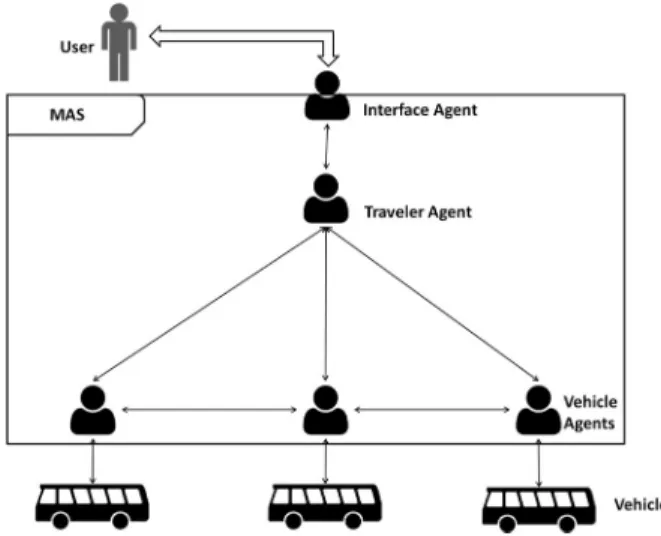
Hybrid dispatching is a compromise between the centralized and decentralized approach. In the hybrid approaches (see Figure 3), the travel-er agent acts as a dispatchtravel-er. The traveltravel-er agent disseminates the request, collects the insertion prices of the vehicle agents and chooses the one who proposes the minimum price.
Figure 3. Hybrid dispatching protocol.
The hybrid approach applies the following pro-tocol. A new human user provides the interface agent with the information about his transport request. The interface agent creates a traveler agent who represents him. Then, the new trav-eler agent sends a message to all the vehicles in the system. Each vehicle agent checks if he can insert the traveler in his route. The vehicle agent then sends his insertion price to the travel-er agent. The traveltravel-er agent collects the answtravel-ers from the vehicles and chooses the vehicle that brid protocol the work is split between travelers
and vehicles. Our objective is to verify which dispatching protocol is the most effective, in terms of response time to travelers' requests. The comparison of the different protocols does not take into account the traditional optimiza-tion criteria (number of vehicles mobilized and total costs incurred). Indeed, in terms of optimi-zation, the three dispatching protocols follow the same algorithm and use the same insertion price (described in the next section). The only difference concerns the response time, i.e. the time that takes the system to decide which vehi-cle will visit the traveler. The three dispatching protocols are described in the following subsec-tions.
3.1. Centralized Dispatching Protocol
In the centralized protocol, all processing is performed by a central entity which creates the vehicle routes. One of the main advantages of this protocol is that it allows online optimiza-tion techniques to be used in a centralized fash-ion. Online optimization (e.g. in [19]) provides benefits of the exact optimization techniques while also reducing response times. The princi-ple is to discretize the processing time into time intervals. During each interval, an optimization is carried out with known travelers. New travel-ers are queued up, waiting for the next interval. Known travelers who could not be served and new travelers are submitted for the new optimi-zation round.
Our objective is to maintain the same resolu-tion approach while comparing response times; the centralized approach therefore mimics the same insertion heuristic as the other two dis-patching protocols. In our proposal (see Figure 1), all travelers' requests are processed by the same planner agent. The planner agent has all the necessary information on each vehicle and traveler, as well as their current status. With this information, it places the current traveler in the position incurring the minimum marginal cost. The scenario is as follows. A user appears and an interface agent creates a traveler agent to represent him. The traveler immediately sends a request to the planner agent, who tries to insert it into the route of each vehicle in the system, in all possible positions. To do so, it sequentially performs, for each vehicle, a procedure for cal-culating the insertion price of the vehicle, and chooses the vehicle and the insertion position with the minimum price. If no vehicle can in-sert the traveler, a new vehicle agent is created, with an empty route, and the traveler is inserted in the only possible position. Finally, the plan-ner informs the traveler and the vehicle of the outcome of the procedure. Vehicle agents in the centralized dispatching protocol do not perform any calculations and only acknowledge the up-dates in their routes, decided by the planner agent.
Centralized dispatching has two main disad-vantages. On the one hand, it is not possible to distribute the execution over several calcu-lation units in order to limit the system's
sponse time, which is the main concern in the online VRPTW. On the other hand, a failure of the planner would result in a complete system failure. Nevertheless, the centralized dispatch-ing protocol has the advantage of minimizdispatch-ing communications between the agents, which are limited to the notification of the travelers and vehicles of the computation outcome. The num-ber of messages is N(1 + V), with N being the number of travelers and V being the number of vehicles.
3.2. Decentralized Dispatching
Decentralized dispatching is illustrated in Fig-ure 2. Following this protocol, there is no bot-tleneck for route calculation. Following the principle of the greedy insertion heuristic, each vehicle agent tries to insert the new traveler in his route, and proposes an insertion price, cor-responding to the "most economical" position where he can insert the traveler. The chosen ve-hicle will be the one with the minimum inser-tion price to transport the traveler.
In this dispatching protocol, the choice of the vehicle with the minimum price, the calculation of the price and the choice of the vehicle that will serve the traveler, are all carried out in a distributed way. Indeed, the scenario is as fol-lows. When a new traveler appears, he sends his request to all the vehicles in the system. Upon receipt of the request, each vehicle cal-culates an insertion price for him. When it has completed his calculation, each vehicle issues a message to all vehicles with his ID and price. For the processing of these messages and deter-mination of the winning agent vehicle, we pro-pose the following process. Each vehicle agent broadcasts his own calculated price to other ve-hicle agents. When he receives a new message containing a price calculated by another agent, he sorts the received offers, including his own offer, following their associated prices. When all the other vehicle agents have offered their prices, the vehicle agent checks to see which one is the winner. Then he updates his itinerary with the new inserted traveler and informs the concerned traveler agent accordingly.
This scheduling has the advantage of fully dis-tributing the processing and being fault-toler-ant. With a decentralized dispatching protocol,
the entire system is not blocked following an agent's failure, as it would be the case with the centralized dispatching. In this protocol, for each new traveler, vehicles must cooperate to choose the one that is most appropriate to serve him. However, the number of exchanged mes-sages could increase considerably, which is usually the price to pay for a processing dis-tribution. The number of messages exchanged between vehicles with this dispatching pro-tocol is equal to N × V2. The overall number
of messages between all the agents is equal to
N (1 + V (1 + V)).
3.3. Hybrid Dispatching
Hybrid dispatching is a compromise between the centralized and decentralized approach. In the hybrid approaches (see Figure 3), the travel-er agent acts as a dispatchtravel-er. The traveltravel-er agent disseminates the request, collects the insertion prices of the vehicle agents and chooses the one who proposes the minimum price.
Figure 3. Hybrid dispatching protocol.
The hybrid approach applies the following pro-tocol. A new human user provides the interface agent with the information about his transport request. The interface agent creates a traveler agent who represents him. Then, the new trav-eler agent sends a message to all the vehicles in the system. Each vehicle agent checks if he can insert the traveler in his route. The vehicle agent then sends his insertion price to the travel-er agent. The traveltravel-er agent collects the answtravel-ers from the vehicles and chooses the vehicle that brid protocol the work is split between travelers
and vehicles. Our objective is to verify which dispatching protocol is the most effective, in terms of response time to travelers' requests. The comparison of the different protocols does not take into account the traditional optimiza-tion criteria (number of vehicles mobilized and total costs incurred). Indeed, in terms of optimi-zation, the three dispatching protocols follow the same algorithm and use the same insertion price (described in the next section). The only difference concerns the response time, i.e. the time that takes the system to decide which vehi-cle will visit the traveler. The three dispatching protocols are described in the following subsec-tions.
3.1. Centralized Dispatching Protocol
In the centralized protocol, all processing is performed by a central entity which creates the vehicle routes. One of the main advantages of this protocol is that it allows online optimiza-tion techniques to be used in a centralized fash-ion. Online optimization (e.g. in [19]) provides benefits of the exact optimization techniques while also reducing response times. The princi-ple is to discretize the processing time into time intervals. During each interval, an optimization is carried out with known travelers. New travel-ers are queued up, waiting for the next interval. Known travelers who could not be served and new travelers are submitted for the new optimi-zation round.
Our objective is to maintain the same resolu-tion approach while comparing response times; the centralized approach therefore mimics the same insertion heuristic as the other two dis-patching protocols. In our proposal (see Figure 1), all travelers' requests are processed by the same planner agent. The planner agent has all the necessary information on each vehicle and traveler, as well as their current status. With this information, it places the current traveler in the position incurring the minimum marginal cost. The scenario is as follows. A user appears and an interface agent creates a traveler agent to represent him. The traveler immediately sends a request to the planner agent, who tries to insert it into the route of each vehicle in the system, in all possible positions. To do so, it sequentially performs, for each vehicle, a procedure for cal-culating the insertion price of the vehicle, and chooses the vehicle and the insertion position with the minimum price. If no vehicle can in-sert the traveler, a new vehicle agent is created, with an empty route, and the traveler is inserted in the only possible position. Finally, the plan-ner informs the traveler and the vehicle of the outcome of the procedure. Vehicle agents in the centralized dispatching protocol do not perform any calculations and only acknowledge the up-dates in their routes, decided by the planner agent.
Centralized dispatching has two main disad-vantages. On the one hand, it is not possible to distribute the execution over several calcu-lation units in order to limit the system's
to wait until e). More precisely, the current time
t, plus the travel time between the depot and n
has to be less than or equal to l. Starting from this observation, we define the action zone of a vehicle agent as the set of pairs <n, t> of the space-time network that remain valid given his current route (n can be visited by the vehicle at
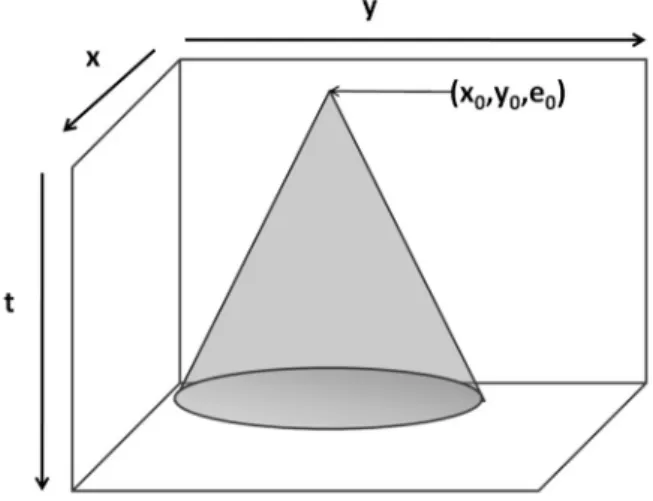
t). The action zone of a vehicle agent with an empty route is illustrated by the conic shadow in Figure 5.
When a vehicle agent inserts a traveler in his route, his action zone is recomputed, since some
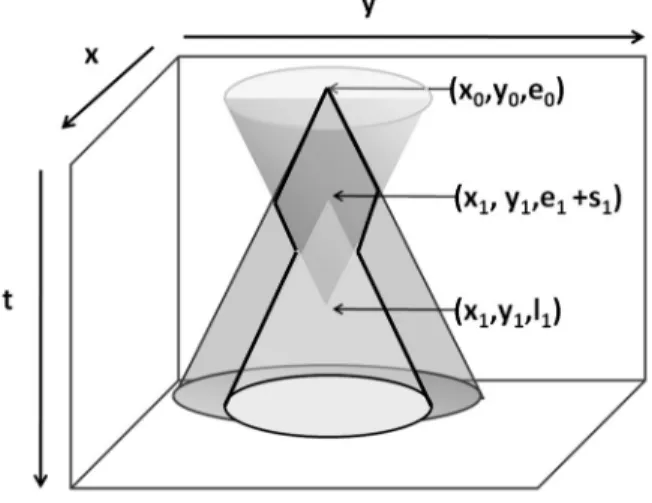
<node, time> pairs become not feasible. In Fig-ure 6, a new traveler is inserted in the route of the vehicle. The action zone of the vehicle agent after inserting the traveler is represented by the interior of the contour of the bold lines which represent the space-time nodes that remain fea-sible after the insertion of the traveler.
Figure 6. Action zone after the insertion of a traveler.
The insertion price sent from a vehicle agent
v to a traveler agent c corresponds to the hy-pothetical decrease of the action zone of v fol-lowing the insertion of c in his route, i.e. the number of space-time nodes that would not be feasible anymore.
The idea is that the chosen vehicle for the inser-tion of a traveler is the one that maintains the maximum chance to be candidate for the inser-tion of future travelers. Thus, the criterion that is maximized by the society of vehicle agents is the sum of their action zones, i.e. the capacity of the MAS to react to the appearance of travel-er agents, without mobilizing new vehicles. To illustrate the action zones and their dynam-ics, we present the version of the measure that is related to a Euclidean problem, i.e. where travel times are computed following the Euclid-ean metric. The following paragraphs detail the measure as well as its dynamics.
4.3. The Computation of Action Zones
In the Euclidean case, the transportation net-work is a plane, and the travel times between two points i (described by (xi, yi)) and j (described by (xj, yj)) is equal to
(
) (
)
2 2
i j i j
x x− + y y− .
Therefore, if a vehicle is in i at the mo-ment ti, it cannot be in j earlier than ti+
(
) (
2)
2i j i j
x x− + y y− .
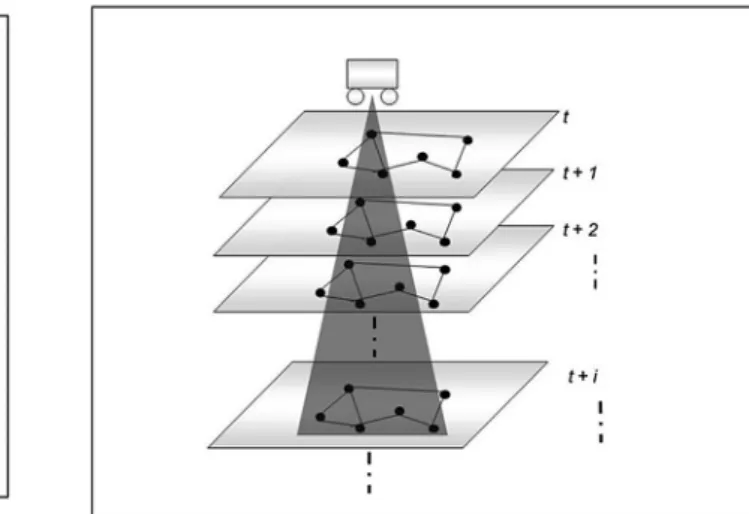
Figure 4. Space-time network. Figure 5. Initial space-time action zone. offers the minimum price. Once he has chosen
the best vehicle that can serve him (if there is at least one that can insert the traveler), he issues a new message to the vehicles to inform them of his decision and asks the winning vehicle agent to insert him in his route and subsequently serve him. When the vehicle agent receives the trav-eler's message informing him that he is the win-ner, he updates his route and inserts the traveler. Thus, the objective of the hybrid approach is to relax the planner of all calculations, and to limit the communication between vehicles. The total number of messages in the hybrid dispatching protocol is equal to 3VN.
In the three dispatching protocols presented in this section, the planner agent, or vehicle agent, calculates a price for the insertion of a given traveler. The price calculation is the same for all three protocols. It is an original measure and can be qualified as a kind of regret heuristic that tries to overcome the disadvantages of tra-ditional insertion price measures. The heuristic is described in the following section.
4. Space-Time Regret Insertion
Heuristic
In the heuristics and multi-agent methods re-ferred to in the literature, the hierarchical ob-jective of minimizing the number of mobilized vehicles is considered as priority w.r.t the gen-eral costs (including the distance traveled by all the vehicles). A majority of the literature heu-ristics are, as a consequence, based on a two-phase approach: minimization of the number of vehicles followed by the minimization of the traveled distance [20]. The model that we propose in this section has the objective of min-imizing the number of used vehicles in priority, while keeping the use of a ''pure'' insertion heu-ristics, i.e. without any further improvements to meet response time requirements. To this end, our heuristic encourages the vehicle agents to cover a maximal space-time area of the trans-portation network, avoiding the mobilization of a new vehicle if a new traveler appears in an uncovered zone.
A space-time pair <i, t> – with i being a node and t being a time – is said to be ''covered'' by a vehicle agent v if v can be in i at t. The set of
space-time nodes that are covered by the vehicle agent is called ''action zone of the vehicle''. In the context of the online VRPTW, the maximization of the vehicle agents' action zones gives them the maximum chance to satisfy the demand of a future (unknown) traveler. Through the model-ing of vehicle agents' space-time action zones, we propose a new method to compute the travel-er's insertion price in the route of a vehicle. This proposal is a kind of regret insertion heuristic. Regret insertion heuristics, instead of choosing the vehicle that has the minimal marginal cost, choose the vehicle and the traveler with the larg-est ''regret''. The regret is a measure of the po-tential price to be paid if a given traveler were not immediately inserted in the route of a given vehicle. There are several methods to compute the regret, such as the the sum of the differences between all the available prices and the mini-mum price (cf. [21] for instance).
4.1. Environment Modeling
Provided the network spatial graph G, we build the MAS environment in the form of a space-time network, inferred from the spatial graph. For each node of the graph we create pairs
<space, time>, each representing the ''state'' of
a node at a discrete time period. The space-time network is made of several spatial subgraphs. Each subgraph is a copy of G and corresponds to the state of the G at a certain period of time (cf. Figure 4). We index the nodes of the subgraphs as follows: <0, t>, ..., <N, t>, with t∈ {1, ..., h}, where 0, ..., N are the nodes of the network and
h is the number of considered discrete time pe-riods. The total number of nodes in the space-time network is then equal to h ×N. The edges linking the nodes of a subgraph are those of the spatial graph, and the costs are the travel times.
4.2. Intuition of the Space-Time Action Zones
to wait until e). More precisely, the current time
t, plus the travel time between the depot and n
has to be less than or equal to l. Starting from this observation, we define the action zone of a vehicle agent as the set of pairs <n, t> of the space-time network that remain valid given his current route (n can be visited by the vehicle at
t). The action zone of a vehicle agent with an empty route is illustrated by the conic shadow in Figure 5.
When a vehicle agent inserts a traveler in his route, his action zone is recomputed, since some
<node, time> pairs become not feasible. In Fig-ure 6, a new traveler is inserted in the route of the vehicle. The action zone of the vehicle agent after inserting the traveler is represented by the interior of the contour of the bold lines which represent the space-time nodes that remain fea-sible after the insertion of the traveler.
Figure 6. Action zone after the insertion of a traveler.
The insertion price sent from a vehicle agent
v to a traveler agent c corresponds to the hy-pothetical decrease of the action zone of v fol-lowing the insertion of c in his route, i.e. the number of space-time nodes that would not be feasible anymore.
The idea is that the chosen vehicle for the inser-tion of a traveler is the one that maintains the maximum chance to be candidate for the inser-tion of future travelers. Thus, the criterion that is maximized by the society of vehicle agents is the sum of their action zones, i.e. the capacity of the MAS to react to the appearance of travel-er agents, without mobilizing new vehicles. To illustrate the action zones and their dynam-ics, we present the version of the measure that is related to a Euclidean problem, i.e. where travel times are computed following the Euclid-ean metric. The following paragraphs detail the measure as well as its dynamics.
4.3. The Computation of Action Zones
In the Euclidean case, the transportation net-work is a plane, and the travel times between two points i (described by (xi, yi)) and j (described by (xj, yj)) is equal to
(
) (
)
2 2
i j i j
x x− + y y− .
Therefore, if a vehicle is in i at the mo-ment ti, it cannot be in j earlier than ti+
(
) (
2)
2i j i j
x x− + y y− .
Figure 4. Space-time network. Figure 5. Initial space-time action zone. offers the minimum price. Once he has chosen
the best vehicle that can serve him (if there is at least one that can insert the traveler), he issues a new message to the vehicles to inform them of his decision and asks the winning vehicle agent to insert him in his route and subsequently serve him. When the vehicle agent receives the trav-eler's message informing him that he is the win-ner, he updates his route and inserts the traveler. Thus, the objective of the hybrid approach is to relax the planner of all calculations, and to limit the communication between vehicles. The total number of messages in the hybrid dispatching protocol is equal to 3VN.
In the three dispatching protocols presented in this section, the planner agent, or vehicle agent, calculates a price for the insertion of a given traveler. The price calculation is the same for all three protocols. It is an original measure and can be qualified as a kind of regret heuristic that tries to overcome the disadvantages of tra-ditional insertion price measures. The heuristic is described in the following section.
4. Space-Time Regret Insertion
Heuristic
In the heuristics and multi-agent methods re-ferred to in the literature, the hierarchical ob-jective of minimizing the number of mobilized vehicles is considered as priority w.r.t the gen-eral costs (including the distance traveled by all the vehicles). A majority of the literature heu-ristics are, as a consequence, based on a two-phase approach: minimization of the number of vehicles followed by the minimization of the traveled distance [20]. The model that we propose in this section has the objective of min-imizing the number of used vehicles in priority, while keeping the use of a ''pure'' insertion heu-ristics, i.e. without any further improvements to meet response time requirements. To this end, our heuristic encourages the vehicle agents to cover a maximal space-time area of the trans-portation network, avoiding the mobilization of a new vehicle if a new traveler appears in an uncovered zone.
A space-time pair <i, t> – with i being a node and t being a time – is said to be ''covered'' by a vehicle agent v if v can be in i at t. The set of
space-time nodes that are covered by the vehicle agent is called ''action zone of the vehicle''. In the context of the online VRPTW, the maximization of the vehicle agents' action zones gives them the maximum chance to satisfy the demand of a future (unknown) traveler. Through the model-ing of vehicle agents' space-time action zones, we propose a new method to compute the travel-er's insertion price in the route of a vehicle. This proposal is a kind of regret insertion heuristic. Regret insertion heuristics, instead of choosing the vehicle that has the minimal marginal cost, choose the vehicle and the traveler with the larg-est ''regret''. The regret is a measure of the po-tential price to be paid if a given traveler were not immediately inserted in the route of a given vehicle. There are several methods to compute the regret, such as the the sum of the differences between all the available prices and the mini-mum price (cf. [21] for instance).
4.1. Environment Modeling
Provided the network spatial graph G, we build the MAS environment in the form of a space-time network, inferred from the spatial graph. For each node of the graph we create pairs
<space, time>, each representing the ''state'' of
a node at a discrete time period. The space-time network is made of several spatial subgraphs. Each subgraph is a copy of G and corresponds to the state of the G at a certain period of time (cf. Figure 4). We index the nodes of the subgraphs as follows: <0, t>, ..., <N, t>, with t∈ {1, ..., h}, where 0, ..., N are the nodes of the network and
h is the number of considered discrete time pe-riods. The total number of nodes in the space-time network is then equal to h ×N. The edges linking the nodes of a subgraph are those of the spatial graph, and the costs are the travel times.
4.2. Intuition of the Space-Time Action Zones
vehicle agent is the one with the minimum loss in his space-time action zone. Therefore, the new regret heuristic encourages to choose the vehicle with the highest marginal probability to be candidate for future travelers.
Figure 8. Space-time action zone after the insertion of c1
.
4.5. Coordination of Action Zones
The objective of the space-time organization model is to allow better space-time coverage of the transportation network. This improve-ment is materialized by a minimal mobilization of vehicles when confronted with the appear-ance of new travelers. With the mechanism de-scribed above, every vehicle agent tries to max-imize his own action zone independently from the other agents. However, it would be more interesting that the agents cover the network in coordination. More precisely, for a vehicle, to lose space-time nodes that he is the only one to cover should be more costly than to lose nodes that are covered by other vehicle agents.
To this end, we associate with every node of the space-time network the list of vehicles covering it. Every vehicle notifies the space-time nodes that they are part of his action zone and every node continuously updates its list. Similarly, when the action zone of a vehicle agent loses a node, the node is notified and its list of vehicles is updated.
Now, when the insertion price of a traveler is computed, every vehicle agent starts by
deter-mining the space-time nodes that it would lose if it had to insert the new traveler. Then, it in-terrogates each of these nodes about the ''price to pay'' if it were not covering it anymore. This price is inversely proportional to the number of vehicles covering this node. More precisely, the price to pay is equal to
,
1
n t
v< >
with v<n, t> denoting the vehicle agents covering
the space-time node <n, t> and |v<n, t>| the
num-ber of such vehicles.
This method associates a higher penalty with a decision to stop covering a node that is less covered by the others. Therefore, the vehicle agents are indirectly incited to cover the whole network in a coordinated way.
5. Experiments
In this section, we provide the experimental re-sults of our simulations. First, we provide op-timization costs for the three dispatching pro-tocols, which are the same since they use the same regret heuristic. Then we compare the three dispatching protocols in terms of the re-sponse time.
Marius M. Solomon [26] has created a set of different static problems for the VRPTW. These challenging and diverse problems can be used as the benchmark examples for comparing different proposed vehicle routing methods. In Solomon's benchmarks, six different sets of problems have been defined: C1, C2, R1
,
R2, RC1 and RC2. From geographical point of view, the travelers are uniformly distribut-ed in the problems of type R, clusterdistribut-ed in the problems of type C, and a mix of travelers, uni-formly distributed and clustered, is used in the problems of type RC. The problems of type 1 have narrow time windows (very few travelers can coexist in the same vehicle's route) and the problems of type 2 have wide time windows. Finally, a constant service time is associated with each traveler, which is equal to 10 in the problems of type R and RC, and to 90 in the problems of type C. Short service times would represent a problem where the loading and un-We can compute at any time, from the currentposition of a vehicle, the set of triples (x, y, t) where it can be in the future. Indeed, consider-ing a plane with an x-axis in [xmin, xmax ] and a
y-axis in [ymin, ymax], the set of space-time posi-tions is the set of points in the cube delimited by [xmin, xmax], [ymin, ymax] and [e0, l0] (e0 and l0 are
the scheduling horizon and are the minimal and maximal values for the time windows). Consid-er a vehicle in the depot (x0, y0) at t0. The set of
points (x, y, t) that are accessible by this vehicle are described by the following inequality:
(
) (
2) (
2)
0 0 0
x x− + y y− ≤ −t t .
The (x, y, t) satisfying this inequality are those that are positioned inside the cone C
of vertex (x0, y0, t0) and with the equation
(
) (
2) (
2)
0 0 0
x x− + y y− ≤ −t t (cf. Figure 7). This cone represents the action zone of a vehi-cle agent, with an empty route, in the Euclidean case. It represents all possible space-time po-sitions that this vehicle agent is able to have in the future.
Figure 7. Initial action zone.
We use the action zone of the vehicle agents when a traveler agent has to choose between several vehicle agents for his insertion. We have to be able to compare the action zones of different vehicle agents. To do so, we propose to quantify it, by computing the volume of the cone C representing the future possible posi-tions of the vehicle:
(
)
30 0
1
( ) 3 .
Volume C = × ×π l e−
This is the quantification of the initial action zone of any new vehicle agent joining the MAS
(volume0). When a new traveler agent appears,
each vehicle agent computes his new action zone and its volume (volume1). The price that
it proposes to the traveler agent is the differ-ence between his old action zone and his new one (volume0 -volume1). The new action zone
computation is detailed in the following para-graph.
4.4. Dynamics of the Action Zones
Consider a traveler c1 (of coordinates (x1, y1)
and with a time window [e1, l1]) that joins the
system, and suppose that v is currently the only available vehicle agent which has an empty route. The agent v has to infer his new space-time action zone, i.e. the space-time nodes that it can still reach without violating the time con-straints of c1. The new action zone answers the
following questions: ''if v had to be in (x1, y1)
at l1, where would it have been before? And if
it had to be there at e1
,
where would it be after e1 + s1?'' (the service time is the time needed toload or unload the travelers). The triples (x, y, t) where the vehicle agent can be before visiting
c1 are described by the inequality (3), and the
triples (x, y, t) where it can be after visiting c1
are described by the inequality (4).
(
) (
2) (
2)
1 1 1
x x− − y y− ≤ l t− (3)
(
) (
2)
2(
)
1 1 1 1
x x− − y y− ≤ −t e s+ (4)
The new action zone is illustrated by Figure 8: the new measure consists of the volume of the intersection of the initial cone C with the union of the two new cones described by the inequal-ities (3) and (4) (denoted respectively by C1
and C2). The new measure of the action zone
is equal to the volume of the intersection of C
with the union of C1 and C2.
vehicle agent is the one with the minimum loss in his space-time action zone. Therefore, the new regret heuristic encourages to choose the vehicle with the highest marginal probability to be candidate for future travelers.
Figure 8. Space-time action zone after the insertion of c1
.
4.5. Coordination of Action Zones
The objective of the space-time organization model is to allow better space-time coverage of the transportation network. This improve-ment is materialized by a minimal mobilization of vehicles when confronted with the appear-ance of new travelers. With the mechanism de-scribed above, every vehicle agent tries to max-imize his own action zone independently from the other agents. However, it would be more interesting that the agents cover the network in coordination. More precisely, for a vehicle, to lose space-time nodes that he is the only one to cover should be more costly than to lose nodes that are covered by other vehicle agents.
To this end, we associate with every node of the space-time network the list of vehicles covering it. Every vehicle notifies the space-time nodes that they are part of his action zone and every node continuously updates its list. Similarly, when the action zone of a vehicle agent loses a node, the node is notified and its list of vehicles is updated.
Now, when the insertion price of a traveler is computed, every vehicle agent starts by
deter-mining the space-time nodes that it would lose if it had to insert the new traveler. Then, it in-terrogates each of these nodes about the ''price to pay'' if it were not covering it anymore. This price is inversely proportional to the number of vehicles covering this node. More precisely, the price to pay is equal to
,
1
n t
v< >
with v<n, t> denoting the vehicle agents covering
the space-time node <n, t> and |v<n, t>| the
num-ber of such vehicles.
This method associates a higher penalty with a decision to stop covering a node that is less covered by the others. Therefore, the vehicle agents are indirectly incited to cover the whole network in a coordinated way.
5. Experiments
In this section, we provide the experimental re-sults of our simulations. First, we provide op-timization costs for the three dispatching pro-tocols, which are the same since they use the same regret heuristic. Then we compare the three dispatching protocols in terms of the re-sponse time.
Marius M. Solomon [26] has created a set of different static problems for the VRPTW. These challenging and diverse problems can be used as the benchmark examples for comparing different proposed vehicle routing methods. In Solomon's benchmarks, six different sets of problems have been defined: C1, C2, R1
,
R2, RC1 and RC2. From geographical point of view, the travelers are uniformly distribut-ed in the problems of type R, clusterdistribut-ed in the problems of type C, and a mix of travelers, uni-formly distributed and clustered, is used in the problems of type RC. The problems of type 1 have narrow time windows (very few travelers can coexist in the same vehicle's route) and the problems of type 2 have wide time windows. Finally, a constant service time is associated with each traveler, which is equal to 10 in the problems of type R and RC, and to 90 in the problems of type C. Short service times would represent a problem where the loading and un-We can compute at any time, from the currentposition of a vehicle, the set of triples (x, y, t) where it can be in the future. Indeed, consider-ing a plane with an x-axis in [xmin, xmax ] and a
y-axis in [ymin, ymax], the set of space-time posi-tions is the set of points in the cube delimited by [xmin, xmax], [ymin, ymax] and [e0, l0] (e0 and l0 are
the scheduling horizon and are the minimal and maximal values for the time windows). Consid-er a vehicle in the depot (x0, y0) at t0. The set of
points (x, y, t) that are accessible by this vehicle are described by the following inequality:
(
) (
2) (
2)
0 0 0
x x− + y y− ≤ −t t .
The (x, y, t) satisfying this inequality are those that are positioned inside the cone C
of vertex (x0, y0, t0) and with the equation
(
) (
2) (
2)
0 0 0
x x− + y y− ≤ −t t (cf. Figure 7). This cone represents the action zone of a vehi-cle agent, with an empty route, in the Euclidean case. It represents all possible space-time po-sitions that this vehicle agent is able to have in the future.
Figure 7. Initial action zone.
We use the action zone of the vehicle agents when a traveler agent has to choose between several vehicle agents for his insertion. We have to be able to compare the action zones of different vehicle agents. To do so, we propose to quantify it, by computing the volume of the cone C representing the future possible posi-tions of the vehicle:
(
)
30 0
1
( ) 3 .
Volume C = × ×π l e−
This is the quantification of the initial action zone of any new vehicle agent joining the MAS
(volume0). When a new traveler agent appears,
each vehicle agent computes his new action zone and its volume (volume1). The price that
it proposes to the traveler agent is the differ-ence between his old action zone and his new one (volume0 -volume1). The new action zone
computation is detailed in the following para-graph.
4.4. Dynamics of the Action Zones
Consider a traveler c1 (of coordinates (x1, y1)
and with a time window [e1, l1]) that joins the
system, and suppose that v is currently the only available vehicle agent which has an empty route. The agent v has to infer his new space-time action zone, i.e. the space-time nodes that it can still reach without violating the time con-straints of c1. The new action zone answers the
following questions: ''if v had to be in (x1, y1)
at l1, where would it have been before? And if
it had to be there at e1
,
where would it be after e1 + s1?'' (the service time is the time needed toload or unload the travelers). The triples (x, y, t) where the vehicle agent can be before visiting
c1 are described by the inequality (3), and the
triples (x, y, t) where it can be after visiting c1
are described by the inequality (4).
(
) (
2) (
2)
1 1 1
x x− − y y− ≤ l t− (3)
(
) (
2)
2(
)
1 1 1 1
x x− − y y− ≤ −t e s+ (4)
The new action zone is illustrated by Figure 8: the new measure consists of the volume of the intersection of the initial cone C with the union of the two new cones described by the inequal-ities (3) and (4) (denoted respectively by C1
and C2). The new measure of the action zone
is equal to the volume of the intersection of C
with the union of C1 and C2.
92 < 107, 53 < 60, 150 < 181, 108 < 121). The average improvement of the space-time mod-el compared to the classic modmod-el is 13.26%. These results validate the intuition of the mod-el, which implies maximizing the future inser-tion possibilities for a vehicle agent.
Once this result has been validated, it is inter-esting to check the results with respect to the total distance traveled by all the vehicles. Ta-ble 2 summarizes the results1. With respect to
this criterion, the space-time model is more efficient for two problem classes (C1 25 trav-elers and R1 100 travtrav-elers), with 1.80% im-provement on average. It is less efficient for four problem classes (R1 25 travelers, R1 50 travelers, C1 50 travelers and C1 100 travelers), with 1.39% improvement for the classic model. The fact remains that our results provide better results than the traditional heuristic, provided that the primary objective of the problem is to minimize the number of vehicles mobilized by the system.
Table 2. Results summary (Criterion: Total Traveled Distance).
Problem/Method Δ Distance Δ Space-Time
R1 25 travelers 6372 6561 C1 25 travelers 3167 3152 R1 50 travelers 12036 12089 C1 50 travelers 6712 7093 R1 100 travelers 17907 17348 C1 100 travelers 16011 16512
The two following subsections provide the re-sults in terms of response time for the three dis-patching protocols.
5.2. Sequential Implementation Experiments
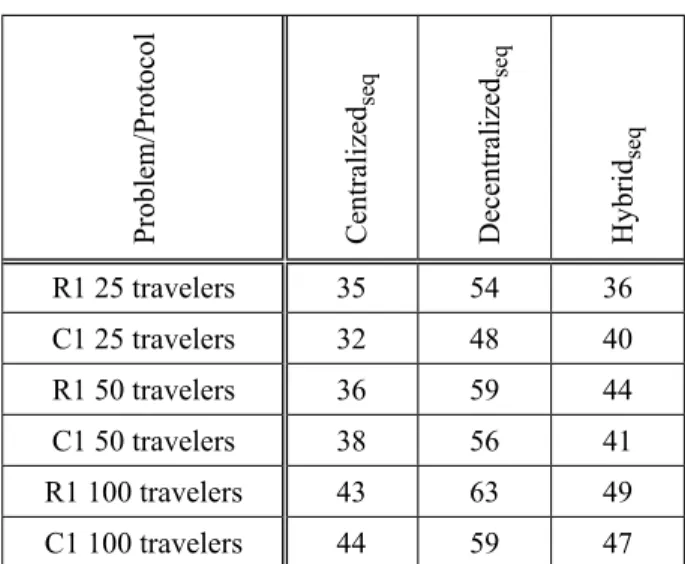
Table 3 provides the values in terms of aver-age response times (in milliseconds) of every dispatching protocols in the centralized imple-mentation. The response time for a traveler is the difference between the moment when the traveler agent is created and the moment when a vehicle is chosen by the traveler. The
central-ized protocol provides the best results (32.80% improvement, in average, compared to the dis-tributed protocol), followed by the hybrid proto-col (24.13% improvement, in average) and the decentralized protocol. This is due to the fact that the centralized approach does not generate communication between agents and does not assume any concurrency management. The hy-brid approach provides results that are close to the centralized dispatching protocol. However, it provides results of worse quality for two rea-sons. On the one side, it generates more messag-es (linear with the number of vehiclmessag-es) between the traveler agent and the vehicle agents. On the other side, the management of concurrent pro-cesses of the vehicles and travelers, and the fact that their contexts have to be restored every time the scheduler executes them, increases the ex-hibited response times for the travelers. Finally, the decentralized approach suffers from the two drawbacks: it generates a quadratic number of messages and it uses pseudo-parallelism which slows down the processing.
Table 3. Sequential implementation (average response time (ms)).
Problem/Protocol Centralized
seq
Decentralized
seq
Hybrid
seq
R1 25 travelers 35 54 36 C1 25 travelers 32 48 40 R1 50 travelers 36 59 44 C1 50 travelers 38 56 41 R1 100 travelers 43 63 49 C1 100 travelers 44 59 47
However, this round of experiments was ex-ecuted on a single computer, therefore these results are not fair towards the decentralized dispatching strategy, and to a lesser extent, to-wards the hybrid approach. Indeed, to use the full capacity of these protocols, we have to exe-cute our simulations on a mini-cloud.
1In Solomon's benchmarks, there is no unit associated with the distances.
loading of the transported entities is fast (trans-port of persons for instance). In every problem set, there are between 8 and 12 files, each con-taining 100 travelers.
We choose to use Solomon's benchmarks, while following the modification proposed by [22] to make the problem dynamic. To this end, let [0, T] be the simulation time. All the time relat-ed data (time windows, service times and travel times) are multiplied by
0 0
T
l e− , with [e0, l0] being the scheduling horizon of the problem. The authors divide the travelers set in two sub-sets, the first subset defines the travelers that are known in advance, and the second one the travelers who appear during execution. We do not make this distinction, since we consider no travelers known in advance. For each traveler, an occurrence time is associated, defining the moment when the traveler is recognised by the system. Given a traveler i, the occurrence time that is associated is generated randomly be-tween
[
0,ei]
, with:0 0
i i T
e e l e= × − . (6)
It is known that the behavior of insertion heu-ristics is strongly sensitive to the appearance order of the travelers to the system. For this reason, we do not consider only one appearance order. We launch the process that we have just described ten times with every problem file, this way creating ten different versions of every problem file.
Figure 9. Sequential implementation (left) and distributed implementation (right).
We have implemented all the systems using the multi-agent Java-based platform Repast
Sim-phony [23]. We have executed our experiments on a PC with an Intel Xeon E7-4820 processor, and 50 GB of RAM for the sequential versions, and a four PC network for the distributed ver-sions, each with the same configuration (Intel Xeon E7-4820 processor, and 50 GB of RAM). Cf. Figure 9.
5.1. Optimization Cost
We have implemented two MAS with almost the same behavior, following the hybrid dis-patching protocol. The only difference concerns the measure used by vehicle agents to compute the insertion price of a traveler. For the first im-plemented MAS, it relies on the Solomon mea-sure (noted Δ Distance). The second relies on the space-time model (noted Δ Space-Time). We choose to run our experiments with the prob-lems of class R and C, of type 1, which are the instances that are very constrained in time (nar-row time windows). Recall that the objective of the problem is to minimize costs, materialized by a minimal number of mobilized vehicles, and then a minimal total traveled distance.
Table 1. Results summary (Criterion: Fleet Size).
Problem/Method Δ Distance Δ Space-Time
R1 25 travelers 64 53 C1 25 travelers 34 31 R1 50 travelers 107 92 C1 50 travelers 60 53 R1 100 travelers 181 150 C1 100 travelers 121 108