A Data Model and an XQuery Extension for Concurrent XML Structures
Emmanuel Bruno and Elisabeth Murisasco LSIS - UMR CNRS 6168
Université du Sud Toulon-Var, BP 20132 83957 La Garde Cedex, France
E-mail:{bruno,murisasco}@univ-tln.fr
Keywords:multistructure, concurrent hierarchy, textual document, tree-like structure, XML data model, XQuery
Received:March 13, 2009
An XML document is mainly hierarhical, but some applications need to simultaneously associate more than one hierarchy to the same data. In general, concurrent hierarchies cannot be merged in order to get a well-formed XML document. This work stands in this context: it aims at describing and querying hierarchical XML structures defined over the same textual data in a concurrent way. Our proposal called MSXD is composed of a data model (which can be seen as an index over the data and between all the structures) and a dedicated query language defined as an extension of XQuery. The key idea is to propose a method for a compact description of multiple tree-like structures over a single text based on segmentation. Segmentation encoding allows querying overlap/containment relations of markups belonging to different structures. This paper also tackles a solution to define a multistructured schema in order to describe the relationships (as weak constraints) between parts of concurrent structures. Finally, this paper focuses on the architecture of the XML environment implementing our proposals.
Povzetek: Sistem omogoˇca uveljavljanje veˇc hierarhij v dokumentih XML.
1
Motivation
XML [10] is thede facto standard to describe structured data. Several applications in the context of information systems are based on their use: electronic publishing, language engineering, technical documentation, digital li-braries, Web, etc.
XML documents are mainly hierarchical. The hierar-chy, captured in a tree-like structure [23], corresponds to one level of analysis of the data contained in the document (e.ga logical analysis). A large set of tools are now avail-able and widely used in particular for edition, querying (XPath [16], XQuery [7]) or transformation (XSLT [15]). According to us, this success is due to the hierarchical structure which is easier to exploit compared to the graph structure. Moreover, manipulation remains simple in an XML environment.
Recently, the title of an article published in the SIG-MOD conference [27] claims that “ One hierarchy is not enough ” for data-centric application context. Indeed, the CONCUR feature of SGML [24] first pointed out this need in the nineties but in context of document-centric encoding where some applications need to consider more than one hierarchy over the same text in a concurrent way. These last years, several other works about concurrent markups have been published [31, 30, 32, 22, 33, 19, 25, 14, 21]. All these different works propose solutions to describe multi-ple tree-like structures (with overlapping) into a single doc-ument. The main problem with concurrent hierarchies is that they cannot be merged in order to get a well-formed
XML document without using a flat representation or hy-perlinks that make the structure difficult to query.
Our work stands in this context. It aims at representing and querying concurrent hierarchical XML structures de-fined over the same textual data. We call such data “ mul-tistructured textual documents ”. The key idea is to pro-pose a method for a compact description of multiple trees over a single text based on its segmentation. Segmentation encoding allows querying overlap/containment relations of markups belonging to different structures. The solution proposed, called MSXD for MultiStructured XML Docu-ments1, is entirely XML compatible.
This paper describes on the first hand the MSXD model and its relative query language, and on the other hand, it details the way these proposals are implemented under an XML environment. We also tackle the description of rela-tionships between structures (as weak constraints) in order to propose a solution to define a multistructured schema enabling validation across multiple hierarchies [20].
This paper is an extended version of different prelimi-nary contributions ( [11], [12] and [13]).
1.1
A running example
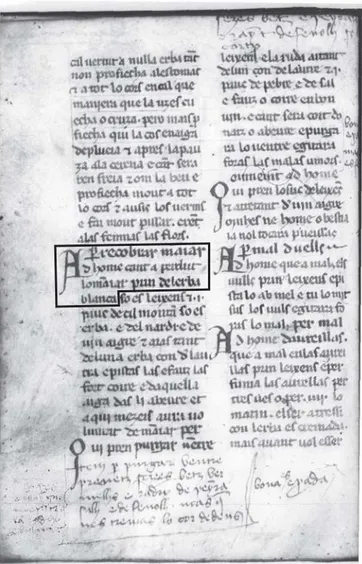
To illustrate the problem, we consider a mediæval manuscript (Princeton, Garrett 80 (PG)) related to medico-pharmaceutical recipes written in Occitan language [8]. This kind of text is studied by philologists of the University
of Pisa (Italy) in the Department of Language and Romance Literature. Philology is a science that studies ancient or mediæval civilizations by the mean of literary documents.
Researchers are interested in studying the text of the manuscript according to different points of view corre-sponding to different uses of the document. Each analysis results in a mainly hierarchical markup of the text which could be easily represented in XML.
From the document represented as an image (see Fig-ure 1), for illustrating our intention, we have extracted the following textual content:
... Per recobrar maniar Ad home cant a perdut lo maniar prin de l erba blanca ...
This same text has been segmented and marked up in three ways: itsphysicalstructureS1 (the manuscript is or-ganized into pages, on two columns composed of lines), its syntacticstructureS2 (the manuscript is composed of sentences and words) and its semantic structureS3 (the manuscript describes medical prescriptions which have signs, ingredients, plants and effects). The result is shown in Figure 2 where three XML documents hierarchically organize the same text according to these three different points of views.
Each structure marks up the text differently from an-other (see Figure 3). For example the segment of text‘Ad home cant a perdut lo maniar’ is tagged by Sign in S3, while it is tagged differently in S1: ‘Ad home cant a perdut’is marked byLinewhereas ‘lo maniar’ begins another textual segment marked also byLine. Moreover notice that aSigncan overlap two lines. Therefore, these documents are independent with potential overlapping.
Structures (but not the relations between them) could be defined by means of a grammar like a DTD, an XML schema [6] or a RelaxNG schema [17].
These XML documents are currently considered sep-arately even if researchers identify correlations between them. In particular, they would like to be able to express the following queries: What are the sentences that follow the signs? (this query combines syntactic and semantic structures); What is the prescription that contains the larger number of lines? (this query combines physical and seman-tic structures); What are the words cut by an end of line? (this query combines physical and syntactic structures).
Usual XML manipulation languages do not support con-current structures, thus our issue is (1) to model multiple hierarchical structures in order to query them in a concur-rent way and (2) to provide an XML environment to sup-port multistructured documents.
Finally, notice that the relationship (eventually weak) be-tween parts of these three structures are not defined: for example, one can remark that a page (in the physical struc-ture) always begins with a prescription (in the semantic structure). It could be useful to use this kind of constraint during querying and to check consistency between struc-tures. We tackle this issue by defining a schema to describe the relationships between parts of the concurrent structures.
1.2
Objectives
Our objectives are the following:
A suitable – XML compatible – data model. This model dedicated to multistructured textual documents is called MSXD. It enables (1) to consider several segmen-tations of the same text, and (2) to define a hierarchical structure for each of these segmentations. Notice that the structures could be weakly coupled and that there is no main structure. The set of segmentations and the set of hierarchical structures are deduced automatically from the given XML structured documents (for example produced by philologists). That is why they could be developed in a distributed way. The replication of the common text (in each XML document) can be seen as a drawback but (i) the data storage according to the volume is not really a prob-lem, and (ii) synchronisation is not an issue because the common text is never updated: the only changing part (the structure) is not replicated. Moreover, each user can then edit its own copy offline. This data model is based on the use of hedges [28], the foundation of grammar language RelaxNG [17] (REgular LAnguage description for XML New Generation);
An extension of XQuery [7]. Our objective is to query the structures and the textual content in a concurrent way and to use an as much as possible unchanged XQuery. One of the original contribution of our proposal is that the Mul-tiStructured document is never instantiated. As we said be-fore, the set of structures can be syntactically described as a distributed set of XML documents: we want to keep each structure safe to use available XML tools and languages for its construction and its manipulation. Given a set of XML documents over the same textual value, a MSXD instance can be seen as an index over the textual value and between all the structures. This index is used to evaluate queries using concurrent structures;
The description of relationships between structures. We propose a solution to define a multistructured schema in order to describe the relationships (as weak constraints) between parts of the concurrent structures. This is done as a set of rules by means of Allen’s relations to constrain the relative position of fragments in the structures. This work is a first step towards validation across multiple hier-archies [20].
Figure 1: A page from the manuscript
2
The MSXD model
We first choose to define the notion of a multistructured document and then to introduce all the concepts used in this definition. We illustrate the MSXD model with our running example. Our data model is based on the use of hedges (the foundation of RelaxNG). Informally, a hedge is a sequence of trees. In the XML terminology, a hedge is a sequence of elements possibly intervened by character data; in particular, an XML document is a hedge [28].
2.1
Formal model definition
Definition 1. A Multistructured document is a triplet (V,I,S)where V is a textual value, I a set of segmentations of V and S a set of structures associated to segmentations from I.
A multistructured document can be seen as a textual value augmented with different hierarchical structures de-fined over it. These structures share the same text but con-cern (in general) different strings extracted from that text.
Definition 2. A segmentation of the textual value V of
length l is a list XV of strings such that XV ={xi|xi= V[bi..ei] and b0=0 and ei≥bi and bi=ei−1+1 and e|Xv|−1=l−1}, biand eiare respectively the start and the end positions of the fragment in V . We define two functions for each XV[i], start(XV[i]) =biand end(XV[i]) =ei. The set XV makes a total partition of the textual value V .
For our example, V is the text extracted from the manuscript (“...Per recobrar maniar Ad home cant a perdut lo maniar prin de l erba blanca...”) and we
con-sider three segmentationsXV1,XV2andXV3(corresponding to the set of textual contents of the XML elements from each structure S1, S2 and S3, see Figure 2):
– X1
V =x11...∪...x14, with in particular x11 = "Per recobrar maniar"andx14="blanca...",
– XV2=x21...∪...x215, with in particularx21="Per"and x215="blanca",
<!-- S1 physical structure -->
<?xml version="1.0" encoding="utf-8"?> <Manuscript>...
<Page> <Column>...
<Line>Per recobrar maniar</Line> <Line>Ad home cant a perdut</Line> <Line>lo maniar prin de l erba</Line> <Line>blanca ...</Line>...
</Column> ... </Page>... </Manuscript>
<!-- S2 syntactic structure --> <?xml version="1.0" encoding="utf-8"?> <Manuscript>
<Syntax>...
<Sentence><W>Per</W><W>recobrar</W><W>maniar</W></Sentence> <Sentence><W>Ad</W> <W>home</W> <W>cant</W><W>a</W>
<W>perdut</W><W>lo</W> <W>maniar</W> <W>prin</W>
<W>de</W><W>l</W> <W>erba</W><W>blanca</W> ...</Sentence>... </Syntax>
</Manuscript>
<!-- S3 semantic structure -->
<?xml version="1.0" encoding="utf-8"?> <Manuscript>
<Prescriptions>...
<Prescription>Per recobrar maniar <Sign>Ad home cant a perdut lo maniar</Sign>prin de l <Ingredient><Plant>erba blanca</Plant>...</Ingredient></Prescription>...
</Prescriptions> </Manuscript>
Figure 2: Physical (S1), Syntactic (S2) and Semantic (S3) structures
Per recobrar maniar Ad home cant a perdut lo maniar prin de l erba blanca ...
Line Line Line Line
Sign Plant
Ingredient Figure 3: Multiple segmentations of the text
We use the concept of fragment to define structures: fragments mark up a segmentation. Fragment positions in the textual value are useful to compute their relative posi-tions.
Definition 3. A fragment f is defined over a segmentation
XV of the textual value V and an alphabetΣV, a set of la-bels:
1. f=ε(the empty fragment), start(f) =end(f) =0
2. f=viwith vi∈XV, start(f) =start(XV[i]), end(f) =end(XV[i])
3. f=v<x>with v∈ΣV and x a fragment, start(f) =start(x),
end(f) =end(x)( f is called a tree)
4. f=xy with x and y two fragments and start(y) =end(x) +1,
start(f) =start(x), end(f) =end(y).
Notice some remarks about definition 3:
– Rule 1 defines the empty fragment. Recall that we want to represent several segmentations of the same
text in order to define a hierarchical structure for each of these segmentations (producing several struc-tured documents over the same text). Using empty fragments (as milestones) is not compatible with our model because a fragment has to be related to a seg-mentation. The only legal empty fragment is the one associated with the empty document.
– Rule 3 uses the alphabetΣV, which is a set of labels for fragments having a tree-like structure corresponding to XML element names:
for the physical analysis,
Σ1
V ={Manuscript,Page,Column,Line}, for the syntactic analysis,
Σ2
V ={Manuscript,Syntax,Sentence,W}, for the semantic analysis,
Σ3
V ={Manuscript,Prescription,Ingredient, Sign,Plant}.
We now give some examples of fragments respectively constructed over segmentationsXV1andXV3:
– OverXV1(two fragments):
(1) f11=x11withx11="Per recobrar maniar", start(f11) =1,end(f11) =19 and
(2) f21 = Line < x11 >, start(f21) = start(f11), end(f21) =end(f11);
The fragment f21 is represented in XML syntax by <Line>Per recobrar maniar</Line>.
– OverXV3(three fragments):
(1) f43 = x34 with x34= "erba blanca", start(f43) =60,end(f43) =70
(2) f53 = Plant < f43 >, start(f53) = start(f43), end(f53) =end(f43)and
(3) f63=Ingredient< f53>, start(f63) =start(f53), end(f63) = 92) (we supposed that 92 is the end position of the textual fragment marked by “..." in our example);
The fragment f63is represented in XML by <Ingredient>
<Plant>erba blanca</Plant>... </Ingredient>.
Definition 4. A structure is a tree f (a labelled fragment)
over a segmentation of the textual value V , end(f) =|XV|− 1and start(f) =0.
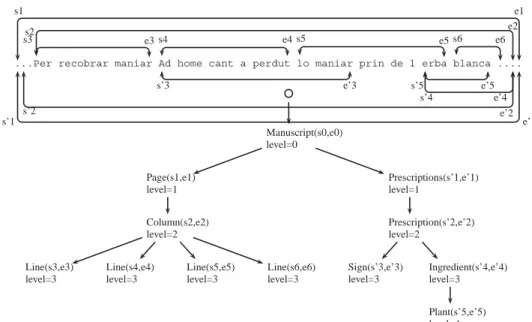
Figure 4 illustrates our model over the twoXV1andXV3 segmentations (we do not show the third segmentation to make the reading of the figure easier) and the two struc-turesS1 andS3 defined over them. The figure is composed of two parts: the first indicates the segmentations (start and end positions are associated to each textual segment inside a segmentation; for convenience the numbering of start and end positions only takes into account the segments used in our example), and the second part shows the hierarchical organization of fragments into a structure (physical struc-ture on the left, semantic strucstruc-ture on the right).
In summary, from the XML documents of Figure 2, we can extract the textV, we can deduce three structures (S1, S2 andS3) built on three segmentations (XV1,XV2andXV3). Fragments are constructed over segmentations.
2.2
Relative position of two fragments
Our model is designed so that Allen’s relations [2] can be used on fragments in order to calculate their relative posi-tion inside a segmentaposi-tion or between two segmentaposi-tions.
Definition 5. Predicates on two fragments f1and f2 are defined over one or two segmentations on the same textual value:
be f ore(f1,f2) ≡f inishes(f2,f1)
≡end(f1)<start(f2) be f ore(f1,f2,n) ≡f inishes(f2,f1,n)
≡start(f2)−end(f1) =n meets(f1,f2) ≡met-by(f2,f1)
≡end(f1) =start(f2) during(f1,f2) ≡contains(f2,f1)
≡start(f1)>start(f2) and end(f1)<end(f2) overlaps(f1,f2) ≡is-overlapped(f2,f1)
≡start(f1)<start(f2) and end(f1)>start(f2) and end(f1)<end(f2)) starts(f1,f2) ≡started-by(f2,f1)
≡start(f1) =start(f2) and end(f1)<end(f2) f inishes(f1,f2) ≡f inished-by(f2,f1)
≡end(f1) =end(f2) and start(f1)>start(f2) equals(f1,f2) ≡start(f1) =start(f2)
and end(f1) =end(f2)
Notice that if f1and f2are defined on the same segmen-tation the predicatesmeetsandoverlapsare always false.
Finally, we need to compute the level of a fragment in a structure. This level captures the parent/child relationship between two fragments in a structure.
Definition 6. Let F(s)(s is a structure) be the set of frag-ments f such that f=s or∃x∈ F(s),∃a∈ΣV|x=a<f>. The function level(s,f)returns the level of the fragment f in the structure s, it is calculated with the following algo-rithm :
– level(s,s) =0
– level(s,y) =level(s,x) +1with x=a<y> (x and y∈F(s)).
Figure 4 also shows the relative position of two frag-ments in two segmentations. In particular, the two follow-ing Allen’s predicates are true (they indicate that aPlant overlaps twoLines):
overlaps(Plant(s5,e5),Line(s5,e5)) =true overlaps(Plant(s5,e5),Line(s6,e6)) =true.
Lastly, notice that in Figure 4, we have associated to each fragment its level in the hierarchical structure to which it belongs. For example, inS1,
level(S1,Manuscript<>) =0 level(S1,Page<>) =1 level(S1,Column<>) = 2 level(S1,Line<>) = 3.
2.3
MSXD XML syntax
...Per recobrar maniar Ad home cant a perdut lo maniar prin de l erba blanca ....
s1 e1
s2 e2
s3 e3 s4 e4 s5 e5 s6 e6
s’3 e’3 s’5 e’5
s’4 e’4
s’1 e’1
s’2 e’2
Manuscript(s0,e0) level=0
Page(s1,e1) level=1
Column(s2,e2) level=2
Line(s3,e3) level=3
Line(s4,e4) level=3
Line(s5,e5) level=3
Line(s6,e6) level=3
Prescriptions(s’1,e’1) level=1
Prescription(s’2,e’2) level=2
Sign(s’3,e’3) level=3
Ingredient(s’4,e’4) level=3
Plant(s’5,e’5) level=4
Figure 4: Illustration of our model
to represent XML documents and the design of RelaxNG is based on this theory [28]. Another equivalent solution could have been to use XML Schemas.
We define an XML syntax for an MSXD instance (see Figure 6). In this figure, we refer to the textual value of the manuscript (identified by an uri), each structure (identified by an uri) and its associated schema. Notice that segmen-tations are implicit.
3
Querying MSXD instances
Our data model is close to XDM (XML Data Model)[23] used in XQuery and XPath. Recall that XDM defines unnested sequences of items (nodes or atomic values). For querying, we propose an extension of XQuery to deal with a multistructured document.
Indeed, we propose to define an XQuery item as an atomic value or a fragment (instead of a node) and then we still deal with sequences of items. Thus, the XQuery lan-guage can be adapted to query a multistructured document. A XQuery on an MSXD instance with a single structure is equivalent to the same XQuery on the XML document cor-responding to this structure. In the case of multiple struc-tures, we extend the semantics of the filters of XQuery. For that, we successively study and extend:
– The accessors defined in the XQuery Data Model (XDM) [23]. Accessors can be seen as a set of prim-itives to access an instance of the XML data model (parent,child, . . . ).
– The axis defined in XQuery [7]. Axis are an higher level access mode to instances of the XML data model. An axis can be an accessor (for instanceparent andchild) or can be based on accessors (for instance
the axisancestoris defined by the recursive applica-tion of the accessorparent).
– The normalization of an extended XQuery into a core XQuery (as defined in the XQuery Formal se-mantics [18]). To formally define the sese-mantics of XQuery, a subset of XQuery named XQuery core has been defined. Every XQuery can be expressed in the core. For instance, an XPath step is translated in a For Let Where Return(FLWR) expression. The dy-namic environment existing during the evaluation of an XQuery is explicitly defined by binding a set of standard variables in the XQuery core.
Our objective is to use an as much as possible unchanged XQuery, that is why we choose to rely on the XQuery nor-mative documents.
3.1
Extending XDM accessors and XQuery
axis
To navigate in every structure and to adapt Allen’s rela-tions, we choose to slighty modify the semantics of some accessors or operators (close to Allen’s relations). In other cases, we define new functions.
Accessors. First, to express the containment we adapt the parent/child relationship: The dm:children and dm:parent accessors have been extended to return ev-ery parent and evev-ery child of a fragment in evev-ery structure it belongs to.
Axis. As a fragment does not belong to every structure and as we want them to be as general as possible, the axis ancestor and descendant cannot be defined by applying recursively the accessors dm:parent and dm:childrenas it is done in XQuery2. Thus, we define
2http://www.w3.org/TR/xquery/
<!-- Physical Structure --> start =
element Manuscript {
element Page { element Column {
element line { text+ }+ }+ }+ }
<!-- Syntactic Structure --> start =
element Manuscript { element Page {
element Column { element line {
text+ }+ }+ }+ }
<!-- Semantic structure --> start =
element Manuscript { element Prescriptions {
element Prescription {
(text | Dosage | Effect | Ingredient | AdministrationMode
| element Sign { text } | element Concoction {
(text | Effect
| AdministrationMode
| element Action { (text | Ingredient)+ })+ })+
}+ } }
Effect = element Effet { text } Sign =
element Ingredient { (text | Dosage
| element Mineral { text } | element Plant { text })+ }
AdministrationMode = element AdministrationMode { text } Dosage = element Dosage { text }
Figure 5: Schemas for the Physical (S1), Syntactic (S2) and Semantic (S3) structures
<MsXmlDoc xmlns="http://lsis.univ-tln.fr/msxd/doc/v1/"> <TextalValue
uri="http://lsis.univ-tln.fr/msxd/value/manuscript"/> <Structure
type="http://lsis.univ-tln.fr/msxd/structure/manuscript/physical" uri="http://lsis.univ-tln.fr/msxd/instance/S1.xml"/>
<Structure
type="http://lsis.univ-tln.fr/msxd/structure/manuscript/syntactic" uri="http://lsis.univ-tln.fr/msxd/instance/S2.xml"/>
<Structure
type="http://lsis.univ-tln.fr/msxd/structure/manuscript/semantic" uri="http://lsis.univ-tln.fr/msxd/instance/S3.xml"/>
</MsXmlDoc>
two new accessors:
dmmsxd:ancestor and dmmsxd:descendant which respectively return the sequence of fragments con-taining a fragment or contained in a fragment (according to start and end positions).
Order. We need to consider Allen’s relations used to compute relative position between two fragments inside a segmentation or between two segmentations. A partial or-der on fragments in a given multistructured document can be defined on start and end positions. As in XQuery, the boolean operatorsn1<<n2, n1>>n2 andn1is n2 can be defined. They are respectively true for the fragmentsn1 andn2, ifn1is beforen2,n1 is aftern2and if n1 andn2 are the same fragment. We use the two first boolean op-erators (<<,>>) to express the following (after) and preceding (before) Allen’s relations.
New functions. We introduce each of the remaining re-lations as functions (evaluated according to the relative po-sitions of two fragments). We only give here the definition of two Allen’s relations (equalsandoverlaps) and the corresponding operators because they are used in the query examples given below. The remaining relations can be de-fined in the same way.
– the functionmsxd:is-equal(n1,n2)and the op-eratoris-equal, are true ifn1andn2have the same start and end positions in the same multistructured document,
– the function msxd:is-overlapping(n1,n2) and the operator is-overlapping, are true if start(n1)<start(n2) and end(n1) >start(n2) and end(n1)<end(n2).
3.2
Extending the dynamic evaluation
In the formal semantics of XPath and XQuery, the dynamic context is explicitly defined by binding variables. In partic-ular$fs:sequence,$fs:dot,$fs:positionand $fs:lastvariables respectively representthe sequence of context items,the context item,the context position, and the context size. The side effect of each operator is also explicit in the core XQuery.
It is necessary to extend the dynamic context to carry information about every structure associated with an MSXD instance. We extend it by binding a new vari-able$msxd:selected_structuresto a sequence of strings that represents the set of ids of the structures to be taken into account during the evaluation of the query.
In our example, when the document is loaded by default:
$msxd:selected_structures =
{"http://lsis.univ-tln.fr/msxd/instance/S1.xml", "http://lsis.univ-tln.fr/msxd/instance/S2.xml", "http://lsis.univ-tln.fr/msxd/instance/S3.xml"};
This variable can be used to restrict the set of structures. If it is set to a subset of the structures, only this subset is taken into account by the XQueries.
We need to define two basic functions to return exist-ing structures in a document and to create the instance of a document:
– msxd:structures($arg as fragment()*) as xs:string*
returns a sequence of strings which represents the ids of structures to which every fragment of the sequence $argbelongs.
– msxd:doc($uri as xs:string?) as document-node()?
retrieves the XML description of an MSXD instance using $uri and returns its document fragment $root (equivalent to fn:doc() in http: //www.w3.org/TR/xpath-functions/). This changes the dynamic context by
bind-ing $msxd:selected_structures to
msxd:structures($root), ie by default every structure of a document are consired during a query.
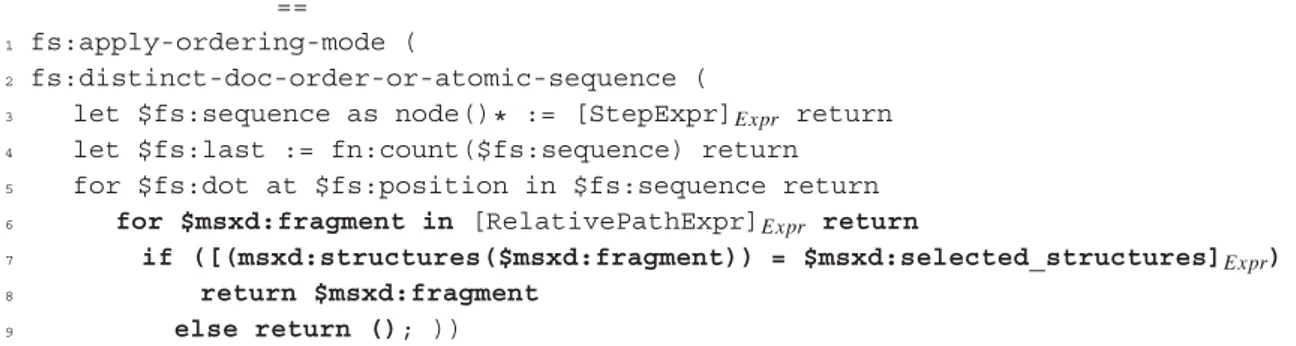
Finally, we slightly modify the normalization of a path expression in XQuery (a step followed by a relative path expression) to return only fragments of the selected struc-tures. The new rule is given in Figure 7.
The standard normalization transforms an XPath step into a FLWRexpression and it sets the dynamic environ-ment after the evaluation of the first step, and for each item of the result ($fs:sequence) the relative path is eval-uated (Lines 3,4 and 5). In our extension, we restrict the results to items from the selected structures (Lines 6, 7 and 8). Lines 1 and 2 ensure that each fragment is unique and that every fragment is sorted according to the document global order.
3.3
Query examples
We propose some queries for our running example: Prolog - Binding the multistructured document to a global variable
declare variable
$msdoc := msxd:doc("manuscript.msxd");
Q1 – Children ofManuscript
$msdoc//Manuscript/*
returns every child of the fragmentManuscriptwhich is shared by every structure (the results is the sequencePage from S1, Syntaxfrom S2 and Prescriptionsfrom S3, see Figure 2),
Q2 – FirstSentenceofPrescriptions described on
oneColumn
$msdoc//Column//Prescription//Sentence[1]
Q3 –Words cut by an end ofLine
for $v in $msdoc//Line
[StepExpr / RelativePathExpr]Expr
==
1 fs:apply-ordering-mode (
2 fs:distinct-doc-order-or-atomic-sequence (
3 let $fs:sequence as node()* := [StepExpr]Expr return
4 let $fs:last := fn:count($fs:sequence) return
5 for $fs:dot at $fs:position in $fs:sequence return
6 for $msxd:fragment in [RelativePathExpr]Expr return
7 if ([(msxd:structures($msxd:fragment)) = $msxd:selected_structures]Expr)
8 return $msxd:fragment
9 else return (); ))
Figure 7: Extended normalization of a Path expression
Q4 –Columns which areSentences
for $v in $msdoc//Sentence
return $msdoc//Column[. is-equal $v]
Q5 –Sentences containingPlant
$msdoc//Sentence[descendant::Plant]
Q6 – FirstSentenceafter aSign
$msdoc//Sign/following::Sentence[1]
Q7 – FirstSentenceafter aSign
for $h in $msdoc//Sign
return $msdoc//Sentence[. >> $h][1] is the same as Q6 but using the order operator instead of thefollowingaxis.
Q8 – Children ofManuscriptin S1
let $msxd:selected_structures :=
"http://lsis.univ-tln.fr/msxd/instance/ S1.xml"
return $msdoc/Manuscript/*
is the same as Q1 but returns only children fromS1 be-cause the variable$msxd:selected_structuresis explicitly set to the identifier ofS1.
4
A Schema for multistructured
documents
We define a schema for multistructured documents as a set of rules (vsa content model definition) because our struc-tures are weakly coupled and the multistructured docu-ment is not hierarchical. Allen’s relations (starts,overlaps, equals, . . . ) enable to constrain the relative position of fragments belonging to different structures. The constrains are expressed using XPath based predicates, we suppose that an XPath expression applied to a structurereturns a sequence of fragments.
Definition 7. A Multistructured document schema is a pair (GS,C)where GSis a set of grammars defining valid struc-tures and C={ci|ci =c(p1 in s1,p2 in s2)} is a set of constrains, where c is the name of an Allen’s predicate
and p1,p2are XPath expressions applied to the structures s1 and s2. The constrain is true if for each fragment f1 in val(p1), it exists a fragment f2 in val(p2) such that c(f1,f2) is true. A document is valid according to the schema if and only if every constrains in C are true.
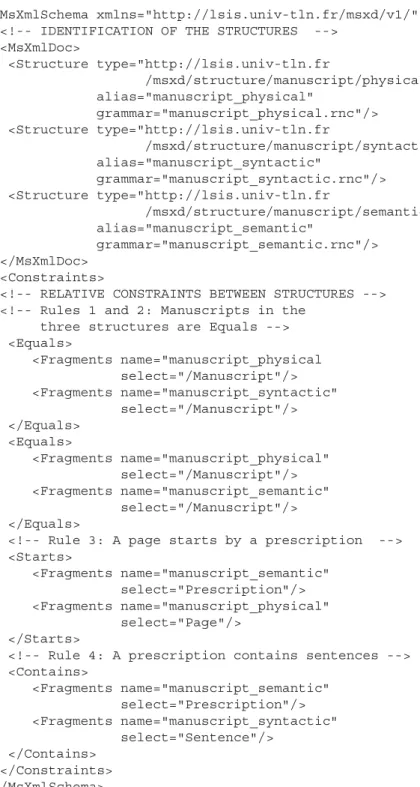
Figure 8 (see comments in the figure) shows an XML syntax for multistructured documents schemas and illus-trates some constrains between fragments of the three structures of our running example (notice that each con-strain is applied to two structures). Every concon-strain could be read in the same way, for example
– Rule 1: Root fragments of physical and syn-tactic structures are equal. Each fragment matching /Manuscript in every document valid according to the structure (whose alias is) manuscript_physicalmust beequalto at least one fragment matching /Manuscript in every document valid according to the structure (whose alias is)manuscript_syntactic;
– Rule 3: A page starts by a prescription. Each fragment matchingPagein every document valid according to the structure (whose alias is)
manuscript_physical starts by at least one fragment matchingPrescriptionin every docu-ment valid according to the structure (whose alias is) manuscript_semantic;
– Rule 4: A prescription contains sentences. Each fragment matching/Prescriptionin every doc-ument valid according to the structure (whose alias is) manuscript_semantic contains at least a fragment matching sentence in every document valid according to the structure (whose alias is) manuscript_syntactic.
<MsXmlSchema xmlns="http://lsis.univ-tln.fr/msxd/v1/">
<!-- IDENTIFICATION OF THE STRUCTURES -->
<MsXmlDoc>
<Structure type="http://lsis.univ-tln.fr
/msxd/structure/manuscript/physical" alias="manuscript_physical"
grammar="manuscript_physical.rnc"/> <Structure type="http://lsis.univ-tln.fr
/msxd/structure/manuscript/syntactic" alias="manuscript_syntactic"
grammar="manuscript_syntactic.rnc"/> <Structure type="http://lsis.univ-tln.fr
/msxd/structure/manuscript/semantic" alias="manuscript_semantic"
grammar="manuscript_semantic.rnc"/> </MsXmlDoc>
<Constraints>
<!-- RELATIVE CONSTRAINTS BETWEEN STRUCTURES --> <!-- Rules 1 and 2: Manuscripts in the
three structures are Equals --> <Equals>
<Fragments name="manuscript_physical select="/Manuscript"/> <Fragments name="manuscript_syntactic"
select="/Manuscript"/> </Equals>
<Equals>
<Fragments name="manuscript_physical" select="/Manuscript"/> <Fragments name="manuscript_semantic"
select="/Manuscript"/> </Equals>
<!-- Rule 3: A page starts by a prescription -->
<Starts>
<Fragments name="manuscript_semantic" select="Prescription"/> <Fragments name="manuscript_physical"
select="Page"/> </Starts>
<!-- Rule 4: A prescription contains sentences --> <Contains>
<Fragments name="manuscript_semantic" select="Prescription"/> <Fragments name="manuscript_syntactic"
select="Sentence"/> </Contains>
</Constraints> </MsXmlSchema>
Figure 9: MSXD functional architecture
5
Implementation of the MXSD data
model and query language
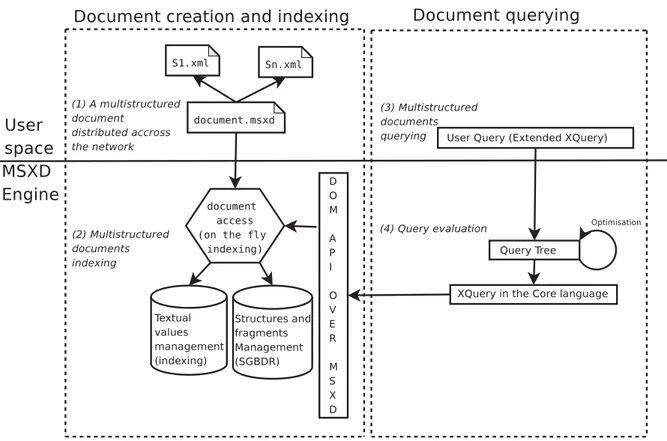
In this section, we describe the architecture of an imple-mentation of the MSXD data model and of a XQuery en-gine extended to support multistructured documents. Fig-ure 9 presents the functional architectFig-ure of our prototype and a typical use case in four steps. The figure is organized in two lines and two columns. The first line presents the user level and the second the MXSD engine level. The first column describes the design and the indexing an MSXD instance from a set of XML documents, the second column illustrates the querying.
5.1
User space: An almost usual XML
environment
The user space (parts 1 and 3 in Figure 9) is close to an usual XML environment. First, each user can describe its structures in XML documents which mark up the same text (see Figure 2). Notice that the structures could be dis-tributed over a network. Then the user defines a (virtual) MXSD instance with respect to MSXD XML syntax (see Figure 6). To do this the user only needs an XML editor, he does not have to change its habits.
To query an MXSD instance, a user can express it using the language defined in Section 3. The indexing is auto-matically done if needed (see next section). Recall that the language extends XQuery: if the user queries a single
struc-ture, it is the standard XQuery. Query result is a sequence of fragments represented in XML.
5.2
MSXD Engine: indexing and querying
structures and content
As we have shown in Section 2, an MSXD document is a XML meta-document which refers to one XML document for each structure (both of them sharing the same textual value); our implementation of the data model can be seen as a dynamically built index between them (part 2 in Fig-ure 9). We choose to separate the indexing of the structFig-ure and the indexing of the content.
The analysis of the first structure enables us to deduce the textual value. The textual value is indexedonly once in a specific component which is in charge of the textual indexing (to answer full text queries) and in charge of the access to the textual values of fragments (to build XML answers to the queries). When the other structures are ana-lyzed, the consistency of the text is checked, and an align-ment by means of spaces, tabulations or end of line is au-tomatically processed if necessary. For the storage of the textual value and its indexing, we use Apache Lucene3.
The analysis of each structure enables the creation of a relational representation of the structures. We define three main relations for a given document to store: (1) the frag-ments with their node type (element, attribute, text, . . . ), their startandendpositions in the normalized textual
value, their label, (2) the structures and (3) the structure contents (id of the structure, id of the fragment,levelof the fragment in the structure). Notice that this representa-tion is independent from the textual value, it usesstart andend positions (the textual value manager stores real values) and it computes thelevelof fragments into each structure (a fragment can then be shared between struc-tures). In our prototype, we choose to embed a java RDBMS4but an external one can also be used.
We define an API consisting in usual DOM [1] API ac-cessors extended with operators based on Allen’s relations (as defined in definition 5). We store segmentations as tu-ples in a RDBMS, so we implemented it in SQL. This API provides a high level access to multistructured documents. MSXD instances conform to the DOM API and provide new methods such as the access to overlapping fragments. The query langage prototype relies on this API.
To implement the query engine (part 4 in Figure 9) for this academic prototype, we choose to work step by step and to use standards. First, we translate the user query in the XQuery Core language5. Even if it is not designed to be the foundation of prototypes, we choose it because we need a clean “ simple ” language with a well defined se-mantics. Then, the XQuery Core query is used to build a query tree, which is optimized before its evaluation. Most of our operators are implemented to work in pipe line, the XQuery filters operators (operators which give access to children, ancestors, ... of a given fragment) use the ex-tended DOM API. Notice that, the SQL translation remains visible at query time for future optimization (for example by grouping several SQL queries nested with FLWR oper-ators into a single SQL query).
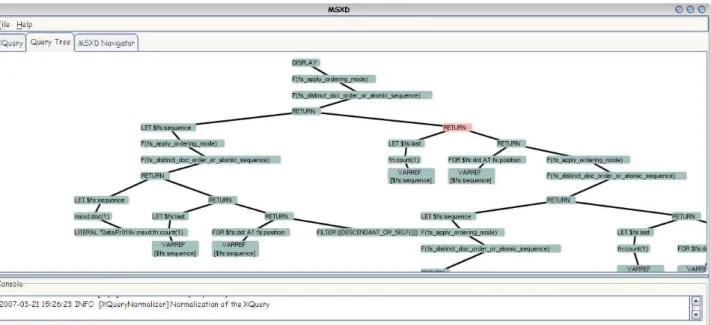
Figures 10 and 11 show two screenshots of the main dow of the application and of the query tree display win-dow. Figure 10 shows a capture from our prototype dur-ing the evaluation of query Q2. A user can select (from a set of test cases) or edit an extended XQuery (top/right). The automatic translation in XQuery Core is shown bot-tom/right and the result (either in XML or in internal for-mat by means of start and end positions) is displayed at bottom/left.
The second figure displays the query tree corresponding to the core query and displays dynamic information dur-ing the execution (number of items created or filtered by operators, . . . ).
Finally, we developed an implementation of the multi-structured schema validation where constraints are checked sequentially. In order to obtain a more efficient valida-tion and to provide a more intuitive way to express con-traints, we are investigating the use of ontologies. We currently tackle this proposal with a linguistic application of multilevel analysis of multimodal data (OTIM–http: //lpl-aix.fr/~otim).
4http://www.hsqldb.org/
5http://www.w3.org/TR/xquery-semantics/
6
Related works
If we look at XML standards, it seems clear that the stan-dard tree-like model [23] and namespaces [9] could be used to represent multistructured documents if each structure is hierarchical and can be merged with others. But, this is not the case in general. In our example, some elements from the physical and syntactic structures can overlap (Line andSentence). The problem of overlapping is not recent see [20] for a review. Several works have studied multi-structured documents in the context of XML for document-centric encoding. We classify the main proposals into three categories.
The first one concerns the very first works about the representation of several hierarchical structures inside the same text (the CONCUR feature [24] of SGML, TEI6); these solutions are often syntactic. TEI’s solutions need to choose either a flat representation of the multistructured document or a main (hierarchical) structure and to use ref-erences (ID/IDREF) for the description of the other struc-tures.
The second category is based on proprietary graph mod-els. LMNL7proposes a new markup language and model such as to overcome the limitations of hierarchical markup in XML and to get an instance of a multistructured docu-ment. LMNL graph-based model is not XML compatible even if it is able to import/export. Notice that LMNL con-siders user annotations but no solution for querying. Mul-tiX [14] is a proprietary graph-based model. It is possible to serialize an instance of it in an unique XML document. The multistructured querying is achieved by means of a set of XQuery [7] functions which in particular, deals with over-lapping. Based on [14], [29] proposed a methodology for the construction of multistructured documents. This high level approach aims at defining structures during the con-struction process. To our knowledge, none other contri-bution considersa priorithe problem of that construction which leads to restructuring and automatic differentiation of structures. We did not yet consider the problem of mul-tistructured document edition.
MVDM (Multiview Document Model) [21] is a propri-etary graph-based model. The model aims at considering multimedia documents and therefore at representing dif-ferent kind of relationship between two document entities (and not only hierarchical relation). MVDM focuses on the notion of view which corresponds to a particular or-ganization of a document. Stored in a document reposi-tory, multistructured documents can be queried according to criteria linked to one or several views of that document (automatic generation of SQL queries taking into account overlapping); another solution to navigate in the repository is proposed with a multidimensional analysis (OLAP).
At last, Annotation graphs (AG) [5] are coming from the linguistic domain. Annotation graphs propose a proprietary formal model for the representation over the same flow
Figure 10: Evaluation of XQuery Q2 in our prototype
Da ta mode ls XM L C ompa tible Mai n st ru ct u re V alida tion Oper at or s
CONCUR none SGML Syntax no no no
TEI (mile-stones)
None XML Syntax yes no yes
Annotation graphs (AG)
Proprietary graph XML Syntax for serialisation no no not for querying Multistructure but only an XPath linguistic extension
LMNL Proprietary graph specific markup and XML import / ex-port
no no no
MultiX Proprietary graph XML import / export yes no specific XQuery functions for querying and struc-ture manipulation
Colored trees Extension of the XML data model
XML export no no XPath step extension
Based on Goddag
Goddag DOM Extension and XML import/export no no XPath axis extension
MSXD Extension of the XML data model
An XML document for each structure no weak con-straints
XQuery semantics extension and new functions
MVDM Proprietary graph XML Syntax by structure no no repository (SQL with overlapping management and multidimensional analysis)
Figure 12: Proposals related to Multistructure
dio, text, . . . ) of several structures (may not be hierarchi-cal). An XML “ flat ” representation of an AG is proposed but no solution for querying.
The third category presents XML compatible contribu-tions. A very interesting framework is proposed in [19]. It is a new model based on the Goddags data structure [31] which can be seen as a generalization of DOM trees for the representation of multi hierarchical XML documents. This proposal defines also an extension of XPath [26] to navi-gate between different structures sharing the same textual data (with a specific axis for concurrent querying such as overlapping,xancestororxdescendant). An-other proposal, the colored trees [27], deals with multi-ple hierarchies in a data-centric context. It aims at sharing atomic data and it does not consider overlapping thus it is out of our scope. The idea is to build several hierarchies (called colors) over the same set of values (text nodes). Thus, nodes are multicolored. In order to navigate between colors/hierarchies, the authors extend the notion of step in XPath. A step begins by a choice of a color (and thus of a structure) before the usual selection of an axis, a test node and some predicates.
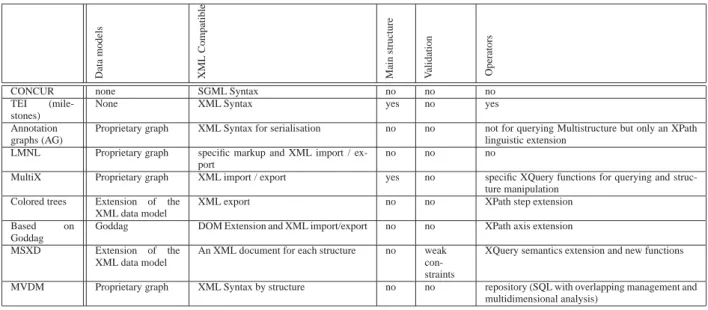
Figure 12 summarizes the main features of each pro-posal related to multistructured documents according to some criteria: Data model,XML compatibility,Existence of a main structure(the user at the logical level or the sys-tem at the physical level chooses a main structure so others structures have to be set with regard to this main structure), Validation of a multistructured document (is it possible to define a schema for multistructured documents valida-tion across multiple hierarchies [20])Operators(for query-ing several structures and content in a concurrent way). No query language has been defined for querying annota-tion graphs, but it exists operators that complete the XML propositions (XPath in particular [3, 4]), they are related to the linguistic context .
Our proposal belongs to the third category, our objective
is to remain close to XML standard. Our model is close to Goddags. Indeed, we want to keep the hierarchical aspect of each structure, so that classical XML tools remain avail-able. But, Goddag does not provide mechanisms to add annotations (as LMNL does) and it does not describe rela-tionships between structures for enabling validation across multiple hierarchies [20] (none of these proposals, what-ever the approach is, proposes it). We do not detail user an-notation but our proposal considers it (see [11] and [12]). Annotations represent textual data added by a user to the text in one structure and so missing in the other structures. It represents specific information que the user needed to integrate to its analysis.
For querying several hierarchies over the same textual content in a concurrent way, we chose to extend the seman-tics of the filter of XQuery. Our objective is not to add new axis (like Goddag) or to extend XPath step with colors (as with colored trees). Moreover, even if we propose every Allen’s relations, we choose to stay simple and to use an as much as possible unchanged XQuery by only adding the necessary function (Unlike MultiX).
7
Conclusion
multistructured documents. Our solution is entirely XML compatible and conforms to standards.
A multistructured textual document is defined as a set of fragments defined on the same textual value and grouped in concurrent hierarchical structures. The key idea is to pro-pose a method for a compact description of multiple trees over a single text based on segmentation. Segmentation encoding allows querying overlap/containment relations of markups belonging to different structures. We showed how each structure can be described in an XML document. The multistructured textual document is never instantiated.
To query a multistructured textual document, we chose to extend the semantics of the filter of XQuery. We show how to take into account equality, overlapping and other Allen’s relations. For that we added functions and opera-tors to XQuery. We are trying to avoid changing the struc-ture of XQuery (as colored trees did without considering overlapping). Moreover, we did not simply add a new axis (as goddag did by addingxancestor xdescendant), but one can notice that it makes the query easier to read. However, normalization ofxancestor,xdescendant or even a new axis associated to Allen’s relations can be rewritten into our proposal.
Moreover, we defined a multistructured schema in or-der to express weak constraints between structures; it is defined as a set of rules, Allen’s relations are used to con-strain the relative position of fragments in the structures. An alternative solution could rely on the use of ontologies. It could offer more flexibility. We currently tackle this pro-posal with a linguistic application of multilevel analysis of multimodal data (Project OTIM8).
Our main perspective is the definition of multiple struc-tures in other modalities than the single textual one. For example, it could be useful to define one or several struc-tures associated to the image of a manuscript as it is done for its textual transcription. Then, the objective would be to manipulate the set of all these structures in a concurrent way. Secondly, we plan to extend our query engine to dis-tribute parts of queries in a P2P network and to enable data sharing.
References
[1] A. Le Hors et al. Document object model (dom) level 3 core specification. Recommendation, W3C, 2004.
[2] J. Allen. Time and time again : The many ways to represent time. International Journal of Intelligent Systems, 6(4):341–355, july 1991.
[3] S. Bird, Y. Chen, S. B. Davidson, H. Lee, and Y. Zheng. Extending XPath to support Linguistic Queries. InProceedings of The ACM Workshop Pro-gramming Language Technologies for XML (PLAN-X), pages 35–46, january 2005.
8http://lpl-aix.fr/~otim
[4] S. Bird, Y. Chen, S. B. Davidson, H. Lee, and Y. Zheng. Designing and evaluating an XPath di-alect for linguistic queries. In Proceedings of The 22nd International Conference on Data Engineering (ICDE’06), april 2006.
[5] S. Bird and M. Liberman. A formal framework for linguistic annotation. InSpeech Communication 33(1,2), pages 23–60, september 2001.
[6] P.-V. Biron and A. Malhotra. XML Schema Part 2: Datatypes second edition. Recommendation, W3C, 2004.
[7] S. Boag. XQuery 1.0 : An XML Query Language. Recommendation, W3C, 2007.
[8] M.S. Corradini Bozzi. Etude des textes de matire medico-pharmaceutique en langue d’oc. InBulletin de l’Association Internationales d’Etudes Occitanes, VIII, pages 29–34, 1990.
[9] T. Bray, D. Hollander, A. Layman, and R. Tobin. Namespaces in XML 1.1 second edition. Recommen-dation, W3C, 2006.
[10] T. Bray, J. Paoli, and C.-M. Sperberg-McQueen. Ex-tensible Markup Language (XML) 1.0. Recommen-dation, W3C, 1998.
[11] E. Bruno and E. Murisasco. MSXD : a formal model for concurrent structures defined over the same tex-tual data . InProceedings of The International Con-ference on Database and Expert Systems Applications (DEXA 2006), pages 172–181. LNCS, 2006.
[12] E. Bruno and E. Murisasco. Describing and querying hierarchical structures defined over the same textual data. InProceedings of the ACM Symposium on Doc-ument Engineering (DocEng 2006), pages 147–154, Amsterdam, The Netherlands, October 2006.
[13] E. Bruno and E. Murisasco. An xml environment for multistructured textual documents. InProceedings of the Second International Conference on Digital In-formation Management (ICDIM’07), pages 230–235, Lyon, France, October 2007.
[14] N. Chatti, S. Kaouk, S. Calabretto, and J.M. Pinon. Multix: an xml based formalism to encode multi-structured documents. In Proceedings of Extreme Markup Languages Conference, August 6-10 2007.
[15] J. Clark. XSL Transformations (XSLT) V1.0. Rec-ommendation, W3C, 1999.
[16] J. Clark and S. Derose. XML Path Language (XPath) V1.0. Recommendation, W3C, 1999.
[18] D. Draper et al. XQuery 1.0 and XPath 2.0 Formal Semantics . Recommendation, W3C, 2007.
[19] A. Dekhtyar and I.-E. Iacob. A framework for man-agement of concurrent xml markup.Data and Knowl-edge Engineering, 52(2):185–208, 2005.
[20] S. DeRose. Markup overlap : a review and a horse. In Proceedings of The Extreme markup language Con-ference, 2004.
[21] K. Djemal, Soule-Dupuy, and Valles-Parlangeau C. Modeling and exploitation of multistructured doc-uments. In Proceedings of the IEEE 3rd Inter-national Conference on Information and Communi-cation Technologies: From Theory to AppliCommuni-cations (ICTTA’ 08)., Damascus, Syria, April 2008.
[22] P. Durusau and M. Brook O’Donnell. Concurrent markup for xml documents. InProceedings of XML Europe Atlanta, 2002.
[23] M. Fernandez, A. Malhotra, J. Marsh, M. Nagy, and N. Walsh. XQuery 1.0 and XPath 2.0 Data Model. Recommendation, W3C, 2007.
[24] C.-F. Goldfarb and Y. Rubinsky. The SGML hand-book. Clarendon Press, Oxford, 1990.
[25] M. Hilbert, O. Schonefeld, and A. Witt. Making con-cur work. In Proceedings of The Extreme Markup Languages Conference, August 2005.
[26] I.-E. Iacob and A. Dekhtyar. Towards a query lan-guage for multihierarchical xml: Revisiting xpath,. In Proceedings of The Eighth International Workshop on the Web and Databases (WebDB’05), pages 43 – 48, june 2005.
[27] H.-V. Jagadish, L.-V.-S. Lakshmanan, M. Scanna-pieco, D. Srivastava, and N. Wiwatwattana. Colorful XML: One Hierarchy Isn’t Enough. InProceedings of The International Conference on Management of Data (SIGMOD’04), pages 251–262, 2004.
[28] M. Murata. Hedge automata: a formal model for XML schemata. Web page, 2000.
[29] P.-E. Portier and S. Calabretto. Creation and mainte-nance of multi-structured documents. InProceedings of the ACM Symposium on Document Engineering (DocEng 2009), Munich, Germany, Septembre 2009.
[30] C.-M. Sperberg-McQueen and L. Burnard. Tei p4 guidelines for electronic text encoding and inter-change, 2001.
[31] C.-M. Sperberg-McQueen and C. Huitfeldt. Goddag: A data structure for overlapping hierarchies. In Proceedings of The Principles of Digital Document and electronic publishing (DDEP/PODDP’00), pages 139–160, 2000.
[32] Jeni Tennison and Wendell Piez. Layered markup and annotation language (lmnl). InProceedongs of The Extreme Markup Languages Conference, 2002.