Unsupervised Color Image
Segmentation Based on Non
Parametric Clustering
Im`ene Kirati and Yamina Tlili
Department of Computer Science, Univesity of Badji Mokhtar, Annaba, Algeria
Many segmentation problems have been addressed using probabilistic modeling. These methods tend to estimate the region membership probabilities for each pixel of the image. The segmentation results depend strongly on the initialization of these regions and the selection of the appropriate number of segments. In this paper we present an unsupervised segmentation method based on non parametric clustering able to deal with these two issues. After a simple splitting, a minimum variance criterion is used to generate both the initial regions and their number. The proposed model was applied on various images(synthetic, natural)showing good visual results. Finally numerical experiments demonstrate the efficiency and the robustness of the proposed model compared to other segmentation methods.
Keywords: image segmentation, non parametric cluster-ing, class initialization, homogeneity
1. Introduction
Image segmentation is one of the fundamental tasks in image processing and computer vision. This process aims to simplify and divide the im-age into meaningful regions making the object recognition and the interpretation simpler. The image pixels are grouped on regions with re-spect to homogenous local features (ex. color, intensity, texture...). Several survey papers re-lated to image segmentation techniques have appeared in the literature[1],[2]. Nevertheless, there is no universal segmentation method that can be applied for all images and the elaboration of an image segmentation algorithm depends on the type of image and the field of application. Many existing segmentation techniques are ba-sed on clustering, which is a powerful technique
employed in diverse applications of image pro-cessing. Clustering algorithms[3]can be classi-fied into four types: hard clustering, fuzzy clus-tering, hierarchical clustering and probabilistic clustering.
This paper deals with probabilistic clustering. This type of clustering models the image on a distribution where each component of this distribution represents a region of the image. These methods rely on the parametric and the non parametric modeling of distribution. In the parametric models, regions are assumed to follow a basic distribution (ex. Gaussian, Poisson...), in this case, the goal of the clus-tering procedure is to determine the distribution parameters and assign each pixel to the com-ponent (region) that has the largest posterior probability.
To solve the image segmentation problem, Co-maniciu et al. [10] suggested a non paramet-ric model using generalized kernel approach. The iterative algorithm aims for finding modes i.e. local maxima of the estimated local den-sity gradient of similar pixels. The set of im-age segments is constituted in function of these modes: pixels having the same modes are as-signed to same segments. The algorithm de-scribed in[11]proposes a color image segmen-tation method by associating the non parametric estimation method with Gaussian kernel func-tion, to a Bayesian classifier to classify image regions into foreground and background. In [12], a hybrid probabilistic framework for image segmentation is described where a non paramet-ric kernel density estimate is combined with a GMM-EM model with the purpose to overcome the shortcoming of the parametric methods re-ported above.
However, in unsupervised probabilistic segmen-tation method, the results depend strongly on the initialization of regions. To achieve an opti-mal convergence, the choice of an initialization method is important and remains an open ques-tion.
Segmentationresult Colortransformation
(Hue)
Simplesplitting
Classinitialization
Nonparametricjoint distribution
Conditional distribution
Mapcriterionand pixelslabeling Inputcolorimage
(RGB) Nonparametric clustering
Figure 1.Outline of the proposed approach.
The initialization step can be done randomly; but in this case, the results are very sensitive and different at each initialization. Many mod-els opt for using existing algorithms such as: K-means [13], Watershed [14] or Superpixels [15] [16]to perform the initialization of regions. Another open question in image segmentation methods concerns the selection of the number of image regions. The large size of images and their complexity make the specification of an “appropriate” number of segments diffi-cult. Many research papers have been published
on unsupervised image segmentation[17],[18], [19]. These methods present algorithms that specify automatically the number of segments with different strategy.
The objective of this paper is to present a new unsupervised image segmentation method based on non parametric clustering. The proposed method has a number of advantages. First, the non parametric clustering can handle the com-plex data of the image (several variables per pixel). The model does not assume a prior dis-tribution and the regions are generated by their own density function, this can be very inter-esting since the regions of the image are not usually of the same shape. Second, using a simple method based on homogeneity criterion, the proposed method is able to tackle the initial-ization problem on one hand and approximate the number of regions on the other.
The rest of the paper is organized as follows. In Section 2, the proposed model for image seg-mentation is described in detail. Qualitative and quantitative experiments on various images with comparison with existing segmentation meth-ods are presented in Section 3. Finally, conclu-sions are given in Section 4.
2. Segmentation Model
The following section will explain in detail the steps of the proposed segmentation model illus-trated in Figure 1.
2.1. Color transformation
The first step of our segmentation model is the color space transformation. The input image is transformed from RGB to HSV space. The HSV space is close to the human perception and, contrary to RGB space, the color informa-tion(hue)of pixel is represented independently from intensity and saturation. This would also be worthwhile because we will use only the quantified hue information to reduce the compu-tational complexity and processing time. Using the hue information instead the RGB compo-nents has many advantages[20]:
• The final result has less regions than by using RGB,
• The segmentation is performed on one di-mension.
2.2. Class initialization
The second step aims to generate the initial re-gions and to specify their number. Here, we propose a simple method inspired by K-means algorithms where each class is represented by its centroid. To generate the initial centroids, we use the variance as a measure of homogeneity. The details of the steps are as follows:
1. Initially, the image is divided into rectangu-lar blocks of size 5×5,
2. Compute the homogeneityVof each block, 3. Keep only blocks with V = 0 and compute
the corresponding mean of hue valueM, 4. Sort the means in ascending order and delete
duplicate value, if any,
5. Set the counter s to one(s=1)and the first centroidC0=M0,
6. If dist(Ms,Ms−1)>T thenCs =Ms,
7. s=s+1 and repeat 6 until allMsare treated.
The number of centroids Cs will represent the
number of regions K.
In addition to setting the threshold of variance to zero, we use blocks to spot neighborhood pix-els with high homogeneity where each centroid is represented by the median of local adjacent pixel having the same hue. In this way, the algorithm tends to generate regions with high homogeneity.
2.3. Non parametric clustering
The last and the main step of our approach is to perform the non parametric clustering. This step aims to compute the class membership probabilities of pixels and assign to each one a class label K.
Letxn = (h,i,j)be the vector representing the nth pixel; n = 1, . . . ,N; where N is the total
number of pixels of the image andhrepresents
the hue value of the corresponding pixel. Fol-lowing the idea of[17] [21], the spatial location iandjof pixels are added to the vector of infor-mation in order to apply spatial constraints. In fact, the clustering-based segmentation methods have the particular characteristic that the spatial information should be considered where it is in-tuitively most likely that the spatially adjacent pixels belong to the same cluster.
Many research papers agree that this prior infor-mation brings improvement to the segmentation results.
The clustering process starts with computing the non parametric joint distribution f(xn,k)
needed for calculating the non parametric con-ditional distribution using in[22]:
f(xn,k) = N m=1
g(xn,xm)A(m)
N y=1
N z=1
g(xy,xz)
(1)
whereA(m)is an indicator function that takes 1 as a value ifxm ∈kand 0 otherwise andg is a Gaussian kernel of width:
g(xn,xm) = 1
22e
−2(xn−2xm)2
(2)
Sincexn,xmare represented by vectors, we use
the Euclidian distance(xn,xm)to compute the
difference between thenthand themthpixels. The formula(1)presented above requires a class initialization. To avoid this drawback, we pro-pose to represent classes by their centroids. The joint distributions are now computed by:
f(xn,k) = N g(xn,Ck)
y=1 K z=1
g(xy,xz)
(3)
whereCk represents the centroid of the classk.
Contrary to the previous formula(1)where all pixels of the class k are used to compute the joint distribution, the formula(3)uses only the centroid of the class. In addition, to improve the initialization step, the use of centroids will be beneficial in terms of reducing complexity and time processing.
The prior probabilitieskare obtained by
from the joint and prior probabilities, using the Bayesian theorem:
P(k|xn) = Kkf(xn,k)
y=1yf(xn,y)
(4)
Finally, we adopt the Maximum a Posteriori criterion(MAP)to assign to each pixel a class labelk:
P(k|xn) =max
k {P(k|xn)} (5)
In other words, pixels are assigned to the clus-terkthat maximizes its conditional probability. This step achieves the clustering and all pixels are grouped in classes. The centroids of the new clusters are recalculated and the whole cluster-ing process is reiterated until the values of the centroids get stabilized.
For the sake of clearness, the whole non para-metric clustering algorithm can be summarized by the following pseudo-code sequence:
Input:Image(N pixels), generated centroids;
Output:labeled pixels;
Begin
1. Whilecentroids changeddo
2. Compute the joint distributionsf(xn,k)and the
probabilitiesk,
3. Compute the conditional distributionsP(k|xn),
4. Apply Map criterion and label pixels, 5. Recalculate the centroids of the new classes, 6. End While
End.
3. Experimental Results
In this section, we conduct experiments on a variety of images to examine the effectiveness of the proposed image segmentation algorithm.
3.1. Synthetic color images
In the first experiment, we demonstrate the ef-fectiveness of the proposed model to approxi-mate the number of segments. For this purpose,
three synthetic color images of different com-plexity were created of size 200×200 with a number of regions equal to 2, 4, 6 for the images a, b, c respectively. To make the segmentation more difficult, the images are degraded with Gaussian noise.
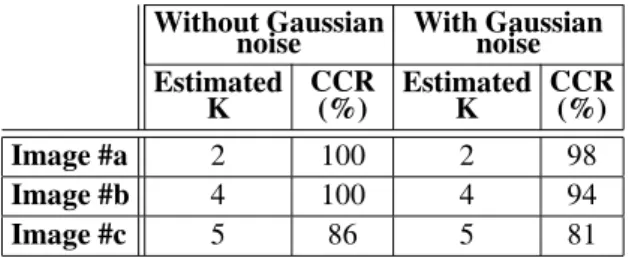
The results provided by the proposed algorithm are illustrated in Figure 2. As it can be ob-served, the method is robust against noise and generates a good segmentation. An evaluation with the correct classification rate(CCR)is also performed and the obtained scores are noted in Table 1.
The first image #a is a simple two class image. The number of regions is well approximate and the rate of correct classification is 100% in the absence of noise and 98 % in the presence of noise.
(a))
(b)
(c)
Figure 2. Segmentation results of synthetic images corrupted by Gaussian noise.
Without Gaussian
noise With Gaussiannoise Estimated
K CCR(%) EstimatedK CCR(%)
Image #a 2 100 2 98
Image #b 4 100 4 94
Image #c 5 86 5 81
Table 1. Average performance of our algorithm on the BSDS, in terms of PR measure.
As illustrated, the third image #c has 6 regions. The rate of correct classification is 86 % in the absence of noise and 81 % in the presence of noise. The number of segments generated is 5, while the correct number of regions is 6. We can perceive that the black and the gray pixels regions are assigned to the same class for the simple reason that, in the absence of saturation, the two colors have the same hue value.
3.2. Natural color images
The second experiment is conducted on real color images. These images were kept from the Berkeley Segmentation Database (BSDS)1
[23]which consists of 300 natural color images of diverse scene categories(200 training images and 100 test images). For each image, five to eight ground truths obtained from human-hand segmentation are available.
For all cases, the images are normalized to be of size 480×320 or 320×480 and each pixel is represented by a vector containing its hue mea-surement and its spatial location. The parameter
is determined empirically and was fixed to 0.1. To quantify the segmentation results, we use the probabilistic rand index (PRI). This mea-sure counts the fraction of pairs of pixels whose labels are consistent with the computed seg-mentation and the ground truth averaging across multiple ground truth segmentations to account for scale variation in human perception [24]. The PR index between two segmentations map is then quantified as:
PR(S,G)=N(N2−1)
i,j i<j
[cijpij+(1−cij)(1−pij)]
(5)
wherecij = 1 if the pixeliandjbelong to the
same region,pij is the ground truth probability
that pixels i and j belong to the same cluster, N is the number of image pixels,Sis the com-puted segmentation results and G is a set of given manually labeled images. The value of the PR index ranges between 0 and 1. For ex-ample, if a PR measure is equal to 0.54, this means that, compared to the ground truth im-age, on average 54 % of pairs of pixel labels are correctly classified. In more exact terms, the closer the PR index value is to one, the better the segmentation result is.
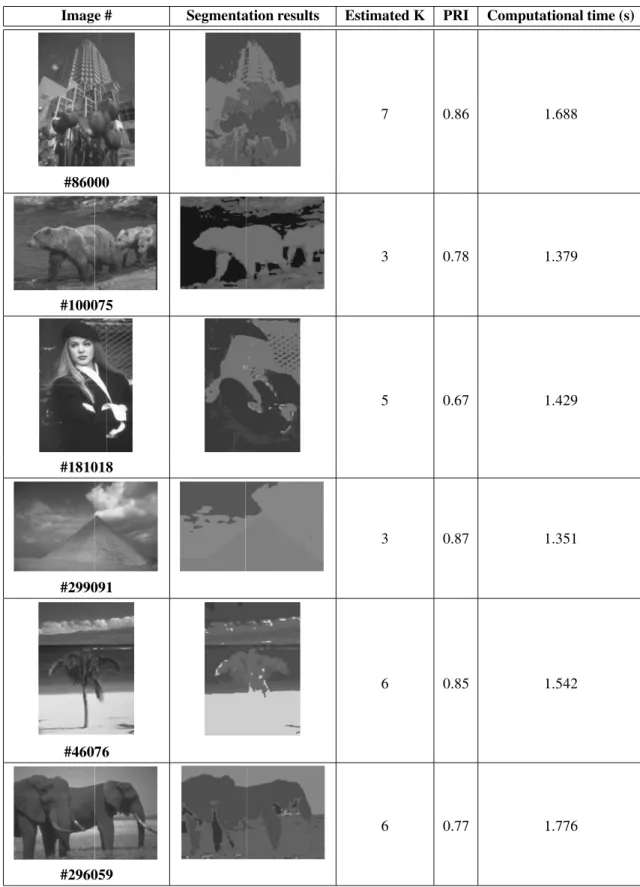
Table 2 displays the obtained segmentation re-sults on six randomly chosen images from the BSDS. The first column presents the original color images and the second presents the visual segmentation results where each region is rep-resented by the mean of its color. The third and fourth columns present the estimated number of segments K and the PRI computed for each result.
As shown in the second column of Table 2, the proposed method yields a good perceptual seg-mentation results and we can observe the ho-mogeneity of the obtained regions and also the accuracy and regularity of their boundaries.
The quantitative evaluation based on the PRI confirms that the segmentation results are close to manual segmentation where we can see high scores of correct classification. Despite this, we notice that the image #181018 subscribe the lowest score, which is due to closeness of the hue value of pixels in the hat, jacket and wall regions. Thus, as demonstrated in the experi-ment on synthetic images above, the absence of saturation may decrease the quality of segmen-tation.
We consider also the computational cost of the proposed method. A PC, which is equipped with a 2.0-GHz Intel core duo CPU and 2-GB memory, is used.
The last column in Table 2 highlights the com-putational cost of each result. We can see that in all cases the algorithm runs in less than 2 sec-onds. The complexity time depends also on the size and the generated number of classes.
Image # Segmentation results Estimated K PRI Computational time (s)
7 0.86 1.688
#86000
3 0.78 1.379
#100075
5 0.67 1.429
#181018
3 0.87 1.351
#299091
6 0.85 1.542
#46076
6 0.77 1.776
#296059
Table 2.Image segmentation results from the Berkeley segmentation database.
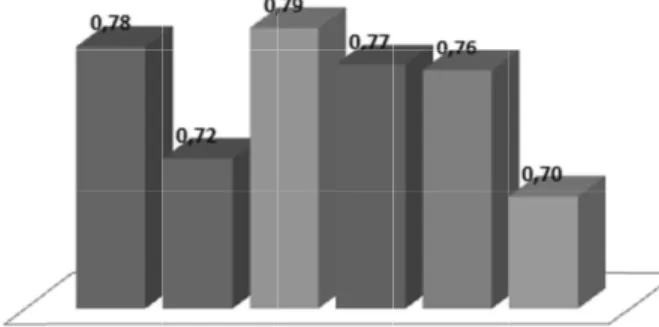
Finally, our method is compared to some of the recent color segmentation methods proposed in the literature: FCR [25], Mean Shift [10],
From Figure 3, we can see that our method achieved a score of 76 % of correct classifica-tion, which is very close to the score achieved by the JESG algorithm; the two methods take the third place after FCR and Mean Shift. Fur-thermore, it outperforms widely the N-Cuts and DCM methods.
Figure 3. Quantitative comparison of our results with other methods used on the BSDS with PRI.
4. Conclusion
In this paper we have presented a new segmen-tation model based on probabilistic clustering. This unsupervised model exploits the robust-ness of the non parametric clustering. Further, it has the capacity to generate an initialization of classes and approximate the number of seg-ments, using a simple strategy based on the ho-mogeneity of regions. Experiments made on a variety of images highlight the validity of the proposed segmentation schema. Results on synthetic images confirm its potential of spec-ifying an appropriate number of regions. The method is also successfully applied on Berkeley image database, showing good visual results. The comparative experimentation is promis-ing where it performs competitively among the recently reported state-of-the-art segmentation methods. Moreover, it requires a low computa-tional complexity suitable for real-time image segmentation processing.
However, experiments show that, in absence of saturation, our method may assign pixels of dif-ferent regions to the same class when their hues are too close. We think also that adding other pixel descriptors like texture could bring refine-ment to the results. Future work will investigate these issues.
References
[1] N. R. PAL, S. K. PAL, A review on image segmen-tation techniques, pattern recognition.Elsevier,26
(1993), 1277–1294.
[2] R. DASS, PRIYANKA, S. DEVI, Image Segmentation Techniques.International Journal of Electronics & Communication Technology,3(1) (2012), 66–70.
[3] R. XU, D. WUNSCHII, Survey of Clustering Algo-rithms.IEEE Transactions on Neural Networks,16
(2005), 645–676.
[4] M. A. T. FIGUEIREDO, A. K. JAIN, Unsupervised learning of finite mixture models. Transactions on Pattern Analysis and Machine Intelligence, 24
(2002), 381–396.
[5] Z. JI, Y. XIA, Q. SUN, Q. CHEN, D. XIA, D. D. FENG, Fuzzy local Gaussian mixture model for brain MR image segmentation.IEEE Transactions on Infor-mation Technology in Biomedicine, May; 16(3) (2012-08-2), 339–347.
[6] M. SUJARITHA, S. ANNADURAI, Color Image Seg-mentation using Adaptive Spatial Gaussian Mixture Model. International Journal of Information and Communication Engineering,6(2010), 28–32.
[7] F. CHEN, K. TANKA, T. HORIGUCHI, Image Segmen-tation Based on Bethe Approximation for Gaussian Mixture Model.Interdisciplinary Information Sci-ences,11(1) (2005), 17–29.
[8] A. PENALVER, F. ESCOLANOET, J. M. S ´˜ AEZ, Color Image Segmentation Through Unsupervised Gaus-sian Mixture Models.Advances in Artificial Intelli-gence, SpringerLink, Volume 4140/2006,(2006), 149–158.
[9] P. K. MALLAPRAGADA, R. JIN, A. JAIN, Non-parametric Mixture Models for Clustering. Inter-national conference on structural, syntactic, and statistical pattern recognition, (2010), Springer-Verlag Berlin, Heidelberg.
[10] D. COMANICIU, P. MEER, Mean Shift: A Robust Approach toward Feature Space Analysis. IEEE Transaction on Pattern Analysis and Machine Intel-ligence,24(2002), 603–619.
[11] H. RAHIMIZADEH, M. H. MARHABAN, R. M. KAMIL, N. B. ISMAIL, Color Image Segmentation Based on Bayesian Theorem and Kernel Density Estimation.
European Journal of Scientific Research, 26(3) (2002), 430–436.
[12] M. ANDREETTO, L. ZELNIK-MANOR, P. PERONA, Non-Parametric Probabilistic Image Segmentation. Presented in theProceedings of the IEEE 11th In-ternational Conference on Computer Vision, ICCV,
[13] M. ZRIBI, M. BENJELLOUN, A. BENHAMIDA, A k-Means Clustering Algorithm Initialization for Un-supervised Statistical Satellite Image Segmentation. Presented in the Procedings of the First IEEE In-ternational Conference on E-Learning in Industrial Electronics,(2006), 11–16, France.
[14] S. MAKROGIANNIS, G. ECONOMOU, S. FOTOPOU-LOS, A region dissimilarity relation that combines feature-space and spatial information for color im-age segmentation.IEEE Systems, Man, and Cyber-netics, Part B: Cybernetics,35(1) (2005), 44–53.
[15] A. Y. YANG, J. WRIGHT, S. SASTRY, Y. MA, Unsu-pervised Segmentation of Natural Images via Lossy Data Compression. Computer Vision and Image Understanding,110(2) (2008), 212–225.
[16] J. CHENG, J. LIU, Y. XU, F. YIN, D. W. WONG, B. H. LEE, C. CHEUNG, T. AUNG, T. Y. WONG, Superpixel classification for initialization in model based optic disc segmentation. Presented in the Procedings of the International Conference of the IEEE Engi-neering in Medicine and Biology Society,(2012), 1450–1453.
[17] C. CONSTANTINOPOULUS, A. LIKAS, Image model-ing and segmentation usmodel-ing incremental Bayesian mixture models.Computer Analysis of Images and Patterns,4673(2007), 596–603.
[18] P. GUO, C. C. CHEUNG, L. XU, Region number de-termination in automatic image segmentation based on BKYY model selection criterion. Presented in the Procedings of the IEEE-EURASIP Workshop on Nonlinear Signal and Image Processing,(June 1999), 743–746, Antalya, Turkey.
[19] J. FAN, D. YAU, A. ELMAGARMID, W. AREF, Au-tomatic image segmentation by integrating color-edge extraction and seeded region growing, IEEE Transaction on Image Processing,10(10) (2001), 1454–1466.
[20] H.-D. CHENG, Y. SUN, A Hierarchical Approach to Color Image Segmentation Using Homogene-ity.IEEE Transaction on image processing,9(12) (2000), 2071–2082.
[21] C. CARSON, S. BELONGIE, H. GREENSPAN, J. MALIK, Blobworld: Image segmentation using expectation-maximization and its application to image querying.
IEEE Transactions on Pattern Analysis and Machine Intelligence,24(2002), 1026–1038.
[22] G. BOUGENI`ERE, C. CARIOU, K. CHEHDI, A. GAY, Non Parametric Stochastic Expectation Maximiza-tion for Data Clustering.Communications in Com-puter and Information Science, Springerlink, 23
(2009), 293–303.
[23] D. MARTIN, C. FOWLKES, D. TAL, J. MALIK, A database of human segmented natural images and its application to evaluating segmentation algorithms and measuring ecological statistics. Presented in the
Proceedings of the 8th Int. Conf. Computer Vision,
2(July 2001), 416–423.
[24] R. UNNIKRISHNAN, C. PANTOFARU, M. HEBERT, A Measure for Objective Evaluation of Image Segmen-tation Algorithms. Presented in theProceedings of CVPR Workshop Empirical Evaluation Methods in Computer Vision,(1967).
[25] M. MIGNOTTE, Segmentation by fusion of histogram-based k-means clusters in different color spaces. IEEE Transaction on Image Processing,
17(5) (2008), 780–787.
[26] J. SHI, J. MALIK, Normalized cuts and image seg-mentation.IEEE Transactions on Pattern Analysis and Machine Intelligence,22(8) (2002), 888–905.
[27] C. NIKOU, A. C. LIKAS, N. P. GALATSANOS, A Bayesian Framework for Image Segmentation with Spatially Varying Mixtures.IEEE Transaction on Image Processing,19(2010), 2278–2289.
[28] Y. DENG, B. S. MANJUNATH, Unsupervised seg-mentation of color texture regions in images and video.IEEE Transactions on Pattern Analysis and Machine Intelligence,23(8) (2001), 800–810.
Received:May, 2013
Revised:October, 2013
Accepted:November, 2013
Contact addresses:
Im`ene Kirati Department of computer science Univesity of Badji Mokhtar Annaba Algeria e-mail:[email protected]
Yamina Tlili Department of computer science Univesity of Badji Mokhtar Annaba Algeria e-mail:[email protected]
IMENE` KIRATIis a PhD student at Badji Mokhtar University Annaba Algeria and she has been preparing her PhD thesis at the Laboratory of Research in Computer Science(LRI)since 2010. Her PhD research is Bayesian approaches to unsupervised color image segmentation. Her main research interests are in computer vision, pattern recognition and image segmentation.