Energy Ef
fi
ciency and Throughput
Optimization of Cognitive
Relay Networks
Yaolian Song, Fan Zhang and Shao Yubin
Faculty of Information Engineering and Automation, Kunming University of Science and Technology, Kunming, China
In this paper, we investigate the energy efficiency and throughput optimization problem of cognitive relay net-works. We propose to design sensing time and signal to noise ratio (SNR)to maximize the energy efficiency and throughput, since analytical and empirical studies have shown that sensing time and SNR are key factors for energy efficiency and throughput. We design a method that simultaneously considers the parameters of spectrum sensing time and SNR to optimize the energy efficiency of cognitive radio networks. Furthermore, we conduct deep experiments which show that there exists the optimal sensing time to maximize energy efficiency and throughput. In addition, optimal sensing time and optimal SNR can be jointly designed to maximize energy efficiency. Finally, we provide simulation results to show that energy efficiency of cognitive relay transmission scheme can be significantly improved compared with that of direct transmission scheme in cognitive radio networks.
Keywords: energy efficiency, cognitive relay transmis-sion, SNR, spectrum sensing time
1. Introduction
Due to the fast development of wireless com-munication networks and mobile users, the de-mand for wireless radio spectrum is rapidly in-creasing. Cognitive radio network has received substantial attention as a promising approach to increasing spectrum efficiency. Cognitive ra-dio enables opportunistic secondary spectrum access and allows secondary users to utilize the licensed frequency bands as long as the inter-ference to the primary users is limited to an acceptable level [1]. Previous works on cogni-tive radio network focused on sensing accuracy, spectral efficiency and throughput[2-4].
Cognitive radio can improve spectral efficiency, meanwhile it will lead to lower energy effi-ciency due to external time overhead and en-ergy consumption for spectrum sensing. Re-cent efforts toward techniques for energy effi-ciency and spectral effieffi-ciency have tended to-ward the concept of the energy efficient cogni-tive radio [5-8]. For instance, energy efficient sensing-access strategies for sequential sensing were addressed in[5], the energy-efficient trans-mission with variable transtrans-mission duration and interference limited to primary user(PU) were discussed when the sensing duration was fixed. Link adaptive transmission was addressed in[6]
to maximize the energy efficiency. In [8], the authors jointly determined sensing duration and transmission duration for an energy-efficient design of cognitive radio networks by assum-ing that the PU does not reoccupy the chan-nel during cognitive user transmission. Energy-harvesting cognitive radio network can improve both energy efficiency and spectral efficiency with a secondary transmitter powered by renew-able energy[10-12].
duration. Energy detector and cognitive relay transmission scheme are addressed. We find that there exist optimal sensing duration and an optimal SNR to achieve the maximum of energy efficiency.
The paper is organized as follows: Section 2 depicts the system model. In Section 3, we show the throughput optimization and energy efficiency optimization of cognitive relay net-works. In Section 4, numerical and simulation results are demonstrated and the paper is con-cluded in Section 5.
2. System Model
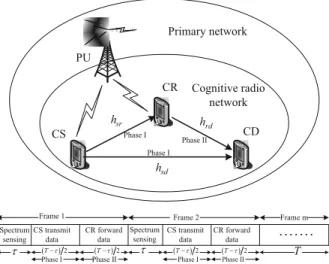
We consider cognitive relay model setup illus-trated in Figure 1, which consists of a single cognitive source (CS), a single cognitive relay
(CR) and a single cognitive destination (CD). PU denotes primary user. The cognitive relay operates in half-duplex AF mode, each trans-mission link between any two nodes is modeled as a Rayleigh fading channel.
The whole cognitive transmit process of cog-nitive system can be divided into three phases: spectrum sensing, cognitive source broadcast-ing information to cognitive relay and cognitive destination, cognitive relay forwarding infor-mation to cognitive destination in AF mode. Finally, the cognitive destination combines re-ceived information from cognitive source and cognitive relay in maximum-ratio combining. If cognitive user didn’t detect idle licensed spec-trum, all cognitive users would keep silent.
Sup-sr
h
sd
h
rd
h
CR
CD CS
PU
Primary network
Cognitive radio network
Spectrum sensing
CS transmit data
CR forward data
Spectrum sensing Phase I
Phase I Phase II
CS transmit data
CR forward data W TW2 TW2 W TW2 TW2
Frame 1 Frame 2 Frame m
T Phase I Phase II Phase I Phase II
Figure 1.System model.
pose thatis the spectrum sensing duration and frame duration isT. So data transmission dura-tion isT−.
Assuming that channel state information is only known by the receiver but not by the transmitter, wherehsr,hsdandhrddenote the fading channel
coefficients between CS and CR, CS and CD, CR and CD respectively, each transmission link between any two nodes is modeled as a Rayleigh fading process with variances2
sd,sr2 andrd2.
3. Throughput and Energy Efficiency Optimization
This section investigates the optimization prob-lem of throughput and energy efficiency based on cognitive relay network.
3.1. Throughput Optimization
Once cognitive user detected idle licensed spec-trum hole, cognitive radio networks would be-gin data transmission. Data transmission uses orthogonal channels, either through time or fre-quency division. The whole process of data transmission can be divided into two phases: 1)
cognitive source broadcasts data to cognitive re-lay and cognitive destination in phase I, and 2)
cognitive relay forward data to cognitive des-tination in AF mode, while cognitive source keeps silent during phase II. Finally, cogni-tive destination combines received data through maximal-ratio combining.
If primary user is idle, the capacity of cogni-tive relay networks can be represented as C0. When primary user is active, the capacity that cognitive relay networks can achieve isC1. The overall throughput of cognitive relay networks can be written as
Th(,) = T −T (C0(1−Pf(,))P(H0) +C1(1−Pd(,))P(H1)) (1) whereis detection threshold,P(H0)andP(H1) are the probability that primary user is inac-tive and acinac-tive respecinac-tively, and meetP(H0) + P(H1) = 1. Pf(,)is the probability of false
false alarm probability related to the target de-tection probabilityP¯dis as follows
Pf() =Q[Q−1( ¯Pd)
(2p+1) +pfs]
(2)
where fs denotes sampling frequency,pis the
received SNR of primary user signal measured at the cognitive receiver of interest under the hypothesisH1. Q(x)is the complementary dis-tribution function of standard Gaussian, i.e.
Q(x) = √1
2 +∞
x
e−t22dt.
The average throughput of the cognitive relay network can be maximized by using and
as the optimization variables subject to enough protection given to the primary user, the through-put optimization problem can be written as fol-lows:
max
, Th(,) s.t. Pd(,)≥P¯d
0< <T
(3)
In cognitive radio networks, primary user should be protected sufficiently, the objective detection probability is satisfied with the constraint of
¯
Pd ≥0.9. Supposing that spectrum usage
prob-abilityP(H1)is low, the throughput of cognitive relay networks can be approximately written as follows:
Th(,)≈ T −T C0(1−Pf(,))P(H0) (4)
C0is as follows[9]
C0=12log2
1+Ps|hsd2 |2
n +
2P
s|hsr|2|hrd|2
(1+2|hrd|2)2
n
(5)
where = Pr
Ps|hs,r|2+n2 is the amplifier gain
[9], Ps = Pr is transmit power of cognitive
source and cognitive relay respectively under the constraint of Ps +Pr = P, P is allowable
total power, 2
n is variance of Gaussian noise.
For a given objective detection probability P¯d,
differentiatingTh()with respect toyields
∇Th() = dThd =−T1P(H0)(1−Pf())C0
−T −T P(H0)C0∇Pf(). (6)
For the given objective detection probabilityP¯d,
the false alarm probability can be written as fol-lows:
Pf() =Q[Q−1( ¯Pd)(2p+1) +pfs]
= √1
2
∞
Q−1( ¯Pd)√(2p+1)+p√fs
e−t22dt.
(7)
DifferentiatingPf()with respect to yields
∇Pf() = dPdf =−√1
2 p√fs
2√
·exp
−(Q−1( ¯Pd)
(2p+1) +p√fs)2
2
.
(8)
From formulas(7)and(8), we have lim
→0Pf() = 1 and lim
→0∇Pf() = −∞. When → T, Q−1( ¯Pd)(2p+1) +p√fscan achieve the
maximum, and we have lim
→T∇Pf() = 0 and
lim
→TPf() = 0. Consequently, we can draw a
conclusion as follows:
lim
→0∇Th() =∞and lim→T∇Th()<0. (9)
From formula (9), it is easy to see that there exists sensing time meet that ∇Th() =
dTh()
d =0 over the period 0 ≤ ≤T. Differ-entiating∇Th()with respect toyields
∇2Th() = d2Th d2
= T2P(H0)∇Pf()R
−T −T P(H0)R∇2Pf()
(10)
follows:
∇2Pf() = dd2P2f = √1
2 p√fs
4√
·exp
−(Q−1( ¯Pd)
(2p+1) +pfs)2
2
− √1
2 p√fs
2√
·exp
−(Q−1( ¯Pd)
(2p+1) +p√fs)2
2
×(Q−1( ¯Pd)
(2p+1) +pfs)p
√
fs
2√ .
(11)
From formula(11), we know that lim →0∇
2P
f()
= ∞ and lim
→T∇
2P
f() = 0. The second
derivative of throughput with respect to can be obtained as follows:
lim →0∇
2Th() =−∞,lim →T∇
2Th() =0. (12)
From formula(12), we can find that∇2Th() =
d2Th
d2 < 0 for ∈ (0,T). Therefore, we can draw a conclusion that there exists optimal sens-ing timeoptto maximize the throughput of
cog-nitive relay networks. Let = 0.52P
n , A = |hsd|
2, B = |h
sr|2 and
C = |hrd|2,A, BandC are greater than 0. The
formula(4)is given by
Th(,,) = T2−T(1−Pf(,))P(H0)
×log2
1+A + (B +BCC2+1)
.
(13)
For given sensing timeand objective detection probabilityP¯d. Differentiating∇Th()with
re-spect to yields
∇Th() =dThd = T2−TP(H0)(1−Pf(,))
×ln 2A(B +C +1)2+BC(B +C +2)
[(B+C+1)(A+1)+BC2](B+C+1).
(14)
From formula (14), we know that ∇Th() > 0. Consequently, we can conclude that the throughput of cognitive radio networks is mono-tonically increasing for parameter.
3.2. Energy Efficiency Optimization
In this section, we investigate the energy effi-ciency of cognitive relay networks. The func-tion of energy efficiency is defined as follows
(,) = ThE((,,)) (15)
where = 2P2
n is signal to noise ratio,E(,)is the average energy consumption of cognitive re-lay networks. There exist three kinds of energy consumption, such as circuit power energy con-sumption, spectrum sensing energy consump-tion and data transmission energy consumpconsump-tion. The average energy consumed by cognitive re-lay networks is formulated as follows
E(,) =P+PcT
+ (T−) 2
n[P(H0)(1−Pf())
+P(H1)(1−Pd())] (16)
wherePis spectrum sensing power,Pcdenotes
circuit power.
Signal to noise ratio and sensing time can be optimized to improve the energy efficiency of cognitive relay network. The objective is to maximize the energy efficiency while satisfy-ing senssatisfy-ing performance constraint, which can be formulated as
max
, (,) =
(T−)P(H0)(1−Pf())
P+PcT+(T−) n2[P(H0)(1−Pf())+P(H1)(1−Pd())]
×21Tlog2
1+|hsd|2+ 2|h
sr|2|hrd|2
(|hsr|2 +|hrd|2 +1)
s.t. 0<<T
0< <∞
Pd()≥P¯d. (17)
Assuming that is constant and let
a=P +PcT,
b= (T −)2
n[P(H0)(1−Pf())
+P(H1)(1−Pd())],
d =|hsd|2,
e=|hsr|2,
f =|hrd|2. (18)
Obviously, we know that a, b, c, d, e and f are constant and greater than zero. The reduced form of energy efficiency can be rewritten as follows
()=a+cb log2
1+d + (e +2fef +1)
.
(19) Clearly, we have
lim
→0() =0 (20)
and
lim →∞()
= lim →∞
clog2 1+d +(e+2fef+1) (a+b)
= lim →∞
c d+ e2+f ef+1− (ef e+2f(e++f1))2
(ln 2)b 1+d + (e+2fef+1) =0.
(21) From equation (20) and (21), we know that
()is a continuous positive function, and there exists certain value for (0< <∞)to meet that
∂()
∂
¯=0. (22)
For a given objective detection probability P¯d,
letA=P(H0) n2,B=P(H1)(1−P¯d) n2and
C =PcT. Assuming that is constant, formula
(17)can be written as follows
T()=P (T−)P(H0)(1−Pf())C0
+C+(T−)(A(1−Pf())+B).
(23)
Let D = P(H0)C0
T , differentiating () with
re-spect to yields
() = ∂∂
= ∂(D(T −)(1−Pf()))
∂(P+C+(T−)(A(1−Pf())+B))
= [−D((1−Pf()) + (T−)∇Pf())] [P+C+ (T−)(A(1−Pf()) +B)]2
· [P +C+ (T−)(A(1−Pf()) +B)]
[P+C+ (T−)(A(1−Pf()) +B)]2
− D(T −)(1−Pf())
[P+C+ (T−)(A(1−Pf()) +B)]2
· [P−A(1−Pf())−B−(T−)A∇Pf()]
[P+C+ (T−)(A(1−Pf()) +B)]2.
(24)
When →0, we know that lim
→0Pf() =1 and lim
→0∇Pf() = −∞. SinceA, B, C and D are constant, we can conclude that
lim
→0∇() =lim→0 ∂
∂
= −DT((CC++BTBT)()2−∞)
= (CDT+∞BT) >0.
(25)
When →T, we know that lim
→TPf() =0 and
lim
→T∇Pf() =0, we can achieve that
lim
→T∇() =lim→T
∂
∂
= −D(TP+C) (TP +C)2 =−(TPD
+C) <0
(26)
From formula(25)and (26), we can conclude that there is sensing time meet that∇() = 0 over the period 0≤ ≤T. The optimal sensing time is obtained when the equality constraint in
(17)is satisfied, which can maximize the energy efficiency of cognitive radio networks.
4. Numerical and Simulation Results
cognitive relay networks. In the following sim-ulations, it is assumed that the channels be-tween PU and secondary users, and bebe-tween cognitive source and cognitive relay, and be-tween cognitive source and cognitive destina-tion, and between cognitive relay and cognitive destination experience Rayleigh fading. The modulated signal bandwidth of primary users is 6MHz. Setting fs = 6 MHz, T = 20 ms,
P(H0) = 0.8, Pc = 200 mW, P = 100 mW and 2
n = 1 (normalized noise variance). The
target detection probability for cognitive user is set toP¯d =0.95 in order to provide PU with
suf-ficient protection. In cognitive relay networks,
2
sd, sr2 and rd2 are set to 1, 5 and 5.
Cogni-tive source and cogniCogni-tive relay are allocated to equal power, and the system signal to noise ratio isSNR= P
2
n
.
-25 -20 -15 -10 -5 0
0 1 2 3 4 5 6 7 8
Wop
t
(ms
)
Jp(dB)
Wopt for energy efficiency
Wopt for throughput
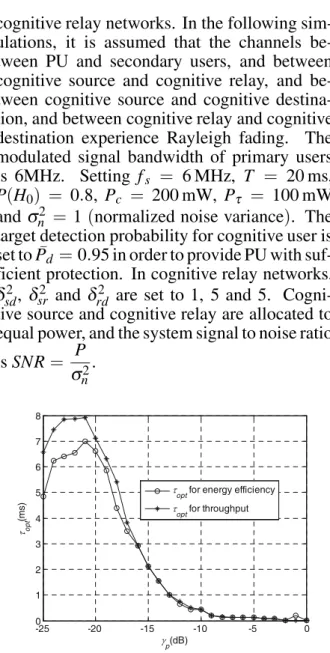
Figure 2.The optimal sensing time for throughput and energy efficiency maximization.
-25 -20 -15 -10 -5 0
0 0.2 0.4 0.6 0.8 1
T
h
ro
ugh
put
(b
it
s
/s
/H
z
)
Jp(dB)
W=Wopt W=5%T
W=15%T
W=25%T
W=35%T
Figure 3.The throughput for different sensing time values.
-25 -20 -15 -10 -5 0
15 20 25 30 35 40
Jp(dB)
en
er
gy
ef
fi
c
iency
(b
it
s
/H
z
/J
)
W=Wopt W=5%T
W=15%T
W=25%T
W=35%T
Figure 4.The energy efficiency for different sensing time values.
-25 -20 -15 -10 -5 0
-1 0 1 2 3 4 5 6
Jp(dB)
SNR
op
t
(d
B
)
direct transmission cognitive relay transmission
Figure 5. OptimalSNRfor energy efficiency maximized versusp.
Figure 2 illustrates that there exists the opti-mal sensing timeoptto make both the
through-put and the energy efficiency of cognitive relay networks maximized under different p. The
optimal sensing time opt of energy efficiency
maximization is smaller than that of throughput maximization.
When SNR = 5 dB, Figure 3 compares the throughput for sensing time =optwith other
sensing time values, such as = 5%T, 15%T, 25%Tand 35%T. It is obvious that the through-put for optimal sensing time is the best. Sim-ilarly, it is easy to see from Figure 4 that the energy efficiency for =opt is the best.
can know that there exists optimalSNRto max-imize the energy efficiency of cognitive radio networks. Obviously, the optimalSNRfor cog-nitive relay transmission is smaller than that of direct transmission under differentp.
In Figure 6, we show the throughput of cog-nitive relay transmission versus sensing time under different SNR. One can see that there is optimal sensing time to maximize the through-put of cognitive radio networks.
Figure 7 depicts the energy efficiency of cogni-tive radio networks versusSNRunder different sensing time values. Note that there exists opti-mal SNRto maximize the energy efficiency of cognitive radio networks. Furthermore, the en-ergy of cognitive relay transmission is superior to that of direct transmission.
0 2 4 6 8 10 12 14 16 18 20
0 0.5 1 1.5
th
ro
ugh
put
(b
it
s/
s/
H
z
)
spectrum sensing timeW(ms)
SNR=1dB
SNR=10dB
SNR=20dB
Figure 6.Throughput of cognitive relay transmission versus sensing time.
-5 0 5 10 15 20
5 10 15 20 25 30 35
en
er
gy
ef
fi
c
iency
(b
it
s
/s
/H
z
/J
)
SNR(dB)
directW=2ms cognitive relayW=2ms directW=5ms cognitive relayW=5ms directW=15ms cognitive relayW=15ms
Figure 7.Energy efficiency of cognitive radio networks versusSNR.
0 5 10 15 20
0 5 10 15 20 25 30 35
e
ner
gy ef
fi
c
ie
n
c
y
(b
it
s
/s/
H
z
/J
)
spectrum sensing timeW(ms) directSNR=0dB
cognitive relaySNR=0dB directSNR=4dB cognitive relaySNR=4dB directSNR=10dB cognitive relaySNR=10dB
Figure 8.Energy efficiency of cognitive radio networks versus sensing time.
Figure 9.Energy efficiency of cognitive relay transmission versus sensing time andSNR.
Figure 8 shows that there is optimal sensing time to maximize the energy efficiency of cogni-tive radio networks under differentSNR. When SNR = 4 dB, the energy efficiency of both cognitive relay transmission scheme and direct transmission scheme outperforms that of other SNR.
Figure 9 illustrates three-dimensional graph of energy efficiency. It is obvious that there ex-ists optimal sensing time and optimal SNR to make the energy efficiency of cognitive re-lay networks maximized. When opt=6.5 ms,
SNRopt=3.25 dB, we can achieve the
5. Conclusion
In this paper, we have presented throughput and energy efficiency maximization based on nitive relay network. Our idea proves that cog-nitive radio network can significantly improve both spectral efficiency and energy efficiency by optimally designing spectrum sensing duration and SNR. The energy efficiency of cognitive relay transmission scheme is superior to that of non-relay transmission scheme.
Acknowledgment
This work was supported by the Foundation of Yunnan Province under grant No. 2011FB035 and School training fund.
References
[1] C. CORMIO, K. R. CHOWDHURY, A survery on mac
protocols for cognitive radio networks. Ad Hoc Networks,7(2007), 1315–1329.
[2] Y. C. LIANG, Y. ZENG, E. C. Y. PEH, A. T. HOANG,
Sensing throughput tradeoff for cognitive radio net-works.IEEE Trans. Wireless Communications,7(4) (2008), 1326–1337.
[3] P. P. CHEN, Q. Y. ZHANG, Joint temporal and spatial
sensing based cooperative cognitive networks.IEEE Commun. Lett.,15(5) (2011), 530–532.
[4] A. O. ERCAN, M. O. SUNAY, Energy sensing
strat-egy optimization for opportunistic spectrum access.
IEEE Commun. Lett.,16(6) (2012), 828–830.
[5] P. YIYANG, L. YING-CHANG, Energy-Efficient
De-sign of Sequential Channel Sensing in Cognitive Radio Networks: Optimal Sensing Strategy, Power Allocation, and Sensing Order. Selected Areas in Communications, IEEE Journal, 29(8) (2001), 1648–1659.
[6] L. LI, X. ZHOU, H. XU, Y. LI, D. WANG, A. SOONG,
Energy-efficient transmission in cognitive radio net-works.IEEE Trans. Broadcast.,57(3) (2011), 718– 720.
[7] Y. WU, D. H. K. TSANG, Energy-efficient spectrum
and transmission for cognitive radio system.IEEE Commun. Lett.,15(5) (2011), 545–547.
[8] L. LIYING, Z. XIANGWEI, Energy-Efficient
Trans-mission in Cognitive Radio Networks. Con-sumer Communications and Networking Confer-ence (CCNC), 7th IEEE,(2010).
[9] J. N. LANEMAN, D. N. C. TSE, G. W. WORNELL,
Cooperative Diversity in Wireless Networks: Effi-cient Protocols and Outage Behavior.Information Theory, IEEE Transactions,50(2004), 3062–3080.
[10] C. HUANG, R. ZHANG, S. CUI, Throughput
maxi-mization for the gaussian relay channel with energy harvesting constraints.IEEE J. Sel. Areas Commun.,
31(8) (2013), 1469–1479.
[11] S. PARK, H. KIM, D. HONG, Cognitive radio
net-works with energy harvesting.IEEE Trans. Wireless Commun.,12(3) (2013), 1386–1397.
[12] S. PARK, D. HONG, Achievable throughput of energy
harvesting cognitive radio networks.IEEE Transac-tions on Wireless CommunicaTransac-tions,13(2) (2014), 1010–1022.
Received:May, 2014
Revised:July, 2014
Accepted:July, 2014
Contact addresses:
Yaolian Song Faculty of Information Engineering and Automation Kunming University of Science and Technology Kunming, 650504 China e-mail:[email protected]
Fan Zhang Faculty of Information Engineering and Automation Kunming University of Science and Technology Kunming, 650504 China Shao Yubin Faculty of Information Engineering and Automation Kunming University of Science and Technology Kunming, 650504 China
YAOLIANSONGgraduated from Nanjing University of Posts and Telecom-munications(NUPT), Ph.D., Wireless Communication Major at Kun-ming University of Science and Technology(KMUST), Information Engineering and Communication Department. She is concentrating on the area of wireless communication and cognitive radio.