DOI: 10.1534/genetics.107.083816
Management of Subdivided Populations in Conservation Programs:
Development of a Novel Dynamic System
J. Ferna´ndez,*
,1M. A. Toro* and A. Caballero
†*Departamento de Mejora Gene´tica, Instituto Nacional de Investigacio´n y Tecnologı´a Agraria y Alimentaria, 28040 Madrid, Spain and†Departamento de Bioquı´mica, Gene´tica e Inmunologı´a, Facultad de Biologı´a,
Universidad de Vigo, 36310 Vigo, Spain Manuscript received October 25, 2007 Accepted for publication March 7, 2008
ABSTRACT
Within the context of a conservation program the management of subdivided populations implies a compromise between the control of the global genetic diversity, the avoidance of high inbreeding levels, and, sometimes, the maintenance of a certain degree of differentiation between subpopulations. We present a dynamic and flexible methodology, based on genealogical information, for the maximization of the genetic diversity (measured through the global population coancestry) in captive subdivided populations while controlling/restricting the levels of inbreeding. The method is able to implement specific restrictions on the desired relative levels of coancestry between and within subpopulations. By accounting for the particular genetic population structure, the method determines the optimal contributions (i.e., number of offspring) of each individual, the number of migrants, and the particular subpopulations involved in the exchange of individuals. Computer simulations are used to illustrate the procedure and its performance in a range of reasonable scenarios. The method performs well in most situations and is shown to be more efficient than the commonly accepted one-migrant-per-generation strategy.
I
N most ex situ conservation programs (i.e., zoos, natural reserves, etc.) individuals are not kept in a single nucleus but different populations are maintained with some degree of isolation for logistic reasons. The maintenance of subdivided populations implies, as a positive effect, a reduction in the risk of extinction because of accidental or sanitary reasons (fires, infectious diseases, etc.), as the effect of such events would cause the extinction of only a single group. In addition, from classical theoretical principles, the maximum genetic diversity of a population in the long term is attained by subdividing it in as many isolated groups as possible (see,e.g., Wang and Caballero 1999), as different allelic
variants will get fixed in each group, becoming a genetic reservoir of variation. Finally, in some situations sub-division has a clear biological meaning, as different subpopulations are characterized by local adaptations. This may be, for example, the case of domestic breeds, where separation is desirable to keep a required level of morphological differentiation.
However, population fragmentation because of natu-ral or human-induced activities is a widely recognized threat for endangered species in the wild (Frankham
et al. 2002). The negative effect of subdivision is that each subpopulation will necessarily have a relatively low effective population size and, therefore, higher levels of
inbreeding. Thus, higher levels of inbreeding depres-sion are expected to occur relative to a single large one (Falconerand Mackay1996). To avoid this side effect
it has been suggested that a certain degree of gene flow should be maintained through migration of individuals between subpopulations. There is an ample theory re-garding the consequences of different models of migra-tion on the genetic parameters of subdivided populamigra-tions (see, for example, Allendorf and Luikart 2007). A
commonly accepted rule of thumb, based on the island model derived by Wright (1931), establishes that the
needed migration rate to maintain a considerable differ-entiation between subpopulations but avoiding an exces-sive increase in inbreeding is to allow for one migrant per generation and subpopulation (Mills and Allendorf
1996). The one-migrant-per-generation rule was derived from a set of assumptions that rarely hold, and its ap-plicability should be tested with caution. Wang(2004a)
studied the robustness of this strategy against departures from the assumptions of the original proposed frame-work. He concluded that most of the deviations from the ideal model can be accounted for by the use of the effective number of migrants, Me¼Ne3 me, whereNe
is the effective population size of each subpopulation andmethe effective migration rate, so that the rule may be
interpreted as one effective migrant per generation. However, a critical characteristic of this simple manage-ment method is that the particular migration scheme used is independent of the genetic structure of the population, assuming equal (or regular) population sizes
1Corresponding author: Departamento de Mejora Gene´tica Animal,
Instituto Nacional de Investigacio´n y Tecnologı´a Agraria y Alimentaria, Crta. A Corun˜a Km. 7,5, 28040 Madrid, Spain. E-mail: [email protected]
and sex ratios across subpopulations. A further problem to be faced by managers is that translating between ef-fective and actual number of migrants (MetoM) may not
be straightforward in real populations.
Wang(2004b) recently proposed a method for the
management of subdivided populations to optimize the global genetic diversity while controlling the rise of inbreeding, devoted to the situation where genealogical and molecular data are absent. He assumed that the levels of inbreeding are proportional to the historical census sizes of each subpopulation and that the degree of relationship between them can be estimated from past exchanges of individuals known to have occurred between subpopulations. The method then provides a way to implement contributions of subpopulations and migration schemes from the expected levels of inbreed-ing and differentiation inferred from the demographic data. The optimization of contributions by this method, however, is made at the subpopulation level instead of the individual level. A refinement of the method seems, therefore, necessary to incorporate data from pedigrees. This would allow for the optimization of the contribu-tions of particular individuals rather than whole sub-populations and, therefore, a more efficient control of the levels of both genetic diversity and inbreeding.
The objective of this study is to develop a dynamic and flexible methodology, to be used when genealogical in-formation is available, for the maximization of the global genetic diversity (measured through the global population coancestry) maintained in captive subdivided popula-tions while controlling the levels of inbreeding gener-ated in each subpopulation. The method accounts for any particular genetic population structure and allows us to determine the optimal contributions (i.e., number of offspring) of each individual, the number of migrants, and the particular subpopulations involved in these migrations, with a specific control on the desired relative levels of coancestry between and within subpopulations.
MANAGEMENT METHOD
Following the established theory (see,e.g., Ballouand
Lacy 1995; Caballero and Toro 2000), the optimal
contribution of an individual to the next generation to maximize the global gene diversity maintained in a population is attained by minimizing the value of the expression
XN
i¼1 XN
j¼1
fijcicj;
where N is the number of individuals, fij is the mean
coancestry between individuals i and j, and ci is the
contribution of individualito the population in the next generation (i.e., the number of offspring generated by that individual). Because of the opposite relationship between f and the expected heterozygosity (or gene
diversity), contributions of minimum coancestry maxi-mize gene diversity.
When dealing with a structured (subdivided) popu-lation, individuals’ contributions can be partitioned into those from each individual to every subpopulation (including its own one). Therefore, the previous ex-pression is equivalent to
XN
i¼1 XN
j¼1
fij X
n
k¼1
cik
! Xn
l¼1
cjl
!
; ð1Þ
wherenis the number of subpopulations,Nis the total population size (N/neach subpopulation), andcikis the
contribution of individual i to subpopulation k. Note that when subpopulation kis different from the sub-population of individuali,cik6¼0 implies the movement
of individuals between subpopulations and, therefore, migration. Thus, the algorithm provided in expression (1) introduces the possibility of managing contributions and migration simultaneously, by including the appro-priate restrictions.
The formulation also allows for controlling the maxi-mum number of migrants by adding up the contributions of each individual to subpopulations other than its own one. Thus, the following restriction can be imposed to the optimization,
XN
i¼1 Xn
k6¼l
cik#2nM;
wherelis the subpopulation of individuali, andMis the maximum number of individuals allowed to move (on average) per generation from/to any subpopulation.
When the level of subpopulation inbreeding is really a concern, control could be applied by including the following restriction to the feasible solutions,
Xn
k¼1 PN
i¼1 PN
j¼1fijcikcjk ð2NÞ2=n #Ct1 1;
whereCt11 is the maximum level of
within-subpopula-tion average coancestry desired for the next generawithin-subpopula-tion. This procedure is that used for restricting the increase of inbreeding in single-population selection programs (Meuwissen1997; Grundyet al.1998; Ferna´ ndezand
Toro1999). However, in many situations there may not
be a clear indication of the precise value ofCt11 to be
used as a threshold. An alternative and general way for controlling the level of inbreeding when managing structured populations is the following. Expression (1) can be rearranged and partitioned into a term corre-sponding to the coancestry of offspring to be reared in the same subpopulation,
W ¼X
n
k¼1 XN
i¼1 XN
j¼1
which is proportional to the within-subpopulation di-versity in the next generation, and another term corre-sponding to the coancestry of offspring to be allocated in different subpopulations,
B¼X
n
k¼1 Xn
l6¼k
XN
i¼1 XN
j¼1
fijcikcjl:
This decomposition allows for a differential weighting of each term (i.e., within- and between-subpopulation coancestry), depending on the relative importance to be given to each (see Bennewitzand Meuwissen2005,
Toroand Caballero 2005, and Toroet al.2008 for
considerations about the importance to be given to within- and between-subpopulation diversity). Conse-quently, the objective function to be minimized will then be
B1lW; ð2Þ
wherelis the factor balancing the relative importance of within-subpopulation coancestry (diversity). Under random mating, higher values of l would lead to solutions with lower average inbreeding levels, as more weight is given to the within-subpopulation coancestry generated.
Generalizing the formulation, when dealing with subpopulations of different census sizes and/or skewed sex ratios, within- and between-subpopulation terms of the objective function should be written as
W ¼X
n k¼1 1 4 X2 s¼1 X2 s9¼1 XN i¼1 XN j¼1
fijciskcjs9k NskNs9k
!
and
B¼X
n
k¼1 Xn
l6¼k 1 4
X2
s¼1 X2
s9¼1 XN
i¼1 XN
j¼1
fijciskcjs9l NskNs9l
! ;
sands9being the sex of the offspring to be generated,Nsk
the number of individuals of sexsin subpopulationk, andciskthe number of offspring of sexs to be
contri-buted by individualito subpopulationk. Note that, in this form, the same weight is given to males and females. Analogously, the same weight is attached to each sub-population whatever its size.
If subpopulation census sizes (Nk) and the total
population size (N¼N11N21. . .1Nn) are to stand
constant along generations, extra restrictions have to be included. First, the total number of generated offspring must sum to 2N;i.e.,PNi¼1Pnk¼1cik¼2N. Second,
off-spring to be grown in each particular subpopulation (independently of their origin) must sum to twice the subpopulation size; i.e., PNi¼1ci1 ¼2N1 . . . PNi¼1cik¼
2Nk. . .PNi¼1cin¼2Nn.
COMPUTER SIMULATIONS
Computer simulations were carried out with two objectives: first, to illustrate the operational aspects and the usefulness of the proposed method and, second, to compare its performance with the classical one-migrant-per generation rule. A number of reasonable scenarios were assumed, as described below.
Population structure: The total population size was assumed to be 100 individuals allocated in five sub-populations. Four different scenarios were simulated, corresponding to the combination of the following two classifications. Regarding demographic aspects, two situations were considered:
Equal: All five subpopulations had the same census size and sex ratio (10 males and 10 females each). Unequal: Subpopulations had different census sizes and
different sex ratios. In particular, the numbers of males (females) for subpopulations 1–5 were 10 (10), 10 (20), 2 (8), 10 (10), and 4 (16), respectively. Con-sequently, the total number of males was 36 and that of females was 64.
Regarding the initial coancestry between and within subpopulations, two scenarios were considered:
Unrelated: Subpopulations were constituted directly from the base population and, thus, comprised unrelated noninbred individuals. Therefore, coancestry was zero between all pairs of subpopulations at the start of the management program and only self-coancestries had to be accounted for when calculating the within-subpopulation coancestries.
Related: The purpose of this scenario was to obtain a population structure where one of the subpopulations was genetically differentiated and more inbred than the other four. Thus, the initial population was divided into two groups, one with 10 males and 10 females and the other with the rest of the individuals up to 100 (40 males and 40 females for the equal scheme or 26 males and 54 females for the unequal one). Five discrete generations were carried out with random contribu-tions from parents and random mating within each of the two groups. Afterward, the large group was divided into four subpopulations according to the type of scenario (equal or unequal), thus providing the five subpopulations available for management.
Management strategies: From the corresponding
initial population, a management program was carried out for 10 discrete generations. The genealogical relationships among individuals were recorded every generation (including those run previously to the start of the management program for the related scenario). Four management systems were applied:
Isolated subpopulations: Each subpopulation was managed under the criterion of minimum coancestry contribu-tions but without migration between them.
One migrant per generation: Individual contributions were also optimized for minimal coancestry within sub-populations. Every generation, each subpopulation sent a descendant to (and, consequently, received a descendant from) another randomly chosen subpop-ulation. Note that the particular implementation per-formed avoided that any subpopulation would receive its own migrant and guaranteed a constant, rather than variable, number of migrants per generation for all subpopulations.
Dynamic method: The contributions of each individual to both its own subpopulation and the others (i.e., the number of migrants and their subpopulations of origin and destination) were optimized by minimizing the objective function (2). The weight given to within-subpopulation coancestry (l) took values of 0, 0.5, 1, 10, or 1000. The maximum per subpopulation and generation number of migrants (M) was restricted to 0, 0.2, 1, 2, or 200 (nM ¼0, 1, 5, 10, or 1000 migrants considering the whole population), the last number corresponding to a scenario where migration was unlimited.
To guarantee that total males’ and females’ contribu-tions were equal within each subpopulation, from the initial solution constructed under this restriction, the algorithm created alternative solutions by removing one offspring from a random individual and, in addition, another offspring from an individual of opposite sex randomly chosen from the same subpopulation. In all sim-ulations, mating was at random within each subpopulation.
Estimated parameters: The global, within- and
between-subpopulation coancestry, the average inbreed-ing coefficient, and theFST(Wright1951) values were
obtained from the genealogical relationships each gen-eration. As for the objective function, the same weight was given to all subpopulations, irrespective of size, when averaging within- and between-subpopulation coances-tries. Each set of parameters and strategies was replicated 50 times, and results were averaged across replicates.
All optimizations were performed using a simulated
annealingalgorithm (Kirkpatricket al.1983). A more
detailed explanation on the implementation of this method to the optimization of contributions in breed-ing or conservation programs is given by Ferna´ ndez
and Toro(1999).
RESULTS
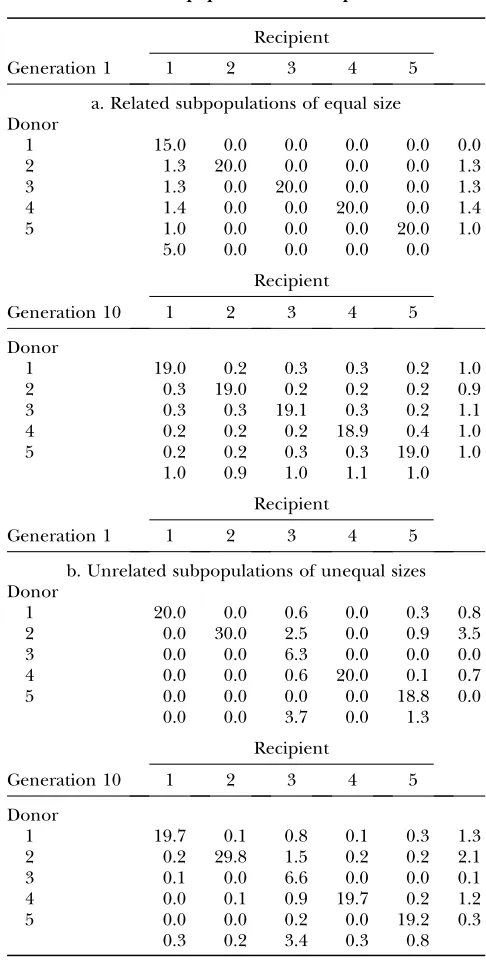
To illustrate the dynamic method proposed, Table 1 shows the average number of offspring and the migra-tion design between subpopulamigra-tions at generamigra-tions 1 and 10 for the case of l ¼ 1, M ¼ 1, and scenarios comprising subpopulations of equal sizes and related individuals (case a) or unequal sizes and unrelated
individuals (case b). In the first scenario (Table 1a), because of the simulation design, individuals of sub-population 1 were much more related to each other and more inbred than those belonging to the other sub-populations. Therefore, as a nonnull weight was given to
TABLE 1
Average number of offspring and migrations between subpopulations in generation 1 and generation 10 under the dynamic management method: scenarios comprising
(a) related subpopulations of equal size and (b) unrelated subpopulations of unequal sizes
Recipient
Generation 1 1 2 3 4 5
a. Related subpopulations of equal size Donor
1 15.0 0.0 0.0 0.0 0.0 0.0
2 1.3 20.0 0.0 0.0 0.0 1.3
3 1.3 0.0 20.0 0.0 0.0 1.3
4 1.4 0.0 0.0 20.0 0.0 1.4
5 1.0 0.0 0.0 0.0 20.0 1.0
5.0 0.0 0.0 0.0 0.0
Recipient
Generation 10 1 2 3 4 5
Donor
1 19.0 0.2 0.3 0.3 0.2 1.0
2 0.3 19.0 0.2 0.2 0.2 0.9
3 0.3 0.3 19.1 0.3 0.2 1.1
4 0.2 0.2 0.2 18.9 0.4 1.0
5 0.2 0.2 0.3 0.3 19.0 1.0
1.0 0.9 1.0 1.1 1.0
Recipient
Generation 1 1 2 3 4 5
b. Unrelated subpopulations of unequal sizes Donor
1 20.0 0.0 0.6 0.0 0.3 0.8
2 0.0 30.0 2.5 0.0 0.9 3.5
3 0.0 0.0 6.3 0.0 0.0 0.0
4 0.0 0.0 0.6 20.0 0.1 0.7
5 0.0 0.0 0.0 0.0 18.8 0.0
0.0 0.0 3.7 0.0 1.3
Recipient
Generation 10 1 2 3 4 5
Donor
1 19.7 0.1 0.8 0.1 0.3 1.3
2 0.2 29.8 1.5 0.2 0.2 2.1
3 0.1 0.0 6.6 0.0 0.0 0.1
4 0.0 0.1 0.9 19.7 0.2 1.2
5 0.0 0.0 0.2 0.0 19.2 0.3
0.3 0.2 3.4 0.3 0.8
within-population coancestry (l ¼ 1), the algorithm determined that the optimal strategy at generation 1 was to replace the highest possible number of individuals of that subpopulation by individuals from the remainder, not recommending migrations between subpopulations 2–5. Note that, in contrast to the one-migrant-per-generation (OMPG) design, the dynamic method allowed for solutions where the number of offspring generated per subpopulation was not equal for all subpopulations. In generation 10 (in fact just after the third generation of management), subpopulations were already homogenized in terms of relationships; i.e., there were similar within- and between-subpopulation coancestries for all subpopulations. Thus, contributions and migrations were equal and regular, converging to a kind of OMPG scheme but with directed migrations instead of a random migration design. When the weight on within-subpopulation coancestry was strongly increased (e.g.,l¼10), coancestry within subpopulations 2–5 had a higher impact on the global solution and, thus, a certain exchange of individuals occurred between those subpo-pulations from generation 1 (results not shown). As a consequence, homogenization of subpopulation 1 took longer (6 generations). Nevertheless, during this period contributions from subpopulation 1 were smaller than those from the others.
In the second scenario (Table 1b), involving un-related subpopulations of different sizes and sex ratios, migrations were not equalized among subpopulations with time, because the source of disequilibrium in the population was the different size and sex ratio of each subpopulation. Thus, some subpopulations (with large size and/or equal numbers of males and females, such as subpopulation 2) were permanent sources of mi-grants, whereas small subpopulations or with skewed sex ratios (such as subpopulation 3) were always net recipients of migrants.
The dynamic nature of the method and its ability to take account of particular changes in the genetic and demographic structure of the population can be seen in Figure 1, which shows the average number of migrants sent and received by a particular subpopulation. The results correspond to a specific simulation where the ‘‘death’’ of half of the individuals of one subpopulation was imposed at generation 5, reflecting a hypothetical situation of a punctual catastrophe in that subpopula-tion. During the previous generations, as all the initial subpopulations were unrelated and noninbred, the number of migrants coming in and out of the sub-population was approximately one. At generation 5 the dynamic method took account of the reduced number of breeders in the subpopulation, trying to prevent an increase in inbreeding by reducing abruptly the number of outgoing migrants and increasing the corresponding number of incoming migrants. The previous equilibrium situation was progressively reached in about five further generations.
An assessment of the performance of the proposed method for all the investigated scenarios in comparison with other management strategies is shown in Tables 2 and 3. Table 2 gives the values of global coancestry (the complement of gene diversity) maintained after 10 gen-erations. Withl¼0 the dynamic method led to large levels of global coancestry,i.e., large losses of gene diver-sity. The reason is that, in this situation, only between-subpopulation coancestry was accounted for, ignoring the diversity stored within subpopulations. For values of
l.0, differences in global coancestry between methods and scenarios were generally low, but the different performance of the methods could be assessed.
For the dynamic strategy, the lowest levels of coances-try were reached forl¼1, as this implies accounting for within- and between-subpopulation coancestry in the same proportion. As expected, the dynamic method produced levels of coancestry similar to those obtained by isolating subpopulations when no migration was allowed (M ¼ 0) and a high value for l (¼ 10) was imposed, as then the between-subpopulation coancestry term of the dynamic method was negligible. Analo-gously, the dynamic method produced levels of coan-cestry similar to those obtained with a single undivided population when unlimited migration was allowed (M¼ 200) andl¼1, in the scenario with equal subpopula-tion sizes. For the scenario with unequal subpopulasubpopula-tion sizes and/or sex ratios, however, the single-population strategy appeared to be more advantageous than the dynamic method because, for unequally subdivided populations, averages under the dynamic method were performed giving the same weight to all subpopulations irrespective of their size. Finally, except for scenarios involvingl¼0, lower values of global coancestry were obtained under the dynamic method and M ¼1 (to make a ‘‘fair’’ comparison) than using the one-migrant-per-generation strategy. This held true, not only for
Figure1.—Average number of individuals sent (solid line)
generation 10, but also for earlier generations, as can be seen in Figures 2 and 3.
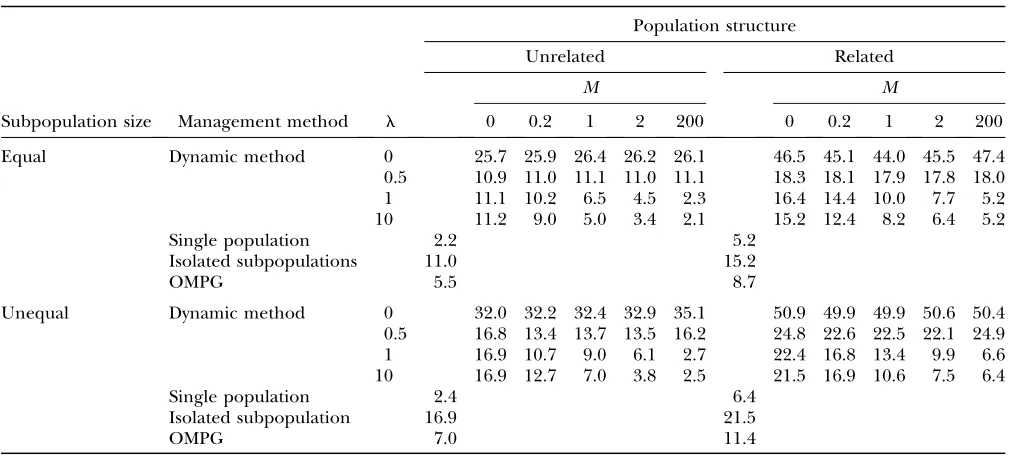
Average values of the inbreeding coefficient for the whole population after 10 generations are shown in Table 3. As expected, the lowest inbreeding levels corresponded to the single-population scenario because of its higher census size, and only with the dynamic method and unlimited migration similar values could be obtained for subdivided populations. Also expectedly, the isolated
populations showed the highest levels of inbreeding, as the only way to avoid inbreeding in this case was to rearrange contributions within subpopulations, with no possibility of exchanging individuals with other subpopulations.
Obviously, the highest levels of inbreeding were found for the dynamic method when within-subpopulation coancestry was not accounted for (l¼0), whatever the limit imposed to the total number of migrants. In this TABLE 2
Global coancestry (percentage) at generation 10 under all management methods for different scenarios
Population structure
Unrelated Related
M M
Subpopulation size Management method l 0 0.2 1 2 200 0 0.2 1 2 200
Equal Dynamic method 0 5.9 6.1 6.1 6.1 6.0 11.0 11.0 10.5 10.7 10.9
0.5 2.9 2.9 2.9 2.9 2.9 6.1 6.1 6.0 6.0 5.9
1 2.9 2.9 3.0 3.0 3.0 6.0 6.0 6.0 6.1 6.0
10 2.9 3.0 3.1 3.2 3.3 6.4 6.3 6.3 6.3 6.2
Single population 3.0 6.0
Isolated subpopulations 2.9 6.4
OMPG 3.4 6.6
Unequal Dynamic method 0 7.4 7.5 7.5 7.6 8.1 12.8 12.6 12.5 12.6 12.6
0.5 4.3 3.9 4.0 4.0 4.4 8.3 8.1 8.0 7.9 8.2
1 4.3 3.8 3.9 3.9 3.7 8.2 7.8 7.8 7.8 7.6
10 4.3 4.2 4.1 4.0 3.8 8.6 8.3 8.1 7.8 7.7
Single population 3.3 7.2
Isolated subpopulations 4.3 8.8
OMPG 4.5 8.8
Standard errors,0.2.
TABLE 3
Average inbreeding levels (percentage) at generation 10 under all management methods for different scenarios
Population structure
Unrelated Related
M M
Subpopulation size Management method l 0 0.2 1 2 200 0 0.2 1 2 200
Equal Dynamic method 0 25.7 25.9 26.4 26.2 26.1 46.5 45.1 44.0 45.5 47.4
0.5 10.9 11.0 11.1 11.0 11.1 18.3 18.1 17.9 17.8 18.0
1 11.1 10.2 6.5 4.5 2.3 16.4 14.4 10.0 7.7 5.2
10 11.2 9.0 5.0 3.4 2.1 15.2 12.4 8.2 6.4 5.2
Single population 2.2 5.2
Isolated subpopulations 11.0 15.2
OMPG 5.5 8.7
Unequal Dynamic method 0 32.0 32.2 32.4 32.9 35.1 50.9 49.9 49.9 50.6 50.4
0.5 16.8 13.4 13.7 13.5 16.2 24.8 22.6 22.5 22.1 24.9
1 16.9 10.7 9.0 6.1 2.7 22.4 16.8 13.4 9.9 6.6
10 16.9 12.7 7.0 3.8 2.5 21.5 16.9 10.6 7.5 6.4
Single population 2.4 6.4
Isolated subpopulation 16.9 21.5
OMPG 7.0 11.4
situation, there was no optimization of contributions within subpopulations, and the optimal strategy found consisted of exchanging a few individuals at the begin-ning to redistribute the individuals’ variation and to avoid exchanging individuals thereafter to keep the lowest between-subpopulation coancestry. For a fixed value ofM, the dynamic method generated lower levels of inbreeding when increasing the weight given to within-subpopulation coancestry (l). However, the re-duction in the observed inbreeding levels mostly oc-curred from l ¼0–10, and little or no improvement could be obtained increasinglfurther. For example, in the scenario with equal sizes andM¼1, inbreeding did not change (at 5.0%) or decreased from only 8.2 to 8.1% when moving froml¼10 tol¼1000.
Forl $1, lower levels of inbreeding were found for a given value of the weighting factor the higher the number of migrants that could be exchanged, as there were more opportunities to rearrange the population. Forl,1 no clear trend was observed as the importance of within-subpopulation coancestry was relaxed, and the degrees of freedom gained with the number of pos-sible migrants were devoted to obtaining lower levels of between-subpopulation coancestry.
The OMPG scheme yielded intermediate inbreeding levels between a single population and isolated sub-populations. When compared with the dynamic method for the appropriate number of migrants (M¼1), the OMPG scheme yielded lower levels of inbreeding than
the dynamic method whenl #1, but this outperformed the OMPG strategy for higher values of the weighting factor (i.e., when an explicit importance is given to coancestry within subpopulations) whatever the sce-nario considered. With the appropriate weighting value the advantage of the dynamic method over OMPG held for the whole considered period (see Figures 2 and 3). Somewhat surprisingly, even in the most equilibrated situation (equal/unrelated) the dynamic method began yielding lower levels of inbreeding in a few generations. Thus, the method was able to detect small differences between subpopulations that occurred by chance, cor-recting them by making the optimal exchanges rather than random migrations, as in the OMPG strategy. For example, under the OMPG design it may happen that migration occurs between the same subpopulations several generations by chance, inducing an increase in inbreeding. In contrast, the dynamic method can detect this situation and avoid the repetition of exchanges.
The patterns observed for the differentiation between populations (FST) were very similar to those of
inbreed-ing presented in Table 3 and, therefore, are not shown.
DISCUSSION
Managing subdivided populations in the context of conservation programs implies a compromise of three different factors: first, the maintenance of the highest possible levels of genetic diversity for the whole set of
Figure2.—Average global expected heterozygosity (left) and inbreeding levels (F, right) plotted against generations for
subpopulations; second, the preservation of the ge-netic differentiation between subpopulations, as they could be the consequence of worthy local adapta-tions; and third, the restriction of the levels of within-subpopulation diversity, because of the implication of inbreeding on productive and fitness-related traits. The first two factors (i.e., global diversity and differentiation) would be optimized if the subpopulations are com-pletely isolated, but then levels of inbreeding (the third factor) would increase beyond acceptable levels. The way of coping with the dilemma of an increased in-breeding level when maximizing the global genetic diversity is allowing for some gene flow, by forcing the exchange of individuals between groups. Most theory about the effects of migration has been constructed around Wright’s island model. One of the practical conclusions from those studies was the OMPG rule that states that receiving (sending) on average one migrant per generation and per subpopulation is enough to keep a certain degree of differentiation but reduces the rate of inbreeding induced in each subpopulation. Beyond cor-rections for the departures from the assumptions of the island model (Mills and Allendorf 1996; Wang
2004a), the main problem of the OMPG strategy is that the number of exchanged individuals and the particular scheme of movements are independent of the genetic structure of the whole population. Performing OMPG in a regular framework (e.g., under circular exchange of individuals) has been claimed to be useful in the control of inbreeding in subdivided populations (see Honda
et al. 2004), but some simulations run under such a
scheme have shown no differences with a random OMPG design (data not shown).
By generalizing the optimum management proce-dure for single populations, we derived a dynamic management method that allows for optimizing the individuals’ contribution by minimizing the whole-population coancestry. The method takes account of both within- and between-subpopulation components of coancestry (with variable weights depending on the importance desired for each one) and, at the same time, provides the optimum scheme of migrations, being able to control the total number of movements if required. For all the considered scenarios (regarding the relation-ship between subpopulations and their censuses and sex ratios), values of l could be found for which the dynamic method outperformed the OMPG strategy for the same number of migrants allowed each generation (M ¼ 1). Thus, less inbreeding, more global gene diversity (expected heterozygosity), and more differen-tiation could be maintained with the dynamic method than with the OMPG method. The reason is threefold. First, OMPG assumes constant contributions of each sub-population, whereas the dynamic method can penalize/ favor particular subpopulations because of their genetic structure. Second, OMPG forces the same migration rate from/to every subpopulation, whereas the dynamic method is able to detect ‘‘peculiar’’ populations, redi-recting the migration flow to/from them. This is particularly important to correct for ‘‘historical’’ events
Figure3.—Average global expected heterozygosity (left) and inbreeding levels (F, right) plotted against generations for scenarios
(that occurred before the program started) and for disequilibria occurring along generations (‘‘structural’’ demographic differences, punctual catastrophes, etc.). Finally, particular individuals’ contributions were de-cided independently within each subpopulation, not accounting for the relationship between subpopulations (it must be remembered that in our simulations we implemented the OMPG design including optimal contributions within subpopulations, for the sake of a fair comparison of methods). In contrast, under the dynamic method contributions of individuals are influ-enced by their coancestry with individuals from all subpopulations, optimizing the global genetic diversity even if no migration is allowed.
Another advantage of the proposed method over the classical OMPG strategy is that it allows us to work with actual numbers of migrants. Solutions provided are real numbers of individuals to move from one subpopulation to another and there is no need to deal with the concept of effective number of migrants and then translate it to an actual number depending on the detected deviations from the original island model. Moreover, when re-ferring to the differentiation between subpopulations, the values ofFSTmaintained by OMPG are influenced by
deviations from the ideal model (Wang2004a). Under
the dynamic method there is no need to detect/de-termine what those departures are and correct for them, but knowing just the desired level of differentiation and the genetic relationship between individuals.
Due to the implemented strategy (optimization of the contributions to the next generation), the proposed methodology does not ensure finding the best result in the long-term horizon, in terms of either global diversity or the average inbreeding levels. However, the one-generation-at-a-time approach is very valuable because of its dynamic nature, allowing us to make decisions accounting for the particular situation (i.e., degree of relationship between groups, levels of inbreeding at each of them, etc.) at each time.
The proposed method offers the possibility of control-ling/fixing the most demanding parameter (global gene diversity or coancestry; inbreeding, if inbreeding de-pression is important; or differentiation, if local adapta-tion exists), by including an upper (lower) bound to that parameter and optimizing the other two. If the factor to be controlled were the differentiation between sub-populations, a restriction on the common measure, FST, could be imposed. Because there is a simple
relation-ship betweenFSTand the measures of coancestry,FST¼
ð˜ffÞ=ð1fÞ(e.g., Caballeroand Toro2002), where
˜fis the mean coancestry within subpopulations and f is the global coancestry for the whole population, the method can be applied constraining the desired levels of within- and between-subpopulation coancestry that fit the desiredFST.
It is worth noting that, under the dynamic method, decisions on the contributions of individuals in a
par-ticular subpopulation are influenced by individuals from the other subpopulations and, thus, there is a possibility of global management even when no migra-tion is allowed. This can be clearly seen for values ofl #
1, where the dynamic strategy kept levels of inbreeding (and FST) higher than the scheme with isolated
sub-populations. For example, for the case of equal/un-related scenarios,l¼0 and M¼0, theFSTunder the
dynamic method was 0.26, whereas that for isolated subpopulations was 0.12 (see also Table 3). The reason is that differentiation between isolated subpopulations occurred just by drift, whereas under the dynamic method with low values of l (i.e., giving more impor-tance to between-subpopulation coancestries), contri-butions were optimized to increase differences between groups (whether migrations occurred or not).
For situations with unknown pedigree, Wang(2004b)
developed a system where within- and between-subpopulation coancestry was estimated only on the basis of demographic/historical data. Within the frame-work presented here, Wang’s formulation would be equiv-alent to using the dynamic method with a coancestry matrix carrying the same value for all pairs of indi-viduals within the same subpopulation and the same relationship for all possible couples from individuals of two different subpopulations. However, the consider-ation of differentiated coancestries, taken from the knowledge of individual genealogical relationships, should allow for a better exploitation of the available information and, therefore, for a more precise control of the parameters of interest.
Due to the availability of an increasingly large number of markers, a possible strategy would be to use molecular information to reconstruct as far as possible the pedi-gree or to calculate molecular measures of coancestry on which to base decisions. This latter strategy deserves a deeper investigation, as well as evaluation of the in-fluence of other factors such as different mating systems or the possibility of making decisions on a fixed number of already born individuals, instead of optimizing parents’ contributions beforehand. The effect of the management method on the fitness of the populations and on the expression of other possible traits of interest subject to selection should also be investigated.
The authors thank two anonymous referees for useful comments. This work was funded by the Instituto Nacional de Investigacio´n y Tecnologı´a Agraria y Alimentaria, Spain (project CPE03-004-C2) and the Ministerio de Educacio´n y Ciencia, Spain (project CGL2006-13445-C02/BOS).
LITERATURE CITED
Allendorf, F. W., and G. Luikart, 2007 Conservation and the Genetics
of Populations.Blackwell Publishing, Malden, MA.
Ballou, J., and R. Lacy, 1995 Identifying genetically important
individuals for management of genetic variation in pedigreed populations, pp. 76–111 inPopulation Management for Survival and Recovery, edited by J. D. Ballou, M. Gilpinand T. J. Foose.
Bennewitz, J., and T. H. E. Meuwissen, 2005 Estimation of
extinc-tion probabilities of five German cattle breeds by populaextinc-tion viability analysis. J. Dairy Sci.88:2949–2961.
Caballero, A., and M. A. Toro, 2000 Interrelations between
effec-tive population size and other pedigree tools for the manage-ment of conserved populations. Genet. Res.75:331–343. Caballero, A., and M. A. Toro, 2002 Analysis of genetic diversity
for the management of conserved subdivided populations. Con-serv. Genet.3:289–299.
Falconer, D. S., and T. F. C. Mackay, 1996 An Introduction to
Quan-titative Genetics, Ed. 4. Longman, Harlow, UK.
Ferna´ ndez, J., and M. A. Toro, 1999 The use of mathematical
pro-gramming to control inbreeding in selection schemes. J. Anim. Breed. Genet.116:447–466.
Frankham, R., J. D. Ballouand D. A. Briscoe, 2002 Introduction to
Conservation Genetics. Cambridge University Press, Cambridge, UK.
Grundy, B., B. Villanuevaand J. A. Woolliams, 1998 Dynamic
se-lection procedures for constrained inbreeding and their conse-quences for pedigree development. Genet. Res.72:159–168. Honda, T., T. Nomuraand F. Mukai, 2004 Reduction of inbreeding
in commercial females by rotational mating with several sire lines. Genet. Sel. Evol.36:509–526.
Kirkpatrick, S., C. D. Gelattand M. P. Vecchi, 1983 Optimization
by simulated annealing. Science220:671–680.
Meuwissen, T. H. E., 1997 Maximizing the response of selection
with a predefined rate of inbreeding. J. Anim. Sci.75:934–940. Mills, L. S., and F. W. Allendorf, 1996 The
one-migrant-per-generation rule in conservation and management. Conserv. Biol. 10:1509–1518.
Toro, M. A., and A. Caballero, 2005 Characterisation and
conser-vation of genetic diversity in subdivided populations. Philos. Trans. R. Soc. Ser. B360:1367–1378.
Toro, M. A., J. Ferna´ ndezand A. Caballero, 2008 Molecular
char-acterization of breeds and its use in conservation. Livest. Sci. (in press).
Wang, J., 2004a Application of the one-migrant-per-generation rule
in conservation and management. Conserv. Biol.18:332–343. Wang, J., 2004b Monitoring and managing genetic variation in
group breeding populations without individual pedigrees. Con-serv. Genet.5:813–825.
Wang, J., and A. Caballero, 1999 Developments in predicting the
effective size of subdivided populations. Heredity82:212–226. Wright, S., 1931 Evolution in Mendelian populations. Genetics16:
97–159.
Wright, S., 1951 The genetic structure of populations. Ann. Eugen.
15:323–354.