1041
Using the Fuzzy Grey Relational Analysis Method in Wastewater
Treatment Process Selection
Abdolreza Karimi
1, Behrouz Ahmadpour
2, Mohammad Reza Marjani
*31) Department of Civil Engineering, Qom University of Technology, Qom, Iran 2)Department of Civil Engineering, Qom University of Technology, Qom, Iran 3)Department of Industrial Engineering, Qom University of Technology, Qom, Iran *Author for Correspondence:[email protected]
Received: 26 Apr. 2017, Revised: 30 Dec. 2017, Accepted: 28 Jan. 2018
ABSTRACT
Due to the variety of treatment processes, the decision to choose the best treatment process is difficult. This paper describes a fuzzy grey relational analysis (GRA) method for selection of the optimal wastewater treatment process. The rating of all alternatives and the weight of each criterion is described by linguistic variables, which can be expressed in triangular fuzzy numbers. Then, a vertex method is used to calculate the distance between two triangular fuzzy numbers. According to the concept of the GRA, a fuzzy relative relational degree is defined to determine the ranking order of all alternatives by calculating the degree of fuzzy grey relational coefficient to both the fuzzy positive ideal solution (FPIS) and fuzzy negative ideal solution (FNIS) simultaneously. Furthermore, a case study is carried out and solved by both methods (i.e., GRA and fuzzy GRA) to show the feasibility and effectiveness of the proposed method. In the case study, five anaerobic wastewater treatment alternatives are evaluated and compared against technical, economic, environmental and administrative criteria and their sub-criteria. Finally, the related results of ranking alternatives from two methods are compared with each other's. By using both Fuzzy GRA and GRA, ABR process has been selected as the first priority and the best anaerobic process. The frequency count assessment of the Iran's industrial parks' WWTPs which have used this method and their performance, proved the priority of this method.
Key words:
Decision Making, Fuzzy, Grey Relational Analysis, Multi-Criteria, SelectionList of Abbrivation
GRA: Grey Relational Analysis FGRA: Fuzzy Grey Relational Analysis FPIS: Fuzzy Positive Ideal Solution FNIS: Fuzzy Negative Ideal Solution MCDM: Multi-Criteria Decision Making DMs: Decision Makers
WWTP: Wastewater Treatment Plant WWT: Wastewater Treatment
UASB: Up-flow Anaerobic Sludge Blanket UAFB: Up-flow Anaerobic Fixed Bed Reactor ABR: Anaerobic Baffled Reactors
INTRODUCTION
Recently, public knowledge about water scarcity and pollution has improved. Also relevant laws and regulations have become stringent. Therefore, the number of wastewater treatment facilities are rising. In this context, the selection of the wastewater treatment process is a challenging; hence, knowledge from experts, researches, engineers and operators is necessary [1].
Due to the variety of treatment processes and effective parameters, existence of sustainability assessment
1042
The scenario-based decision making systems, reduce selection complexity of appropriate wastewater treatment processes [2]. Selecting the best wastewater treatment process is depended on various factors that usually are done by using separate ways for the true assessment of multi-criteria evaluation [3]. In traditional MCDM methods, the ratings and weights of the criteria are known precisely [4-5]. In general, decision maker’s judgments are often uncertain and cannot be estimated by an exact numerical value. Thus, the selection problem has many uncertainties and difficulties.
The grey system theory developed by Deng [6] has been widely applied to various fields, such as engineering prediction and control, social and economic system management, and environmental system decision making [7-9]. It has been proven to be useful for dealing with poor, incomplete and uncertain information.
Several authors have been applied some MCDM methods and the fuzzy set theory to deal with the selection problem. Zhang and Liu proposed an intuitionist fuzzy MCDM with grey relational analysis for personnel selection problem [10]. In another study, a fuzzy multi-criteria approach is used to allocate the best landfill disposal site among the given alternative sites [11].
In this analysis, environmental, economic and technical issues in both quantitative (e.g. cost and place requirements) and qualitative (e.g. flexibility and impact) scales are considered. However, some parameters like reliability are positive whereas others are negative, such as effects. In evaluating method, differences must be considered.
Higher reliability, has higher score in the ranking of this parameter, while higher impacts obtains a lower score for this parameter [1].
Selection of an appropriate treatment process is an important issue before designing and implementing any wastewater treatment plant (WWTP). MCDM techniques are generally enabled to structure the problem clearly and systematically. With this characteristic, the decision makers (DMs) have the possibility to easily examine and scale the problem in accordance with their requirements [12].
The DMs face up to the uncertainty and vagueness from subjective perceptions and experiences in the decision-making process [13]. The vagueness and inadequacies which are related to the conventional methods, especially in the process selection, made researchers use fuzzy MCDM methods.
At first grey relational analysis (GRA) was introduced by Deng [14] and its applications were emerged in different MADAM problems [15 - 17].
Users may be more willing to accept a solution coming from the GRA since the idea of GRA is intuitively
similar to human problem-solving behavior and hence may be easier for non-technical users to understand it [18].
The grey theory is one of the new mathematical theories born out of the concept of the grey set. It is an effective method used to solve uncertainty problems with discrete data and incomplete information. Generally, the grey numbers and variables present a system with uncertain information which in technical terminology the whole system is called a grey system. The concept of a grey system is illustrated in Fig.1.
Fig.1: The concept of a grey system (Lee et al.)
The GRA method has been used in many studies. In many situations, the preference information on criteria is uncertain and inconsistent, so a grey possibility degree is presented to select the ideal alternative based on grey numbers. This method is very suitable for solving the group decision-making problem in an uncertain environment [19]. The GRA method is to analyze the relational grade for discrete sequences. It uses information from the grey system to dynamically compare each factor quantitatively. The GRA is one of the major directions among the current applications of the grey system theory. It has been proven to be useful for dealing with poor, incomplete and uncertain information. The grey relational grade indicates the degree of similarity between the comparability sequence and the reference sequence [20].
The paper is organized as follows. Firstly, the GRA and fuzzy GRA methods have been described. Secondly, the case study problem is explained, and the alternatives and the criteria have been determined. Finally, the application of these methods for selecting the best anaerobic wastewater treatment process based on the field studies in Iran's industrial estates is described and the related results of these two methods are discussed and compared.
MATERIALS AND METHODS
1043
also called the grey relational generating. According to these normalized experimental data, a reference sequence (ideal target sequence) is defined. Then, the grey relational coefficients between all comparability sequences and the reference sequence are calculated. To this end, the grey relational grade was estimated based on these grey relational coefficients which were between the source (reference) sequence and each comparability sequence. If a comparability sequence from an option has the highest grey relational grade, that option will be the best choice [22]. The procedures of grey relational analysis are illustrated in Fig. 2.
Fig. 2: Procedure of the grey relational analysis (Kuo et al.) The likeness between the dependent feature and the independent feature are the most determining, especially when FGRA is used in the case of selecting the most predictive features. The features that have high similarity will set up the optimal feature set. The FGRA is also used to retrieve the nearest projects to the reference project by measuring the similarity degree between the reference project and all other comparative projects.
Grey relational analysis
The GRA procedure is as Cheng and Wang [23] that a higher grey relational grade indicates that the compared sequence is the most similar to the reference sequence. The procedure of the GRA method is as follow:
Step 1: A committee of decision makers is formed and the criteria weights of alternatives are identified. Assume that a decision group has K persons, and then the criteria weight of criterion j can be calculated by:
K
j j
j
j
w
w
w
K
w
1
1 2...
(1)
Where,
K j
w
(j = 1, 2 . . . n) is the criterion weight of the Kth DMs and can be described by grey number
K
j K j K
j
w
w
w
,
Step 2: The criteria rating value can be calculated by:
1Fuzzy Positive Ideal Solution
K
ij ij
ij
ij
G
G
G
K
G
1
1 2...
(2)
Step 3: Establish the grey decision matrix.
mn m
m
n n
G G
G
G G
G
G G
G
D
2 1
2 21
21
1 12
11
(3)
Step 4: Normalize the grey decision matrix.The normalization method is to preserve the property that the ranges of the normalized grey umber belong to [0, 1].
Step 5: Establish the weighted normalized grey decision matrix.
Step 6: Make the ideal alternative as a referential alternative.
Step 7: Calculate the grey possibility degree between compared alternatives set and ideal referential alternative.
Step 8: Rank the order of alternatives.
Fuzzy grey relational analysis
The procedure of the fuzzy grey relational analysis with an algorithm of multi-person MCDM with a fuzzy set approach is given as follows.
Step 1: Assume that a decision group has K persons. So, the importance of the criteria and the rating of alternatives with respect to each criterion can be calculated by:
𝒳̃𝑖𝑗 =𝐾1(𝒳̃𝑖𝑗1 + 𝒳̃𝑖𝑗2+ ⋯ + 𝒳̃𝑖𝑗𝐾),𝒲̃𝑗 =𝐾1(𝒲̃𝑗1+
𝒲̃𝑗2+ ⋯ + 𝒲̃𝑗𝐾)
(4)
The fuzzy problem can be concisely expressed in a
matrix format that
x
ij~
and
w
j~
are linguistic variables that can be described by triangular fuzzy numbers,
U
ij M ij L ij
ij a a a
x , ,
~
and
U j M j L j
j
w
w
w
w
~
,
,
.
Step 2: The normalized fuzzy decision matrix is
obtained as denoted byR~.
𝑅̃ = [𝑟̃
𝑖𝑗]
𝑚∗𝑛= [𝑟
𝑖𝑗𝐿, 𝑟
𝑖𝑗𝑀, 𝑟
𝑖𝑗𝑈]
𝑚∗𝑛(5)
Step 3: The weighted normalized fuzzy decision matrix can be used in the following equation considering the different importance of each criterion. 𝑌̃ = [𝑦̃𝑖𝑗]𝑚×𝑛 = [𝑟̃𝑖𝑗× 𝑤̃𝑗]𝑚×𝑛 , i=1, 2… m; j=1, 2…
n (6)
Step 4: Defining the (FPIS1, Y+) and (FNIS2, Y-) as:
n
y
y
y
Y
~
1,
~
2,
...
,
~
,
n
y
y
y
Y
~
1,
~
2,
...
,
~
(7)
2Fuzzy Negative Ideal Solution
Grey relational generating
Reference sequence definition
Grey relational coefficients calculation
1044
Where, 𝑦̃𝑗+= (
max
i 𝑦𝑖𝑗𝐿 , i
max
𝑦𝑖𝑗𝑀, imax
𝑦𝑖𝑗𝑈 ) and
𝑦̃𝑗+= ( i
max
𝑦𝑖𝑗𝐿 , imax
𝑦𝑖𝑗𝑀, imax
𝑦𝑖𝑗𝑈 )Step 5: Calculating the fuzzy grey relational coefficient of each alternative from FPIS and FNIS using the following equation, respectively. Where the
identification coefficient
0.5.Step 6: Using FPIS and FNIS the following equation can be written to determine the degree of the fuzzy grey relational coefficient of each alternative.
nj ij i
n
11
,
nj ij i
n
11
, i=1, 2, …, m. (8) Step 7: Calculating the fuzzy relative relational degree of each alternative from FPIS by using the following equation.
)
/(
i i ii
C
, i=1, 2… m. (9)
Step 8: According to the fuzzy relative relational degree, the ranking order of all alternatives can be determined. If any alternative has the highest Ci value, then it is the most important alternative.
RESULTS
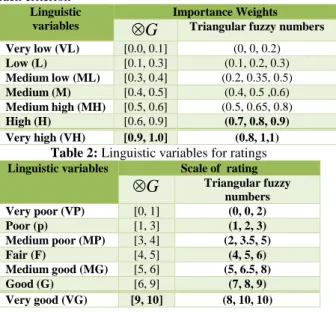
Assume that A= {A1, A2,... Am} is a discrete set of m possible process options, C= {C1, C2, ..., Cn} is a set of n criteria and W is the vector of criteria weights. In this paper, the criteria weights, and ratings of options are considered as linguistic variables, grey number a triangular fuzzy number. Here, these linguistic variables expressed by the 1–7 scale as shown in Table 1. The criteria ratings also expressed as shown in Table 2.
w
w
w
n
G
1,
2,...,
In the case study, the selection of the best anaerobic wastewater treatment process, based on the wastewater treatment plants conditions that are in operation in Iran's industrial estates is considered. The process selection criteria have been issued on the basis
of objectivity in industrial estates and consist of technical, economic, environmental and administrative criteria. The alternatives include five anaerobic treatment processes, which are operating in Iran industrial estates. These are as follows:
1) Up-flow Anaerobic Sludge Blanket (UASB) operating in 9 industrial estates in Iran;
2) Up-flow Anaerobic Fixed Bed Reactor (UAFB), operating with 7 reactors currently;
3) Anaerobic Baffled Reactors (ABR) used as an anaerobic system of many treatment plants in Iran's industrial estates;
4) Contact anaerobic process operating as an anaerobic system of one of Industrial estate's treatment plant successfully, and designing in some other estates; and 5) Anaerobic lagoons operating in some wastewater treatment plants of industrial estates in Iran.
Grey Relational Analysis Method
To solve the problem with this method following steps has been done:
Step 1: Three decision-makers (DMs) evaluate the importance of criteria by using the linguistic variables, as described in Table 1. The importance weights of the criteria as grey numbers are shown in Table 3. Table 1: Linguistic variables for the importance weight of each criterion
Linguistic variables
Importance Weights
G
Triangular fuzzy numbers Very low (VL) [0.0, 0.1] (0, 0, 0.2)Low (L) [0.1, 0.3] (0.1, 0.2, 0.3)
Medium low (ML) [0.3, 0.4] (0.2, 0.35, 0.5)
Medium (M) [0.4, 0.5] (0.4, 0.5 ,0.6)
Medium high (MH) [0.5, 0.6] (0.5, 0.65, 0.8)
High (H) [0.6, 0.9] (0.7, 0.8, 0.9) Very high (VH) [0.9, 1.0] (0.8, 1,1)
Table 2: Linguistic variables for ratings Linguistic variables Scale of rating
G
Triangular fuzzynumbers Very poor (VP) [0, 1] (0, 0, 2)
Poor (p) [1, 3] (1, 2, 3)
Medium poor (MP) [3, 4] (2, 3.5, 5)
Fair (F) [4, 5] (4, 5, 6)
Medium good (MG) [5, 6] (5, 6.5, 8)
Good (G) [6, 9] (7, 8, 9)
Very good (VG) [9, 10] (8, 10, 10)
Table 3: Criteria weights for alternatives
Criteria
G
of linguistic variables Grey numbers (
G
)DM1 DM2 DM3
Technical [0.90, 1.00] [0.60, 0.90] [0.90, 1.00] [0.80, 0.97]
Economical [0.60, 0.90] [0.60, 0.90] [0.60, 0.90] [0.60, 0.90]
Environmental [0.60, 0.90] [0.60, 0.90] [0.50, 0.60] [0.57, 0.80]
Administrative [0.50, 0.60] [0.50, 0.60] [0.60, 0.90] [0.53, 0.70]
Step 2: Linguistic variables which are presented in Table 2 have been used for rating of alternatives assessment regarding to each criterion. Grade of 5
alternatives have been issued according to 4 criterions which are presented in Table 4.
1045
Criteria Alternatives
G
of Linguistic Variables Grey Number
(Cj) (Ai) DM1 DM2 DM3
ij
G
Technical
UASB [5, 6] [5, 6] [6, 9] [5.33, 7.00]
UAFB [6, 9] [6, 9] [6, 9] [6.00, 9.00]
ABR [5, 6] [6, 9] [6, 9] [5.67, 8.00]
Contact Process [6, 9] [5, 6] [5, 6] [5.33, 7.00]
Anaerobic Lagoon [6, 9] [6, 9] [6, 9] [6.00, 9.00]
Economical
UASB [6, 9] [6, 9] [6, 9] [6.00, 9.00]
UAFB [6, 9] [6, 9] [6, 9] [6.00, 9.00]
ABR [9, 10] [9, 10] [9, 10] [9.00, 10.0]
Contact Process [5, 6] [5, 6] [5, 6] [5.00, 6.00]
Anaerobic Lagoon [4, 5] [4, 5] [4, 5] [4.00, 5.00]
Environmental
UASB [6, 9] [5, 6] [6, 9] [5.67 ,7.00]
UAFB [6, 9] [6, 9] [6, 9] [6.00, 9.00]
ABR [5, 6] [5, 6] [6, 9] [5.33,7.00]
Contact Process [5, 6] [5, 6] [5, 6] [5.00, 6.00]
Anaerobic Lagoon [4, 5] [4, 5] [4, 5] [4.00, 5.00]
Administrative
UASB [4, 5] [4, 5] [5, 6] [4.33,5.33]
UAFB [5, 6] [5, 6] [5, 6] [5.00, 6.00]
ABR [5, 6] [6, 9] [6, 9] [5.67, 8.00]
Contact Process [5, 6] [6, 9] [5, 6] 5.33, 7.00]
Anaerobic Lagoon [6, 9] [5, 6] [6, 9] [5.67, 8.00]
Step 3: The grey decision matrix is established by linguistic variables based on the grey number, as follow.
00 . 8 , 67 . 5 00 . 5 , 00 . 4 00 . 5 , 00 . 4 00 . 9 , 00 . 6
00 . 7 , 33 . 5 00 . 6 , 00 . 5 00 . 6 , 00 . 5 00 . 7 , 33 . 5
00 . 8 , 67 . 5 00 . 7 , 33 . 5 0 . 10 , 00 . 9 00 . 8 , 67 . 5
00 . 6 , 00 . 5 00 . 9 , 00 . 6 00 . 9 , 00 . 6 00 . 9 , 00 . 6
33 . 5 , 33 . 4 00 . 8 , 67 . 5 00 . 9 , 00 . 6 00 . 7 , 33 . 5
D
Step 4: Normalize the grey decision matrix is created as the result is illustrated in Table 5.
Table 5: Grey normalized decision table Alternatives Technical
(C1)
Economical (C2)
Environmental (C3)
Administrative (C4)
UASB [0.59, 0.78] [0.60, 0.90] [0.63, 0.89] [0.54, 0.67]
UAFB [0.67, 1.00] [0.60, 0.90] [0.67, 1.00] [0.63, 0.75]
ABR [0.63, 0.89] [0.90, 1.00] [0.59, 0.78] [0.71, 1.00]
Contact Process [0.59, 0.78] [0.50, 0.60] [0.56, 0.67] [0.67, 0.88]
Anaerobic Lagoon [0.67, 1.00] [0.40, 0.50] [0.44, 0.56] [0.71, 1.00]
The normalization method mentioned above is to preserve the property that the ranges of the normalized grey umber belong to [0, 1].
Step 5: Establish the weighted normalized grey decision matrix. With considering, the weighted normalized grey decision matrix is calculated and the results are shown in Table 6.
[0.80,0.97][0.60,0.90][0.57,0.80][0.53,0.70]
wj
Step 6: The ideal alternative is made as a referential alternative as follow.
[0.53,0.97][0.54,0.90] [0.38,0.80][0.38,0.70]
max
A
Step 7: Calculate the grey possibility degree between compared alternatives set A= {A1, A2, A3, A4, A5}
and ideal referential alternative
A
max.
n
j
j ij
i P V G
n A
A P
1
max
max 1
1046
A Amax
0.688P UASB
A
A
max
0
.
595
P
UAFB
max
0.561A A
P ABR
A Amax
0.765P CP
max
0.765A A
P AnL
Table 6: Grey weighted normalized decision table
Alternatives Technical (C1) Economical (C2) Environmental (C3) Administrative (C4)
UASB [0.47, 0.75] [0.36, 0.81] [0.36, 0.71] [0.29, 0.47]
UAFB [0.53, 0.97] [0.36, 0.81] [0.38, 0.80] [0.33, 0.53]
ABR [0.50, 0.86] [0.54, 0.90] [0.34, 0.62] [0.38, 0.70]
Contact Process [0.47, 0.75] [0.30, 0.54] [0.32, 0.53] [0.35, 0.61]
Anaerobic Lagoon [0.53, 0.97] [0.24, 0.45] [0.25, 0.44] [0.38, 0.70]
Step 8: Rank the order of alternatives. When
max
i
P A A
is smaller, the ranking order of Ai is better. According to this method, the ABR process is the best anaerobic process and the ranking order of processes is as:
ABR > UAFB > UASB > Contact process = Anaerobic lagoon
Fuzzy Grey Relational Analysis Method
Three DMs evaluate the importance of criteria by using the linguistic variables shown in Table 1. The importance weights of the criteria are shown in Table 7.
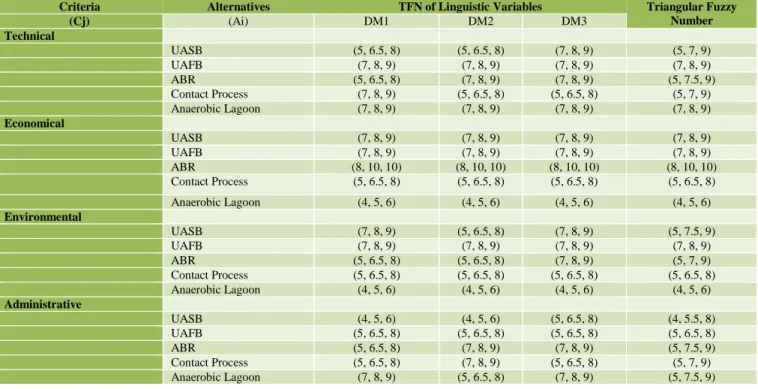
Linguistic variables which are presented in Table 2 have been used for rating of alternatives assessment regarding to each criterion. Regarding to mentioned baselines, grade of 5 alternatives have been issued according to 4 criterions which are presented in Table 8.
Table 7: Importance weight of criteria from three decision-makers
Criteria Linguistic variables Triangular fuzzy numbers
DM1 DM2 DM3
Technical (0.80, 1.00,1.00) (0.70, 0.80,0.90) (0.80, 1.00, 1.00) (0.70, 0.93, 1.00)
Economical (0.70, 0.80, 0.90) (0.70, 0.80, 0.90) (0.70, 0.80, 0.90) (0.70, 0.80, 0.90)
Environmental (0.70, 0.80, 0.90) (0.70, 0.80, 0.90) (0.50, 0.65, 0.80) (0.50, 0.75, 0.90)
Administrative (0.50, 0.65, 0.80) (0.50, 0.65, 0.80) (0.70, 0.80, 0.90) (0.50, 0.70, 0.90)
Table 8: Criteria rating value for alternatives
Criteria Alternatives TFN of Linguistic Variables Triangular Fuzzy
Number
(Cj) (Ai) DM1 DM2 DM3
Technical
UASB (5, 6.5, 8) (5, 6.5, 8) (7, 8, 9) (5, 7, 9)
UAFB (7, 8, 9) (7, 8, 9) (7, 8, 9) (7, 8, 9)
ABR (5, 6.5, 8) (7, 8, 9) (7, 8, 9) (5, 7.5, 9)
Contact Process (7, 8, 9) (5, 6.5, 8) (5, 6.5, 8) (5, 7, 9)
Anaerobic Lagoon (7, 8, 9) (7, 8, 9) (7, 8, 9) (7, 8, 9)
Economical
UASB (7, 8, 9) (7, 8, 9) (7, 8, 9) (7, 8, 9)
UAFB (7, 8, 9) (7, 8, 9) (7, 8, 9) (7, 8, 9)
ABR (8, 10, 10) (8, 10, 10) (8, 10, 10) (8, 10, 10)
Contact Process (5, 6.5, 8) (5, 6.5, 8) (5, 6.5, 8) (5, 6.5, 8)
Anaerobic Lagoon (4, 5, 6) (4, 5, 6) (4, 5, 6) (4, 5, 6)
Environmental
UASB (7, 8, 9) (5, 6.5, 8) (7, 8, 9) (5, 7.5, 9)
UAFB (7, 8, 9) (7, 8, 9) (7, 8, 9) (7, 8, 9)
ABR (5, 6.5, 8) (5, 6.5, 8) (7, 8, 9) (5, 7, 9)
Contact Process (5, 6.5, 8) (5, 6.5, 8) (5, 6.5, 8) (5, 6.5, 8)
Anaerobic Lagoon (4, 5, 6) (4, 5, 6) (4, 5, 6) (4, 5, 6)
Administrative
UASB (4, 5, 6) (4, 5, 6) (5, 6.5, 8) (4, 5.5, 8)
UAFB (5, 6.5, 8) (5, 6.5, 8) (5, 6.5, 8) (5, 6.5, 8)
ABR (5, 6.5, 8) (7, 8, 9) (7, 8, 9) (5, 7.5, 9)
Contact Process (5, 6.5, 8) (7, 8, 9) (5, 6.5, 8) (5, 7, 9)
1047
The proposed method is currently applied to solve this problem and the computational procedure is summarized as follows:
Step 1: Converting the linguistic evaluation into triangular fuzzy numbers to construct the fuzzy
decision matrix
X
~
and determine the fuzzy weight ofeach criterion as matrixW~.
67 . 8 , 50 . 7 , 33 . 6 00 . 6 , 00 . 5 , 00 . 4 00 . 6 , 00 . 5 , 00 . 4 00 . 9 , 00 . 8 , 00 . 7 00 . 9 , 00 . 8 , 00 . 7 00 . 8 , 50 . 6 , 00 . 5 00 . 8 , 50 . 6 , 00 . 5 33 . 8 , 00 . 7 , 67 . 5 67 . 8 , 50 . 7 , 33 . 6 33 . 8 , 00 . 7 , 67 . 5 0 . 10 , 0 . 10 , 00 . 8 67 . 8 , 50 . 7 , 33 . 6 00 . 8 , 50 . 6 , 00 . 5 00 . 9 , 00 . 8 , 00 . 7 00 . 9 , 00 . 8 , 00 . 7 00 . 9 , 00 . 8 , 00 . 7 33 . 8 , 00 . 7 , 67 . 5 33 . 8 , 00 . 7 , 67 . 5 00 . 9 , 00 . 8 , 00 . 7 33 . 8 , 00 . 7 , 67 . 5 ~ X
0
.
80
,
1
.
00
,
1
.
00
0
.
57
,
0
.
70
,
0
.
83
0
.
73
,
0
.
87
,
0
.
93
0
.
63
,
0
.
75
,
0
.
87
~
W
Step 2: Constructing the normalized fuzzy decision matrix as
R
~
.
96 . 0 , 83 . 0 , 70 . 0 67 . 0 , 56 . 0 , 44 . 0 60 . 0 , 50 . 0 , 40 . 0 00 . 1 , 89 . 0 , 78 . 0 00 . 1 , 89 . 0 , 78 . 0 89 . 0 , 72 . 0 , 56 . 0 80 . 0 , 65 . 0 , 50 . 0 93 . 0 , 78 . 0 , 63 . 0 96 . 0 , 83 . 0 , 70 . 0 93 . 0 , 78 . 0 , 63 . 0 00 . 1 , 00 . 1 , 80 . 0 96 . 0 , 83 . 0 , 70 . 0 89 . 0 , 72 . 0 , 56 . 0 00 . 1 , 89 . 0 , 78 . 0 90 . 0 , 80 . 0 , 70 . 0 00 . 1 , 89 . 0 , 78 . 0 93 . 0 , 78 . 0 , 63 . 0 93 . 0 , 78 . 0 , 63 . 0 90 . 0 , 80 . 0 , 70 . 0 93 . 0 , 78 . 0 , 63 . 0 ~ RStep3: Constructing the weighted normalized fuzzy decision matrix as
Y
~
.
84 . 0 , 63 . 0 , 44 . 0 62 . 0 , 48 . 0 , 32 . 0 50 . 0 , 35 . 0 , 23 . 0 00 . 1 , 89 . 0 , 62 . 0 87 . 0 , 67 . 0 , 49 . 0 83 . 0 , 63 . 0 , 41 . 0 66 . 0 , 46 . 0 , 29 . 0 93 . 0 , 78 . 0 , 50 . 0 84 . 0 , 63 . 0 , 44 . 0 86 . 0 , 68 . 0 , 46 . 0 83 . 0 , 70 . 0 , 46 . 0 96 . 0 , 83 . 0 , 56 . 0 77 . 0 , 54 . 0 , 35 . 0 93 . 0 , 77 . 0 , 57 . 0 75 . 0 , 56 . 0 , 40 . 0 00 . 1 , 89 . 0 , 62 . 0 81 . 0 , 58 . 0 , 40 . 0 86 . 0 , 68 . 0 , 46 . 0 75 . 0 , 56 . 0 , 40 . 0 93 . 0 , 78 . 0 , 50 . 0 ~ YStep 4: Determining FPIS and FNIS as:
ny
y
y
Y
~
1,
~
2,
...
,
~
,
ny
y
y
Y
~
1,
~
2,
...
,
~
,
0
.
62
,
0
.
89
,
1
.
00
0
.
46
,
0
.
70
,
0
.
83
0
.
57
,
0
.
77
,
0
.
93
0
.
49
,
0
.
67
,
0
.
87
~
Y
0
.
50
,
0
.
78
,
0
.
93
0
.
23
,
0
.
35
,
0
.
50
0
.
32
,
0
.
48
,
0
.
62
0
.
35
,
0
.
54
,
0
.
77
~
Y
Step 5: Calculating the fuzzy grey relational coefficient of each alternative from FPIS and FNIS as follow.
79 . 0 35 . 0 33 . 0 00 . 1 00 . 1 53 . 0 44 . 0 60 . 0 79 . 0 63 . 0 00 . 1 74 . 0 55 . 0 00 . 1 61 . 0 00 . 1 66 . 0 63 . 0 61 . 0 60 . 0 ij
62 . 0 83 . 0 00 . 1 50 . 0 54 . 0 00 . 1 57 . 0 74 . 0 62 . 0 50 . 0 33 . 0 60 . 0 90 . 0 35 . 0 42 . 0 50 . 0 74 . 0 44 . 0 42 . 0 74 . 0 ij Where, the identification coefficient ρ= 0.5. Step 6: The output degree of fuzzy grey relational coefficient of each alternative is:
62 . 0
1
, 2 0.79 3 0.79 4 0.64 62 . 0 5 59 . 0 1
2 0.54
3 0.51
71 . 0 4
5 0.74
1048
following equation.
/(
)
i i ii
C
, i=1, 2, …, m.
C1=0.51, C2=0.59, C3=0.61, C4=0.47, C5=0.46
Step 8: If any alternative has the highest Ci value, then, it is the most important alternative. According to the fuzzy relative relational degree, the ranking order of all alternatives can be determined. According to the fuzzy relative relational degree, the ranking orders of the five candidates are ABR, UAFB, UASB, contact process and anaerobic lagoon. Obviously, the best selection is ABR processes.
To evaluate, and to compare this model, two methods were proposed. The findings of these methods, proved the conformity of this model. Meanwhile, the results of this model have confirmed by experts opinions and in the real conditions of exploitation. The model could cover the uncertainties and could consider the quantities and qualities of the effective priorities.
DISCUSSION
Accuracy of a model depends on the characteristics of the dataset, which has considerable uncertainty. The inherent uncertainty in wastewater treatment process selection criteria has significant impact on estimation accuracy because these criteria are measured based on human judgment and are often vague and imprecise. By integrating fuzzy set theory with grey relational analysis, this challenge is overcome.
In this regard, the fuzzy set theory is used to reduce vagueness and GRA is used to assess resemblance between two alternatives. In conventional multi-criteria decision making (MCDM) methods the ratings and the weights of criteria must be known precisely. However, in many situations judgments are uncertain and cannot be estimated by an exact numerical value. So, in the fuzzy grey relational analysis (GRA) method that has been proposed based on the grey and fuzzy theory, assessment of alternatives with respect to criteria and the importance weights have been described by the linguistic variables instead of numerical values. Then a vertex method, which is an effective and simple method, has been used to measure the distance between two triangular fuzzy numbers. By studying the concept of the GRA and representing the fuzzy relative relational degree, the ranking of all other alternatives was determined by the use of FPIS and FNIS at the same time. Finally, the anaerobic wastewater treatment process selection as a case study according to Iran’s industrial estates condition has been carried out and solved by both GRA and fuzzy GRA methods. Comparison of ranking order of alternatives in two methods shows the same results. So, the grey theory and fuzzy theory are useful in study
of uncertainty in problems with vagueness and imprecise data. Flexibility is the key feature of GRA which makes it a better method to deal with the uncertainty than fuzzy sets theory. The proposed criterions in this study were in relative agreement with the other MCDM studies [24-25]. The fuzzy theory was also used in other studies which investigate choosing the best WW treatment process. In another study, Fuzzy Analytic Hierarchy Process multi-criteria method was investigated, in which triangular fuzzy numbers were used to cover vagueness and uncertainties of the DM process [26].
In the case of selecting the best treatment process, it's not rational to generalize the best process for all situations. According to the diversity of treatment processes, in each case, the best choice should be selected. Therefore, using the models which can prioritize criterions by their weights and their importance, is a crucial decision. The Fuzzy GRA model, considers all different criterions, covers uncertainties in the weighting of criterions and exhibits the importance of the criterions by using the fuzzy linguistic variables.
To conquer difficulties of DM, the proposed method seems to be useful for decision makers. Also to test the model's reliability, the model's results were validated by actual case studies. The effectiveness of the proposed method is verified through an actual case study. The study indicates that such an approach can provide a useful tool for the complicated multiple objective decision-making to obtain scientific and reasonable results for decision makers. The results of this study, which has assessed the prioritization of the anaerobic treatment processes of Iran's industrial parks, are confirmed by the in situ facts and the technical assessments of WWTPs. Therefore, this model can be used for WWT process, based on each case's features.
CONCLUSION
1049
model's results, anaerobic processes in the Iran industrial park's WWTPs were evaluated by Fuzzy GRA and GRA methods based on experts' comments on each specific process and field facts in the WWTPs. The arrangement order of the studied processes was ABR, UAFB, UASB, Contact process and anaerobic lagoon. The best treatment process was ABR. Not only were both methods' results similar to each other, but also the arrangement order of processes was the same as the field facts.
ETHICAL ISSUES
Ethical issues have been observed by the authors
.
CONFLICT OF INTEREST
The authors have declared no conflict of interests
AUTHORS’ CONTRIBUTION
All authors have made contributions in drafting, revising, and approving of the manuscript.
FUNDING/ SUPPORTS
This research received no specific grant from any funding agency.
REFERENCES
[1] Castillo A, Cheali P, Gomez V, Comas J, Poch M, Sin G. An integrated knowledge-based and optimization tool for the sustainable selection of wastewater treatment process concepts. Environmental Modelling & Software, 2016a; 84: 177-92.
[2] Kalbar P P, Karmakar S, Asolekar S R. Life cycle-based decision support tool for selection of wastewater treatment alternatives. Journal of Cleaner Production, 2016; 117: 64-72.
[3] Castillo A, Porro J, Garrido-Baserba M, Rosso D, Renzi D, Fatone F, Gomez V, Comas J, Poch M. Validation of a decision support tool for wastewater treatment selection, Journal of Environmental Management. 2016b; 184: 409-18.
[4] Delgado, M, Verdegay J L, Vila M A. Linguistic decision-making models. International Journal of Intelligent Systems. 1992; 7: 479–492.
[5] Kaufmann A, Gupta M M. Introduction to fuzzy arithmetic, theory and applications, Van Nostrand Reinhold, New York; 1991.
[6] Deng, J L. The basic methods of grey system, Wuhan: Press of Huazhong University of Technology; 1988.
[7] Huang G H, Baetz B W, Patry G G. Grey dynamic programming for waste-management planning under uncertainty. Journal of Urban Planning and Development, 1994; 120(3): 132–56.
[8] Kuo Y, Yang T, Huang G-W. Fuzzy relational analysis for multi criteria water resources management. Journal of Water Resources Planning and Management. 1999; 125: 41–47.
[9] Yeomans J S, Huang G H. An evolutionary grey, hop, skip, and jump approach: generating alternative policies for the expansion of waste management facilities. Journal of Environmental Informatics. 2003; 1(1): 37–51.
[10] Zhang S F, Liu S Y. A GRA-based intuitionistic fuzzy multi-criteria group decision making method for personnel selection, Expert Systems with Applications. 2011; 38(9): 11401–05.
[11] Singh A P, Vidyarthi A K. Optimal Allocation of Landfill Disposal Site: A Fuzzy Multi-Criteria Approach. Iran. J. Environ. Health. Sci. Eng. 2008; 5 (1): 25-34.
[12] Isiklar G, Buyukozkan G. Using a multi-criteria decision making approach to evaluate mobile phone alternatives. Computer Standards and Interfaces.2006; 29(2): 265–74.
[13] Ertuğrul İ, Karakaşoğlu N. The fuzzy analytic hierarchy process for supplier selection and an application in a textile company. Proceedings of 5th International Symposium on Intelligent Manufacturing Systems. 2006; 195–207.
[14] Deng J L. The introduction of grey system. The Journal of Grey System.1989; 1 (1): 1–24.
[15] Chen W H. Distribution system restoration using the hybrid fuzzy-grey method, IEEE Transactions on Power Systems. 2005; 20(1): 199–05.
[16] Olson D L, Wu D. Simulation of fuzzy multi-attribute models for grey relationships, European Journal of Operational Research. 2006; 175(1): 111– 20.
[17] Wu D S. Supplier selection in a fuzzy group decision making setting: a method using grey related analysis and Dempster–Shafer theory, Expert Systems with Applications. 2009; 36: 8892–8899.
[18] Hsu C J, Huang C Y. Improving Effort Estimation Accuracy by Weighted Grey relational Analysis during Software development. 14th Asia-Pacific Software Engineering Conference. 2007; 534-41. [19] Li G-D, Yamaguchi D, Nagai M. A grey-based decision-making approach to the supplier selection problem, Mathematical and Computer Modelling. 2007; 46(3-4): 573–81.
[20] Fung C P. Manufacturing process optimization for wear property of fiber-reinforced polybutylene terephthalate composites with grey relational analysis. Wear, 2003; 254(3-4): 298–06.
1050
[22] Kuo Y, Yang T, Huang G-W. The use of grey relational analysis in solving multiple attribute decision-making problems. Computers & Industrial Engineering. 2008; 55(1): 80–93.
[23] Cheng S, Wang R. Analyzing hazard potential of typhoon damage by applying grey analytic hierarchy process. Natural Hazards. 2004; 33(1): 77–03. [24] Zeng G, Jiang R, Huang G, Xu M, Li J. Optimization of wastewater treatment alternative selection by hierarchy grey relational analysis. Journal of Environmental Management, 2007; 82(2): 250–59. [25] Molinos-Senante, M, Gómez, T, Caballero, R, Hernández-Sancho, F, Sala-Garrido, R. Assessment of wastewater treatment alternatives for small communities: An analytic network process approach. Science of the Total Environment, 2015; 532: 676– 687.
![Table 5: Grey normalized decision table Alternatives Technical (C1) Economical (C2) Environmental (C3) Administrative (C4) UASB [0.59, 0.78] [0.60, 0.90] [0.63, 0.89] [0.54, 0.67] UAFB [0.67, 1.00] [0.60, 0.90] [0.67, 1.00] [0.63, 0.75]](https://thumb-us.123doks.com/thumbv2/123dok_us/8041081.2129185/5.918.192.732.106.557/table-normalized-decision-alternatives-technical-economical-environmental-administrative.webp)