Study of Viability of Energy Efficiency in
Public Lighting Controlled by the
Management System: A Case Study of
Electrical Efficiency using Led Technology in
Cisneiros - MG, Brazil
Lavínia de Oliveira Montini¹, Jesusimar de Oliveira Dornelas², Antônio Elízio de Oliveira³
¹Student ofIndustrialEngineering, Faculdades Integradas de Cataguases-FIC/UNIS ²Master in Administration, Faculdade Novos Horizontes-FNH
³Specialist in strategic business management, Universidade de São Paulo-USP Cataguases/MG, Brazil
Abstract
This study presents a viability study of the energy efficiency in public lighting of the District of Cisneiros / MG controlled by the management system. Today, due to a series of transformations, the concern with the environment is increased. There is much discussion about preservation alternatives and positive and conscious attitudes that people and organizations can practice for the preservation of life. Energy efficiency plays an increasingly important role in this scenario, considering the implementation of programs aimed at reducing electric losses, associating the idea of producing more or equal, spending less. In this study, the economic viability applied in an energy efficiency project will be studied in which mercury vapor lamps were replaced by LED luminaires, aiming to reduce consumption, improve the operating system and reduce environmental impact. The methodology applied to the case study was based on bibliographic research, articles found in Google Scholar and also on ANEEL's Propee. With the analysis of the project, it was verified the economic feasibility, with the obtained results, it is suggested that it be executed.
Keywords - Energy Efficiency,Economic Viability, Remote Management System., Financial Analysis.
I. INTRODUCTION
Due to a number of transformations in the environment, much is being discussed today about preservation alternatives and positive and conscious attitudes that people and organizations can practice for the preservation of life. According to [1] (2007), the objective of these alternatives is to create forms that cause less consequences to the environment and humans living on the planet, as over time increases the concern about the risk of extinction of biodiversity and climate change. According to the author, there is much talk today about good practices
related to the conscious use of the resources available in nature, as well as on the practice of environmental education and reuse of the waste generated by the human being.
Considering the movements for the environment, the treaties related to climate change, energy efficiency has been placed as a privileged instrument to mitigate the effects of emissions of greenhouse gases and destroyers of the ozone layer. Over time, it has been realized that increased efficiency can be one of the most economical and environmentally friendly ways to meet the energy requirements of energy efficiency programs, such as the National Program for the Conservation of Electric Energy (PROCEL) and the Energy Efficiency Program (PEE).
In energy efficiency projects, obsolete or outdated equipment is replaced by modern equipment and better performance, so that energy savings in public lighting networks with financial gains for the client and the investor. Some projects achieve gains with the automation of the equipment, improving all process from the control of the damaged equipment and optimization of luminous flow. Despite this, investors need to evaluate financial gains and for this there are investment analysis techniques that help in decision making.
This article presents a viability study of energy efficiency in public lighting controlled by the management system of a district in the interior of Minas Gerais. The district of Cisneiros is composed of approximately 1050 inhabitants and has 125 points of illumination that were analyzed for the verification of the efficiency. After the study, investment analysis techniques were used to demonstrate the return on invested capital and the gain generated for investors to demonstrate the viability of the project.
The general objective of the study is to verify the feasibility of energy efficiency in public lighting in the District of Cisneiros / MG controlled by the
Remote Management system. Specifically,
be carried out, demonstrating the viability of the project and a comparison considering the two forms of analysis, the project being funded with the resources of the city and the second the project being funded by the National Agency of Electric Energy (ANNEL), proving that it has a cost / benefit ratio of less than or equal to 0.8, according to ANEEL's PEE methodology, being an autarchy under a special regime linked to the Ministry of Mines and Energy, with the purpose production, transmission and commercialization of electricity, in accordance with the policies and guidelines of the federal government.
This study is justified due to the proposal of the reduction in the consumption of electric energy and by the facility to replicate in other cities, considering the fact that in the majority they make use of the artificial lighting during the night. Considering all the previously mentioned concern, it is opportune to reaffirm that the whole of society must really collaborate for an improvement of our environment. According to [2] (2015), the world is facing a water crisis that brings serious social and economic impacts, so that all changes of principles, for the sake of life, practiced by people and organizations will contribute to the future generations of our planet.
II. LITERATURE REVISION
A. Energy efficiency
Energy efficiency is the method of achieving more energy using less. According to [3], this means using energy efficiently. Energy efficiency is the ratio between the amount of energy applied in an activity and the amount available for its consummation. According to [4], energy efficiency means producing more energy or the same amount, spending a lower amount of energy, as energy advancement and rational use of energy will practice of using few natural resources to generate energy, to minimize negative effects on the environment.
B. Led technology (Lamps)
According to [5], LED technology advances in light due to its perceived, studied and proven attributes, such as: long service life, simple maintenance, controllable luminous flux, luminous efficiency, wide range of possible colors and most importantly, low power consumption. According to [6] say that the propensity is that LED lighting progresses more and more in projects, today's technology in LED has a higher price of execution when compared to the other options that the market offers, but the trend is that these new technologies have a greater decrease in cost, making it more feasible and affordable, since the cost / benefit can be perceived in the short term and the results are seen in the medium and long term. According to [5], at present, and the efficiency of an LED is around 100lm/W, however in 2020 it is expected that this efficiency will be able to exceed 200lm/W.
C. Remote Management System
The Remote Management System is the use of devices with the purpose of controlling and monitoring the public lighting networks, through applications capable of performing the activation or disconnection of the luminaire, control the luminous flux, inform about consumption, time of use and defects. According to [7], these systems make it possible to manage specific luminaires or in conjunction with access to lighting points and direct mode operation in the point of illumination. According to the same author, Tele-management systems provide a series of innovations and advantages in the control of lighting as the reduction in emissions of greenhouse gases; greater reliability and safety; lower consumption of fossil fuels, with the reduction of CO2 emissions; of the "green image".
D. Investment analysis
According to [8] the analysis of investments includes in the critique of a single investment with the purpose of judging whether it is of their interest or not, but also in the study of the alternatives between two or more investments to choose the best. Also, according to [9] the analysis of an investment seeks to ascertain whether or not the project is feasible to be implemented, in this way a comparison is made using the analysis methods and parameters that associate costs and own revenues to the project. It is important for the effective application of scarce resources in an organizational environment, according to [10].
III. METHODOLOGY
The present study was carried out based on bibliographical research in scientific articles and monographs available in academic google and in books found in the library of the Integrated Faculties of Cataguases (FIC / UNIS) and specific sites, from February to May 2018, in order to obtain a theoretical basis on the content addressed and the methods to be used.
demonstration of the monthly consumption of public lighting in Cisneiros District/MG.
The purpose of the project is to demonstrate its feasibility and financial analysis, whose benefits assist the city in the decision making of investment in the energy efficiency project.
Public lighting in the district of Cisneiros / MG is made up of a total of 125 lighting points and all of these points can be made more efficient by replacing all those luminaires with mercury vapor lamps of 125 W with 50 W LED public lighting fixtures. objective of giving a better efficiency to the public lighting of the district, seeking a reduction in energy consumption, reduction in lighting maintenance costs, longer equipment life, reduction of energy wastage and reduction of environmental damage.
IV. RESULTS AND DISCUSSION
A. Financial analysis using the municipality's own resources
For an initial evaluation of the results were made quotations of equipment, systems and labor with a specialized local service provider in order to define which luminaire would be used and determine the total investment of the project. In order to determine which luminaire would be used, the lighting project was carried out to demonstrate that it is feasible to install the lamp on the spot, comparing the luminous flux of the current lamps to 5,550 lumens and the luminous flux that the 50 W LED luminaire proposes is of 6,517.8 lumens, thus meeting the population, the height, the distance between the posts and the width of the street.
Table 1: Initial Investment.
He consumption of the current and proposed luminaire was calculated, being multiplied the power of the luminaires by the hours and days of operation, thus achieving the total consumption, according to the following formula: Consumption (kWh / month) = Power (W) x operating hours x days operation / 1000. Twelve operating hours per day were considered, operating 30 days per month for 12 months, to calculate the consumption, according to table 2 below:
Table 2: Monthly consumption of the proposed luminaire.
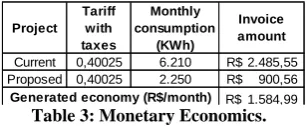
Through an energy invoice provided by a public agency in Palmas / MG it can be verified that the tariff value is 0,40025 R $ / kWh, in this way was calculated the monetary savings that the project will have, making the substitution of lighting. The following equation was used for the calculation of the monetary economy: Economy (R$/month)=Economy x energy tariff.
Table 3: Monetary Economics.
After obtaining monetary savings, the simple payback was calculated to verify the return on investment. The following equation was used for the calculation of simple payback. For the calculation of the simple payback in years the result was divided in months by 12. Simple payback (months) = Value of the investment (R$) / Economy (R $).
Table 4: Simple Payback.
Using the Excel software, the NPV (net present value) and the internal rate of return (IRR) of the project were also calculated. For the calculation of NPV and IRR we use the formulas that excel itself makes available, we consider a TMA (minimum attractiveness rate) of 0.5467% which refers to the long-term interest rate available on the IRS website and also through the cash flow that demonstrates the inputs and outputs of the project.
Table 5: Simple Payback.
Considering a TMA of 0.5467, according to table 5, the results prove that the project is feasible, since the IRR was higher than the TMA. The NPV is positive.
B. Viability analysis carried out by ANEEL's Energy Efficiency Program
Using the methodologies set forth in ANEEL's Energy Efficiency Program, calculations were also made to demonstrate the feasibility of implementing
the project through ANEEL resources. The
concessionaires of electric power in the concession area open public calls so that these projects can be submitted and approved. Initially, the project costs
Lighting power
(W) 50
Lifespan
(hours) 70000 Lifespan
(years) 16 Investiment
equipment R$ 69.468,93 Manpower
instalation R$ 21.328,18 Remote control
system ( 25 luminaires)
23.258,41 R$
Total
investment R$ 114.055,92
Lighting power
(W)
Reactor power
(W)
Amount
Operation per day (hours)
Operation in month (days)
Monthy consumption (KWh/month)
125 13 125 12 30 6.210
50 - 125 12 30 2.250
Project Tariff
with taxes
Monthly consumption
(KWh)
Invoice amount
Current 0,40025 6.210 R$ 2.485,55 Proposed 0,40025 2.250 R$ 900,56 1.584,99 R$
Generated economy (R$/month)
Initial investment
Monthly savings
Simple payback (months)
Simples payback (years)
114.055,52
R$ R$ 1.584,99 72 6
VPL TIR
73.682,74
were considered, as shown in the table below. Following ANEEL's procedures, marketing, disposal, measurement and verification costs were included.
Table 6: Project Costs.
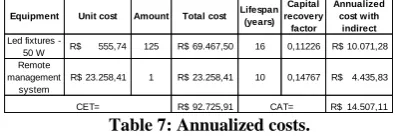
After defining the project costs, the annualized costs were calculated considering the capital recovery factor at a rate of 8% per year and taking into consideration the useful life of the equipment.
Table 7: Annualized costs.
The annualized benefit was calculated using the following formula:
BAT = (EE × EEC) + (RDP × CED)
Considering the unit cost of energy saved (CEE) R $ 610.86/MW/h and unit cost avoided (CED) R$ 847,26/kW/h. These values were presented in the announcement of the public call of the on-site distributor. The monthly consumption value was multiplied by 12 months and divided by 1000 to find the annual consumption in MWh and decreasing the annual consumption of the current equipment by the proposed one, we arrive at the calculation of the annual energy saved (MWh/year) and for the calculation of the demand reduction in kW (RDP) was multiplied the quantity by power, divided by 1000 and subtracted the current by the proposal.
Table 8: Monetary savings and demand reduction in peak hours.
BAT= (47,52 x 610,86) + (11 x 847,26) = R$
38.347,93/year
And after the calculations made above, the cost benefit ratio (RCB) of the project is defined, this calculation demonstrates whether or not the project can be done by ANEEL's own resources. The criterion is to demonstrate that the cost benefit ratio is equal to or less than 0.8.
RCB= CAT/ BAT
CAT - Annualized total cost (R$/year)
BAT - Annualized benefit (R$/year)
RCB= 14.507,12 / 38.347,93 = 0,38
Thus, with an RCB of 0.38 it is evident that the project has feasibility and can be executed with own resources offered by ANEEL.
C. Practical Result
In the case of execution of the project would be carried out the measurement and verification to prove the savings. This measurement follows the standards prescribed in the EVO (Efficiency Valuation
Organization) international measurement and
performance verification protocol. Measurements were made in lamps of the same model and power of the current ones and 50 W led luminaires of the same model proposed. The digital et-4091 minipa wattmeter was used to carry out the measurements and to prove the expected savings. First, the number of samples required for the current and proposed lamp was calculated. The Aneel lighting worksheet was used to perform the calculations. The formulas used for the calculation are found in the appendix. Number of lamps: 125/Z: 1,96/Reliability: 95%/and (precision target): 10%/estimated cc: 0.1/n0: 4/n: 4. ANEEL defines in the program that the measurements must have an accuracy of 10% with a reliability of 95%. Through the calculations it was defined that the number of lamps to be measured would be 4 samples per lamp type. In this way, the measurements were performed on the defined samples. Finding the values as per the table below.
Table 9: Definition of samples.
The means of the measurements were calculated, using the formula of Excel itself. And the measurements will be in the appendix. The coefficient of variance (CV) is found by dividing the mean by the standard deviation. After these results were obtained the calculations of the economy with the real values (measured).
Table 10: Calculation of the economy with the average of the measurements made.
Description Lifespan
(years) Amount Unit cost Total cost Led fixtures -
50 W 16 125 R$ 555,74 R$ 69.467,50 Remote
management system
10 1 R$ 23.258,41 R$ 23.258,41
Installation 1 R$ 21.328,18 R$ 21.328,18
Marketing 1 R$ 2.500,00 R$ 2.500,00
Discard 125 R$ 1,60 R$ 200,00
M & V 1 R$ 3.000,00 R$ 3.000,00
Equipment Unit cost Amount Total cost Lifespan (years)
Capital recovery
factor
Annualized cost with
indirect
Led fixtures -
50 W R$ 555,74 125 R$ 69.467,50 16 0,11226 R$ 10.071,28 Remote
management system
23.258,41
R$ 1 R$ 23.258,41 10 0,14767 R$ 4.435,83
92.725,91
R$ R$ 14.507,11
CET= CAT=
Equipment
Monthly consumption (KWh/month)
Annual consumption
(MWh/year)
Demand at the point (KW)
Current 6.210 74,52 17,25
Proposed 2.250 24 6,25
3.960 47,52 11
Initial sample 4 Initial sample 4
Sample carried out 4 Sample carried out 4
Average 140 W Average 48,3 W Sample standard
deviation 1,9 W
Sample standard deviation 0,4 W Calculated cv 1,40% Calculated cv 0,70%
e ( precision found) 1,30% e ( precision found) 0,70%
BAT= (49,46 x 610,86) + (11,45 x 847,26) = R$ 39917,80/year
Considering current power 140 W and the proposed 48.3 W.
RCB= 14.507,12 / 39917,80 = 0,36
It can be concluded from this practice that the result was better than expected, since the predicted in the viability analysis was a rcb of 0.38 and through practice we verified the economy and feasibility of the project, demonstrating a rcb of 0.36. That is, the 2 rcb presented are lower than the maximum allowed by ANEEL which is 0.8. Enabling the project to be executed with ANEEL resources.
V. CONCLUSIONS
In view of the current water crisis that the country is experiencing and the increase of researches in the area of energy efficiency, the objectives of the present work were met, calculations of monetary and energy economy, showing the viability of the project and a comparison considering the 2 (two) forms of analysis, the project being funded with the resources of the city hall and the second the project being funded by ANNEL, proving if it has a cost / benefit ratio of less than or equal to 0.8, according to ANEEL's PEE methodology.
The methodology applied to the case study was based on bibliographical research, articles found in Google Scholar and also on ANEEL's Propee to verify which parameters are determined. Microsoft Office Excel 2010 software was used to compile tables and perform calculations. The project presented economic feasibility, demonstrating that the first option of analysis presented IRR greater than 0 and NPV positive and the second option resulted in a cost / benefit ratio (RCB) of 0.38. And after performing the practice performing the measurements the RCB was at 0.36, proving that the project is once again viable.
REFERENCES
[1] CORTEZ, A. T. C.; ORTIGOZA, S. A. G. Consumo Sustentável: conflitos entre necessidade e desperdício. São Paulo: Unesp, 2007.
[2] CERQUEIRA, G. A. et al. A Crise Hídrica e suas Consequências. Brasília. Núcleo de Estudos e Pesquisas/CONLEG/Senado. Abril/2015 (Boletim do Legislativo nº 27, de 2015).
[3] ABESCO. Associação Brasileira das Empresas de Serviços de Conservação de Energia - O que é eficiência energética? - Disponível em: <http://www.abesco.com.br/pt/o-que-e-eficienciaenergetica-ee/.Acesso em 12 de Abril de 2018. [4] EPE. Empresa de Pesquisa Energética Eficiência Energética.
Disponível em:
http://www.epe.gov.br/pt/abcdenergia/eficiencia-energetica>. Acesso em: 17 de abril de 2018.
[5] BALIZA, Émerson Silva. Otimização da iluminação pública utilizando sistemas de controle e automação. 2016.
[6] VASCONCELLOS, L., & LIMBERGER, M. Iluminação Eficiente - Inciativas da Eletrobras, Procel e Parceiros. Rio de Janeiro: Eletrobras, Procel. 2013.
[7] PINTO, Danilo P et al. Projeto aplicado na formação de engenheiros: Iluminação pública a led no campus da ufjf. 2016.
[8] VERAS, L. L. Matemática Financeira. 6ª. ed. São Paulo: Atlas, 2011.
[9] REZENDE JLP, OLIVEIRA AD. Análise econômica e social de projetos florestais. 2. ed. Viçosa: UFV; 2008.
[10] SANTOS, Susana Fernandes. O Risco na Análise de
Investimentos. 2012. Disponível
em:http://repositorio.uportu.pt/mwginternal/de5fs23hu73ds/pr ogress?id=enIhJ5vl7f8btXNAHmjvYhxGA2tGwRdRg2Gpm 7VFuW0,&dl. Acesso em 30 de maio de 2018.