Improving the Security Levels
of e-Government Processes
within Public Administration
through the Establishment
of Improved Security Systems
Andrea K¨o
1and B´alint Moln´ar
21Corvinus University of Budapest, Hungary
2Corvinus University of Budapest, Information System Department, Hungary
Processes that are related to the identification and the authentication of persons and other legal entities have been necessarily existing and functioning for a while in public administration and business. Information Society offers new e-services for citizens and businesses, which dramatically change the administration and results in additional challenges, risks and opportunities. Citizen’s confidence and trust in services has to be improved, meanwhile several requirements, like personal data and privacy protection and legal requirements have to be satisfied. The usual business process of identification of the corresponding entity is generally based on some trivial control mechanism, typically password identifica-tion. In order to keep the trust of the public in the public administration activities, the process for entity identifi-cation(both person and legal entity)should be amended, taking in account the business and security consideration. Identity management solutions show intriguing variation of approaches in Europe, they are at a different maturity level of services.
Our paper gives an overview about the most frequently cited identity management architectures (namely: Lib-erty Alliance Architecture, Sibboleth, Government Gate-way Model and Austrian Model)and presents an identity management framework (based on the PKI, but im-proved it), customized for the Hungarian specialities, which offer possibilities to improve the related services quality.
We give an overview about the decisive identity manage-ment approaches and we suggest an identity managemanage-ment framework (based on the PKI, but improved it), pro-posed as a general solution. The concrete example as a case study demonstrates a solution customized for the Hungarian specialities. Our paper shows a solu-tion for the improvement of the identity management in e-government processes through the development of security mechanisms making use of the readily available technologies. The improved business and
technol-ogy processes are demonstrated through the Hungarian solution to the problem as a case study.
Keywords: Public Key Infrastructure, e-government, se-curity, digital signature, e-ID, smart card
1. Introduction
The PKI architecture provides services that are rooted in the available IT technologies. The ser-vices implicate business process, directly or in-directly. The existing business processes should be aligned with the services of PKI that en-force some business and IT architecture and ap-proaches for making use of technology. How-ever, the basic issues, namely concepts related to identity management: the identification, certifi-cation, authentication of persons, and moreover the business processes involved in the previ-ously mentioned activities own an interpretation in common sense that is not bound by the con-straints and limits of technology. Regarding the whole bunch of business processes associated to PKI, we should investigate the requirements for process improvement, the opportunities for enhancing the currently existing business and software processes.
The challenge is that even if the more mod-ern PKI technology is used, PKI itself cannot guarantee the authentication and authorization of the identity at the level that is anticipated by the public administration. Both business pro-cess side and the supporting IT technology for e-government services should be re-engineered; the available technology solutions should be complemented with appropriate parts.
The basic problem that should be solved some-how is the following: in the relationship be-tween the citizen and the public administration, there is a very strong requirement for mutual verification and validation of the identities of partners, usually prescribed by the law, by the legal environment and by the jurisdiction. The most important Hungarian regulation approach can be found in Ket(CXL. Law, 2004). Ket cov-ers the regulation about the way how to handle the linking of government to citizen(G2C)and vice versa, furthermore it codifies the rules for e-government processes and procedures. It is applied as a legal framework for business pro-cesses, procedures and standards within Hun-garian public administration. Regarding the available technologies, there are several oppor-tunities to implement a proper technical solu-tion. However, a technically satisfying solution could collide with the legislation environment and jurisdiction. In some countries, the law permits ade factocentral register of electronic identity of citizens; in other countries, either the laws in force or the practice of jurisdiction pro-hibits centralization of the registered electronic
identities, and allows only some kind of dis-tributed solution. The technology should pro-vide services even in distributed or federated cases thereby the partners — the public admin-istration and citizen — could build up a trust relationship mutually. The identity of citizen proved by a certification of PKI technology and issued by a commercial organization — the Cer-tification Authority — could not be regarded convincing enough for the public administra-tion. The certification contains some kind of name or names, but it does not have enough information for unambiguous authentication. Our paper gives an overview about the deci-sive identity management approaches and we present an identity management framework( ba-sed on the PKI, but improved it), proposed as a general solution. The concrete example as a case study demonstrates a solution customized for the Hungarian specialities.
The outlined approach provides a solution among the constraints raised by the legal environment and the available technology, and avoiding some pitfalls that apparently yield a resolution but it hides some traps because disregarding the basic principles of cryptography. The solution is at higher security level than the traditional ones, and it even develops further the available PKI technology approaches providing improvement in the business process and supporting technol-ogy related processes and the applied software environment.
2. The Opportunities for the Improvement of Identity Management in an
e-Government Environment
anonymously. An identity management system would empower the user to maintain their pri-vacy and control their digital identity[7]. The next business drivers of identity management are cited in the literature[5]:
• Cost reduction(unsatisfactory management of identity can increase the cost(e.g. waiting for permissions, etc.)).
• Increased security(inadequate access rights can be an additional risk for an organiza-tion).
• Increased compliance(an identity manage-ment system can help the organization to comply with laws(e.g. data protection laws)
and regulatory environment).
• Increased usability(users are able to control their working environment and customize it).
• Infrastructure consolidation and application development speed (solutions can be built more rapidly, with applying reusable secu-rity elements).
Two major areas are distinguished in identity management; namely, enabling user access( au-thorization, authentication, etc.) and user life cycle management (user administration, provi-sioning, etc.). Another view is user’s perspec-tive (focus on efficiency (one single sign-on to many applications)) vs. administrator per-spective (focus on efficiency of management) aspect. Major building blocks of identity man-agement are the enterprise directory services, authentication, access control, and user man-agement(ITGI, 2004). Four elements manage the whole life cycle of the identity within an organization, from creation to termination. • Theenterprise directoryservice consists of
two major components:
• Directory services databasethat operates
as a hub data store for identity and au-thentication information.
• Meta-directory: Its major functional
ser-vice is to share identity-specific data, to carry out data synchronization among various directories, databases and appli-cations within an organization.
Authenticationis the procedure that checks the identity of a user so that he or she may have the right to use some resources and the access rights
can be granted or denied correctly. The aim of
access control is to guarantee that users are provided access only to those applications or resources they are permitted to use it some way.
User management as IT function is responsi-ble for providing user identities across multiple applications or systems.
Most important requirements against identity management are functional services and privacy
[7]. Another important aspect which has to be emphasized is personal data and privacy protec-tion. For the e-government services, the identity management solution elaborated in the past that are in use within corporate environment must have been, in principle, a perfect technological solution. However, several pre-conditions for a full–fledged application should be satisfied. The foundation of basic technological architec-ture for the identity management is laid in Public Key Infrastructure. The basic principle is that the subject of identity management owns a key-pair: a public key and a private key. Even if the subject jealously guards his/her private key and publishes his/her public key, it is impossible to prove that the published key really belongs to the person who claimed it as his own. For this problem, a trusted business process was needed that “permanently” links the owner’s identity to the public key. Thereby, a trust hierarchy came into life. The point of trust would bind public key to an identity (and maybe other personal information)on behalf of the owner of the key-pair. Everybody could then accept the single point of trust as a reliable authority that links the end-entity (person or legal entity) identity to the key-pair and the certificate that contains information about the owner and the public key. The degree of validation at a reliable trust point, at Certification Authority(CA), can be reflected using extra information embedded into certifi-cates: typically validation takes place at the level of e-mail address, in a corporate envi-ronment against the Human Resource directory, face-to-face meeting with additional checking of official credentials(passport, personal identi-fication document, driving license, social secu-rity data, tax authosecu-rity’s identification number etc.)
in the owner certificate represents only a small part of data that would be interesting, required by and significant for the partner who would like to identify the owner of the certificate and to verify. Generally, the certificate contains an e-mail address, a personal name, maybe some other names, and the public key. The certificate database that is publicly available may provide access only to the personal name, and down-loading the certificate containing the public key, nothing less. Nevertheless, it may seem sur-prising that so little data are available for iden-tification, but the anxiety for privacy and the attacks manifested during the past years justi-fies this practice. Based on agent and artificial intelligence technology, several soft bots( “soft-ware robot”)were created to collect information from public Web sites as e.g. directory services for using the acquired e-mail addresses for gen-erating spams, unsolicited e-mails. The only escape route is to avoid capturing of e-mail ad-dresses by this easy way and against the owner original intention is using “captcha” like e-mail addresses. To protect the other personal data, the only solution is not to publish at all on pub-licly available Web sites, directory services. The Certification Authority may have a paper or electronic database that contains the data that were checked during the validation pro-cess. The personal data and privacy protection acts in EU and the member states support this practice. However, the public administration in an e-government process needs much more in-formation for an accurate identification of the owner of a certificate and a key-pair. Putting it simply, the question for the public administra-tion is: among the several John Doe who is the right one?
The direct access to the database of personal in-formation stored at the Certification Authorities raises security questions. If the public admin-istration can retrieve data from this protected database, then anyone could do it. The previous issue leads to the common identity management processes:
1. There must be a functional capability for in-dividuals to authenticate themselves with ap-plications.
2. When identity data is passed from one coun-try to another, it is likely that data conver-sions will have to be applied. This could
be done by semantic integration and meta-directory services. As an example, last names of persons in Ireland stored in a di-rectory should be mapped to last names of persons in Spain in the appropriate directory, and vice versa. To avoid interfering with principle of subsidiarity, these services are likely to operate on the basis of a common data model with mappings of this common data model to and from the data models of each single member state.
3. There should be some function of the direc-tory service that retrieves the addresses or links of those services that want to interact with each other. A local authentication ser-vice may have to redirect an authentication request to the authentication service being cognizant.
4. Finally, legislation may require the existence of logging and notification services.
The problem can be formulated in the following way: the public administration requires a strong identification and authentication mechanism for its partners, in spite of the personal data and pri-vacy protection obligation of government. How can we improve the business process for identity management for the purpose of e-government? Approaches of IdM architectures show hetero-geneous picture, we discuss briefly only the most frequently cited ones, namely: Liberty Alliance Architecture, Sibboleth, Government Gateway Model and Austrian Model, in order to compare them with the Hungarian approach.
2.1. Liberty Alliance Architecture
It offers the technology, knowledge and certi-fications to build identity into the foundation of mobile and web-based communications and transactions. Liberty Alliance Architecture is widely applied and cited in the area of identity management. The following part of the section provides a brief overview of the Liberty Al-liance’s federated network identity management architecture’s components and the main features of the components. A high-level overview of Liberty Alliance Architecture modules can be seen in the following figure:
XML-Enc. HTTP
SAML WSS WSDL
XML-DSIG
XML
WAP SSL/TLS SOAP
LIBERTY IDENTITY FEDERATION FRAMEWORK
(ID-FF)
LIBERTY IDENTITY WEB SERVICE FRAMEWORK
(ID-WSF) LIBERTY IDENTITY SERVICES INTERFACE
SPECIFICATIONS (ID-SIS)
Figure 1.High-level overview of the Liberty Alliance Architecture.
Main modules are the following:
• Liberty Identity Federation Framework
(ID-FF)
• Identity Services Interface Specifications
(ID-SIS)
• Liberty Identity Web Services Framework
(ID-WSF).
Liberty Identity Federation Framework
empow-ers identity federation and management through features such as identity/account linkage, sim-plified sign on, and simple session management. The Liberty ID-FF module supports the feder-ation of identities, including the corresponding management. This framework enables the in-teroperability of the most varied platforms and defines the federation for PCs and mobile de-vices(mobile phones, PDAs etc.). With ID-FF, the user has access to Single-Sign-On in his/her personal CoT (“Circle of Trust”). The ID-FF module also defines the exchange of metadata. The ID-FF module is the central module of the Liberty specifications.
Identity Services Interface Specificationsis based
on ID-WSF and contains specifications for the following functions: user registration, address book, calendar, location-specific services, and alarms(“alerts”). Liberty Identity Services In-terface Specifications (ID-SIS) enables inter-operable identity services such as contact book service, geo-location service, presence service, personal identity profile service, and so on.
Liberty Identity Web Services Framework(
ID-WSF)provides the framework for building in-teroperable identity services, identity service description and discovery, permission-based at-tribute sharing, and the associated security pro-files. ID-WSF, Identity Web Services Frame-work, is based on ID-FF and forms the basis to provide personified services. ID-WSF includes: • the exchange of individual attributes (
“per-mission-based attribute sharing”),
• the collection of identity elements in a dis-tributed environment (“identity service dis-covery”)
• interaction services(“interaction services”) additional security profiles, which are to be observed during data exchange (“security profiles”)
• “Simple Object Access Protocol Binding”
(SOAP binding)
• “extended client support”(extended support for end devices, not IP/HTTP specific)
• “Identity services templates”(personality pro-files specification).
Underlying part of the architecture – extension of industrial standards represents a collection of international standards relevant to Liberty. ID-FF, ID-WSF and ID-SIS are based on these stan-dards. These refer to existing standards; as nec-essary and when required, they will be extended and approved with the appropriate standardisa-tion organisastandardisa-tions. Liberty Alliance works to-gether with many organisations; some of them are:
• Organisation for the Advancement of Struc-tured Information Standards(OASIS) • World Wide Web Consortium(W3C)
2.2. Government Gateway Model
The goals of the model were to make all Gov-ernment services accessible on-line by 2005, provide universal access to the Internet and en-sure the UK is the best place in the world for e-commerce [4]. Government Gateway is the common channel linking the public with gov-ernment systems via Web sites, govgov-ernment por-tals and Internet-enabled applications. It is de-signed not only to benefit government and pub-lic sector departments, but also three million UK businesses and 60 million citizens. Main features of the gateway model are the follow-ing:
• Aims to centralise authentication of citizens and businesses
• Heavy PKI origins - costly and complex for users, low take-up
• Looking to ease user registration and in-crease take-up
• Have registration & enrolment process. Government Gateway provides a secure, easy-to-use means for people and businesses to enrol for services and file forms including income tax and value-added tax returns. Anyone able to use a Web browser can access the system, and it is easy for the Government to operate, manage and maintain. When launched, the UK online e-government initiative faced challenges in ad-dition to connecting a huge number of users. It had to integrate a single access path, serv-ing all users, with departmental IT infrastruc-tures that had operated independently for many years. The role of the Government Gateway is to provide departmental systems with an outward-looking perspective, responsive to the needs of individual citizens and businesses of every size and type.
2.3. Austrian Model
By the Austrian e-government strategy, the un-ambiguous and secure identification of citizens/ businesses and administration units as commu-nication partners is a decisive factor implement-ing e-government services. Therefore elec-tronic signatures – in some sensitive cases se-cure or “qualified”(by the EU directive notion)
electronic signatures – are required for commu-nication to public administration.
The Austrian government has got a software application developed for a middleware – it is called Security-Capsule – which is the link be-tween different signature tokens (smart cards, USB-Tokens, mobile phones) and the various e-government applications.
The sectors of public administration that of-fer smart cards (e.g. Social Security Author-ity, Passport Office, Banks, teaching institu-tions), can integrate this software into their e-government related services and converting the smart cards or tokens issued by particular sec-tors of public administration to official citizen cards, which can be used in all e-government processes.
string as the denomination of the certain sector of public administration.
During the procedure, these data is fed as in-put to a hash function — that does not have an inverse function — constructing the required identifier. In this way, the person is identified in any official procedure by the person binding and his/her digital signature on the document. The authority can unambiguously identify and authenticate the person through this informa-tion. There is a well-elaborated mechanism for a trusted hierarchy assigning the legal respon-sibility to another person or legal entity to act on behalf of the person in official procedures of e-government services.
The communication between the person as a client in the sense of IT and the e-government services takes place in a secure format using proper protocols as SSL, TSL. In each official procedure, there is a front-end for security con-trol, the so called Security Entrance, that pro-vides the necessary checking for the following information item as the digital signature, client credentials, identity checking through the per-son binding transmitted, deducting the procedure-specific-identifier for the particular official pro-cedure; and, if necessary, the assignment hier-archy for legal responsibility.
At the interface of an e-government service provider, the identification mechanism uses a cryptographically safe SSL communication tun-nel. Initialising the SSL connection, the public key of the smart card is used to build a data block for authentication. Thereby, at the same time, the client, the browser and the person are authenticated, and made unnecessary to exploit the User-ID and password, assuming that the in-tegrity of the card in the sense of cryptography is ensured.
At the basis of the Austrian e-government work-flow are XML-forms provided by online appli-cations via a central portal, which can easily be displayed by the web browser. If preferred by the user, some fields on the form can be filled in automatically because of the Security-capsule which stores personal information of the card-holder(e.g. name, birth date, ID-number). The data for the remaining fields needs to be pro-vided by the citizen. If necessary, attachments like birth certificate or electronic payment con-firmations can be added. Upon completion of
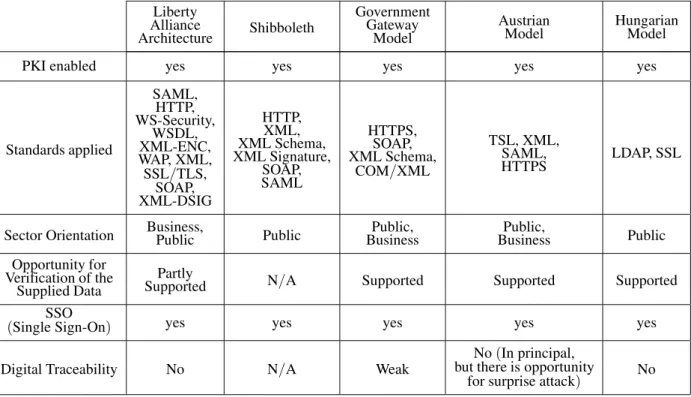
the form, the Security-capsule requests the citi-zen to sign with the citiciti-zen card. After the entry of a PIN number, the complete form is delivered to the back office application. When the back-office process is concluded, the administrational notification will be electronically signed by the authority, encrypted with the citizen’s public key and delivered to the citizen’s electronic livery service. Comparison of the above de-scribed IdM approaches is demonstrated in the Table 1.
2.4. Shibboleth
Shibboleth is an Internet2/MACE project de-veloping architectures, policy structures, practi-cal technologies and an open source implemen-tation to support inter-institutional sharing of web resources with access control requirements. It uses SAML as an underlying technology. The Shibboleth project also created OpenSAML, an open source implementation of the SAML spec-ification. Shibboleth is a federated approach to attribute sharing. It enables resource sites to request attributes about a visiting user from the users’ origin site. The origin site must know its users and be able to authenticate them. These attributes can then be securely transferred to the resource site. It is up to the user to specify which information can be released about the user and to which site. It is possible that resource sites only receive a small set of attributes about a given user(e.g. the location) and do not get to know which particular user it is, and thus Shib-boleth is seen as a privacy enabling technology. Shibboleth is aiming to solve the needs that uni-versities typically have, but it is not restricted to that domain in its use and application. It has the potential to be used much more widely as a single-on or privacy enhancing technology.
3. Service Requirements against PKI Infrastructure Enforced by Business Processes of e-Goverment
Liberty Alliance
Architecture Shibboleth
Government Gateway
Model AustrianModel
Hungarian Model
PKI enabled yes yes yes yes yes
Standards applied
SAML, HTTP, WS-Security,
WSDL, XML-ENC, WAP, XML, SSL/TLS,
SOAP, XML-DSIG
HTTP, XML, XML Schema, XML Signature,
SOAP, SAML
HTTPS, SOAP, XML Schema,
COM/XML
TSL, XML, SAML,
HTTPS LDAP, SSL
Sector Orientation Business,Public Public BusinessPublic, BusinessPublic, Public
Opportunity for Verification of the
Supplied Data
Partly
Supported N/A Supported Supported Supported
SSO
(Single Sign-On) yes yes yes yes yes
Digital Traceability No N/A Weak but there is opportunityNo(In principal,
for surprise attack) No
Table 1.Comparison of the IdM Approaches.
Identification of the owner — (the end entity, EE) — of a digital certificate does not cause problem in a closed business world or in a rel-atively narrow trust community, where the per-sonal details and the content of the digital cer-tificate can be mapped to each other with little effort. Nevertheless, the e-commerce and the public administration of a nation (e.g. tax sys-tem)oblige the unambiguous mapping the iden-tity of the cyber eniden-tity embodied by the digital certificate and the end entity as it exists in the business life, the real world and in the relation-ships with the public administration.
Basic elements of PKI architecture are the Reg-istration Authority and the Certification Au-thority. These two components are exactly mapped to two disparate software constituents of the IT architecture that are typically licensed separately. The explanation is that the underly-ing organizational architecture and the IT solu-tion are strongly coupled to each other.
Thereby, in a PKI environment, there is anRA
(Registration Authority). The end entity
sub-mits its details through RA to the Certification
Authority(CA). The RA performs some checks
on the validity of the supplied data, and then
the RA gets a unique identifier code and the public key written in the certificate instead of the user-specific information. The data stored within the end entity’s certificate are supplied by CA through a secure channel to theRA. The end entity possesses its private keys that are tied to the public key contained in the certifi-cate; the ownership of the key-pair by the end entity cannot be questioned rightfully. The PKI system, theCAandRAtogether ensure that the user-specific details are publicly not available and accessible, and not even published in the certificate. However, theCAis able to provide verification information about the identity of the end entity, and some details of data of EE for an enquirer supplying e.g. the unique identifier code from within the certificate.
piece of information, moreover makes use of their own databases containing legally stored, not public information about the end entity. The agent can match the information coming from different sources namely, the CA/RA, its own databases and the end entity. The available data can be matched, verified and validated algorith-mically proving or disproving the identity of the end entity. This solution can be named as “Identity background checking”,
A closely related issue is the management of the Certificate Revocation List(CRL). The val-idation service in a PKI environment is very similar to the very early credit card companies’ solutions whereby a list of cancelled cards — for whatever reason — was regularly distributed to the business partners. The burden of checking and controlling that an issued digital certificate is used rightfully, conforming to the intended policy, regulation and specific authorization is on the recipient (the relying party). The re-cipient should check whether the user’s trusted status has been revoked by the issuing CA or not. The issuing CA regularly creates a CRL that identifies its revoked certificates ( regard-less of their possessing valid expiry dates, at-tributes and signatures). A CRL is dated, and then signed, by the issuing CA to show its au-thenticity and is issued perhaps on an hourly, or daily basis. The CRL has a fixed validity period as well.
The recipient, the relying party uses the logi-cal decision “IF a certificate is not included in the CRL THEN it is OK”. This logical infer-ence uses ‘the negation as failure’ or ‘the closed world assumption’ that is well-known in the log-ics of mathematlog-ics and computer science/ infor-matics, and legally applicable when no other reliable information source is available. For security reason, the only correct logical conclu-sion that can be drawn is “IF certificate is listed in the CRL THEN it is NOT OK”.
There is some technological solution, but be-cause of the lack of the accepted business model and the mutually beneficiary financial solution, some extra technological burden should be un-dertaken, the solutions are not very widespread. The on-line certificate status protocol (OCSP) allows certificates status to be validated in real time. The content of the answer is generally constrained legally to “YES” or “NO”. CRL to
be advertised, there is no need for the appli-cation of “the negation as failure” logic. The content of the answer is generally constrained legally to “YES” or “NO”.
The simple Certificate Validation Protocol
(SCVP) is a similar approach to OCSP, but it permits for the relying party to get rid of much of the certificate chain checking work and pass it to the SCVP responder. Responses could be more than “YES” or “NO” if it is legally accept-able to provide more detailed information about the user/certificate owner who has elicited the query on the side of the enquirer.
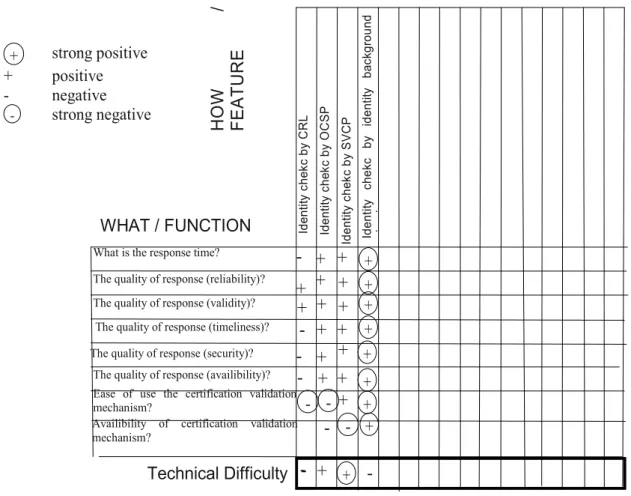
Based on the requirement analysis described above and illustrated using the QFD approach
(Quality Function Deployment)in Figure 2, the conclusion can be drawn that the viable and fea-sible solution regarding the state-of-the-art of PKI is the identity background check that could be implemented in a reasonable time-frame and could fit into the public administration and cur-rently available PKI framework.
4. The PKI Technology as a Viable Tool for e-Government — Arguments for the Solution Selected for the
e-Government in Hungary
For political and economic reasons, there is a strong pressure to implement more and more public administration services using informa-tion technology appearing as e-government ser-vices.
The remote access to the e-government services makes it necessary that the citizen should iden-tify and authenticate itself by a reliable and se-cure manner that ensures mutual trust for both public administration and the citizen. However, we have to talk about client or end entity instead of citizen as not only natural persons but other legal entities may have contact with the public administration.
FEATURE
HO
W
/
Technical Difficulty WHAT / FUNCTION + strong positive
+ positive - negative
- strong negative
What is the response time?
The quality of response (reliability)?
The quality of response (validity)?
The quality of response (timeliness)?
The quality of response (security)? The quality of response (availibility)? Ease of use the certification validation mechanism? Id entit y c he kc by C R L Identi ty c he kc by O C SP Identi ty c he kc by SV CP Id entit y che kc b y iden tit y ba ck gr ou nd hk + + + + + + +
Availibility of certification validation
mechanism? -+ + + + + + + + + + + + + + -+ + -+ + --
-Figure 2.QFD for requirement analysis of the technical solution for identification approaches.
use of PKI by enterprises, especially the inter-nal utilization of PKI for the secure and reli-able communication and business management among the staff of the organization.
The definite difference is the privacy and pro-tection of personal data. A person can be identi-fied unambiguously or with high probability by using some natural bits of information as e.g. the given name, second name, date and place of birth, mother’s maiden name, and home ad-dress. There are some identification numbers or character strings used within certain sectors of public administrations as tax number, social insurance number, personal identification num-ber, etc. Although these unambiguous and easy-to-handle identifiers cannot be used together be-cause of the legal environment in some countries and jurisdiction, they cannot be stored in the same data store and cannot be linked to each other. With slight differences, this statement is valid largely for the member countries of EU. Within a certain organization for internal use, the content of digital certificates and data related to the person owning the certificate does not
e-mail provided for official use is public data, but other e-mail addresses should be considered as personal data. The debate on this topic is continually carried on, and still has not been concluded.
If a citizen as a client of the public administra-tion acquires a digital certificate from one of the commercial certification authorities (CA) for managing his/her own business with the public administration then the public directory of the certification authority will not contain other data as the name of the citizen and digital certificate containing the public key. Moreover, the di-rectory(e.g. LDAP technology directory)may hold an e-mail address that is strictly coupled to the digital certificate. Optionally, the directory record may include the name of organization, department/business unit, country code, iden-tification number/serial number, name of city or town may appear as public information. But the publication of these data is a little bit risky because of privacy issues, unless the person has given permission for the publication. The pub-lic key and the serial number of the certifica-tion at a particular CA can be considered as an unambiguous, unique identifier of a person. For identification and authentication, these data seem to be perfect, from both view points of the public administration and information technol-ogy. Though, what does the public key identify? The popular view is that the person is identified. The question is which person is identified. Us-ing public key included in the certificate, only the name and maybe the e-mail address of the person are public. What is the process that can identify unambiguously the person on the side of the public administration in this situation? Because, generally, the available information is not sufficient for the unambiguous identifica-tion as the names (given name, second name, etc.) are not unique. The e-mail address is unique but there is no mechanism to map the e-mail address onto a person. The alternatives for public administration are the following: 1. The public administration creates a central
database of e-mail addresses and couples them to certain persons.
2. The public administration creates a central database of public keys and links to certain persons.
3. The public administration uses the exist-ing central databases of tax numbers,
Certificate ServerCommercial CA
E-E Database Certification Database (CD)
A gateway to a service of a specific sector of Public Administration Internet
Certificate and Identifier validation
Protocol Certificate and
Identifier validation Protocol
E-E Database for the sector
End-entity (citizen, partner of PA)
1
2
3 4
5
6
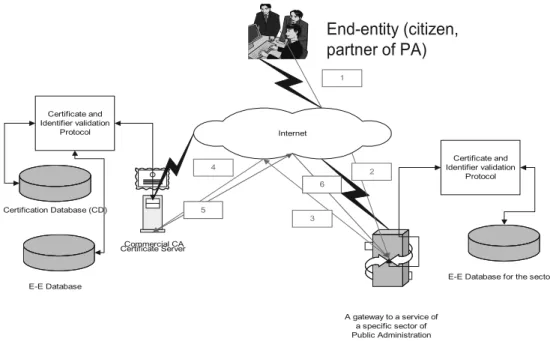
Figure 3.Communication lines among the participating partners of mutually trusted e-government service points
(numbers denote the order of the communication).
national models try to find an appropriate solu-tion that satisfies both the technology and the legal environment.
5. The Hungarian Solution that Improves both the Service and the Security Level of e-Government Processes and
Ensuring Privacy
In Hungary, the Gordian knot of the above men-tioned problem is sliced to in the following ways:
1. The request for a certificate enclosing a dig-ital signature and the registration with con-forming rigorous Certification Policy (CP)
at a commercial Certification Authority that enables the certification holder to do busi-ness with government through e-government services. Avoidance of centralisation of per-sonal data is automatically guaranteed and designates a movement towards a federated PKI architecture.
2. At a single CA, the person’s naturally identi-fying data is stored a secure database beside the certificate and the public data that will be published in a directory. The certificate con-tains an indicator that signals the appropri-ateness for public administration, to handle issues through e-government services. The
identifiers specific to certain sectors of pub-lic administration(tax number, social insur-ance number, etc.) are not stored either in the certificate or in the personal registration database, not even some coded format that might be created by a cryptographic algo-rithm or a hash function.
3. The CA-s should own by the Force of Law a so-called CRL site. At this site, the CA should provide specific services that for an identification request from public adminis-tration answers by a “Yes” or “No”. The CA receives a data package including the naturally identifying data of a person, public key and/or the serial number of the certifi-cate. The service carries out a check on the database, retrieves information and unifies to the provided data. If there is a match the answer is “Yes”, in all other cases the answer is “No”.
certificate issuer CA and performs an in-ternal check on its own inin-ternal database. After gaining an answer which is satisfying and fitting to the available data from both re-sources, i.e. internal and external, the person is authenticated, moreover authorised to ex-ecute transactions through the e-government service.
The above description conforms to the legal environment in Hungary embodied in the Act about the Processes of Public Administration
(by the Hungarian legal acronym, Ket (CXL. Law, 2004)). The registration Authority is re-cently withThe Credentials Officesrun by lo-cal government. The Credentials Offices issue driving licences, personal identity cards and the electronic identifiers for “Client Gateway” of e-government in Hungary. TheCredentials
Of-ficescreate digital certificates for digital signa-ture and electronic identity for those who re-quest one. The basic principle in Hungary is the “opt in”, i.e. the electronic identity — for a while — is not compulsory but optional. Now, it seems that two logical types for electronic identities and separate smart cards will be in operation in the near future in Hungary. There will be one for general personal identification and one for Health Insurance.
The Credentials Officesare linked to the
Cen-tral Registration Office for People and Ad-dresses on-line for sending the identification data and the checking happens in batch pro-cessing at theCentral Registration Office.
6. Conclusion
The original aim of PKI technology was to pro-vide services regarding identification, authenti-cation and authorisation for e-commerce and for enterprises’ internal IT infrastructure. Within the e-commerce, the PKI technology would have enabled that any contract would be un-repudiated and before the court it could have been enforced, it would have been especially important in the copyright-related products and commercial artefacts. Nevertheless, the various pre-payment method, bank card solutions, and direct transfer between the bank accounts elec-tronically, furthermore the enhanced security of before-mentioned type of transactions played down the urgent need for application of digital
signature and the related technology in practice. Together with the developed logistics of Post services, the e-commerce was able to increase its volume without the extensive proliferation of digital signature and PKI infrastructure.
For internal use of PKI within enterprises has got an impetus. The market leaders of software manufacturers on the office, document handling and e-mail technology have built in their product the major element of PKI technology as e.g. lo-cal Certification Authority, issuing certificates of digital signatures and identification, e-mail systems integrated with LDAP technology for storing the person’s data. There are no legal problems with this approach as the publica-tion of personal data happens within a restricted and closed community. The PKI technology in such an environment serves well the interests of enterprise workflow management, operates smoothly together with other software applica-tions and, at the same time, ensures a secure, reliable and trusted IT environment.
On the other hand, the public administration faces lots of legal issues as the circle that may want to do business with it is not closed, it could be rather regarded open. The procedures of public administration obey to strict regulations, laws and other legal rules, for this reason the e-government service should find the narrow path between the legal opportunities and solutions provided by the PKI technology. The public administration is between Scylla and Charyb-dis.
The Austrian approach for utilizing the PKI in-frastructure and the smart card technology for the e-government services is fairly sound. How-ever, there are two minor faults.
security forces on the activities of data collec-tion about persons even by liberal governments and jurisdiction.
The second one is more technical, namely the use of hash function for information protection. The original purpose of the hash function was to ensure the integrity of the data message, not for protecting the data from algorithmic attack. As the famous attack for password recovering in the UNIX systems demonstrates —the so called dictionary attack — if the structure and space message is known and constrained, the attack could be successful. The success depends only on the computing power uses up. The procedure to create the person binding and the sector spe-cific identifier uses a hash function in the case of Austrian e-government. The data used as start-ing point and their structure are well known and publicized. Theoretically, there is a chance for surprise attack as there is no rigorous mathemat-ical proof for the security of the hash function applied, and the hash function is used for other purposes as it was designed enhancing the po-tential threat and vulnerability of the method. The Hungarian approach avoids several pitfalls. 1. There is no central registration of citizens acquiring certificates for either qualified or advanced digital signature.
2. The registration process does not use any sector specific identifier of the Hungarian public administration at the commercial Cer-tification Authority. The central register of citizens and addresses could be queried by the person’s naturally identifying data, and the central register responds only by a “yes” or “no”, thereby supplying an enforcement of the authenticity of the transmitted data. The personal data, identifier stored in the central register do not play any role generat-ing the certificate, the digital signature and the personalization of a token (smart card, USB token, etc.)
3. The certification issued by the commercial Certification Authority contains sufficient information for interfaces and automated soft-ware solutions at the various sectors of the Hungarian Public Administration to carry out the procedure for authentication and val-idation of the certificate of digital signature and other supplied and retrieved data from
the databases of the particular sector of gov-ernment. For example, the URL of Certi-fication Authority where the data exchange could be performed.
4. The applied cryptographic procedures re-lated to the PKI technology are the widespread, technically sophisticated, sound and accord-ing to the state of the art are reliable and resistant to the known algorithmic attack. The Hungarian solution is technically sound and conforms to the legal environments without any compromise, for this reason it is worth consid-ering to push the international proliferation of this approach.
References
[1] ALFRED J. MENEZES, PAUL C. VAN OORSCHOT, SCOTTA. VANSTONE,Handbook of Applied Cryp-tography. CRC Press, 2001, ISBN: 0849385237.
[2] BURNETT, S., PAINE, S., RSA Security’s Offi -cial Guide to Cryptography. New York, Osborne/McGraw-Hill, 2001, ISBN 0-07-213139-X.
[3] DELFS, H., KNEBL, H.,Introduction to Cryptogra-phy, Principles and Applications. Berlin, Springer-Verlag, 2002, ISBN 3-54042278-1.
[4] Gateway to e-Government-Success Story,
www. gateway.gov.uk, 2001, (December 18, 2005).
[5] GUIDE – Creating an European Identity Man-agement Architecture for e-Government(FP6 IST project – Networked Businesses and Governments
(IST-2002-2.3.1.9)), 2006.
[6] HERREWEGHEN E. ET. AL., Enterprise PIM Roadmap ,,Privacy Enhancing Technologies and Identity Management Systems in Enterprises”, manuscript, 2002.
[7] IDA Enterprise DG: Architecture Guidelines for Trans-European Telematics Networks for Adminis-trations Brussels, September 2004.
[8] ITGI (IT Governance Institute) – ISACA ( Infor-mation Systems Audit and Control Association): ,,Enterprise Wide Identity Management – Manag-ing Secure and Controllable Access in the Extended Enterprise Environment”, manuscript,
www.itgi.org, 2004.
[10] NASH, A., DUANE, W, JOSEPH, C., BRINK, D.,PKI: Implementing and Managing E-security. New York, Osborne/McGraw-Hill, 2001, ISBN 0-07-213123-3.
[11] PRIME - The PRIME project receives research funding from the European Union’s Sixth Frame-work Programme and the Swiss Federal Office for Education and Science, (FP6 IST project –
(IST-507591), 2006.
[12] STEVEN, J. R., Identity Architecture, Information Systems Control Journal, Volume 4, 2003.
[13] TEMPLE, R., REGNAULT, J. (EDS.),Internet and Wire-less Security. The Institution of Electrical Engineers, London, UK, 2002.
[14] The Liberty Alliance,
http://www.projectliberty.org (December 18, 2005).
[15] Shibboleth,
http://shibboleth.internet2.edu (December 18, 2005).
Received:July, 2007
Revised:October, 2008
Accepted:November, 2008
Contact addresses:
Andrea K¨o, PhD 1093 Budapest F¨ov´am t´er 13-15. II/225 Corvinus University of Budapest Hungary e-mail:[email protected]
Dr. B´alint Moln´ar 1093 Budapest F¨ov´am t´er 13-15. II/225 Corvinus University of Budapest Information System Department Hungary e-mail:[email protected]
ANDREAK ¨O, PhD, is Associate Professor at Corvinus University of Budapest, Hungary. She has MSc in Mathematics and Physics from Etvs Lrnd University of Budapest, Hungary(1988), a University Doc-toral degree in Computer Science(1992)from Corvinus University of Budapest, Hungary and a PhD degree in Management and Business Administration(2005)from Corvinus University of Budapest, Hun-gary. She participated in several international and national research projects in the areas of: identity management and IT audit; seman-tic technologies; knowledge management and e-government. She has published more than 50 papers in international scientific journals and conferences. Her research interests include business intelligence, intel-ligent systems, knowledge management, semantic technologies and IT audit.