EFFECT OF CIRCUIT TRAINING ON FIGHTING PERFORMANCE OF
YOUNG SILAT ATHLETES - A CASE STUDY
Mohamad Nizam Mohamed Shapie1,3*, Jon Oliver2, Peter O’Donoghue2, and Richard Tong2
1Faculty of Sports Science and Recreation, Universiti Teknologi MARA, Shah Alam, Malaysia,
2Cardiff School of Sport, Cardiff Metropolitan University, United Kingdom, 3Seni Gayung Fatani Malaysia Association
*Email: [email protected]
(Received 20 December 2017; accepted 29 December 2017; published online 29 January 2018)
To cite this article: Mohamed Shapie, M. N., Oliver, J., O’Donoghue, P., & Tong, R. (2018). Effect of circuit training on fighting performance of young silat athletes - a case study. Movement,
Health & Exercise, 7(1), 27-41. http://dx.doi.org/10.15282/mohe.v6i2.157 Link to this article: http://dx.doi.org/10.15282/mohe.v6i2.157
Abstract
which may help to facilitate coaches of the demands and requirements of the combat sport.
Keywords: circuit training, silat, fighting performance, Seni Silat Malaysia
Introduction
The scientific approach to understanding the demands of combat sports and the physiological characteristics that contribute to success has received much attention for the past 20 years, particularly in those sports included in the Olympic Games [5, 6, 7, 8, 9, 10, 11]. There are also several other combat sports that have received scientific attention and used an empirical approach to inform training and the fitness requirements of sports such as mixed martial arts [12, 13], karate [14, 15, 16], muay thai [17, 18], kickboxing [19, 20] and silat [21]. Moreover, Douris et al. [22] reported that participation in martial arts increases strength, anaerobic capacity, balance, and flexibility as well as an overall improvement in cardiorespiratory fitness, which is supported by the work of other researchers [5, 23] and in part by Shapie et al. [4]. However, only a few studies have examined young athlete’s fitness and training requirements [24, 25] in combat sports. This is important as compared with training studies in adults, relatively less is known about the trainability of adolescents [26]. Importantly, adolescence is a stage of development characterised by unprecedented physiological changes in musculoskeletal, cardiorespiratory and reproductive systems of the body [26]. It has also been argued that it is important for coaches to fully maximise a young athlete’s potential at every stage of development, as proposed in the Long-Term Athlete Development (LTAD) model [27]. However, to the author’s knowledge there is no published research documenting adolescent’s physical characteristics and training in silat. Consequently, the research presented by Shapie and co provides valuable information regarding the fitness characteristics of male and female silat performers aged 13 to 16-year-old [2] and also the effect of a silat-specific training programme on the fitness development of young silat performers.
It was then shown by Shapie et al. [4] that six weeks of silat-specific circuit training provided significant improvements in several fitness variables. The improvements observed across a number of groups were dependent on the type of training employed (circuit training versus traditional silat training) and the age/maturation status of the participants. Thus, the authors concluded that improvements in fitness following a circuit training intervention appeared to be related to age and maturation, whereas the traditional silat training may be better at improving upper body strength and power.
training outcome (competitive performance). However, it is not known if improving fitness can enhance an exponent’s performance in silat competition. Further research is required in order to examine whether improvements made throughout a training programme can help improve competitive performance. In particular, whether improved fitness allows an exponent to maintain a greater work/complete a greater number of strikes and better avoid being hit, both of which contribute to winning a match.
Therefore, the objectives of this study are to use a case study approach to describe the activity pattern of individual exponents during competitive fights completed before and after a 6 week circuit training programme in the 13-year-old and 16-year-old exponent.
Material and methods
Participants
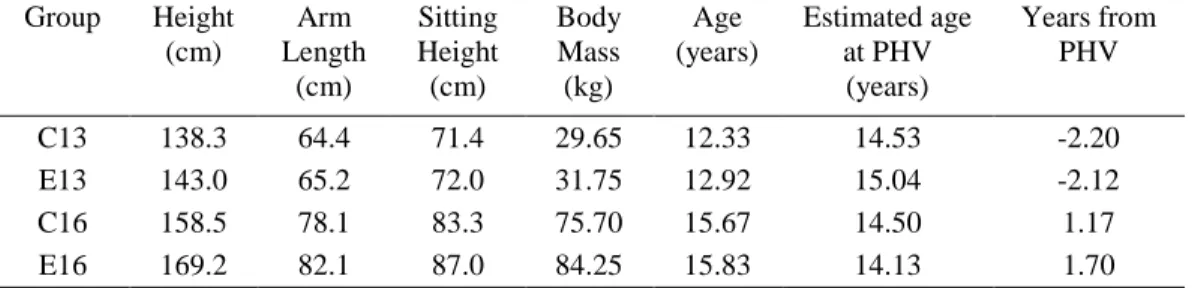
Four silat exponents aged 13 (N=2) and 16-year-old (N=2) served as participants for this study. Exponents were chosen based on their age, maturation, weight, competitive standard none had participated in an official silat match, and initial fitness performance (Table 1). For each age, there was one control and one experimental participant. Biological maturity was assessed via the non-invasive technique proposed by Mirwald et al. [1] using measures of standing height, sitting height, age and body mass. Descriptions of individual characteristics are presented in Table 1. None of the participants reported injury at the time of sparring, and all were involved in regular silat training. All information letters and assent forms outlining the study details and scope of the child’s involvement were handed out to the children. Written informed assent was obtained from the child as well as the consent of the parent/guardian consent. Participants were asked to wear their silat uniform with footwear and to avoid drinking, eating and participating in any exercise activities up to two hours before sparring. All procedures were granted ethical approval by the University Research Ethics Committee.
Table 1: Descriptive details for all participants involved in the case study.
Group Height (cm)
Arm Length
(cm)
Sitting Height (cm)
Body Mass (kg)
Age (years)
Estimated age at PHV
(years)
Years from PHV
C13 138.3 64.4 71.4 29.65 12.33 14.53 -2.20
E13 143.0 65.2 72.0 31.75 12.92 15.04 -2.12
C16 158.5 78.1 83.3 75.70 15.67 14.50 1.17
E16 169.2 82.1 87.0 84.25 15.83 14.13 1.70
C13 = age 13 control group; E13 = age 13 experimental group; C16 = age 16 control group; E16 = age 16 experimental group
Procedures
(n=1) and 16 year (n=1) olds continued with their normal training. The control group continued with their normal silat training for 2 hours per session (twice per week) while the experimental group underwent 30-45 minutes circuit training plus 75-90 minutes of normal silat training. Participants in the intervention group were prescribed with an intervention programme which involved circuit training activities that consisted with 8 silat-specific activities (2 times per week for 6 weeks) [4].
The participants took part in the research and followed all the activities described in the training programme. In addition, the participants in the current case study were paired (based on age) and required to spar under competition rules before and after the training programme. The sparring took place indoors on the silat matt with the same dimensions as a silat olahraga ring and followed all the rules of a silat olahraga competition [28]. A qualified silat instructor was appointed as referee for the match. The participants performed a 15-minute warm-up before being allowed to fight. All matches were held between 1800 – 2100 hours and the temperature ranged from 27-30°C and humidity was between 64-70%. The sparring consisted of 3 rounds of 2 minutes, each followed by 1-minute of recovery, during which the subject passively rested at their own corner. The round consisted of a series of attack and defensive actions, and only strikes with either the arms or legs are considered legal. The exponents were verbally encouraged to perform maximally through the match. Each match was recorded using a video camera (JVC, Everio model). Each participant was required to attend 1 silat match during the pre- and post-training programme. Participants were advised not to eat at least 2-hours before the silat match.
The pre-matches were held 2-days before the starts of the circuit training, while the post-matches were organised 6-days (which included 2 days of post-test fitness testing) after the 6-weeks of training. All matches were converted into .mpg files and analysed using the same procedure by Shapie et al. [3].
Statistical Analysis
Results
Fighting performance
1) Competition Performance Pre- and Post-Training in 13-year-old Participants
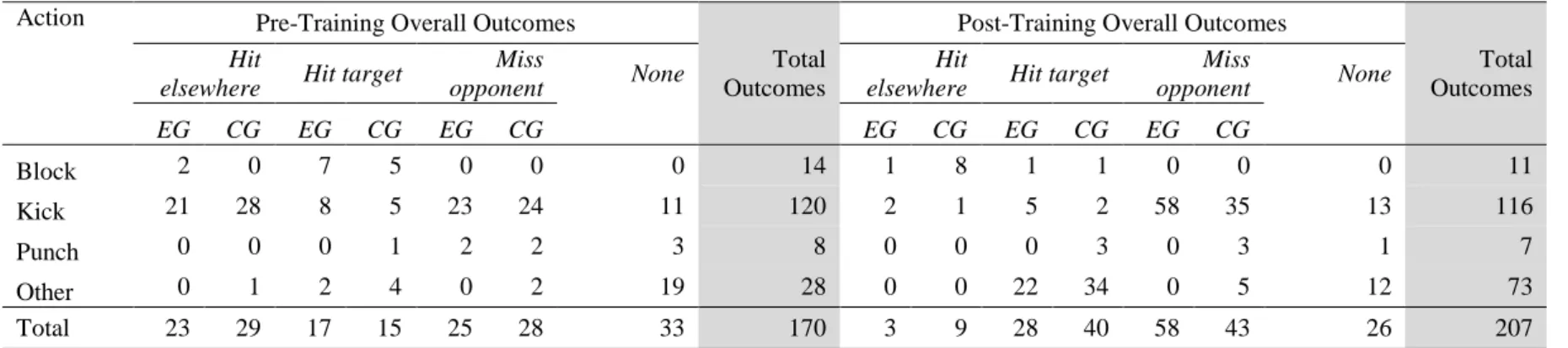
The pre- and post-match information can be observed in Table 2 and 3. The overall frequency highlights the increase of the total frequency of actions post-training (207 actions) compared to pre-training (170 actions) with both exponents E13 (70 to 95 actions) and C13 (81 to 100 actions) performing more total actions post-training. Overall, there was a decrease in all silat action variables (blocks, punches, and kicks) in the post-training match except in other activities (dodge, catch, and off- fight contact actions/ low-intensity activities [others]), which shows a big increase from 28 to 73 actions. The E13 performed 15 more kicking actions and 20 more other actions (dodges) in the post-training match. Whereas, the C13 performed more punches (increased by 2 actions), blocks (increased by 4 actions) and other (dodges) actions in the post-training match compared the pre-training match. The E13 shows a decrease in the number of blocks (decreased by 7 actions) and punches (decreased by 3 actions), while C13 shows a bigger decreases in kicks, with a reduction of 19 actions post-training compared to the pre-training match.
Table 3 shows the increase in the number of total successful ‘hit target’ outcomes pre- and post-training in E13 (from 17 to 28 actions) or C13 (from 15 to 40 actions). The number of successful block performance in E13 decreased (decreased 6 actions) along with the total number of block actions post-training (Table 2).
Even though there was an increase in the overall frequency of kicks due to the training intervention in E13; the successful number of kicks decreased by 3 actions. There was an increase in the number of ‘miss opponent’ (35 actions kick outcomes in E13).
2) Competition Performance Pre- and Post-Training in 16-year-old Participants
The pre- and post-match training information can be observed in Table 4 and 5. The overall frequency of the pre- and post-training events between both silat exponents shows that there were decreases in the total frequency of actions post-training (135-actions) compared to pre-training (222-actions). The overall frequency of kicks showed an increase (increased by 20-actions) compared to other silat activities (decrease in block, punch, and other actions) post-training match. The overall performance of the experimental exponent (E16) decreased by 23-actions across all silat actions (block, punch, and other actions) except in kicks, which increased from 37 to 63-actions post-training. The overall performance of the control exponent (C16) decreased by 54 actions (block, kick and punch) except in other actions (catch and topple down), which was increased by 4 to 10-actions following the training programme.
Table 2: Pre- and post-training competition overall frequency of events during round 1, 2 and 3 for the 13-year-old group.
Table 3: Pre- and post-training competition overall outcomes of events during round 1, 2 and 3 for the 13-year-old group.
Action Pre-Training Overall Outcomes
Total Outcomes
Post-Training Overall Outcomes
Total Outcomes Hit
elsewhere Hit target
Miss
opponent None
Hit
elsewhere Hit target
Miss
opponent None
EG CG EG CG EG CG EG CG EG CG EG CG
Block 2 0 7 5 0 0 0 14 1 8 1 1 0 0 0 11
Kick 21 28 8 5 23 24 11 120 2 1 5 2 58 35 13 116
Punch 0 0 0 1 2 2 3 8 0 0 0 3 0 3 1 7
Other 0 1 2 4 0 2 19 28 0 0 22 34 0 5 12 73
Total 23 29 17 15 25 28 33 170 3 9 28 40 58 43 26 207
* EG = Experimental group silat exponent; CG = control group silat exponent; Other = any silat actions other than block, kick and punch; None = means action that did not count as an outcome by the researcher; Hit elsewhere = any attacking or defensive silat actions that miss or did not successfully hit the ‘target’; Hit target = any successful attacking or defensive silat actions (some contributes to scoring points; but some did not) or any silat actions that hit the ‘target (scoring point area); Miss opponent = any attacking or defensive silat actions that miss the ‘target’ or failed to deliver points. None = any attacking or defensive silat actions that did not contribute to point score.
Action Pre-Training Overall Frequency Total Post-Training Overall Frequency Total
EG CG Others Frequency EG CG Others Frequency
Block 9 5 0 14 2 9 0 11
Kick 56 64 0 120 71 45 0 116
Punch 3 5 0 8 0 7 0 7
Other 2 7 19 28 22 39 12 73
Total 70 81 19 170 95 100 12 207
Table 4: Pre- and post-training competition overall frequency of events during round 1, 2 and 3 for the 16-year-old group.
Action Pre-Training Overall Frequency Total Post-Training Overall Frequency Total
EG CG Others Frequency EG CG Others Frequency
Block 35 22 0 57 7 9 0 16
Kick 37 39 0 76 63 33 0 96
Punch 25 43 0 68 2 2 0 4
Other 3 4 14 21 0 10 9 19
Total 100 108 14 222 72 54 9 135
* EG = Experimental group silat exponent; CG = control group silat exponent; Others = means off fight-contact actions or low-intensity activities performed by both exponents; Other = any silat actions other than block, kick and punch
Table 5: Pre- and post-training competition overall outcomes of events during round 1, 2 and 3 for the 16-year-old group.
Action Pre-Training Overall Outcomes
Total Outcomes
Post-Training Overall Outcomes
Total Outcomes Hit
elsewhere Hit target
Miss
opponent None
Hit
elsewhere Hit target
Miss
opponent None
EG CG EG CG EG CG EG CG EG CG EG CG
Block 4 4 28 16 3 2 0 57 2 0 2 9 3 0 0 16
Kick 14 8 1 3 22 27 1 76 39 2 1 4 23 27 0 96
Punch 2 0 13 16 9 24 4 68 0 0 1 1 1 1 0 4
Other 0 0 2 3 1 1 14 21 0 0 0 5 0 5 9 19
Total 20 12 44 38 35 54 19 222 41 2 4 19 27 33 9 135
Discussion
For analysis purposes, each participant was treated as a single subject design case study. Advantages of this design were such that observed changes in data obtained could be more confidently attribute to specific interventions for each individual [29]. Both qualitative and quantitative data (as in this study) are regarded as legitimate sources of information in case study designs [30].
Effect of Training on Fighting Performance in 13-year-old Participants
The analysis of fighting performance of the 13-year-old participants before and after the 6-weeks silat-specific training programme will be explained based on two elements; frequency and outcomes of the silat actions in the match. In this study the following observations were made:
1. Other action. The study shows a large improvement (160% increased) post-test in other actions in both participants. Here, the other actions referred to any silat actions other than blocking, kicking and punching (i.e., low-intensity actions, catching, dodging, swiping, self-release or topple down actions). Further analysis on the match (‘other’ actions) shows that the dominant action of the other actions was the dodge. During the pre-test match, there were no dodge actions applied during the match, this suggests both E13 and C13 exponents had not been exposed to this defensive movement yet by their coach. The increase of (the E13 increased by 22-actions and C13 by 32-actions) dodge actions in both participants was likely due to the introduction of this technique by the silat coach during the 6-week training programme. Therefore, technical training at this young age may give more of an impact on fighting performance than physical conditioning. The importance of evading/dodging strikes in a silat match is one of the defensive skills that require exponents to avoid being hit; moving the body quickly either to the left, right or retreating. There are 10 techniques related to evading/dodging techniques in silat olahraga that have been discussed in detailed by Anuar [31]. This post-match match analysis showed that both exponents have the ability to evade the strike from their opponent well with 100% success of this action. Thus, the current study shows that dodge or evading skills are the best defensive technique in 13-year-old group and can be learnt during a 6 week training period.
2. Block action. There was a 21% decrease in the number of blocking actions pre- to post-training. The percentage of successful blocking actions dropped from 85% in the pre-training match to 18% post-training match. There was an increase in number of blocks in C13 but not in E13 (5 to 9 for C13 and 9 to 2 for E13). As the E13 improved their dodging skills post-intervention period, they became less reliant on the need to block. Moreover, as a consequence of E13 increasing the number of kick actions, C13 was required to increase the number of dodges and blocking actions in the post-training. This is similar with the results in Shapie et al. [3], where when one exponent is dominant in the attack, the other opponent has to defend to avoid being hit. Therefore, increasing the number of kicks made E13 more dominant in the post-training match (E13 won the post-training match).
3. Punch action. There was a 12.5% decrease in the number of punches in the post-training match. However, there was an increase in the number of successful punches of from 12.5% to 42.8% in C13, while there was no punch action in a post-test match in E13. It was suggested that the increase in punches was due to a decrease in the number of kicks in C13, reflecting a change in fighting/style tactics post-training interventions. This again suggests that skill/tactical coaching, or adapting to an opponent’s style (i.e., as E13 increase kicks, C13 increase punches in the post-training match) may have more of an influence on competition performance than the physical conditioning.
4. Kick action. The results show that there was 3% decrease in overall kick frequency post-training. The overall outcome shows that the successful kicks that hit the target was better in the pre-training match (11%) compare to post-training match (7%). This was partly due to the improvements made by both participations at dodging/evading. Consequently, it became more difficult for them to hit their opponents target area during the silat match.
actions of catch, no self-release and swipe occurring during the post-training match, no referee judgement was needed to stop the fight, and the match continued without any disruption. It is also suggested that improved in whole body or local muscular endurance, allowing participants to maintain a greater work rate and complete a greater total number of high-intensity actions (increase from 151 in pre-training to 195 actions in the post-training match).
6. Overall outcomes. The current study shows that there was an increase in ‘hit target’ overall outcomes, increasing from 18.8% to 32.8% pre- to post-training match. However, the analysis showed that there were only increases in punch (increased by 2-actions) and other (increased by 36-actions) activities. Conversely, there were decreases of some hit target outcomes; 83% on block and 46% on kick. These results suggested that the decrease of successful blocking actions was due to the increase of other activities (e.g., dodge).
During the pre-training match, E13 and C13 did not perform any successful dodge, but E13 successful dodged 22 times and C13 32 times in the post-training match (detailed analysis on ‘other’ actions). Moreover, the ability of both exponents to dodge attacks (e.g., kick strikes) raised the ‘miss opponent’ outcomes (93-actions) post-training. This is explained by other results, which showed that there was no dodge action in the pre-training match, most kicks landed either hit elsewhere or were successfully blocked by the other exponent.
7. Overall analysis. Overall analysis of both matches in the 13-year-old group suggested that the E13 performed more kicks and evading actions while C13 increased block and dodge/evading actions in the post-training match. It is speculated that two reasons influenced this outcome; Firstly, the silat syllabus emphasizes basic blocking techniques (hand-block) should be coached during the first three months of the silat training programme. Secondly, both silat exponents benefited from the silat training/coaching and consequently improved dodging/evading actions. Furthermore, the circuit training may have promoted the physical conditioning of E13, with improved kick test performance reflected in increased kicking contribution in the post-training match, requiring C13 to block more.
Effect of Training on Fighting Performance in 16-year-old Participants
As per the 13-year-old group the analysis of fighting performance of the 16-year-old group will be explained based on two elements (frequency and outcomes). In this study the following observations were made:
1. Other actions. The study shows a decrease post-training in other actions in the experimental (decrease to zero action) but not in control participants (increase 150%). The C16 performed more actions in other (increased by 6-actions), which relates the improvement of toppling down and catch abilities within the silat training (detailed analysis on ‘other’ actions). Both E16 and C16 improved aspects of fitness that may be associated with improved catching and topple down techniques. It is likely the improvement in catch was due to this silat skill being taught to C16 during the normal silat training.
2. Block action. Shapie et al. [3] highlighted that 11% of the total frequency of activities during a silat match between young adults were blocks. While, the current results shows 8% (pre-test) and 5% (post-test) for 13-year-old and 26% (pre-(post-test) and 12% (post-(post-test) of 16-year-old groups. These values support the importance of this defensive technique in a silat match. A single block action does not deliver a point-score in a silat match, but any blocking technique (either with hand or leg) that is followed with a legal strike that hits the target (i.e., punch, kick, or topple down) will be awarded an extra bonus point. The results of the current study also reflect that the numbers of block actions can be as high as 26% (pre-training 16-year-old) when both athletes rely more on kick strikes and decrease as low as 5% (post-training 13-year-old) when the exponents improved other skills such as catching or dodging. Thus, it is speculated that the number of block actions in the current study moves close to adults (12% in post-match 16-year-old and 11% in Shapie et al. [3]) once the exponents increased age, training history, and improvements of other attacking and defensive techniques in silat.
punching for both exponents (E16 decreased from 25 to 2 actions, and C16 decreased from 43 to 2 actions in pre- to post-training match). Kazemi et al. [6] reported that success in competition is indeed a combination of physical attributes, talent, skill, technique, determination, psychological preparedness and tactical or strategy. Thus, it was speculated that changes in match tactics/strategy [6, 18] influenced the frequency and outcomes of the fights.
Both the E16 and C16 might improve aspects of fitness that may be associated with improved upper body attacking and defensive skills. However, it seems much more likely that the improvement in the fitness failed to influence the match outcomes in the number of punches thrown.
4. Kick action. The biggest increase of the post-fighting performance was kick action, with an increase in frequency in E16 (70% increase) but not in C16 (15% decrease). Similar with the younger group, the E16 performed 88% of his total action with kicks. However, even with the improvement in frequency of kick, there was no improvement in the number of successful hits with kick actions. There was only an increase in the number of kicks that hit elsewhere. It was speculated that a change in tactics had more of an influence in the 16-year-old fight.
5. Low-intensity action (others). There was a 36% decrease in low-intensity events post-intervention. The reasons for this decrease similar with what was observed in the 13-year-old match, where due to less disruption of the match, with less actions of successful topple down (all topple down actions were unsuccessful), no self-release and swipe occurring during the post-training match no referee judgement was needed to stop the fight.
6. Overall frequency and outcomes. In contrast to the 13-year-old group, the pre-post match data shows that E16 decreased 28% and C16 decreased 50% in the overall frequency of silat actions. The pre- to post-test match of E16 shows a 100% decrease in other actions, 92% in punch, and 80% in block performance but an increase in kicks (increased by 70%). Meanwhile, C16 shows a decrease in all silat actions (block [decreased 59%], punch [decreased 95%] and kicks [decreased 15%]) except in other actions (catch and topple down). The outcomes of the other actions show C16 successfully implemented the catch techniques (5 actions) in the post-test match but failed in all topple down activity which also known as ‘miss opponent’ (detailed analysis on ‘other’ actions).
The current study shows that there was a decrease in the overall ‘hit target’ outcomes, which is shown by the 72% decrease in this category in the post-training match. Details showed that there was a decrease in block (decreased by 75%) and punch (decreased by 93%) actions. Conversely, there was a small increase of hit target outcomes by 1-action in kick. There was also no improvement of the numbers of other actions (any silat actions other than block, kick, punch and low-intensity activity [others]) between pre and post-test match. These results suggested that the decrease (28 to 2 actions pre-post training) of the successful blocking activities were due to the changing strategy by the experimental participant (E16), which performed more kicks in the post-training match. The number of kicks performed by E16 increased from 37 – 63 pre-post training. Thus, it was speculated that this changed influenced the number and types of activities performed by E16 and also C16. Due to the increased number of kicks by E16, the control group exponent tended to catch and topple down the kicks performed by E16, which is supported by the results. However, the result shows only 5% of the kicks performed by both exponents hit the target while the other kicks miss opponent or hit elsewhere. These interpretations suggest limited transference of fitness into competition over the intervention period, with match tactics seeming to have a greater influence on competition performance in the older group.
General Issues of 13 and 16-year-old in Fighting Performance
There are several points that are important to be addressed in this study based on all the aforementioned discussion on the effect of silat-specific circuit training in two 13 and 16-year-old boys. This study highlights the individual responses to the specific intervention training on competitive performance. Even though some individuals might improve their fitness more (than an opponent), it does not necessarily mean they can transfer those characteristics into silat.
1. This is important as while on a group basis most 13-year-old exponents might improve muscular endurance, lower body strength and motor coordination and most 16-year-old benefitted from increased endurance, concentric strength, and muscular endurance as stated by Shapie and co [4], there is considerable individual variability within the group response. Moreover, what has the researcher showed throughout the applied methodology in this study might be useful to coaches to replicate those methods to targeted individuals, in order to predict the effectiveness of a training programme on fighting performance. Also, the applied nature of this study might be taking into coaching perspectives how effectively training is transferred to competitive performance. Two aspects that the coaches need to aware of are; do not rely solely on fitness data in order to predict fighting performance and second, there are technical and tactical issues in the silat match that need to be put into consideration in order to understand the factors that influence competitive fighting performance. For example, a previous study showed that aerobic power in lightweight senior Indian male boxers was 58.30 + 2.2 mL·kg -1·min-1 [11], even though the junior boxer can easily reach that level of endurance, it does not mean the junior can have similar skills and technical abilities to compete with his senior counterpart.
2. Technically, one interesting point to highlight was that research by Shapie et al. [3] showed that the percentage of punch and kick actions contributed around 57% of the overall match frequency. However, the current study shows that the amount of both actions in 13-year-old contributed 75% in the pre-test and 59% in post-training matches; whereas the 16-year-old contributed 65% in the pre-test and 74% during the post-training matches. These results suggest the 13-year-old groups rely more on both actions during the pre-test match but adaptation to other skills such as dodge and catch post-training match. This change is speculated to result from the technical coaching received by both participants during the intervention period. Furthermore, the decrease of punch actions in E13 did not mean that the exponent lacked upper body skill or the ability to perform a strike, but the adaptation to lower body endurance gains during the intervention might influence E13 to perform more kicks and dodge during the latter match. It has been reported that children performances differences tend to be less skill related and more knowledge-based [33, 34]. Both skill and knowledge increase as a result of practice, experience, and maturation, however, younger children demonstrate less variation in skill than older children and adults [32]. Thus, E13 performed more kicks, and dodge actions compare to other silat skill due to the above factors. It would be suggested for E13 to practice punching technique in training to aid further development.
3. Meanwhile, a large increase of kick actions was found in E16 but not in C16. It was speculated that this increase was related to knowledge, skill, and performance as described by Thomas and Thomas [32]. The authors described that novices lack declarative knowledge such as goals and subgoals of the game, rules of the game, offensive and defensive strategies, terminology, and etiquette. E16 successfully punched his opponent 13/25 times compared to only 1/37 kicks in the pre-training match. Therefore, the incapability of E16 to recognise his appropriate skill in the post-training match resulted in a poor performance with only 1 successful kick from 63 kicks applied and 1/2 punch. Thus, the inability for E16 to determine punching as an appropriate skill that can contribute points in the post-training match was a limitation of his performance. Novices often do not know which skills to execute or when to execute a skill [32].
activities happened particularly because E16 used a different strategy (using kicks instead of punch) than that adopted in the pre-training match.
5. The current study did not provide the points scored for each exponent in all matches. However, in order to give a better understanding about the fighting performance, the author thought that this point needs to be raised in order to understand the importance of selecting a proper silat skill (i.e., punch, kicks, block + punch, dodge + punch amongst others) in order to score points in silat match. The ability for silat exponents to score maximum points during 3-rounds of a fight is critical to win the silat match match [31].
Conclusion
This was the first case study to examine the changes in competitive fighting performance of four young performers from experimental and control groups following a silat-specific circuit training programme. The younger experimental exponent showed a changed in combative fighting performance with increases in kick and dodge/evade actions and with more successful evading actions. This improvement was suggested to be associated with training improvements in upper body endurance and power, lower body strength, kicking speed-endurance, kick speed and agility which promoted relates to increase of kicks and dodge actions during a silat match. The older experimental exponent might gains in isometric strength, upper body endurance and power, and lower body strength but did not transfer this positive improvement into fighting performance, probably due to the tactical strategy during the silat match. Both C13 and E13 increased in dodge particularly due to the technical training. Kick performance might the only transferred to competition. Gains in fitness may have some positive influence in performance in younger silat athletes. However, it is suggested that all silat fitness testing protocols could be used as valuable elements of information to evaluate an athlete’s performance, although other important factors also need to be considered.
Acknowledgements
We would like to thank the Akademi Silat Malaysia for volunteering for the study. A special thanks to Grandmaster Shahid Elias (Seni Silat Malaysia). We also like to thank Grandmaster Aminuddin Anuar and late Grandmaster Allahyarham Salehuddin Abdul Wahab from Pertubuhan Seni Gayung Fatani Malaysia for their support in this study. We also like to thank Cardiff School of Sports, Cardiff Metropolitan University, UK for the equipment used in this study. Sincere gratitude and appreciation to University Teknologi MARA (UiTM), Malaysia especially Faculty of Sports Science and Recreation for the given funding to publish the research.
References
Mirwald RL, Adam DG Baxter-Jones, Bailey DA et al. An assessment of maturity from anthropometric measurements. Med Sci Sports Exerc 2002; 34 (4): 689–94.
Shapie MNM, Oliver J, O'Donoghue PG et al. Fitness characteristics of youth silat performers. Malaysian J Sport Sci Res 2014; 10 (1): 40-53.
Shapie MNM, Oliver J, O'Donoghue PG et al. Activity profile during action time in national silat competition. J Combat Sports Mar Arts 2013; 4: 81-6.
Shapie MNM, Oliver J, O'Donoghue PG et al. Affect of circuit training on fitness development in youth silat. Poster presentation for 5th ISN International Sports Medicine and Sports Science Conference; 2011 Sept 27-30; Kuala Lumpur, Malaysia.
Kazemi M, Waalen J, Morgan C et al. A profile of Olympic taekwondo competitors. J Sports Sci Med 2006; 5 (CSSI): 114-21.
Smith MS. Physiological profile of senior and junior England international amateur boxers. J Sports Sci Med 2006; CSSI: 74- 89.
Yoon J. Physiological profiles of elite senior wrestlers. Sports Med 2002; 23(4): 225-33.
Callister RJ, Staron RS, Fleck SJ et al. Physiological characteristics of elite judo athletes. Int J Sports Med 1991; 12: 196-203.
Guidetti L, Musulin A, Baldari C. Physiological factors in middleweight boxing performance. J Sport Med Phys Fit 2002, 42, 309-14.
Khanna GL, Manna I. Study of physiological profile of Indian boxers. J Sports Sci Med 2006; 5:90-8.
Amtmann JA, Amtmann KA, Spath WK. Lactate and rate of perceived exertion responses of athletes training for and competing in a mixed martial arts event. J Strength Cond Res 2008; 22(2): 645-47.
Bounty P L, Campbell BI, Galvan E et al. Strength and conditioning considerations for mixed martial arts. Strength Cond Res J 2011; 33: 56-67.
Francescato MP, Talon T, Prampero PE. Energy cost and energy sources in karate. Eur J Appl Physiol O 1995; 71(4): 355-61.
Beneke R, Beyer T, Jachner C et al. Energetics of karate kumite. Eur J Appl Physiol 2004; 92: 518–23.
Doria C, Veicsteinas A, Limonta E et al. Energetics of karate (kata and kumite techniques) in top-level athletes. Eur J Appl Physiol 2009; 107: 603-10.
Turner AN. Strength and conditioning for Muay Thai athletes. Strength Cond J; 31(6): 78-92.
Crisafulli A, Vitelli S, Cappai I et al. Physiological responses and energy cost during a simulation of a Muay Thai boxing match. Appl Physiol Nutr Metab 2009; 34(2): 143-50.
Buse GJ, Santana JC. Conditioning strategies for competitive kickboxing. Strength Cond J 2008; 30(4): 42-8.
Zabukovex R, Tiidus P. Physiological and anthropometric profile of elite kickboxers. J Strength Cond Res 1995; 9(4): 240-42.
Aziz AR, Tan B, Teh, KC. Physiological responses during matches and profile of elite pencak silat exponents. J Sports Sci Med 2002; 1: 147-55.
Douris P, Chinan A, Gomez M et al. Fitness levels of middle aged martial art practitioners. Br J Sports Med 2004; 38:143-47.
Hain TC, Fuller L, Weil L et al. Effects of tai chi on balance. Arch Otolaryngol Head Neck Surg 1999; 125: 1191-95.
Violan MA, Small EW, Zetaruk MN et al. The effect of karate training on flexibility, muscle strength, and balance in 8 to 13-year-old boys. Pediatr Exerc Sci 1997; 9: 55-64.
Melhim AF. Aerobic and anaerobic power responses to the practice of taekwon-do. Br J Sports Med 2001; 35: 231-235.
Balyi I, Hamilton A, editors. Long-term athlete development: trainability in childhood and adolescence. Windows of opportunity. Optimal trainability. Victoria: National Coaching Institute British Columbia & Advanced Training and Performance Ltd; 2004.
Anuar AW. Silat Olahraga. Kuala Lumpur: Dewan Bahasa dan Pustaka; 1987.
Brown D, Hughes M. The effectiveness of quantitative and qualitative feedback on performance in squash. In: Reilly T, Hughes M, Lees A, editors. Science and racket sport, London: E & FN Spon; 1995: 232-37.
Smith RE. The logic and design of case study research. Sport Psychol 1988; 2: 1-12.
Anuar AW. Silat Olahraga. The art, technique and regulations. 2nd ed Kuala Lumpur: Dewan Bahasa dan Pustaka; 1993.
Thomas KT, Thomas JR. Developing expertise in sport: the relation of knowledge and performance. Int J Sports Psychol 1994; 25(3): 295-312.
French KE, Thomas JR. The relation of knowledge development to children's basketball performance. J Sport Psychol 1987; 9(1): 15-32.
McPherson SL, Thomas JR. Relation of knowledge and performance in boys' tennis: Age and expertise. J Exp Child Psychol 1989; 48(2): 190-211.