Universal Infant Hearing Screening by Automated Auditory Brainstem
Response Measurement
Judith A. Mason, MS*, and Kenneth R. Herrmann, MD‡
ABSTRACT. Background. Our purpose was to iden-tify infants with a bilateral, permanent, handicapping hearing loss and to provide them with amplification before age 6 months.
Methodology. The study population consisted of 10 372 infants born during a 5-year period. Universal hearing screening by automated auditory brainstem re-sponse was done in the nursery. Infants who failed the screening test were followed up diagnostically. Infants who were not tested in the nursery were followed up as outpatients. Hearing aids were recommended for those infants who had bilateral hearing loss.
Results. Successful screening in the nursery was achieved for 96% of infants. The failure rate was 4%. The incidence of bilateral loss requiring amplification was 1.4/1000. The false-positive rate was 3.5% after the initial screening and .2% when a two-stage screening procedure was used. The incidence of congenital bilateral hearing loss in the well population was 1/1000, and in the neo-natal intensive care unit population, 5/1000. The cost of screening was $17 per infant, and the cost to identify each true bilateral hearing loss was $17 750. Amplification was recommended for 15 infants; well infants who used hear-ing aids before age 6 months achieved age-appropriate speech and language development.
Conclusions. Mild, moderate, and severe bilateral, persistent hearing loss can be identified in the nursery by automated auditory brainstem response measurement to provide amplification before age 6 months and thus optimize speech and language development. Pediatrics 1998;101:221–228;infant hearing screening, newborn hear-ing screenhear-ing, neonatal hearhear-ing screenhear-ing, universal new-born hearing screening, automated auditory brainstem re-sponse, bilateral hearing loss, congenital hearing loss.
ABBREVIATIONS. AABR, automated auditory brainstem re-sponse; NICU, neonatal intensive care unit; ABR, auditory brain-stem response; OAE, otoacoustic emissions.
T
he Kaiser Permanente Medical Center inHonolulu, Hawaii, established a universal newborn hearing screening program in 1992 in response to state and national legislation. We chose automated auditory brainstem response (AABR)
measurement performed in the nursery before dis-charge to optimize the identification of hearing-impaired infants. We report our 5-year experience in screening 10 372 newborn infants using AABR.
MATERIALS AND METHODS Study Group
Well infants, hospitalized from 24 to 36 hours, were screened at age 3 to 36 hours; neonatal intensive care unit (NICU) infants were screened before discharge (at age 2 days to 90 days or more). Specific statistics on the age of each infant at screening were not kept. All the NICU infants had risk factors1,2for hearing loss; risk factors occurred in ,2% of the well-infant population and in-cluded cleft palate, exposure to antibiotics, skin tags near the ears, and a family history of hearing loss.
The races of the population sampled included white, Asian, Pacific Islander, and mixed. Compared with the racial composi-tion of the United States as a whole, Hispanic and black represen-tation was minimal.
Less than 1% of our total population represented deaths or transfers to and from other facilities. The NICU is a level 2 facility, providing all services except cardiac surgery and extracorporeal membrane oxygenation.
Equipment
The ALGO-1 Plus3(Natus Medical Inc, San Carlos, CA) was used for all screenings. This automated hearing screener uses auditory brainstem response (ABR) measurement with a broad-band click stimulus [technical specifications for the click stimulus: duration5100 microseconds; intensity535 dB nHL; polarity5 alternating; acoustic frequency spectrum5700 to 5000 Hz (65 dB); filter settings: 0.05 to 1.5 kHz, 6 dB high pass, 24 dB low pass] which tests at frequencies greater than 1000 Hz.3Built-in artifact rejection for myogenic, electrical, and environmental noise inter-ference ensures that data collection is halted if testing conditions are unfavorable. The automated screener provides a pass-fail re-port; no test interpretation by an audiologist is required.
Screening in the Nursery
Infants born at Kaiser Permanente Medical Center, Honolulu, Hawaii, from March 1992 and through February 1997 were screened before discharge as part of an ongoing universal new-born hearing screening program. Screening was done 7 days per week, 365 days per year, by audiologists during the first 2 years of the program and subsequently by technicians. Successful screen-ing requires infant comfort, a relatively quiet environment, proper application (electrode impedance,12 K ohms3) of surface elec-trodes in a noncephalic montage4(electrode montage: noninvert-ing5high forehead, inverting5nape, and common5mastoid), application of adhesive circumaural headphones, and presenta-tion of the click stimulus. Well-infant screenings were performed at the mother’s bedside with the infant resting in the mother’s arms or in a quiet room adjoining the nursery with the infant in an open bassinet. NICU infants were screened in the nursery. Exam-inations took a mean 15 minutes (range, 1 to 60 minutes), depend-ing on the infant’s state and the infant’s heardepend-ing status. Outpatient screening was conducted for infants who failed nursery screening and for those who were not screened in the nursery. Diagnostic ABR was done before age 1 month.
From the Departments of *Audiology Services and ‡Pediatrics, Kaiser Per-manente Medical Center, Honolulu, Hawaii.
Related material was presented at the American Academy of Audiology Annual Conference, Richmond, Virginia, April 26, 1994, and at the Amer-ican Academy of Audiology Annual Conference, Dallas, Texas, April 1, 1995.
Received for publication Jan 28, 1997; accepted Jun 18, 1997.
Diagnostic Follow-up Testing and Intervention
Infants referred for outpatient evaluation were tested by using diagnostic ABR (Compact Auditory 4; Nicolet Biomedical Inc, Madison, WI). Normal findings were defined as click thresholds of
#35 dBnHL.5 Diagnostic testing also included high-frequency tympanometry and ipsilateral acoustic reflex testing (GSI-33; Lucas Grason-Stadler, Inc, Littleton, MA), behavioral observation audiometry using low-frequency stimuli and running speech (GSI-10, Lucas Grason-Stadler), and an evaluation by an otolaryn-gologist. Referrals were made outside our facility for distortion product otoacoustic emissions testing. Infants were discharged from the screening program if bilateral hearing loss was ruled out. Test results were communicated to the families and their primary care physicians.
Hearing aids and referrals to infant speech and language ha-bilitation programs were provided when indicated. Well infants received aural habilitation therapy through private agencies. This therapy consisted of private one-to-one sessions conducted 2 to 3 times per week during the first 6 months and a home intervention curriculum provided at no charge via mail-order through a char-itable private national agency. NICU infants received therapy as their health permitted.
Speech and language development was tested outside our fa-cility, and information on test scores was retrieved from infants’ medical records.
RESULTS
Of the 10 773 infants born during the 5-year study period, 10 372 (96.3%) were screened before dis-charge from the hospital (Table 1); 401 infants were not screened successfully in the nursery.
Infants Screened in the Nursery
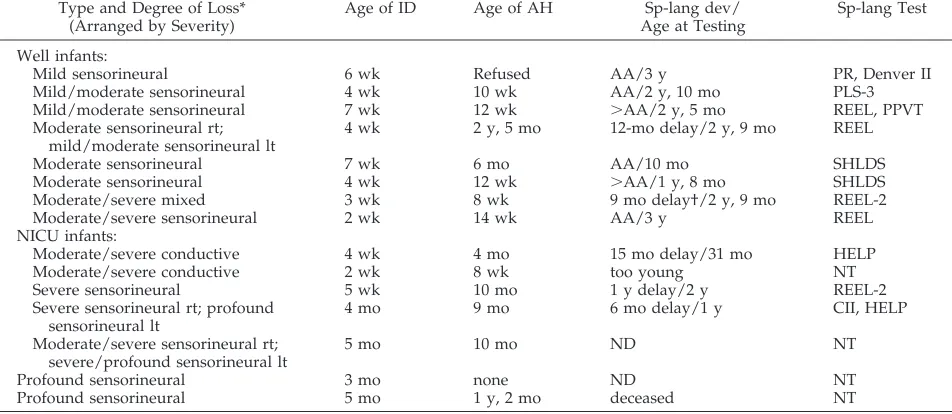
Of the 10 372 infants screened in the nursery, 9957 passed screening, and 415 failed. Fifteen (3.6%) of the infants who failed had permanent bilateral loss.35 dB, a rate of .9/1000 of the study population (Table 2). The remaining 400 infants are described in Table 3. The 15 infants identified as having bilateral hear-ing impairment had losses ranghear-ing from mild to profound (Table 4). At initial diagnostic testing, all the infants had moderate or greater ABR thresholds; their audiometric test results shifted as they grew older, and 3 were later found to have mild to mod-erate hearing impairment. Eleven of the hearing losses were sensorineural, 2 were mixed with a sub-stantial sensorineural component, and 2 were perma-nent conductive (1 with craniofacial anomalies, 1
with bilateral atresia). Seven well infants and 6 NICU infants received hearing aids.
Infants Not Screened in the Nursery
We discharged 401 infants without successful screening; 250 screening examinations were unsuc-cessful because of myogenic interference, 143 infants were discharged before testing, and 8 parents re-fused screening. Attempts were made to recall all of these infants for outpatient screening. Only one half (n 5 212) returned; the remaining infants’ families moved (n5101) or had parents who declined testing (n5 88). Of the 212 who returned, most (n5 200) had normal results of screening examinations. Ab-normal results were found in 12 infants; 11 of these infants had transient losses or are still under evalu-ation. One infant had bilateral loss and received hearing aids.
DISCUSSION
Development of Newborn Hearing Screening Programs Hearing loss in infants is a handicap which, if left unidentified and untreated, results in delayed speech and language development as well as emotional, social, and academic difficulty. Normal speech and language development depend on normal hearing, and even mild, persistent loss may result in de-lays.6-16 The average age of identification of hearing
loss in the United States is 20 to 24 months,15,17 and
mild and moderate losses are usually not identified until $48 months.18 Thus, intervention, which
should ideally begin by age 6 months,19 has often
been delayed.
Funding of early intervention programs for hand-icapped infants and toddlers was enacted in 1986 by the United States Congress. Public Law 99 – 457 re-authorized Public Law 94 –142, The Education of the Handicapped Act, which included a provision for early intervention programs for handicapped
per-TABLE 1. Newborn Infants Tested by Automated Auditory
Brainstem Response (AABR) Measurement Screening Program
n %
Screened before discharge 10 372 96.3
Screened after discharge 212 2.0
Not screened* 189 1.7
Total births† 10 773 100
* 1015moved, 805noncompliant, 85parents refused, 15not screened because of continuing hospitalization (not included in this calculation). Infants who died are not included in our study population.
† Total ear-specific data on this group was not kept. If an infant passed the initial screen in one or both ears, she or he was discharged and a note was made in the chart if one ear failed, but these infants were not tracked. During the first 3 years of the program, infants recalled were tested behaviorally at age 6 to 7 months; sound field visual response audiometry was done and ear-specific data was not available. By year 4, we screened all recalled infants by AABR.
TABLE 2. Bilateral AABR Failures in Newborn Infants
Screened Before Hospital Discharge
Population n Loss at
Nursery Screening
Confirmed Loss
Well infants 8971 347 8
NICU infants 1401 68 7
Total 10 372 415 15
TABLE 3. Evaluation of Infants Labeled False Positive After Initial Screening in the Nursery
Result n % of Total
Failed
Normal diagnostic ABR or AABR rescreening
219 52.8
Unilateral loss 115 27.8
Bilateral transient or fluctuating loss*
26 6.2
Lost to follow-up 38 9.1
Testing incomplete 2 .5
Total 400 96.4
sons from birth to age 3 years.20,21In July 1990, the
Hawaii State Legislature mandated development of a statewide program for early identification of hear-ing-impaired infants.22 In 1993, the National
Insti-tutes of Health recommended that all infants receive hearing screening within the first 3 months of life.23
Past efforts to evaluate newborn hearing have in-cluded various screening tools. The high-risk regis-ter24-26 reviewed birth certificates and hospital
records to identify infants at risk for hearing loss. Parental noncompliance was a major problem with this method.27,28 Another screening tool monitored
movement associated with a stimulus sound.29This
method proved unsatisfactory because false-positive rates ranged from 14%30 to 20%.29 Modifying the
motion detection method by adding behavioral test-ing improved the sensitivity and specificity. How-ever, precise identification of hearing loss remained elusive because these screening methods omitted the well-infant population,31–34 which accounts for
one-half of all individuals afflicted with congenital hear-ing loss.35
More recently, two methods have been investi-gated for hearing screening: otoacoustic emissions (OAE) and ABR. Electrophysiologic measurement of responses to auditory stimuli eliminates the ambigu-ity of measuring body motion in response to audi-tory stimuli.
OAE, sounds theorized to be generated by the outer hair cells of the cochlea,36 may be measured
microphonically in response to a click stimulus.37– 43
The sensitivity of OAE screening in a typical hospital setting has been reported as 50% and the specificity, 53%.44In addition, OAE requires interpretation by an
audiologist for each of several (mean, 4) screening examinations performed on an infant.
ABR uses a click stimulus to elicit an electrical
brainstem response measured by surface elec-trodes.11,45– 47The sensitivity of the ABR screener has
been reported as 100% and the specificity, 97 to 98%.48 –50 AABR screening does not require
interpre-tation by an audiologist. Universal newborn hearing screening by OAE43,51,52and screening of NICU
pop-ulations by conventional ABR and AABR49,53–55have
been reported. We chose AABR because of its supe-rior operating characteristics and because of the lower cost of professional services required to achieve accurate screening results.
Incidence of Bilateral Congenital Hearing Loss
We defined bilateral congenital hearing loss as the number of infants for whom amplification was rec-ommended, regardless of etiology. This number in-cluded infants whose loss exceeded 35 dB and for whom the loss was permanent. Our incidence was 1.4/1000 for the universal population (Table 5). An-other study using an alternate screening method re-ported a universal incidence of 3/100043; the
differ-ence between our inciddiffer-ence and theirs may be explained by the higher incidence for their NICU population, discussed in more detail below.
For the well-infant population, we reported an incidence of approximately 1/1000. This number represented a comparatively large group; only one other study focused on well infants as a separate population,50and the size of that group was
insuffi-cient (n 5 628) to identify any hearing loss. Others have reported data for a well population43and found
an incidence of 1.2/1000, which is not substantially different from ours.
The largest differences in incidence among studies may be seen in the NICU population. Our incidence
TABLE 4. Infants With Bilateral Hearing Loss
Type and Degree of Loss* (Arranged by Severity)
Age of ID Age of AH Sp-lang dev/
Age at Testing
Sp-lang Test
Well infants:
Mild sensorineural 6 wk Refused AA/3 y PR, Denver II
Mild/moderate sensorineural 4 wk 10 wk AA/2 y, 10 mo PLS-3
Mild/moderate sensorineural 7 wk 12 wk .AA/2 y, 5 mo REEL, PPVT
Moderate sensorineural rt; mild/moderate sensorineural lt
4 wk 2 y, 5 mo 12-mo delay/2 y, 9 mo REEL
Moderate sensorineural 7 wk 6 mo AA/10 mo SHLDS
Moderate sensorineural 4 wk 12 wk .AA/1 y, 8 mo SHLDS
Moderate/severe mixed 3 wk 8 wk 9 mo delay†/2 y, 9 mo REEL-2
Moderate/severe sensorineural 2 wk 14 wk AA/3 y REEL
NICU infants:
Moderate/severe conductive 4 wk 4 mo 15 mo delay/31 mo HELP
Moderate/severe conductive 2 wk 8 wk too young NT
Severe sensorineural 5 wk 10 mo 1 y delay/2 y REEL-2
Severe sensorineural rt; profound sensorineural lt
4 mo 9 mo 6 mo delay/1 y CII, HELP
Moderate/severe sensorineural rt; severe/profound sensorineural lt
5 mo 10 mo ND NT
Profound sensorineural 3 mo none ND NT
Profound sensorineural 5 mo 1 y, 2 mo deceased NT
Abbreviations: ID, identification; AH, amplification and habilitation; Sp-lang, speech and language; dev, development; AA, age appro-priate; rt, right; lt, left; ND, neurologically devastated; PR, parent report; Denver II, Denver Developmental Screening Test II73; PLS-3, Preschool Language Scale 374; REEL, Receptive-expressive Emergent Language Scale75; PPVT, Peabody Picture Vocabulary Test76; NT, not tested; SHLDS, SKI*HI Language Development Scale77; HELP, Hawaii Early Language Profile; CII, Communicative Intention Inventory.78 * Losses are symmetrical except as noted.
of 5/1000 is markedly lower than that which others reported, and this difference may be explained by the inclusion in our NICU population of all infants who are not entirely normal (13% of our births), including minimally symptomatic infants. The higher inci-dence of hearing loss reported in other studies re-flects populations of sicker infants. One study tested only infants whose gestation was,30 weeks,56and 2
others tested only those requiring highly specialized intensive care;57,58these are regional tertiary facilities
that receive infants who are at greater risk for death and disability. Poor compliance with follow-up ex-aminations in the NICU population limited data in some studies.57–59
We noted that 38 infants (34 well, 4 in NICU) failed the initial hearing screening bilaterally and were un-available at follow-up by our program (30 moved, 8 were noncompliant). Letters were sent to their fam-ilies, and, when possible, referrals were made to other local newborn hearing screening programs. Be-cause we found that 4% of infants who failed initial screening examination had true bilateral hearing loss, the 38 infants unavailable at follow-up may have included 1 infant who had bilateral congenital hearing impairment.
Remediation
Practical application of screening requires identi-fication of remediable loss at an appropriate devel-opmental stage and on early intervention. However, initiation of amplification may be delayed for $6 months after hearing loss is identified.17,60 – 62Recent
research has shown the benefits of early identifica-tion and amplificaidentifica-tion. Yoshinaga-Itano, et al19
re-ported that children in whom bilateral hearing loss was identified at birth or before age 6 months had statistically significantly larger lexicons and higher expressive language scores than children in which bilateral hearing loss was identified at age $6 months. At age 4 years, no differences in language development were found between the group in whom bilateral hearing loss was not identified until age 6 months and the group in whom bilateral hear-ing loss was not identified until age 2 years. This
finding shows that hearing loss must be identified and amplification initiated before age 6 months.
No profound hearing losses were identified in our well-infant population. In addition, none of our ing-impaired well infants had a risk factor for hear-ing loss. All hearhear-ing loss in well infants was remedi-able by amplification, and well infants who complied with hearing aid use and who regularly attended aural habilitation sessions showed speech and lan-guage development at and greater than age equiva-lency (Table 4). Well infants are the population for whom screening programs hold the greatest value, and because these infants gain the most by early identification and aural habilitation, society at large is spared the expense of remedial education.
The NICU population showed a notable lack of speech and language acquisition despite early iden-tification of hearing loss. Pervasive medical prob-lems and additional handicaps limited the use of hearing aids and reduced attendance at infant aural habilitation sessions. Neurologic cognitive impair-ments in this population limited speech and lan-guage development independent of auditory system function. Identification and amplification efforts in this population yielded less success.
Treatment of Unilateral Loss
Currently, no accepted standard interventions ex-ist for infants who have unilateral impairment. To conserve resources, our program focused on infants who had persistent bilateral hearing loss because appropriate remediation is available for this popula-tion. Other programs have structured their efforts similarly.35,49,58,59,63,64Although infants with unilateral
hearing loss were not tracked in our program, the AABR screening methodology may provide a mech-anism to identify and to clarify the natural history of unilateral hearing loss.
Identification of unilateral hearing loss was not part of this hearing screening program. When indi-vidual treatment of unilateral loss is requested, the parents are counseled and the infant is monitored every 6 months to ensure that the status of the nor-mal-hearing ear has not changed; referral to an
oto-TABLE 5. Reported Incidence of Bilateral Congenital Hearing Loss79
Infant Population Incidence
per 1000
n Method of
Evaluation
Reference
Universal* 3.0 1850 OAE White, 199343
Universal 1.4 10 372 AABR Mason (current study)
Well 0 628 AABR Joseph, 199350
Well 1.2 1546 OAE White, 199343
Well 0.9 8971 AABR Mason (current study)
NICU and high risk 21.0 373 ABR Schulman-Galambos, 197980
NICU 34.0 451 ABR Berrick, 198559
NICU and high risk 60.0 117 ABR Bradford, 198556
NICU 15.0 600 ABR Durieux-Smith, 198757
NICU and high risk 30.0 137 ABR Swigonski, 198758
High risk 37.0 322 ABR Watkin, 199135
NICU and high risk 12.0 405 ABR McClelland, 199281
NICU 13 304 OAE White, 199343
NICU 5.0 1401 AABR Mason (current study)
laryngologist is made as needed. When the child reaches school age, unilateral amplification or a con-tralateral routing of signal instrument is considered. Teachers are informed of the student’s unilateral hearing loss. Parents and the student are counseled regarding the hazards of noise exposure and contact sports.
Capture Rate
Satisfactory testing requires a quiet neuromuscular state. The test was unsuccessful for infants who were active or crying; these infants were recalled for out-patient testing. In 250 infants (2.3%), testing was unsuccessful because of myogenic interference; 237 were well infants and 13 were NICU infants. Myo-genic interference resulted in exclusion of infants from the program in the beginning years. We now extend the test time in the nursery for these infants, which saves the larger expense of aggressive efforts made to track them by phone, by letter, and by coordinating appointments with pediatricians. The increased skill and perseverance of our technicians led to the steadily declining number of infants not tested in the nursery because of myogenic interfer-ence, from 6% in year 1 to 0.05% in year 5.
The 5-year capture rate of our screening program (98%) compares favorably with rates (71% to 97%) previously reported.50,51,65– 67 Despite the trend
to-ward shorter duration between birth and discharge, we were able to screen infants by using a single daily evaluation time. In the early years of our program, 2.6% of our infants were not screened. Successfully integrating our screening program into the regular nursery protocol led to a .1% rate of infants left unscreened during year 5, and all of the unscreened infants were successfully recalled for outpatient screening within 2 days of discharge from the hos-pital, producing a capture rate of 100%.
We recommend that other screening programs take steps to maximize the number of infants who receive nursery screening by extending the test time (ie, so that active infants may be soothed) and by recalling excluded infants for outpatient screening as soon as possible after discharge from the hospital.
False-positive Rate
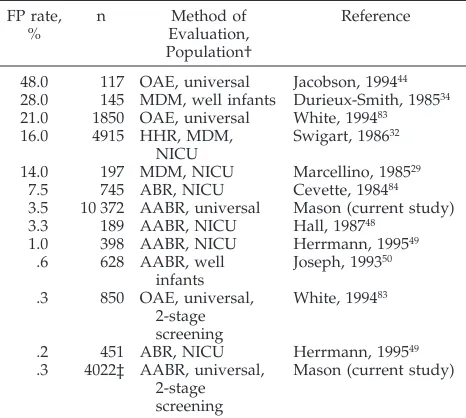
The false-positive rate merits further discussion. Of the 376 infants who returned for repeated testing as outpatients, 96% had normal hearing in at least one ear (Table 3). We believe that they were correctly identified at initial screening and had a transient conductive loss,68 possibly caused by incomplete
clearance of normal fetal middle ear fluid. Normal responses established within 1 month relieved con-cern regarding development of speech and language in this group.
Another subset of infants had bilateral transient or fluctuating loss at initial diagnostic examination (Ta-ble 3) but with serial testing showed slowly progres-sive improvement in hearing. Because of concerns related to acquisition of cognitive skills in the first year of life, we suggest that these might not be false-positive results and that these infants might benefit from amplification during the first year of life, even
though the hearing losses might resolve later. Inves-tigation related to the natural history and benefit of amplification in this subpopulation is suggested.
In 1995, 3 years into our program, we purchased a second automated screener and began rescreening all infants who failed initial screening. Rescreening took place at age 4 weeks; 14 infants failed the sec-ond-stage screening, and 4 had confirmed bilateral hearing losses. Using this two-stage protocol, the false-positive rate dropped to .3% (Table 6), yielding a positive predictive value69 of 27%. We recognize
that a false-positive result may cause emotional stress for families until more definitive diagnostic testing is completed. The benefits of a two-stage screening process are that it reduces stress for fami-lies and reduces the number of time-consuming and costly diagnostic evaluations.
Cost
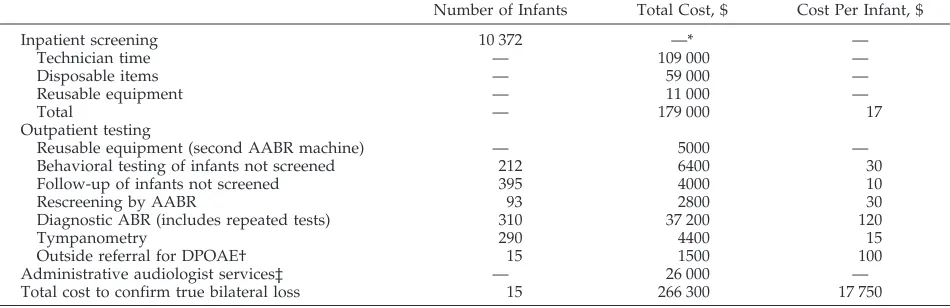
The cost of screening may be important to groups who are considering establishing hospital-based neo-natal hearing screening programs. Cost varies re-gionally, and confusion may arise when comparing the cost to do a test, the cost to the person who pays for the test, and the cost to the community if the test is not done. Because our program is a prepaid health care plan, members are not charged; nonmembers are charged $30. We report a per infant screening cost of $17 (Table 7). This cost may be compared with the charges for existing state programs that screen newborns. Current charges for phenylketonuria screening examinations range from $17 to $50 each,
TABLE 6. False-positive82* (FP) Rate in Universal Infant Hear-ing ScreenHear-ing Programs
FP rate, %
n Method of
Evaluation, Population†
Reference
48.0 117 OAE, universal Jacobson, 199444 28.0 145 MDM, well infants Durieux-Smith, 198534 21.0 1850 OAE, universal White, 199483
16.0 4915 HHR, MDM,
NICU
Swigart, 198632
14.0 197 MDM, NICU Marcellino, 198529
7.5 745 ABR, NICU Cevette, 198484
3.5 10 372 AABR, universal Mason (current study)
3.3 189 AABR, NICU Hall, 198748
1.0 398 AABR, NICU Herrmann, 199549
.6 628 AABR, well
infants
Joseph, 199350
.3 850 OAE, universal, 2-stage screening
White, 199483
.2 451 ABR, NICU Herrmann, 199549
.3 4022‡ AABR, universal, 2-stage screening
Mason (current study)
* False-alarm rate for the protocol is the percentage of normal hearing infants in the nursery who are incorrectly called hearing impaired. True normals5those who pass on initial screen and those who pass on diagnostic retest.82 All FP rates refer to a single-screen method except as noted.
† Universal, both well and NICU infants; OAE, otoacoustic emis-sions test; MDM, motion detection method; HRR, high risk regis-ter; AABR, automated auditory brainstem response test; ABR, conventional auditory brainstem response test; NICU, neonatal intensive care unit infants.
and for hypothyroid screening examinations, charges range from $28 to $50 each. The estimated incidence of phenylketonuria in the United States is 1/6000 to 1/25 000,70and the estimated incidence of
congenital hypothyroidism is 1/5000.71
This screening program was inspired by legisla-tion that recognized the benefits and cost savings obtainable (from speech and language acquisition, avoidance of special educational programs, and im-proved quality of life) when infants’ hearing loss is detected and treated with amplification. The cost of not identifying hearing impairment in one person may reach 1 million dollars.72Considering the cost of
screening and the incidence of hearing loss we iden-tified, we conclude that the cost effectiveness of our program compares favorably with that of other state screening programs.
Beyond immediate financial consideration is the evaluation of hearing loss caused by trauma, infec-tion, or heredity (in cases in which the latter causes progressive hearing loss). Our data differentiated only between acquired and congenital hearing im-pairment.
CONCLUSION
AABR was used to screen a large newborn popu-lation for bilateral hearing loss. The incidence of congenital bilateral loss in a large population of well infants has not previously been reported. Hearing loss identified in the well-infant population was re-mediable by amplification. The cost of identifying infants’ hearing loss at birth was a fraction of the anticipated cost of providing educational and com-munity services to people whose hearing loss is found later. We recommend a two-stage universal newborn screening protocol, amplification before age 6 months, and regular attendance of infants at aural habilitation sessions. We feel that further re-search is warranted for infants who have transient and fluctuating hearing losses because this group may benefit from temporary amplification.73– 84
ACKNOWLEDGMENTS
Christine Jiminez, MA, provided program design and data collection; June Uyehara-Isono, MS, managed infant amplification
and aural habilitation; Georgiana Yap, RN, provided guidance for the program; and Yi Ching, MD, reviewed the manuscript.
The Medical Editing Department, Kaiser Foundation Research Institute, provided editorial assistance.
REFERENCES
1. Guidelines for the identification of hearing impairment in at risk infants age birth to 6 months.ASHA. 1988(Apr);30(4):61– 64
2. Audiologic screening of newborn infants who are at risk for hearing impairment.ASHA. 1989(Mar);31(2):89 –92
3. Natus Medical, Inc.ALGO-1 Plus Infant Hearing Screener. User Manual. Foster City, CA: Natus Medical, Inc; 1990:23
4. Hall JW III. Newborn auditory screening. In: Hall JW III, ed.Handbook of Auditory Evoked Responses. Boston, MA: Allyn and Bacon; 1992: 475–509
5. Hall JW III. Calibration and normative data. In: Hall JW III, ed.Handbook of Auditory Evoked Responses.Boston, MA: Allyn and Bacon; 1992:267 6. Ross M. Implications of delay in detection and management of deafness.
Volta Rev. 1990;92:69 –79
7. Davis JM, Elfenbein J, Schum R, Bentler RA. Effects of mild and mod-erate hearing impairments on language, educational, and psychosocial behavior of children.J Speech Hear Disord. 1986;51:53– 62
8. Brackett D, Maxon AB, Blackwell PM. Intervention issues created by successful universal newborn hearing screening.Semin Hear. 1993;14: 88 –104
9. Davis A, Wood S. The epidemiology of childhood hearing impairment: factors relevant to planning of services.Br J Audiol. 1992;26:77–90 10. Haggard M. Screening children’s hearing.Br J Audiol. 1992;26:209 –215.
Editorial
11. Hall JW III, Kripal JP, Hepp T. Newborn hearing screening with audi-tory brainstem response: measurement problems and solutions.Semin Hear. 1988;9:15–33
12. Hasenstab MS. Auditory learning and communication competence: im-plications for hearing-impaired infants.Semin Hear. 1987;8:175–180 13. Hayes D. Auditory brainstem response (ABR) in infants: screening and
diagnostic applications. In: Bess FH, Hall JW III, eds.Screening Children for Auditory Function. Nashville, TN: Bill Wilkerson Center Press; 1992: 127–143. (International Symposium on Screening Children for Auditory Function; June 27–29, 1991; Nashville, TN)
14. Northern JL, Downs MP.Hearing in Children. 3rd ed. Baltimore, MD: Williams & Wilkins; 1984:1–21
15. United States Maternal and Child Health Bureau.Healthy Children 2000: National Health Promotion and Disease Prevention Objectives Related to Mothers, Infants, Children, Adolescents, and Youth. Washington, DC: DHHS; 1990:177. US Department of Health and Human Services pub-lication HRSA-M-CH-91–2
16. Mahon WJ. Hearing care for infants and children: issues in identifica-tion and management.Hear J. 1987(Sep);40(9):7–11
17. Stein LK, Jabaley T, Spitz R, Stoakley D, McGee T. The hearing-impaired infant: patterns of identification and habilitation revisited.Ear Hear. 1990;11:201–205
18. Coplan J. Deafness: ever heard of it? Delayed recognition of permanent hearing loss.Pediatrics. 1987;79:206 –213
TABLE 7. Costs Associated With Screening for Bilateral Hearing Loss in a 5-Year Period
Number of Infants Total Cost, $ Cost Per Infant, $
Inpatient screening 10 372 —* —
Technician time — 109 000 —
Disposable items — 59 000 —
Reusable equipment — 11 000 —
Total — 179 000 17
Outpatient testing
Reusable equipment (second AABR machine) — 5000 —
Behavioral testing of infants not screened 212 6400 30
Follow-up of infants not screened 395 4000 10
Rescreening by AABR 93 2800 30
Diagnostic ABR (includes repeated tests) 310 37 200 120
Tympanometry 290 4400 15
Outside referral for DPOAE† 15 1500 100
Administrative audiologist services‡ — 26 000 —
Total cost to confirm true bilateral loss 15 266 300 17 750
* —5not applicable.
† DPOAE, distortion product otoacoustic emissions.
19. Yoshinaga-Itano C, Sedey A, Apuzzo M, Carey A, Day D, Coulter D.The Effect of Early Identification on the Development of Deaf and Hard-of-hearing Infants and Toddlers. Presented at the American Academy of Audiology Annual Conference; April 1996; Salt Lake City, UT
20. Bailey DB Jr. Current issues in early intervention. In: Bess FH, Hall JW III, eds. Screening Children for Auditory Function. Nashville, TN: Bill Wilkerson Center Press; 1992:385–398. (International Symposium on Screening Children for Auditory Function; June 27–29, 1991; Nashville, TN)
21. Roush J, McWilliam RA. A new challenge for pediatric audiology: Public Law 99 – 457.J Am Acad Audiol. 1990;1:196 –208
22. State of Hawaii. A bill for an act relating to a newborn hearing screening program for the early identification of hearing loss. Senate Bill No. 2587 ed. 1990:Act 85
23. Early identification of hearing impairment in infants and young chil-dren. NIH Consens Statement. 1993;(Mar 1–3);11(1):1–24
24. Feinmesser M, Tell L, Levi H. A combination of high-risk and mass hearing screening: a follow-up of 40,000 infants.Semin Hear. 1984;5: 79 – 83
25. Kenworthy OT. Screening for hearing impairment in infants and young children.Semin Hear. 1990;11:315–332
26. Marge M. Guidelines for the prevention of communication disorders: concepts, principles, and models.Semin Hear. 1991;12:93–115 27. Hall JW III, Prentice CH. Newborn hearing screening with auditory
brainstem response (ABR): experience with 1982 versus 1990 Joint Com-mittee Risk Criteria. In: Bess FH, Hall JW III, eds.Screening Children for Auditory Function. Nashville, TN: Bill Wilkerson Center Press; 1992: 145–161. (International Symposium on Screening Children for Auditory Function; June 27–29, 1991; Nashville, TN)
28. Salamy A, Amochaev A. A practical approach to hearing screening of the newborn and at risk infant.Semin Hear. 1984;5:39 – 47
29. Marcellino GR. The Crib-o-gram in neonatal hearing screening. In: Swigart ET, ed.Neonatal Hearing Screening. San Diego, CA: College-Hill Press; 1986:47– 66
30. Miller K, Simmons FB. A retrospective and an update on the Crib-O-Gram neonatal hearing screening audiometer.Semin Hear. 1984;5:49 –56 31. Hosford-Dunn H, Johnson S, Simmons FB, Malachowski N, Low K. Infant hearing screening: program implementation and validation.Ear Hear. 1987;8:12–20
32. Swigart ET. Model program IV: a high-risk register, Crib-o-gram, and auditory brainstem response. In: Swigart ET, ed. Neonatal Hearing Screening. San Diego, CA: College-Hill Press; 1986:183–222
33. McClatchie AC, Mikulich DM. Model program I: the Crib-o-gram. In: Swigart ET, ed.Neonatal Hearing Screening. San Diego, CA: College-Hill Press; 1986:145–155
34. Durieux-Smith A, Jacobson JT. Comparison of auditory brainstem re-sponse and behavioral screening in neonates.J Otolaryngol Suppl. 1985; 14:47–53
35. Watkin PM, Baldwin M, McEnery G. Neonatal at risk screening and the identification of deafness. Arch Dis Child. 1991;66(10 Spec No): 1130 –1135
36. Kemp DT. Stimulated acoustic emissions from within the human audi-tory system.J Acoust Soc Am. 1978;64:1386 –1391
37. Bonfils P, Uziel A, Pujol R. Screening for auditory dysfunction in infants by evoked oto-acoustic emissions. Arch Otolaryngol Head Neck Surg. 1988;114:887– 890
38. Bergman BM, Gorga MP, Neely ST, Kaminski JR, Beauchaine KL, Peters J. Preliminary descriptions of transient-evoked and distortion-product otoacoustic emissions from graduates of an intensive care nursery.J Am Acad Audiol. 1995;6:150 –162
39. Kemp DT, Ryan S. The use of transient evoked otoacoustic emissions in neonatal hearing screening programs.Semin Hear. 1993;14:30 – 45 40. Lutman ME. Reliable identification of click-evoked otoacoustic
emis-sions using signal-processing techniques.Br J Audiol. 1993;27:103–108 41. Salomon G, Groth J, Anthonisen B. Preliminary results and
consider-ations in hearing screening of newborns based on otoacoustic emis-sions.Br J Audiol. 1993;27:139 –141
42. Thornton ARD, Kimm L, Kennedy CR, Cafarelli-Dees D. External- and middle-ear factors affecting evoked otoacoustic emissions in neonates. Br J Audiol. 1993;27:319 –327
43. White KR, Vohr BR, Behrens TR. Universal newborn hearing screening using transient evoked otoacoustic emissions: results of the Rhode Island Hearing Assessment Project.Semin Hear. 1993;14:18 –29 44. Jacobson JT, Jacobson CA. The effects of noise in transient EOAE
newborn hearing screening. Int J Pediatr Otorhinolaryngol. 1994;29: 235–248
45. Gorga MP, Reiland JK, Beauchaine KA, Worthington DW, Jesteadt W. Auditory brainstem responses from graduates of an intensive care
nursery: normal patterns of response.J Speech Hear Res. 1987;30:311–318 46. Jacobson JT, Morehouse CR, Johnson MJ. Strategies for infant auditory
brain stem response assessment.Ear Hear. 1982;3:263–270
47. Jacobson JT, Hyde ML. The auditory brainstem response in neonatal hearing screening. In: Swigart ET, ed.Neonatal Hearing Screening. San Diego, CA: College-Hill Press; 1986:67–98
48. Hall J, Kileny P, Ruth R, Kripal J. Newborn auditory screening with ALGO-1 vs. conventional ABR. Presented at the American Speech and Hearing Association Annual Convention; November 15, 1987; New Orleans, LA
49. Herrmann BS, Thornton AR, Joseph JM. Automated infant hearing screening using the ABR: development and validation.Am J Audiol. 1995;4:6 –14
50. Joseph JM, Herrmann BS, Thornton AR, Pye RK. Well-baby Hearing Screening Using Automated ABR. Presented at the American Speech-Language-Hearing Association Annual Convention; November 1993; Anaheim, CA
51. Hunter MF, Kimm L, Cafarelli Dees D, Kennedy CR, Thornton ARD. Feasibility of otoacoustic emission detection followed by ABR as a universal neonatal screening test for hearing impairment.Br J Audiol. 1994;28:47–51
52. Maxon AB, White KR, Behrens TR, Vohr BR. Referral rates and cost efficiency in a universal newborn hearing screening program using transient evoked otoacoustic emissions. J Am Acad Audiol. 1995;6: 271–277
53. Stewart DL, Bibb KW, Pearlman A. Automated newborn hearing testing with the ALGO-1 screener.Clin Pediatr (Phila). 1993;32:308 –311 54. Jacobson JT, Jacobson CA, Spahr RC. Automated and conventional ABR
screening techniques in high-risk infants.J Am Acad Audiol. 1990(Oct); 1(4):187–195
55. Stroble MF, Thelin JW.Hearing Screening in the Well-baby Nursery. Pre-sented at the American Academy of Pediatric Otolaryngology; May 20, 1989; San Diego, CA
56. Bradford BC, Baudin J, Conway MJ, Hazell JWP, Stewart AL, Reynolds EOR. Identification of sensory neural hearing loss in very preterm infants by brainstem auditory evoked potentials.Arch Dis Child. 1985; 60:105–109
57. Durieux-Smith A, Picton TW, Edwards CG, MacMurray B, Goodman JT. Brainstem electric-response audiometry in infants of a neonatal intensive care unit.Audiology. 1987;26:284 –297
58. Swigonski N, Shallop J, Bull MJ, Lemons JA. Hearing screening of high risk newborns.Ear Hear. 1987;8:26 –30
59. Berrick JM, Thornton AR, Herrmann BS. ABR Hearing Screening of Intensive Care Nursery Graduates. Poster Session presented at the Amer-ican Speech-Language-Hearing Association Annual Convention; No-vember 1985; Washington, DC
60. Harrison M, Roush J. Age of suspicion, identification, and intervention for infants and young children with hearing loss: a national study.Ear Hear. 1996;17:55– 62
61. Hayes D. Problems in habilitation of hearing-impaired infants.Semin Hear. 1987;8:181–185
62. Elssmann SF, Matkin ND, Sabo MP. Early identification of congenital sensorineural hearing impairment.Hear J. 1987(Sep);40(9):13–17 63. Weber B. Screening of high-risk infants using auditory brainstem
re-sponse audiometry. In: Bess F, ed.Hearing Impairment in Children. Park-ton, MD: York Press; 1988:112–132
64. Weber B, Jacobson C. Newborn hearing screening. In: Jacobson JT, ed. Principles and Applications in Auditory Evoked Potentials. Boston, MA: Allyn and Bacon; 1994:357–383
65. Mahoney T. Early identification of hearing loss in the USA.Audiol Today. 1993(May–June);5(3):27–30
66. Salamy A, Eldredge L, Sweetow R. Transient evoked otoacoustic emissions: feasibility in the nursery.Ear Hear. 1996;17:42– 48 67. Marlowe JA. Screening all newborns for hearing impairment in a
com-munity hospital.Am J Audiol. 1993;2:22–25
68. Stein LK. Evaluating the efficiency of auditory brainstem response as a neonatal hearing screening test.Semin Hear. 1984;5:71–78
69. Fria T. Screening principles and test selection. In: Swigart ET, ed. Neonatal Hearing Screening. San Diego, CA: College-Hill Press; 1986: 21–29
70. Avery ME, First LR, eds.Pediatric Medicine. Baltimore, MD: Williams & Wilkins; 1989:925
71. Fisher DA, Dussault JH, Foley TP Jr, et al. Screening for congenital hypothyroidism: results of screening one million North American in-fants.J Pediatr. 1979;94:700 –705
73. Frankenburg WK, Dodds JB, Fandal AW.The Denver Developmental Screening Test. Denver, CO: University of Colorado Press; 1975 74. Zimmerman I, Steiner V, Pond R.The Preschool Language Scale-3. San
Antonio, TX: The Psychological Corporation; 1992
75. Bzoch K, League R.Receptive-expressive Emergent Language Scale. Austin, TX: Pro-Ed; 1970
76. Dunn L, Dunn L.The Peabody Picture Vocabulary Test—Revised. Circle Pines, MN: American Guidance Service; 1981
77. Tonelson S, Watkins S.SKI*HI Language Development Scale. Logan, UT: Project SKI*HI; 1979
78. Coggins T, Carpenter R. The communicative intention inventory.Appl Psycholinguistics. 1981;2:235–251
79. Joint Committee on Infant Hearing. Position statement 1990.Audiol Today. 1991;3:14 –17
80. Schulman-Galambos C, Galambos R. Brain stem evoked response au-diometry in newborn hearing screening. Arch Otolaryngol Head Neck Surg. 1979;105:86 –90
81. McClelland RJ, Watson DR, Lawless V, Houston HG, Adams D. Reli-ability and effectiveness of screening for hearing loss in high risk neonates.BMJ. 1992;304:806 – 809
82. Turner RG. Modeling the cost and performance of early identification protocols.J Am Acad Audiol. 1991;2:195–205
83. White KR, Vohr BR, Maxon AB, Behrens TR, McPherson MG, Mauk GW. Screening all newborns for hearing loss using transient evoked otoacoustic emissions.Int J Pediatr Otorhinolaryngol. 1994;29: 203–217
84. Cevette M. Auditory brainstem response testing in the NICU.Semin Hear. 1984;5:57– 68
TOBACCO DEATHS
Smoking now claims more lives in China than in any other country. A study unveiled in Beijing at the 10th World Conference on Tobacco and Health estimates that smoking kills 750 000 Chinese each year, pushing into second place the US toll of 400 000. The study, led by Liu Boqi of the Chinese Academy of Medical Sciences and Richard Peto of the University of Oxford, predicts that one third of the 300 million Chinese men now under the age of 30 will be killed by cigarettes.
New Scientist. September 6, 1997.
DOI: 10.1542/peds.101.2.221
1998;101;221
Pediatrics
Judith A. Mason and Kenneth R. Herrmann
Measurement
Universal Infant Hearing Screening by Automated Auditory Brainstem Response
Services
Updated Information &
http://pediatrics.aappublications.org/content/101/2/221
including high resolution figures, can be found at:
References
http://pediatrics.aappublications.org/content/101/2/221#BIBL
This article cites 47 articles, 3 of which you can access for free at:
Subspecialty Collections
http://www.aappublications.org/cgi/collection/neonatology_sub Neonatology
sub
http://www.aappublications.org/cgi/collection/fetus:newborn_infant_ Fetus/Newborn Infant
rders_sub
http://www.aappublications.org/cgi/collection/ear_nose_-_throat_diso Ear, Nose & Throat Disorders
ub
http://www.aappublications.org/cgi/collection/dentistry:oral_health_s Dentistry/Oral Health
following collection(s):
This article, along with others on similar topics, appears in the
Permissions & Licensing
http://www.aappublications.org/site/misc/Permissions.xhtml
in its entirety can be found online at:
Information about reproducing this article in parts (figures, tables) or
Reprints
http://www.aappublications.org/site/misc/reprints.xhtml
DOI: 10.1542/peds.101.2.221
1998;101;221
Pediatrics
Judith A. Mason and Kenneth R. Herrmann
Measurement
Universal Infant Hearing Screening by Automated Auditory Brainstem Response
http://pediatrics.aappublications.org/content/101/2/221
located on the World Wide Web at:
The online version of this article, along with updated information and services, is
by the American Academy of Pediatrics. All rights reserved. Print ISSN: 1073-0397.