Exact Approaches to the Single Source Network Loading Problem
Ivana Ljubić
∗Peter Putz
∗Juan-José Salazar González
?∗
Department of Statistics and Decision Support Systems, University of Vienna Brünnerstr. 72, 1210 Vienna, Austria
?
DEIOC, Universidad de La Laguna
Av. Astrofísico Francisco Sánchez, s/n, 38271 La Laguna, Tenerife, Spain
Abstract
We consider the problem of deploying a broadband telecommunications system that lays optical fiber cable from a central office to a number of end-customers. We are dealing with a capacitated network design problem that requires an installation of fiber optic cables with sufficient capacity to carry the traffic from the central office to the end-customers. This is the single-source variant of thenetwork loading problem.
In this paper we propose a new compact disaggregated mixed integer programming (MIP) formulation for the problem. We project out flow variables by introducing Benders’ cuts that are further strengthened by additional inequalities. The whole procedure is incorporated into a branch-and-cut framework.
In our computational experiments we do see improved gaps, when deploying Benders’ inequalities, at least in some cases. Reducing the computational cost for separating the Benders’ cuts and improving our primal heuristic to help closing the gap faster is the main focus of our ongoing effort.
Keywords: Network Loading Problem, Branch-and-Cut, Benders Inequalities
1
Introduction
We consider the problem of deploying a broadband telecommunications system that lays optical fiber cable from a central office to a number of end-customers. In case of the fiber to the home technology, the end-customers represent houses, whereas when deployingfiber to the curbtechnology, the end-customers are usually multiplexor devices. In both cases, we are dealing with a capacitated network design problem that requires an installation of fiber optic cables with sufficient capacity to carry the traffic from the central office to the end-customers. We start with a network without capacities, or with some pre-installed capacities, and search for the installation of at most one cable type per link at minimum total cost.
In this paper we provide a theoretical and computational comparison of several mixed integer program-ming (MIP) formulations for the problem. We also propose a branch-and-cut approach based on the cut-set inequalities, extended with strengthening Benders’ inequalities.
In our computational experiments we do see improved gaps, when deploying Benders’ inequalities, at least in some cases. Reducing the computational cost for separating the Benders’ cuts and improving our primal heuristic to help closing the gap faster is the main focus of our ongoing effort.
Problem Definition We are given an undirected, connected graphGu(V, E)with a root noder∈V, with edge lengths lij ∈R>0 ∀{i, j} ∈E, and a set of customers D ⊆V \ {r}. To each customer, a non-negative demand dk ∈ R>0 is assigned. Furthermore, on every edge e ∈ E we are able to install different cable types (modules) Ne = {n1, n2, . . . , n|Ne|} with capacities ue,n ∈ R>0, 1 ≤ n ≤ |Ne| and costs ce,n ∈ R>0,
1≤n≤ |Ne|.
TheNetwork Loading Problem(NLP) asks for an installation of at most one cable on each edge at minimum total cost, so that the demands can be simultaneously routed from the root to all customers without exceeding installed edge capacities. The problem we are concentrating on is therefore a single-source multiple-sink routing and a link capacity assignment network design problem.
Previous Work Due to its importance in telecommunications, transportation, computer and energy supply networks, NLP has been widely studied in literature. Many authors consider the problem in which a routing from multiple sources to multiple sinks is required. Polyhedral structures of the general NLP and its variants are studied in [13, 10, 2, 9, 14, 1]. Benders’ decomposition approaches have been studied as well: for the multiple-source multiple-sink NLP, an exact algorithm was given in [6], whereas in [3] the objective function is extended by flow dependent costs. In [7] the authors look into speeding up Benders’ decomposition. The single-source variant has been studied in [12, 11]. In terms of approximation algorithm (NLP) is also known as the single-sink buy-at-bulk network design problem. The best approximation ratio of 76.5 is obtained in [8].
Observe that we allow the flow between the root and some customer to be split apart. Therefore, we are speaking of a non-bifurcated problem formulation.
2
MIP Formulations
Typically, the NLP is modeled using compact flow-based MIP formulations, involving binary design variables and continuous flow variables. When disaggregating flow variables, we face the problem of trading-off between the quality of lower bounds and the size of the underlying linear program.
In this section, we first propose a new disaggregated flow-based formulation. Similar ideas for related problems have been considered in [5, 4]. We then show how to project out flow variables by introducing Benders inequalities. Finally, we recall the cut-set based ILP formulation whose violated inequalities can be separated in polynomial time, as far as single-source NLP is concerned.
It is well known that the MIP formulations of NLP and related problems on bidirected graphs provide better lower bounds than their undirected counterparts. Therefore, we work with directed graphs and transform our input graphGu= (V, E)into a directed graphG= (V, A)such thatA={(i, j)| {i, j} ∈E, j6=r}. The costs of the cable types on the arcs remain symmetric, i.e.cij,n=cji,n=c{i,j},n,n∈ N{i,j}. It easy to see that no
optimal solution of the single-source NLP contains a directed cycle, and therefore, the capacity of every arc will be used in exactly one direction and we can setuij,n=uji,n=u{i,j},n,n∈ N{i,j}.
2.1
Multi-Cabletype Multi-Commodity Flow Formulation
MMCF
To model the problem, we introduce binary variables xij,n ∈ {0,1} that are one iff the cable type n∈ Nij is installed on the arc (i, j). To model the feasible routing of the traffic between the root r and any single customerk ∈D, we use the disaggregated flow variablesfk
ij,n that define thefraction of flow of commodity
k∈D, routed on the arc(i, j)using the cable typen∈ Nij. The MIP model then reads as follows:
(MMCF) min X (i,j)∈A lij X n∈Nij cij,nxij,n (1) s.t. X (i,j)∈A X n∈Nij fij,nk − X (j,i)∈A X n∈Nji fji,nk = −1, i=k 1, i=r 0, otherwise ∀i∈V, ∀k∈D (2) X k∈D
fij,nk dk ≤xij,nuij,n ∀(i, j)∈A ∀n∈ Nij (3)
X
n∈Nij
xij,n≤1 ∀(i, j)∈A (4)
0≤fij,nk ≤xij,n ∀(i, j)∈A ∀k∈D ∀n∈ Nij (5)
xij,n∈ {0,1} ∀(i, j)∈A ∀n∈ Nij (6)
Theflow conservation constraints (2) ensure the feasibility of the flow sent fromr to every customer k∈D. Thecoupling constraints(5) take care that, if there is any flow in the cable-typenon the arc(i, j), that cable type has to be in the solution. Inequalities (3) are thecapacity constraints, i.e. the total flow in cable typen
on arc(i, j)must not exceed the capacity of the given cable type n. As cable types are given explicitly, the
This model containsO(|A| · |N | · |D|) constraints and O(|A| · |N | · |D|) variables (|N |= maxe∈E|Ne|), and it is very unlikely that even the most sophisticated MIP solvers may solve instances of moderate size using
(MMCF) formulation. Our preliminary computational experiments with (MMCF) also confirmed this. How-ever,(MMCF)provides much stronger lower bounds than its aggregated counterparts. Therefore we propose to project out the flow variables and to introduce Benders inequalities instead, keeping the quality of lower bounds, and even improving them by rounding techniques.
It is easy to see that the explicit cost model can be equivalently modelled by using the incremental cost
(orexpansion steps) model (see [13]).
2.2
Benders’ Decomposition for
MMCF
Let the master problem be the one given by the objective function (1) subject to constraints (4) and (6). A solutionx0 of the master problem defines a feasible solution for the LP-relaxation of the (MMCF) iff there exist flow variablesf satisfying the linear system of inequalities given by (2), (3) and (5), where x=x0.
Farkas’ lemma states that a linear system of equations{Ax≤b:x≥0} has a solution iffuTb≥0for all
u≥0such thatuTA≥0. To apply Farkas’ lemma to the system (2), (3), (5), we define dual variablesαki, βij,nk
andγij,nassociated to (2), (5) and (3) respectively. The polyhedron defined by this system is non-empty iff
X k∈D (αkr−αkk) + X (i,j)∈A X n∈Nij X k∈D
βij,nk +uij,nγij,n
!
x0ij,n≥0. (7)
for all(α, β, γ), such that
αki −αkj+βkij,n+dkγij,n≥0 ∀(i, j)∈A, ∀k∈D, ∀n∈ Nij (8)
(α, β, γ)≥0 (9)
Inequalities (7) are called Benders’ cuts. Violated Benders’ inequalities can be separated within a branch-and-cut framework as follows. Given a fractional solutionx0 we minimize the left hand side of (7), s.t. (8)-(9). If this subproblem (SUB) is unbounded, there is an unboundedness direction (α0, β0, γ0)that defines a violated Benders’ cut that can be added to the master:
X (i,j)∈A X n∈Nij X k∈D
βij,n0k +uij,nγ0ij,n
!
xij,n≥
X
k∈D
(α0kk−α0rk) (10)
We can round down the coefficient of variablexij,n tomin Pk∈Dβ0 k
ij,n+uij,nγij,n0 ,
P k∈D(α0 k k −α0 k r) . If the subproblem (SUB) is bounded, it means that we can not find a violated Benders’ cut.
2.3
Strenghtening Benders Inequalities by Metric Inequalities
It has been shown in [3] that any Benders’ inequality associated to a non-extreme ray can be strengthened to ametric inequalityas follows. For any fixed(α0, β0, γ0)satisfying (8)-(9), one can look for(α(β0, γ0), β0, γ0)
that maximizes the right-hand side of (10):
(SPDUAL) maxX k∈D αkk (11) s.t. βij,n0k +dkγij,n0 ≥α k j −α k i ∀(i, j)∈A, ∀k∈D, ∀n∈ Nij (12) αkr = 0 ∀k∈D (13) α≥0 (14)
This problem can be decomposed into the duals of|D|independent shortest path problems. For anyk∈D,
αkk(β0, γ0)is the length of the shortest(r, k)path corresponding to edge weightswijk = minn∈Nij β
0k
ij,n+dkγ0ij,n
2.4
Directed Cut-Set-Formulation (
CUTSET
)
We now recall the cut-set formulation for the single-source NLP on directed graphs. For any subsetS ⊂V, we denote withδ+(S) :={(i, j)∈A:i∈S, j∈V \S} andδ−(S) :={(i, j)∈A:i∈V \S, j∈S}outgoing and ingoing cuts respectively. For anyS⊆V we denote the induced arc set withA(S) :={(i, j)∈A:i∈S, j∈S}. Projecting out aggregated flow variablesfij =Pk∈D
P
n∈Nijdkf
k
ij,nleads to the following cut-set inequalities:
X (i,j)∈δ+(S) X n∈Nij uij,nxij,n≥ X k∈D\S dk ∀S⊂V :r∈S, S∩D6=D (15)
Inequalities (15) can be separated in polynomial time. For a given fractional solution x0, we define the directedsupport graph G0 = (V0, A0)whereV0 :=V ∪ {t} with an additional sink tand A0:=A1∪A2 being
A1 :={(i, j)∈A:Pn∈Nijuij,nx0ij,n >0} and additional arcs A2 :={(k, t) :k∈D}. The arc capacities are set toP
n∈Nijuij,nx
0
ij,n ∀(i, j)∈A1 and todk ∀(k, t)∈A2. If the minimum-capacity cut betweenr andt in
G0 is less thanP
k∈Ddk it defines a violated inequality (15).
2.5
Cover Inequalities
Given a cutset inequality (15) defined byS⊂V, r∈S, define the index setI(S) ={(i, j, n)|(i, j)∈δ+(S), n∈
Nij}andB =Pk∈D\Sdk. SetM ⊂I(S)is called acoverwith respect toI(S)ifP(i,j,n)∈Muij,n< B and a
maximal coverif, in addition, for all S0 ⊃M, P
(i,j,n)∈S0uij,n ≥B. IfM is a maximal cover with respect to
I(S), then the followingcover inequalitiesare valid:
X
(i,j,n)∈I(S)\M
xij,n≥1. (16)
In general, the separation of cover inequalities is NP-hard. We show that for the single-source NLP the problem of finding the most violated cover inequality (16) is equivalent to solving theprecedence constrained knapsack problem. Assume that indices n∈ Nij are sorted according to increasing arc capacities and that demands are integers. To model any coverM with respect to I(S), we introduce the binary variableszij,n that are equal to one iff (i, j, n)∈M. For every arc (i, j)∈δ+(S), we define u
ij,0 = 0. The most violated cover inequality can then be found by solving the following MIP problem:
(KNAP) max X
(i,j,l)∈I(S)
x0ij,nzij,n (17)
X
(i,j,n)∈I(S)
(uij,n−uij,n−1)zij,n≤B−1 (18)
zij,n≥zij,n+1, ∀(i, j, n)∈I(S) (19)
zij,n∈ {0,1}, ∀(i, j, n)∈I(S) (20) Letz0 be the optimal solution to(KNAP). The corresponding cover inequality then reads as follows:
X
(i,j,n)∈I(S)
(1−z0ij,n)xij,n≥1.
These inequalities are similar to theband inequalitiesfor the incremental cost model in [13].
3
Branch-and-cut approach based on Benders’ Decomposition
In this section we explain the branch-and-cut scheme based on the (CUTSET) formulation and extended by projected Benders’ inequalities introduced in the last section.
Initialization We initialize the LP with capacitated and uncapacitated in-degree constraintsassociated to each customer k ∈D. Furthermore, for all non-customers l ∈V \D\ {r} we add flow-balance constraints:
P (i,l)∈A,i6=j P n∈Nilxil,n≥ P n∈Nljxlj,n,∀(l, j)∈Aand P (l,i)∈A,i6=j P n∈Nlixli,n≥ P n∈Njlxjl,n,∀(j, l)∈A.
Separation We separate cutset and connectivity inequalities in a straight-forward way using a maximum-flow procedure. After rounding we add the constraints into the LP. Furthermore, during the separation, we prefer theminimum-cardinality cuts: they are obtained during separating connectivity inequalities in a graph in which to every capacityxij,n, an epsilon value is added. By default, up to 100nested cut-sets are added at once, before resolving the LP. Finally, to speed-up the separation, usingback cutswe also consider reversal flow, from the customerkto the rootr.
After no further violated cut-set inequalities can be found, we separate Benders’ cuts (10), by solving the linear program (SUB). To speed-up the computation, we add severaldisjoint Benders’ cuts: after determina-tion of (α0, β0, γ0) as described in Sec. 2.2, we add constraints βij,nk = 0,∀β0k
ij,n >0 andγij,n = 0,∀γij,n0 >0 and resolve (SUB).
Primal Heuristic We employ a simple rounding heuristic. Given a feasible fractional solution x, denote the total installed capacity on each arc byXij =Pn∈Nijuij,nxij,n. Initializex
0= 0. Now for every arc(i, j)
install the cheapest fitting cable typex0ij,˜n= 1 : ˜n=arg-min{n∈Nij|uij,n≥Xij}cij,n. The resultingx
0 is integer
feasible. However, it is often too generous and can be reduced quite simply with the help of the minimum cost flow algorithm. We define the arc capacities asXij0 and arc cost ofCij0 =P
n∈Nijcij,nx
0
ij,n and compute the min-cost-flowf ∈R|A|. Then we replace the current designx0, with a new cheapest fitting x00 : x00ij,˜n = 1 :
˜
n=arg-min{n∈Nij|uij,n≥fij}cij,n. Since the min-cost-flow algorithm only works for integer capacity and cost
X0 and C0 have to be rounded first.
4
Computational Results
Test Instances We used the street map of the Aus-trian city Bregenz with 1014 nodes and 1191 edges as underlying network. As customers we considered 4 different sets of nodes with cardinalities 36, 45, 52 and 67, whereas each customer has a demand ran-domly chosen from{4,8,12,16,20}.
CT N (capacityc, costu) . . . NA 2 (30, 2.2) (1020, 146.0) NB 2 (120, 7.0) (1020, 146.0) NC 3 (30, 2.2) (60, 4.0) (1020, 146.0)
ND 4 (30, 2.2) (60, 4.0) (120, 7.0) (1020, 146.0)
As cable types we employed 4 different sets uniformly on all edges (see the table above). The resulting networks have been preprocessed by applying degree one- and two-tests.
Experiments We implemented our algorithms using C++ and CPLEX 11.0. An Intel Core 2 computer with 1.8 Ghz and 3.25 GB was used for testing purposes. We tried to solve the test instances with three different MIP models(MMCF), (MCF), i.e. flow aggregated by cable type (fk
ij =
P
n∈Nijf
k
ij,n) and (SCF), i.e. flow aggregated by cable type and customer(fij =Pk∈Df
k
ij). We compared these results to three branch-and-cut approaches: (CUTSET), (BEND), which additionally generates Benders’ cuts if no cut-sets are found and
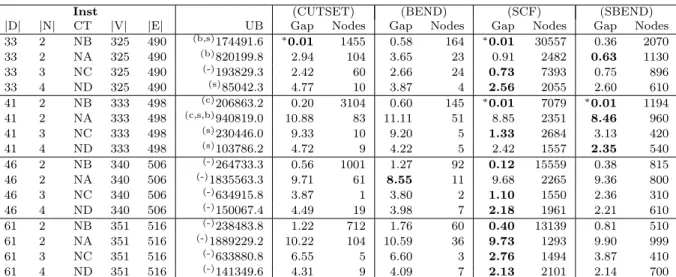
(SBEND), which uses (SCF) as master problem and generates Benders’ cuts in the root node and in every 10-th branch-and-bound node. (MMCF)and(MCF)were unable to produce any reasonable bounds - usually the LP relaxation was not solved within an hour. Table 1 compares the results of the other four approaches.
Conclusion It can easily be shown that (CUTSET) is stronger than (SCF). Similarly, (MMCF), resp.
(BEND)is stronger than(CUTSET). Neverthelss, the branch-and-cut approaches could usually not supersede the bounds and gaps achieved with branch-and-bound on the (SCF) model. This is surprising, since the aggregated flow formulation is known to have arbitrarily bad lower bounds. It can probably be explained by very sophisticated mixed integer rounding (MIR) cuts and other advanced procedures integrated into the commercial MIP solver CPLEX 11. Indeed, after turning off all these features, the (SCF) model is not able to produce any reasonable results. (SBEND) attempts to combine the practically successful (SCF) with the computationally more expensive, stronger cuts of (BEND). This works out to some degree, in 5 out of 16 cases (SBEND) produces a better lower bound than (SCF). While the lower bound after the root note is much better for(SBEND) than for(SCF), it seems that the rounding heuristic does not work so well for the branch-and-cut approaches.
Inst (CUTSET) (BEND) (SCF) (SBEND)
|D| |N| CT |V| |E| UB Gap Nodes Gap Nodes Gap Nodes Gap Nodes
33 2 NB 325 490 (b,s)174491.6 ∗0.01 1455 0.58 164 ∗0.01 30557 0.36 2070 33 2 NA 325 490 (b)820199.8 2.94 104 3.65 23 0.91 2482 0.63 1130 33 3 NC 325 490 (-)193829.3 2.42 60 2.66 24 0.73 7393 0.75 896 33 4 ND 325 490 (s)85042.3 4.77 10 3.87 4 2.56 2055 2.60 610 41 2 NB 333 498 (c)206863.2 0.20 3104 0.60 145 ∗0.01 7079 ∗0.01 1194 41 2 NA 333 498 (c,s,b)940819.0 10.88 83 11.11 51 8.85 2351 8.46 960 41 3 NC 333 498 (s)230446.0 9.33 10 9.20 5 1.33 2684 3.13 420 41 4 ND 333 498 (s)103786.2 4.72 9 4.22 5 2.42 1557 2.35 540 46 2 NB 340 506 (-)264733.3 0.56 1001 1.27 92 0.12 15559 0.38 815 46 2 NA 340 506 (-)1835563.3 9.71 61 8.55 11 9.68 2265 9.36 800 46 3 NC 340 506 (-)634915.8 3.87 1 3.80 2 1.10 1550 2.36 310 46 4 ND 340 506 (-)150067.4 4.49 19 3.98 7 2.18 1961 2.21 610 61 2 NB 351 516 (-)238483.8 1.22 712 1.76 60 0.40 13139 0.81 510 61 2 NA 351 516 (-)1889229.2 10.22 104 10.59 36 9.73 1293 9.90 999 61 3 NC 351 516 (-)633880.8 6.55 5 6.60 3 2.76 1494 3.87 410 61 4 ND 351 516 (-)141349.6 4.31 9 4.09 7 2.13 2101 2.14 700
Table 1: The best known upper bounds are given inUB and marked with (c),(b) and (s), when found by
(CUTSET),(SBEND)or(SCF). For each approach we show the integrality gapGap=U B−LB
LB ·100%, where
LB is the best lower bound computed within the time limit of one hour. Nodes denotes the number of branch-and-bound nodes that have been processed. Optimal solutions are denoted by (*).
Future work will concentrate on improving or replacing the primal heuristic and investigating other classes of cuts to strengthen/speedup branch-and-cut.
References
[1] P. Avella, S. Mattia, and A. Sassano. Metric inequalities and the network loading problem.Discrete Optimization, 4(1):103– 114, 2007.
[2] D. Bienstock, S. Chopra, O. Günlük, and C.-Y. Tsai. Mininum cost capacity installation for multicommodity flows. Mathe-matical Programming, 81(2):177–199, 1998.
[3] A. M. Costa, J.-F. Cordeau, and B. Gendron. Benders, metric and cutset inequalities for multicommodity capacitated network design.Computational Optimization and Applications, 2007. doi:10.1007/s10589-007-9122-0.
[4] K. L. Croxton, B. Gendron, and T. L. Magnanti. Variable disaggregation in network flow problems with piecewise linear costs. INFORMS Operations Research, 55(1):146–157, 2007.
[5] A. Frangioni and B. Gendron. 0-1 reformulations of the multicommodity capacitated network design problem. Discrete Applied Mathematics, In Press, doi:10.1016/j.dam.2008.04.022, 2008.
[6] V. Gabrel, A. Knippel, and M. Minoux. Exact solution of multicommodity network optimization problems with general step cost functions. Operations Research Letters, 25(1):15–23, August 1999.
[7] M. Gendreau, W. Rei, J.-F. Cordeau, and P. Soriano. Accelerating benders decomposition by local branching. InNetwork Optimization Workshop, Saint-Rémy de Provence, France, August 2006.
[8] A. Gupta, A. Kumar, M. Pál, and T. Roughgarden. Approximation via cost sharing: Simpler and better approximation algorithms for network design.Journal of the ACM, 54(3):11, 2007.
[9] O. Günlük. A branch-and-cut algorithm for capacitated network design problems.Mathematical Programming, 86(1):17–39, 1999.
[10] T. L. Magnanti, P. Mirchandani, and R. Vachani. Modeling and solving the two-facility capacitated network loading problem.
Operations Research, 43(1):142–157, 1995.
[11] S. Raghavan and D. Stanojević. A note on search by objective relaxation. InTelecommunications Planning: Innovations in Pricing, Network Design and Management, volume 33 ofOperations Research/Computer Science Interfaces Series, pages 181–201. Springer US, 2005.
[12] F. S. Salman, R. Ravi, and J. N. Hooker. Solving the capacitated local access network design problem.INFORMS Journal on Computing, 20(2):243–254, 2008.
[13] M. Stoer and G. Dahl. A polyhedral approach to multicommodity survivable network design. Numerische Mathematik, 68(1):149–167, 6 1994.
[14] S.P.M. van Hoesel, A.M.C.A. Koster, R. L. M. J. van de Leensel, and M. W. P. Savelsbergh. Bidirected and unidirected capacity installation in telecommunication networks. Discrete Applied Mathematics, 133(1-3):103–121, 2003.