Giuseppe Anastasi
Pervasive Computing & Networking Lab. (PerLab) Dept. of Information Engineering, University of Pisa
PerLab
System and Network
Security
Based on original slides by - Silberschatz, Galvin and Gagne - Kurose and Ross
2 Operating Systems and Computer Networks Security
PerLab
Objectives
Discuss security threats and attacks Explain the fundamentals of encryption
Examine the uses of cryptography in computing
Secrecy
Authentication
Message Integrity, Digital Signature
Describe the various countermeasures to security attacks
PerLab
Overview
Threats and attacks
Cryptography as a Security Tool
Secrecy Authentication Message integrity Digital signature … Security Defenses User Authentication Antivirus Firewalls …
4 Operating Systems and Computer Networks Security
PerLab
Security vs. Protection
Protection mechanisms protect system resources
from the internalenvironment
Security considers the externalenvironment of the system
Security defenses are aimed at protecting system resources from external threats and attacks
5 Operating Systems and Computer Networks Security
PerLab
Security Threats and Attacks
Intruders (crackers) attempt to breach security Threatis potential security violation
Attackis attempt to breach security Attack can be accidental or malicious
Easier to protect against accidental than malicious misuse
6 Operating Systems and Computer Networks Security PerLab
Security Violations
Categories Breach of confidentiality Breach of integrity Breach of availability Theft of service Denial of service7 Operating Systems and Computer Networks Security
PerLab
Security Violations
Methods
Masquerading (breach authentication)
Replay attack Message modification
Man-in-the-middle attack
Session hijacking
8 Operating Systems and Computer Networks Security
PerLab
Standard Security Attacks
PerLab
Security Measure Levels
Security must occur at four levels to be effective:
Physical
Human
Avoid social engineering, phishing, dumpster diving
Operating System
Network
10 Operating Systems and Computer Networks Security
PerLab
Program Threats
Trojan Horse
Code segment that misuses its environment
Exploits mechanisms for allowing programs written by users to be executed by other users
Variants:
Login spoofing, spyware, pop-up browser windows, covert channels
Trap Door
Specific user identifier or password that circumvents normal security procedures
Could be included in a compiler
Logic Bomb
Program that initiates a security incident under certain conditions
Stack and Buffer Overflow
Exploits a bug in a program (overflow either the stack or memory buffers)
11 Operating Systems and Computer Networks Security
PerLab
C Program withBuffer-overflow Condition
#include <stdio.h>
#define BUFFER SIZE 256 int main(int argc, char *argv[]) {
char buffer[BUFFER SIZE]; if (argc < 2) return -1; else { strcpy(buffer,argv[1]); return 0; } }
12 Operating Systems and Computer Networks Security
PerLab
C Program withoutBuffer-overflow Condition
#include <stdio.h>
#define BUFFER SIZE 256 int main(int argc, char *argv[]) {
char buffer[BUFFER SIZE]; if (argc < 2)
return -1; else {
strncpy(buffer, argv[1], sizeof(buffer)-1);
return 0; }
13 Operating Systems and Computer Networks Security
PerLab
Layout of Typical Stack Frame
14 Operating Systems and Computer Networks Security
PerLab
Modified Shell Code
#include <stdio.h>
int main(int argc, char *argv[]) {
execvp(‘‘\bin\sh’’,‘‘\bin \sh’’, NULL); return 0;
}
PerLab
Hypothetical Stack Frame
16 Operating Systems and Computer Networks Security
PerLab
How to avoid the Buffer-Overflow Attack? CPU doesn’t allow code execution in stack
segments
Sun Spark, used by Solaris
NX bit in page table (AMD, Intel) The corresponding page cannot be executed
Used by Linux, Windows XP
17 Operating Systems and Computer Networks Security
PerLab
Program Threats (Cont.)
Viruses
Code fragment embedded in legitimate program
Very specific to CPU architecture, operating system, applications
Usually borne via email or as a macro Visual Basic Macro to reformat hard drive
Sub AutoOpen() Dim oFS
Set oFS = CreateObject(’’Scripting.FileSystemObject’’) vs = Shell(’’c:command.com /k format c:’’,vbHide) End Sub
18 Operating Systems and Computer Networks Security
PerLab
Program Threats (Cont.)
Virus dropper(typically a Trojan Horse) inserts virus onto the system
Many categories of viruses, literally thousands of viruses File Boot Macro Source code Polymorphic Encrypted Stealth (clandestino) Tunneling (sotterraneo) Multipartite (composito Armored (corazzato)
19 Operating Systems and Computer Networks Security
PerLab
A Boot-sector Computer Virus
20 Operating Systems and Computer Networks Security
PerLab
System and Network Threats
Worms
use spawnmechanism; standalone program
Morris Internet worm (Nov 1988)
Exploited UNIX networking features (remote access) and bugs in fingerand sendmailprograms
Grappling hookprogram uploaded main worm program
Port scanning
Automated attempt to connect to a range of ports on one or a range of IP addresses
PerLab
The Morris Internet Worm
22 Operating Systems and Computer Networks Security
PerLab
System and Network Threats
Denial of Service
Overload the targeted computer preventing it from doing any useful work
Distributed denial-of-service (DDOS) come from multiple sites at once
SYN Flooding A B C SYN SYN SYN SYN SYN SYN SYN
23 Operating Systems and Computer Networks Security
PerLab
Overview
Threats and attacks
Cryptography as a Security Tool Secrecy Authentication Message integrity Digital signature … Security Defenses User Authentication Antivirus Firewalls …
24 Operating Systems and Computer Networks Security
PerLab
Cryptography as a Security Tool
Broadest security tool available
Source and destination of messages cannot be trusted without cryptography
Means to constrain potential senders (sources) and / or receivers (destinations) of messages
Allows secure communicationsover an intrinsically insecure medium
25 Operating Systems and Computer Networks Security
PerLab
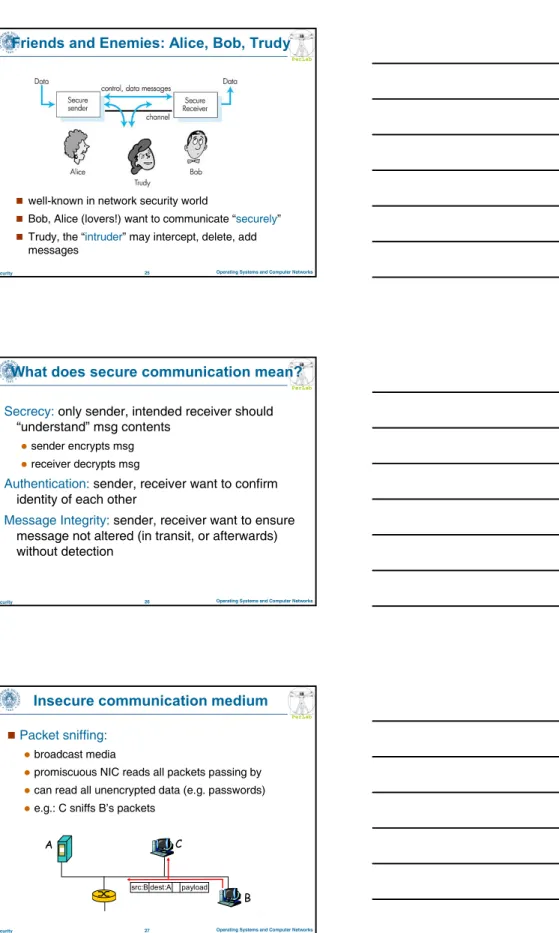
Friends and Enemies: Alice, Bob, Trudy
well-known in network security world
Bob, Alice (lovers!) want to communicate “securely”
Trudy, the “intruder” may intercept, delete, add messages
Figure 7.1 goes here
26 Operating Systems and Computer Networks Security
PerLab
What does secure communication mean?
Secrecy:only sender, intended receiver should“understand” msg contents sender encrypts msg
receiver decrypts msg
Authentication:sender, receiver want to confirm identity of each other
Message Integrity:sender, receiver want to ensure message not altered (in transit, or afterwards) without detection
PerLab
Insecure communication medium
Packet sniffing:
broadcast media
promiscuous NIC reads all packets passing by
can read all unencrypted data (e.g. passwords)
e.g.: C sniffs B’s packets
A
B C
28 Operating Systems and Computer Networks Security
PerLab
Insecure communication medium
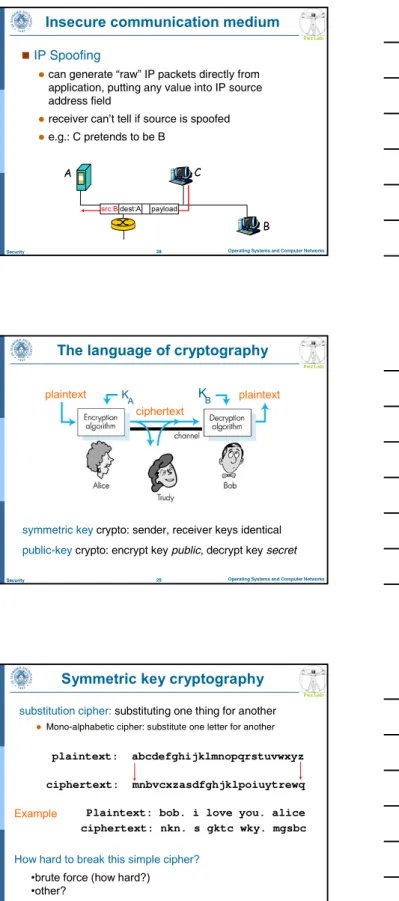
IP Spoofing
can generate “raw” IP packets directly from application, putting any value into IP source address field
receiver can’t tell if source is spoofed
e.g.: C pretends to be B
A
B C
src:Bdest:A payload
29 Operating Systems and Computer Networks Security
PerLab
The language of cryptography
symmetric keycrypto: sender, receiver keys identical public-keycrypto: encrypt key public, decrypt key secret
Figure 7.3 goes here
plaintext plaintext
ciphertext
K
A KB
30 Operating Systems and Computer Networks Security
PerLab
Symmetric key cryptography
substitution cipher:substituting one thing for another
Mono-alphabetic cipher: substitute one letter for another plaintext: abcdefghijklmnopqrstuvwxyz ciphertext: mnbvcxzasdfghjklpoiuytrewq Plaintext: bob. i love you. alice ciphertext: nkn. s gktc wky. mgsbc
Example
How hard to break this simple cipher? •brute force (how hard?) •other?
31 Operating Systems and Computer Networks Security
PerLab
Symmetric key crypto: DES
DES: Data Encryption Standard
US encryption standard [NIST 1993]
56-bit symmetric key, 64 bit plaintext input
How secure is DES?
DES Challenge: 56-bit-key-encrypted phrase (“Strong cryptography makes the world a safer place”) decrypted (brute force) in 4 months
making DES more secure
use three keys sequentially (3-DES) on each datum
use cipher-block chaining
32 Operating Systems and Computer Networks Security
PerLab
Other Symmetric Algorithms
DES is most commonly used symmetric
block-encryption algorithm (created by US Govt)
3-DES considered more secure
Advanced Encryption Standard (AES), twofishup and coming
RC4 is most common symmetric stream cipher,
but known to have vulnerabilities
Encrypts/decrypts a stream of bytes (i.e wireless transmission)
Key is a input to pseudo-random-bit generator Generates an infinite keystream
PerLab
Public Key Cryptography
Symmetrickey crypto
requires sender, receiver know shared secret key
Q: how to agree on key in first place (particularly if never “met”)?
Publickey cryptography
radically different approach [Diffie-Hellman76, RSA78]
sender, receiver do not
share secret key
encryption key public
(known toall) decryption key private
34 Operating Systems and Computer Networks Security
PerLab
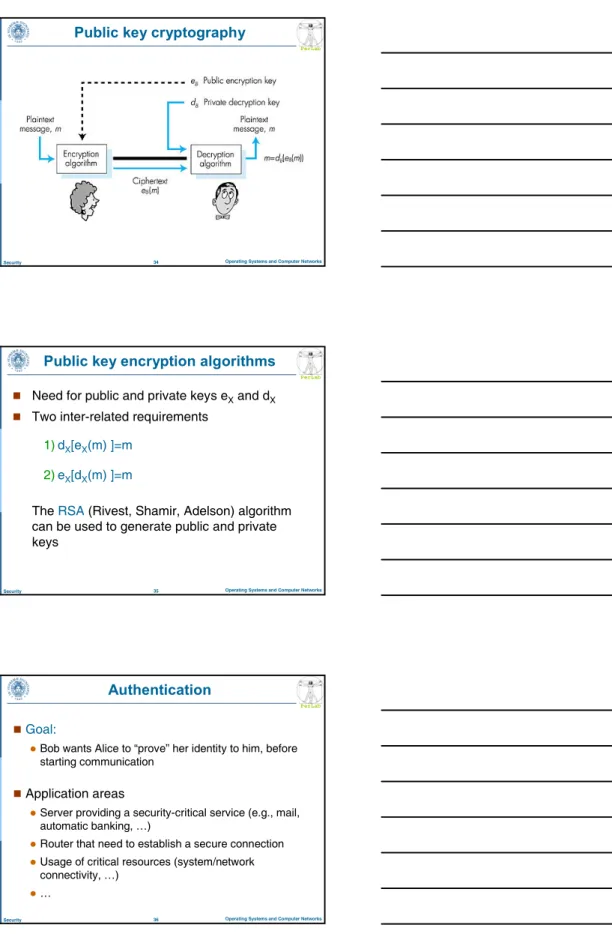
Public key cryptography
Figure 7.7 goes here
35 Operating Systems and Computer Networks Security
PerLab
Public key encryption algorithms
Need for public and private keys eXand dX
Two inter-related requirements
1)dX[eX(m) ]=m
2)eX[dX(m) ]=m
TheRSA (Rivest, Shamir, Adelson) algorithm can be used to generate public and private keys
36 Operating Systems and Computer Networks Security
PerLab
Authentication
Goal:
Bob wants Alice to “prove” her identity to him, before starting communication
Application areas
Server providing a security-critical service (e.g., mail, automatic banking, …)
Router that need to establish a secure connection
Usage of critical resources (system/network connectivity, …)
37 Operating Systems and Computer Networks Security
PerLab
Authentication
Protocol ap1.0:Alice says “I am Alice”
38 Operating Systems and Computer Networks Security
PerLab
Authentication: another try
Protocol ap2.0:Alice says “I am Alice” and sends her IP address along to “prove” it.
PerLab
Authentication: another try
Protocol ap3.0:Alice says “I am Alice” and sends her secret password to “prove” it.
40 Operating Systems and Computer Networks Security
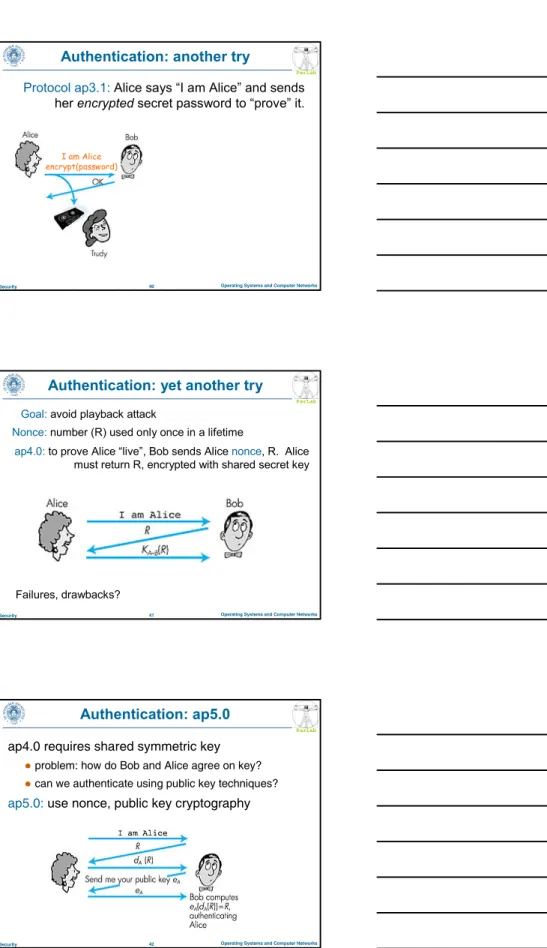
PerLab Protocol ap3.1:Alice says “I am Alice” and sends
her encryptedsecret password to “prove” it.
I am Alice encrypt(password)
Authentication: another try
41 Operating Systems and Computer Networks Security
PerLab
Authentication: yet another try
Goal:avoid playback attack
Failures, drawbacks?
Figure 7.11 goes here
Nonce:number (R) used only once in a lifetime
ap4.0:to prove Alice “live”, Bob sends Alice nonce, R. Alice must return R, encrypted with shared secret key
42 Operating Systems and Computer Networks Security
PerLab
Figure 7.12 goes here
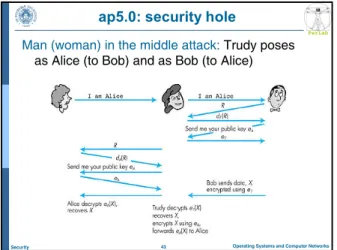
Authentication: ap5.0
ap4.0 requires shared symmetric key problem: how do Bob and Alice agree on key?
can we authenticate using public key techniques? ap5.0:use nonce, public key cryptography
43 Operating Systems and Computer Networks Security
PerLab
Figure 7.14 goes here
ap5.0: security hole
Man (woman) in the middle attack:Trudy poses as Alice (to Bob) and as Bob (to Alice)
44 Operating Systems and Computer Networks Security
PerLab
Digital Signature
Authentication techniques allow for on-line identification of the remote messages
PerLab
Digital Signature: Requirements
Cryptographic technique analogous to hand-written signatures.
The sender (Bob) digitally signs document, establishing he is the document owner/creator.
Verifiable
The recipient (Alice) can verify and prove that Bob, and no one else, signed the document.
Non-forgeable
The sender can prove that someone else has signed a message
Non repudiation
The recipient (Alice) can prove that Bob signed m and not m’
Message integrity
46 Operating Systems and Computer Networks Security
PerLab
Digital Signature: Sender
Simple digital signature for message m:
Bob encrypts m with his public key dB, creatingsigned message, dB(m). Bob sends m and dB(m) to Alice.
47 Operating Systems and Computer Networks Security
PerLab
Suppose Alice receives msgm, and digital signature
dB(m)
Alice verifies msigned by Bob by applying Bob’s public
key eBto dB(m) thenchecks eB(dB(m) ) = m.
If eB(dB(m) ) = m, whoever signed mmust have used
Bob’s private key.
Digital Signature: Recipient
48 Operating Systems and Computer Networks Security
PerLab
Are requirements satisfied?
Alice thus verifies that:
Bob signed m. No one else signed m. Bob signed m and not m’.
Non-repudiation:
Alice can take m, and signature dB(m)to court and prove that Bob signed m.
Message Integrity
49 Operating Systems and Computer Networks Security
PerLab
Question
How can Alice achieve Bob’s public key?
E-mail?
Website?
??
50 Operating Systems and Computer Networks Security
PerLab
Message Digests
Computationally expensive to public-key-encrypt long messages
Goal:fixed-length,easy to compute digital signature, “fingerprint”
Apply hash function H to m, get fixed size message digest, H(m).
PerLab
Hash Function
Hash function properties:
Many-to-1
Produces fixed-size msg digest (fingerprint)
Given message digest x
computationally infeasible to find msuch that x = H(m)
computationally infeasible to find any two messages m and m’such that H(m) = H(m’).
52 Operating Systems and Computer Networks Security
PerLab
Digital signature = Signed message digest
Bob sends digitally signed message:
Alice verifies signature and integrity of digitally signed message:
53 Operating Systems and Computer Networks Security
PerLab
Hash Function Algorithms
Internetchecksum
would make a poor message digest.
Too easy to find two messages with same checksum.
MD5 hash function widely used.
Computes 128-bit message digest in 4-step process.
arbitrary 128-bit string x, appears difficult to construct msg m whose MD5 hash is equal to x.
SHA-1is also used.
US standard
160-bit message digest
54 Operating Systems and Computer Networks Security
PerLab
Trusted Intermediaries
Problem:
How do two entities establish shared secret key over network? Solution:
trusted key distribution center (KDC) acting as intermediary between entities
Problem:
When Alice obtains Bob’s public key (from web site, e-mail, diskette), how does she know it is Bob’s public key, not Trudy’s? Solution:
trusted certification authority (CA)
55 Operating Systems and Computer Networks Security
PerLab
Key Distribution Center (KDC)
Alice,Bob need shared symmetric key.
KDC:server shares different secret key with each registered user.
Alice, Bob know own symmetric keys, KA-KDC
KB-KDC , for
communicating with KDC.
Alice communicates with KDC, gets session key R1, and K B-KDC(A,R1)
Alice sends Bob
KB-KDC(A,R1), Bob extracts R1
Alice, Bob now share the symmetric key R1.
56 Operating Systems and Computer Networks Security
PerLab
Certification Authorities
Certification authority (CA) binds public key to particular entity.
Entity (person, router, etc.) can register its public key with CA.
Entity provides “proof of identity” to CA.
CA creates certificate binding entity to public key.
Certificate digitally signed by CA.
When Alice wants Bob’s public key:
gets Bob’s certificate (Bob or elsewhere).
Apply CA’s public key to Bob’s certificate, get Bob’s public key
PerLab
Secure e-mail
• generates random symmetric private key, KS. • encrypts message with KS
• also encrypts KSwith Bob’s public key. • sends both KS(m) and eB(KS) to Bob.
58 Operating Systems and Computer Networks Security
PerLab
Secure e-mail (Cont’d)
Alice wants to provide sender authentication message integrity.
•Alice digitally signs message.
• sends both message (in the clear) and digital signature.
59 Operating Systems and Computer Networks Security
PerLab
Secure e-mail (cont’d)
Alice wants to provide secrecy, sender authentication, message integrity.
Note:Alice uses both her private key, Bob’s public key.
60 Operating Systems and Computer Networks Security
PerLab
Pretty good privacy (PGP)
Internet e-mail encryption scheme, a de-facto standard.
Uses symmetric key cryptography, public key cryptography, hash function, and digital signature as described.
Provides secrecy, sender authentication, integrity.
Inventor, Phil Zimmerman, was target of 3-year federal investigation.
---BEGIN PGP SIGNED MESSAGE---Hash: SHA1
Bob:My husband is out of town tonight.Passionately yours, Alice ---BEGIN PGP SIGNATURE---Version: PGP 5.0 Charset: noconv yhHJRHhGJGhgg/12EpJ+lo8gE4vB3mqJ hFEvZP9t6n7G6m5Gw2 ---END PGP SIGNATURE---A PGP signed message:
61 Operating Systems and Computer Networks Security
PerLab
Secure Sockets Layer (SSL)
PGP provides security for a specific network application
SSL works at transport layer. Provides security to any TCP-based application using SSL services.
Cryptographic protocol that limits two computers to only exchange messages with each other
Very complicated, with many variations
Used between browsers and Web servers for secure communication (https)
E.g., credit card number in e-commerce applications
SSL security services:
server authentication
data encryption
client authentication (optional)
62 Operating Systems and Computer Networks Security
PerLab
SSL Encrypted Session
Server authentication
The server is verified through a certificateassuring that the client is talking to correct server
Key exchange
Asymmetric cryptography used to establish a secure session key(symmetric encryption) for communication
Browser
generates a symmetric session key Ks
encrypts it with server’s public key sends encrypted key to server.
Server
Using its private key, the server decrypts the session key Ks
PerLab
SSL Encrypted Session
Secure communication
All data sent into TCP socket (by client or server) are encrypted with session key Ks
64 Operating Systems and Computer Networks Security
PerLab
SSL: Final Remarks
SSL: basis of IETF Transport Layer Security (TLS). SSL can be used for non-Web applications, e.g.,
IMAP.
Client authentication can be done with client certificates.
65 Operating Systems and Computer Networks Security
PerLab
Overview
Threats and attacks
Cryptography as a Security Tool
Secrecy Authentication Message integrity Digital signature … Security Defenses User Authentication Antivirus Firewalls …
66 Operating Systems and Computer Networks Security
PerLab
Security Defenses
Defense in depthis most common security theory – multiple layers of security
Security policy describes what is being secured
Proactive Approaches
Access Control (User Authentication)
Firewall
Virus Protection
…
Reactive Approaches
Auditing, accounting, and logging of all or specific system or network activities
Intrusion detection endeavors to detect attempted or successful intrusions
67 Operating Systems and Computer Networks Security
PerLab
User Authentication
Crucial to identify user correctly, as protection systems depend on user ID
User authentication can be based on
Something the user has
key, card, …
Something the user knows
password, …
Something the user is
fingerprint, biometric properties, …
68 Operating Systems and Computer Networks Security
PerLab
Passwords
Passwords can be considered a special case of either keys or capabilities
Passwords must be kept secret
Use of “non-guessable” passwords
Frequent change of passwords
Log all invalid access attempts
Passwords may also either be encrypted or allowed to be used only once
Good way to generate password
Mg’sniG!
My girlfriend’s name is Giulia!
PerLab
Traditional Defense Principle
70 Operating Systems and Computer Networks Security
PerLab
Lucca’s Walls
71 Operating Systems and Computer Networks Security
PerLab
Firewall
72 Operating Systems and Computer Networks Security
PerLab
73 Operating Systems and Computer Networks Security
PerLab
Firewall Classification A network firewall is placed between trusted and
untrusted hosts
The firewall limits network access between these two security domains
Personal firewall
Software module in our host (e.g., PC)
Can monitor/limit traffic to and from the host
Packet Filtering firewall
permits/denies input or output of packets based on their IP addresses, port number, …
Application Gateway
understands application protocol and can control them (i.e., SMTP)
74 Operating Systems and Computer Networks Security
PerLab
Packet Filtering
Source/Destination IP Address
Protocol Type in IP datagrams TCP, UDP, ICMP, …
Source/Destination Port Number
TCP flags (SYN, ACK, …)
ICMP Message Type
…
Different rules for datagrams leaving/entering the internal network
PerLab
Packet Filtering Rules
76 Operating Systems and Computer Networks Security
PerLab
Packet Filtering Rules
77 Operating Systems and Computer Networks Security
PerLab
Application Gateway
Packet filtering only allows general rules
Deny input access to all telnet sessions (TCP port number 23) Allow output access to all telnet sessions (TCP port number 23)
Does not allow to distinguish between different users
E.g., Allow input access to all telnet sessions from user / IP address X
Possible Solution: Packet filtering router + application gateway
78 Operating Systems and Computer Networks Security
PerLab
Application Gateway
79 Operating Systems and Computer Networks Security
PerLab
Application Gateway
Limits
Dedicated gateway for each single application
Performance degradation
All connection must pass through the application gateway
The software client must be adapted to contact the application gateway
80 Operating Systems and Computer Networks Security
PerLab
Firewall Limitations
Can be tunneled or spoofed
Tunneling allows disallowed protocol to travel within allowed protocol (i.e. telnet inside of HTTP)
Firewall rules typically based on host name or IP address which can be spoofed
Often use stringent policies
E.g., : Deny all UDP traffics
May contains configuration bugs
That allows potential intruders to overcome security defenses May be by-passed
Wireless Communications
Communications via modem
PerLab